Bookyourdata vs Easy Email Verification (2026 Review)
Bookyourdata sells ready-made B2B lists; Easy Email Verification cleans them. See which one your team actually needs in 2026 — plus a smarter third option.
Bookyourdata vs Easy Email Verification: Which One Do You Actually Need?
Picking between Bookyourdata and Easy Email Verification feels like a head-to-head, but it isn't really. One sells you contacts. The other tells you whether the contacts you already have still work. Putting them in the same ring confuses a lot of buyers, so this guide untangles the two, shows where each wins, and explains why most outbound teams end up wanting a third capability neither one fully covers.
TL;DR#
- Bookyourdata is a pay-as-you-go B2B contact database. You buy pre-built lists of emails, phone numbers, and firmographics. Its headline claim is a 97% accuracy guarantee.
- Easy Email Verification is a validation-only service. It doesn't find contacts — it scrubs a list you already own to remove bounces, spam traps, and bad syntax.
- They solve different jobs: acquisition vs. hygiene. Comparing them directly is apples-to-oranges, but buyers still do it because both touch "email quality."
- Cost shape differs: Bookyourdata charges per credit/record; Easy Email Verification charges per email checked. Stacking both gets expensive fast.
- A find-and-verify platform like Tomba handles sourcing and validation in one workflow, which is what most teams are really shopping for.
What is Bookyourdata?#
Bookyourdata is a self-serve B2B data marketplace. You filter by industry, job title, location, company size, and a few dozen other attributes, then buy the matching records on a credit basis. Each record can include a business email, direct dial, LinkedIn URL, and company firmographics.
The pitch is speed and a verification guarantee: build a list in minutes, and the platform promises a 97% deliverability rate or it credits you back for the bad ones. For teams that need volume right now and don't want to scrape or research, that's a real convenience.
The trade-offs are the same ones every prebuilt database carries. You're buying a snapshot of data that ages the moment it's exported — people change jobs, companies fold, and titles shift. You also share that data with every other buyer, so the "fresh" list you pull is often the same one your competitors pulled last week. And because pricing is per record, large campaigns add up quickly.

What is Easy Email Verification?#
Easy Email Verification does one thing: it validates email addresses. You upload a list (or hit the API), and it runs each address through syntax checks, MX record lookups, SMTP pings, disposable-domain detection, and spam-trap filtering. What comes back is a clean list sorted into valid, invalid, risky, and unknown.
It does not find or enrich contacts. If your list is empty, Easy Email Verification has nothing to do. Its entire value sits downstream of acquisition — it protects your sender reputation by stopping you from blasting dead addresses.
That role matters more than people think. A high bounce rate is one of the fastest ways to tank your email deliverability and get your domain flagged. Mailbox providers treat repeated hard bounces as a signal that you're a careless or malicious sender. So even a perfect list from a data vendor should pass through verification before your first send — especially if it's been sitting in a spreadsheet for a few weeks.
Bookyourdata vs Easy Email Verification: the core difference#
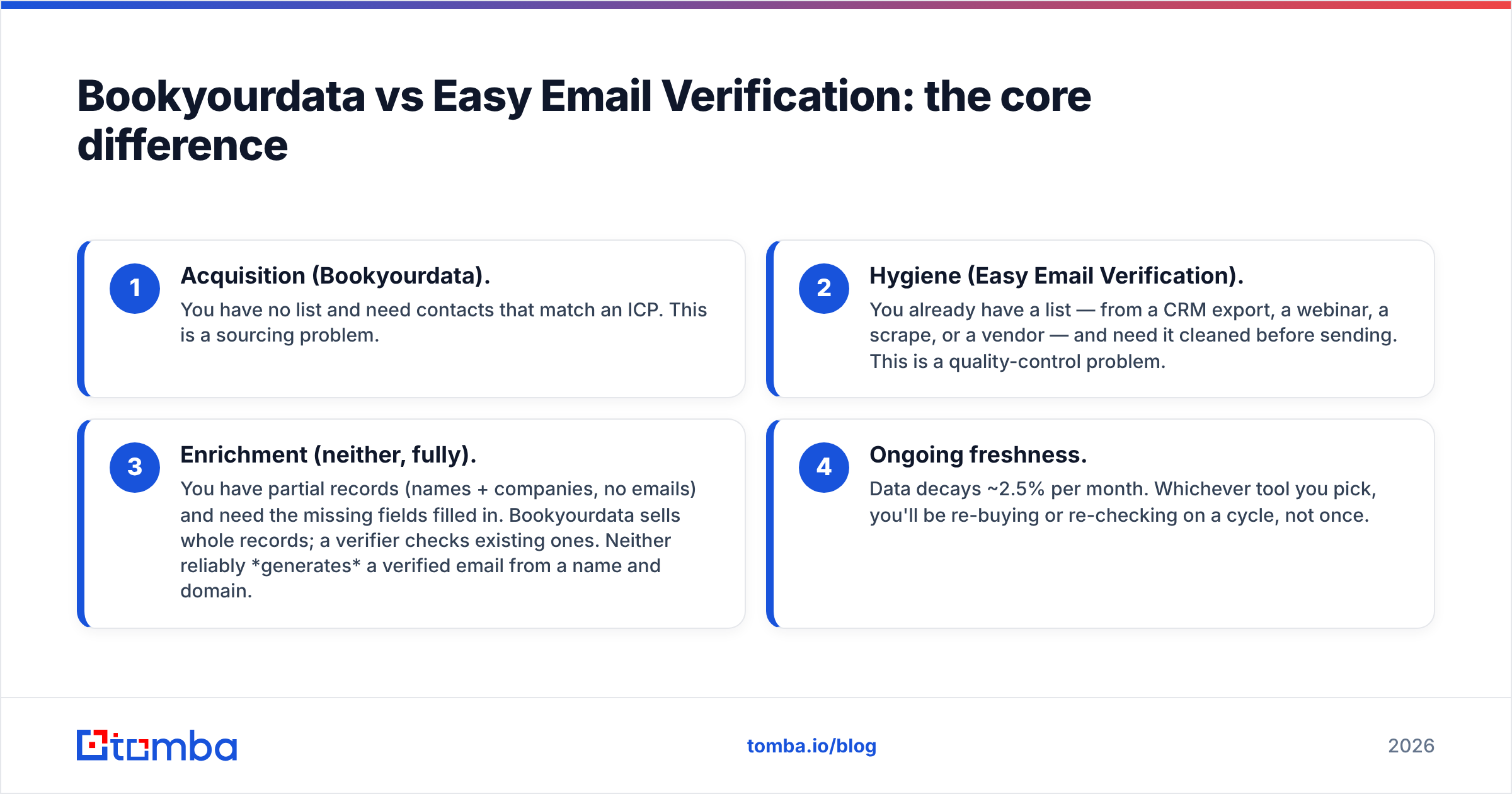
Here's the cleanest way to think about it. Bookyourdata answers "who should I contact?" Easy Email Verification answers "will this email actually land?" You can use both, one, or neither depending on where your gap is.
- Acquisition (Bookyourdata). You have no list and need contacts that match an ICP. This is a sourcing problem.
- Hygiene (Easy Email Verification). You already have a list — from a CRM export, a webinar, a scrape, or a vendor — and need it cleaned before sending. This is a quality-control problem.
- Enrichment (neither, fully). You have partial records (names + companies, no emails) and need the missing fields filled in. Bookyourdata sells whole records; a verifier checks existing ones. Neither reliably generates a verified email from a name and domain.
- Ongoing freshness. Data decays ~2.5% per month. Whichever tool you pick, you'll be re-buying or re-checking on a cycle, not once.
If you only remember one thing: a verifier cannot replace a data source, and a data source cannot replace a verifier. They sit on opposite ends of the same pipeline.
How do they compare on features and pricing?#
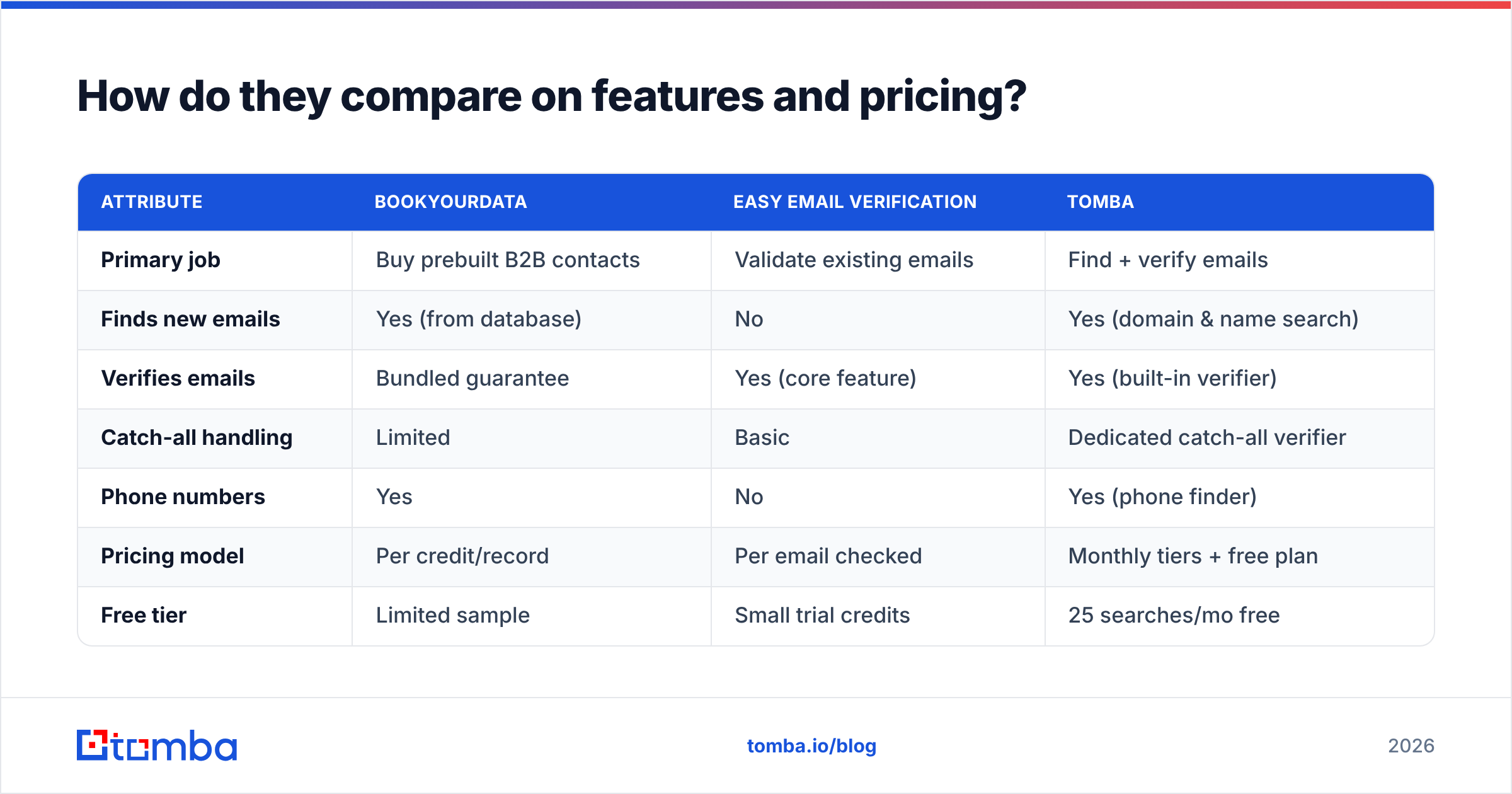
The table below lines up what each tool actually does, so you can stop treating them as substitutes.
| Attribute | Bookyourdata | Easy Email Verification | Tomba |
|---|---|---|---|
| Primary job | Buy prebuilt B2B contacts | Validate existing emails | Find + verify emails |
| Finds new emails | Yes (from database) | No | Yes (domain & name search) |
| Verifies emails | Bundled guarantee | Yes (core feature) | Yes (built-in verifier) |
| Catch-all handling | Limited | Basic | Dedicated catch-all verifier |
| Phone numbers | Yes | No | Yes (phone finder) |
| Pricing model | Per credit/record | Per email checked | Monthly tiers + free plan |
| Free tier | Limited sample | Small trial credits | 25 searches/mo free |
| Entry paid price | Pay-as-you-go credits | Per-volume packs | $49/mo Starter |
| Best for | Volume list buying | List cleaning only | End-to-end prospecting |
| API access | Yes | Yes | Yes (Tomba API) |
Two things jump out. First, Bookyourdata and Easy Email Verification barely overlap — one fills the bucket, the other strains it. Second, if you genuinely need both jobs done, running two separate vendors means two logins, two bills, and a manual export-import step between them every single campaign.
Is Bookyourdata accurate enough to skip verification?#
Short answer: don't skip it. Bookyourdata advertises a 97% accuracy guarantee, and that's a strong number for a prebuilt database. But "accurate at time of collection" and "accurate the day you send" are different claims. The moment a list is exported, it starts decaying. By the time it clears your team's review, gets loaded into a sequencer, and goes out, a slice of those addresses are already stale.
There's also the catch-all problem. Many corporate domains accept every address at the server level, so a simple SMTP check returns "valid" even when the specific mailbox doesn't exist. A guarantee based on deliverability metrics doesn't always resolve that ambiguity — which is exactly why a dedicated catch-all finder and verification step earns its keep regardless of where the list came from.

The practical takeaway: treat any vendor's accuracy claim as a starting point, not a finish line. Run a verification pass before your first send, and re-verify any list older than 30 days. That habit protects your sender reputation far more reliably than trusting a one-time guarantee.
When should you choose Bookyourdata?#
Bookyourdata makes sense in a few specific situations:
- You're starting cold with no data. No CRM history, no scraped lists, no inbound — you need contacts fast and you're willing to pay per record for the convenience.
- You want firmographics bundled in. You're not just after emails; you want company size, revenue band, and tech stack attached to each contact.
- You prefer pay-as-you-go over subscriptions. If your outbound is bursty — a quarterly campaign rather than always-on — buying credits when you need them can beat a monthly seat.
Where it struggles: niche or non-US markets, very specific personas the database underrepresents, and any workflow where you need to source contacts at named target accounts rather than browse a generic pool. For account-based work, you usually want to search a specific company's domain, which is a different motion entirely.
When should you choose Easy Email Verification?#
Reach for a standalone verifier like Easy Email Verification when:
- You already have a sizable list and just need it cleaned before a send.
- You collect emails through forms or signups and want to validate them at the point of capture via API.
- You're consolidating multiple lists and need to dedupe and scrub before they hit your CRM.
It's a focused, useful tool. The limitation is equally clear: it has zero acquisition ability. If your real problem is "I don't have enough good contacts," a verifier won't help — it can only improve the contacts you've already got. Many teams discover this after buying a verification plan and realizing their pipeline gap was sourcing all along. For an honest comparison of pure-play verifiers, the categories on G2 are a reasonable neutral reference.
Why most teams want find-and-verify in one place#
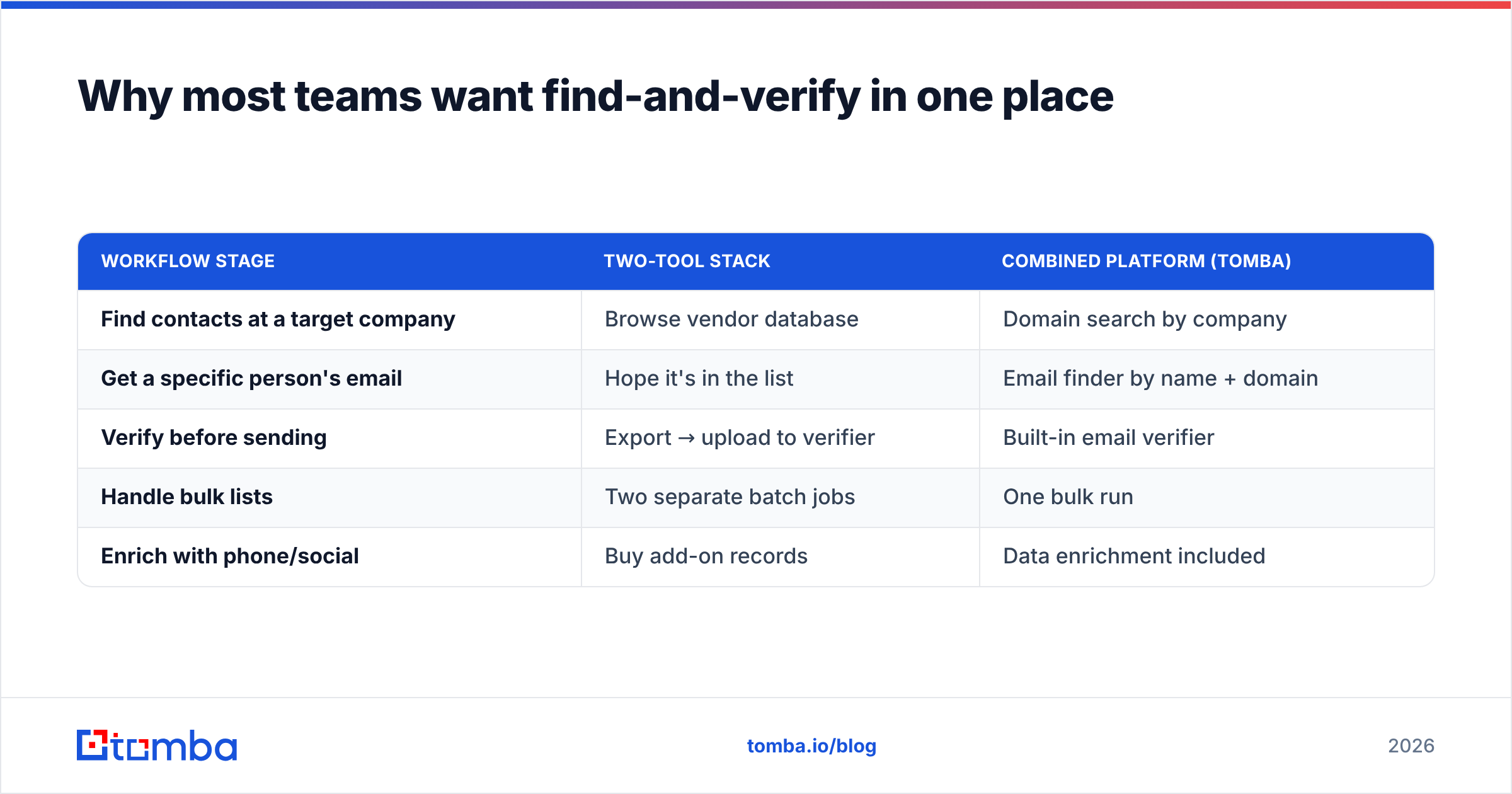
Here's the pattern we see constantly: a team buys a list from a data vendor, then buys a separate verification tool to clean it, then still ends up manually researching emails for the accounts the database missed. That's three tools and a lot of copy-paste to do what is, conceptually, one job — get verified contacts for the people I want to reach.
This is where a combined platform changes the math. Instead of buying a static list and cleaning it elsewhere, you search a target domain, get the contacts, and they come back already verified in the same step.
| Workflow stage | Two-tool stack | Combined platform (Tomba) |
|---|---|---|
| Find contacts at a target company | Browse vendor database | Domain search by company |
| Get a specific person's email | Hope it's in the list | Email finder by name + domain |
| Verify before sending | Export → upload to verifier | Built-in email verifier |
| Handle bulk lists | Two separate batch jobs | One bulk run |
| Enrich with phone/social | Buy add-on records | Data enrichment included |
Tomba's core product is the email finder, with verification, domain search, catch-all checks, phone lookup, and enrichment sitting alongside it. The point isn't that it replaces every specialized tool on earth — it's that for the find-and-verify loop that drives outbound, you're not duct-taping two vendors together. Pricing runs a Free tier (25 searches/month), Starter at $49/mo, Growth at $99/mo, and Pro at $249/mo, so you can test the workflow before committing. You can see the full breakdown on the Tomba pricing page.
How do the costs really stack up?#
The honest answer is that it depends on volume, but the shape of the cost matters as much as the number.
- Bookyourdata charges per record. Predictable for small pulls, but a 50,000-contact campaign is a large one-time spend — and you'll repeat it as data decays.
- Easy Email Verification charges per email checked. If you're cleaning vendor lists and your own CRM regularly, those checks recur on top of whatever you paid for the data.
- A combined plan charges a flat monthly rate for a search/verify quota. For always-on outbound, this tends to be more predictable than paying twice — once to acquire, once to validate.
Run your own numbers, but factor in the hidden cost of the two-tool stack: the engineering or ops time spent moving data between systems, reconciling formats, and re-running jobs. That overhead rarely shows up on an invoice but it's real.
The bottom line#
Bookyourdata and Easy Email Verification aren't competitors — they're neighbors on a pipeline. Bookyourdata fills your list; Easy Email Verification cleans it. If you have a genuine, isolated need for only one of those jobs, buy the specialist that does it.
But if you're like most outbound teams and your real goal is "verified contacts for the accounts I care about, without a Frankenstein toolchain," a find-and-verify platform is the more direct path. You skip the export-import shuffle, you verify at the moment of discovery, and you pay one predictable bill.
Ready to find and verify in one step?#
Stop buying lists in one tool and cleaning them in another. With the Tomba Email Finder you can search any company domain, pull the exact contacts you need, and get them back already verified — all on a Free plan that gives you 25 searches a month to try it. When you're ready to scale, the $49/mo Starter tier unlocks the volume most teams need to run real campaigns. Source smarter, send cleaner, and skip the two-vendor tax.
// get started
Find, verify and enrich your first contacts today
Start on the free plan with 25 searches a month, then scale when your team is ready.
Free plan · No credit card required · GDPR & CCPA
// about the author