Bookyourdata vs Emailable: Data & Verification Compared 2026
Bookyourdata sells pay-as-you-go B2B lists; Emailable verifies them. We compare accuracy, pricing, and coverage in 2026 — and where a true email finder beats both.
You are comparing two tools that do different jobs. Bookyourdata sells you a B2B contact list; Emailable checks whether the emails on a list are deliverable. Knowing which one you actually need — or whether you need a third option entirely — is the difference between a campaign that lands and one that bounces.
TL;DR#
- Bookyourdata is a pay-as-you-go B2B contact database. You filter by title, industry, and geography, then buy credits to download verified-on-export contacts.
- Emailable is a dedicated email verification service. It does not find contacts; it tells you which addresses on a list you already own are safe to send.
- They are complements, not substitutes: many teams buy from Bookyourdata, then re-verify through Emailable before loading into a sequencer.
- On a cost-per-usable-contact basis, neither is the cheapest path if your real job is finding and verifying contacts at known companies.
- A combined finder-plus-verifier like Tomba Email Finder collapses both steps into one workflow, often at a lower blended cost.
What is Bookyourdata?#
Bookyourdata is a self-serve B2B data marketplace. You open the platform, apply filters — job title, seniority, company size, industry, technology used, location — and the system returns a count of matching contacts. You then spend credits to unlock and export them as CSV or push them into a CRM.
The headline pitch is a "95% accuracy guarantee" with credit refunds for bounced emails, and pay-as-you-go pricing so you are not locked into a subscription. That model suits teams that buy data in bursts: you top up credits, pull a targeted list for a quarter's campaign, and stop paying when you stop pulling.
The catch with any marketplace database is staleness. B2B data decays at roughly 2–3% per month as people change jobs, so a "verified" record is only as good as the day it was last checked. Bookyourdata verifies on export to mitigate this, but you are still buying from a fixed pool rather than searching live company domains. You can read more about how source freshness affects results on Tomba's data sources page.
What is Emailable?#
Emailable is a single-purpose email verifier. Feed it a list of addresses and it runs syntax checks, MX-record lookups, SMTP handshakes, role-account detection, and disposable-domain filtering, then returns a deliverability verdict per address: deliverable, undeliverable, risky, or unknown.
Emailable does not generate contacts. It assumes you already have emails — from a database, a form, a scrape, or an old CRM export — and its job is to scrub that list so your bounce rate stays under the 2–3% threshold that mailbox providers tolerate before they start throttling you.
Where Emailable earns its keep is the "risky" bucket, especially catch-all domains, where a server accepts all mail regardless of whether the mailbox exists. Resolving those reliably is the hard part of verification; if catch-alls dominate your list, look closely at how each tool scores them. Tomba's catch-all verifier exists for exactly this problem.

Bookyourdata vs Emailable: what's the core difference?#
The cleanest way to think about it: Bookyourdata answers "who should I email?" and Emailable answers "will this email land?" One produces contacts, the other validates them.
- Bookyourdata — a sourcing tool. Output is new contact records with names, titles, companies, and emails.
- Emailable — a hygiene tool. Output is a pass/fail verdict on emails you supply.
- Overlap — both touch "accuracy," but they mean different things. Bookyourdata's accuracy is about record correctness at export; Emailable's is about deliverability at send time.
- Sequence — in a typical stack, sourcing comes first and verification comes second, right before the list enters your sender.
- Failure mode if you skip one — buy a list and skip verification, and you risk a bounce spike; verify a list you never properly sourced, and you are just cleaning bad targeting.
How do Bookyourdata and Emailable compare on features?#
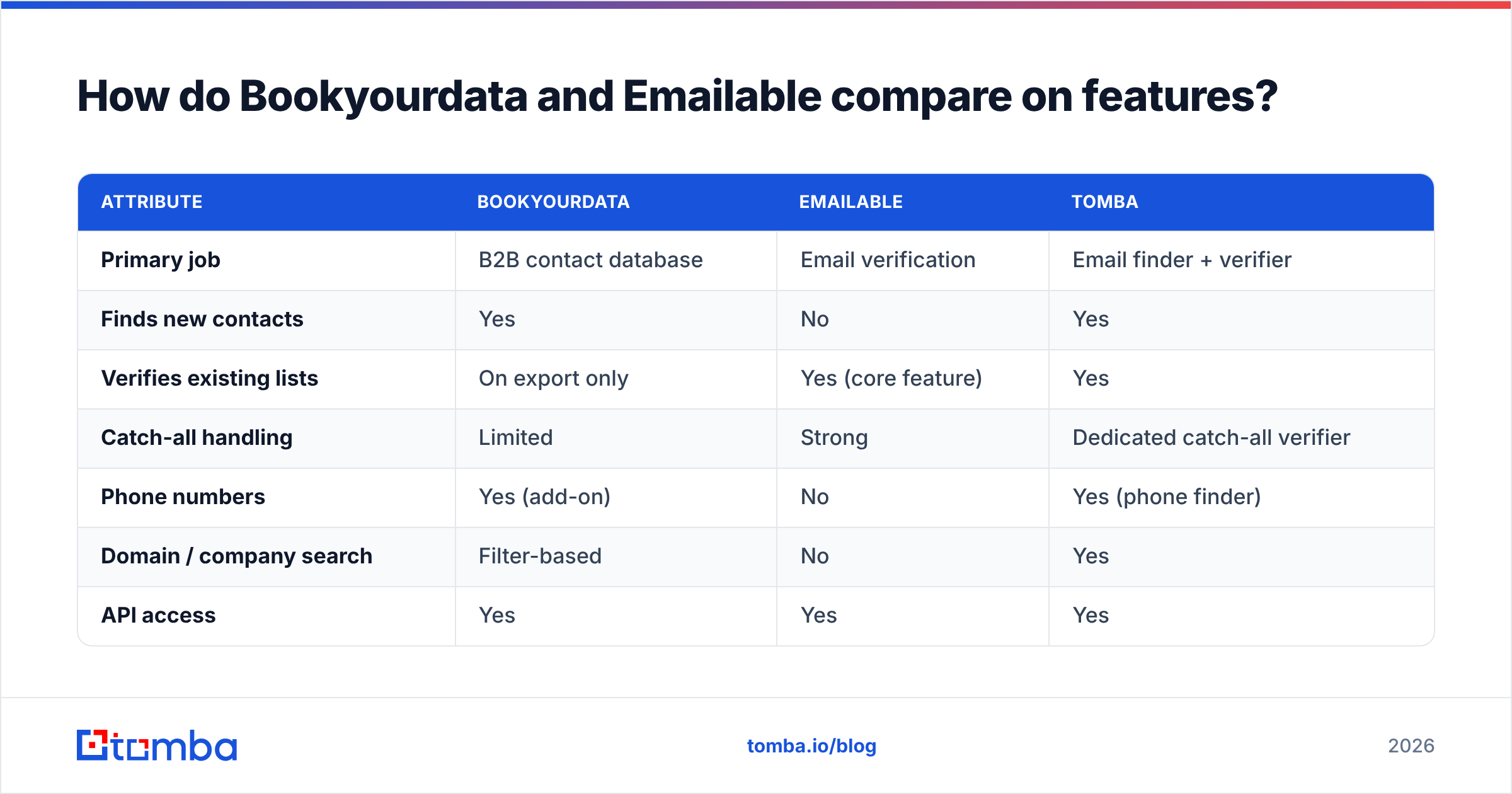
| Attribute | Bookyourdata | Emailable | Tomba |
|---|---|---|---|
| Primary job | B2B contact database | Email verification | Email finder + verifier |
| Finds new contacts | Yes | No | Yes |
| Verifies existing lists | On export only | Yes (core feature) | Yes |
| Catch-all handling | Limited | Strong | Dedicated catch-all verifier |
| Phone numbers | Yes (add-on) | No | Yes (phone finder) |
| Domain / company search | Filter-based | No | Yes |
| API access | Yes | Yes | Yes |
| Pricing model | Pay-as-you-go credits | Credits / subscription | Free tier + monthly plans |
| Free tier | Trial credits | Free monthly credits | 25 searches/mo |
| Bulk processing | CSV export | Bulk verify | Bulk finder + verify |
The table makes the gap obvious: these tools sit on opposite ends of the same pipeline. If you only own one, you have a hole in your workflow. Bookyourdata users still need verification at send time; Emailable users still need a way to get contacts in the first place.
Which one is more accurate?#
Neither tool can be "more accurate" than the other because they measure different things, but here is how to judge each on its own terms.
For Bookyourdata, accuracy means: of the records you export, how many have a correct, current email and a correct title? The 95% guarantee is enforced by refunding credits on bounces, which is fair, but a refund does not give you back the contact — you still lost a prospect and a send. Test it by exporting a sample, running those emails through an independent verifier, and measuring the real deliverable rate.
For Emailable, accuracy means: of its verdicts, how many are correct? The honest benchmark is the "unknown" and "risky" rate. A verifier that marks 20% of your list "unknown" has effectively given up on a fifth of your contacts. Compare the unknown rate head-to-head on the same sample list, because that is where verification tools quietly differ.
The practical move is to verify with a tool that did not source the data. Self-verification has an obvious conflict of interest, which is why even Bookyourdata buyers often pass exports through a separate verifier. That second pass is non-negotiable if deliverability matters to you.
How does pricing compare?#
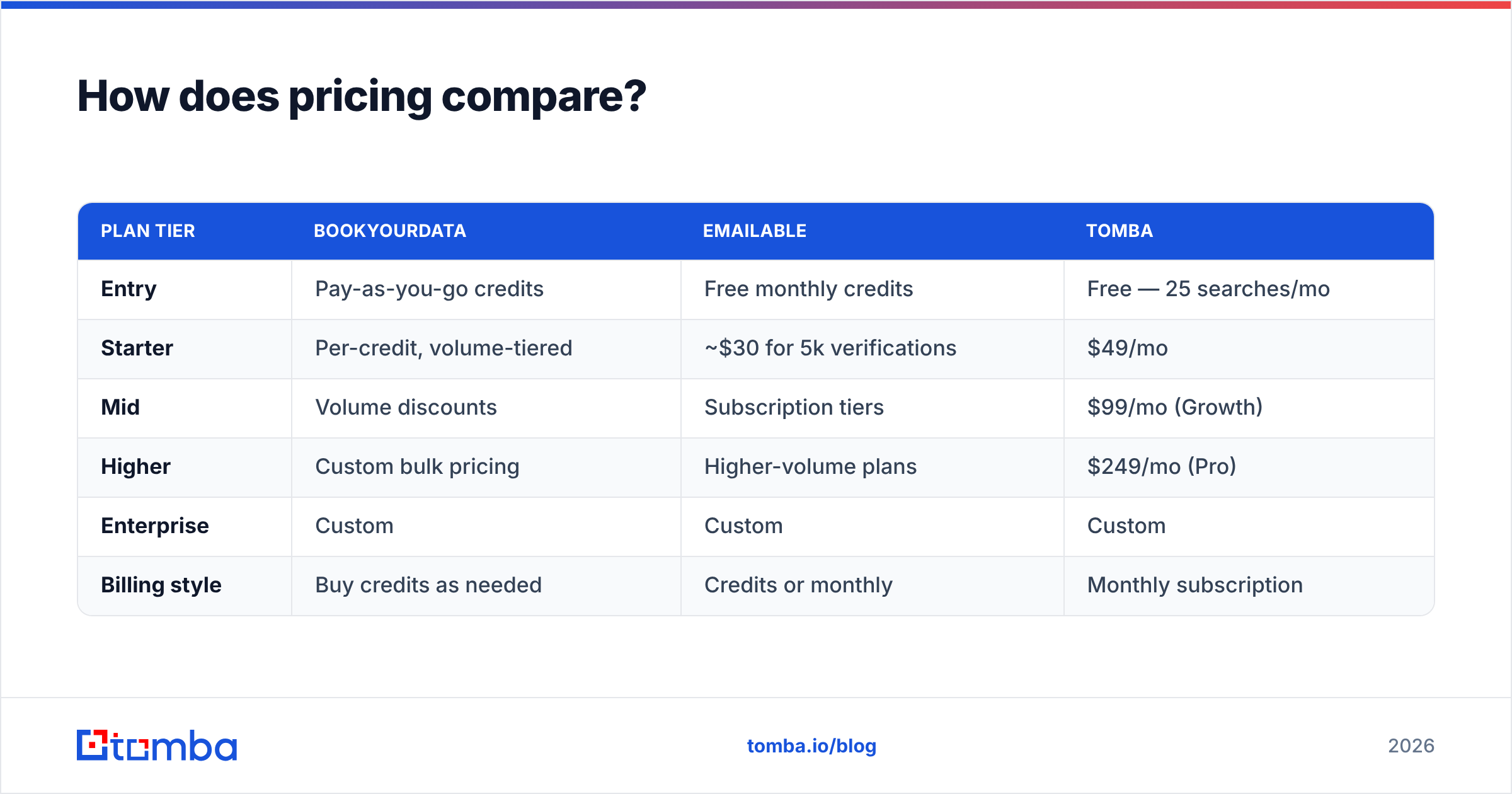
| Plan tier | Bookyourdata | Emailable | Tomba |
|---|---|---|---|
| Entry | Pay-as-you-go credits | Free monthly credits | Free — 25 searches/mo |
| Starter | Per-credit, volume-tiered | ~$30 for 5k verifications | $49/mo |
| Mid | Volume discounts | Subscription tiers | $99/mo (Growth) |
| Higher | Custom bulk pricing | Higher-volume plans | $249/mo (Pro) |
| Enterprise | Custom | Custom | Custom |
| Billing style | Buy credits as needed | Credits or monthly | Monthly subscription |
Bookyourdata's pay-as-you-go model looks cheap until you account for the contacts you pay for but cannot use — bad titles, role accounts, and catch-alls you then pay again to verify. Emailable's per-verification pricing is transparent and reasonable for pure list cleaning, but it adds a line item on top of whatever you spent sourcing.
When you stack the two — buy contacts, then pay to verify them — your real cost per usable contact climbs. That is the math that makes a combined tool attractive. Compare it against transparent Tomba pricing, where finding and verifying happen under one plan and the starter tier is a flat $49/mo.
When should you choose Bookyourdata?#
Pick Bookyourdata when:
- You have no contact list at all and need to build one fast by firmographic filters.
- Your buying is bursty — a campaign per quarter — and a subscription would sit idle.
- You want phone numbers alongside emails and value a marketplace's breadth over live search.
- Your targeting is broad — "all VPs of Marketing in US SaaS" — rather than a specific named-account list.
Bookyourdata is weakest when your targets are a known list of companies. Buying a generic database to reach 50 specific accounts is overkill; a domain search against those exact domains is faster and more current.
When should you choose Emailable?#
Pick Emailable when:
- You already have emails and just need them scrubbed before a send.
- You inherited an old CRM or list and bounce risk is your main worry.
- You run high-volume sends where even a 2% bounce bump threatens your sender reputation.
- You want a focused, no-frills verifier and already have a separate sourcing tool you trust.
Emailable is the wrong tool if your actual problem is finding contacts — it will happily verify an empty pipeline and leave you no further ahead.
Is there a better alternative to running both?#
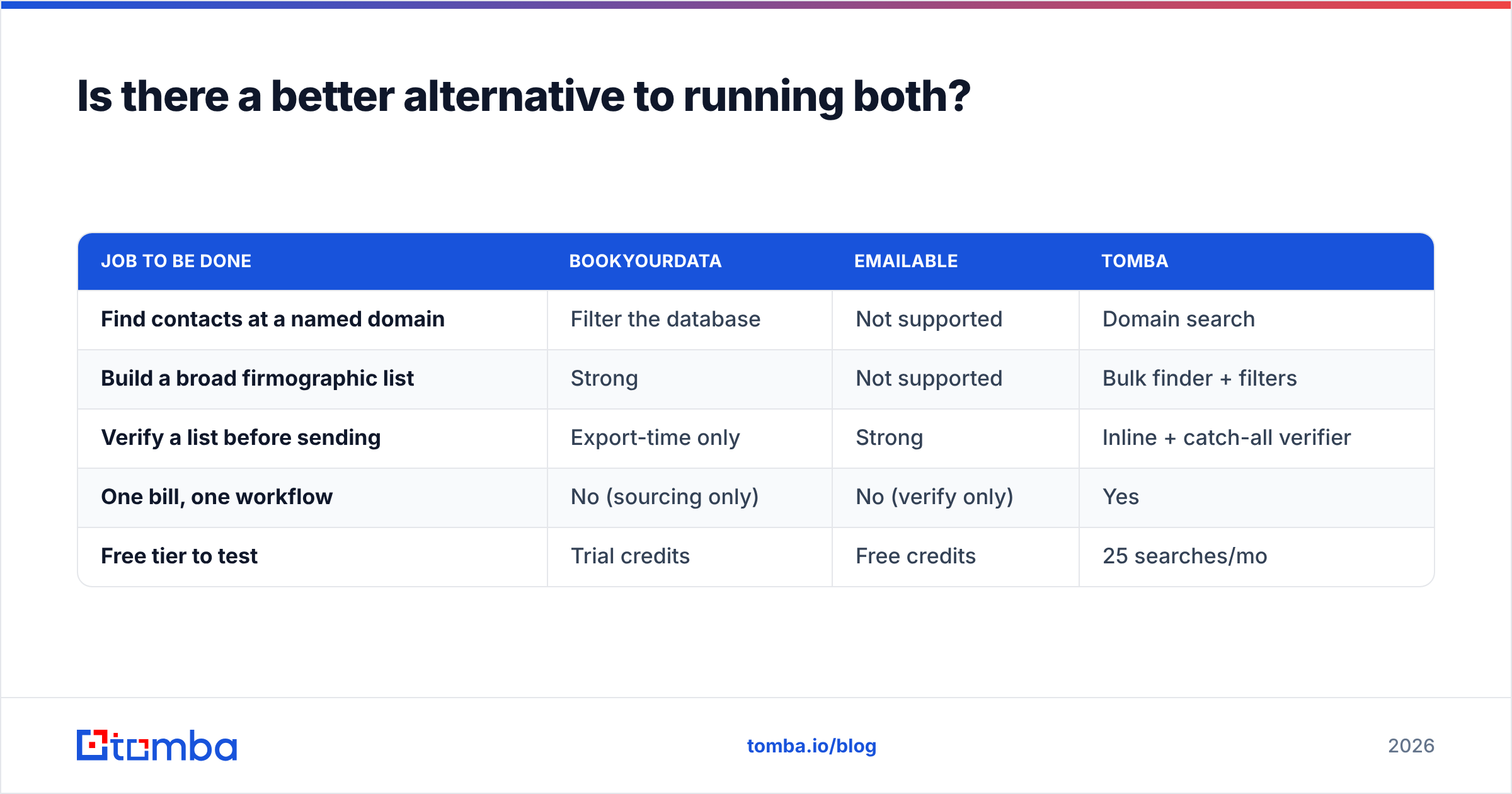
Here is the strategic question most buyers miss: if your job is to reach the right people at known companies, you need finding and verifying in the same loop — and paying two vendors for two halves of one workflow rarely wins on cost or speed.
A combined platform like Tomba covers both jobs. You search a company domain to find contacts, the addresses are verified inline, and catch-alls are resolved by a dedicated verifier — no second vendor, no CSV round-trip. The same engine powers a bulk email finder for list builds and a Tomba API for product workflows.
| Job to be done | Bookyourdata | Emailable | Tomba |
|---|---|---|---|
| Find contacts at a named domain | Filter the database | Not supported | Domain search |
| Build a broad firmographic list | Strong | Not supported | Bulk finder + filters |
| Verify a list before sending | Export-time only | Strong | Inline + catch-all verifier |
| One bill, one workflow | No (sourcing only) | No (verify only) | Yes |
| Free tier to test | Trial credits | Free credits | 25 searches/mo |
This is not to say Bookyourdata and Emailable are bad tools — each is good at its half. It is to say that splitting a single workflow across two specialists adds cost, latency, and a CSV handoff that breaks more often than vendors admit.
How do you decide in practice?#
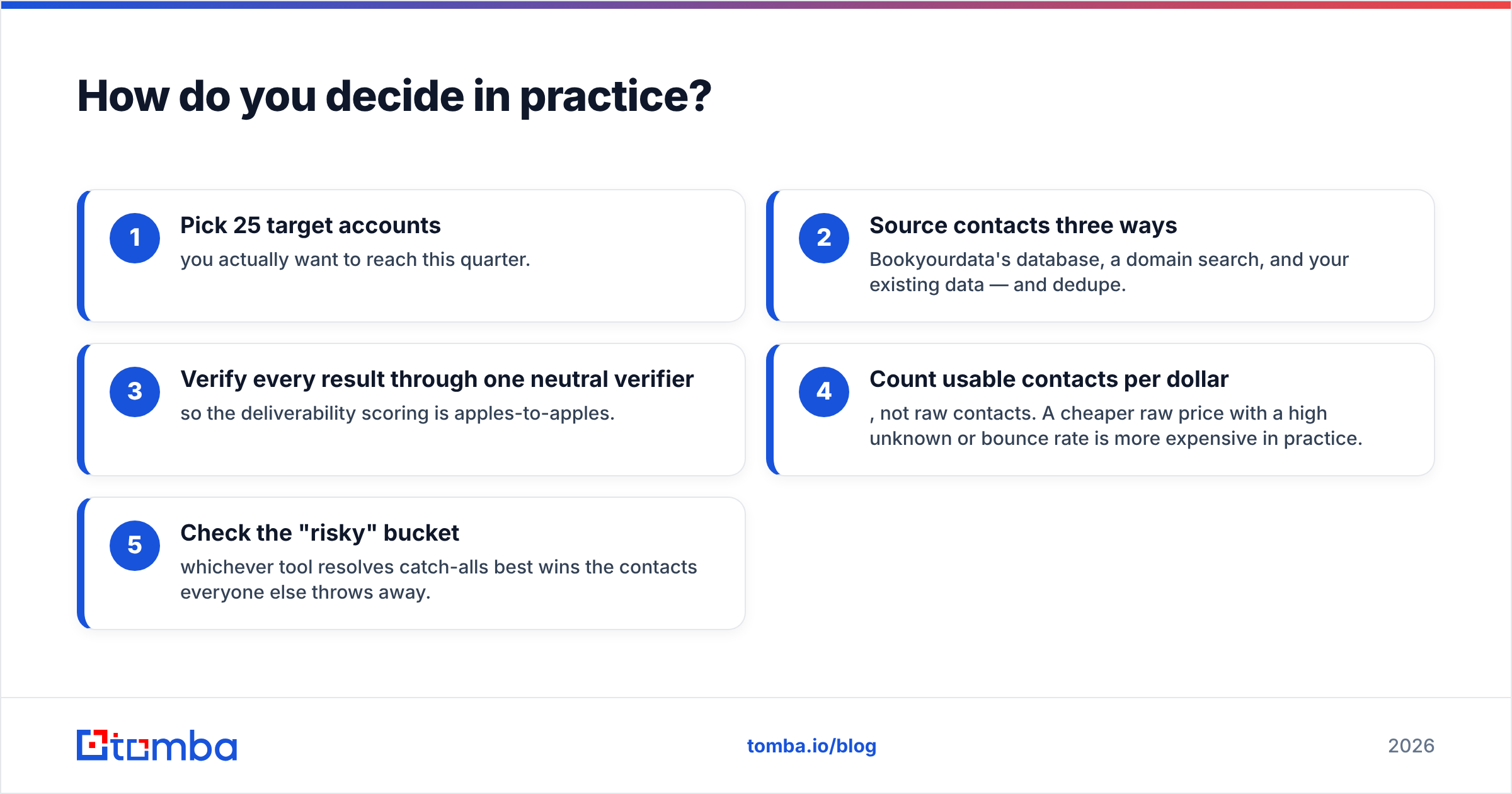
Run a 30-minute test before committing budget:
- Pick 25 target accounts you actually want to reach this quarter.
- Source contacts three ways — Bookyourdata's database, a domain search, and your existing data — and dedupe.
- Verify every result through one neutral verifier so the deliverability scoring is apples-to-apples.
- Count usable contacts per dollar, not raw contacts. A cheaper raw price with a high unknown or bounce rate is more expensive in practice.
- Check the "risky" bucket — whichever tool resolves catch-alls best wins the contacts everyone else throws away.
Whichever tool produces the most deliverable, correctly-targeted contacts per dollar is your answer. For most teams chasing named accounts, that turns out to be a finder-plus-verifier rather than a database-plus-verifier pair.
You can sanity-check vendor claims against independent reviews on G2 and the official Bookyourdata and Emailable sites before you spend.
The bottom line#
Bookyourdata and Emailable are not really competitors — they are two pieces of one pipeline. Bookyourdata finds contacts; Emailable proves they are deliverable. If you buy one, plan to buy or build the other. And if you are paying for both, do the math on a combined tool first, because two vendors for one workflow usually costs more than it should.
If your real goal is reaching the right people at the companies you care about, start with the Tomba Email Finder. You get domain-level search, inline verification, and catch-all resolution in a single workflow — with a free tier of 25 searches a month so you can test it against your own target accounts before paying a cent. Source and verify in one place, and let the per-usable-contact math decide.
// get started
Find, verify and enrich your first contacts today
Start on the free plan with 25 searches a month, then scale when your team is ready.
Free plan · No credit card required · GDPR & CCPA
// about the author