Bookyourdata vs Emailvalidationio: Best Data Tool 2026
One sells you contacts, the other checks them. Here's how Bookyourdata and Emailvalidation.io actually compare in 2026 — and where a finder-plus-verifier beats both.
You are comparing two tools that solve opposite halves of the same problem, and that is exactly why the choice is confusing. Bookyourdata sells you contacts. Emailvalidation.io tells you whether contacts are real. Picking one without understanding the other is how teams end up paying twice and still emailing dead inboxes.
This guide breaks down Bookyourdata vs Emailvalidationio on pricing, data, verification depth, and real workflows — then shows where a combined find-and-verify approach quietly outperforms both.
TL;DR — Bookyourdata vs Emailvalidationio at a glance#
- Bookyourdata is a pay-as-you-go B2B contact database: you build a list by filters (title, industry, location) and download verified emails and phone numbers. Credits don't expire.
- Emailvalidation.io is an email verification API from apilayer: you feed it addresses you already have, and it returns syntax, MX, SMTP, disposable, and role-account checks.
- They are not direct competitors. One generates contacts; the other validates them. Many teams need both functions, not both vendors.
- For accuracy, Bookyourdata advertises a ~97% deliverability guarantee; Emailvalidation.io's accuracy depends entirely on the list you supply.
- If your real goal is "find a decision-maker's email and know it won't bounce," a single email finder with built-in email verification replaces the two-tool stack.
What is Bookyourdata?#
Bookyourdata is a self-serve B2B contact data platform. You log in, apply filters — job title, seniority, industry, company size, geography — and the system returns matching contacts with business emails, direct dials, and firmographic fields. You pay per credit, one credit per revealed contact, and unused credits roll over indefinitely.
Its pitch rests on three claims: a large database (hundreds of millions of contacts), real-time verification at the moment of export, and a deliverability guarantee that refunds credits spent on hard-bounced emails. For a sales team that needs a list — say, 2,000 marketing directors in SaaS — this is the faster path than manually sourcing each person.
The trade-off is that you are buying from a shared database. The same VP of Engineering you exported is available to every other Bookyourdata customer, so list freshness and saturation matter. Job changes happen monthly; a contact verified in January may have moved by March.
What is Emailvalidation.io?#
Emailvalidation.io is a single-purpose verification API. It does not find or sell contacts. You send it an address — jane@acme.com — and it returns a structured verdict: is the syntax valid, does the domain have MX records, does the SMTP server accept the mailbox, is it a disposable provider, is it a role account like info@ or sales@, and a deliverability score.
It is built by apilayer, the same team behind a suite of developer APIs, so it is genuinely API-first. There is a free tier (around 100 verifications per month) and metered paid plans above that. Developers like it because it drops into a signup form or a data pipeline with a few lines of code, blocking junk emails before they enter your CRM.
What it cannot do is tell you which address to check. If you don't already have the email, Emailvalidation.io has nothing to verify. It is the quality gate, not the source.

Bookyourdata vs Emailvalidationio: the core difference#
Think of it like buying produce. Bookyourdata is the supermarket that hands you a full basket. Emailvalidation.io is the inspector who checks each item for freshness. The supermarket without the inspector sells you bruised fruit; the inspector without the supermarket has nothing to inspect.
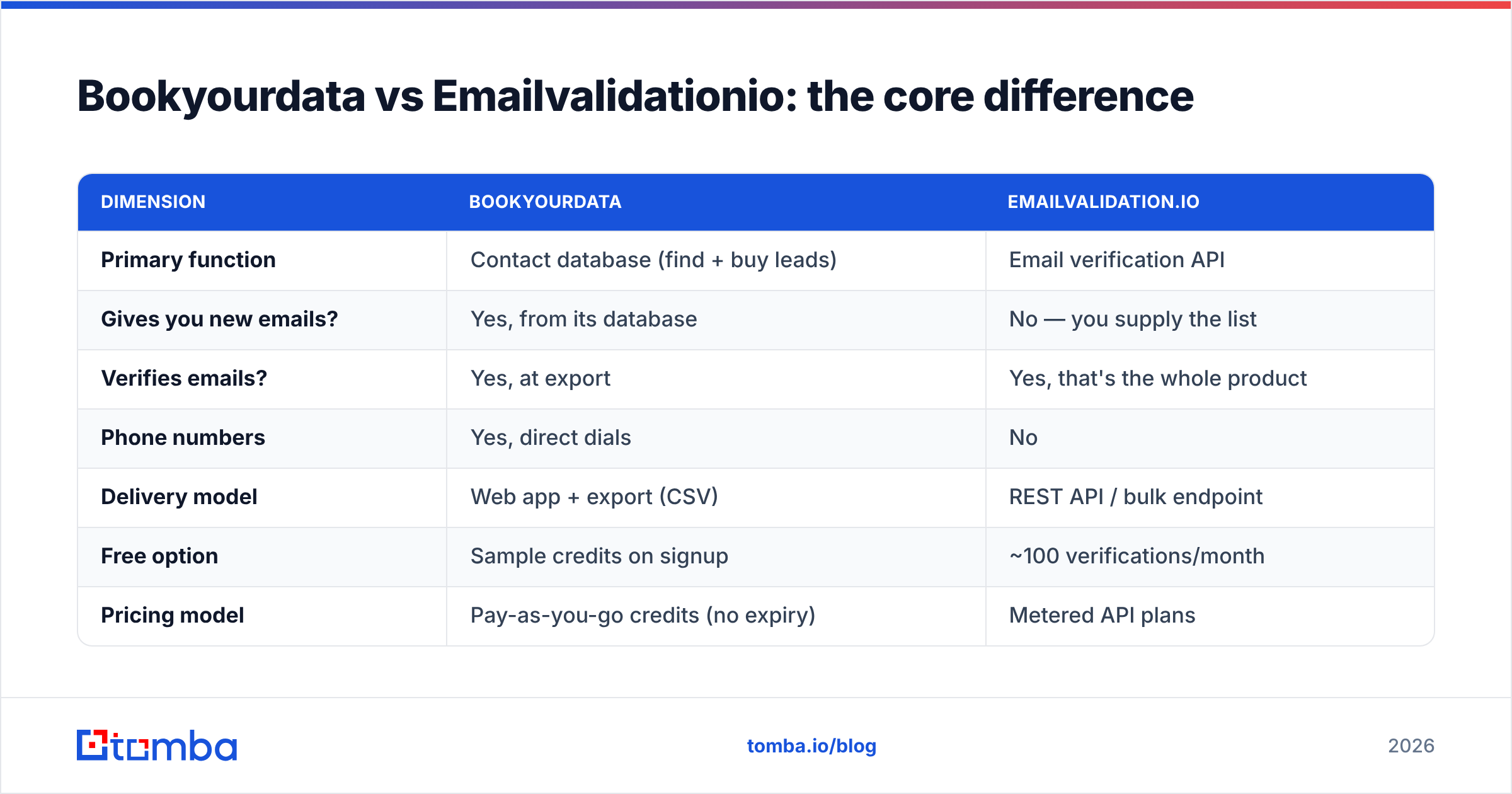
Here is the structural comparison:
| Dimension | Bookyourdata | Emailvalidation.io |
|---|---|---|
| Primary function | Contact database (find + buy leads) | Email verification API |
| Gives you new emails? | Yes, from its database | No — you supply the list |
| Verifies emails? | Yes, at export | Yes, that's the whole product |
| Phone numbers | Yes, direct dials | No |
| Delivery model | Web app + export (CSV) | REST API / bulk endpoint |
| Free option | Sample credits on signup | ~100 verifications/month |
| Pricing model | Pay-as-you-go credits (no expiry) | Metered API plans |
| Best for | Building targeted lead lists | Cleaning lists you already own |
| Developer fit | Light (UI-first) | Strong (API-first) |
The takeaway: comparing them head-to-head is like comparing a car to a fuel gauge. You can use the gauge in many cars, and the car needs a gauge — but they are not substitutes.
Which one should you choose?#
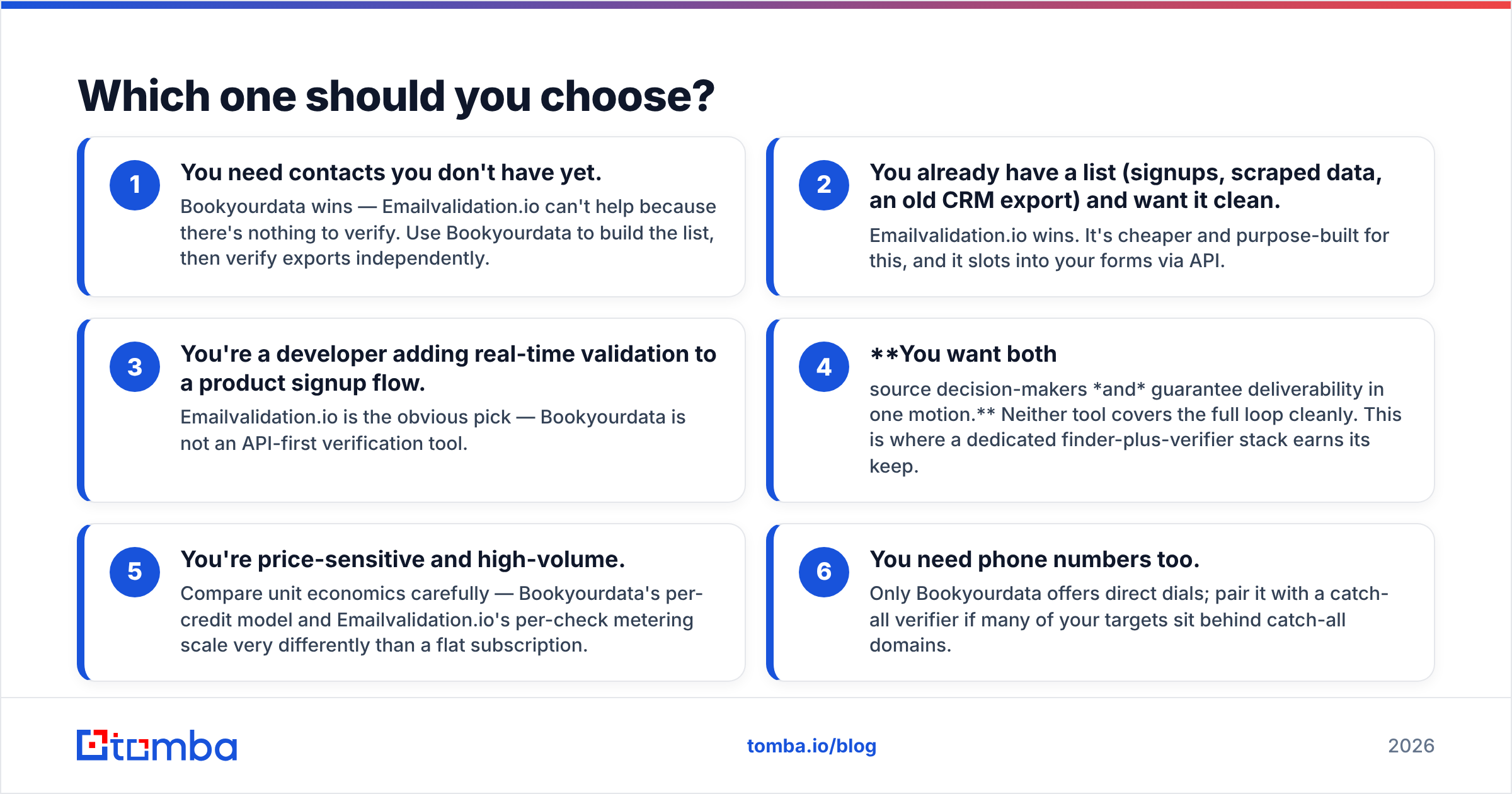
Match the tool to the job you actually have.
- You need contacts you don't have yet. Bookyourdata wins — Emailvalidation.io can't help because there's nothing to verify. Use Bookyourdata to build the list, then verify exports independently.
- You already have a list (signups, scraped data, an old CRM export) and want it clean. Emailvalidation.io wins. It's cheaper and purpose-built for this, and it slots into your forms via API.
- You're a developer adding real-time validation to a product signup flow. Emailvalidation.io is the obvious pick — Bookyourdata is not an API-first verification tool.
- You want both: source decision-makers and guarantee deliverability in one motion. Neither tool covers the full loop cleanly. This is where a dedicated finder-plus-verifier stack earns its keep.
- You're price-sensitive and high-volume. Compare unit economics carefully — Bookyourdata's per-credit model and Emailvalidation.io's per-check metering scale very differently than a flat subscription.
- You need phone numbers too. Only Bookyourdata offers direct dials; pair it with a catch-all verifier if many of your targets sit behind catch-all domains.
How accurate is each tool?#
Accuracy means different things for each product, and conflating them leads to bad decisions.
Bookyourdata's accuracy is about the data it sells. Its ~97% deliverability guarantee refunds credits for hard bounces, which is a real commitment — but "97% deliverable at export" is a snapshot. Decay starts immediately as people change jobs. Independent reviews on G2 consistently note that any database vendor's freshness varies by industry and region, so treat headline accuracy numbers as a ceiling, not a guarantee for your segment.
Emailvalidation.io's accuracy is about verdict correctness — does it correctly flag a dead mailbox or a disposable domain? SMTP-based verification is strong for standard mailboxes but inherently uncertain on catch-all domains, where the server accepts everything and reveals nothing. No SMTP verifier fully solves catch-all; the honest ones tell you when they're unsure. That's why a serious workflow pairs verification with a dedicated catch-all email resolution step rather than trusting a single boolean.
The practical lesson: a contact is only as good as its freshest check. Buying from a database and never re-verifying before a send is the most common way teams burn their sender reputation.
What does it cost? Bookyourdata vs Emailvalidationio pricing#
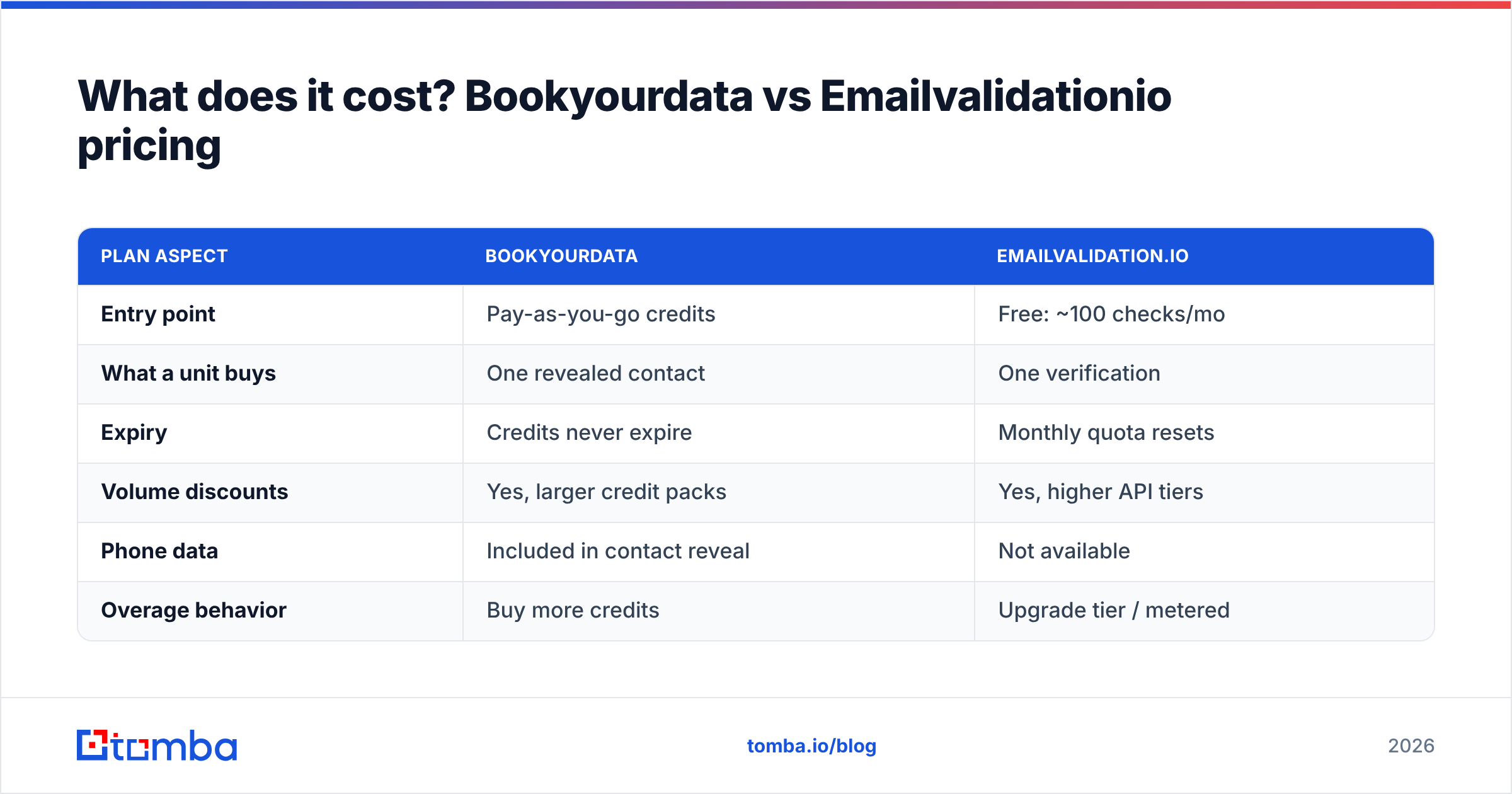
The two pricing models are not directly comparable because you're buying different things — list credits versus verification calls. Here's a representative breakdown (always confirm current numbers on the vendors' own pages, since plans change):
| Plan aspect | Bookyourdata | Emailvalidation.io |
|---|---|---|
| Entry point | Pay-as-you-go credits | Free: ~100 checks/mo |
| What a unit buys | One revealed contact | One verification |
| Expiry | Credits never expire | Monthly quota resets |
| Volume discounts | Yes, larger credit packs | Yes, higher API tiers |
| Phone data | Included in contact reveal | Not available |
| Overage behavior | Buy more credits | Upgrade tier / metered |
For comparison, a combined platform like Tomba pricing bundles finding and verifying into one subscription: a free tier with 25 searches/month, Starter at $49/mo, Growth at $99/mo, and Pro at $249/mo. If you'd otherwise pay one vendor to source contacts and a second to verify them, a single bundled plan often lands cheaper once you count both line items — and removes the CSV hand-off between tools.

Can you use both together?#
Yes, and plenty of teams do: source with Bookyourdata, then re-verify with Emailvalidation.io right before a campaign to catch decay since export. That's a legitimate belt-and-suspenders setup.
But it has friction. You're managing two contracts, two dashboards, and a manual export-import loop. Every CSV that moves between tools is a chance to lose UTF-8 characters, duplicate rows, or drop a column. If you go this route, at minimum run a bulk verify pass and a dedupe step so you're not paying to validate the same address twice.
The deeper issue is timing. Verification is only meaningful at the moment of send. If you export in January, verify in January, and email in April, your January verification is stale. The tighter your find → verify → send loop, the fewer bounces you eat — which is the entire argument for collapsing the stack.
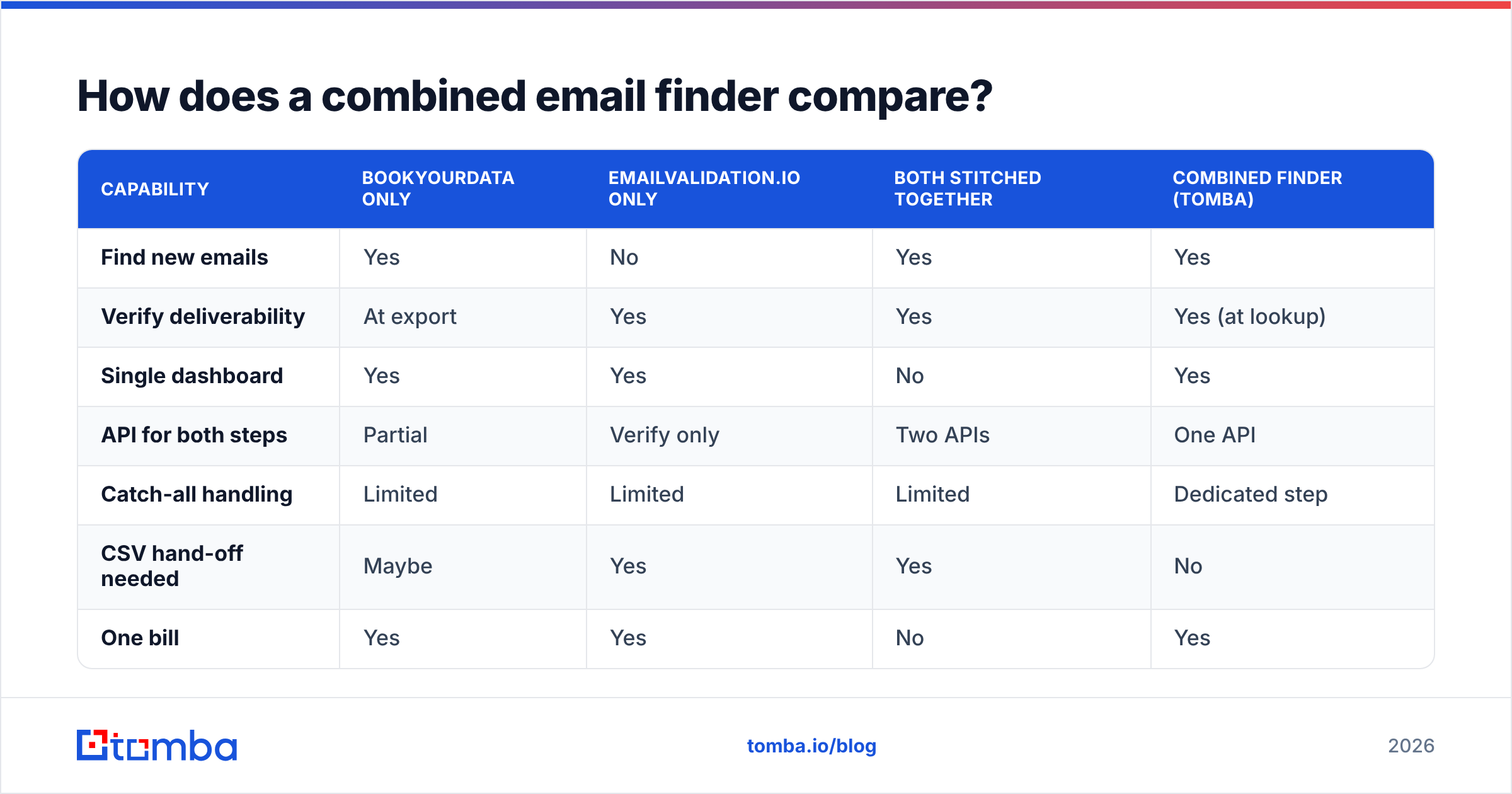
How does a combined email finder compare?#
A find-and-verify platform handles both halves in one pass: you search by company domain search or by name, the tool returns the address and its verification status in the same response, and you skip the export-import shuffle entirely.
Here's how the approaches stack up for a typical outbound workflow:
| Capability | Bookyourdata only | Emailvalidation.io only | Both stitched together | Combined finder (Tomba) |
|---|---|---|---|---|
| Find new emails | Yes | No | Yes | Yes |
| Verify deliverability | At export | Yes | Yes | Yes (at lookup) |
| Single dashboard | Yes | Yes | No | Yes |
| API for both steps | Partial | Verify only | Two APIs | One API |
| Catch-all handling | Limited | Limited | Limited | Dedicated step |
| CSV hand-off needed | Maybe | Yes | Yes | No |
| One bill | Yes | Yes | No | Yes |
The advantage isn't just convenience. When finding and verifying happen in the same call, the email you get is verified now, not whenever the database last touched it. That's the difference between a 2% and a 12% bounce rate on the same target list, and bounce rate is what protects your domain's standing with mailbox providers (see Google's own sender guidelines for why that threshold matters).
You can also reach the same data programmatically through the Tomba API or pull it straight into a spreadsheet with the Google Sheets add-on, so the workflow fits both developers and ops teams without a second subscription.
Pros and cons summary#
Bookyourdata — pros: large self-serve database, phone numbers included, credits never expire, deliverability guarantee with refunds. Bookyourdata — cons: shared/saturated data, freshness decays after export, not a real-time verification API, no built-in catch-all resolution.
Emailvalidation.io — pros: clean API-first design, generous free tier, fast to integrate, solid for form-level validation. Emailvalidation.io — cons: finds nothing on its own, catch-all uncertainty like all SMTP verifiers, useless without an existing list.
Combined finder — pros: one loop for find + verify, verified-at-lookup freshness, single bill and dashboard, dedicated catch-all step. Combined finder — cons: if you only need to scrub an existing list and never source new contacts, a standalone verifier may be marginally cheaper.
The verdict on Bookyourdata vs Emailvalidationio#
There's no single winner because they answer different questions. Choose Bookyourdata when you need to buy a targeted list with phone numbers and you'll verify separately before sending. Choose Emailvalidation.io when you already have addresses and want a developer-friendly API to keep junk out. Choose a combined finder when you want to source decision-makers and trust the address in the same step, on one bill.
For most outbound and growth teams, the two-vendor stack is more overhead than it's worth. You're paying twice, hand-offs introduce errors, and verification goes stale between export and send. Folding the workflow into a single tool removes all three problems.
If that's your situation, start with the Tomba Email Finder — find professional emails by domain, name, or company, get verification baked into every lookup, and resolve catch-all domains in the same workflow. The free tier gives you 25 searches a month to test it against your current Bookyourdata exports and Emailvalidation.io checks before you commit to either. Run the same 50 contacts through all three and compare the bounce rates yourself — that's the only benchmark that matters for your list.
// get started
Find, verify and enrich your first contacts today
Start on the free plan with 25 searches a month, then scale when your team is ready.
Free plan · No credit card required · GDPR & CCPA
// about the author