Bookyourdata vs Enrichley: Which B2B Data Wins in 2026?
Bookyourdata sells pay-as-you-go contact lists; Enrichley focuses on CRM enrichment. We compare accuracy, pricing, and fit so you pick the right B2B data source in 2026.
Choosing between Bookyourdata and Enrichley comes down to one question: do you want to buy a contact list, or enrich the records you already have? They look similar on a feature grid, but they solve opposite ends of the same problem — and picking the wrong one wastes budget on data you can't use.
TL;DR — Bookyourdata vs Enrichley in 30 seconds#
- Bookyourdata is a pay-as-you-go B2B contact list builder. You filter by industry, title, and geography, then buy verified records in bulk. Best for one-off list pulls.
- Enrichley leans toward CRM enrichment and data appending — you feed it partial records and it fills the gaps. Best for cleaning an existing database.
- Accuracy is the real battleground. Both claim high deliverability; neither verifies in real time at the moment you export, which is where bounces creep in.
- Pricing models differ fundamentally: Bookyourdata charges per credit/record, Enrichley leans subscription. Your cost per usable contact depends entirely on bounce rate.
- If you want live verification at the point of search plus enrichment in one workflow, a dedicated finder like Tomba is the cheaper, more accurate third option.
What is Bookyourdata?#
Bookyourdata is a self-service B2B contact database. You build a list inside their UI by stacking filters — job title, industry, company size, location, technology used — and the platform returns matching records with emails and, on some plans, direct dials. You pay for what you export, credit by credit, with a "real-time email verification" promise attached to each record.
The pitch is speed. If you need 5,000 marketing directors in SaaS companies by lunch, Bookyourdata hands you a CSV without a long sales cycle. That convenience is also the catch: you're buying a snapshot of a database, and B2B data decays at roughly 2.5% per month as people change jobs. A list that was 95% accurate at export can drift fast.
You can verify a Bookyourdata export the same way you'd vet any purchased list — run it through an independent email verifier before your first send so you're not torching your sender reputation on dead inboxes.
What is Enrichley?#
Enrichley sits on the enrichment side of the market. Instead of starting from filters, you start from records you already own — a half-finished CRM, a webinar signup list, a scraped set of company names — and Enrichley appends the missing fields: work email, phone, company data, social profiles.
This is a different job. Enrichment tools win when you have signal (a name, a domain, a LinkedIn URL) and need to turn it into a contactable record. They lose when you have nothing and need net-new prospects, because there's no seed data to enrich. Most enrichment platforms, including this category broadly, price on monthly subscriptions tied to enrichment volume rather than per-record purchases.
If your core problem is a messy CRM rather than an empty one, this model fits. The question is whether a single-purpose enrichment tool beats a platform that does finding, verifying, and data enrichment together.

How accurate is each one?#
Accuracy is where comparisons get slippery, because every vendor quotes a deliverability number from their own internal test. Here's the honest framing: a list is only as good as its freshness at the moment you send.
Bookyourdata verifies records, but the verification happens against its database state, not necessarily a live SMTP check at export time. Enrichley appends data from aggregated sources, which means a returned email can be a pattern guess rather than a confirmed mailbox. Both approaches produce bounces when the underlying record is stale.
The defensive move is the same regardless of which you choose: never trust a vendor's "verified" badge blindly. Re-verify before sending. Tools that confirm the mailbox at the point of search — not weeks earlier in a static database — start you from a higher floor. This is also why catch-all verification matters: a huge share of B2B domains accept all mail, and a tool that can't distinguish a real inbox from a catch-all will inflate its own accuracy claims.

Bookyourdata vs Enrichley: side-by-side comparison#
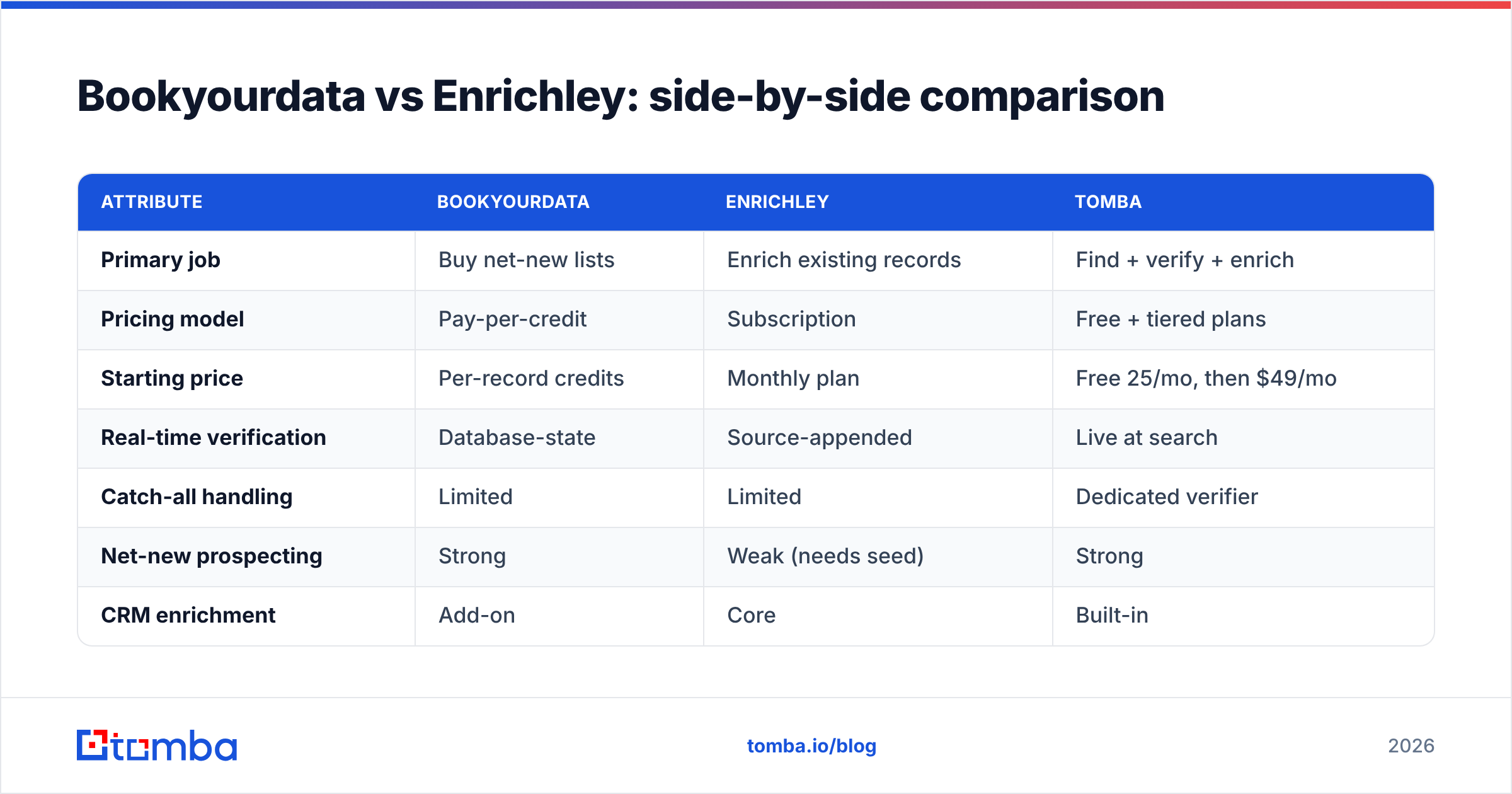
| Attribute | Bookyourdata | Enrichley | Tomba |
|---|---|---|---|
| Primary job | Buy net-new lists | Enrich existing records | Find + verify + enrich |
| Pricing model | Pay-per-credit | Subscription | Free + tiered plans |
| Starting price | Per-record credits | Monthly plan | Free 25/mo, then $49/mo |
| Real-time verification | Database-state | Source-appended | Live at search |
| Catch-all handling | Limited | Limited | Dedicated verifier |
| Net-new prospecting | Strong | Weak (needs seed) | Strong |
| CRM enrichment | Add-on | Core | Built-in |
| API access | Yes | Yes | Yes (full REST) |
| Free tier | No | Limited | Yes (25 searches) |
| Best for | Bulk list buyers | Database cleanup | End-to-end outbound |
The table makes the split obvious: Bookyourdata and Enrichley each own one column of the workflow, while an all-in-one finder spans the whole row. If your team would otherwise pay for both a list source and an enrichment tool, consolidating is usually cheaper per usable contact.
Which pricing model actually costs less?#
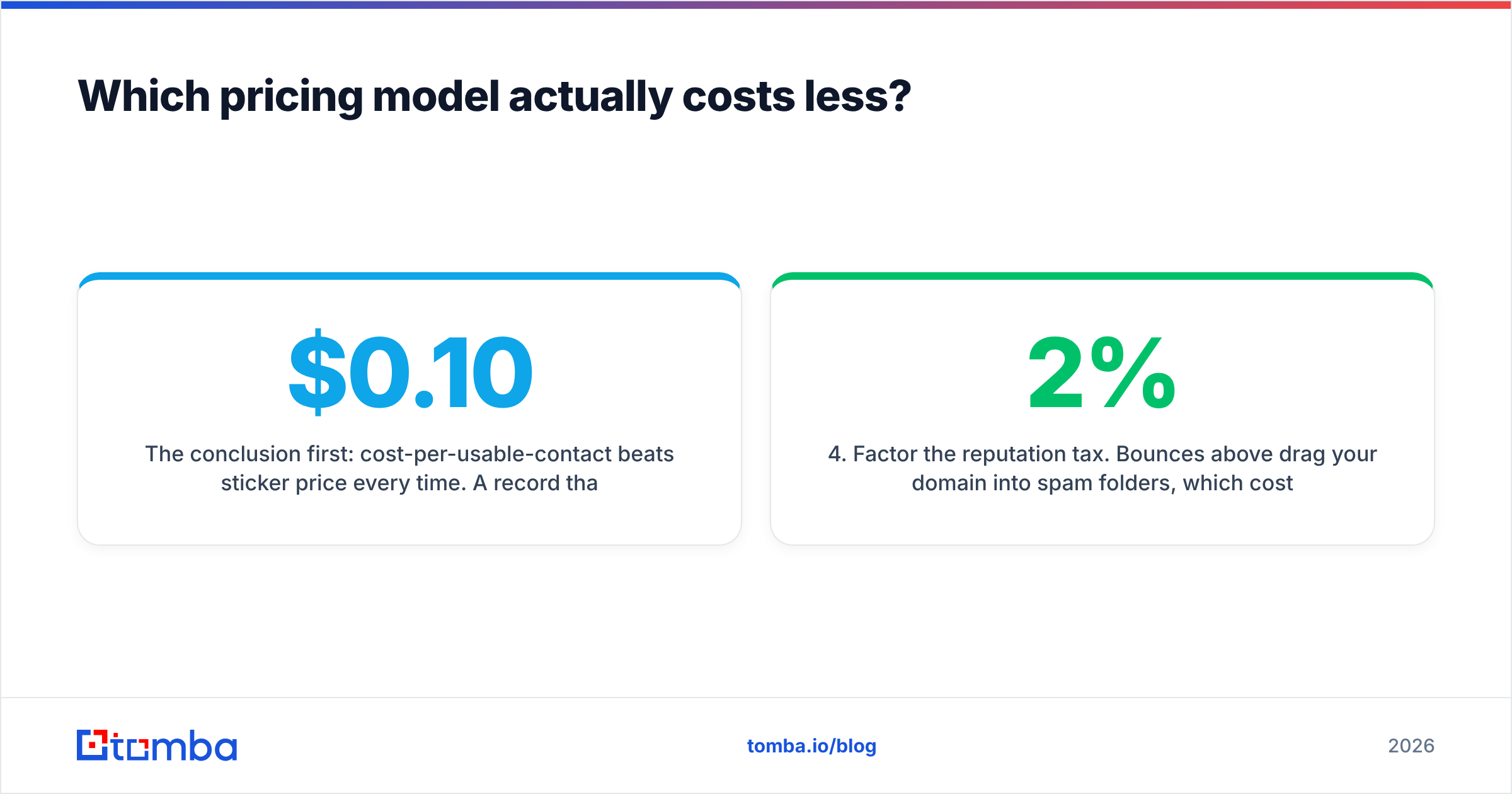
The conclusion first: cost-per-usable-contact beats sticker price every time. A $0.10 record that bounces 20% of the time costs you $0.125 per deliverable contact, plus the reputation damage of the bounces.
Bookyourdata's pay-as-you-go model looks attractive for one-time campaigns — you don't commit to a subscription, you buy what you need. But credits expire on some plans, and bulk discounts pressure you to over-buy. Enrichley's subscription is predictable but you pay whether or not you enrich your full allotment that month.
Here's how to evaluate any of the three honestly:
- Get the real bounce rate, not the marketing number. Buy or trial a small batch, send it, measure hard bounces.
- Divide spend by deliverable contacts, not total records returned.
- Add the cost of a separate verifier if the tool doesn't verify live — that's a hidden line item.
- Factor the reputation tax. Bounces above 2% drag your domain into spam folders, which costs far more than data fees.
- Check for a free tier so you can benchmark before committing budget.
By that math, a platform with a free tier and transparent pricing often wins even if its headline price isn't the lowest, because you pay for confirmed mailboxes rather than raw rows.

When should you pick Bookyourdata?#
Pick Bookyourdata when net-new list building is your bottleneck and you don't already have a seed database to work from. Specific scenarios:
- You're launching outbound into a brand-new segment and need volume fast.
- Your team prefers a filter-and-export UI over an API-first workflow.
- You run occasional campaigns and don't want a recurring subscription.
The trade-off you're accepting: you must verify the export yourself before sending, and you'll re-buy as the data ages. Treat Bookyourdata lists as raw material, not finished contacts.
When should you pick Enrichley?#
Pick Enrichley (or any enrichment-first tool) when your problem is data you already have, not data you lack. Specific scenarios:
- Your CRM is full of half-complete records — names without emails, companies without contacts.
- You capture leads via forms and need to append firmographics for routing and scoring.
- You want enrichment to run continuously in the background against new signups.
The trade-off: enrichment can't conjure prospects from nothing. If your pipeline is empty, an enrichment tool has nothing to enrich. You'll still need a finder to source the initial records.
Is there a better all-in-one alternative?#
Yes — if your honest answer to "do I need to find or enrich?" is "both," then splitting the job across two vendors is the expensive path. This is the gap a dedicated finder fills.
Tomba combines net-new finding, live verification, and enrichment in one workflow. You can run a domain search to pull every contactable email at a target company, verify each mailbox live, and enrich the record with firmographic and social data — without exporting to a second tool. For teams already paying separately for a list provider and an enrichment platform, that consolidation is where the savings show up.

Where the all-in-one model genuinely wins:
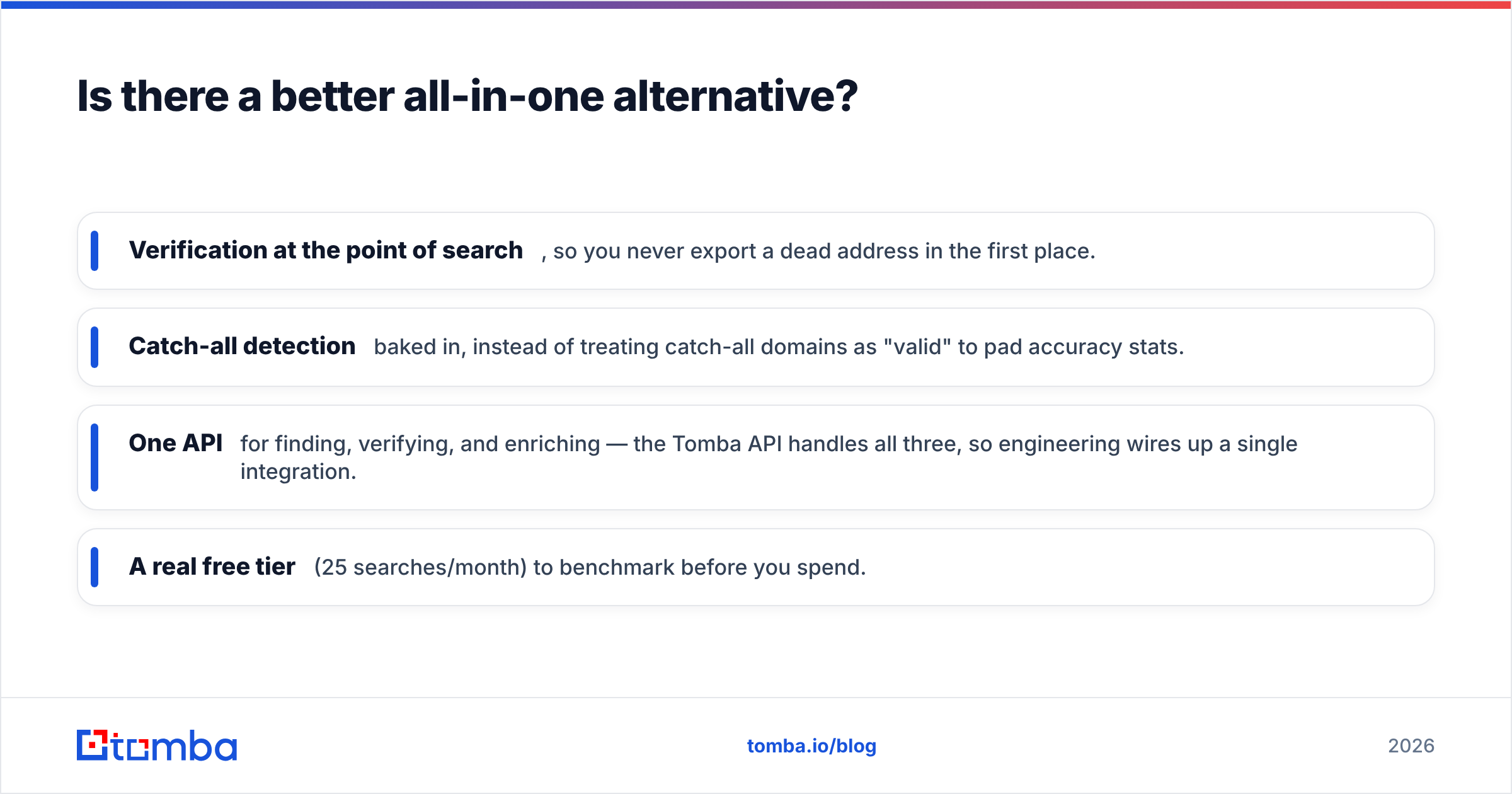
- Verification at the point of search, so you never export a dead address in the first place.
- Catch-all detection baked in, instead of treating catch-all domains as "valid" to pad accuracy stats.
- One API for finding, verifying, and enriching — the Tomba API handles all three, so engineering wires up a single integration.
- A real free tier (25 searches/month) to benchmark before you spend.
None of this means Bookyourdata or Enrichley are bad tools. It means that if you're choosing between them, you may be solving half the problem twice. Validate that against independent reviews on G2 and Capterra before you commit, and check the Bookyourdata homepage directly for current credit pricing — vendor pages shift faster than review sites.
How to decide in practice#
A simple decision path:
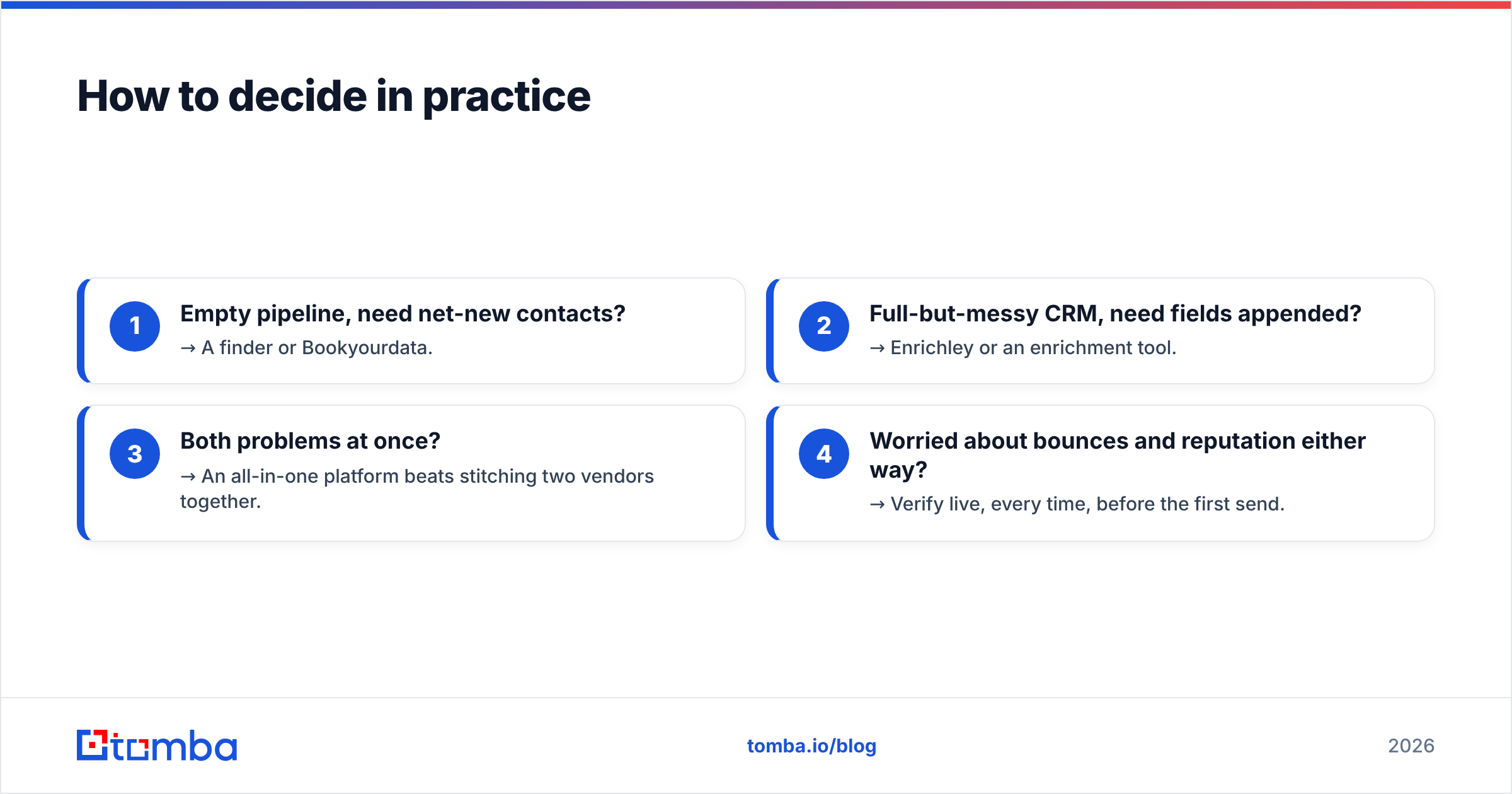
- Empty pipeline, need net-new contacts? → A finder or Bookyourdata.
- Full-but-messy CRM, need fields appended? → Enrichley or an enrichment tool.
- Both problems at once? → An all-in-one platform beats stitching two vendors together.
- Worried about bounces and reputation either way? → Verify live, every time, before the first send.
Whatever you pick, run a small paid trial and measure the deliverable contact rate yourself. Vendor accuracy claims are a starting point for negotiation, not a guarantee.
Final verdict#
Bookyourdata and Enrichley aren't really competitors — they're two halves of an outbound data stack. Bookyourdata gets you net-new lists; Enrichley fills in records you already hold. If you only have one of those problems, either can be the right call. If you have both, you're about to pay two subscriptions to do what one platform does in a single workflow.
Before you commit to either, try finding and verifying your next batch of prospects with the Tomba Email Finder. Search by domain, name, or company; get live-verified emails with catch-all detection built in; and start on the free tier (25 searches/month) so you can compare deliverable-contact cost against Bookyourdata and Enrichley with your own numbers — not the vendors'. It's the fastest way to see whether one tool can replace two.
// get started
Find, verify and enrich your first contacts today
Start on the free plan with 25 searches a month, then scale when your team is ready.
Free plan · No credit card required · GDPR & CCPA
// about the author