Bookyourdata vs Enrow: Which B2B Data Tool in 2026?
Bookyourdata sells prebuilt contact lists; Enrow runs waterfall email enrichment. Here's how the two compare on accuracy, pricing, and real-world fit in 2026.
Bookyourdata vs Enrow: Which B2B Data Tool Wins in 2026?
Choosing between Bookyourdata and Enrow comes down to one question: do you want to buy a list or build one? They sound like competitors, but they solve different halves of the same problem. This guide breaks down where each one earns its price — and where a verification-first tool beats both.
TL;DR#
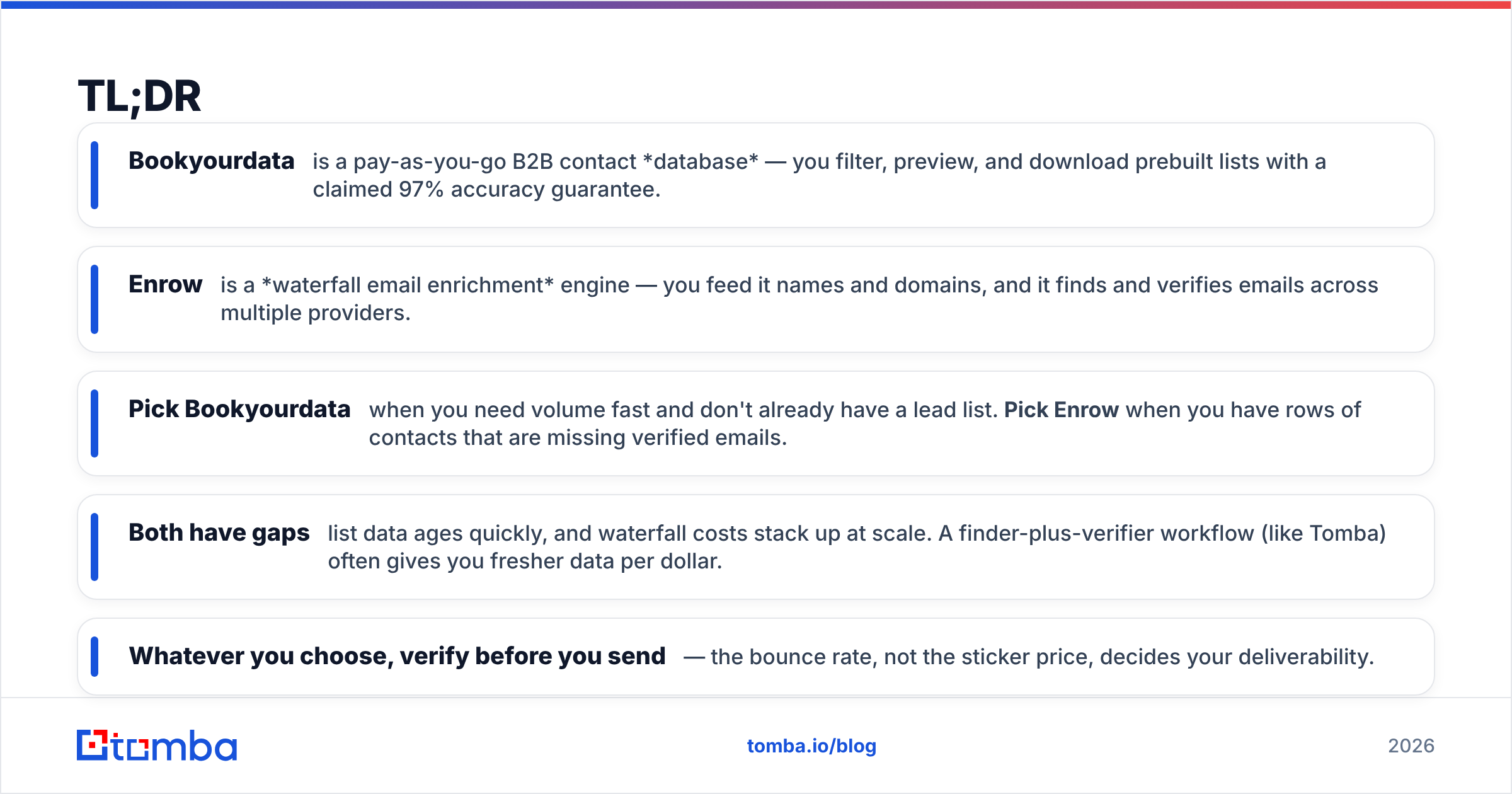
- Bookyourdata is a pay-as-you-go B2B contact database — you filter, preview, and download prebuilt lists with a claimed 97% accuracy guarantee.
- Enrow is a waterfall email enrichment engine — you feed it names and domains, and it finds and verifies emails across multiple providers.
- Pick Bookyourdata when you need volume fast and don't already have a lead list. Pick Enrow when you have rows of contacts that are missing verified emails.
- Both have gaps: list data ages quickly, and waterfall costs stack up at scale. A finder-plus-verifier workflow (like Tomba) often gives you fresher data per dollar.
- Whatever you choose, verify before you send — the bounce rate, not the sticker price, decides your deliverability.
What is Bookyourdata?#
Bookyourdata is a self-service B2B contact database. Think of it like a grocery store for leads: you walk in with filters (job title, industry, company size, location, technology used), the shelves show you how many matching contacts exist, and you pay only for the records you put in your cart.
Its headline pitch is a 97% accuracy guarantee with real-time email verification at the point of download, plus a credit-back policy when a record bounces. You get direct dials, business emails, LinkedIn URLs, and firmographic fields. There's no forced annual contract — credits are pay-as-you-go and don't expire, which is unusual in this category.
The trade-off is that you're buying from a prebuilt pool. The data was collected before you searched for it, so freshness depends on how recently that record was refreshed. For a contact who changed jobs last month, a static database is structurally a step behind.

What is Enrow?#
Enrow takes the opposite approach. Instead of selling you a list, it enriches one you already have. You upload contacts (or pipe them through an API), and Enrow runs a "waterfall" — it queries multiple email-finding sources in sequence, returns the first valid hit, and verifies it before handing it back.
Waterfall enrichment is the current favorite among outbound operators because no single provider has complete coverage. If source A misses a contact, source B might catch it. Enrow markets strong verification accuracy and a low catch-all error rate, which matters because catch-all domains are where most "verified" emails quietly bounce.
The catch: you need input data first. Enrow doesn't generate net-new prospect lists from filters — it fills in the missing emails for people you've already identified. If your CRM is empty, Enrow has nothing to enrich.
Bookyourdata vs Enrow: side-by-side comparison#
Here's the core breakdown. Note that vendor pricing shifts, so treat these as directional and confirm on each official site before buying.
| Attribute | Bookyourdata | Enrow |
|---|---|---|
| Primary model | Prebuilt contact database | Waterfall email enrichment |
| Net-new list building | Yes — filter and download | No — needs input contacts |
| Email verification | Real-time at download | Built-in, catch-all focused |
| Pricing model | Pay-as-you-go credits | Per-email / credit packs |
| Contract lock-in | None; credits don't expire | Plan-based |
| Best input | Filters (title, industry, tech) | Name + company/domain |
| Phone numbers | Yes (direct dials) | Limited / via integrations |
| Accuracy claim | ~97% guarantee | High verify rate, low catch-all error |
| Ideal user | Teams needing volume fast | Teams enriching existing data |
When each tool wins#
- You have zero leads yet — Bookyourdata wins. You can go from filters to a downloadable list in minutes.
- You have a CRM full of partial records — Enrow wins. It fills missing emails without you rebuilding the list.
- You sell into niche or fast-moving roles — Lean enrichment (Enrow-style) plus live verification, since static lists decay fastest in volatile segments.
- You need direct dials alongside email — Bookyourdata bundles phone data more directly; for standalone numbers a dedicated phone finder closes the gap.
- You're scaling outbound to tens of thousands — Watch unit costs. Waterfall per-email fees and list credits both balloon; a bulk email finder workflow with verification often costs less per usable contact.
Is Bookyourdata more accurate than Enrow?#
Accuracy is the wrong single number to chase — the question is accuracy at the moment you send. A 97% guarantee on a record refreshed eight months ago is weaker than a freshly verified email found today.
Bookyourdata verifies at download, which is good, but it can't fix data that aged inside the pool before you searched. Enrow verifies what it finds in real time during the waterfall, which tends to produce fresher results for contacts you specify — but only for contacts you already know exist.
This is why serious senders treat any data source as a starting point, not a finish line. Running every list through an independent email verifier before a campaign is the cheapest insurance you can buy. A catch-all domain, a recently departed employee, or a typo'd record will quietly tank your sender reputation, and no purchase guarantee protects your inbox placement.

For more on why placement depends on hygiene as much as data source, see the fundamentals of email deliverability and how sender reputation compounds over time.
How do pricing models compare?#
The pricing philosophies differ as much as the products.
Bookyourdata is pure pay-as-you-go: you buy credits, spend one per revealed record, and unused credits don't expire. That's attractive for spiky usage — a one-off campaign doesn't force a subscription. The risk is paying repeatedly for records that overlap with data you already own.
Enrow typically sells credit packs or per-email enrichment tiers. You pay for results found, which feels fair, but waterfall sourcing means you're effectively paying for multiple provider lookups bundled into one price. At high volume those packs add up.
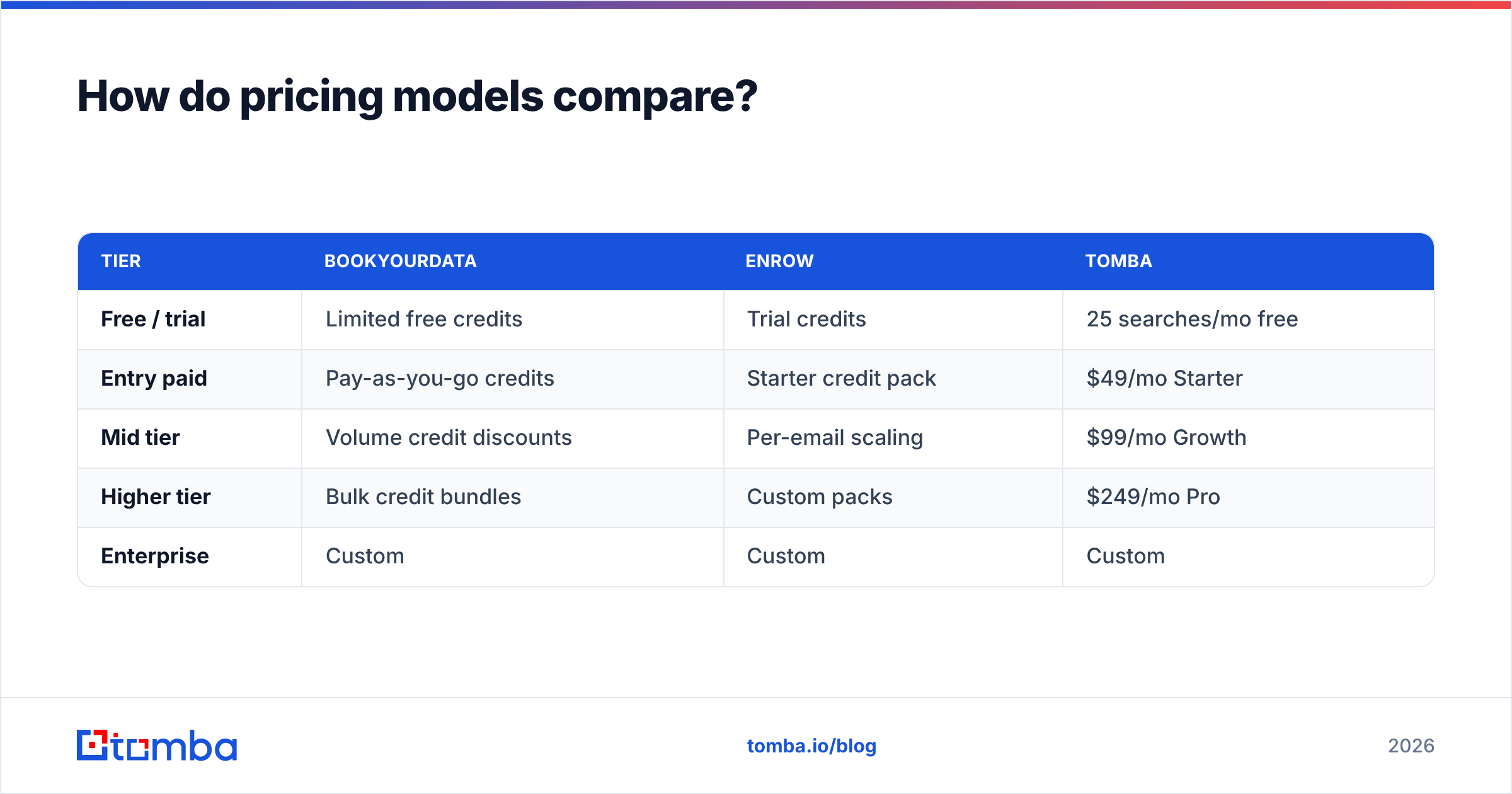
Here's a simplified comparison against a verification-first finder so you can see the spread:
| Tier | Bookyourdata | Enrow | Tomba |
|---|---|---|---|
| Free / trial | Limited free credits | Trial credits | 25 searches/mo free |
| Entry paid | Pay-as-you-go credits | Starter credit pack | $49/mo Starter |
| Mid tier | Volume credit discounts | Per-email scaling | $99/mo Growth |
| Higher tier | Bulk credit bundles | Custom packs | $249/mo Pro |
| Enterprise | Custom | Custom | Custom |
You can see full Tomba pricing for exact credit allocations. The takeaway: pay-as-you-go is great for unpredictable bursts; a flat monthly plan is cheaper once outbound becomes a steady motion.

What about data freshness and compliance?#
Two things separate a usable B2B dataset from a liability: how recently it was refreshed and how it was sourced.
Prebuilt databases like Bookyourdata are only as fresh as their last refresh cycle. The B2B world churns roughly 25–30% of contact data per year as people change roles, so a list bought today and used in six months is meaningfully degraded. Enrichment tools sidestep some of this by finding data on demand, but they still draw from underlying sources that have their own staleness.
On compliance, anyone buying or enriching B2B contact data should understand the regional rules — GDPR in the EU, CAN-SPAM in the US — and confirm the vendor's lawful basis for processing. Reputable directories like G2 and review platforms such as Capterra are useful for sanity-checking a vendor's compliance posture and real user complaints before you commit budget. For the regulatory baseline itself, the official GDPR text is worth a skim if you sell into Europe.
Freshness is also why the workflow matters more than the source. Whether you pull from a database or a waterfall, re-verifying at send time and re-enriching stale rows on a schedule keeps your list healthy. Tools like data enrichment and domain search let you rebuild and top up lists continuously instead of buying one big block that decays.
Which should you choose — and is there a better fit?#
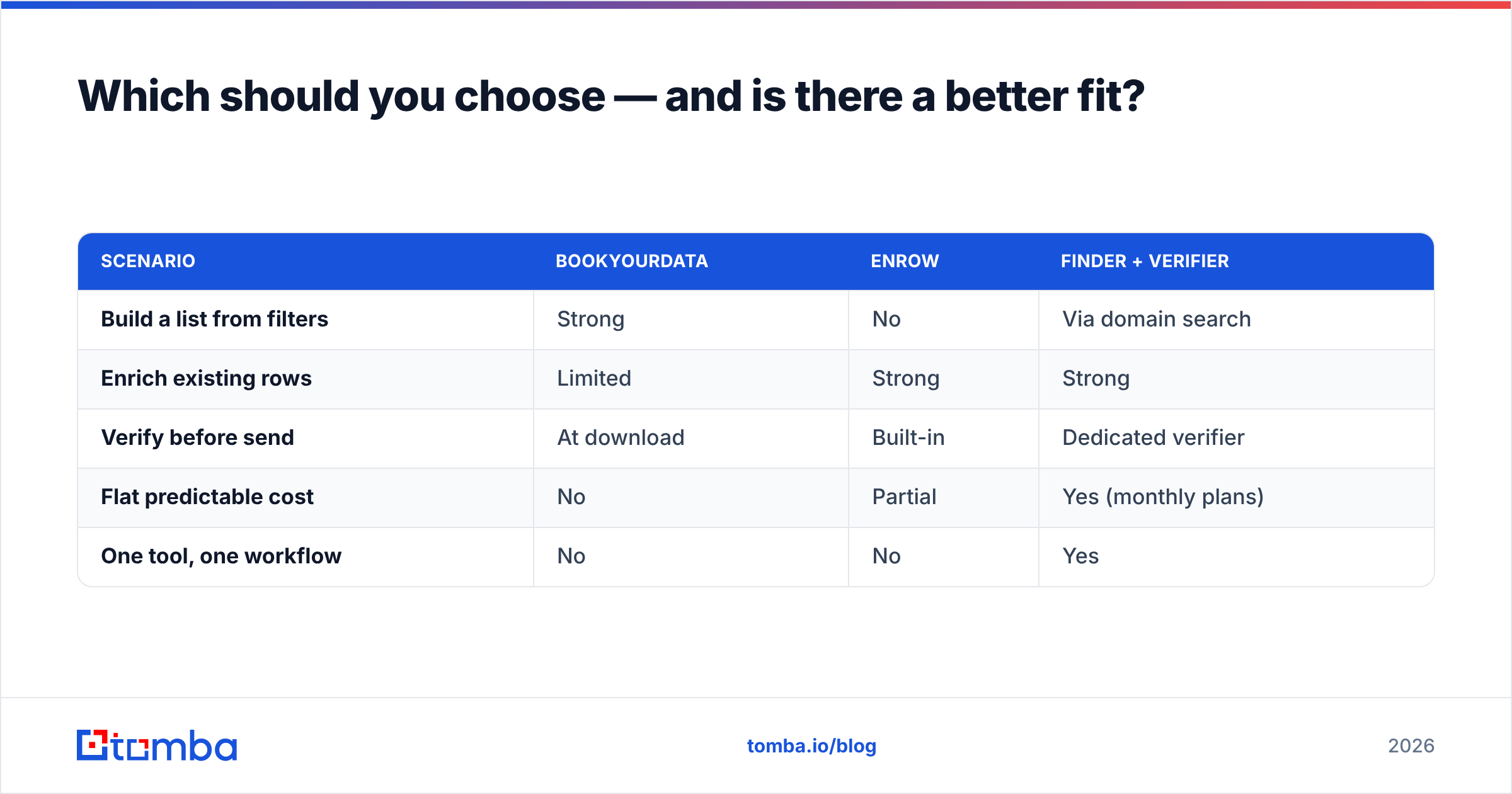
Decision in one line: Bookyourdata if you need a list from scratch, Enrow if you need to complete a list you already have. They're complements more than rivals.
But there's a third path that often beats running both. A finder-plus-verifier platform gives you net-new discovery and enrichment and verification in one credit pool — without buying a static database or stacking waterfall fees.
| Scenario | Bookyourdata | Enrow | Finder + verifier |
|---|---|---|---|
| Build a list from filters | Strong | No | Via domain search |
| Enrich existing rows | Limited | Strong | Strong |
| Verify before send | At download | Built-in | Dedicated verifier |
| Flat predictable cost | No | Partial | Yes (monthly plans) |
| One tool, one workflow | No | No | Yes |
This is where Tomba fits. You can find emails by name and domain, run company email search to pull every public address at an account, enrich partial records, and verify the whole batch — all inside one plan. If you live in spreadsheets or a CRM, the HubSpot integration and Google Sheets add-on keep the workflow where you already work.
It's not that Bookyourdata or Enrow are bad tools — they're focused tools. The question is whether you want to manage two vendors and two billing models, or run discovery, enrichment, and hygiene from a single source you can audit.
Final recommendation#
If your blocker is not having a list, Bookyourdata's pay-as-you-go database gets you moving fastest. If your blocker is incomplete records, Enrow's waterfall enrichment is purpose-built for that gap. And if you'd rather not stitch two products together — or you want flat, predictable pricing with verification baked in — consolidate the whole motion into one platform.
Start with the Tomba Email Finder: use the free tier's 25 monthly searches to test accuracy on your own target accounts, run the results through the verifier, and compare the usable-contact-per-dollar against a Bookyourdata list pull or an Enrow enrichment run. Let your own bounce rate pick the winner — that's the only benchmark that pays your salary.

// get started
Find, verify and enrich your first contacts today
Start on the free plan with 25 searches a month, then scale when your team is ready.
Free plan · No credit card required · GDPR & CCPA
// about the author