Bookyourdata vs Exactverify 2026: Which B2B Data Tool Wins?
Bookyourdata sells pay-as-you-go B2B lists; Exactverify scrubs the emails you already have. Here is how the two compare on accuracy, pricing, and real-world fit in 2026 — plus where a dedicated finder beats both.
You are comparing two tools that solve different halves of the same problem. Bookyourdata sells you ready-made B2B contact lists. Exactverify checks whether the email addresses you already have are still deliverable. Picking between them without understanding that split is how teams end up paying twice and still bouncing into spam folders.
This guide breaks down exactly what each tool does, how accuracy and pricing actually compare, and which workflow fits your team in 2026. It also covers the option most "X vs Y" posts skip: building a fresh, verified list from scratch instead of buying or scrubbing one.
TL;DR#
- Bookyourdata is a list seller — pay-as-you-go B2B contacts with claimed 97%+ accuracy, no monthly commitment. Good for one-off list buys, weak for ongoing freshness.
- Exactverify is a pure email verifier — it cleans lists you already own (bounce detection, catch-all checks, syntax/MX validation). It does not find new contacts.
- They are complementary, not interchangeable. Buying from Bookyourdata still benefits from a re-verify; verifying with Exactverify still needs a source for the emails.
- Accuracy decays fast. Any purchased list is a snapshot. Roughly 2–3% of B2B contacts change jobs every month, so a list "verified" at purchase is partly stale within a quarter.
- The cleaner path for most teams: find emails on demand from current company domains and verify in the same step. That is what a dedicated email finder plus email verifier does — fresh source, fresh check.
What is Bookyourdata?#
Bookyourdata is a B2B contact database you buy from on a pay-as-you-go basis. You filter by industry, job title, location, company size, and similar firmographics, then purchase the resulting list of names, emails, phone numbers, and company details. There is no forced subscription — you buy credits and spend them on records.
Its main selling points are the no-commitment pricing model and a claimed accuracy rate in the high-90s, backed by a bounce guarantee. For a sales team that needs a targeted list for a single campaign — say, 2,000 HR directors in US manufacturing — it is a fast way to get contacts without recruiting them one by one.
The trade-off is the trade-off of every list vendor: you are buying a snapshot of a database, not a live lookup. The moment the list is exported, it starts aging. People change roles, companies rebrand domains, and inboxes get deactivated. The "97% accurate" figure describes the database at validation time, not the file sitting in your CRM three months later.

What is Exactverify?#
Exactverify is an email verification service. You upload a list of addresses — from a form, an old CRM export, a scraped file, or a purchased database — and it tells you which ones are safe to send to. Typical checks include syntax validation, domain and MX record lookup, mailbox existence (SMTP ping), role-account detection (info@, sales@), disposable-domain flagging, and catch-all identification.
Critically, Exactverify does not generate contacts. It is a filter, not a faucet. If you hand it an empty file, you get an empty file back. Its job is to lower your bounce rate and protect your sender reputation before a campaign, which directly improves email deliverability.
That makes Exactverify a natural downstream step for any email source — including a Bookyourdata export. Even a vendor that guarantees accuracy is worth re-checking right before send, because the gap between "validated last quarter" and "valid today" is where bounces live.
Bookyourdata vs Exactverify: the core difference#
The single most important thing to understand: these tools sit at different points in the pipeline.
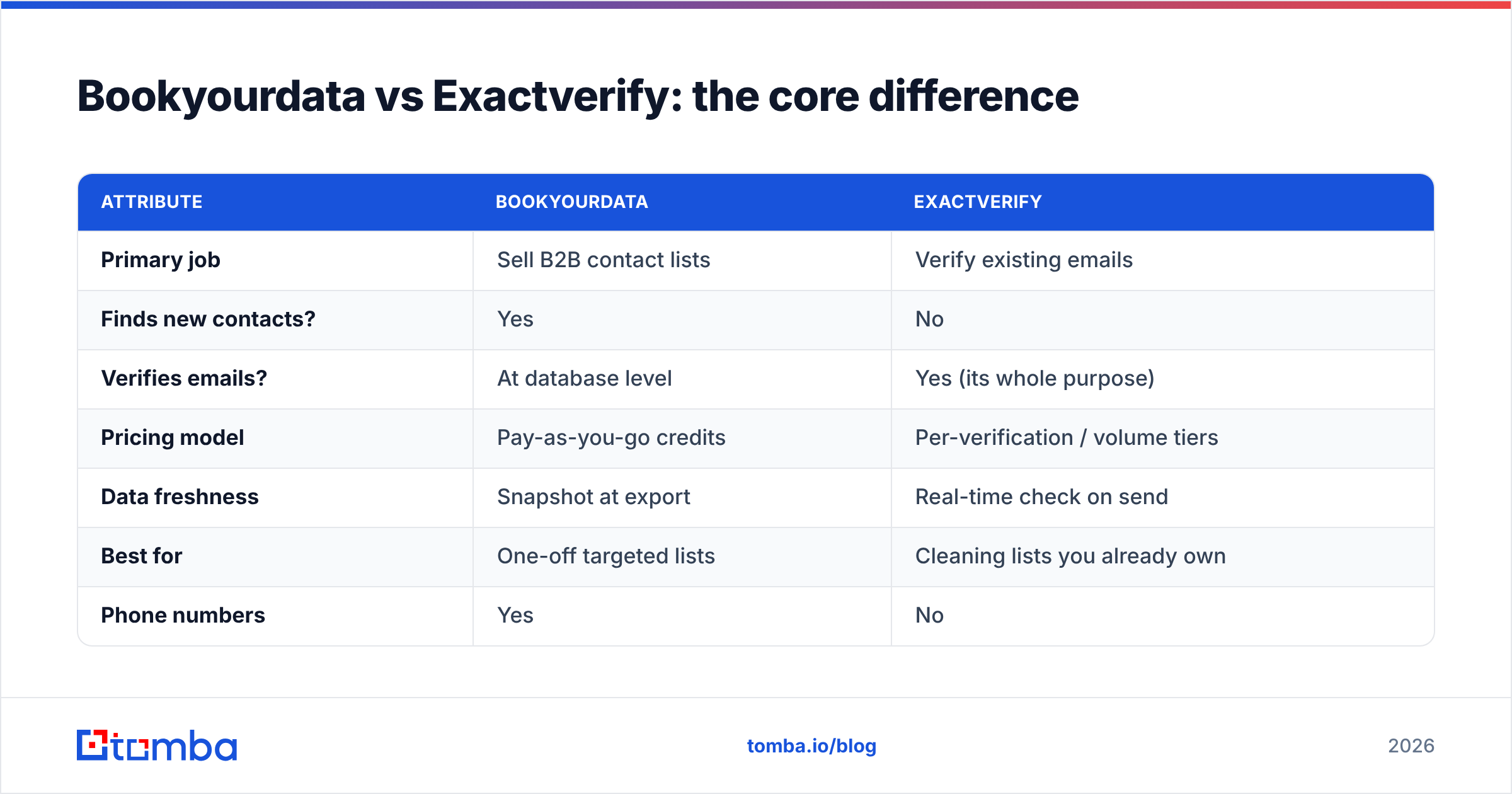
| Attribute | Bookyourdata | Exactverify |
|---|---|---|
| Primary job | Sell B2B contact lists | Verify existing emails |
| Finds new contacts? | Yes | No |
| Verifies emails? | At database level | Yes (its whole purpose) |
| Pricing model | Pay-as-you-go credits | Per-verification / volume tiers |
| Data freshness | Snapshot at export | Real-time check on send |
| Best for | One-off targeted lists | Cleaning lists you already own |
| Phone numbers | Yes | No |
| Catch-all handling | Limited | Yes |
| Ongoing prospecting | Weak | N/A (not a source) |
Read that table and the decision gets simpler. If you have no contacts, Exactverify cannot help you. If you have a pile of unverified addresses, Bookyourdata is the wrong tool. Most teams that ask "Bookyourdata vs Exactverify" actually need both functions — a source and a verifier — which is the real argument for a platform that does both in one pass.
How do they compare on accuracy?#
Accuracy is where the marketing language and the operational reality drift apart, so be precise about what each number means.
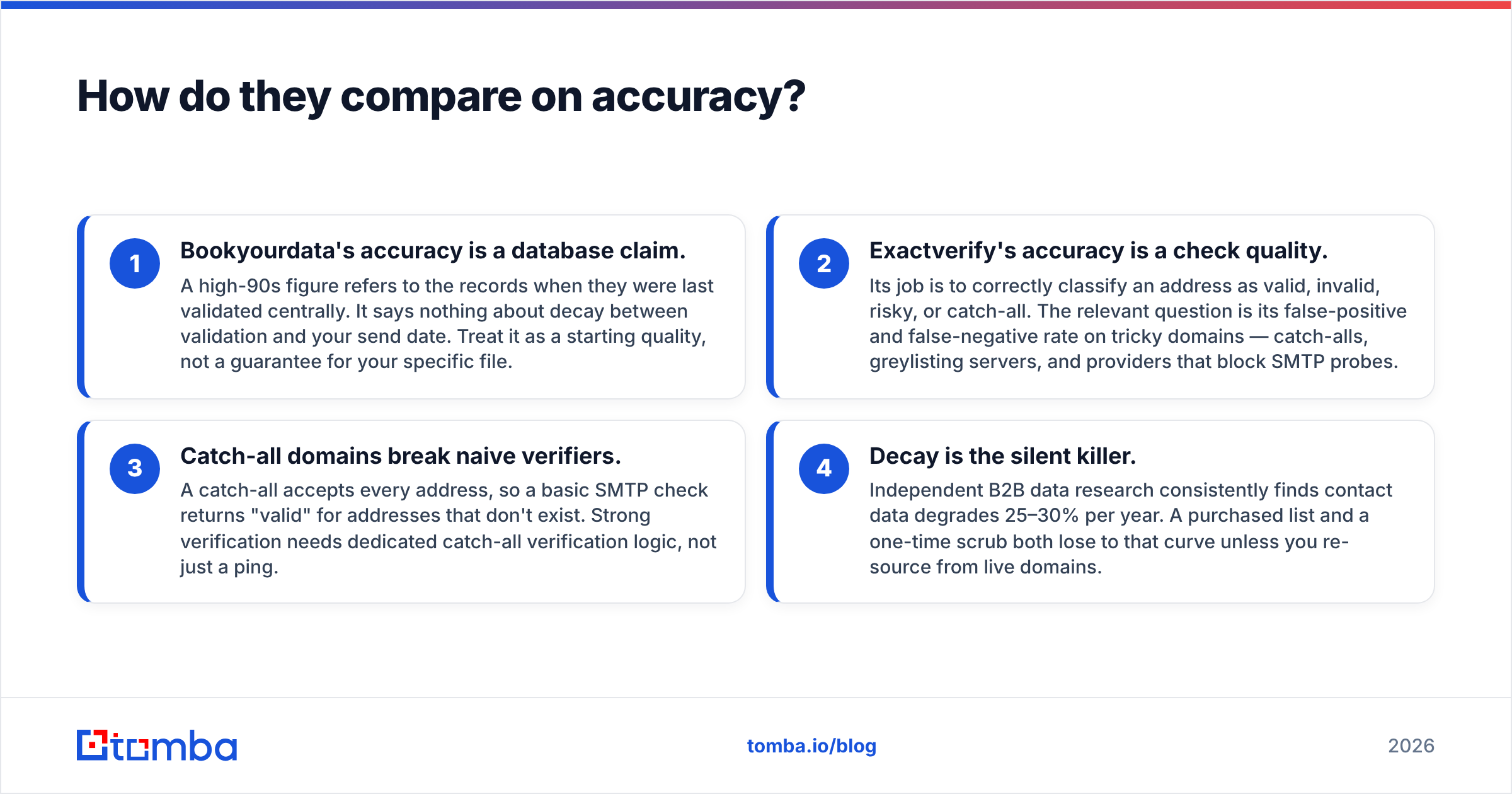
- Bookyourdata's accuracy is a database claim. A high-90s figure refers to the records when they were last validated centrally. It says nothing about decay between validation and your send date. Treat it as a starting quality, not a guarantee for your specific file.
- Exactverify's accuracy is a check quality. Its job is to correctly classify an address as valid, invalid, risky, or catch-all. The relevant question is its false-positive and false-negative rate on tricky domains — catch-alls, greylisting servers, and providers that block SMTP probes.
- Catch-all domains break naive verifiers. A catch-all accepts every address, so a basic SMTP check returns "valid" for addresses that don't exist. Strong verification needs dedicated catch-all verification logic, not just a ping.
- Decay is the silent killer. Independent B2B data research consistently finds contact data degrades 25–30% per year. A purchased list and a one-time scrub both lose to that curve unless you re-source from live domains.
The honest takeaway: neither tool alone keeps you accurate over time. A bought list ages; a single verification pass is a moment-in-time photo. Sustained accuracy comes from re-finding and re-verifying against current company domains — see how a finder sources and checks data on Tomba's data sources page.

How does pricing compare?#
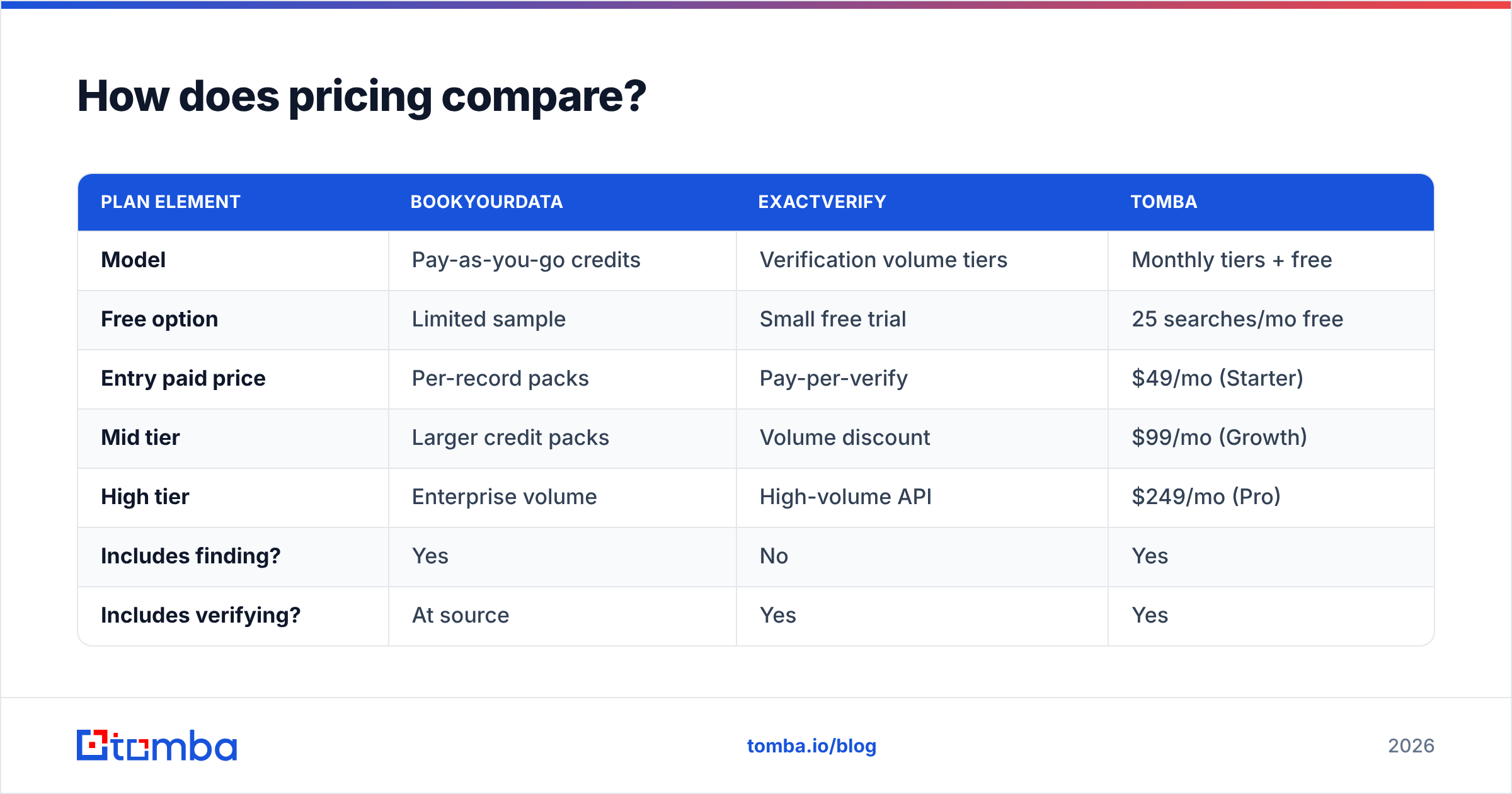
The two tools price for different jobs, so a head-to-head per-record number is slightly apples-to-oranges. Here is the shape of it, with Tomba added as the do-both reference point.
| Plan element | Bookyourdata | Exactverify | Tomba |
|---|---|---|---|
| Model | Pay-as-you-go credits | Verification volume tiers | Monthly tiers + free |
| Free option | Limited sample | Small free trial | 25 searches/mo free |
| Entry paid price | Per-record packs | Pay-per-verify | $49/mo (Starter) |
| Mid tier | Larger credit packs | Volume discount | $99/mo (Growth) |
| High tier | Enterprise volume | High-volume API | $249/mo (Pro) |
| Includes finding? | Yes | No | Yes |
| Includes verifying? | At source | Yes | Yes |
| Phone data | Yes (add-on) | No | Yes (phone finder) |
A few practical notes. Buying lists looks cheap per record until you factor in the share that bounces or has already churned — you pay for rows you can't use. Pure verification looks cheap until you realize it's an add-on cost on top of whatever you paid to get the emails. A combined platform folds both into one credit and adds a free tier to test the data first. Full numbers are on the Tomba pricing page.
Which tool should you choose?#
Match the tool to the job you actually have:
- Choose Bookyourdata if you need a one-off, highly targeted list right now, you want phone numbers bundled in, and you prefer paying per record with no subscription. Re-verify the export before you send.
- Choose Exactverify if you already have a meaningful list — inbound signups, an old CRM, a scraped file — and your only goal is to cut the bounce rate before a campaign. It will not build pipeline on its own.
- Choose a combined finder + verifier if you prospect continuously and need data that is fresh at the moment you use it, not at the moment a vendor last refreshed a database. This is where on-demand lookup beats both list-buying and standalone scrubbing.
If your honest answer is "I need to keep finding new, accurate contacts every week," neither a list vendor nor a verifier alone is the efficient choice. You'd be stitching two tools and two invoices together to reproduce one workflow.
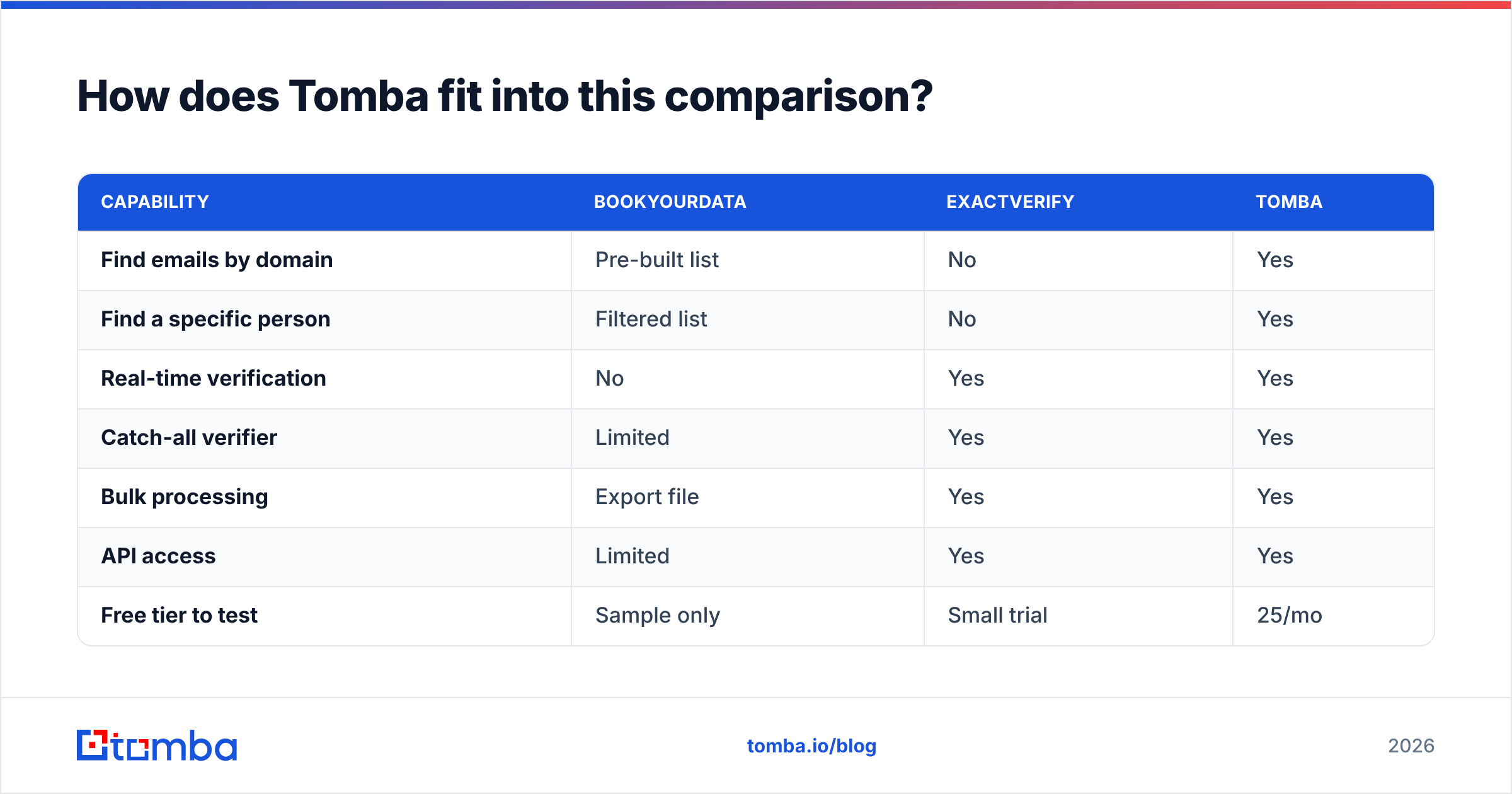
How does Tomba fit into this comparison?#
Tomba collapses the source-then-verify split into one motion. Instead of buying a static list or scrubbing an old one, you look up contacts against live company domains and verify them in the same step.
The practical workflow looks like this:
- Find — use domain search to pull every public email pattern for a target company, or the email finder to get a specific person's address by name and domain.
- Verify — every result runs through the email verifier, with catch-all logic for domains that accept everything.
- Scale — push the whole job through the bulk email finder or wire it into your stack with the Tomba API.
Because the data is sourced at lookup time, freshness isn't a snapshot you bought last quarter — it's current to the domain today. That is the structural advantage over both a list vendor (snapshot) and a standalone verifier (no source).
| Capability | Bookyourdata | Exactverify | Tomba |
|---|---|---|---|
| Find emails by domain | Pre-built list | No | Yes |
| Find a specific person | Filtered list | No | Yes |
| Real-time verification | No | Yes | Yes |
| Catch-all verifier | Limited | Yes | Yes |
| Bulk processing | Export file | Yes | Yes |
| API access | Limited | Yes | Yes |
| Free tier to test | Sample only | Small trial | 25/mo |
| One invoice for both jobs | No | No | Yes |
For deeper benchmarking of how finders stack up on accuracy and price, this comparison view is useful:

What do the experts say about list quality?#
The wider industry consensus reinforces the same point. Analyst coverage of B2B data — for example Gartner's market guides on sales and marketing data providers — repeatedly stresses that data quality is a process, not a one-time purchase, and that decay management matters more than headline accuracy claims. Peer-review sites like G2 show the same theme in user feedback: buyers love a clean list on day one and complain about bounces a few months later.
Email service providers agree on the downstream stakes. HubSpot's deliverability guidance and major inbox providers all tie list hygiene directly to inbox placement — send to dead addresses and your domain reputation falls, which hurts even your good contacts. That is why verification is not optional regardless of where the emails came from, and why a source that verifies inline removes a whole failure mode.
Common mistakes to avoid#
- Skipping re-verification on a "guaranteed" list. A bounce guarantee is a refund mechanism, not a deliverability guarantee. Re-verify before send.
- Treating verification as a source. Exactverify and tools like it clean what you have; they never create pipeline. Budget for finding separately.
- Ignoring catch-all domains. Many corporate domains accept everything. Without a real catch-all check, your "verified" list quietly includes addresses that don't exist.
- Paying per record for data that's already churned. With B2B data decaying ~2–3% monthly, the cheapest per-row list can be the most expensive per usable row.
- Running two tools when one does the job. If you find and verify constantly, a combined platform is cheaper and faster than a list vendor plus a verifier.
The bottom line#
Bookyourdata and Exactverify aren't really rivals — they're two stages of one pipeline. Bookyourdata gets you contacts; Exactverify checks them. If you only ever need one static list, buy it and scrub it. But if your team prospects on an ongoing basis, you'll keep paying both tools to reassemble a workflow a single platform already handles.
For continuous, fresh, verified B2B contacts, start with the Tomba Email Finder. Source emails against live company domains, verify them — catch-alls included — in the same step, and process the whole list in bulk or via API. The free tier gives you 25 searches a month to test the data against your own targets before you commit, so you can compare accuracy on contacts you actually care about instead of trusting a vendor's headline number. Find fresh, verify inline, and stop paying twice for one job.
// get started
Find, verify and enrich your first contacts today
Start on the free plan with 25 searches a month, then scale when your team is ready.
Free plan · No credit card required · GDPR & CCPA
// about the author