BookYourData vs Forager 2026: B2B Data Tools Compared
BookYourData sells pay-as-you-go contact lists; Forager pushes real-time people data. We compare accuracy, pricing, and verification to see which fits your 2026 pipeline.
You are choosing between two very different ways to buy B2B contact data, and the wrong pick burns budget on bounced emails and dead phone numbers. BookYourData sells pay-as-you-go email lists from a fixed database. Forager positions itself around real-time, freshly scraped people and company data. They solve overlapping problems with opposite philosophies — and neither is automatically right for your team.
This breakdown compares both on accuracy, pricing, coverage, verification, and workflow fit, then shows where a verification-first tool like Tomba Email Finder changes the math.
TL;DR#
- BookYourData is best when you want to buy a one-off, filtered list of contacts and own the CSV outright with a pay-as-you-go credit model.
- Forager is best when you value data freshness and real-time enrichment over a static download, and you're comfortable with a more developer-leaning workflow.
- Accuracy is the real battleground. Both claim high deliverability, but a purchased list decays ~2–3% per month regardless of vendor — verification at send time matters more than the headline number.
- Pricing models differ sharply: BookYourData charges per record you export; Forager leans toward subscription/API access. Cost-per-usable-contact is what you should actually compare.
- The smarter play for most outbound teams is finding and verifying emails on demand rather than buying bulk lists — that's where Tomba's email verifier and on-demand finder fit.
What is BookYourData?#
BookYourData is a B2B contact database you buy from directly. You filter by job title, industry, location, company size, and technology, then pay only for the records you export — a pay-as-you-go model rather than a forced monthly subscription. The pitch is a 97%+ deliverability guarantee on exported emails and instant CSV download.
It's a "self-serve list builder." You define your audience, see a count, buy the credits, and walk away with a spreadsheet you own permanently. That ownership and the no-subscription option are the two things customers consistently like.
The trade-off: a list is a snapshot. The moment you export, the data starts aging. People change jobs, companies get acquired, and inboxes go dark. A static CSV has no way to know that next month.
What is Forager?#
Forager (forager.ai) focuses on real-time B2B data — people and company profiles enriched closer to the moment you query, rather than served from a months-old warehouse. It targets teams that care about freshness: knowing someone's current role, not the title they held two quarters ago.
Forager's angle is enrichment and API-first access, which appeals to RevOps and growth engineers wiring data into their own systems. Instead of "download a list," the mental model is "pull current data into my workflow when I need it."
The cost of that freshness is usually a steeper learning curve and a pricing structure built around access rather than simple per-record exports. For a non-technical SDR who just wants 500 contacts today, that can feel heavier than necessary.
BookYourData vs Forager: how do they compare?#
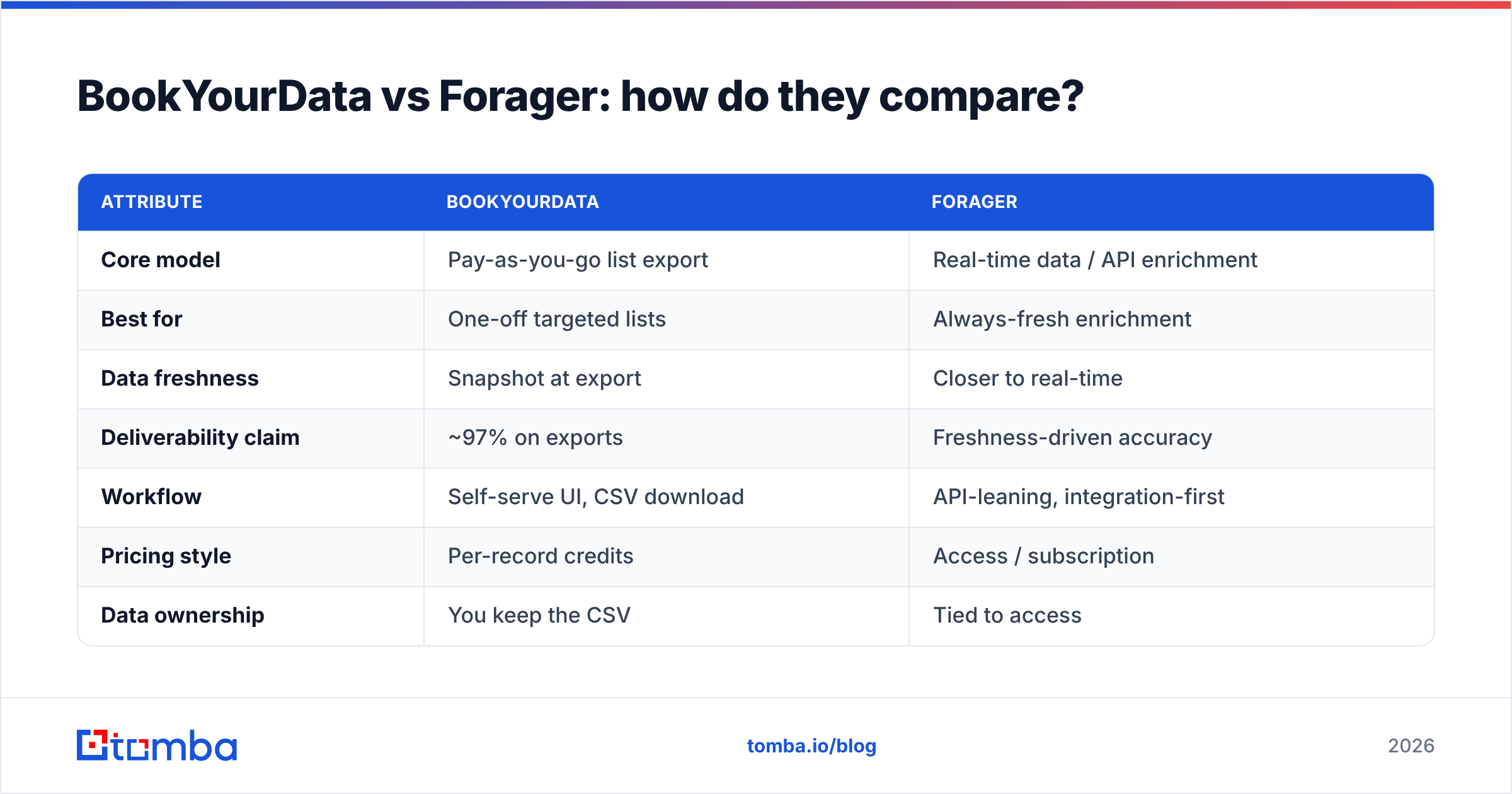
Here's the head-to-head on the attributes that actually drive ROI in outbound.
| Attribute | BookYourData | Forager |
|---|---|---|
| Core model | Pay-as-you-go list export | Real-time data / API enrichment |
| Best for | One-off targeted lists | Always-fresh enrichment |
| Data freshness | Snapshot at export | Closer to real-time |
| Deliverability claim | ~97% on exports | Freshness-driven accuracy |
| Workflow | Self-serve UI, CSV download | API-leaning, integration-first |
| Pricing style | Per-record credits | Access / subscription |
| Data ownership | You keep the CSV | Tied to access |
| Learning curve | Low | Medium–high |
| Verification | Pre-export cleaning | Real-time sourcing |
The pattern is clear: BookYourData optimizes for simplicity and ownership, Forager optimizes for freshness and integration. Your choice should follow your workflow, not the marketing.
Which is more accurate?#
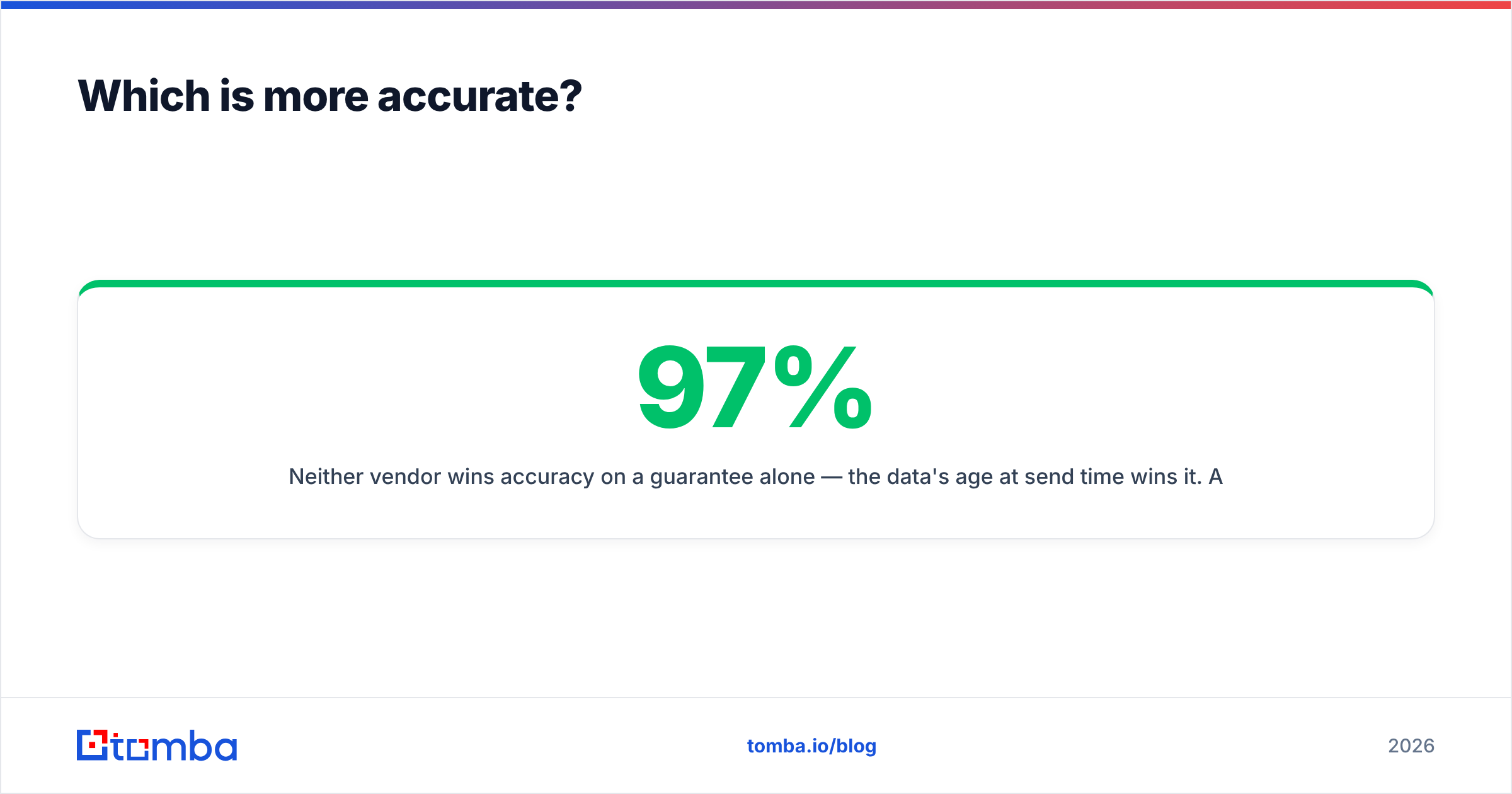
Neither vendor wins accuracy on a guarantee alone — the data's age at send time wins it. A 97% deliverability claim describes the list the day it was built. Email lists decay at roughly 2–3% per month as people switch jobs, so a "97% clean" list bought in January can be 88–90% by April.

This is why Forager's freshness angle is genuinely valuable — and also why even fresh data needs a verification step before you press send. Real-time sourcing reduces decay, but it doesn't catch every catch-all domain, role-based alias, or temporarily-down server.
The discipline that actually protects your sender reputation: verify every address right before the campaign, regardless of source. Run any list — BookYourData export, Forager pull, or a manually built one — through a verifier and a catch-all verifier so you're not gambling your domain on stale records. According to G2, verification is the single most cited factor separating high-deliverability senders from blocklisted ones.
How does pricing compare?#
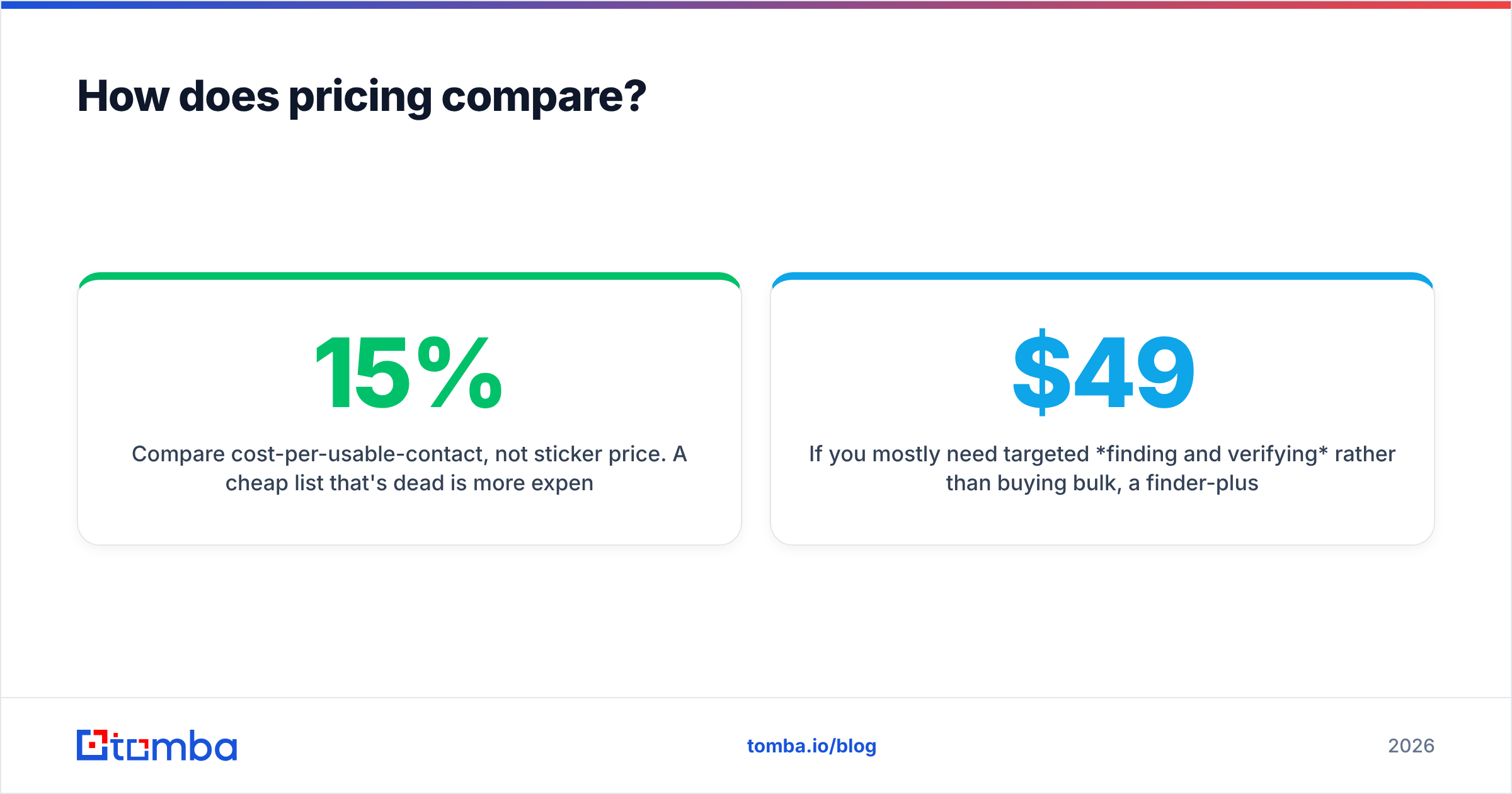
Compare cost-per-usable-contact, not sticker price. A cheap list that's 15% dead is more expensive than a pricier list that's 98% live, once you factor in wasted send volume and reputation damage.
- BookYourData — Pay-as-you-go credits. You buy what you export, no recurring commitment. Predictable for one-off campaigns; can get expensive at scale because every record costs again.
- Forager — Access/subscription oriented. Better unit economics if you query continuously and integrate via API; overkill if you just need an occasional list.
- The hidden cost — Bounces. Every undeliverable email eats sending reputation and can push good messages to spam. That cost doesn't show up on either invoice.
If you mostly need targeted finding and verifying rather than buying bulk, a finder-plus-verifier subscription is usually cheaper per usable contact. For reference, Tomba pricing runs a Free tier (25 searches/mo), Starter at $49/mo, Growth at $99/mo, and Pro at $249/mo — credits cover both finding and verifying, so you're not paying twice.
When should you choose each tool?#
Match the tool to the job:
- Choose BookYourData if you want to own a downloadable CSV, you run occasional campaigns, and a no-subscription pay-as-you-go model fits your budget rhythm. It's the lowest-friction way to get a filtered list today.
- Choose Forager if data freshness is non-negotiable, you have the technical resources to integrate an API, and you're enriching continuously rather than buying one-off batches.
- Choose an on-demand finder + verifier (like Tomba) if your real need is "get me the verified email for this specific person or company," not "sell me a bulk list." This is the most common outbound reality and where pre-bought lists overserve.
Most teams overestimate how much bulk data they need. You rarely need 10,000 contacts; you need the right 300, current and verified. A domain search plus targeted finding usually beats a giant purchased file on response rate.
How does Tomba fit into this comparison?#
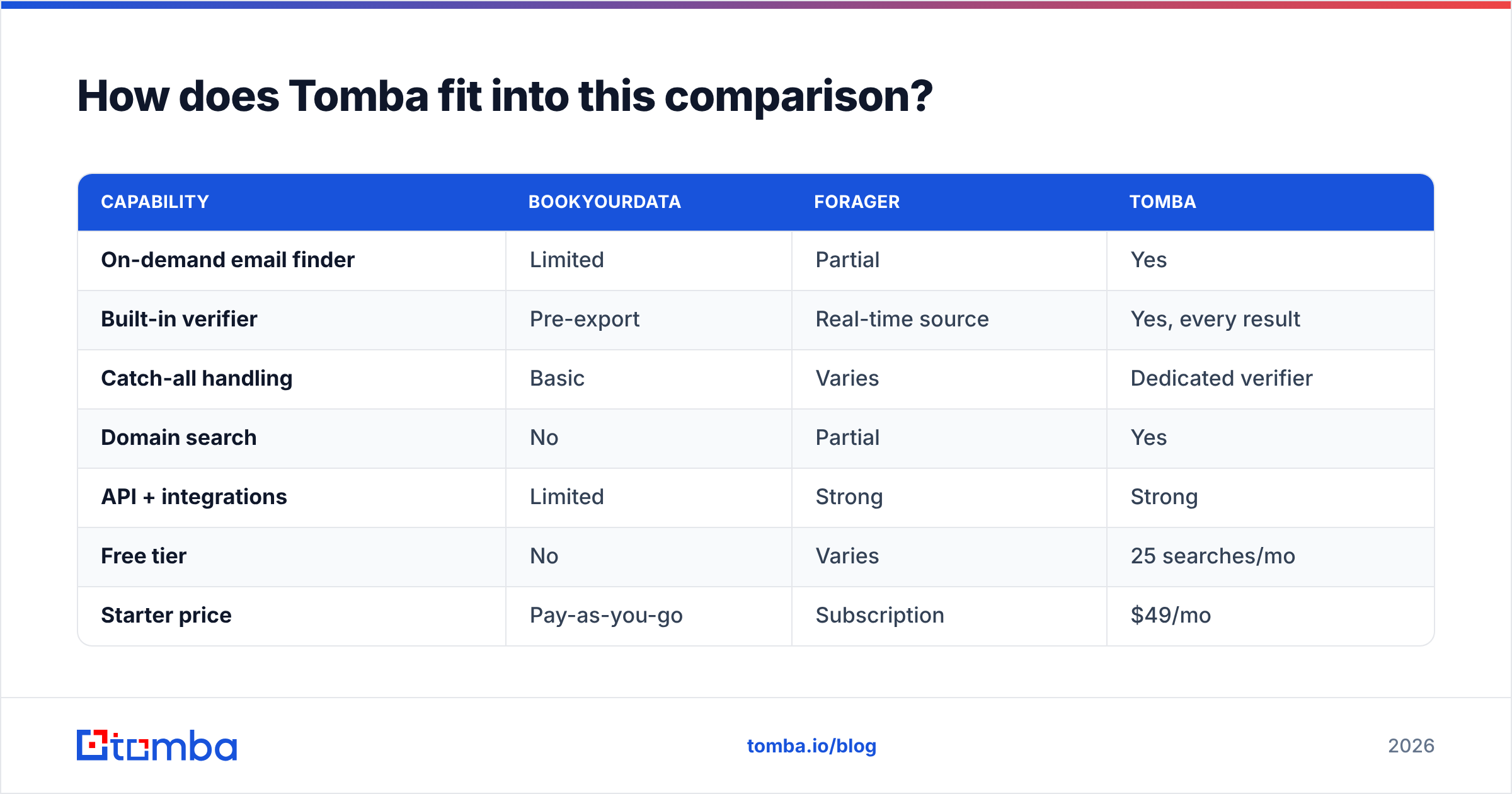
Tomba sits in a different lane than both: it's a verification-first email finder, not a list reseller. Instead of selling you a snapshot, it finds the address you need and verifies it at the moment you query — which sidesteps the decay problem that haunts purchased lists.

| Capability | BookYourData | Forager | Tomba |
|---|---|---|---|
| On-demand email finder | Limited | Partial | Yes |
| Built-in verifier | Pre-export | Real-time source | Yes, every result |
| Catch-all handling | Basic | Varies | Dedicated verifier |
| Domain search | No | Partial | Yes |
| API + integrations | Limited | Strong | Strong |
| Free tier | No | Varies | 25 searches/mo |
| Starter price | Pay-as-you-go | Subscription | $49/mo |
The practical workflow many teams land on: use Tomba's domain search to map a target company's email pattern, find the specific decision-makers, and confirm each address before it ever enters a sequence. You get the freshness benefit Forager promotes and the simplicity BookYourData promotes, without buying data you can't trust by next quarter. Tomba's data sources are public-web signals re-verified at query time, not a one-time scrape.
If you do buy a list from either vendor, the smartest insurance is to push it through Tomba's verifier before launch — treat any purchased data as "unverified until proven otherwise." Reference HubSpot's guidance on list hygiene: clean before you send, every time.
Is buying lists still worth it in 2026?#
For most outbound teams, on-demand finding plus verification beats buying static lists. Lists still make sense for genuinely one-off, broad campaigns where you accept some decay. But the default has shifted: deliverability scrutiny from Google and Microsoft is harsher, and a stale list now does measurable damage to sender reputation faster than it did three years ago.
BookYourData and Forager both have legitimate niches — BookYourData for simple owned exports, Forager for fresh API-driven enrichment. Just go in knowing that whichever you pick, verification is not optional, and the headline accuracy number is a starting point, not a guarantee.
Final verdict#
Pick BookYourData for low-friction, pay-as-you-go list ownership. Pick Forager for real-time, integration-heavy enrichment. But if your actual job is reaching specific, verified people without betting your domain on aging data, skip the list-reseller model entirely.
Tomba Email Finder finds professional email addresses by domain, name, or company and verifies each one as you go — so you spend credits on contacts that actually land, not on bounces. Start free with 25 searches a month, scale to Starter at $49/mo when outbound ramps, and keep your sender reputation clean while BookYourData and Forager users are still cleaning their CSVs. Try the email finder and build a list you can trust on the first send.
// get started
Find, verify and enrich your first contacts today
Start on the free plan with 25 searches a month, then scale when your team is ready.
Free plan · No credit card required · GDPR & CCPA
// about the author