BookYourData vs Gazelle: B2B Data Tools Compared (2026)
BookYourData sells pay-as-you-go email lists; Gazelle pushes account intelligence. See which B2B data tool fits your pipeline in 2026 — and where a live email finder beats both.
Choosing between BookYourData and Gazelle comes down to one question: do you want a pre-built list dumped into a CSV, or do you want live, verified contact data you can pull on demand? Both promise B2B contacts. They get you there in very different ways — and both leave a gap that a real-time email finder fills better than either.
TL;DR — BookYourData vs Gazelle at a glance#
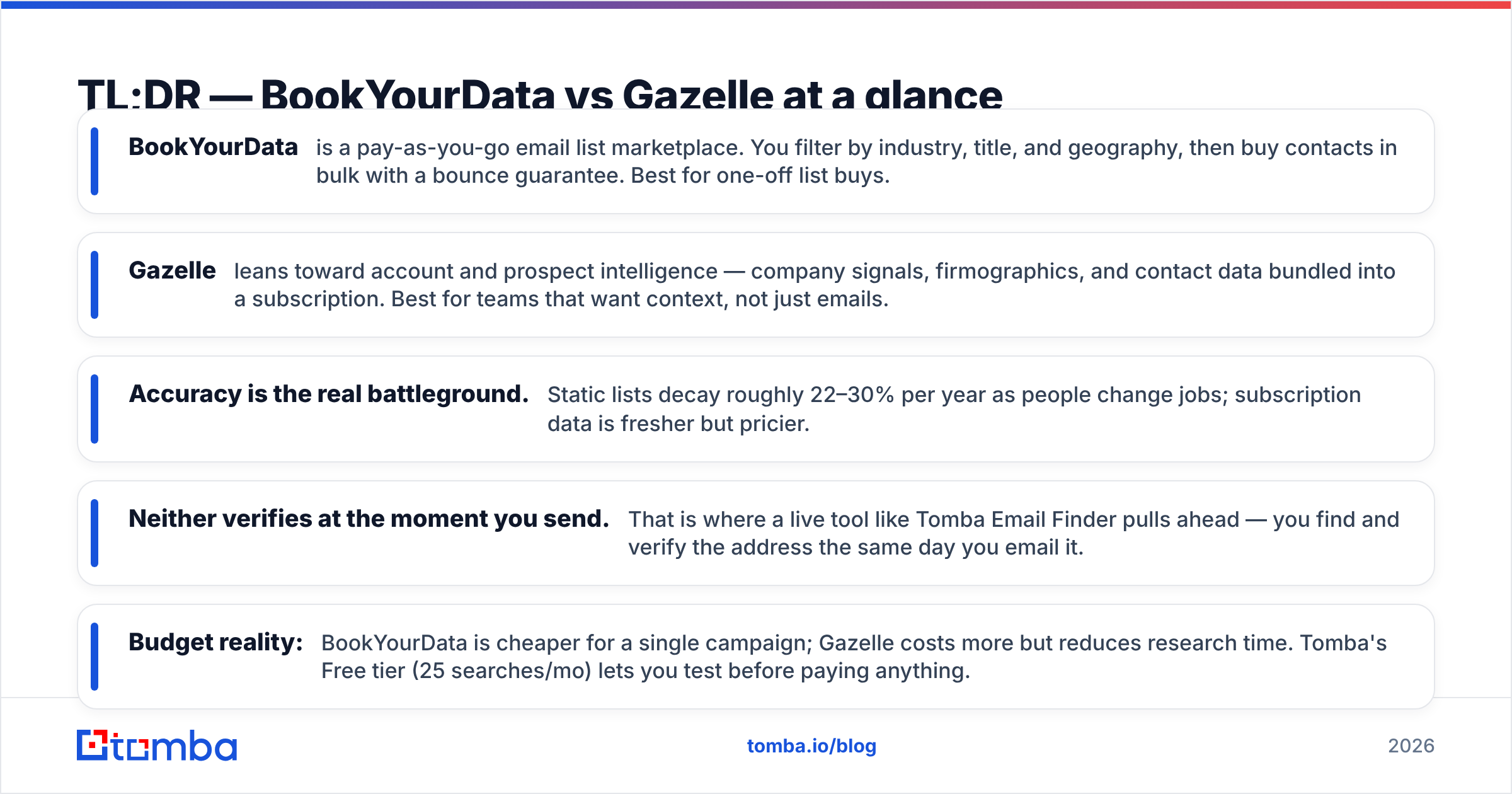
- BookYourData is a pay-as-you-go email list marketplace. You filter by industry, title, and geography, then buy contacts in bulk with a bounce guarantee. Best for one-off list buys.
- Gazelle leans toward account and prospect intelligence — company signals, firmographics, and contact data bundled into a subscription. Best for teams that want context, not just emails.
- Accuracy is the real battleground. Static lists decay roughly 22–30% per year as people change jobs; subscription data is fresher but pricier.
- Neither verifies at the moment you send. That is where a live tool like Tomba Email Finder pulls ahead — you find and verify the address the same day you email it.
- Budget reality: BookYourData is cheaper for a single campaign; Gazelle costs more but reduces research time. Tomba's Free tier (25 searches/mo) lets you test before paying anything.
What is BookYourData?#
BookYourData is a self-service B2B email list platform. You open the builder, apply filters — industry, job title, company size, location, technology used — and the tool shows you a count of matching contacts. You pay per record, download a CSV, and you are done. No subscription required.
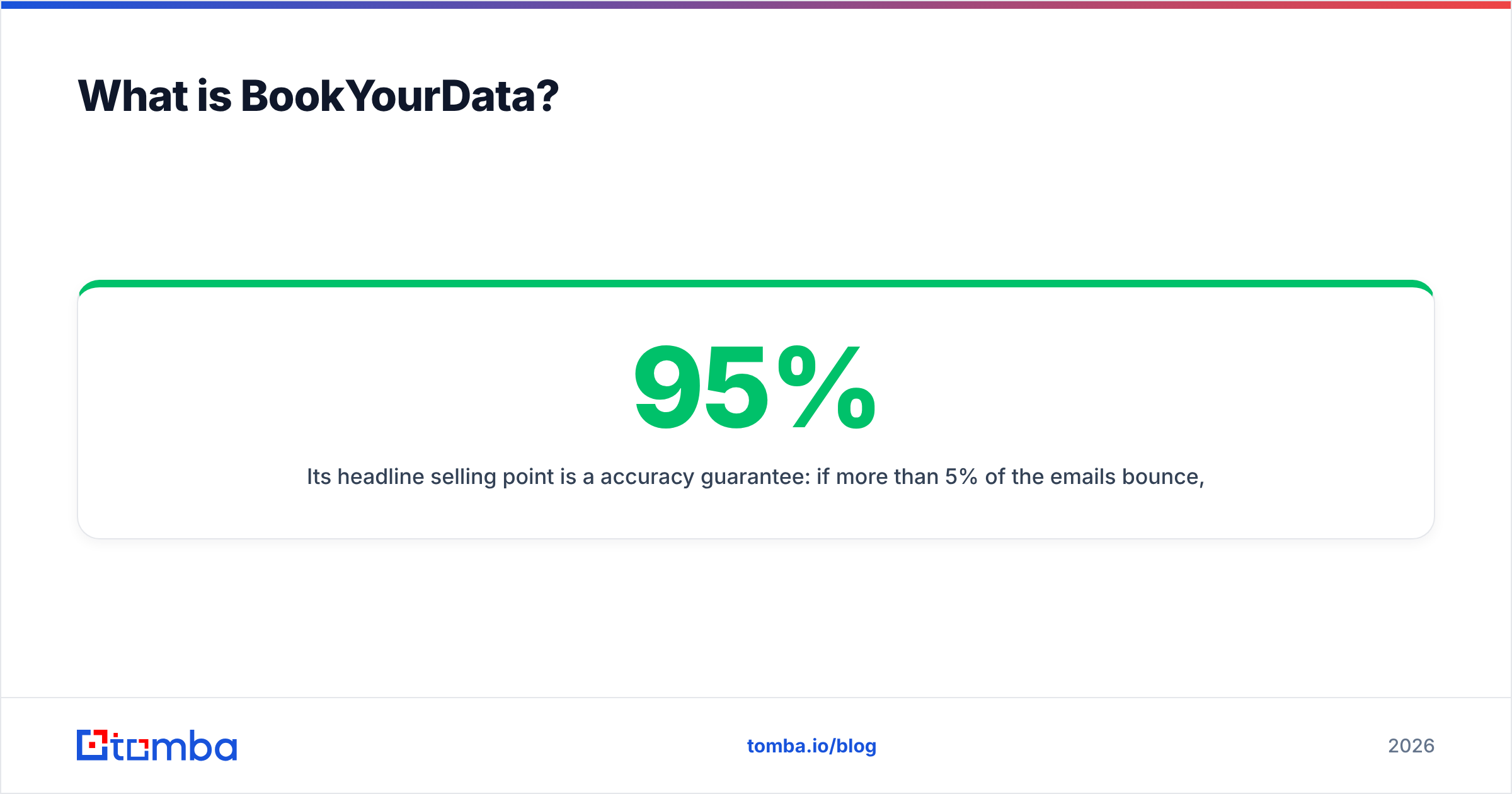
Its headline selling point is a 95% accuracy guarantee: if more than 5% of the emails bounce, you get credits back. That guarantee is real, but read it carefully. It covers hard bounces at the moment of delivery, not whether the person still works there or whether the role still exists. A list that is 95% deliverable can still be 30% out of date on job titles.
BookYourData works well when you need a chunk of contacts fast for a single outbound push and you do not want a recurring bill. It struggles when you need ongoing freshness, because the moment you download the file, decay starts.
What is Gazelle?#
Gazelle positions itself closer to a sales-intelligence layer than a list shop. Instead of selling you a flat export, it bundles firmographic data, company signals, and contact records into a subscription, often with a UI for building target-account lists and tracking changes over time.
The pitch is context. Rather than "here are 5,000 emails," Gazelle wants to tell you which accounts are worth chasing, who the decision-makers are, and what changed recently. For account-based teams that prioritize fit over volume, that framing is useful.
The trade-off is cost and commitment. Subscriptions lock you into a monthly or annual spend whether or not you run a campaign that month, and the per-contact economics rarely beat a pay-as-you-go buy if your usage is bursty.
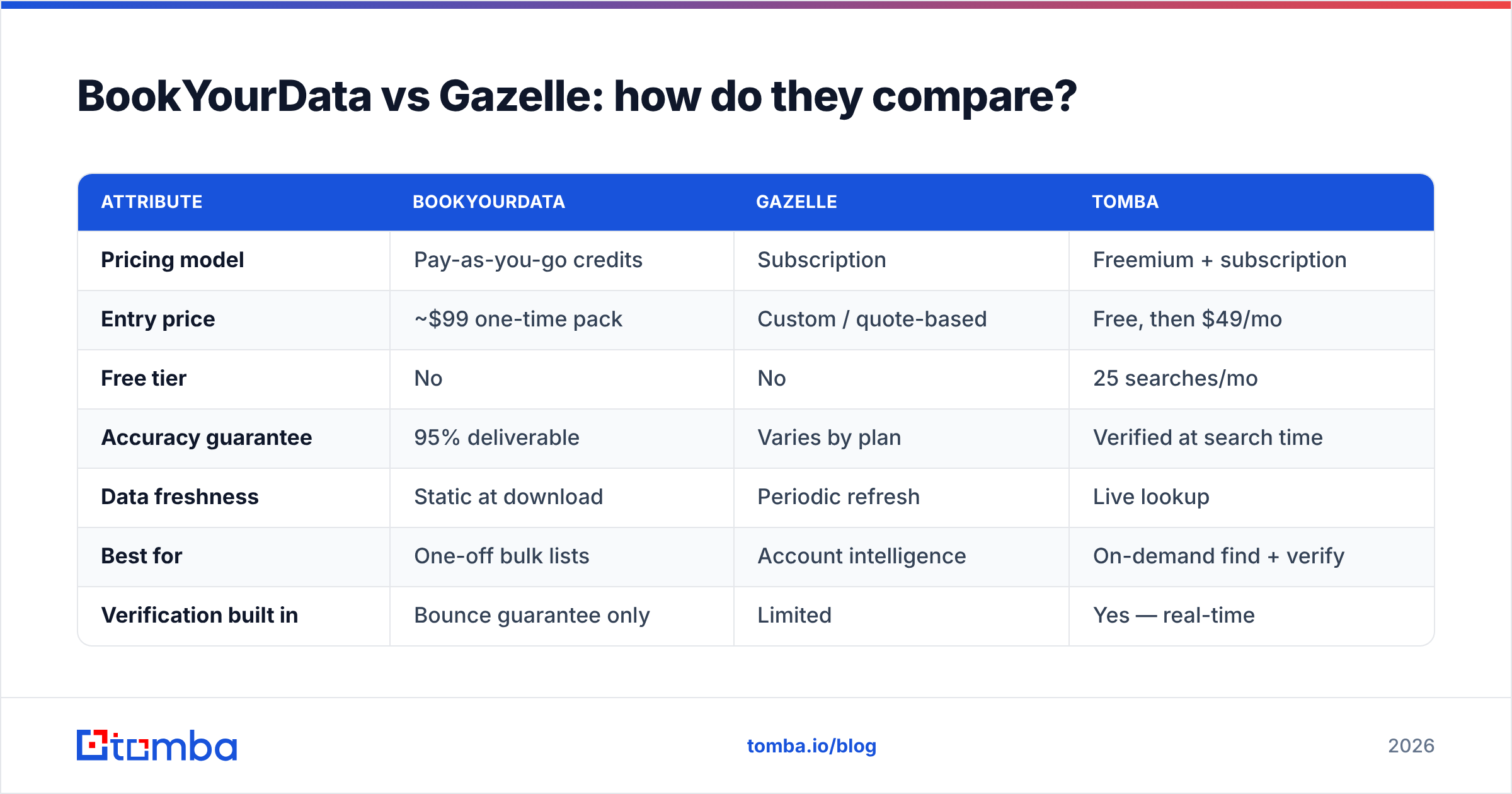
BookYourData vs Gazelle: how do they compare?#
Here is the side-by-side. Treat the numbers as representative of each model rather than a fixed price sheet — both vendors change packaging frequently.
| Attribute | BookYourData | Gazelle | Tomba |
|---|---|---|---|
| Pricing model | Pay-as-you-go credits | Subscription | Freemium + subscription |
| Entry price | ~$99 one-time pack | Custom / quote-based | Free, then $49/mo |
| Free tier | No | No | 25 searches/mo |
| Accuracy guarantee | 95% deliverable | Varies by plan | Verified at search time |
| Data freshness | Static at download | Periodic refresh | Live lookup |
| Best for | One-off bulk lists | Account intelligence | On-demand find + verify |
| Verification built in | Bounce guarantee only | Limited | Yes — real-time |
| API access | Limited | Yes | Full REST API |
The pattern is clear. BookYourData wins on simplicity and one-time cost. Gazelle wins on context and ongoing account tracking. But both share a structural weakness: the data is only as good as its last refresh, and you are trusting that refresh blindly.
Which one has more accurate data?#
Short answer: neither model guarantees the accuracy you actually need, because both decouple finding the contact from verifying it at the moment you reach out.
B2B data decays fast. Industry benchmarks from sources like Gartner and vendor studies put contact-data decay at roughly 22–30% per year — people switch jobs, companies rebrand, domains change. A list that was 95% accurate in January is materially worse by June. BookYourData's guarantee protects you against hard bounces on day one, not against a prospect who left the company in March.
Gazelle's periodic refresh helps, but "periodic" is doing heavy lifting. If the refresh cycle is quarterly and you pull a contact mid-cycle, you can still be working from stale records.
This is exactly why a live email verifier matters. Verifying at send time — checking the MX record, SMTP response, and catch-all status the same hour you email — catches the decay that a static export cannot. If you care about deliverability, pair any list source with real-time verification or skip the static list entirely.

How does pricing really work out?#
The honest answer depends on your usage shape, not the sticker price.
- Bursty, one campaign a quarter — BookYourData wins. You buy a pack, run the campaign, and pay nothing until next quarter. A subscription would sit idle.
- Steady, account-based motion — Gazelle's subscription amortizes better, because you are pulling and tracking accounts continuously.
- Researcher-on-demand, find one contact at a time — neither model fits cleanly. You do not want to buy a 5,000-record pack to email 40 founders, and you do not want a heavy subscription for occasional lookups.
- Hybrid teams — most real teams need a bit of all three, which is why a freemium tool with a free tier and a clean upgrade path tends to be the cheapest place to start.
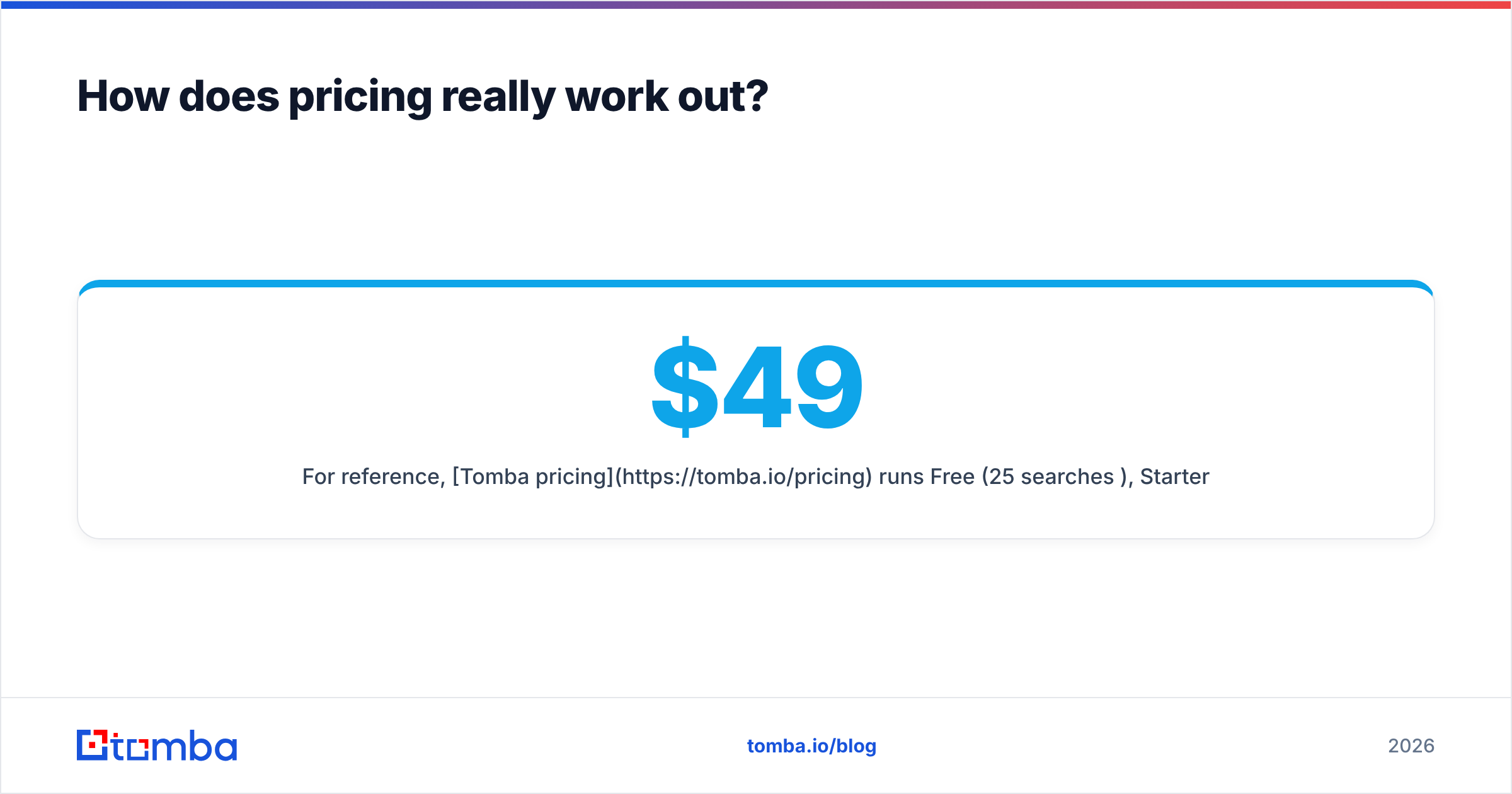
For reference, Tomba pricing runs Free (25 searches/mo), Starter at $49/mo, Growth at $99/mo, and Pro at $249/mo, with bulk and API usage included as you scale. The free tier alone covers most "I just need to validate this approach" moments without a purchase order.
When should you use a list provider vs a live email finder?#
Use a list provider (BookYourData or Gazelle) when:
- You need volume now and accept some decay as the cost of speed.
- You are seeding a brand-new territory and want raw coverage to segment later.
- Your compliance and suppression processes are strong enough to scrub a cold list.
Use a live email finder when:
- You are targeting specific named accounts and people, not a broad segment.
- Deliverability and sender reputation matter — you cannot afford a 15% bounce spike that gets your domain flagged.
- You want the contact and the verification in one step, the day you send.
The two approaches are not mutually exclusive. A common, effective pattern: use a list for top-of-funnel coverage, then re-find and re-verify the high-value accounts with a live tool right before outreach. The list gives you breadth; the finder gives you confidence on the records that matter.
For teams working account-by-account, a domain search plus the email finder is usually faster and cheaper than buying a whole list you will mostly discard. You feed a company domain, get the verified contacts that match your target roles, and move on — no minimum purchase, no idle subscription.
How do BookYourData and Gazelle handle verification and deliverability?#
This is where the static-list model shows its age. BookYourData's bounce guarantee is a financial backstop, not a deliverability strategy. Getting credits back after a campaign tanks your domain reputation does not un-tank your reputation. Once mailbox providers see a spike in invalid sends, your inbox placement suffers for weeks.
Gazelle's subscription refresh narrows the window but does not close it. Neither tool checks the address at the moment you press send.
A live workflow flips the order. You find the email, verify it against the mail server in real time, flag catch-all domains separately, and only then load it into your sequence. That single change — verify-then-send instead of buy-then-hope — is the biggest lever on cold-email deliverability that most teams ignore. Catch-all domains in particular need their own handling; a dedicated catch-all verifier tells you whether an accept-all server will actually deliver before you risk it.
If you want to compare the broader category — finders, verifiers, and list tools side by side — the accuracy benchmarks below put the trade-offs in one frame.

What about coverage, geography, and compliance?#
BookYourData's strength is filterable breadth — large industry and geographic coverage you can slice with many filters. Gazelle's strength is depth on the accounts it tracks, with richer firmographic and signal data per company.
On compliance, both put the burden on you. A purchased list is not automatically GDPR- or CAN-SPAM-compliant just because you paid for it; you are responsible for lawful basis, suppression lists, and honoring opt-outs. Vendor guidance on this is thin, and reputable sources like HubSpot's deliverability documentation consistently warn that bought lists carry the highest spam-complaint risk of any acquisition channel.
A find-and-verify model reduces, though never eliminates, that risk: you are pulling specific business contacts for a specific, documented purpose rather than blasting a broad purchased file. It is a more defensible posture, and it keeps your sending volume tied to genuine, targeted intent.
Is there a better alternative to both?#
For most B2B teams in 2026, the answer is a live email finder rather than either static model — especially if your motion is targeted rather than spray-and-pray.
The decision tree is simple:
- Need broad coverage, accept decay, one-time spend? BookYourData.
- Need account intelligence and ongoing tracking, have budget? Gazelle.
- Need verified contacts on demand, account by account, without a list minimum? A live finder.
The third option is where the market has been moving, because it collapses three steps — find, verify, enrich — into one workflow and ties cost to actual usage. You stop paying for records you never email, and you stop emailing records that no longer exist.
The bottom line#
BookYourData and Gazelle are both legitimate tools that solve real problems — bulk coverage and account intelligence, respectively. But both inherit the core flaw of any static data product: the moment the data leaves the vendor, it starts going stale, and neither verifies the address the day you actually send.
If your outbound depends on hitting the inbox, start with a tool that finds and verifies in the same motion. Tomba Email Finder lets you pull professional, verified email addresses by name, company, or domain — with real-time verification, a full API, and a free tier so you can test it against your own target accounts before spending a cent. Find the contact, confirm it is live, and send with confidence. Start free, then scale on a plan that matches how you actually prospect.
// get started
Find, verify and enrich your first contacts today
Start on the free plan with 25 searches a month, then scale when your team is ready.
Free plan · No credit card required · GDPR & CCPA
// about the author