Bookyourdata vs Grata: Which B2B Data Tool Wins in 2026?
Bookyourdata sells pay-as-you-go contact lists; Grata maps private companies for dealmakers. Here's which B2B data tool fits your team in 2026 — and where a verified email finder beats both.
Bookyourdata and Grata both call themselves "B2B data" platforms, but they solve almost opposite problems. Picking the wrong one wastes a quarter of budget and leaves your reps staring at a list they can't use.
TL;DR — Bookyourdata vs Grata in 2026#
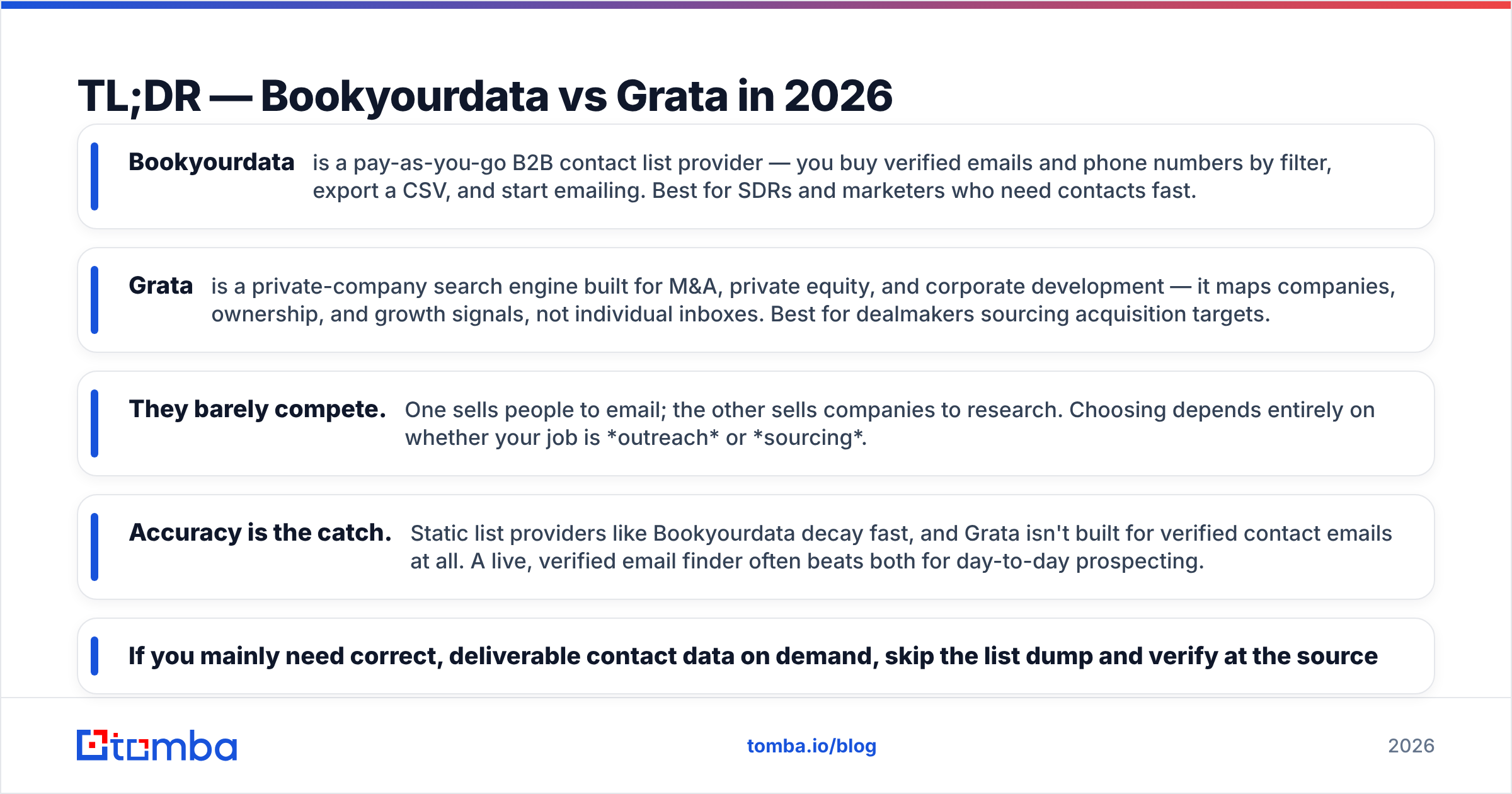
- Bookyourdata is a pay-as-you-go B2B contact list provider — you buy verified emails and phone numbers by filter, export a CSV, and start emailing. Best for SDRs and marketers who need contacts fast.
- Grata is a private-company search engine built for M&A, private equity, and corporate development — it maps companies, ownership, and growth signals, not individual inboxes. Best for dealmakers sourcing acquisition targets.
- They barely compete. One sells people to email; the other sells companies to research. Choosing depends entirely on whether your job is outreach or sourcing.
- Accuracy is the catch. Static list providers like Bookyourdata decay fast, and Grata isn't built for verified contact emails at all. A live, verified email finder often beats both for day-to-day prospecting.
- If you mainly need correct, deliverable contact data on demand, skip the list dump and verify at the source.
What is Bookyourdata?#
Bookyourdata is a self-service B2B contact database. You log in, apply filters (industry, job title, location, company size, technology used), and the platform shows a count of matching contacts. You pay per credit — one credit roughly equals one revealed contact record — and export the result as a CSV or push it to your CRM.
The pitch is speed and a "95% accuracy guarantee": if an email bounces, you get the credit back. Records typically include a work email, direct or company phone, job title, company name, and LinkedIn URL. There's no long contract; you can buy a small credit pack and go.
That model works well when you need a list today and don't want to negotiate an annual seat. It's closer to ZoomInfo's data without the enterprise price tag, sold by the record instead of the seat.
The weakness is structural. A purchased list is a snapshot. The moment you export, people start changing jobs — B2B data decays at roughly 2–3% per month, so a list is meaningfully stale within a quarter. The bounce-back credit helps, but it doesn't fix a campaign that already burned sender reputation on dead addresses.

What is Grata?#
Grata is a deal-sourcing and company-intelligence platform aimed at private equity, M&A advisors, investment banks, and corporate development teams. Its core job is to find and map private companies — the millions of small and mid-market businesses that don't show up cleanly in traditional databases.
Instead of "give me 5,000 marketing managers," Grata answers "show me every founder-owned industrial automation company in the Midwest doing $10M–$50M in revenue that looks like an acquisition target." It uses search across company websites, ownership signals, headcount growth, funding, and similar-company recommendations to build a target list of businesses, not individual leads.
Grata does surface some contact information for executives, but that's a supporting feature, not the product. You don't buy Grata to launch a cold-email campaign to 10,000 SDryers — you buy it to build a curated pipeline of 50 acquisition or partnership targets and research them deeply.
Pricing is quote-based and lands in the enterprise range — typically annual contracts in the low-to-mid five figures. That's normal for the dealmaking audience but absurd for a two-person sales team that just needs emails.
Bookyourdata vs Grata: how do they actually compare?#
The honest summary: these tools sit on opposite ends of the B2B data spectrum. One optimizes for volume of contactable people, the other for depth of company intelligence.
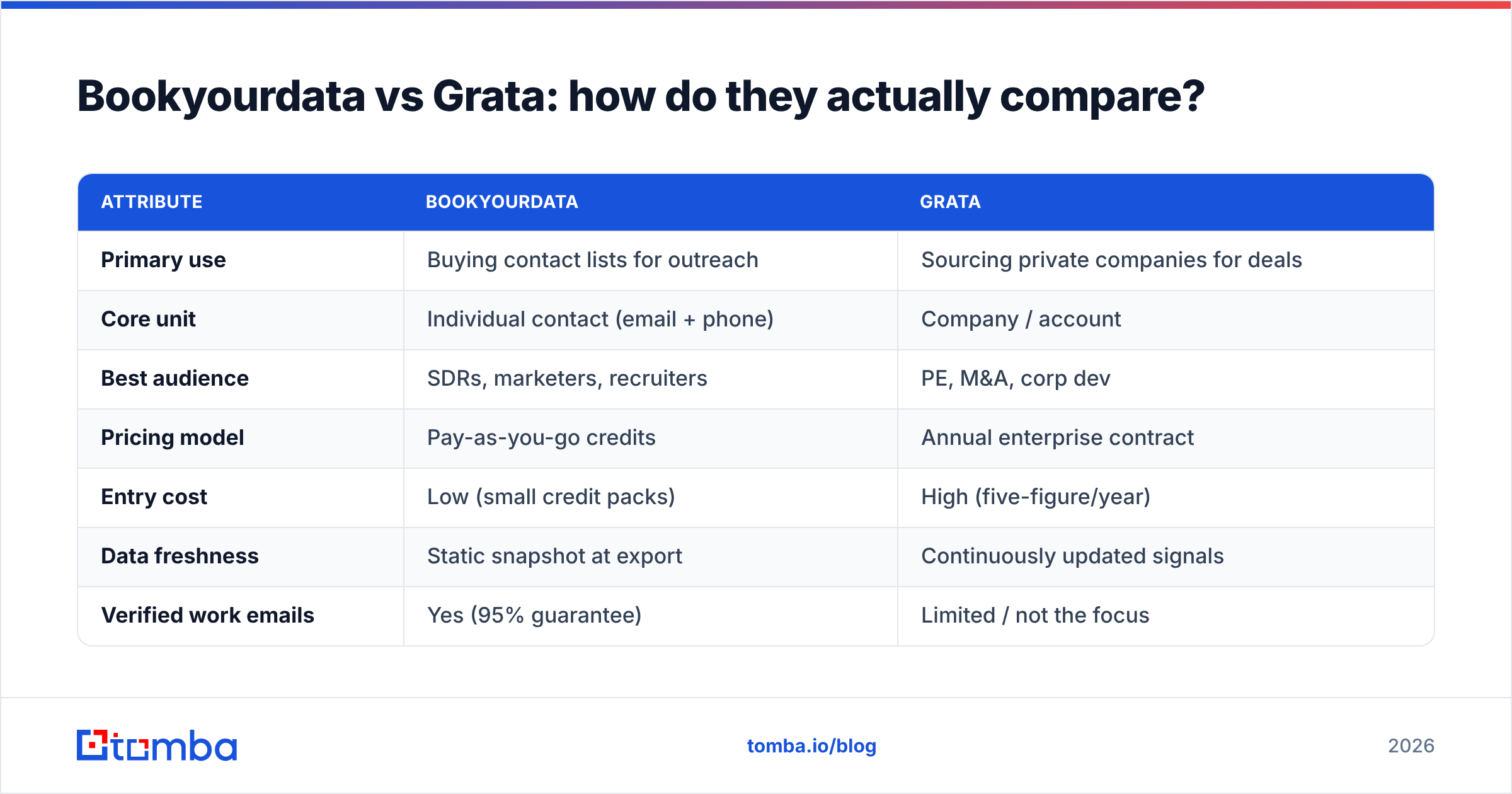
| Attribute | Bookyourdata | Grata |
|---|---|---|
| Primary use | Buying contact lists for outreach | Sourcing private companies for deals |
| Core unit | Individual contact (email + phone) | Company / account |
| Best audience | SDRs, marketers, recruiters | PE, M&A, corp dev |
| Pricing model | Pay-as-you-go credits | Annual enterprise contract |
| Entry cost | Low (small credit packs) | High (five-figure/year) |
| Data freshness | Static snapshot at export | Continuously updated signals |
| Verified work emails | Yes (95% guarantee) | Limited / not the focus |
| Intent & growth signals | Minimal | Strong (headcount, funding, similar-co) |
| Learning curve | Minutes | Days |
Read that table top to bottom and the decision makes itself. If the row that matters most to you is "verified work emails" or "low entry cost," you're a Bookyourdata buyer. If it's "intent & growth signals" or "company sourcing," you're a Grata buyer. Almost nobody genuinely needs both at once.
When Bookyourdata is the right call#
- You run outbound and need contactable people this week.
- Your budget is per-campaign, not annual.
- You're a recruiter, agency, or SMB sales team without a data ops function.
- You can tolerate some list decay because you verify before sending.
When Grata is the right call#
- Your job is finding companies, not emailing individuals.
- You work in M&A, PE, or strategic partnerships.
- You need ownership structure, growth signals, and similar-company discovery.
- You have the budget and a small, high-value target list rather than a mass list.
Is buying a list even the right move in 2026?#
Here's where both tools share a blind spot: a list is only as good as the day you bought it. Bookyourdata's snapshot decays. Grata's contact emails aren't verification-grade. Either way, if you push raw exported data straight into a sending tool, you're gambling your domain reputation on records you didn't check.
The modern alternative is to stop hoarding lists and instead pull verified contacts on demand, right before you need them. That's the difference between a static CSV and a live API call.

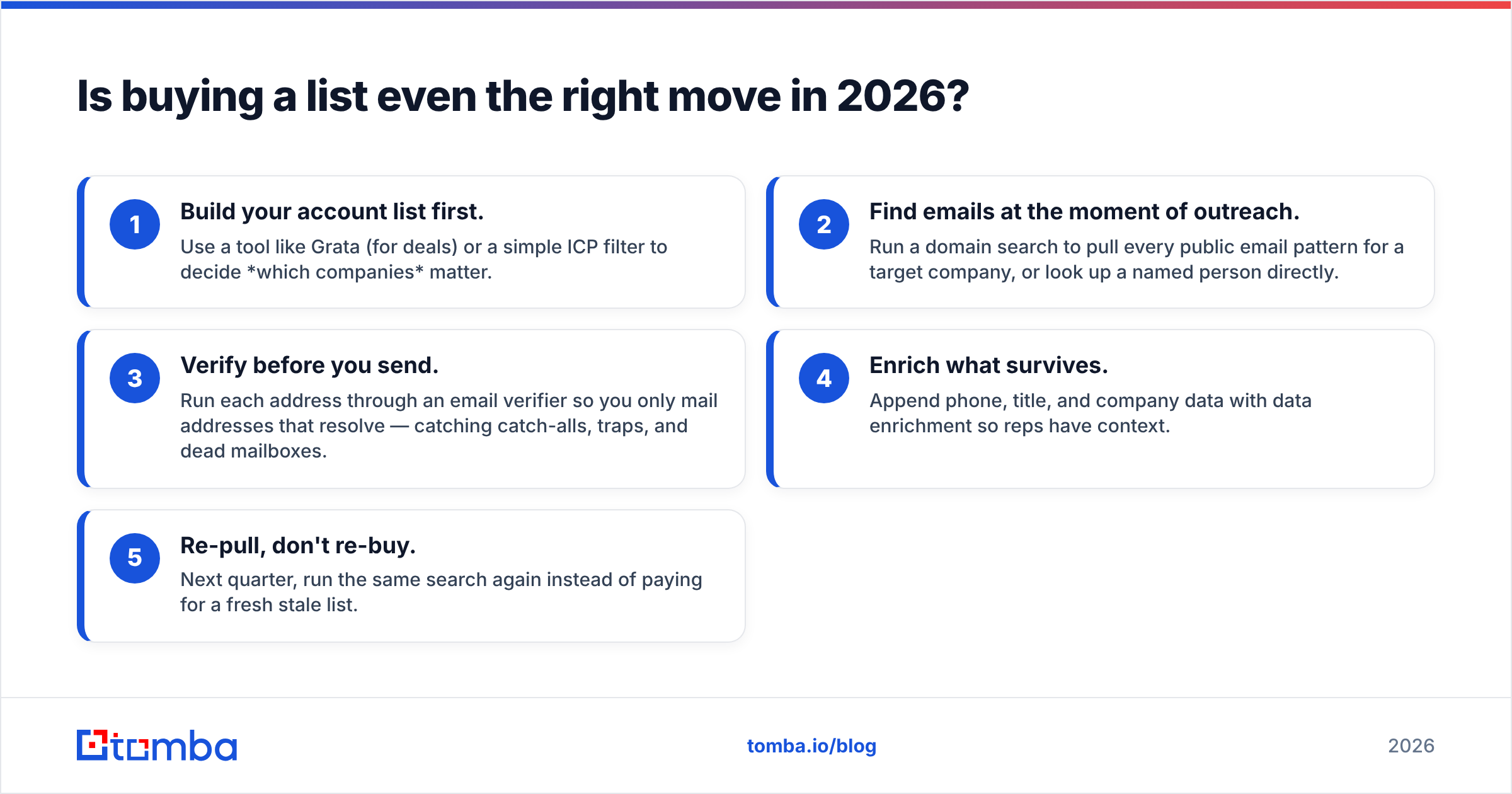
A find-and-verify workflow looks like this:
- Build your account list first. Use a tool like Grata (for deals) or a simple ICP filter to decide which companies matter.
- Find emails at the moment of outreach. Run a domain search to pull every public email pattern for a target company, or look up a named person directly.
- Verify before you send. Run each address through an email verifier so you only mail addresses that resolve — catching catch-alls, traps, and dead mailboxes.
- Enrich what survives. Append phone, title, and company data with data enrichment so reps have context.
- Re-pull, don't re-buy. Next quarter, run the same search again instead of paying for a fresh stale list.
This is why an email-finder approach often beats a list provider for pure prospecting: the data is generated against live mail servers at the moment you use it, not warehoused months ago.
How does Tomba fit between these two?#
Tomba isn't a deal-sourcing engine like Grata, and it isn't a buy-a-bulk-list vendor in the Bookyourdata mold. It sits exactly where most sales teams actually feel pain: turning a company or a name into a verified, deliverable email.
Where Bookyourdata sells you a frozen export, Tomba finds and validates emails live. Where Grata stops at the company, Tomba gets you to the inbox. A few concrete differences:
- Verify-first, not guarantee-after. Instead of refunding a bounce after it's hurt your sender score, Tomba's verifier flags bad addresses before you send.
- Pay for results, transparently. Tomba pricing runs Free (25 searches/mo), Starter at $49/mo, Growth at $99/mo, and Pro at $249/mo — predictable monthly tiers, not opaque enterprise quotes.
- Built for workflows. The Tomba API, a bulk email finder, and a Chrome extension mean you can wire verification into the exact step where you'd otherwise paste a stale CSV.
Quick three-way frame#
| Job to be done | Best fit |
|---|---|
| Source private companies for a deal | Grata |
| Buy a one-off contact list, no contract | Bookyourdata |
| Find + verify emails on demand for outreach | Tomba |
| Keep contact data fresh every quarter | Tomba (re-run searches) |
Plenty of teams pair them: Grata to build the target account list, then Tomba to find and verify the right contacts at each of those companies. Bookyourdata can fill the same "get me contacts" slot — but you trade live verification for a snapshot.
What do reviewers say?#
Both tools hold solid public ratings, but for different reasons. On G2, Bookyourdata reviews praise the no-commitment credit model and fast exports while flagging occasional outdated records — exactly the decay problem above. Grata reviews highlight its private-company coverage and similar-company search, with the main complaint being price and a steeper learning curve.
If you want to validate either claim yourself, check the vendors directly — bookyourdata.com and grata.com — and weigh the reviews against your actual use case rather than the marketing copy. A 95% accuracy badge means little if your campaign needs 99% deliverability to protect a warmed-up domain.
Which should you choose?#
Decide by your job title, not the feature list:
- You source deals (PE / M&A / corp dev): Grata. Nothing here replaces its company-mapping. Use a verifier afterward for any contact you actually email.
- You need a quick, cheap contact list and you'll verify before sending: Bookyourdata is a reasonable pay-as-you-go option.
- You run ongoing outbound and care about deliverability: lead with a verify-first email finder so your data is fresh every time, and only buy bulk lists when you genuinely need scale you can't generate on demand.
The trap is treating "B2B data" as one category. It isn't. Grata answers which companies. Bookyourdata answers which people, frozen in time. A live email finder answers which inbox, verified right now — and for most sales and marketing teams, that last question is the one that actually pays.
Start with verified contacts, not stale lists#
If your real goal is reaching the right people without torching your sender reputation, skip the list dump and find emails at the source. The Tomba Email Finder turns a domain or a name into a verified, deliverable email in seconds — with a free tier to test it, a transparent $49/mo Starter plan, and an API when you're ready to automate. Build your target accounts however you like; let Tomba make sure the emails are real before you hit send.
// get started
Find, verify and enrich your first contacts today
Start on the free plan with 25 searches a month, then scale when your team is ready.
Free plan · No credit card required · GDPR & CCPA
// about the author