Bookyourdata vs Heybounce 2026: Data and Verification Compared
Bookyourdata sells ready-made B2B contact lists; Heybounce verifies the emails you already have. Here is how the two actually compare in 2026 — and where a finder-plus-verifier stack beats both.
Bookyourdata vs Heybounce: Which One Belongs in Your 2026 Stack?
People search "Bookyourdata vs Heybounce" expecting a head-to-head between two competitors. They are not really competitors. One sells you contact lists; the other tells you whether the emails on a list (any list) are safe to send to. Comparing them fairly means comparing two different jobs in the same outbound workflow — and being honest about where each one stops.
TL;DR#
- Bookyourdata is a pay-as-you-go B2B contact database. You filter by industry, title, and geography, then buy ready-made records (emails, phones, firmographics).
- Heybounce is an email verification service. It does not source contacts — it cleans lists you already have so your bounce rate stays low.
- They solve different problems: Bookyourdata answers "who do I email?"; Heybounce answers "will this email land?"
- Buying a static list still leaves you verifying it before send, so most teams end up paying for both — or for a tool that finds and verifies in one pass.
- If your real goal is fresh, verified contacts on demand, a finder-plus-email verifier stack like Tomba usually beats list-buying plus standalone verification on both cost and freshness.
What is Bookyourdata?#
Bookyourdata is a B2B data marketplace. You build a segment in their UI — say, "marketing directors at SaaS companies in the US, 50–200 employees" — and it returns matching records you can buy on a credit basis. Each record can include a business email, direct or company phone, job title, company size, and other firmographics.
The model is list buying. You are purchasing a snapshot of a contact database that other customers also buy from. Bookyourdata markets a high accuracy guarantee and offers credit refunds on hard bounces, which is a meaningful protection if you read the terms. The strength here is speed: you can go from zero to a few thousand contacts in minutes without scraping or research.
The structural weakness of any purchased list is the same across every vendor: decay. B2B contact data goes stale at roughly 2–3% per month as people change jobs, companies rebrand, and inboxes get deactivated. A list that was 95% accurate the day you bought it is materially worse a quarter later. That is not a knock on Bookyourdata specifically — it is physics for static data.
What is Heybounce?#
Heybounce is a dedicated email verification tool. You upload a list, it runs each address through syntax checks, domain/MX validation, SMTP probing, and catch-all and role-account detection, then returns each contact tagged as valid, invalid, risky, or unknown. The point is to strip out addresses that will bounce or trap you before you hit send.
Heybounce does not find anyone. It assumes you already have the emails — from a CRM export, a scraped list, a webform, or a purchased database like Bookyourdata. Its job is hygiene: protecting your sender reputation and keeping bounce rates under the ~2% threshold that mailbox providers watch.
Good verification matters more in 2026 than it did a few years ago. Google and Yahoo's bulk-sender rules now enforce authentication and low spam complaint rates, so a dirty list does not just waste credits — it can quietly tank your email deliverability for weeks. Heybounce is built for exactly that risk.
Bookyourdata vs Heybounce: the core difference#
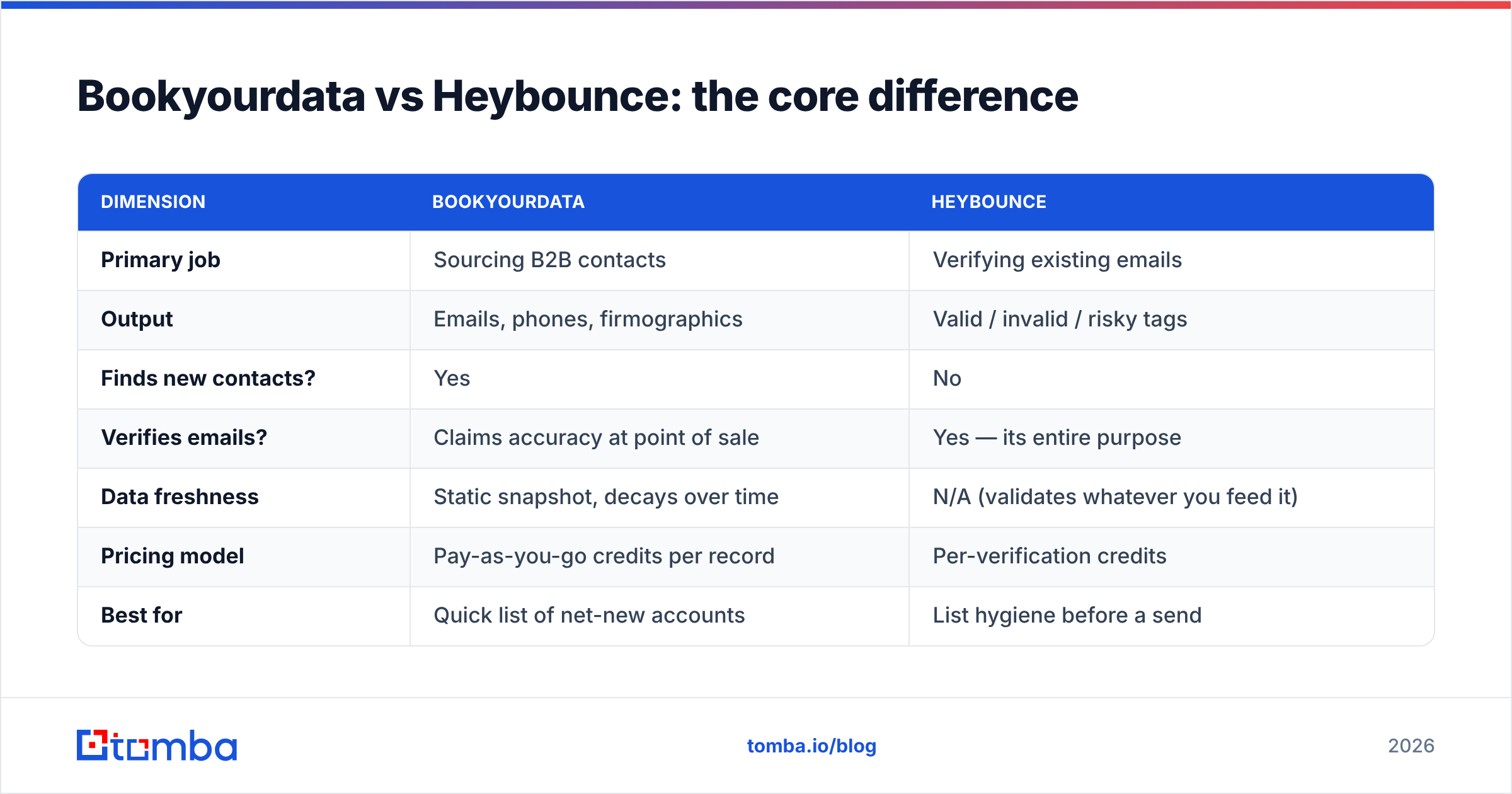
The cleanest way to think about it: Bookyourdata is a source, Heybounce is a filter. You cannot substitute one for the other, and using only one leaves a gap.
| Dimension | Bookyourdata | Heybounce |
|---|---|---|
| Primary job | Sourcing B2B contacts | Verifying existing emails |
| Output | Emails, phones, firmographics | Valid / invalid / risky tags |
| Finds new contacts? | Yes | No |
| Verifies emails? | Claims accuracy at point of sale | Yes — its entire purpose |
| Data freshness | Static snapshot, decays over time | N/A (validates whatever you feed it) |
| Pricing model | Pay-as-you-go credits per record | Per-verification credits |
| Best for | Quick list of net-new accounts | List hygiene before a send |
| Gap it leaves | Still must verify before send | Still must find contacts first |
The takeaway: if you buy from Bookyourdata, you still want a verifier running before you send — purchased lists are not exempt from decay between purchase and send. And if you run Heybounce, you still need something to produce the contacts in the first place. Neither tool is a full pipeline on its own.
Which problem are you actually trying to solve?#
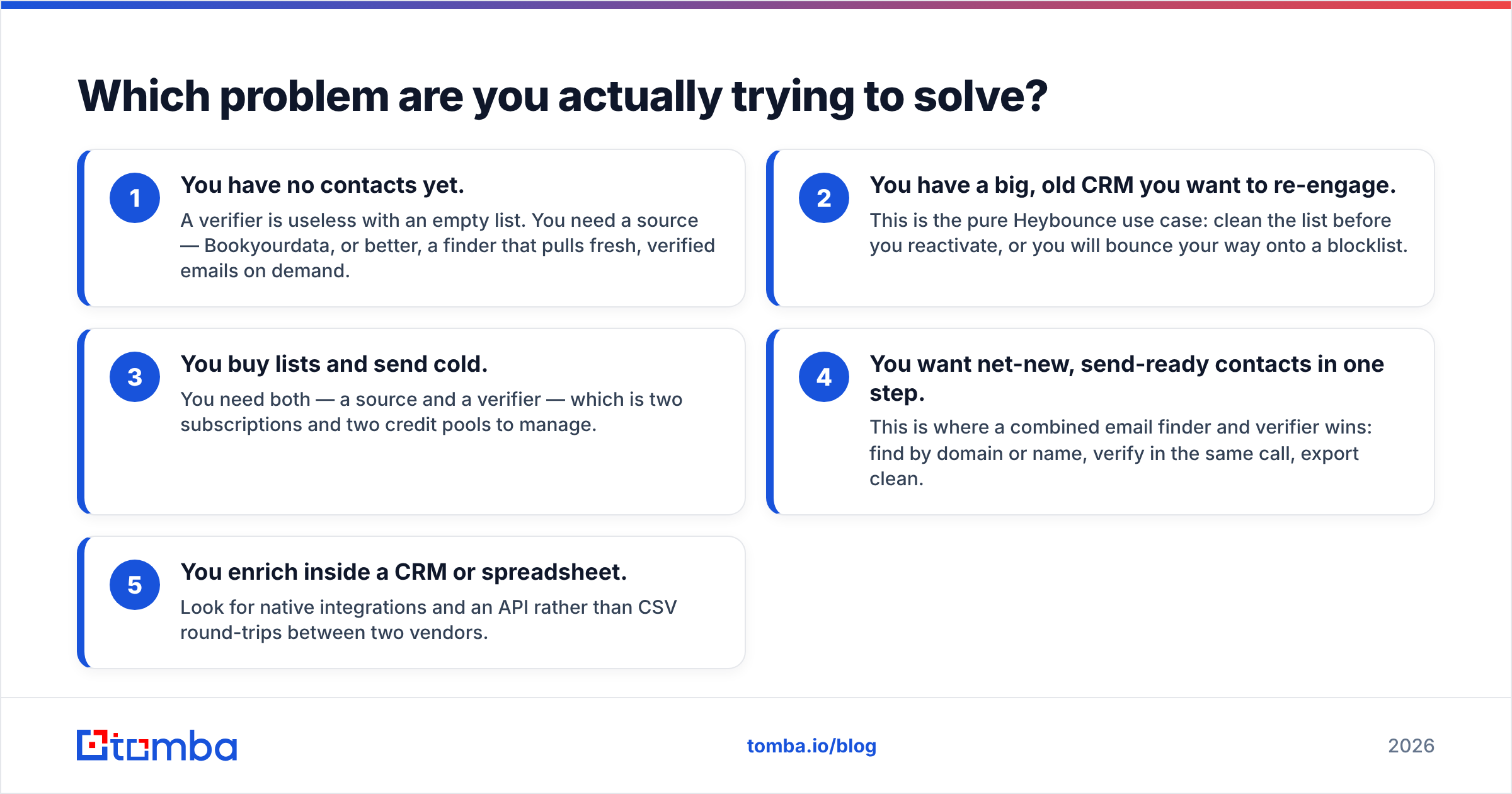
Pick based on where your bottleneck is right now.
- You have no contacts yet. A verifier is useless with an empty list. You need a source — Bookyourdata, or better, a finder that pulls fresh, verified emails on demand.
- You have a big, old CRM you want to re-engage. This is the pure Heybounce use case: clean the list before you reactivate, or you will bounce your way onto a blocklist.
- You buy lists and send cold. You need both — a source and a verifier — which is two subscriptions and two credit pools to manage.
- You want net-new, send-ready contacts in one step. This is where a combined email finder and verifier wins: find by domain or name, verify in the same call, export clean.
- You enrich inside a CRM or spreadsheet. Look for native integrations and an API rather than CSV round-trips between two vendors.
Most outbound teams are in bucket 3 or 4 — which is exactly why pairing or replacing these tools matters more than picking a "winner."
How does Tomba fit between the two?#
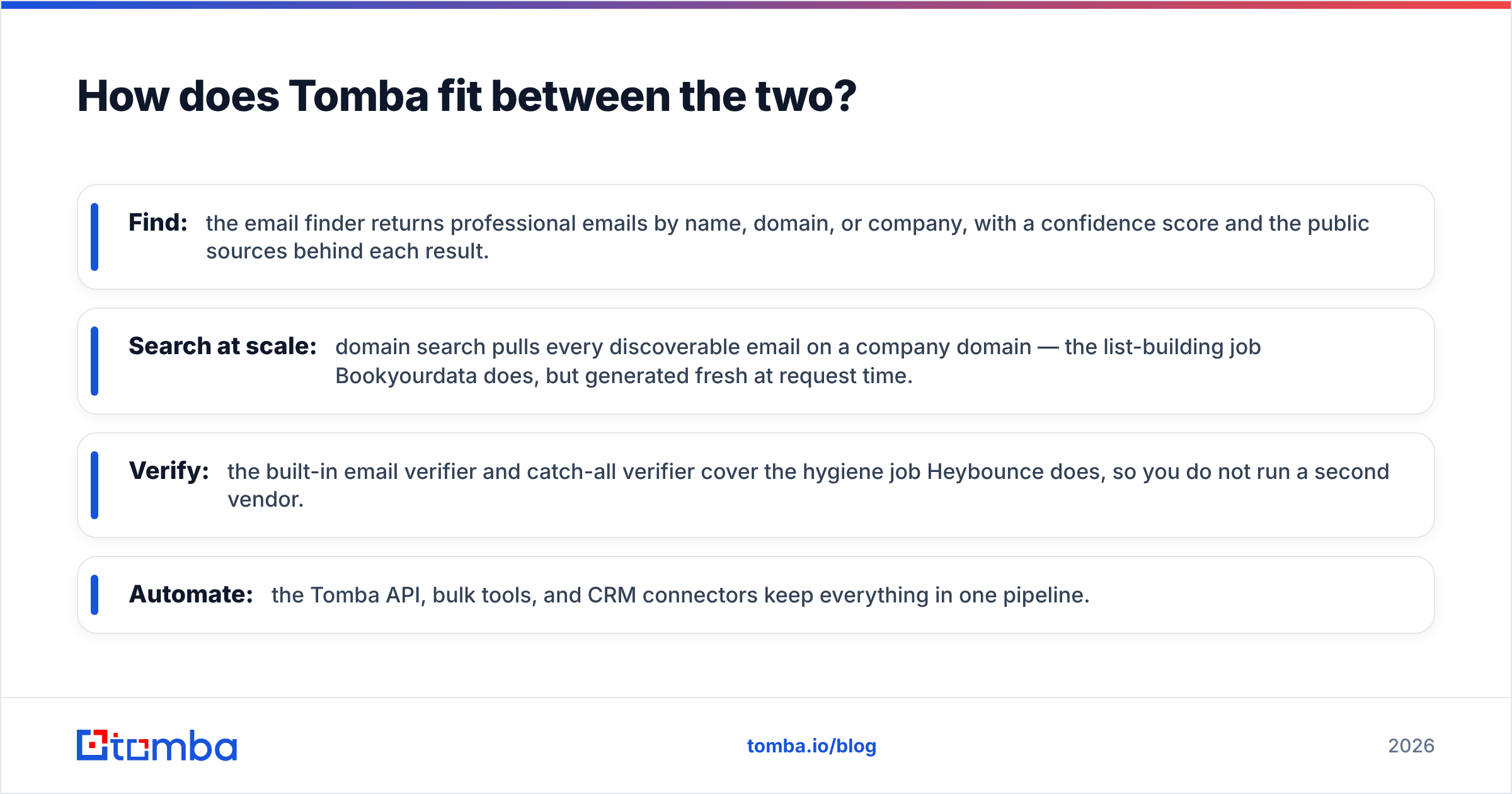
Tomba collapses the source-plus-filter split into one workflow. Instead of buying a static list and then paying a separate service to verify it, you find the contact and verify it in the same step, against live data rather than a snapshot.
- Find: the email finder returns professional emails by name, domain, or company, with a confidence score and the public sources behind each result.
- Search at scale: domain search pulls every discoverable email on a company domain — the list-building job Bookyourdata does, but generated fresh at request time.
- Verify: the built-in email verifier and catch-all verifier cover the hygiene job Heybounce does, so you do not run a second vendor.
- Automate: the Tomba API, bulk tools, and CRM connectors keep everything in one pipeline.
That does not make Bookyourdata or Heybounce bad tools. If you specifically want phone-heavy purchased records, Bookyourdata is a legitimate option, and Heybounce is a solid standalone verifier. The argument is about stack economics: one find-and-verify flow usually beats stitching a list vendor to a verifier.
Pricing: how the models compare#
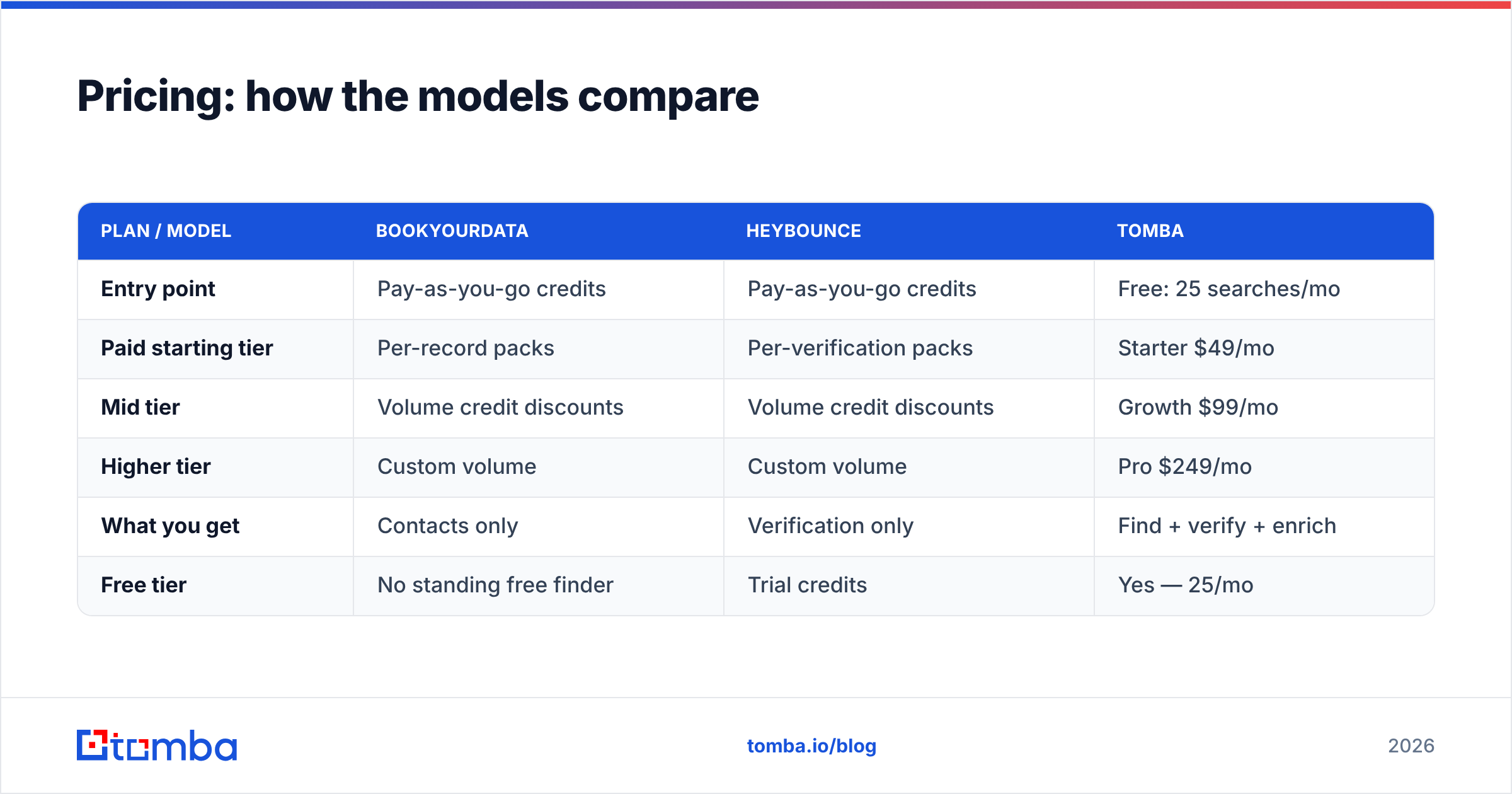
This is where the comparison gets slippery, because all three price differently. Bookyourdata charges per record. Heybounce charges per verification. Tomba bundles finding, verification, and enrichment into monthly plans.
| Plan / model | Bookyourdata | Heybounce | Tomba |
|---|---|---|---|
| Entry point | Pay-as-you-go credits | Pay-as-you-go credits | Free: 25 searches/mo |
| Paid starting tier | Per-record packs | Per-verification packs | Starter $49/mo |
| Mid tier | Volume credit discounts | Volume credit discounts | Growth $99/mo |
| Higher tier | Custom volume | Custom volume | Pro $249/mo |
| What you get | Contacts only | Verification only | Find + verify + enrich |
| Free tier | No standing free finder | Trial credits | Yes — 25/mo |
Two things to watch. First, with the Bookyourdata + Heybounce combo you pay twice: once to acquire each record, once to verify it. Second, pay-as-you-go feels cheap until volume climbs — at scale, a flat monthly plan that includes verification is often the lower total cost. Always model your real monthly volume against each pricing page rather than the headline number; full Tomba pricing is public, and you can check vendor pages directly on G2 and Capterra for current Bookyourdata and Heybounce rates.
Does buying a list still make sense in 2026?#
Sometimes — but with eyes open. Purchased lists carry three recurring risks:
- Decay. As covered, a snapshot ages immediately. Verify right before send, not at purchase.
- Shared exposure. Other buyers email the same records. By the time a list reaches you, the best contacts may already be fatigued.
- Compliance. Cold-emailing purchased EU contacts runs into GDPR lawful-basis questions. Review HubSpot's guidance on buying contact lists before you commit budget — their position is bluntly skeptical, and it is worth understanding why.
Generating contacts on demand from public, attributable sources sidesteps most of the staleness and shared-exposure problem, because you pull the data when you need it rather than inheriting an aging file. That is the practical case for a finder over a list marketplace. If you do buy, treat verification as mandatory, not optional — which is precisely the role Heybounce (or Tomba's verifier) plays.
Bookyourdata vs Heybounce: quick verdict#
- Choose Bookyourdata if you want to buy ready-made B2B records — especially phone-heavy data — and you accept the freshness and compliance tradeoffs of purchased lists.
- Choose Heybounce if you already have lists and only need clean, reliable verification before sending.
- Choose a combined finder + verifier (Tomba) if you want fresh, attributable, send-ready contacts without running two vendors and two credit pools.
The honest framing is that "Bookyourdata vs Heybounce" is rarely the right question. The right question is "do I need a source, a filter, or both?" — and for most outbound teams, the answer is both, ideally in one tool.
Closing: skip the two-vendor shuffle#

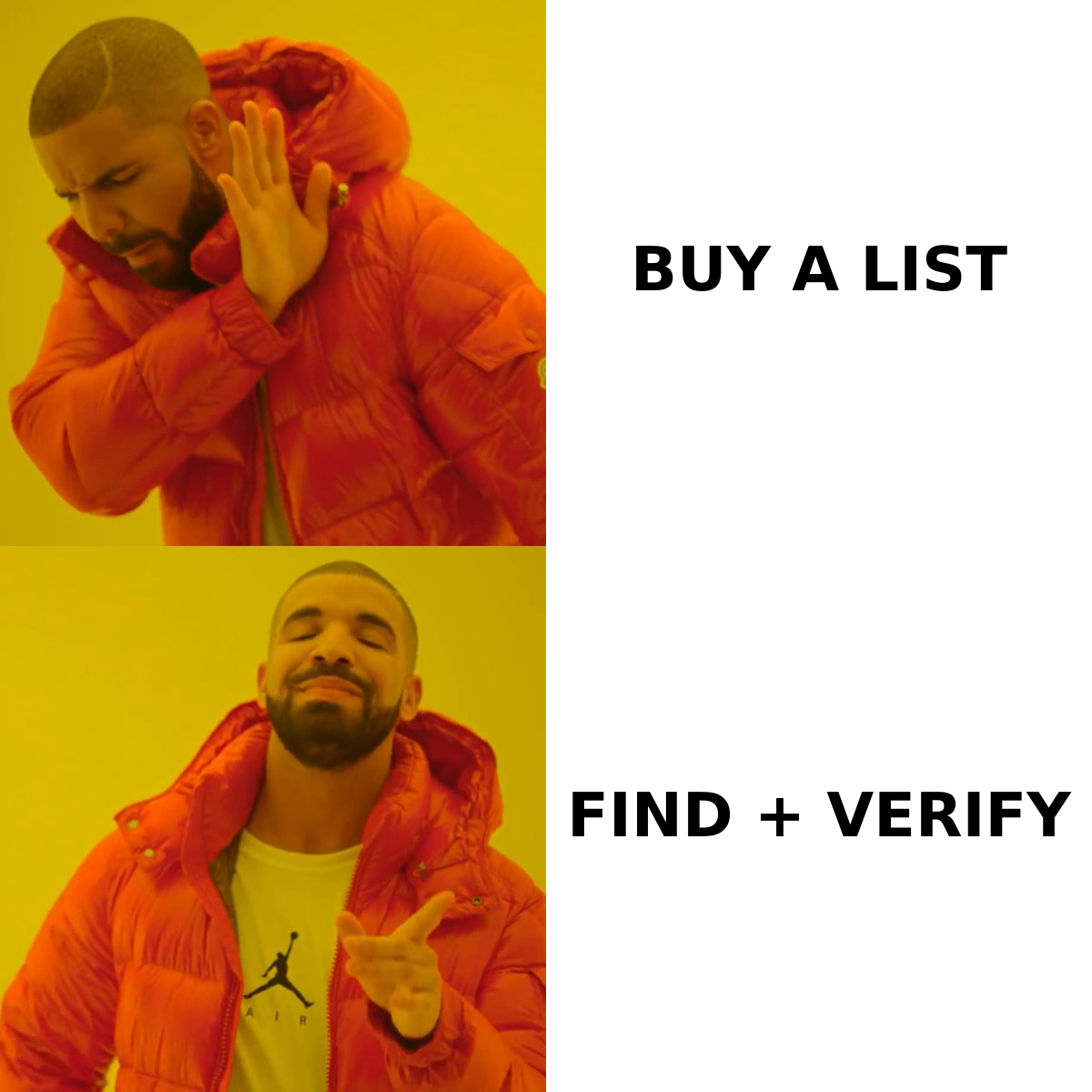
If your pipeline today is buy-a-list-then-verify-it, you are paying twice and still sending against decaying data. Tomba's email finder generates fresh professional emails by name, domain, or company and verifies them in the same flow — the sourcing job Bookyourdata does and the hygiene job Heybounce does, in one pass. Start free with 25 searches a month, point it at a domain you actually want to reach, and compare the results to your last purchased list. The freshness difference shows up on the first send.
Sources:
// get started
Find, verify and enrich your first contacts today
Start on the free plan with 25 searches a month, then scale when your team is ready.
Free plan · No credit card required · GDPR & CCPA
// about the author