Bookyourdata vs Infofree 2026: Which B2B Data Tool Wins?
Bookyourdata sells pay-as-you-go verified contact lists; Infofree pushes flat-rate small-business records. Here's which B2B data tool actually fits your pipeline in 2026.
Choosing a B2B data provider usually comes down to a boring question with expensive consequences: do you pay per record for verified contacts, or pay a flat monthly fee for unlimited access to a broader, older database? That is the real fight in Bookyourdata vs Infofree.
Both sell contact data to sales and marketing teams. They sell it in almost opposite ways. This guide breaks down pricing, accuracy, coverage, and use cases so you can pick the one that matches how your team actually prospects — and where a usage-based email finder fits better than either.
TL;DR#
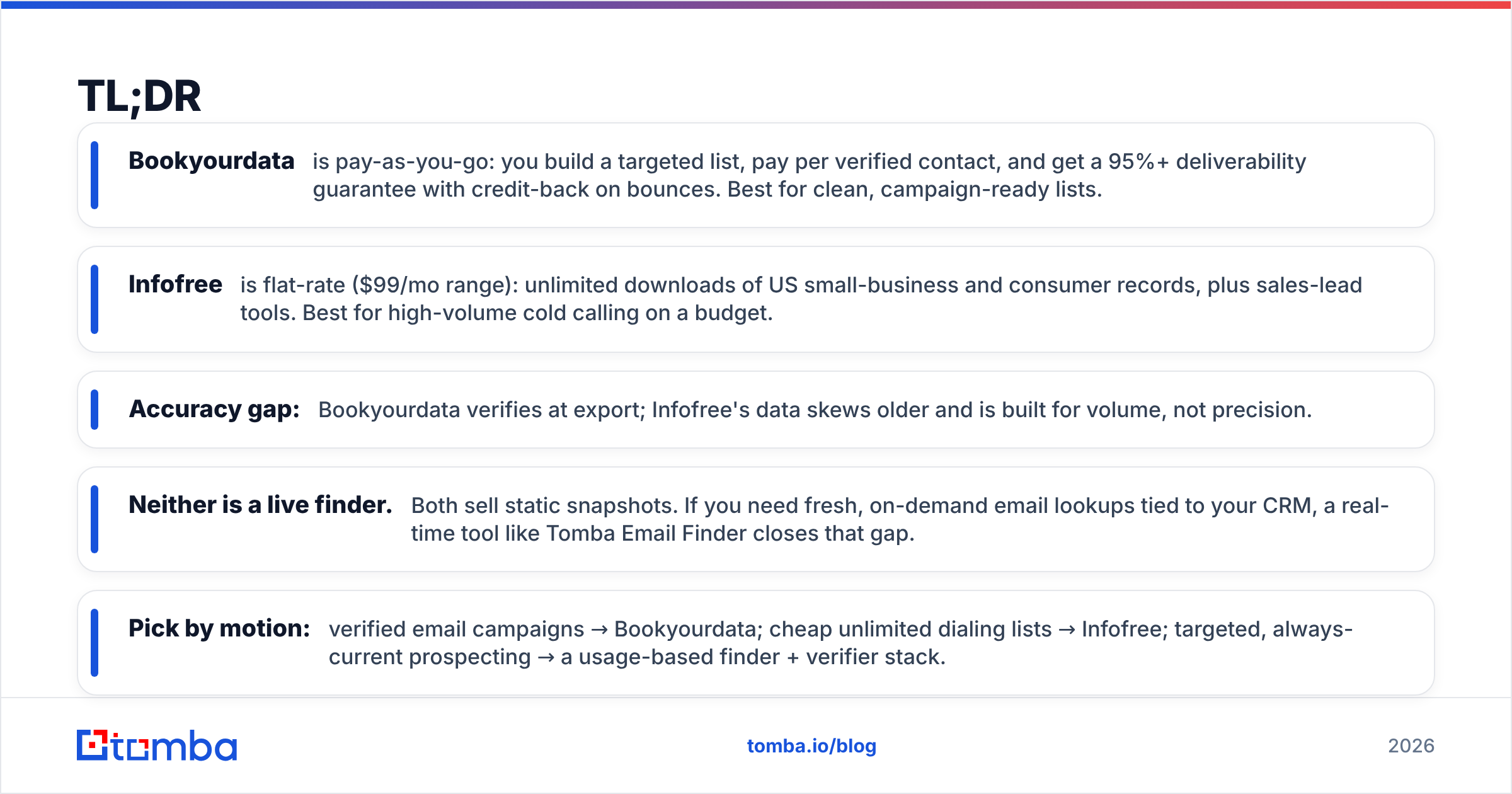
- Bookyourdata is pay-as-you-go: you build a targeted list, pay per verified contact, and get a 95%+ deliverability guarantee with credit-back on bounces. Best for clean, campaign-ready lists.
- Infofree is flat-rate ($99/mo range): unlimited downloads of US small-business and consumer records, plus sales-lead tools. Best for high-volume cold calling on a budget.
- Accuracy gap: Bookyourdata verifies at export; Infofree's data skews older and is built for volume, not precision.
- Neither is a live finder. Both sell static snapshots. If you need fresh, on-demand email lookups tied to your CRM, a real-time tool like Tomba Email Finder closes that gap.
- Pick by motion: verified email campaigns → Bookyourdata; cheap unlimited dialing lists → Infofree; targeted, always-current prospecting → a usage-based finder + verifier stack.
What is Bookyourdata?#
Bookyourdata is a self-service B2B contact database where you filter by industry, job title, location, company size, and other firmographics, then pay only for the records you export. There are no forced subscriptions — credits don't expire, and you can buy a few hundred contacts or tens of thousands.
Its main selling point is the 95%+ email deliverability guarantee. Records are verified at the point of download, and Bookyourdata credits back contacts that hard-bounce. That makes it attractive for teams who'd rather pay more per record than waste a sending domain's sender reputation on a dirty list.
Coverage is global, with strength in business email addresses, direct dials, and titles. The trade-off: per-record pricing gets expensive fast at scale, and like any pre-built database, the data is a snapshot — accurate the day you export it, decaying every week after.
What is Infofree?#
Infofree takes the opposite approach. For a flat monthly fee (commonly around $99/month), you get unlimited downloads of US business and consumer records, plus a sales-lead manager, mailing lists, and a built-in CRM-lite. It's pitched squarely at small businesses, insurance agents, realtors, and outbound callers who burn through a lot of records.
The appeal is predictable cost. You're not metering every contact — you dial, mail, and download as much as you want. The catch is that Infofree's database leans heavily on compiled and public-record sources, which means more coverage of small US businesses but lower freshness and verification rigor than a verify-on-export model. It's a volume tool, not a precision tool.

Bookyourdata vs Infofree: full comparison#
Here's the side-by-side on the attributes that actually change your results.
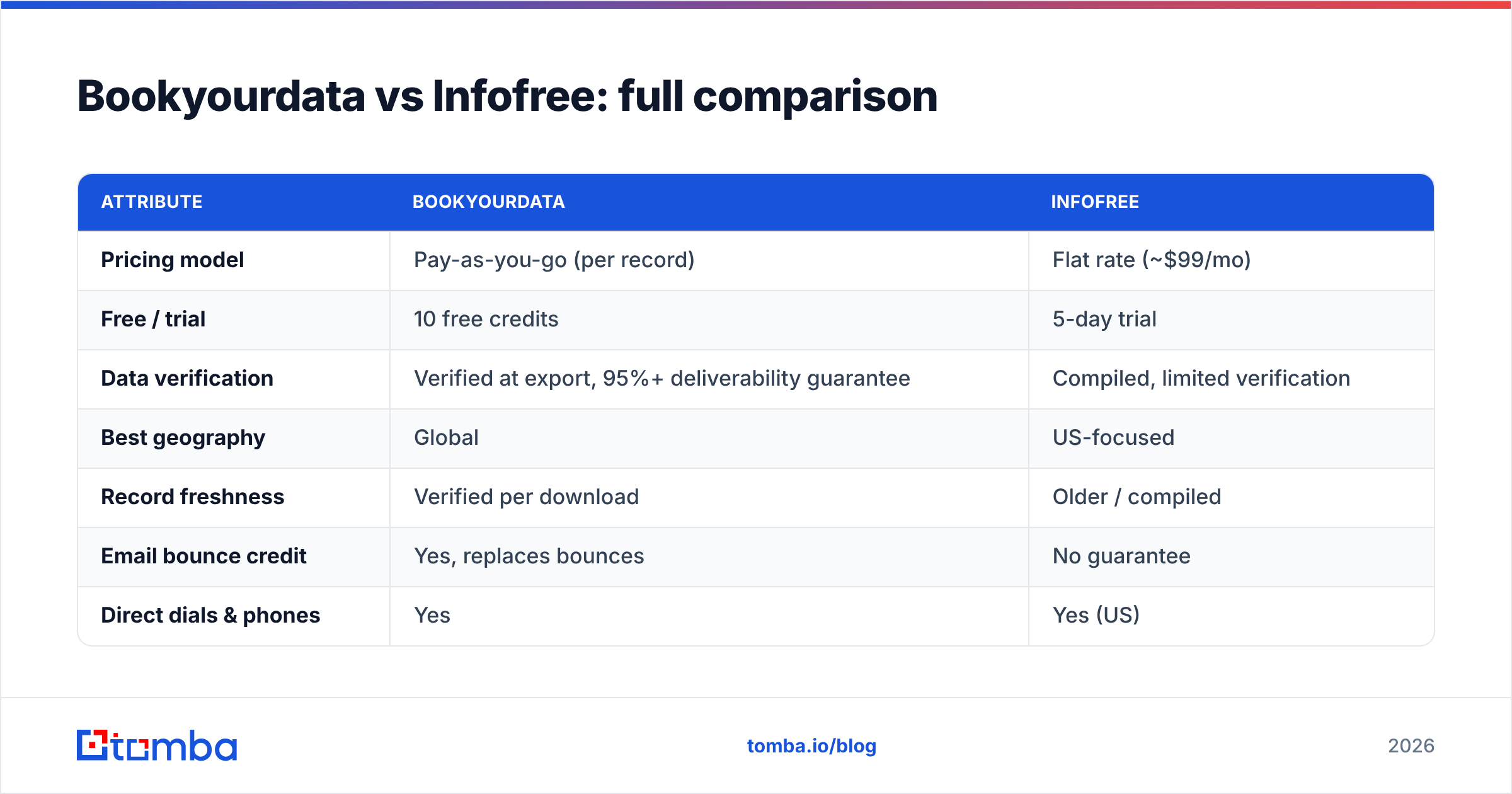
| Attribute | Bookyourdata | Infofree |
|---|---|---|
| Pricing model | Pay-as-you-go (per record) | Flat rate (~$99/mo) |
| Free / trial | 10 free credits | 5-day trial |
| Data verification | Verified at export, 95%+ deliverability guarantee | Compiled, limited verification |
| Best geography | Global | US-focused |
| Record freshness | Verified per download | Older / compiled |
| Email bounce credit | Yes, replaces bounces | No guarantee |
| Direct dials & phones | Yes | Yes (US) |
| Built-in CRM | No | Yes (lead manager) |
| Ideal volume | Targeted lists | Unlimited / high volume |
| Best for | Email campaigns needing deliverability | Cold calling on a budget |
Read that table as two philosophies: Bookyourdata optimizes for cost-per-valid-contact, Infofree optimizes for cost-per-month. Neither is wrong — they suit different sales motions.
Is Bookyourdata more accurate than Infofree?#
Yes, on email deliverability specifically — and that gap is the headline. Bookyourdata verifies addresses at export and refunds bounces, so the list you send to is the list that was checked. Infofree's model rewards breadth and volume over per-record verification, so you should expect a higher bounce rate and more stale phone numbers, especially on older small-business records.
But "more accurate" needs an asterisk for both tools: all pre-built databases decay. People change jobs at roughly 20–30% per year. A contact verified in January can be invalid by June regardless of which vendor sold it. That's the structural weakness of buying static lists — and the reason verification can't be a one-time event.
If you're running cold outreach, run any purchased list through an email verifier immediately before each campaign, not just once at purchase. Protecting email deliverability is cheaper than rebuilding a burned domain.
How does pricing really compare?#
Do the math on your actual volume — the "cheaper" tool flips depending on how many records you touch.
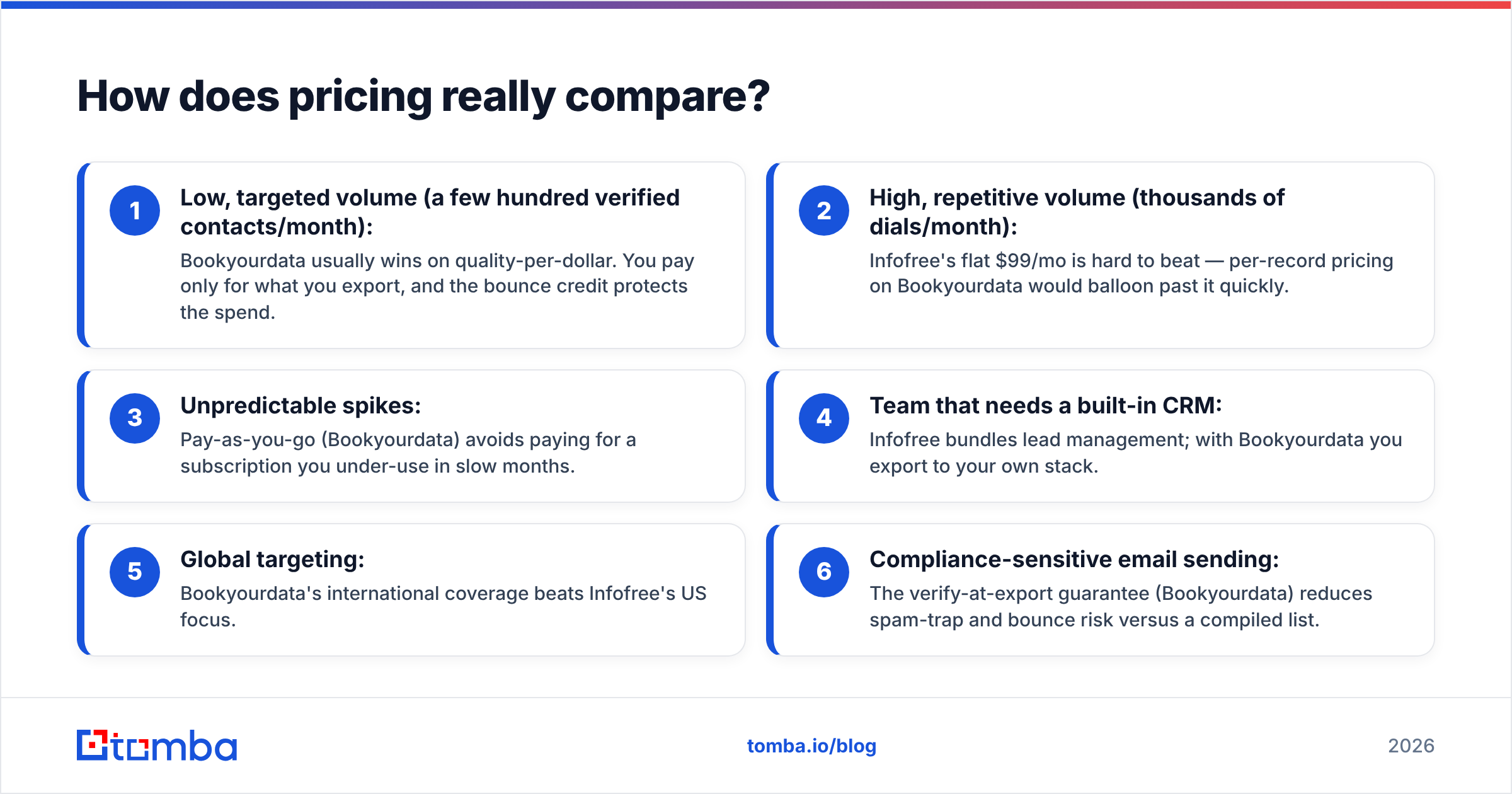
- Low, targeted volume (a few hundred verified contacts/month): Bookyourdata usually wins on quality-per-dollar. You pay only for what you export, and the bounce credit protects the spend.
- High, repetitive volume (thousands of dials/month): Infofree's flat $99/mo is hard to beat — per-record pricing on Bookyourdata would balloon past it quickly.
- Unpredictable spikes: Pay-as-you-go (Bookyourdata) avoids paying for a subscription you under-use in slow months.
- Team that needs a built-in CRM: Infofree bundles lead management; with Bookyourdata you export to your own stack.
- Global targeting: Bookyourdata's international coverage beats Infofree's US focus.
- Compliance-sensitive email sending: The verify-at-export guarantee (Bookyourdata) reduces spam-trap and bounce risk versus a compiled list.
The honest summary: Infofree is cheaper for raw volume; Bookyourdata is cheaper per usable email. Map that to whether your team lives in the dialer or the inbox.

Where both tools fall short#
Both Bookyourdata and Infofree sell you a snapshot. You filter, you download, and from that moment the file ages. That's fine for a one-off campaign, but it breaks down for two common modern workflows:
- Targeted, account-based prospecting where you need the current email for one specific decision-maker at one specific company — not a bulk list.
- CRM-native enrichment where new leads should be enriched the moment they enter your pipeline, automatically, not via a monthly manual download.
For those, a real-time, usage-based finder is a better fit than either database. Instead of buying a list and hoping it's still valid, you query a name + domain and get a freshly-found, verifiable address. Tools like Tomba's domain search and finder API are built for that on-demand motion, and they plug into your CRM rather than living in a separate portal. You can compare options on a neutral marketplace like G2's lead intelligence category before committing.
When should you choose Bookyourdata?#
Pick Bookyourdata if:
- You run email-led campaigns and protecting deliverability is non-negotiable.
- You want global B2B coverage, not just US records.
- Your volume is targeted and variable — you'd rather pay per record than carry a subscription.
- You value the bounce credit-back guarantee as insurance on list quality.
Check current rates on the Bookyourdata pricing page before you model costs, since per-record tiers change.
When should you choose Infofree?#
Pick Infofree if:
- You're a small business, agent, or high-volume caller working primarily US territories.
- You want predictable flat-rate cost and unlimited downloads.
- You need a built-in lead manager / CRM-lite and don't want to wire up a separate stack.
- Per-record email deliverability is less critical than raw reach (e.g., phone-first outreach).
Confirm the current plan inclusions on Infofree's site — features bundled into the flat fee shift over time.
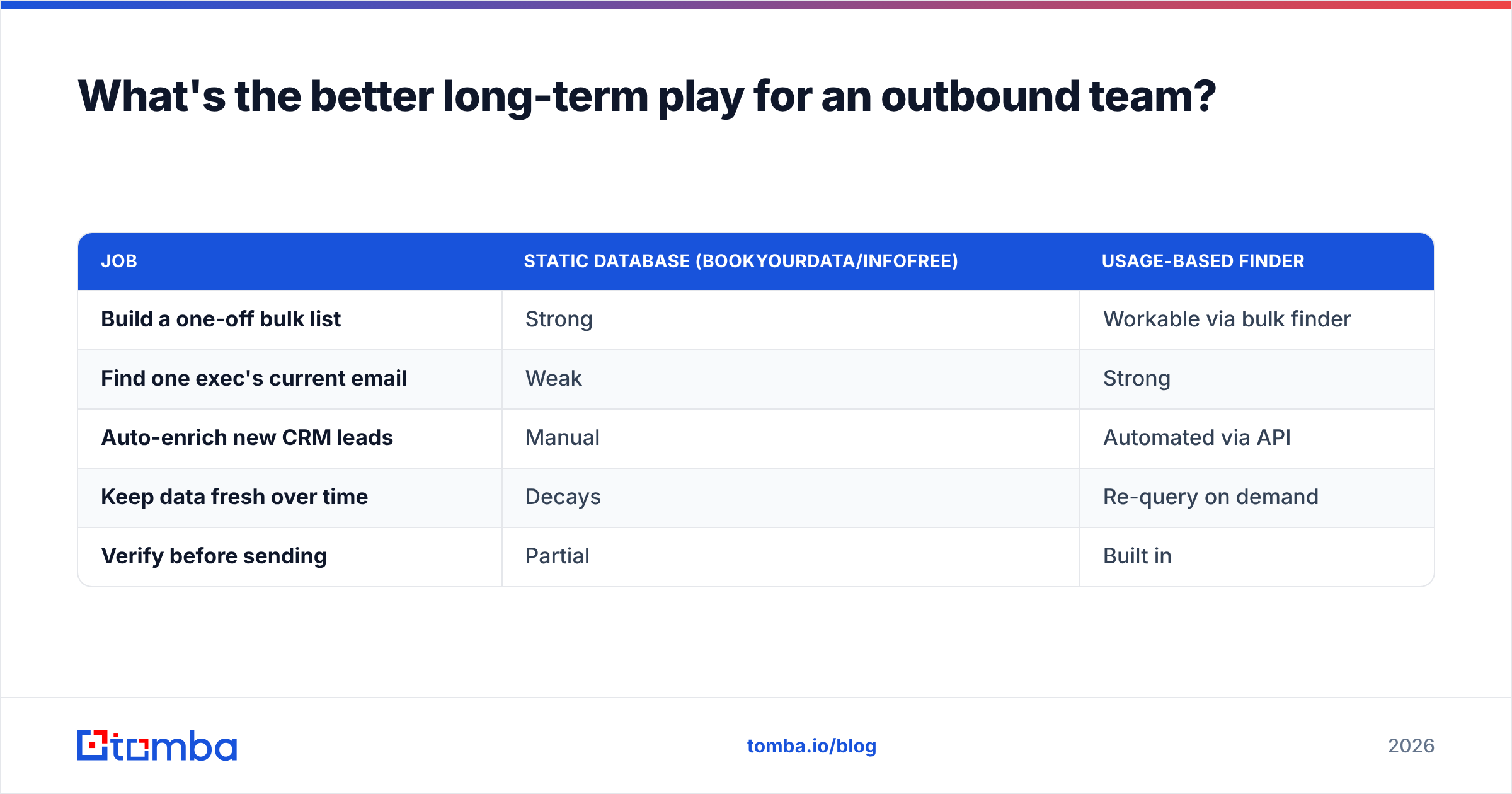
What's the better long-term play for an outbound team?#
Conclusion first: for a scaling outbound team, a usage-based finder + verifier beats owning a static list outright — and you can layer it on top of whichever database you already use.
The reason is data decay. A flat-rate database tempts you to treat the file as a permanent asset; it isn't. A targeted finder lets you pull the current contact at the moment you need it, verify it before sending, and enrich it straight into your CRM. That's the workflow that keeps bounce rates low and reps focused on real conversations instead of cleaning spreadsheets.
A practical stack many teams land on in 2026:
| Job | Static database (Bookyourdata/Infofree) | Usage-based finder |
|---|---|---|
| Build a one-off bulk list | Strong | Workable via bulk finder |
| Find one exec's current email | Weak | Strong |
| Auto-enrich new CRM leads | Manual | Automated via API |
| Keep data fresh over time | Decays | Re-query on demand |
| Verify before sending | Partial | Built in |
You don't have to pick exclusively. Use a database for breadth, then use a finder and data enrichment to keep the records that matter actually current.
Frequently asked questions#
Is Bookyourdata or Infofree better for cold email? Bookyourdata, in most cases. Its verify-at-export model and bounce guarantee protect your sending reputation, which matters more for email than Infofree's volume-first approach. Still verify again right before you send.
Is Infofree good value? For US-focused, high-volume calling on a tight budget, yes — flat-rate unlimited downloads are genuinely cheap per record. For deliverability-sensitive email, the lower verification rigor costs you elsewhere.
Do I still need an email verifier if I buy from either? Yes. Even verified lists decay. Run any purchased data through verification before each campaign to catch job changes and newly-invalid addresses.
Can I avoid buying a static list entirely? Often, yes. A usage-based finder lets you pull current contacts on demand and enrich them into your CRM, which sidesteps the decay problem of owning a snapshot.
The bottom line#
Bookyourdata wins on email-ready accuracy and global reach; Infofree wins on flat-rate volume for US calling. Choose by motion, not by brand.
But if your real problem is keeping contact data current — finding the right person's email today and verifying it before you hit send — a static database is the wrong primary tool. Start with Tomba Email Finder to pull fresh, verifiable B2B emails on demand, enrich them into your CRM automatically, and stop paying to re-clean lists that were already aging the day you downloaded them. Spin up the free tier (25 searches/month), then scale on usage-based Tomba pricing when your pipeline does.
// get started
Find, verify and enrich your first contacts today
Start on the free plan with 25 searches a month, then scale when your team is ready.
Free plan · No credit card required · GDPR & CCPA
// about the author