Bookyourdata vs Kaspr 2026: B2B Contact Data Compared
Bookyourdata sells prepaid email lists; Kaspr pulls phone and email from LinkedIn. Here's which B2B data tool fits your outbound motion in 2026 — and where a verification-first finder beats both.
Bookyourdata vs Kaspr: Which B2B Contact Data Tool Wins in 2026?
You need contact data, and two very different tools keep showing up on your shortlist. Bookyourdata pitches a pay-as-you-go database of pre-built email lists. Kaspr pitches a LinkedIn-first extension that grabs phone numbers and emails one prospect at a time. They solve overlapping problems in almost opposite ways — and picking wrong burns budget and tanks your deliverability.
This breakdown compares Bookyourdata vs Kaspr on data model, accuracy, pricing, compliance, and the workflows each one actually fits. No fluff, no vendor spin.
TL;DR — Bookyourdata vs Kaspr at a glance#
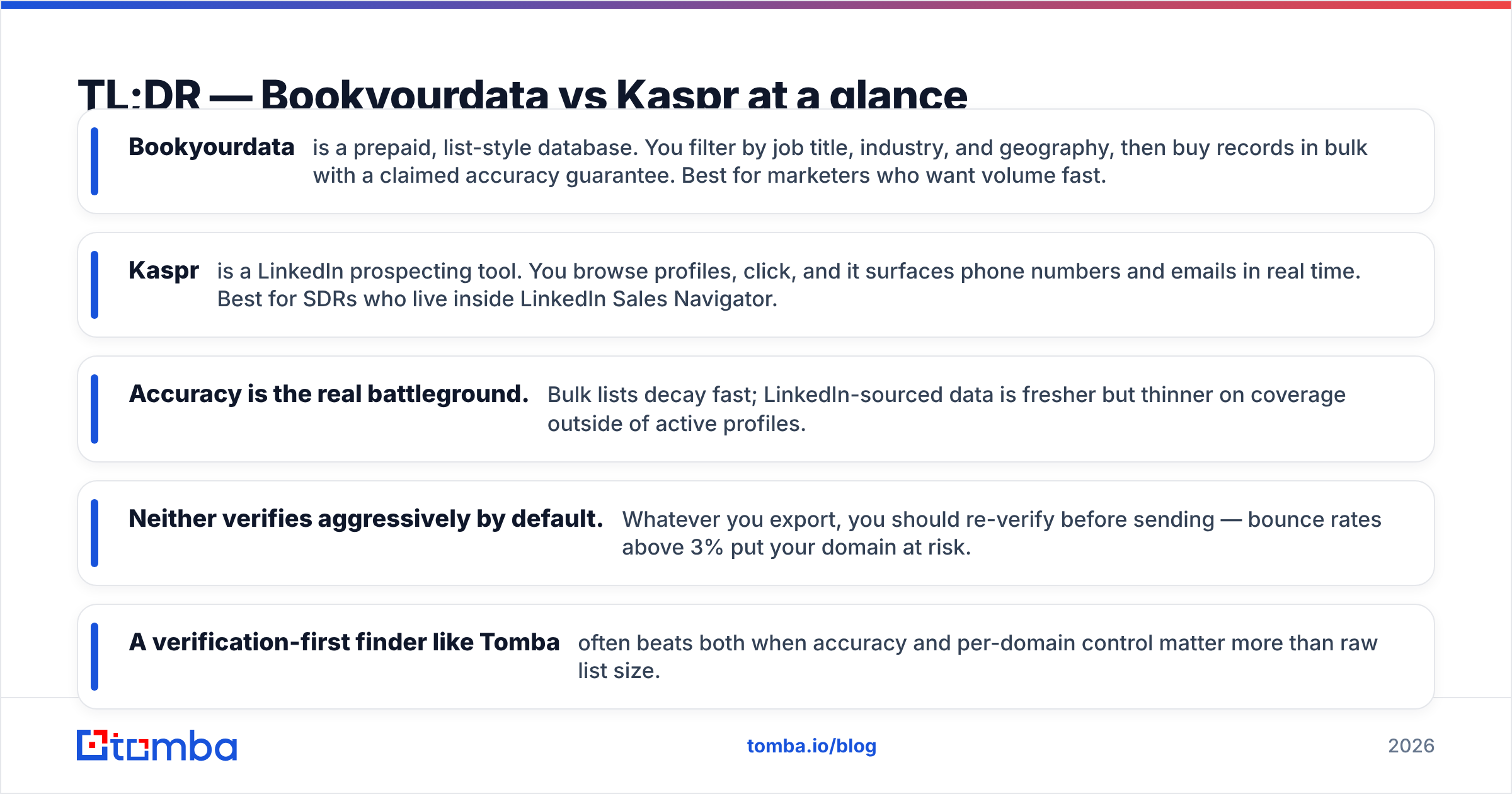
- Bookyourdata is a prepaid, list-style database. You filter by job title, industry, and geography, then buy records in bulk with a claimed accuracy guarantee. Best for marketers who want volume fast.
- Kaspr is a LinkedIn prospecting tool. You browse profiles, click, and it surfaces phone numbers and emails in real time. Best for SDRs who live inside LinkedIn Sales Navigator.
- Accuracy is the real battleground. Bulk lists decay fast; LinkedIn-sourced data is fresher but thinner on coverage outside of active profiles.
- Neither verifies aggressively by default. Whatever you export, you should re-verify before sending — bounce rates above 3% put your domain at risk.
- A verification-first finder like Tomba often beats both when accuracy and per-domain control matter more than raw list size.

What is Bookyourdata?#
Bookyourdata is a self-service B2B contact database built around prepaid credits. Instead of a monthly seat, you load a balance, apply filters (job title, seniority, industry, company size, location, tech stack), and purchase the matching records. The platform advertises a 97%+ email accuracy guarantee and refunds credits for verified bounces.
The mental model is a wholesale list broker with a modern UI. You're buying static snapshots of contact records — name, business email, phone, company, title — in whatever quantity your filters return. That makes it fast for one thing: getting thousands of plausible contacts into a CSV in minutes.
The tradeoff is freshness. Bulk databases are compiled from many sources and re-crawled on a schedule, so a record that was accurate last quarter may point to someone who changed jobs. People change roles roughly every two to three years, which means any static list silently rots. That's why an email verifier pass before sending isn't optional — it's the difference between landing in the inbox and landing on a blocklist.
What is Kaspr?#
Kaspr is a prospecting tool built primarily as a Chrome extension that overlays LinkedIn, including Sales Navigator. When you open a prospect's profile, Kaspr reveals their phone numbers and email addresses, and lets you push the contact into a workflow or your CRM. It's owned by Cognism, which gives it access to a sizable European-leaning data pool with a focus on mobile numbers.
The mental model here is the opposite of Bookyourdata: instead of buying a list up front, you enrich prospects one at a time as you discover them. That makes Kaspr a natural fit for LinkedIn outreach and account-based plays where you've already identified specific people you want to reach.
The tradeoff is throughput and coverage. You're limited to people with LinkedIn presence, credits gate how much you can reveal, and phone-number availability varies widely by region. Great depth on an active EU sales contact; thin or empty on a non-LinkedIn operations lead.
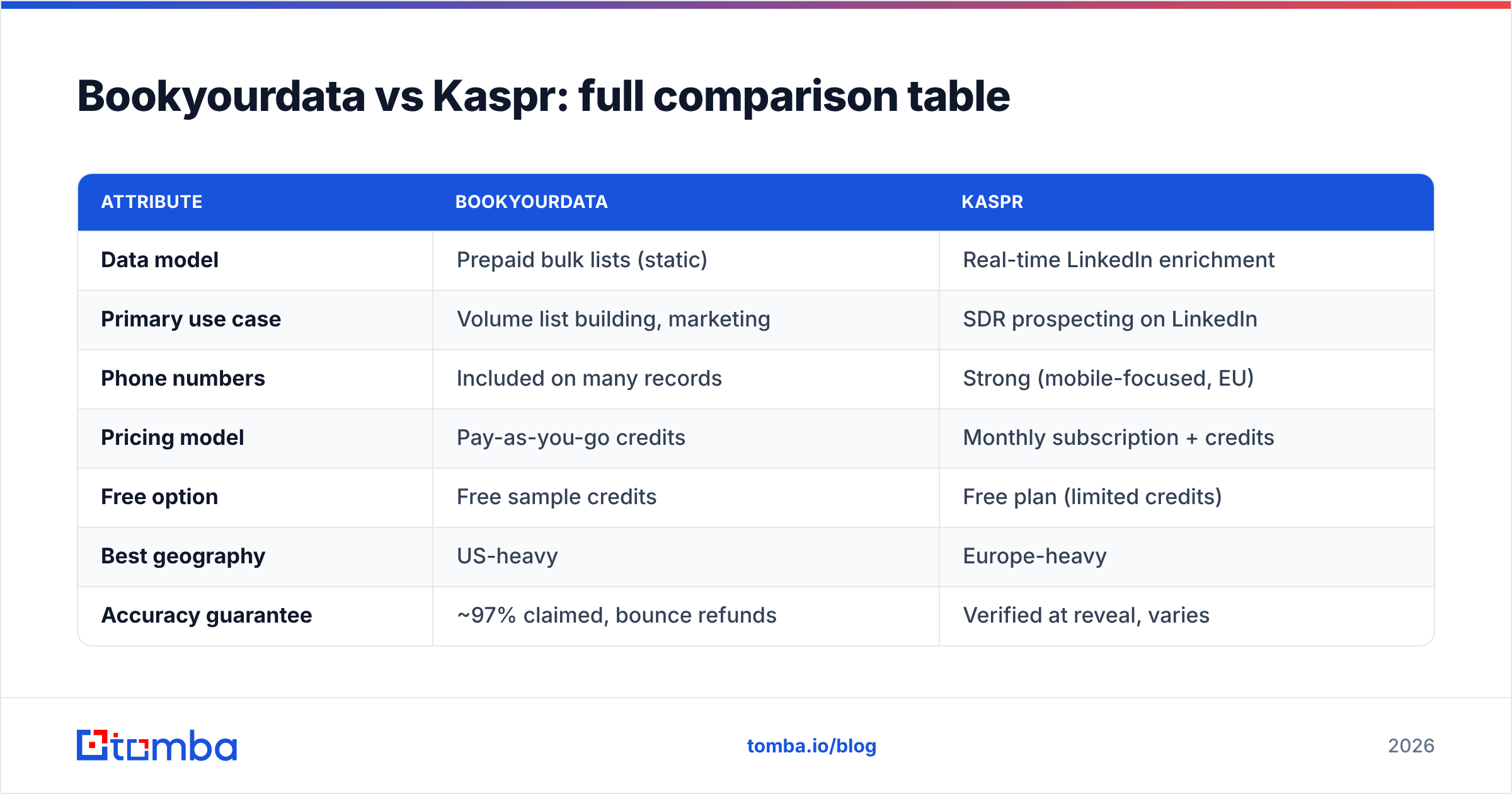
Bookyourdata vs Kaspr: full comparison table#
Here's how the two stack up on the attributes that decide most purchases. Treat vendor-published accuracy numbers as ceilings, not guarantees — your real-world rate depends on how recently records were verified.
| Attribute | Bookyourdata | Kaspr |
|---|---|---|
| Data model | Prepaid bulk lists (static) | Real-time LinkedIn enrichment |
| Primary use case | Volume list building, marketing | SDR prospecting on LinkedIn |
| Phone numbers | Included on many records | Strong (mobile-focused, EU) |
| Pricing model | Pay-as-you-go credits | Monthly subscription + credits |
| Free option | Free sample credits | Free plan (limited credits) |
| Best geography | US-heavy | Europe-heavy |
| Accuracy guarantee | ~97% claimed, bounce refunds | Verified at reveal, varies |
| Compliance posture | List purchase model | GDPR-focused (Cognism lineage) |
| Verification built in | Light | Light |
| Ideal team | Demand gen, agencies | Outbound SDR teams |
The short read: Bookyourdata wins on raw volume and US coverage; Kaspr wins on freshness, mobile numbers, and EU compliance posture. Neither is a verification engine, which is the gap that bites teams after the data lands.
Is Bookyourdata or Kaspr more accurate?#
Accuracy depends on how the data was sourced, not just the headline percentage. Three factors decide what actually reaches the inbox:
- Recency of verification. A 97% claim means little if the record was last checked nine months ago. Kaspr's reveal-time model tends to be fresher because it pulls when you click; Bookyourdata's bulk lists are only as current as the last crawl.
- Catch-all domains. Many corporate domains accept every address, so a server "valid" response doesn't prove the mailbox exists. You need a dedicated catch-all verifier to separate real mailboxes from accept-all traps — most bulk lists don't flag these.
- Source transparency. If you can't see where a record came from, you can't judge its reliability. This is where buyers get burned: a list that looks clean in a spreadsheet can carry 10–15% dead addresses.
Both tools give you a starting point, not a finished product. The professional workflow is the same regardless of vendor: export, then run every address through verification before it touches a sending domain. Skip that step and your bounce rate — not the vendor's accuracy claim — decides your sender reputation.

How do Bookyourdata and Kaspr price compare?#
The pricing philosophies mirror the data models.
Bookyourdata uses prepaid credits. You pay per record, with volume discounts as your balance grows, and unused credits roll forward. There's no seat cost, which suits occasional bulk pulls — but per-record costs add up fast at scale, and you pay again for records that decay.
Kaspr runs on monthly subscriptions tiered by credits and seats, plus a limited free plan to test the LinkedIn workflow. That's predictable for a team running steady daily prospecting, but you're paying recurring fees whether or not you hit your credit ceiling.
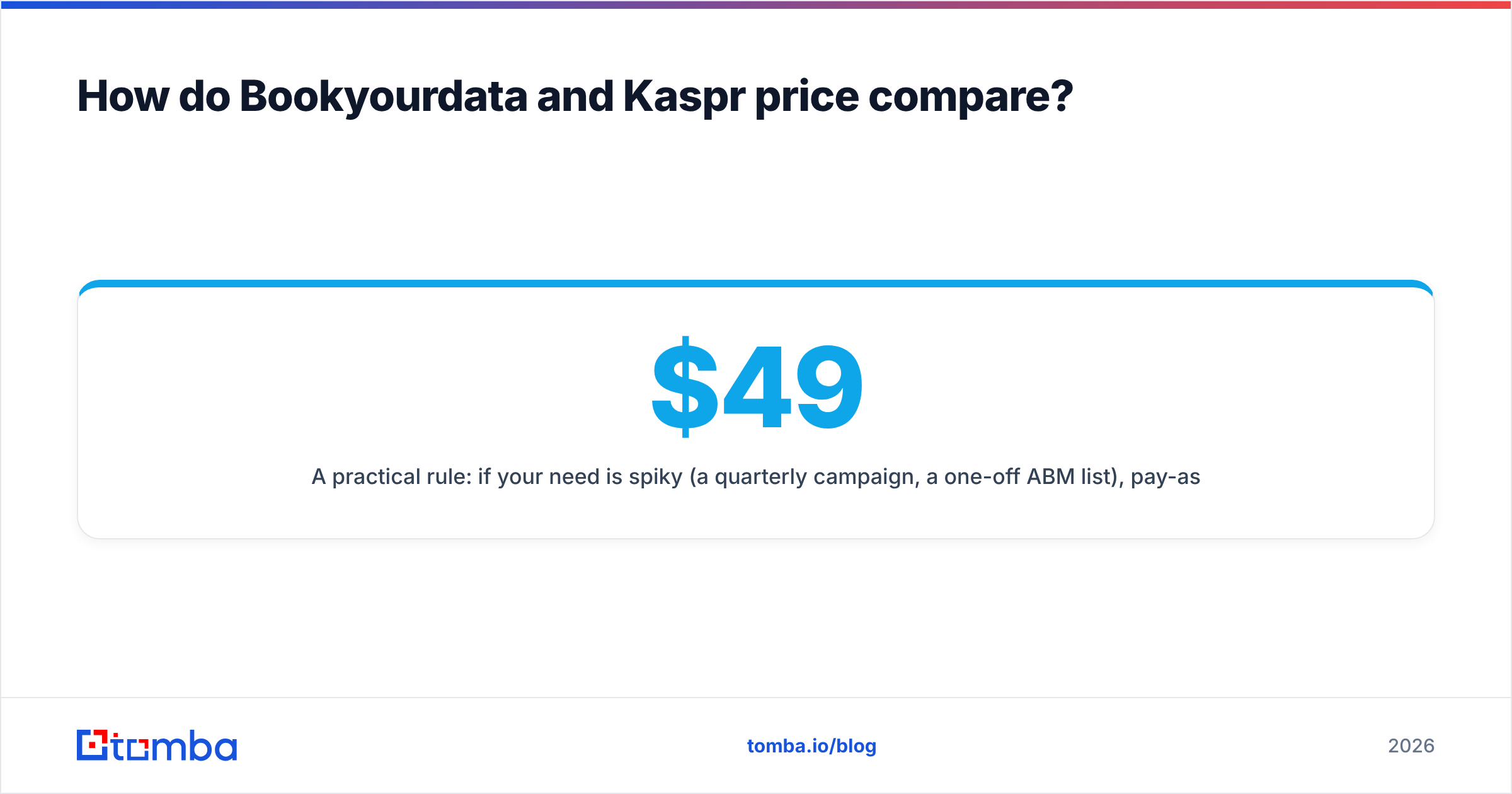
A practical rule: if your need is spiky (a quarterly campaign, a one-off ABM list), pay-as-you-go like Bookyourdata wins. If you prospect every day inside LinkedIn, a subscription like Kaspr amortizes better. And if you want both predictable cost and verification baked in, compare against transparent Tomba pricing — a Free tier of 25 searches, Starter at $49/mo, Growth at $99/mo, and Pro at $249/mo — where every credit returns a verified result rather than a raw guess.
Which one fits your workflow?#
Match the tool to the motion, not the marketing.
- You run demand gen or an agency and need 5,000 US contacts by Friday. Bookyourdata's bulk model is built for this. Pair it with a bulk email finder and verification pass so the list you bought is the list you can actually send to.
- You're an SDR living in Sales Navigator chasing named accounts. Kaspr's in-LinkedIn reveal keeps you in flow and is strong on EU mobile numbers for cold calling.
- You build by domain — "everyone in marketing at these 200 companies." Neither list tool nails this cleanly. A domain search returns every known address at a company with the email pattern and confidence score attached, which is a tighter fit for account-based targeting.
- You need data inside a CRM or spreadsheet, not another tab. Check native integrations first; an email finder API or a Google Sheets add-on often replaces the export-import shuffle entirely.
Where do both tools fall short — and what to use instead?#
Both Bookyourdata and Kaspr have the same blind spot: they hand you data and assume you'll deal with quality yourself. Bookyourdata's static lists decay; Kaspr's coverage thins outside active LinkedIn profiles. In both cases, the burden of verification lands on you, and a 5% bounce rate is enough to throttle your email deliverability for weeks.
This is the case for a verification-first finder. Instead of buying a snapshot and hoping, you search by name and domain and get back an address that's already been SMTP-checked, catch-all flagged, and scored — so the result you export is the result you can send. For teams that have been burned by dead lists, that shift from "trust the vendor's percentage" to "verify every record at the source" is the whole ballgame. It's also why many buyers evaluating these tools end up comparing them against a dedicated email finder rather than choosing between two list products.
If compliance is a concern, this matters even more: a transparent finder that shows you where the data comes from is easier to defend than a purchased list of unknown provenance. For a wider market view, neutral directories like G2 and Capterra are useful for reading unfiltered user reviews of all three options before you commit budget.
Bookyourdata vs Kaspr vs Tomba: quick verdict#
| Question | Best pick |
|---|---|
| Cheapest one-off bulk list | Bookyourdata |
| Best for daily LinkedIn SDR work | Kaspr |
| Best EU mobile phone coverage | Kaspr |
| Best US volume | Bookyourdata |
| Highest send-ready accuracy | Verification-first finder (Tomba) |
| Best for domain/account targeting | Tomba domain search |
| Most transparent data sourcing | Tomba |
There's no single winner — there's a winner for your motion. If you're optimizing for cheap volume, Bookyourdata. If you're optimizing for in-LinkedIn speed, Kaspr. If you're optimizing for what actually lands in the inbox without wrecking your domain, you want verification at the point of search.
Final take and next step#
Bookyourdata and Kaspr are both legitimate tools that solve real problems — just different ones. The mistake is treating either as a finished pipeline. Whatever you export, your sender reputation is decided by quality, not quantity, so verification is the non-negotiable step both tools leave to you.
If accuracy, per-domain targeting, and transparent sourcing are what you actually care about, start with the Tomba Email Finder. Search by name, company, or domain, get verified addresses with confidence scores out of the box, and test it free with 25 searches a month before you spend a dollar. Build the list once, send with confidence, and stop paying twice for data that decayed before you used it.
// get started
Find, verify and enrich your first contacts today
Start on the free plan with 25 searches a month, then scale when your team is ready.
Free plan · No credit card required · GDPR & CCPA
// about the author