Bookyourdata vs Kickbox 2026: Data List vs Verifier
Bookyourdata sells ready-made B2B contact lists; Kickbox verifies the emails you already have. Here's which one fits your 2026 outbound stack — and where a finder beats both.
You typed "Bookyourdata vs Kickbox" into a search bar expecting two versions of the same thing. They are not. One sells you contact lists. The other tells you whether the emails you already own are real. Picking between them as if they competed head-to-head is how teams end up paying twice and still bouncing on send day.
This guide breaks down what each tool actually does, where they overlap, what they cost in 2026, and — honestly — when neither one is the right first purchase.
TL;DR#
- Bookyourdata is a B2B contact database. You buy pre-built lists (emails, phones, titles) by filtering an existing pool. Pay-as-you-go credits, no contract required.
- Kickbox is an email verification service. It cleans a list you already have, flagging deliverable, risky, and undeliverable addresses before you send.
- They are complements, not rivals. A clean Bookyourdata export still benefits from verification; a Kickbox check does nothing if you have no list to begin with.
- Accuracy claims differ by category. Bookyourdata advertises a 97% deliverability guarantee on purchased data; Kickbox focuses on real-time SMTP validation quality.
- If you need targeted, fresh contacts rather than a bulk list dump, an email finder like Tomba Email Finder often beats buying a static database outright.
What is Bookyourdata?#
Bookyourdata is a prospect data provider. Think of it like a grocery store for B2B contacts: you walk the aisles (filters for industry, job title, location, company size, technology used), fill your cart, and pay per contact at checkout. You get back a spreadsheet of names, business emails, direct dials, LinkedIn URLs, and firmographics.
The selling points are speed and a pay-as-you-go model. There is no annual seat license to negotiate — you buy credits, spend them, and download. Bookyourdata markets a 97% email deliverability guarantee, meaning they'll credit you back for addresses that bounce above that threshold.
Where it gets tricky: bought lists are a snapshot. The moment someone changes jobs — and roughly 30% of B2B contacts do every year — your purchased row goes stale. You bought accuracy on the day of export, not accuracy forever.
What is Kickbox?#
Kickbox is an email verification platform. It does not give you contacts. It takes a list you already have and runs each address through a battery of checks: syntax, domain/MX records, SMTP handshake, role-account detection (info@, sales@), disposable-domain flags, and catch-all identification.
The output is a status per email — typically deliverable, undeliverable, risky, or unknown — plus a "Sendex" quality score. The goal is simple: stop you from blasting a dirty list, tanking your sender reputation, and landing in spam folders.
Kickbox is well-regarded for accuracy and for being one of the more transparent verifiers about how it handles catch-all and unknown results. It integrates with major ESPs (Mailchimp, SendGrid, HubSpot) and offers both bulk uploads and a real-time API for form sign-ups.
In short: Bookyourdata gets you a list. Kickbox keeps a list clean. That single sentence resolves 90% of the confusion behind the "bookyourdata vs kickbox" search.
Bookyourdata vs Kickbox: side-by-side comparison#
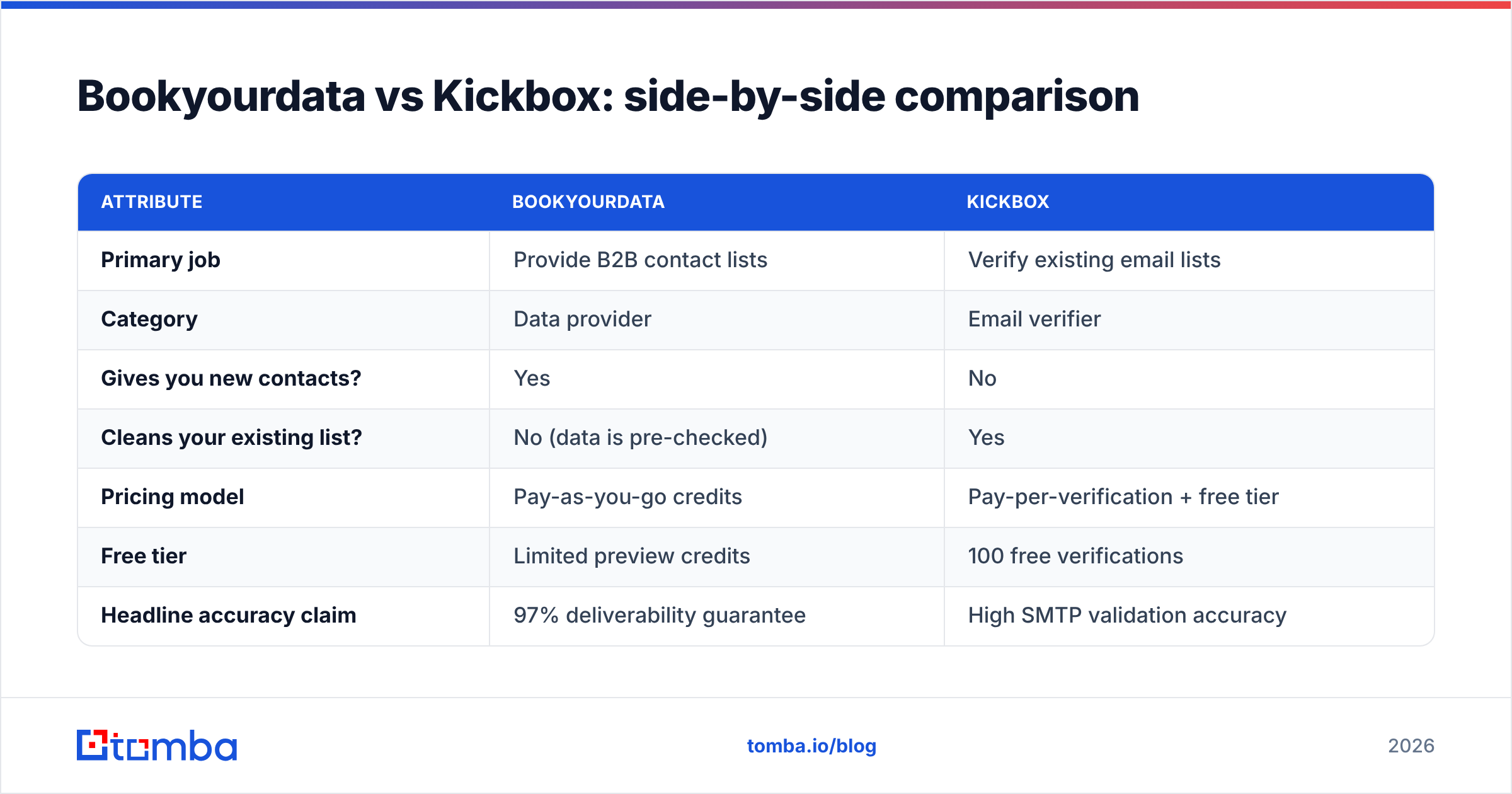
Here's how the two stack up across the attributes that actually drive a buying decision.
| Attribute | Bookyourdata | Kickbox |
|---|---|---|
| Primary job | Provide B2B contact lists | Verify existing email lists |
| Category | Data provider | Email verifier |
| Gives you new contacts? | Yes | No |
| Cleans your existing list? | No (data is pre-checked) | Yes |
| Pricing model | Pay-as-you-go credits | Pay-per-verification + free tier |
| Free tier | Limited preview credits | 100 free verifications |
| Headline accuracy claim | 97% deliverability guarantee | High SMTP validation accuracy |
| Real-time API | Limited | Yes (verification API) |
| Best for | Buying targeted lists fast | Hygiene before a send |
| Data freshness risk | Snapshot, ages over time | N/A — checks at time of run |
The takeaway from the table: these tools live in different stages of the same pipeline. You'd plausibly use both — buy from one, verify with the other — rather than choose one to replace the other.
Is Bookyourdata better than Kickbox?#
Wrong question, but here's the honest answer: it depends entirely on what you're missing.
- You have no contacts at all? Kickbox is useless to you today. You need a data source first — Bookyourdata, an email finder, or a domain search tool.
- You have a list (scraped, exported, inherited) and a high bounce rate? Bookyourdata won't help; you need verification. That's Kickbox's lane.
- You bought a Bookyourdata list six months ago? Run it through a verifier before reusing it — the snapshot has aged.
A useful way to think about it: Bookyourdata is the acquisition layer and Kickbox is the hygiene layer. Asking which is "better" is like asking whether a faucet or a water filter is better. They solve different problems in the same plumbing.
How much do Bookyourdata and Kickbox cost in 2026?#
Both avoid forced annual contracts, which is refreshing in a market full of lock-in.
Bookyourdata runs on credit packs. You pay per contact revealed, with volume discounts as pack size grows. Because pricing is per-record, your true cost depends on how tightly you filter — buy 10,000 loosely-targeted contacts and you'll pay for thousands you never email.
Kickbox charges per verification, also in packs, with a standing free tier (100 verifications) so you can test quality before committing. Per-email cost drops at higher volumes.
A rough framing of where each spends best:
- Low volume, exact targeting — Bookyourdata works if you filter hard; otherwise per-record cost balloons.
- One-time list cleanup — Kickbox's pay-as-you-go verification is ideal; no subscription needed.
- Ongoing prospecting — neither pay-per-record model is cheap at scale; a finder subscription with predictable monthly search limits usually wins.
- Form/signup protection — Kickbox's real-time API is purpose-built for this.
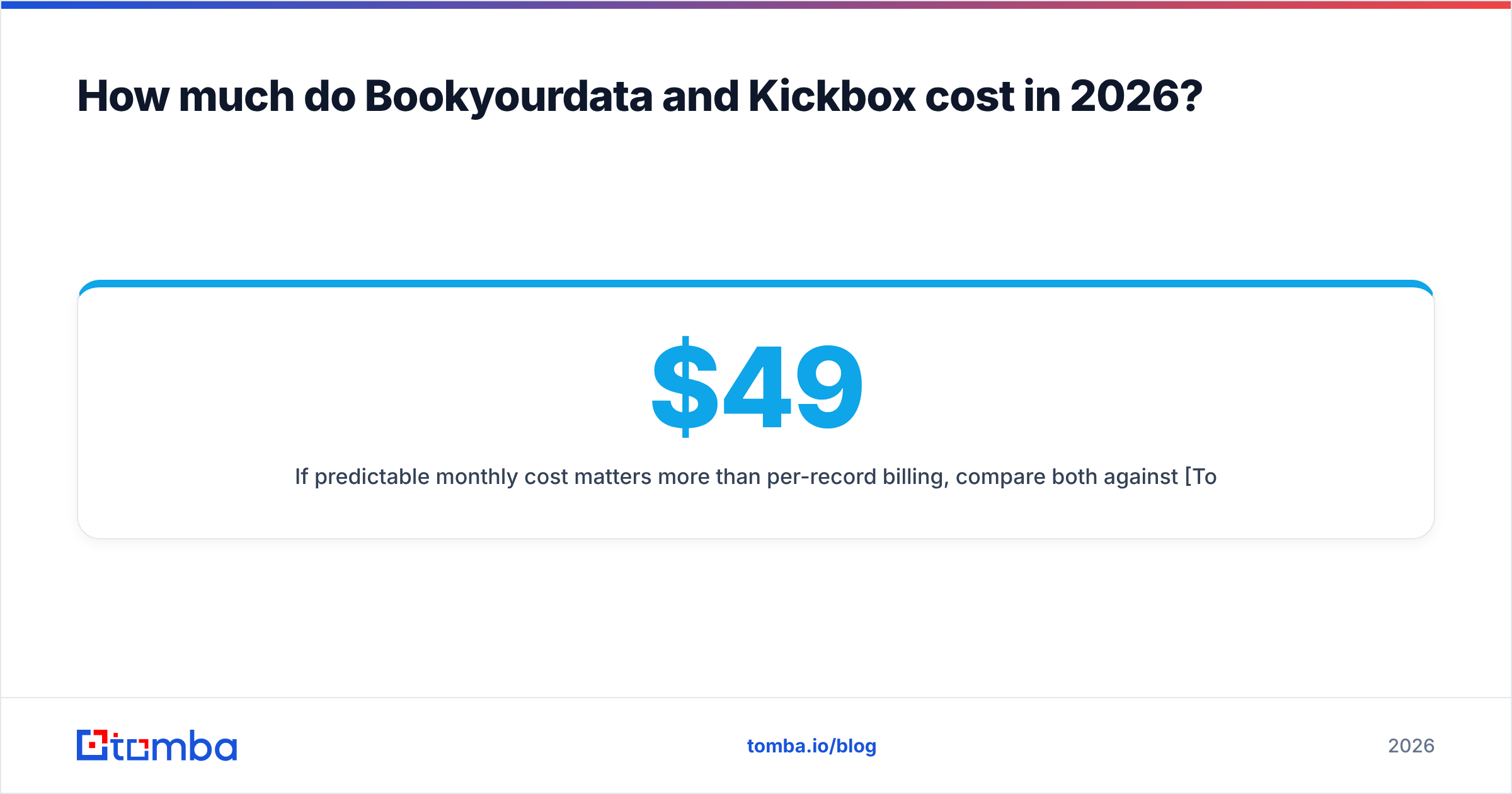
If predictable monthly cost matters more than per-record billing, compare both against Tomba pricing: a Free tier (25 searches/mo), Starter at $49/mo, Growth at $99/mo, and Pro at $249/mo — flat plans rather than metered credit burn.
Where does an email finder fit in?#
Here's the part most "bookyourdata vs kickbox" comparisons skip: buying a bulk list is often the wrong move entirely.
Bought databases optimize for volume. But modern outbound rewards precision — you identify the specific people at the specific accounts you want, then find their verified emails on demand. That's a finder's job, not a list vendor's.
An email finder like Tomba flips the workflow:
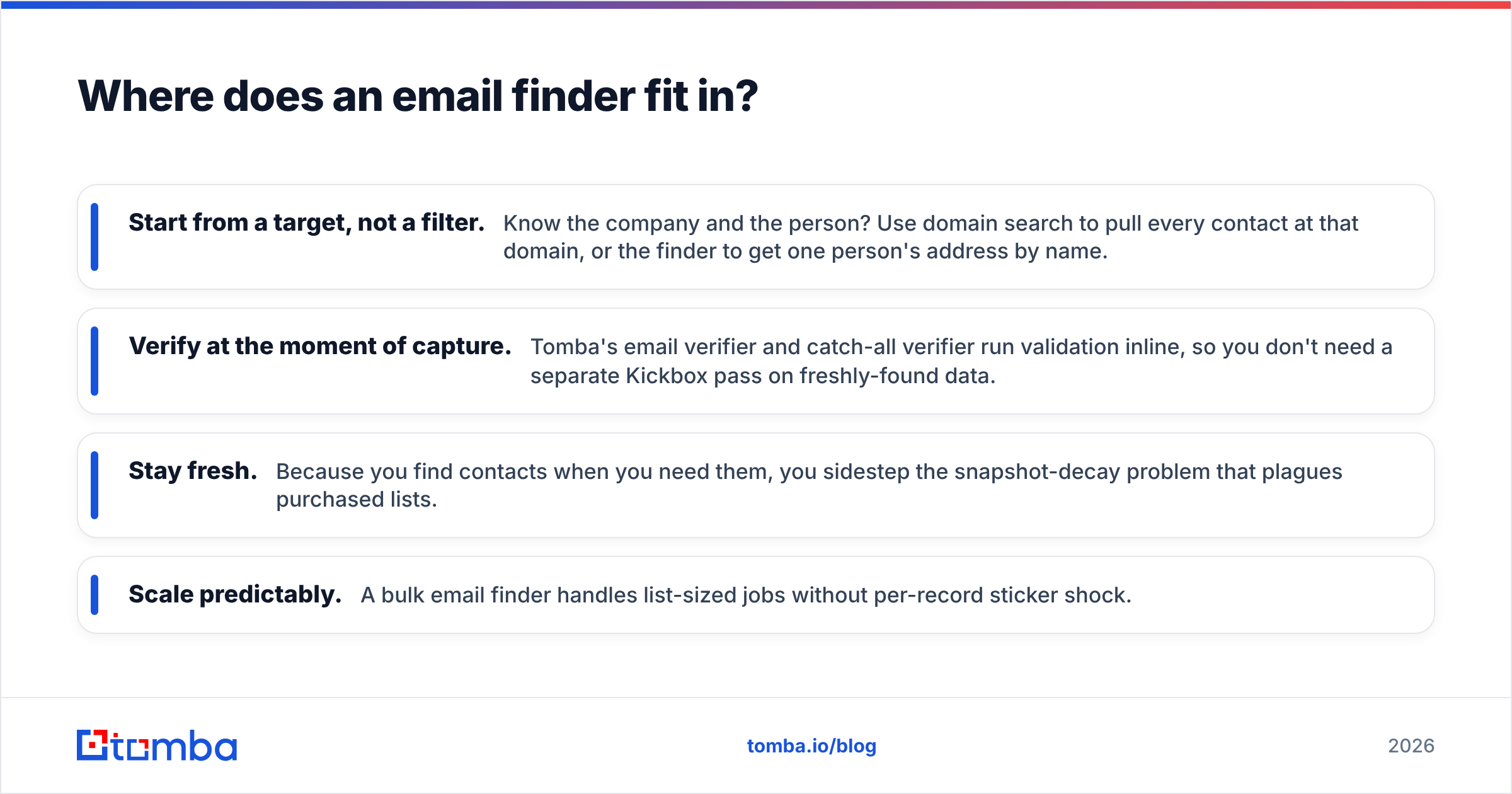
- Start from a target, not a filter. Know the company and the person? Use domain search to pull every contact at that domain, or the finder to get one person's address by name.
- Verify at the moment of capture. Tomba's email verifier and catch-all verifier run validation inline, so you don't need a separate Kickbox pass on freshly-found data.
- Stay fresh. Because you find contacts when you need them, you sidestep the snapshot-decay problem that plagues purchased lists.
- Scale predictably. A bulk email finder handles list-sized jobs without per-record sticker shock.
That last point matters: a finder collapses acquisition and hygiene — the exact two layers Bookyourdata and Kickbox split between them — into one workflow.
What about data accuracy and compliance?#
Accuracy is where the categories diverge most.
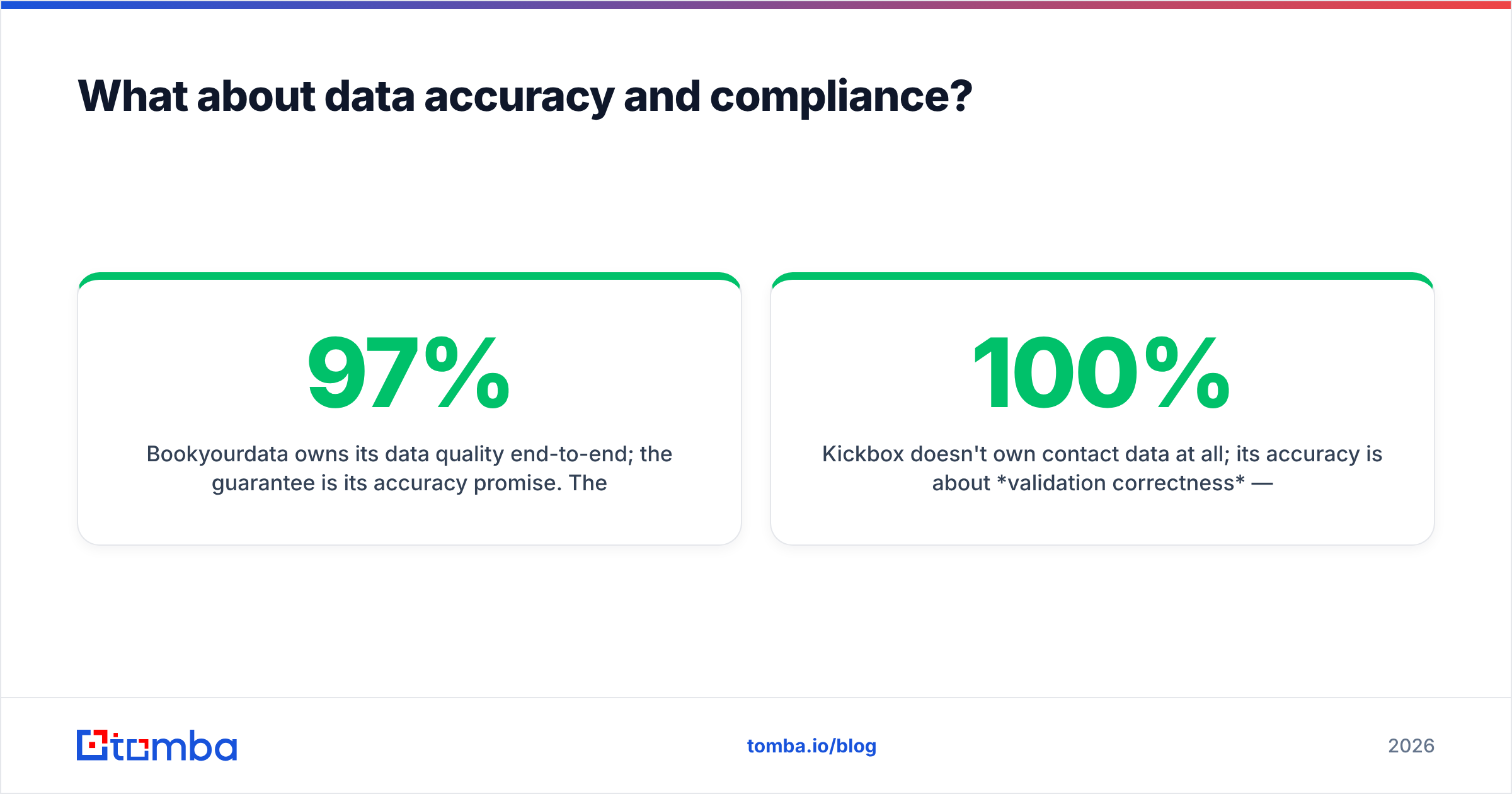
Bookyourdata owns its data quality end-to-end; the 97% guarantee is its accuracy promise. The risk isn't the day-one accuracy — it's decay. A list that's 97% deliverable on export day drifts as people change roles, companies fold, and domains lapse. There's also the compliance dimension: buying lists puts the onus on you to honor GDPR/CAN-SPAM consent and lawful-basis rules. Always confirm how a provider sources and refreshes records — see how transparent vendors document their data sources.
Kickbox doesn't own contact data at all; its accuracy is about validation correctness — does it correctly classify a given address as deliverable? Its reputation here is strong, and it's candid about the inherent uncertainty of catch-all domains, which no verifier can resolve with 100% confidence.
If catch-all domains are a recurring headache (they're common in enterprise), a dedicated catch-all finder is worth more than a generic verifier's "risky" flag, because it attempts resolution rather than just labeling.
For independent reviews, cross-check both vendors on G2 and read each one's own documentation at bookyourdata.com and kickbox.com before committing budget — vendor claims and verified-buyer reviews rarely match perfectly.
Which should you choose?#
Match the tool to the gap in your pipeline:
| Your situation | Best fit |
|---|---|
| Need contacts now, will filter tightly | Bookyourdata |
| Have a dirty list, need to clean it | Kickbox |
| Protecting signup forms in real time | Kickbox API |
| Ongoing, targeted prospecting | Email finder (Tomba) |
| Want acquisition + verification in one | Email finder (Tomba) |
| One-off bulk list, then never again | Bookyourdata + a verification pass |
The most common mistake is treating this as an either/or when your real workflow needs both acquisition and hygiene. If you go the buy-a-list route, plan to verify it. If you'd rather not stitch two tools together — and pay two bills — a finder with built-in verification is the simpler stack.
The bottom line#
Bookyourdata and Kickbox aren't competitors; they're two stages of the same job. Bookyourdata supplies contacts. Kickbox confirms contacts are reachable. Choose Bookyourdata when you need a list fast and can filter precisely. Choose Kickbox when you already have data and bounce rates are hurting your email deliverability. Use both when you're doing one-time bulk work.
But if your real need is ongoing, targeted outbound — finding the right people and reaching them with verified addresses — skip the static-list-plus-separate-verifier dance. Tomba's Email Finder combines precise contact discovery with inline verification, so you find fresh, deliverable emails the moment you need them instead of buying a snapshot that's already aging. Start free with 25 searches a month, then scale on flat plans starting at $49/mo — no per-record surprises. Find your next 100 prospects with Tomba Email Finder and verify them in the same step.
// get started
Find, verify and enrich your first contacts today
Start on the free plan with 25 searches a month, then scale when your team is ready.
Free plan · No credit card required · GDPR & CCPA
// about the author