Bookyourdata vs Leadgibbon: B2B Data Compared (2026)
Bookyourdata vs Leadgibbon: a no-spin breakdown of pricing, data accuracy, credits, and coverage so you pick the right B2B data source in 2026.
Bookyourdata vs Leadgibbon: Which B2B Data Tool Wins in 2026?
You need contact data, you have two tabs open, and both vendors swear they have the freshest records on the planet. Bookyourdata and Leadgibbon target the same buyer — sales and marketing teams who want emails and phone numbers without building a scraper — but they solve the problem in very different ways. This guide breaks down how they actually compare, where each one is strong, and when a verification-first finder beats both.
TL;DR#
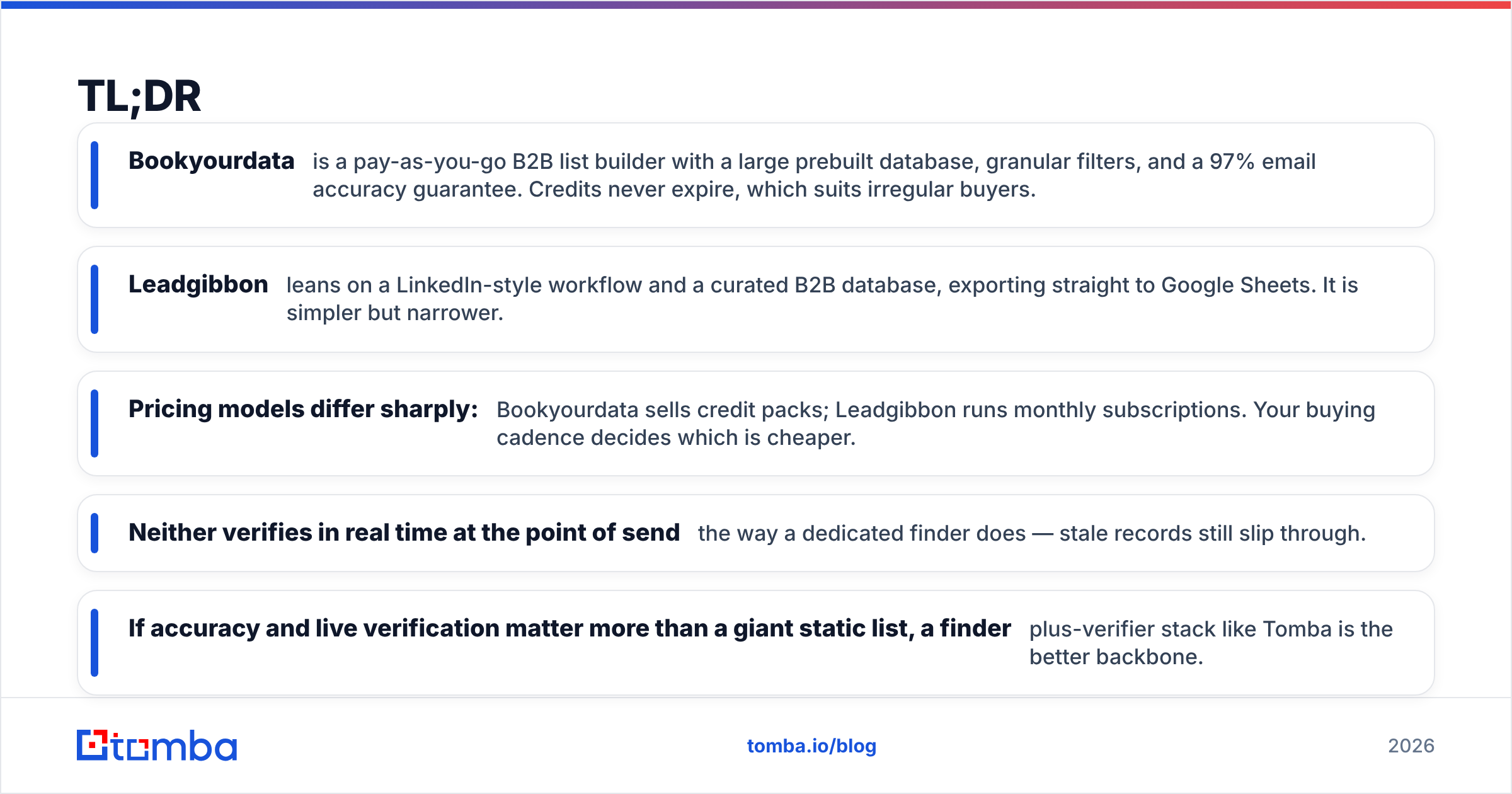
- Bookyourdata is a pay-as-you-go B2B list builder with a large prebuilt database, granular filters, and a 97% email accuracy guarantee. Credits never expire, which suits irregular buyers.
- Leadgibbon leans on a LinkedIn-style workflow and a curated B2B database, exporting straight to Google Sheets. It is simpler but narrower.
- Pricing models differ sharply: Bookyourdata sells credit packs; Leadgibbon runs monthly subscriptions. Your buying cadence decides which is cheaper.
- Neither verifies in real time at the point of send the way a dedicated finder does — stale records still slip through.
- If accuracy and live verification matter more than a giant static list, a finder-plus-verifier stack like Tomba is the better backbone.
What is Bookyourdata?#
Bookyourdata is a self-service B2B contact database. You filter by job title, industry, company size, location, technology used, and more, then buy the records you want with credits. The pitch is simple: build a targeted list in minutes, pay only for what you take, and rely on a 97% deliverability guarantee that refunds credits for bounced emails.
The standout feature is that credits never expire. If you run outbound in bursts — a campaign this quarter, nothing next quarter — you are not paying for a subscription that idles. You can read their model on the Bookyourdata site, but the short version is: it behaves like a data vending machine, not a SaaS seat.

Where it gets interesting is enrichment. Bookyourdata returns emails, direct dials, company firmographics, and some technographic signals. That makes it a reasonable one-stop shop if you want a static export to drop into a CRM or sequencer. The tradeoff: a prebuilt database is only as fresh as its last refresh, and B2B data decays roughly 2–3% every month as people change jobs.
What is Leadgibbon?#
Leadgibbon is a lighter-weight B2B email and lead tool built around a curated database and a browser-driven workflow. Its core appeal is speed: find decision-makers, reveal verified business emails, and push the results straight into Google Sheets without a manual CSV dance.
Leadgibbon markets itself to founders, recruiters, and small sales teams who want a clean, no-friction way to pull a few hundred contacts a month. It runs on monthly subscription tiers rather than perpetual credits, so the economics reward steady, predictable usage. You can see the current packaging on the Leadgibbon homepage.
The limitation is scope. Leadgibbon's database and filtering depth are narrower than a full data platform, and its enrichment fields are fewer. For a focused prospecting motion that lives in a spreadsheet, that simplicity is a feature. For multi-segment, high-volume outbound, it can feel constrained.
Bookyourdata vs Leadgibbon: How do they compare?#
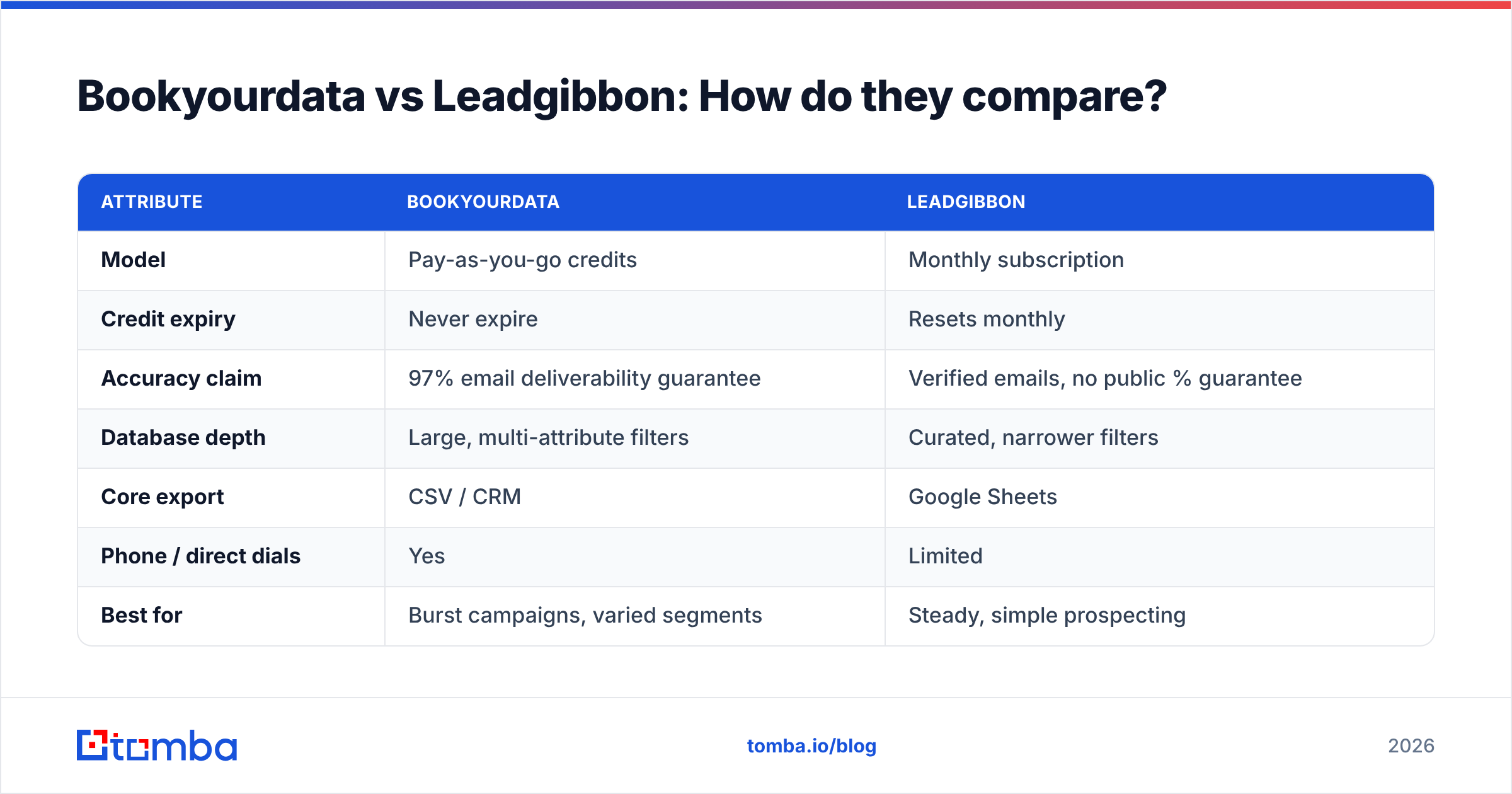
Here is the side-by-side on the attributes that actually change your buying decision. Figures reflect publicly listed positioning in 2026; always confirm current numbers on each vendor's pricing page before you commit.
| Attribute | Bookyourdata | Leadgibbon |
|---|---|---|
| Model | Pay-as-you-go credits | Monthly subscription |
| Credit expiry | Never expire | Resets monthly |
| Accuracy claim | 97% email deliverability guarantee | Verified emails, no public % guarantee |
| Database depth | Large, multi-attribute filters | Curated, narrower filters |
| Core export | CSV / CRM | Google Sheets |
| Phone / direct dials | Yes | Limited |
| Best for | Burst campaigns, varied segments | Steady, simple prospecting |
| Real-time verification | At export, not at send | At export, not at send |
A few takeaways from the table:
- Buying cadence is the real decision. Irregular buyers save with Bookyourdata's non-expiring credits. Consistent monthly users often get a lower effective cost-per-lead from Leadgibbon's flat fee.
- Filter depth favors Bookyourdata. If you run many distinct ICPs, the broader attribute set matters.
- Workflow simplicity favors Leadgibbon. Sheets-native export removes a step for spreadsheet-driven teams.
- Both ship static records. Neither re-checks an address the moment you actually email it, which is where bounces creep in.
Which has better data accuracy?#
Bookyourdata advertises a 97% deliverability guarantee with credit refunds on bounces, which is a stronger explicit commitment than Leadgibbon's general "verified emails" language. But a guarantee on a stored record is not the same as verification at the moment of contact.

Any prebuilt list ages. Someone who was a verified VP of Marketing when the database refreshed may have left three weeks later. That is why high-deliverability teams treat purchased data as a starting point and run a separate email verification pass right before launch — and re-check catch-all domains with a dedicated catch-all verifier rather than trusting a "valid" flag from an old snapshot. The cleaner your list at send time, the better your sender reputation and inbox placement hold up. If you want the background, Tomba's primer on email deliverability is a useful reference.
The honest read: Bookyourdata's guarantee is the more reassuring number on paper, but accuracy is a process, not a one-time stat. Both tools benefit enormously from a verification layer you control.
Which is cheaper for your team?#
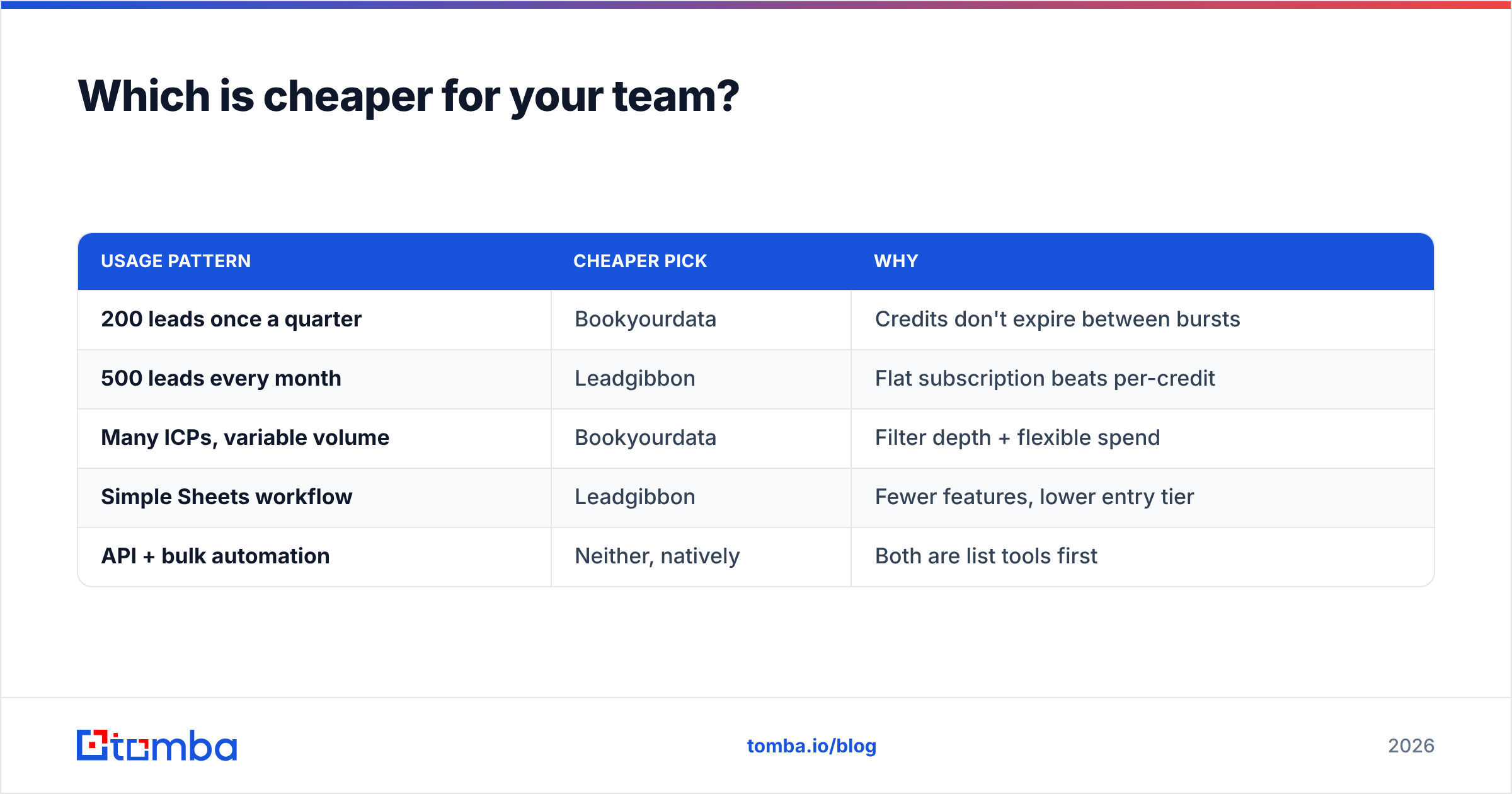
There is no universal answer — it depends entirely on volume and rhythm. Run the math against your real pipeline, not a vendor's headline price.
| Usage pattern | Cheaper pick | Why |
|---|---|---|
| 200 leads once a quarter | Bookyourdata | Credits don't expire between bursts |
| 500 leads every month | Leadgibbon | Flat subscription beats per-credit |
| Many ICPs, variable volume | Bookyourdata | Filter depth + flexible spend |
| Simple Sheets workflow | Leadgibbon | Fewer features, lower entry tier |
| API + bulk automation | Neither, natively | Both are list tools first |
The pattern is clear: Bookyourdata wins on flexibility, Leadgibbon wins on predictability. If your outbound is lumpy, non-expiring credits stop you from paying for idle months. If it is steady, a subscription smooths your cost-per-lead.

What both models share is a ceiling. They sell records, not infrastructure. The moment you want to enrich on the fly inside a CRM, trigger lookups from a workflow, or verify at scale through an email finder API, you have outgrown the "buy a list" pattern entirely.
When should you choose a finder-and-verifier instead?#
Choose a finder-first stack when accuracy at send time, automation, and pay-for-what-you-find economics matter more than owning a giant static database. This is the gap Tomba is built for.
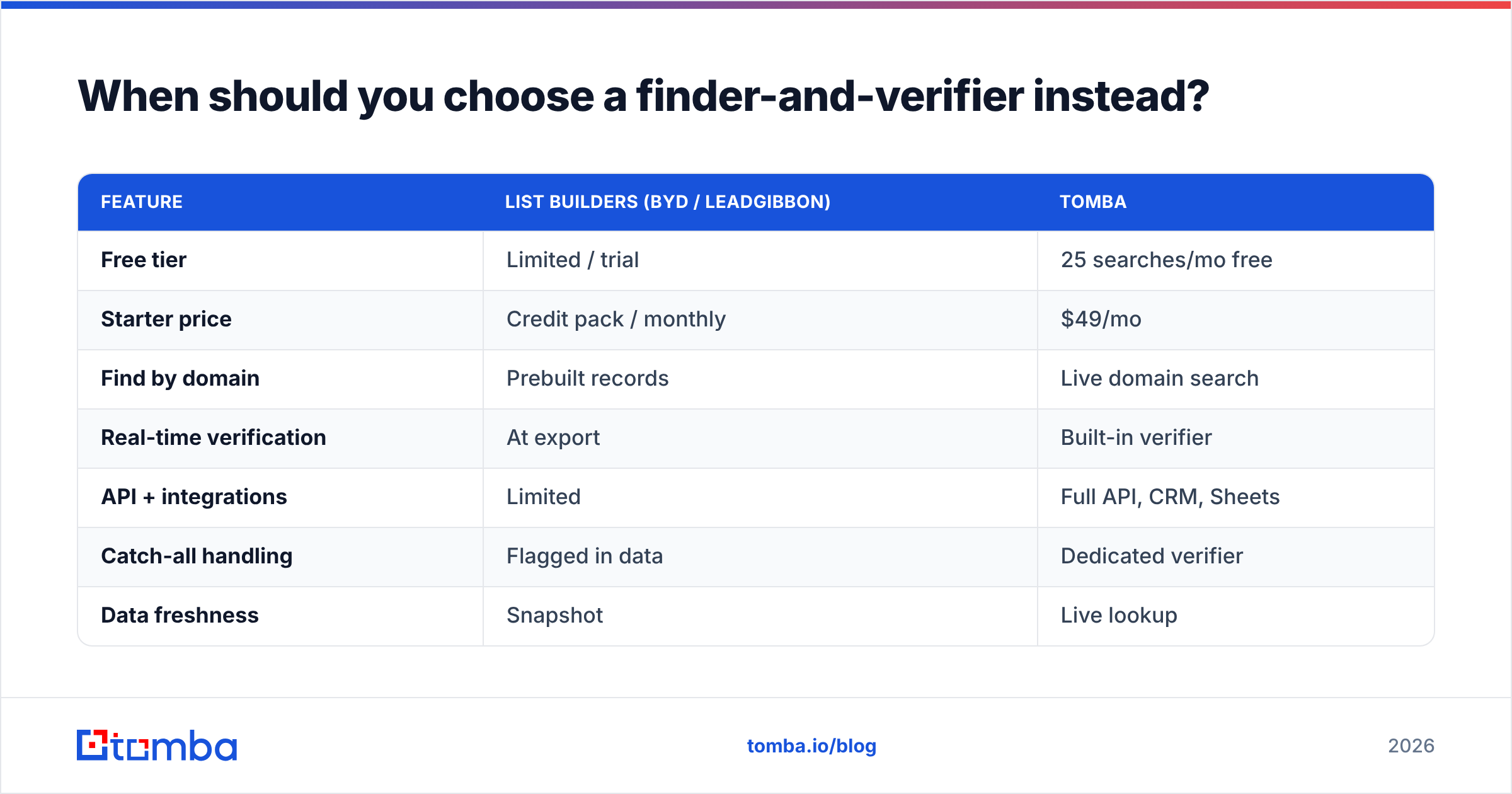
Instead of buying a frozen snapshot, you find the specific contacts you need — by name, by company, or across a whole domain with domain search — and verify them in the same motion. Here is how the approaches differ:
| Feature | List builders (BYD / Leadgibbon) | Tomba |
|---|---|---|
| Free tier | Limited / trial | 25 searches/mo free |
| Starter price | Credit pack / monthly | $49/mo |
| Find by domain | Prebuilt records | Live domain search |
| Real-time verification | At export | Built-in verifier |
| API + integrations | Limited | Full API, CRM, Sheets |
| Catch-all handling | Flagged in data | Dedicated verifier |
| Data freshness | Snapshot | Live lookup |
A few honest caveats. If you specifically want to browse and buy a pre-segmented list of, say, 5,000 dentists in Texas without doing any targeting work yourself, a database like Bookyourdata is genuinely more convenient — that is its core strength. Tomba shines when you know who or which companies you are after and need accurate, verified contact details with automation around them. Different jobs.
For teams running modern outbound, the finder approach usually wins on cost and deliverability because you are not paying for records you never touch, and you are verifying at the moment that matters. You can compare full Tomba pricing against your current per-lead spend to see where the line falls. Independent reviews on G2 are a sensible cross-check before you decide.
What about phone numbers and multichannel?#
Bookyourdata includes direct dials in many records, which is a real advantage if your motion is phone-heavy. Leadgibbon's phone coverage is thinner and more email-centric. If cold calling is core to your pipeline, weight that difference heavily.
That said, phone data decays even faster than email. A direct dial pulled six months ago has decent odds of being wrong. Pairing any data source with a live phone finder and phone validator keeps your dialer connect rates from quietly collapsing. The same logic from email applies: stored is convenient, verified-at-use is accurate.
Bookyourdata vs Leadgibbon: the verdict#
Pick Bookyourdata if you want a deep, flexible, pay-as-you-go database with non-expiring credits, strong filtering, direct dials, and an explicit accuracy guarantee — ideal for burst campaigns across varied segments.
Pick Leadgibbon if you want a simple, Sheets-native prospecting tool with predictable monthly pricing and a curated database — ideal for founders and small teams running a steady, focused motion.
But if your real goal is high deliverability and automation rather than owning the biggest list, a finder-and-verifier stack beats both. You stop paying for stale records, you verify at send time, and you wire lookups directly into your CRM and outbound tools.
Ready to build cleaner lists?#
Stop choosing between a giant snapshot and a narrow one. With the Tomba Email Finder you find the exact contacts you need by name, company, or domain — then verify them in the same workflow so your bounce rate stays low and your sender reputation stays healthy. Start free with 25 searches a month, scale on the $49/mo Starter plan when you are ready, and connect it to your CRM, Google Sheets, or your own scripts through the API. Targeted, verified, and built for outbound that actually lands in the inbox.
// get started
Find, verify and enrich your first contacts today
Start on the free plan with 25 searches a month, then scale when your team is ready.
Free plan · No credit card required · GDPR & CCPA
// about the author