Bookyourdata vs Listclean 2026: B2B Data Tools Compared
Bookyourdata sells ready-made B2B contact lists; Listclean scrubs the lists you already have. Here's which one fits your pipeline in 2026 — and where a third option beats both.
TL;DR
- Bookyourdata is a pay-as-you-go B2B contact database — you buy ready-made lists filtered by job title, industry, and geography. Listclean is an email verification and list-cleaning tool — it scrubs lists you already own.
- They are not really competitors. One gives you contacts; the other checks contacts. Most teams that buy from Bookyourdata still need something like Listclean before they send.
- Bookyourdata advertises a 97% accuracy guarantee and credit-back policy; Listclean focuses on bounce reduction and syntax/MX/SMTP checks at a lower per-record cost.
- If you want one workflow that finds verified emails on demand instead of buying a bulk list and re-cleaning it, a find-and-verify platform like Tomba is the cheaper, fresher path.
- Pick by job-to-be-done: need net-new contacts → Bookyourdata. Need to de-risk an existing list → Listclean. Want continuously fresh, verified data → read the last section.
What are Bookyourdata and Listclean?#
Short answer: they solve two different problems that people confuse because both touch "email data."
Bookyourdata is a B2B data marketplace. You set filters — job title, company size, industry, location, technology used — and it returns a list of contacts with emails, and sometimes phone numbers and LinkedIn URLs. You pay per credit and download a CSV. Think of it like buying a pre-packed box of groceries: convenient, but you're trusting that nothing inside has gone off.
Listclean is an email verification service. You upload a list you already have — exported from your CRM, scraped, or bought elsewhere — and it removes invalid, risky, and duplicate addresses so your bounce rate stays low. It's the equivalent of checking every item's expiry date before you cook.
The overlap is small but important: a bought list decays the moment it's generated. People change jobs at roughly 20–30% per year, so even a "97% accurate" list is materially worse six months later. That's why buying and cleaning are usually sequential steps, not rival products.
How do Bookyourdata and Listclean compare head-to-head?#
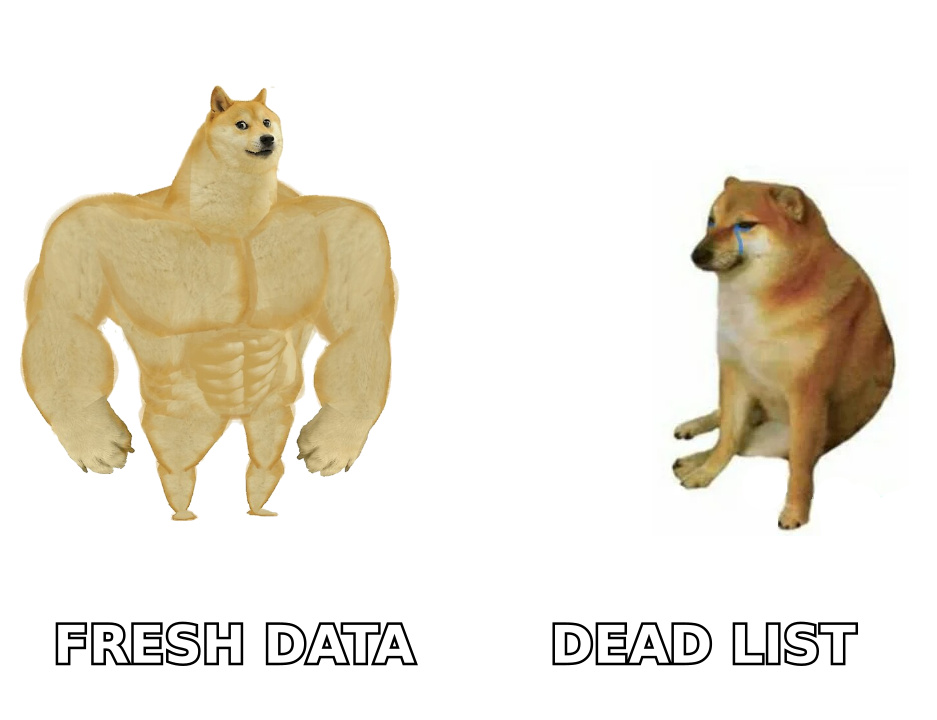
Here's the practical breakdown across the attributes that actually affect your campaigns.
| Attribute | Bookyourdata | Listclean |
|---|---|---|
| Primary job | Buy net-new B2B contacts | Clean/verify existing lists |
| Data direction | Gives you contacts | Checks your contacts |
| Pricing model | Pay-as-you-go credits | Per-verification credits |
| Accuracy claim | ~97% email accuracy guarantee | Bounce-rate reduction via SMTP checks |
| Phone numbers | Yes (on many records) | No |
| Freshness control | Snapshot at purchase | N/A (you supply data) |
| Free tier | Sample/free credits to test | Small free verification batch |
| Best for | Building a list from scratch | De-risking before you send |
| Weakness | Decays after download | Can't create new leads |
Read the table as two halves of one funnel. Bookyourdata fills the top (sourcing); Listclean protects the bottom (deliverability). Neither replaces the other, which is exactly why the "vs" framing is misleading for most buyers.
Is Bookyourdata's accuracy guarantee worth it?#
Mostly yes — with an asterisk. A credit-back guarantee on bounced emails is genuinely useful because it shifts some risk back to the vendor. If a record bounces, you're not paying for dead weight.
But "accurate at the moment of sale" and "accurate when you send" are different claims. A guarantee covers syntax and mailbox existence at export time. It does not cover the prospect who changed companies last week, the address that became a catch-all since the snapshot, or the role account that nobody reads. That's why even guaranteed lists benefit from a fresh verification pass right before a campaign — which is precisely Listclean's pitch.
Two habits keep bought data honest:
- Re-verify on send, not on purchase. Run the list through an email verifier within 48 hours of your first send.
- Segment by risk. Separate confirmed-valid from catch-all and unknown, and warm up sends to the riskier tier slowly.
For deeper background on why this matters, see the concept of email deliverability — bounce rate is a primary input to your sender reputation, and one bad bulk send can suppress inbox placement for weeks.
What does each tool actually cost?#
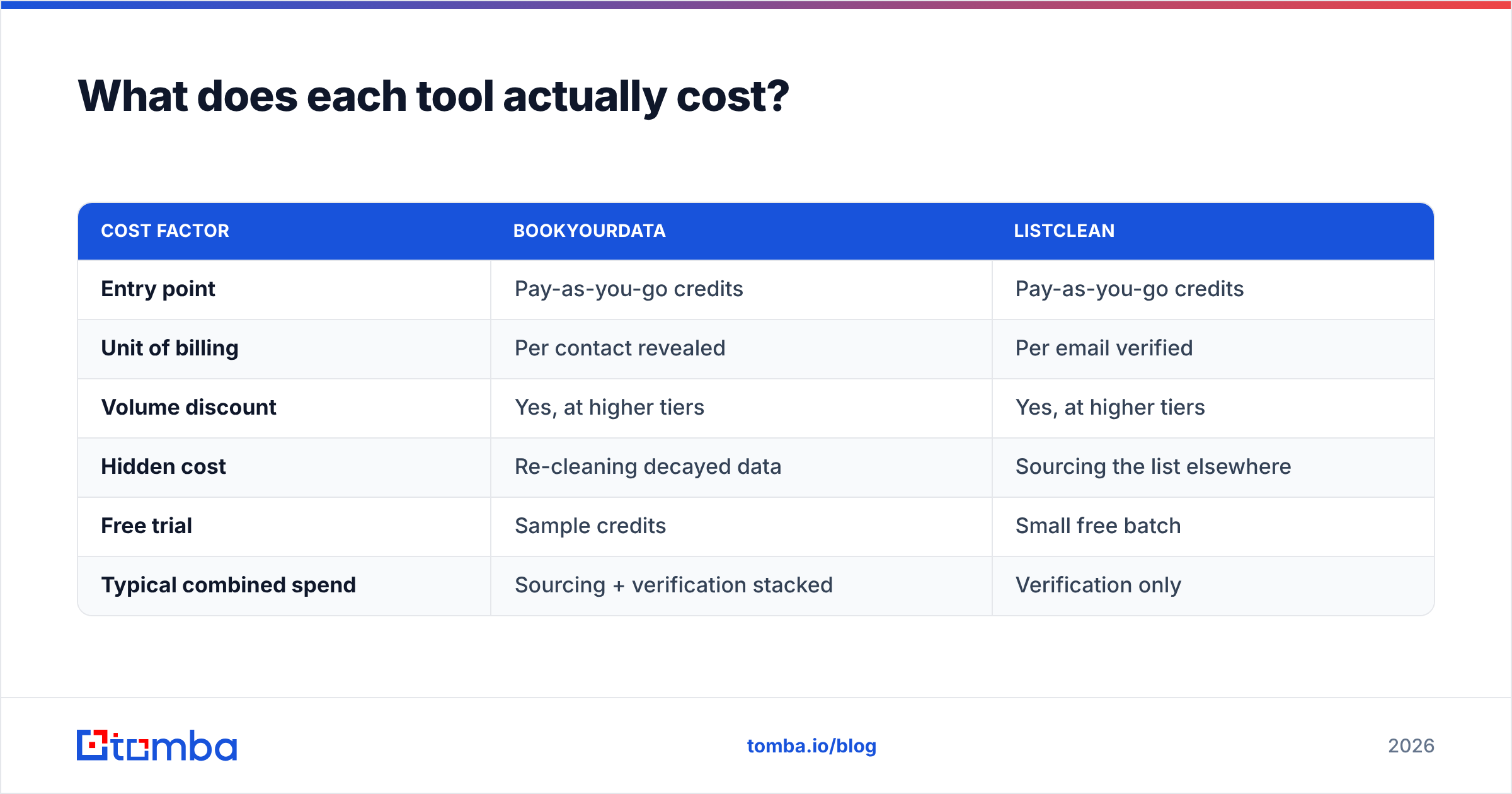
Both use credit models, so cost depends on volume rather than a flat subscription. The key difference: with Bookyourdata you pay for records produced; with Listclean you pay for records checked. If you buy a list and then clean it, you pay both.
| Cost factor | Bookyourdata | Listclean |
|---|---|---|
| Entry point | Pay-as-you-go credits | Pay-as-you-go credits |
| Unit of billing | Per contact revealed | Per email verified |
| Volume discount | Yes, at higher tiers | Yes, at higher tiers |
| Hidden cost | Re-cleaning decayed data | Sourcing the list elsewhere |
| Free trial | Sample credits | Small free batch |
| Typical combined spend | Sourcing + verification stacked | Verification only |
The stacked-cost problem is the quiet story here. A team that buys 10,000 contacts from a database and then runs all 10,000 through a verifier is paying twice for one usable list — and still ends up with a static snapshot. That math is what pushes a lot of buyers toward find-and-verify tools that bundle both steps and only charge for contacts you actually pull.
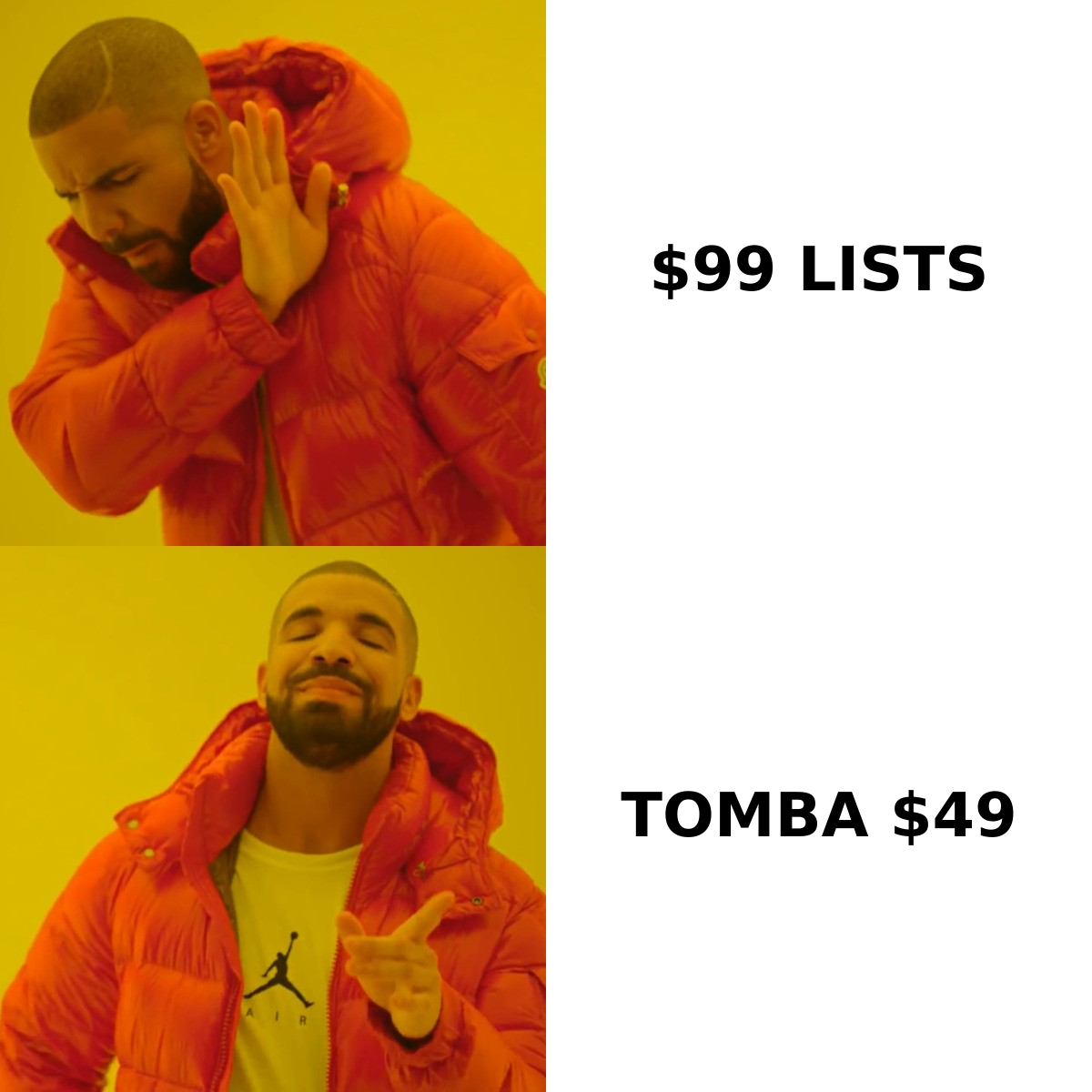
For transparent published numbers, compare against Tomba pricing, which starts with a free tier of 25 searches per month and a Starter plan at $49/mo rather than an open-ended credit meter.
When should you choose Bookyourdata?#
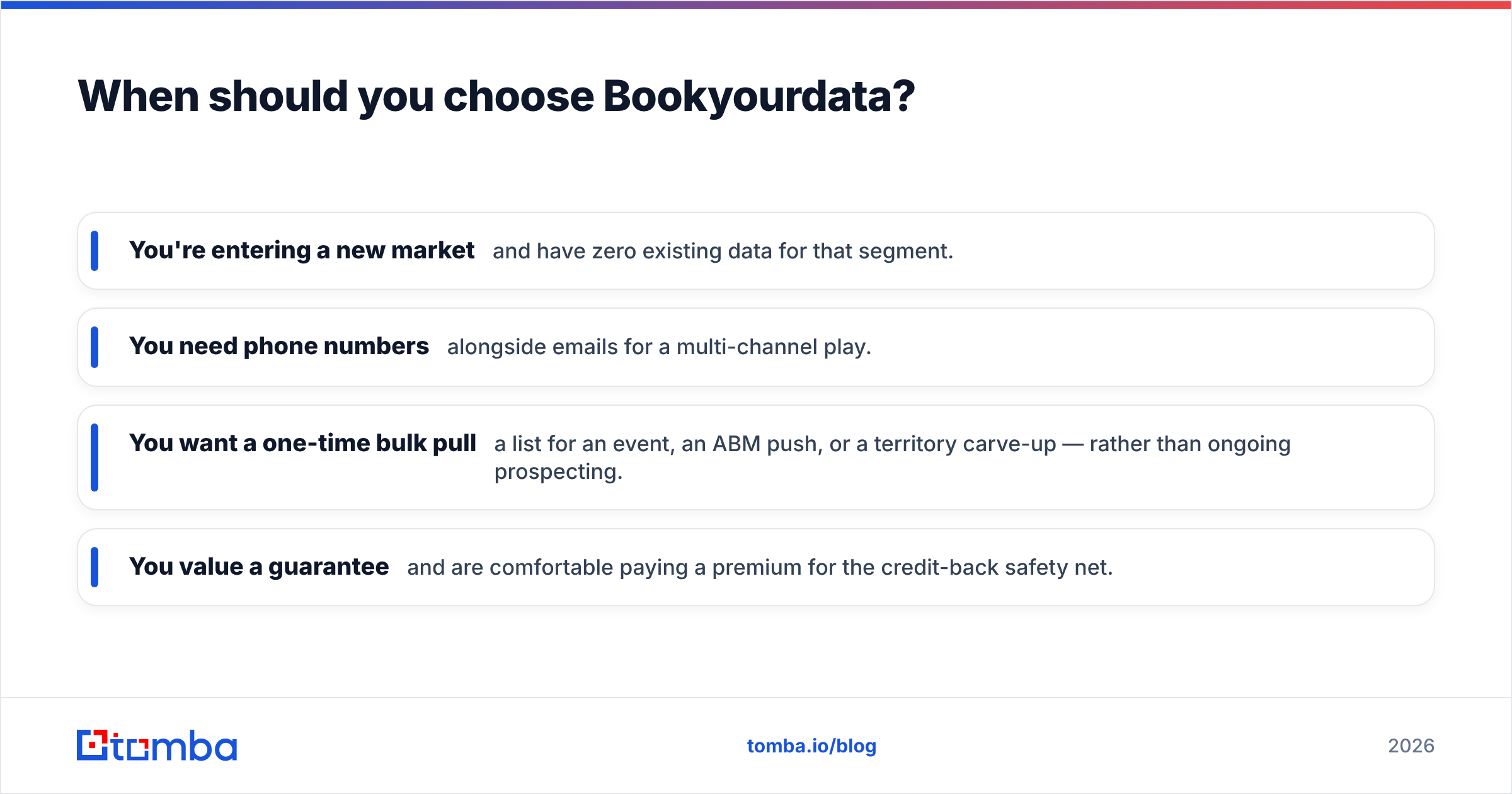
Choose Bookyourdata when your bottleneck is not having enough contacts at all. Specific scenarios where it shines:
- You're entering a new market and have zero existing data for that segment.
- You need phone numbers alongside emails for a multi-channel play.
- You want a one-time bulk pull — a list for an event, an ABM push, or a territory carve-up — rather than ongoing prospecting.
- You value a guarantee and are comfortable paying a premium for the credit-back safety net.
It's a poor fit if your CRM is already full of contacts that have simply gone stale. Buying more records doesn't fix the ones you have — that's a cleaning problem, not a sourcing one.
Independent reviews on G2 and Capterra are the fastest way to sanity-check current accuracy claims against real user reports before you commit credits.
When should you choose Listclean?#
Choose Listclean when your bottleneck is deliverability on a list you already trust the source of. Specific scenarios:
- You exported a CRM segment that hasn't been touched in months and want to cut bounces before a re-engagement send.
- You inherited a list from a merged team, an event sponsorship, or a previous vendor and need to validate it cheaply.
- You're protecting a warmed-up domain and can't afford a spike in hard bounces.
Listclean won't generate a single new lead. If you point at it expecting prospecting, you'll be disappointed. Its value is purely defensive: fewer bounces, cleaner sender reputation, better inbox placement.
Bookyourdata vs Listclean vs a find-and-verify platform#
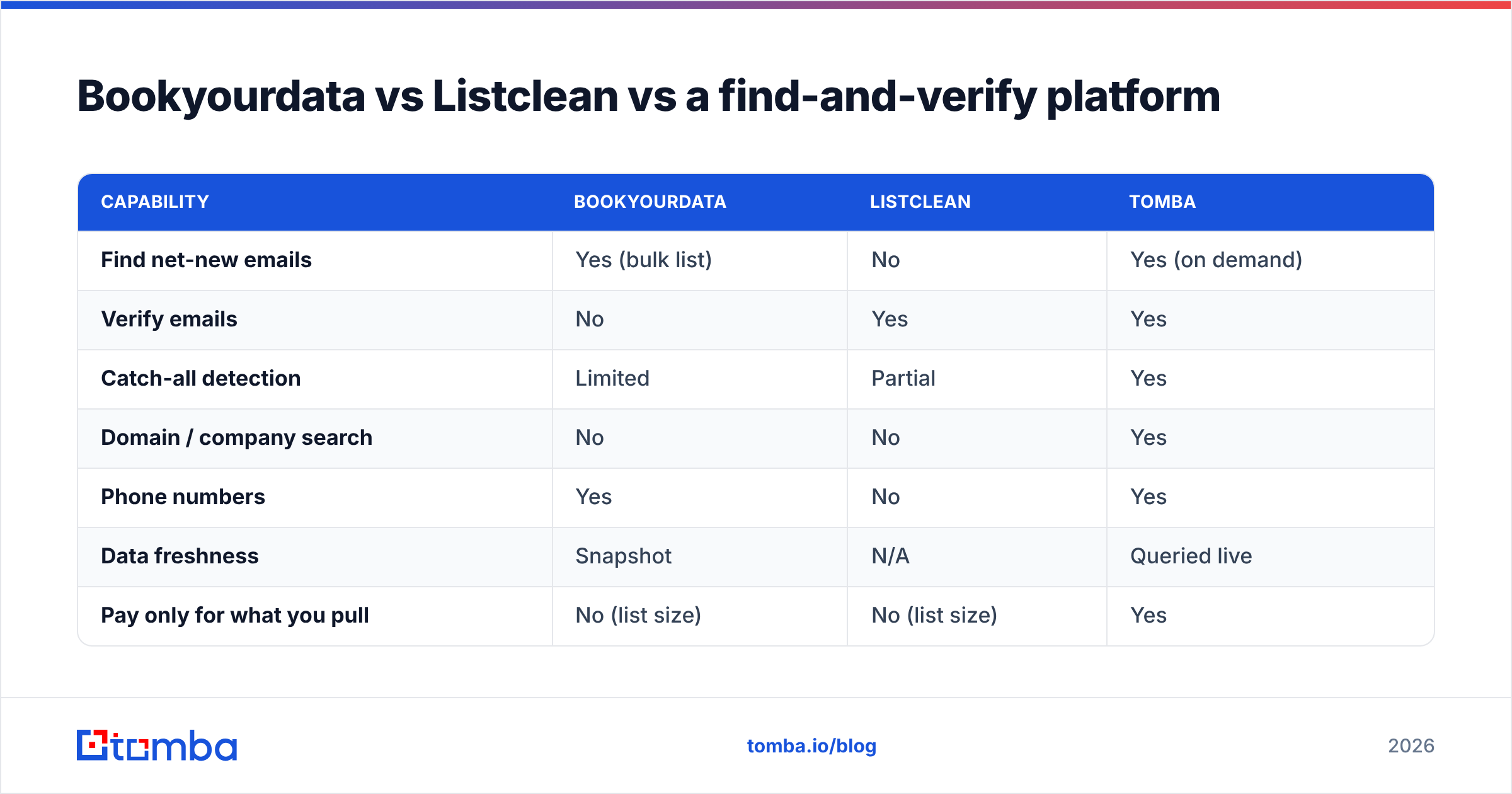
This is the comparison most buyers actually need, because it reframes the choice from "which half do I buy" to "do I need two tools at all."
| Capability | Bookyourdata | Listclean | Tomba |
|---|---|---|---|
| Find net-new emails | Yes (bulk list) | No | Yes (on demand) |
| Verify emails | No | Yes | Yes |
| Catch-all detection | Limited | Partial | Yes |
| Domain / company search | No | No | Yes |
| Phone numbers | Yes | No | Yes |
| Data freshness | Snapshot | N/A | Queried live |
| Pay only for what you pull | No (list size) | No (list size) | Yes |
| Free tier | Sample | Small batch | 25/mo |
| API access | Limited | Yes | Yes |
The structural advantage of a find-and-verify tool is that sourcing and verification happen in the same step, against current data, so you skip the buy-then-re-clean tax entirely. Instead of purchasing a 10,000-row snapshot and scrubbing it, you run a targeted domain search or bulk email finder that returns already-verified contacts for exactly the accounts you're working — and you only spend credits on records you keep.
That doesn't make Bookyourdata or Listclean bad. If you genuinely need a massive one-time list with phone numbers, a database vendor is the right call. If you only ever clean and never source, a dedicated verifier is fine. But for the common case — ongoing outbound where freshness matters more than raw volume — paying for two static steps is the expensive path.
How do I decide in under a minute?#
Match the tool to the sentence that describes your week:
- "I have no contacts for this segment." → Bookyourdata (or a find-and-verify tool if you want freshness).
- "I have a stale list and just need it cleaned." → Listclean (or any solid email verification tool).
- "I prospect continuously and hate paying twice for one list." → A find-and-verify platform.
- "I need phone and email for multi-channel." → Bookyourdata, or Tomba's combined finder with phone finder.
One more rule of thumb: never send to a freshly bought list without a verification pass, and never assume a cleaned list is complete — cleaning removes bad rows, it doesn't add good ones. The two jobs are complementary, which is the entire reason single-platform find-and-verify exists.
Frequently asked questions#
Is Bookyourdata the same as Listclean? No. Bookyourdata is a B2B contact database you buy lists from; Listclean is a verification service that cleans lists you already have. They sit at opposite ends of the same funnel.
Do I still need to verify a list I bought from Bookyourdata? Yes, ideally. Even guaranteed lists decay between purchase and send because people change jobs constantly. A quick verification pass right before sending protects your bounce rate.
Which is cheaper, Bookyourdata or Listclean? They bill for different things, so direct comparison is unfair. Sourcing (Bookyourdata) costs more per record than verification (Listclean). Buying then cleaning means paying for both — which is why bundled find-and-verify tools often win on total cost.
Can one tool do both? Yes. Find-and-verify platforms locate net-new emails and verify them in a single step, against live data, so you avoid the buy-then-re-clean stack.
The bottom line#
Bookyourdata and Listclean aren't really rivals — they're two stops on the same assembly line. Bookyourdata builds the list; Listclean polishes it. If your work is genuinely one-and-done, pick the half you're missing. But if you prospect every week and resent paying twice for a snapshot that's already aging, collapse both steps into one.
That's where Tomba's Email Finder fits: search by name, company, or domain and get back addresses that are already verified, with catch-all detection, phone enrichment, and a clean API — starting free at 25 searches a month and $49/mo when you scale. Stop buying static lists and re-cleaning them. Find fresh, verified contacts the moment you need them, and put your credits toward people who'll actually reply.
// get started
Find, verify and enrich your first contacts today
Start on the free plan with 25 searches a month, then scale when your team is ready.
Free plan · No credit card required · GDPR & CCPA
// about the author