BookYourData vs ListKit 2026: B2B Data Tools Compared
BookYourData sells pay-as-you-go verified contacts; ListKit bundles data with cold-email workflow. Here's which B2B data tool fits your team in 2026 — and where a verify-first stack beats both.
Choosing between BookYourData and ListKit comes down to one question: do you want to buy a contact list, or build an outbound machine? Both promise B2B contact data, but they solve different problems — and pricing one against the other without that context leads to wasted budget and dead inboxes.
This guide breaks down BookYourData vs ListKit on data accuracy, pricing, verification, and real outbound workflow, then shows where a verify-first approach beats buying static lists at all.
TL;DR — BookYourData vs ListKit at a glance#
- BookYourData is a pay-as-you-go B2B contact database. You filter by industry, title, and geography, then buy verified records as a one-time download. Best for one-off list pulls.
- ListKit bundles B2B data with a cold-email workflow — you build lists and push them into sequences inside one platform. Best for agencies running high-volume outbound.
- Accuracy is the real battleground. Both claim high deliverability, but any purchased list decays ~2–3% per month. Re-verification at send time matters more than the vendor's headline number.
- Neither is the cheapest path to accurate data. A find-and-verify stack like Tomba lets you source contacts on demand and confirm them before sending, instead of paying for stale rows.
- Pick BookYourData for occasional bulk buys, ListKit for an all-in-one agency motion, and a verification-first tool when accuracy and cost-per-valid-contact are what you actually care about.
What is BookYourData?#
BookYourData is a self-serve B2B contact database that sells email lists on a pay-as-you-go basis. You open the list builder, apply filters (industry, job title, company size, location, technology), preview the count, and pay per record — no subscription required. It markets a 97% deliverability guarantee and refunds credits for bounced addresses.
The model is simple and that's the appeal. You need 2,000 SaaS marketing directors in the US? Filter, buy, export to CSV, done. There's no seat fee, no annual lock-in, and the credits don't expire as aggressively as some competitors. For teams that pull a list once a quarter, that's a clean fit.
The trade-off is that you're buying a snapshot. The moment you download, the data starts aging — people change jobs, companies fold, inboxes go dormant. BookYourData re-verifies at purchase, but it can't re-verify the day you hit send. That gap is where bounces creep in, and it's why smart teams pair any database with a live email verifier before launching a campaign.
)
What is ListKit?#
ListKit is positioned as an all-in-one outbound platform: B2B data plus the workflow to act on it. You build targeted lists from its database (it leans heavily on triple-verified emails and waterfall enrichment), then move those contacts directly into cold-email sequences or export them to your sending tool. It became popular in the agency and cold-email-operator world because it collapses two steps — sourcing and sending — into one subscription.
ListKit's pitch is workflow, not just rows. Instead of buying a CSV and figuring out the rest, you get list-building, verification, and campaign hooks in the same place. For an agency managing dozens of client campaigns, that consolidation saves real time.
The catch is the same one every bundled tool faces: you pay a recurring subscription whether or not you pull data that month, and you're somewhat locked into ListKit's view of the world. If its database is thin in your niche — say, regional manufacturers or non-US contacts — you're stuck supplementing elsewhere anyway.
BookYourData vs ListKit: the core comparison#
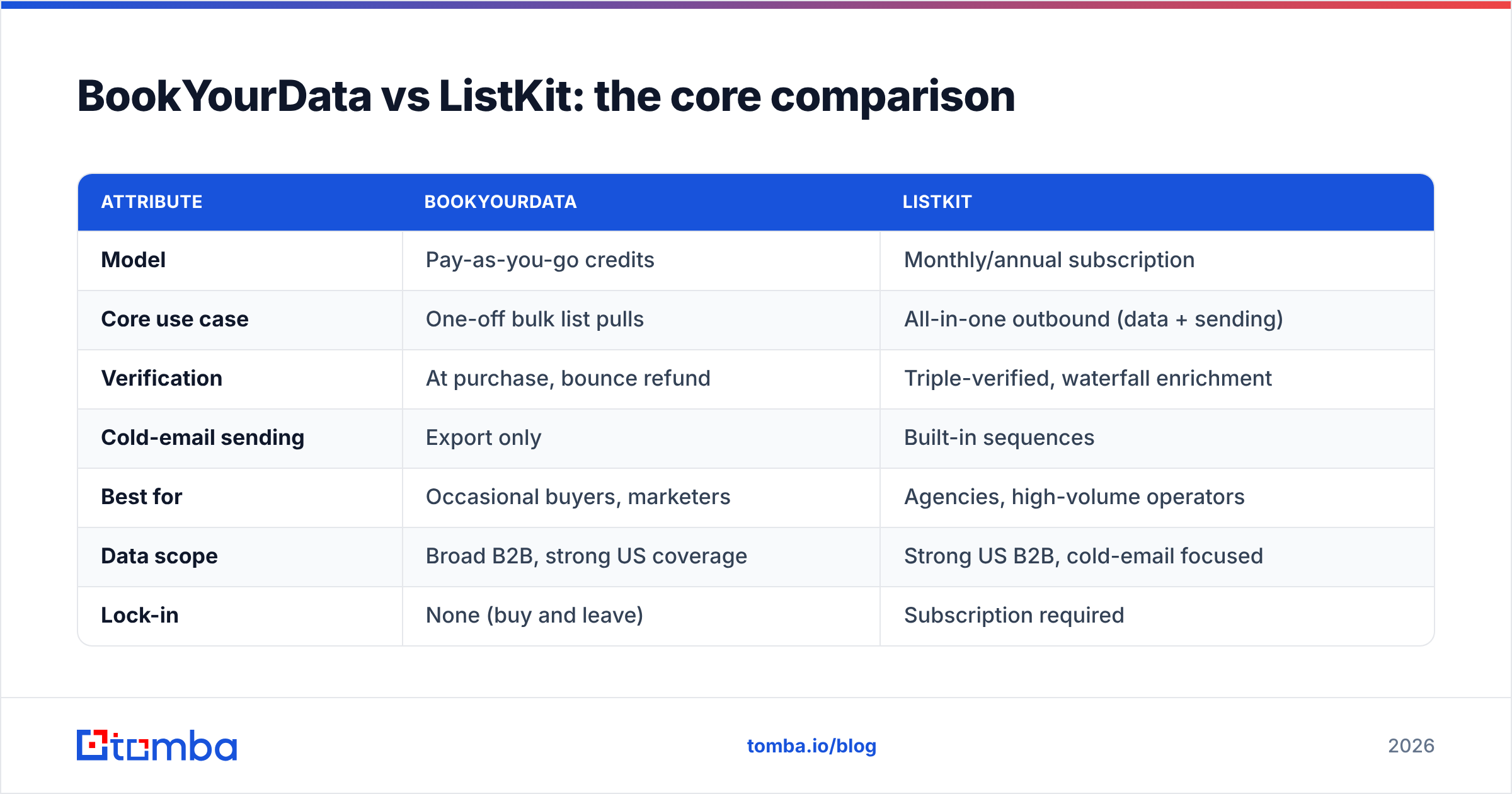
Here's how the two stack up on the attributes that actually drive a buying decision.
| Attribute | BookYourData | ListKit |
|---|---|---|
| Model | Pay-as-you-go credits | Monthly/annual subscription |
| Core use case | One-off bulk list pulls | All-in-one outbound (data + sending) |
| Verification | At purchase, bounce refund | Triple-verified, waterfall enrichment |
| Cold-email sending | Export only | Built-in sequences |
| Best for | Occasional buyers, marketers | Agencies, high-volume operators |
| Data scope | Broad B2B, strong US coverage | Strong US B2B, cold-email focused |
| Lock-in | None (buy and leave) | Subscription required |
| Free trial | Sample credits | Limited free credits |
Read that table by your motion, not by the feature count. If you pull a list twice a year, a subscription is dead weight and BookYourData wins on cost. If outbound is your daily job and you want sourcing and sending in one tab, ListKit's bundle earns its recurring fee.
Is BookYourData or ListKit more accurate?#
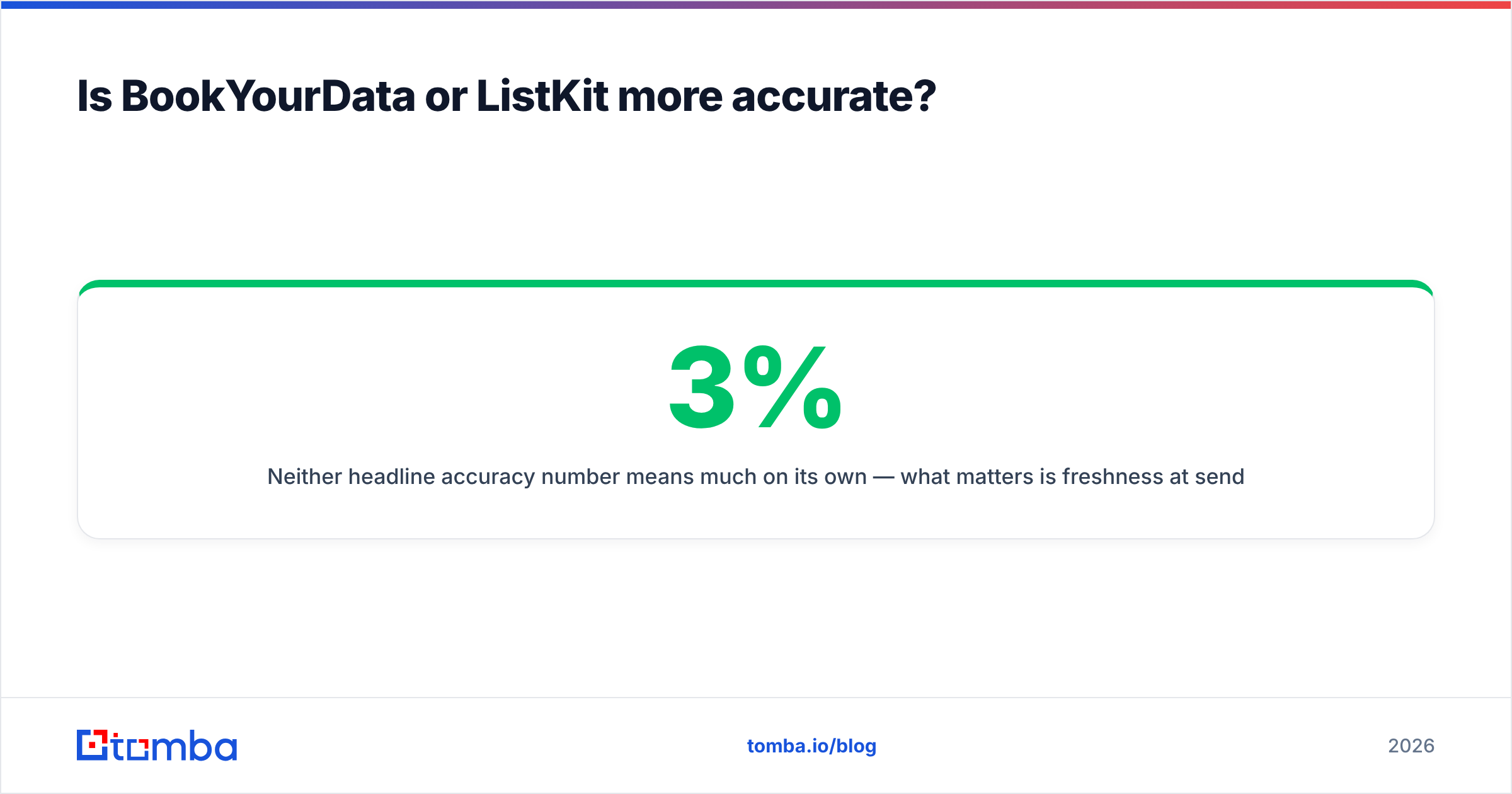
Neither headline accuracy number means much on its own — what matters is freshness at send time. Both vendors verify their data, but B2B contact data decays at roughly 2–3% per month as people switch jobs and companies restructure. A list that's 97% deliverable on purchase day can drift below 90% within a quarter.
The practical accuracy hierarchy looks like this:
- Source quality — where the records originally come from (public web, opt-in, partner feeds, or scraping). Cleaner sources mean fewer junk rows.
- Verification depth — single SMTP ping vs multi-provider waterfall vs catch-all handling. ListKit's triple-verification and BookYourData's bounce refund both address this layer.
- Freshness at send — the step both tools leave to you. Re-verifying right before a campaign is the single highest-ROI action you can take.
- Catch-all handling — many corporate domains accept every address, so a "valid" result can still be a guess. A dedicated catch-all verifier resolves what a basic check can't.
If you take one thing from this section: don't trust a purchased list's age. Run it through verification the day you send, regardless of which vendor sold it to you. This is exactly why a find-then-verify stack often beats buying pre-built lists — you control freshness instead of inheriting it.
How do BookYourData and ListKit price compare?#
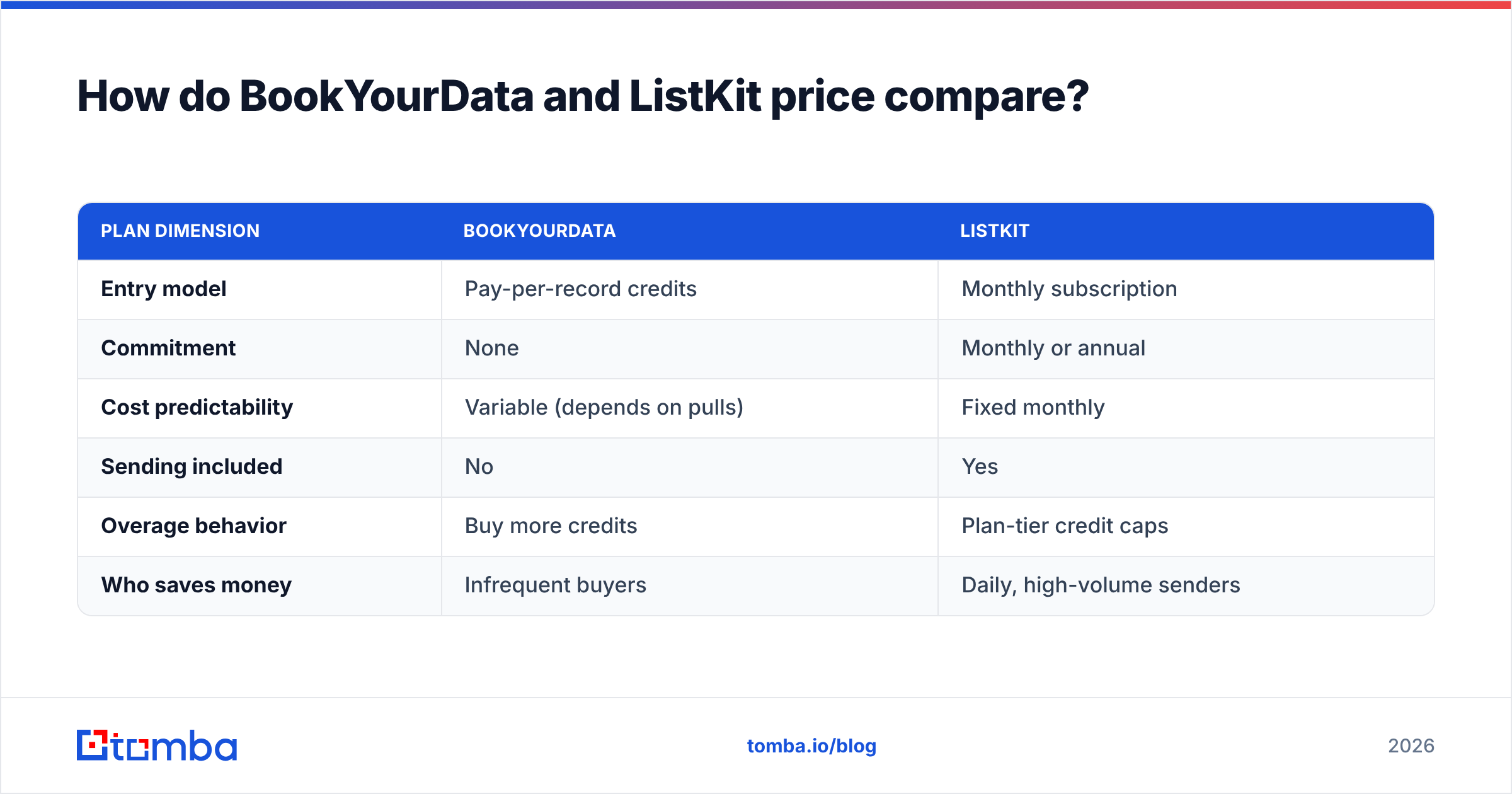
Pricing is where the two diverge most, because the unit is different — BookYourData sells records, ListKit sells access.
| Plan dimension | BookYourData | ListKit |
|---|---|---|
| Entry model | Pay-per-record credits | Monthly subscription |
| Commitment | None | Monthly or annual |
| Cost predictability | Variable (depends on pulls) | Fixed monthly |
| Sending included | No | Yes |
| Overage behavior | Buy more credits | Plan-tier credit caps |
| Who saves money | Infrequent buyers | Daily, high-volume senders |
The honest answer to "which is cheaper" is it depends on volume. Pull a list once and BookYourData's no-subscription model is hard to beat. Run outbound every day and ListKit's bundled sending can be cheaper than stitching a database plus a separate sequencer together.
But there's a third lane both comparisons ignore: paying only for the contacts you actually need, verified, with no list markup. A usage-based email finder lets you enrich a known company or prospect on demand. For transparent per-plan numbers, compare against Tomba pricing — the Free tier covers 25 searches/mo, Starter is $49/mo, and Growth is $99/mo.
)
When should you skip both and build your own list?#
Skip the pre-built list when accuracy, cost-per-valid-contact, and targeting precision matter more than convenience — which is most serious outbound. Buying a static database is renting someone else's snapshot. Building your own pipeline means you source the exact accounts you want and verify them at send time.
Here's what a verify-first stack looks like in practice:
- Define the accounts, not just the filters. Start from a target account list (your ICP), then find the right people inside each company instead of buying a generic title slice.
- Find contacts on demand with domain search — feed a company domain, get the verified email patterns and people who match your roles.
- Verify before you send, every time, so decay never reaches your sequence and your sender reputation stays clean.
- Enrich for personalization using data enrichment to add firmographic and role context, so your copy isn't generic.
- Push to your sequencer of choice — keep sending separate so you're never locked into one vendor's roadmap.
This approach is the reason many teams evaluating list vendors end up comparing them against email-finding tools instead. You can see how that plays out across the category in roundups on G2 and from vendors' own docs like BookYourData and ListKit.
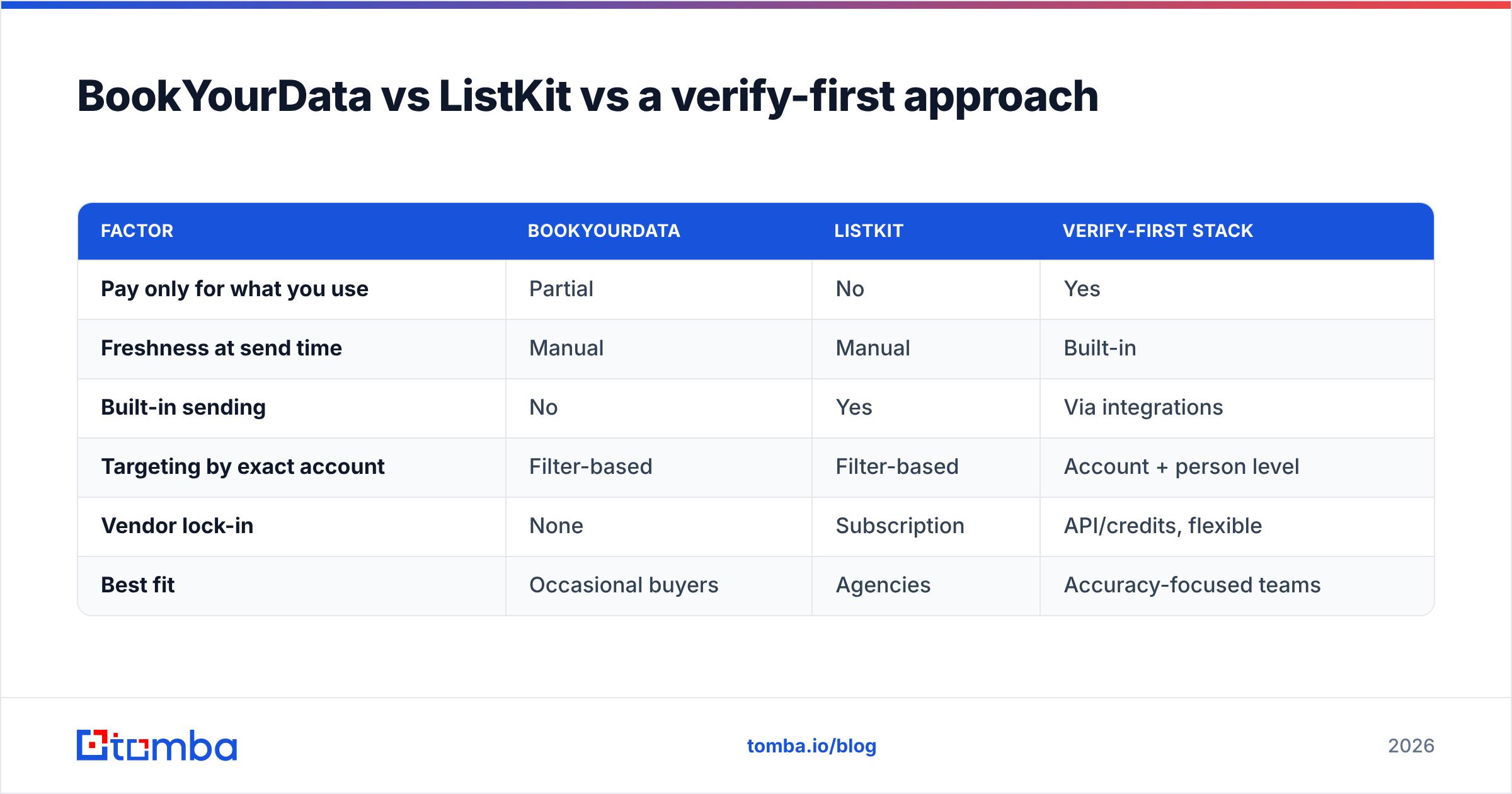
BookYourData vs ListKit vs a verify-first approach#
Putting all three side by side clarifies the real decision.
| Factor | BookYourData | ListKit | Verify-first stack |
|---|---|---|---|
| Pay only for what you use | Partial | No | Yes |
| Freshness at send time | Manual | Manual | Built-in |
| Built-in sending | No | Yes | Via integrations |
| Targeting by exact account | Filter-based | Filter-based | Account + person level |
| Vendor lock-in | None | Subscription | API/credits, flexible |
| Best fit | Occasional buyers | Agencies | Accuracy-focused teams |
There's no universal winner — there's a winner for your motion. The mistake is treating "buy a list" as the only option when a find-and-verify workflow often delivers a higher percentage of inbox-landing emails for less spend.
Which should you choose?#
- Choose BookYourData if you pull lists occasionally, hate subscriptions, and want a clean pay-as-you-go database with a bounce guarantee. It's the low-commitment option.
- Choose ListKit if you're an agency or full-time outbound operator who wants data and sending in one platform and will use it daily enough to justify the recurring fee.
- Choose a verify-first stack if your priority is accuracy and cost-per-valid-contact — sourcing exactly the contacts you need and confirming them before every send, instead of inheriting a snapshot that's already aging.
For most teams scaling outbound, the third path wins on the metric that actually matters: how many of your emails reach a real human. If you've been frustrated by bounce rates from purchased lists, the fix usually isn't a different list vendor — it's owning the find-and-verify step yourself.
Start with the Tomba Email Finder to source verified professional emails by domain, name, or company, then verify them right before you hit send. You'll pay for accurate contacts instead of stale rows — and your sender reputation will thank you. Spin up the Free tier (25 searches/mo) and benchmark it against your current BookYourData or ListKit lists before you renew.
// get started
Find, verify and enrich your first contacts today
Start on the free plan with 25 searches a month, then scale when your team is ready.
Free plan · No credit card required · GDPR & CCPA
// about the author