Bookyourdata vs Listmint: B2B Contact Data Compared 2026
Bookyourdata sells pay-as-you-go lists; Listmint pushes subscription credits. We compare accuracy, pricing, and freshness so you pick the right B2B data source in 2026.
Choosing between Bookyourdata and Listmint comes down to one question: do you want a pre-packaged list you pay for once, or a credit subscription you draw down each month? Both promise millions of B2B contacts. Neither verifies your specific records the moment you export them — and that gap is where most of your bounce rate hides.
This is a neutral breakdown of how the two stack up in 2026, where each one earns its price, and why a live-lookup tool often beats a static list for cold outbound.
TL;DR#
- Bookyourdata is a pay-as-you-go list builder with a 97% accuracy claim and no forced subscription — good for one-off campaigns and quick list pulls.
- Listmint leans on monthly credit subscriptions and bulk segment exports — better if you buy lists every week and want a predictable rate.
- Both sell snapshots. Even an accurate database decays ~22–30% per year, so any static list bounces more the longer it sits.
- For cold email, a live email finder + verifier that checks each address at export time (like Tomba's email finder) protects your sender reputation better than either list vendor.
- Best move: use list data for total addressable market sizing, then re-verify every contact before you send.
What are Bookyourdata and Listmint?#
Both are B2B contact-data vendors, but they sell access differently.
Bookyourdata is a self-serve list-building platform. You filter by industry, title, location, company size, and technology, then buy exactly the records you want — no subscription required. It markets a 97% accuracy guarantee and credits back invalid emails, which is unusually buyer-friendly for the list industry.
Listmint packages similar B2B contact data into a credit-based subscription. You pick a monthly tier, spend credits on exports, and segment by firmographic filters. The pitch is volume and repeatability for teams that pull new lists constantly.
The core thing to understand: both deliver a database snapshot. The contact who was a VP of Marketing when the record was scraped may have changed jobs, companies, or email format by the time you hit send. That is true of every static list, and it is the single biggest reason cold campaigns bounce.

How accurate is each one, really?#
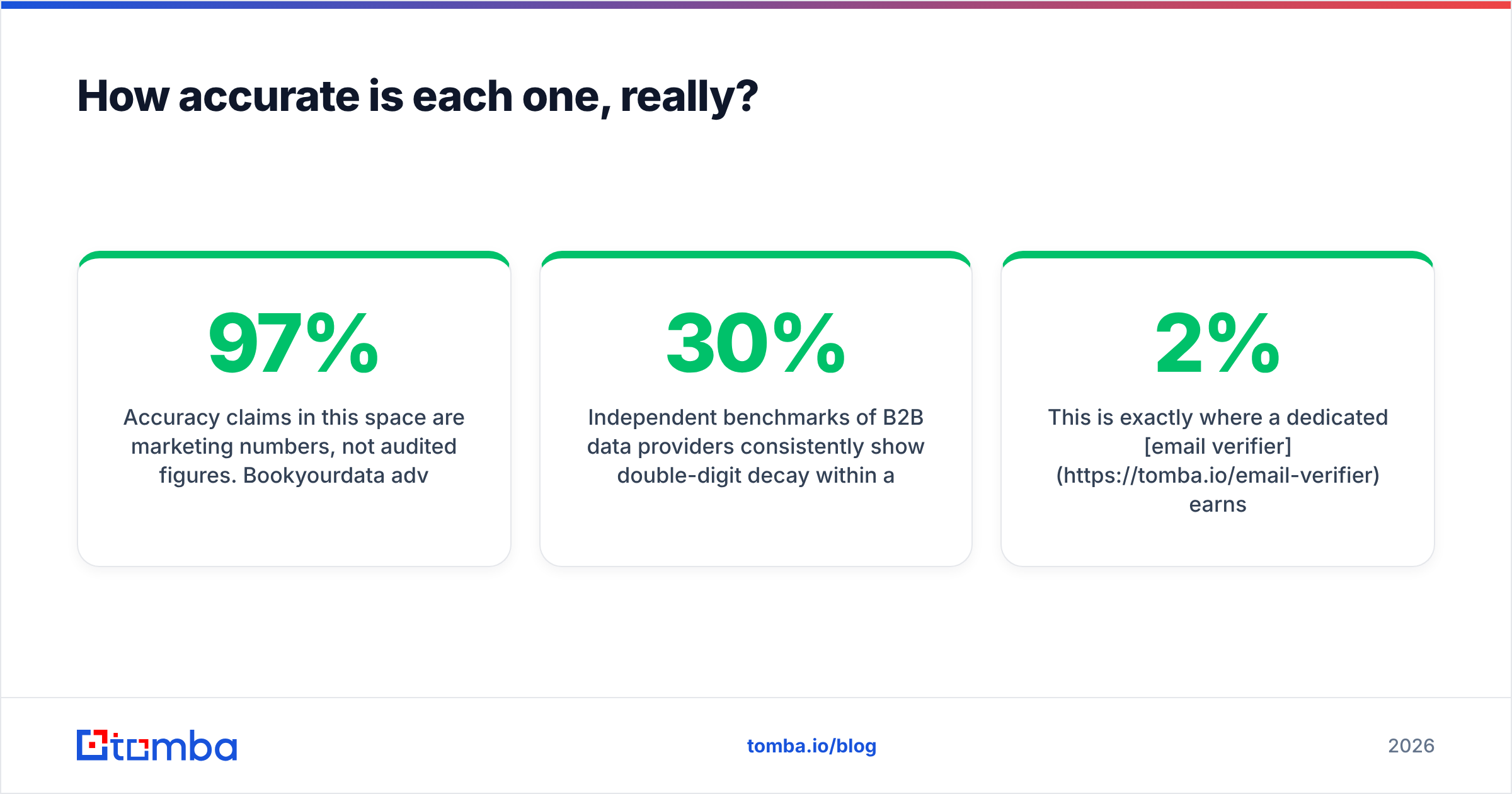
Accuracy claims in this space are marketing numbers, not audited figures. Bookyourdata advertises 97%; most list vendors cluster between 85% and 95% on first export. The honest answer is that accuracy is a moving target — a list that tests at 95% today drifts as people change roles.
Independent benchmarks of B2B data providers consistently show double-digit decay within a year. Industry analysts at Gartner have long flagged that B2B data degrades at roughly 22–30% annually as contacts switch jobs and companies rebrand. So the question is not "what's the accuracy at purchase" but "how fast does it rot, and do I re-verify before sending?"
This is exactly where a dedicated email verifier earns its keep. Whatever list you buy, running it through verification before your first send is the difference between a 2% bounce rate and a 12% one — and bounce rate is what mailbox providers watch when they decide whether you land in the inbox.
Bookyourdata vs Listmint: side-by-side comparison#
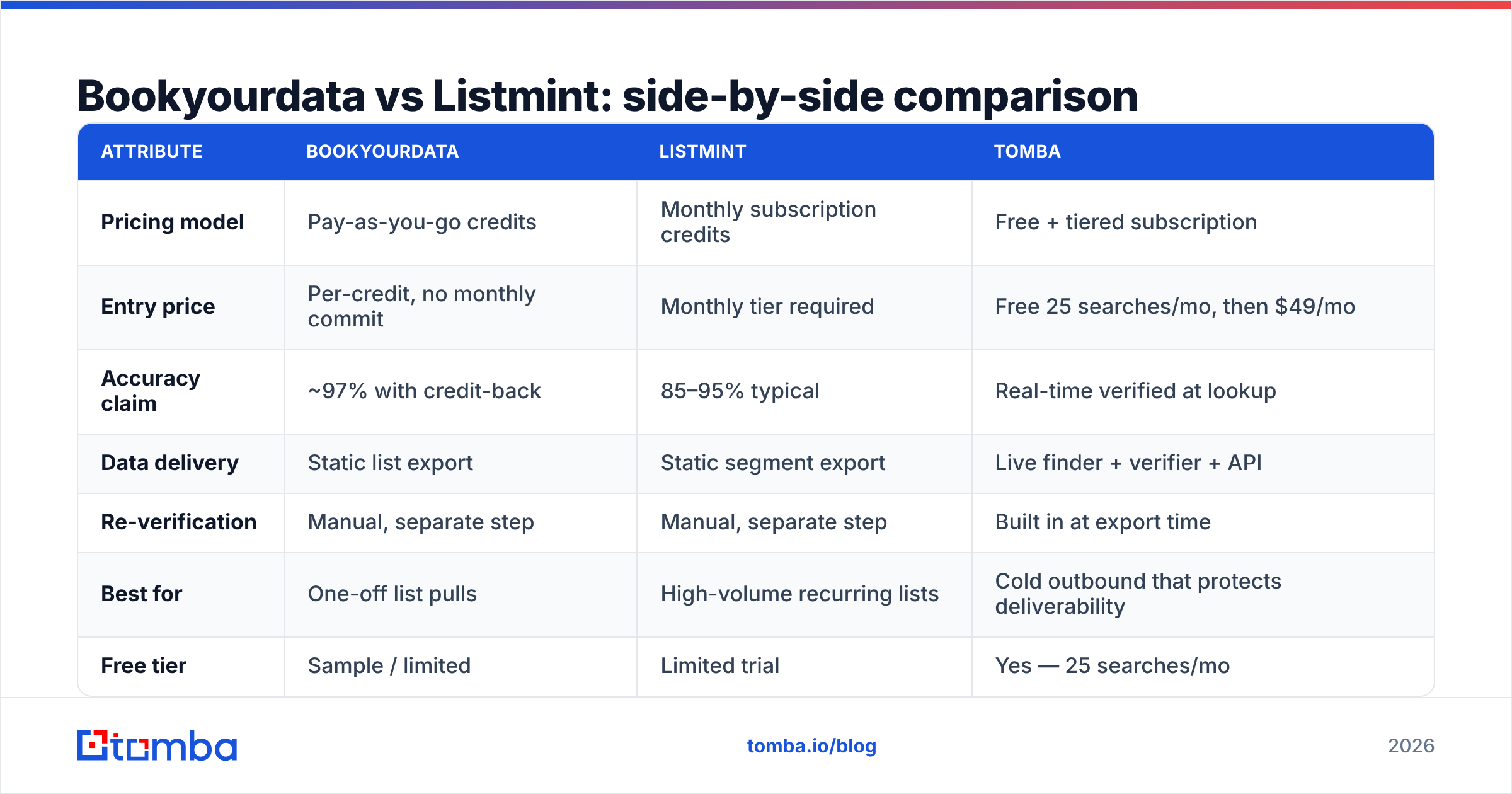
Here is how the two line up on the attributes that actually affect your campaigns and budget.
| Attribute | Bookyourdata | Listmint | Tomba |
|---|---|---|---|
| Pricing model | Pay-as-you-go credits | Monthly subscription credits | Free + tiered subscription |
| Entry price | Per-credit, no monthly commit | Monthly tier required | Free 25 searches/mo, then $49/mo |
| Accuracy claim | ~97% with credit-back | 85–95% typical | Real-time verified at lookup |
| Data delivery | Static list export | Static segment export | Live finder + verifier + API |
| Re-verification | Manual, separate step | Manual, separate step | Built in at export time |
| Best for | One-off list pulls | High-volume recurring lists | Cold outbound that protects deliverability |
| Free tier | Sample / limited | Limited trial | Yes — 25 searches/mo |
| API access | Limited | Limited | Full email finder API |
A few takeaways from the table:
- Bookyourdata wins on commitment-free buying. If you need 2,000 records once, you are not locked into a recurring bill.
- Listmint wins on predictable unit cost if you genuinely pull lists every week — subscriptions amortize better at volume.
- Neither verifies at send time. Both hand you a snapshot, and the responsibility to clean it stays with you.
- A live tool changes the equation because the email is found and checked the moment you request it, not months earlier when it was scraped.
Which one is cheaper for cold outreach?#
It depends entirely on your buying pattern, and the math is less obvious than the sticker price.
If you run occasional campaigns — say a quarterly list of a few thousand contacts — Bookyourdata's pay-as-you-go model usually costs less because you never pay for an idle subscription month. You buy, you export, you stop.
If you pull fresh lists weekly, Listmint's subscription can lower your effective per-record cost, but only if you actually use the credits. Unused subscription credits are the silent budget leak in list buying — teams routinely pay for volume they never export.
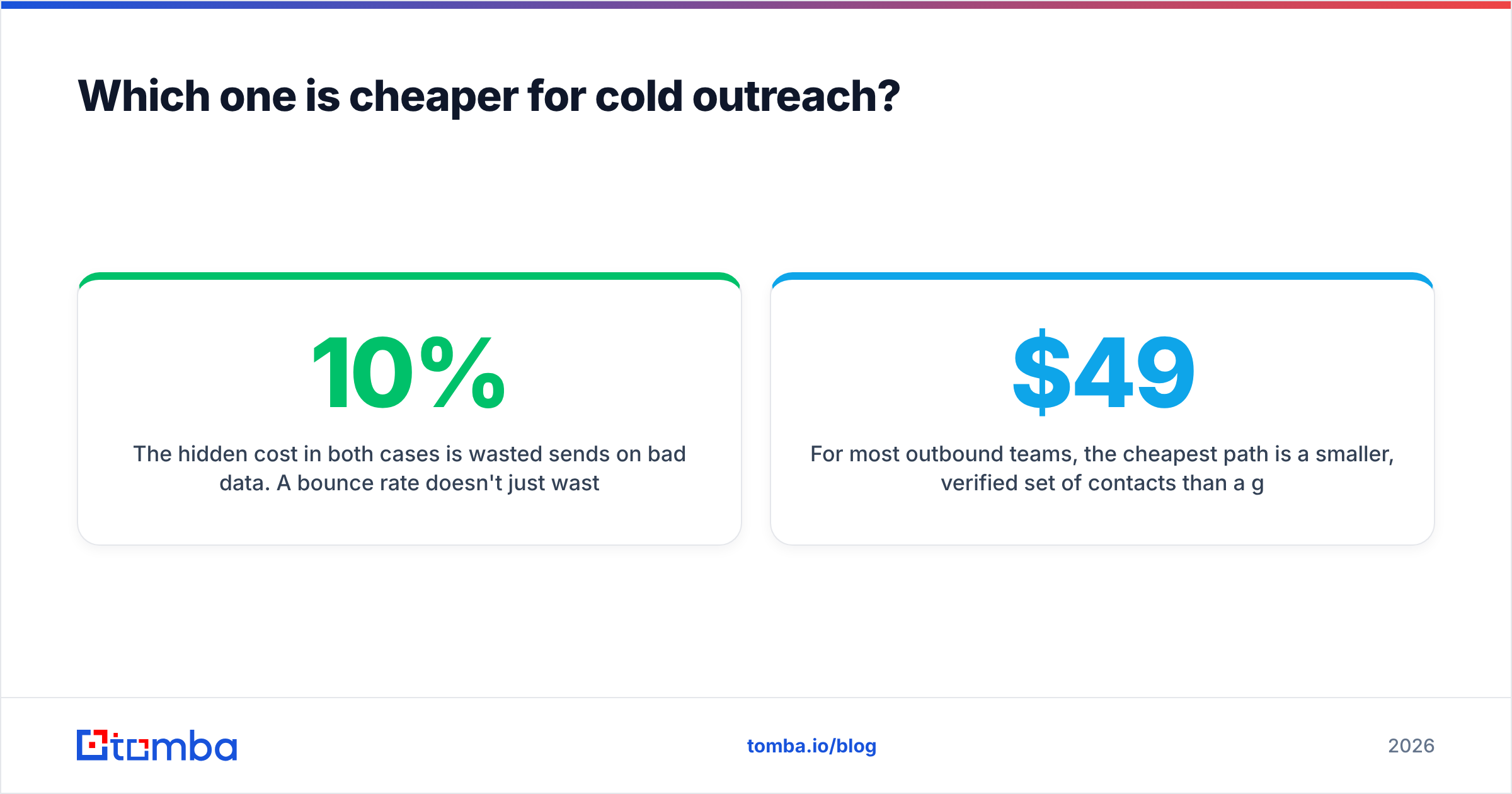
The hidden cost in both cases is wasted sends on bad data. A 10% bounce rate doesn't just waste credits; it damages your sender reputation, which suppresses deliverability for every future email — including to good addresses. That downstream cost dwarfs the list price difference.
For most outbound teams, the cheapest path is a smaller, verified set of contacts than a giant unverified dump. You can compare transparent per-seat economics on the Tomba pricing page: a free tier of 25 searches/month, Starter at $49/mo, Growth at $99/mo, and Pro at $249/mo, with each lookup verified as it happens.

What about compliance and data sourcing?#
This is the part list buyers skip and regret. Buying a B2B list does not transfer compliance risk to the vendor — under GDPR and CAN-SPAM, you are the sender on the hook.
- GDPR (EU contacts): legitimate-interest outreach is possible but requires you to document why the contact is relevant and offer easy opt-out. A purchased list with no provenance trail is hard to defend.
- CAN-SPAM (US): you must include a real physical address and a working unsubscribe in every email. The list source doesn't exempt you.
- Data provenance: ask each vendor where the data comes from. Reputable providers publish their sourcing — Tomba documents its data sources openly, which matters when you need to justify how you got a contact.
Neither Bookyourdata nor Listmint removes your obligation to verify consent grounds and honor opt-outs. Treat any list as raw material that still needs your compliance layer on top.
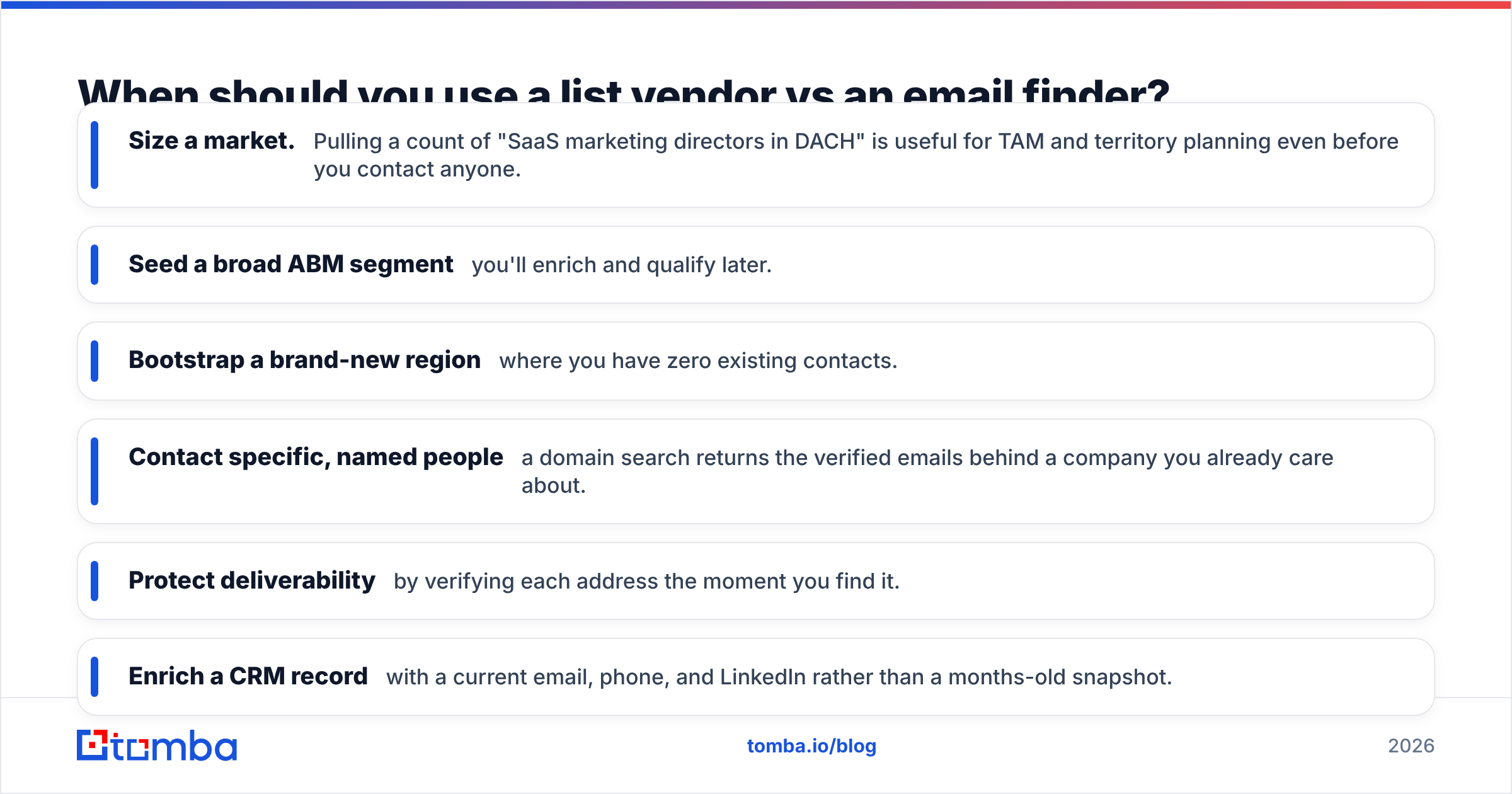
When should you use a list vendor vs an email finder?#
Use the tool that matches the job — they are not actually competing for the same task.
Reach for a list vendor (Bookyourdata or Listmint) when you want to:
- Size a market. Pulling a count of "SaaS marketing directors in DACH" is useful for TAM and territory planning even before you contact anyone.
- Seed a broad ABM segment you'll enrich and qualify later.
- Bootstrap a brand-new region where you have zero existing contacts.
Reach for an email finder when you want to:
- Contact specific, named people — a domain search returns the verified emails behind a company you already care about.
- Protect deliverability by verifying each address the moment you find it.
- Enrich a CRM record with a current email, phone, and LinkedIn rather than a months-old snapshot.
The smartest stack uses both: list data for breadth, then a finder-plus-verifier pass to confirm each contact is real before it enters a sequence. You can even push that flow through Tomba's HubSpot integration or run it in bulk with the bulk email finder so the verification step is not a manual chore.
How do Bookyourdata and Listmint handle freshness?#
Freshness is where static lists structurally lose to live lookups, regardless of brand.
Both vendors re-scrape and update their databases on their own cadence, which you don't control. When you export, you get the state of the record as of the last refresh — which could be days or many months old. There's no signal in the file telling you which records are stale.
A live finder inverts this. When you query for an email at the moment you need it, the result reflects current data and gets verified on the spot. That is the practical reason cold-email specialists increasingly treat purchased lists as a starting point to be re-checked, not a finished product to be mailed.
If you want the underlying mechanics, our breakdown of how email verification actually works — SMTP checks, catch-all detection, role-account flags — shows why a verify pass catches the decay that any list, Bookyourdata's or Listmint's, can't see on its own. For tricky domains, a dedicated catch-all verifier closes the last gap.
Bookyourdata vs Listmint: the honest verdict#
Pick Bookyourdata if you buy lists occasionally and value not being locked into a subscription. The pay-as-you-go model and credit-back-on-invalid policy make it the lower-risk choice for sporadic, one-off list needs.
Pick Listmint if your team pulls fresh segments on a weekly cadence and a predictable monthly rate lowers your effective per-record cost — assuming you actually consume the credits you pay for.
But understand what both share: they sell you a snapshot. The accuracy claim on the box is true the day the data was refreshed and erodes every week after. If your primary use case is cold outbound, the list price is the small number; your bounce rate and sender reputation are the big ones.
For outbound that has to land in the inbox, a live email finder that verifies at the moment of lookup is the more defensible spend. You buy fewer, fresher, verified contacts instead of a large file you have to clean yourself — and you keep your domain reputation intact.
Start with verified data instead of a stale list#
If you're sourcing B2B contacts for cold outreach in 2026, skip the bounce-rate gamble. The Tomba Email Finder finds professional emails by domain, name, or company and verifies each one as it's returned — so the address that enters your sequence is the address that's live today, not the one that was accurate three refreshes ago. Start free with 25 searches a month, scale to Starter at $49/mo when you're ready, and connect it to your CRM through Tomba's integrations. Your deliverability will thank you.
// get started
Find, verify and enrich your first contacts today
Start on the free plan with 25 searches a month, then scale when your team is ready.
Free plan · No credit card required · GDPR & CCPA
// about the author