Bookyourdata vs Logvalid: B2B Data & Verification (2026)
Bookyourdata sells ready-made B2B contact lists; Logvalid cleans the emails you already have. Here is which one actually fits your 2026 outbound stack — and where a third option wins.
You typed "bookyourdata vs logvalid" into a search bar because you want clean, deliverable B2B contacts — and you are trying to figure out whether to buy a list or clean the one you have. Those are two different jobs, and these two tools sit on opposite ends of that workflow.
This guide breaks down what each one actually does, where they overlap, where they don't, and how to decide. Spoiler: for most outbound teams the honest answer is "you need a finder and a verifier, not a static list" — but let's prove it with specifics instead of asserting it.
TL;DR: Bookyourdata vs Logvalid in 30 seconds#
- Bookyourdata is a B2B contact marketplace. You filter by industry, title, geography, and tech stack, then buy records on a pay-as-you-go credit model. It is a source of contacts.
- Logvalid is an email verification service. You upload a list you already own and it flags invalid, risky, and catch-all addresses. It is a cleaner, not a source.
- They are complementary, not direct competitors. Comparing them head-to-head is like comparing a grocery store to a refrigerator — one stocks you, the other keeps it fresh.
- The real gap: neither gives you fresh, on-demand emails for a specific prospect you found on LinkedIn or a company site today. That is the email-finder job.
- Best combined workflow for 2026: find the right person on demand, verify in the same pass, and enrich — which is where an integrated platform like Tomba changes the math.

What is Bookyourdata and who is it for?#
Bookyourdata is a self-service B2B data platform. You build a segment using filters — job title, seniority, company size, industry, location, technologies used — and it returns matching contact records including business emails and, on some records, phone numbers. You pay per record with credits, and the platform markets a high deliverability guarantee on the emails it sells.
The appeal is speed-to-list. If you are launching a campaign into "VP Marketing at US SaaS companies, 50–500 employees" and you have no existing pipeline, you can have a few thousand rows in a spreadsheet in minutes. There is no scraping, no manual lookup, and no LinkedIn navigation.
The trade-offs are the ones every static-list vendor carries:
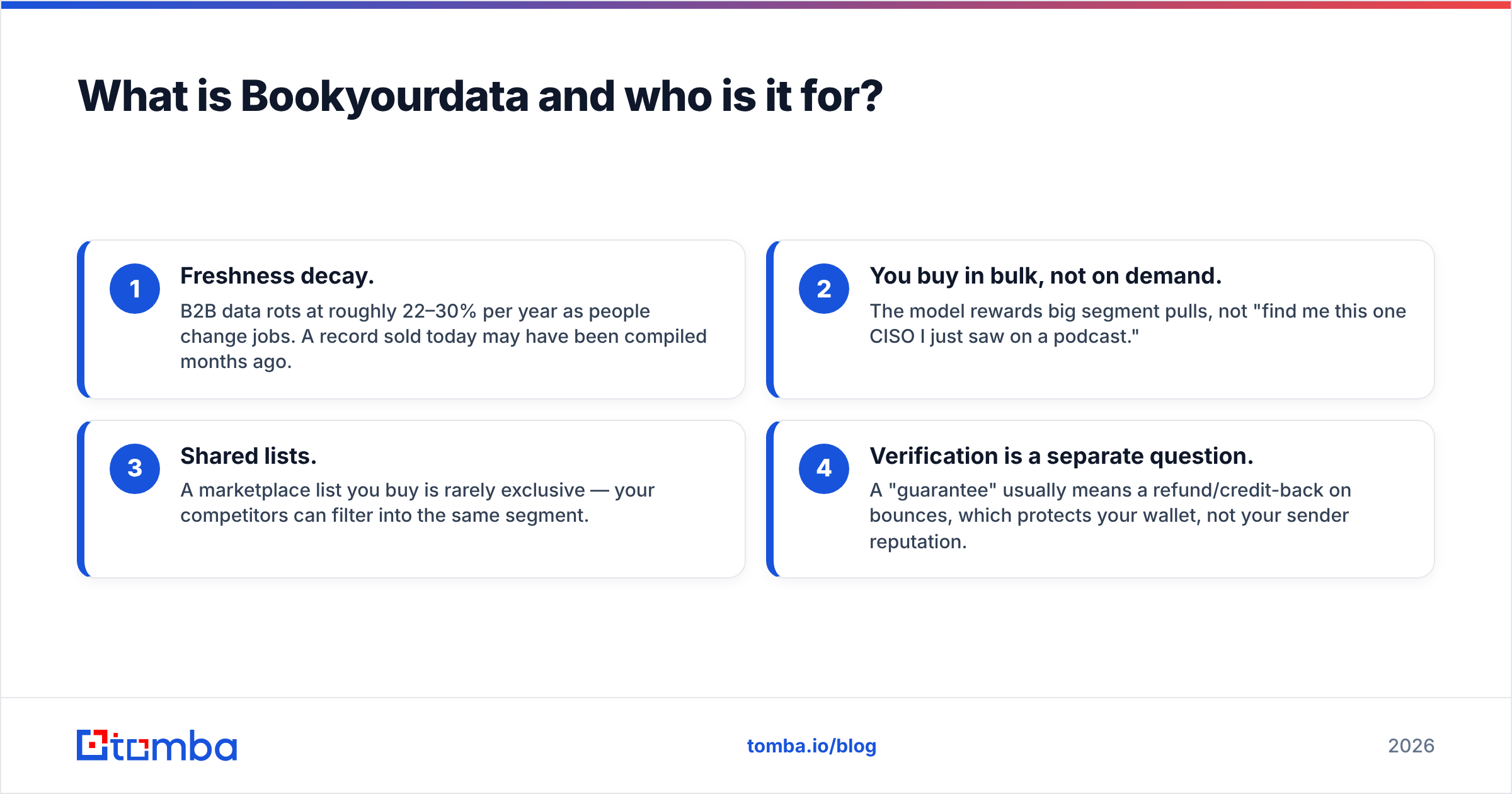
- Freshness decay. B2B data rots at roughly 22–30% per year as people change jobs. A record sold today may have been compiled months ago.
- You buy in bulk, not on demand. The model rewards big segment pulls, not "find me this one CISO I just saw on a podcast."
- Shared lists. A marketplace list you buy is rarely exclusive — your competitors can filter into the same segment.
- Verification is a separate question. A "guarantee" usually means a refund/credit-back on bounces, which protects your wallet, not your sender reputation.
You can read Bookyourdata's own positioning on bookyourdata.com and cross-check user sentiment on G2 before committing budget.
What is Logvalid and who is it for?#
Logvalid is an email verifier. Its job starts after you already have email addresses. You upload a CSV (or call an API), and it runs each address through syntax checks, MX/DNS lookups, SMTP handshakes, disposable-domain detection, role-account flags (info@, sales@), and catch-all detection. It returns a status per address — valid, invalid, unknown, or risky — so you can suppress the junk before you hit send.
This matters because mailbox providers in 2026 are stricter than ever. Google and Yahoo enforce bounce-rate and spam-complaint thresholds, and a list with even 3–5% invalid addresses can tank your sender reputation and push the rest of your mail to spam. A good verifier is non-negotiable for cold outbound.
What Logvalid does not do is find contacts. It has no concept of "give me the marketing director at Acme." If you hand it an empty spreadsheet, you get an empty spreadsheet back. It is a quality gate, full stop. You can see its feature set on logvalid.com.
Bookyourdata vs Logvalid: the core difference#
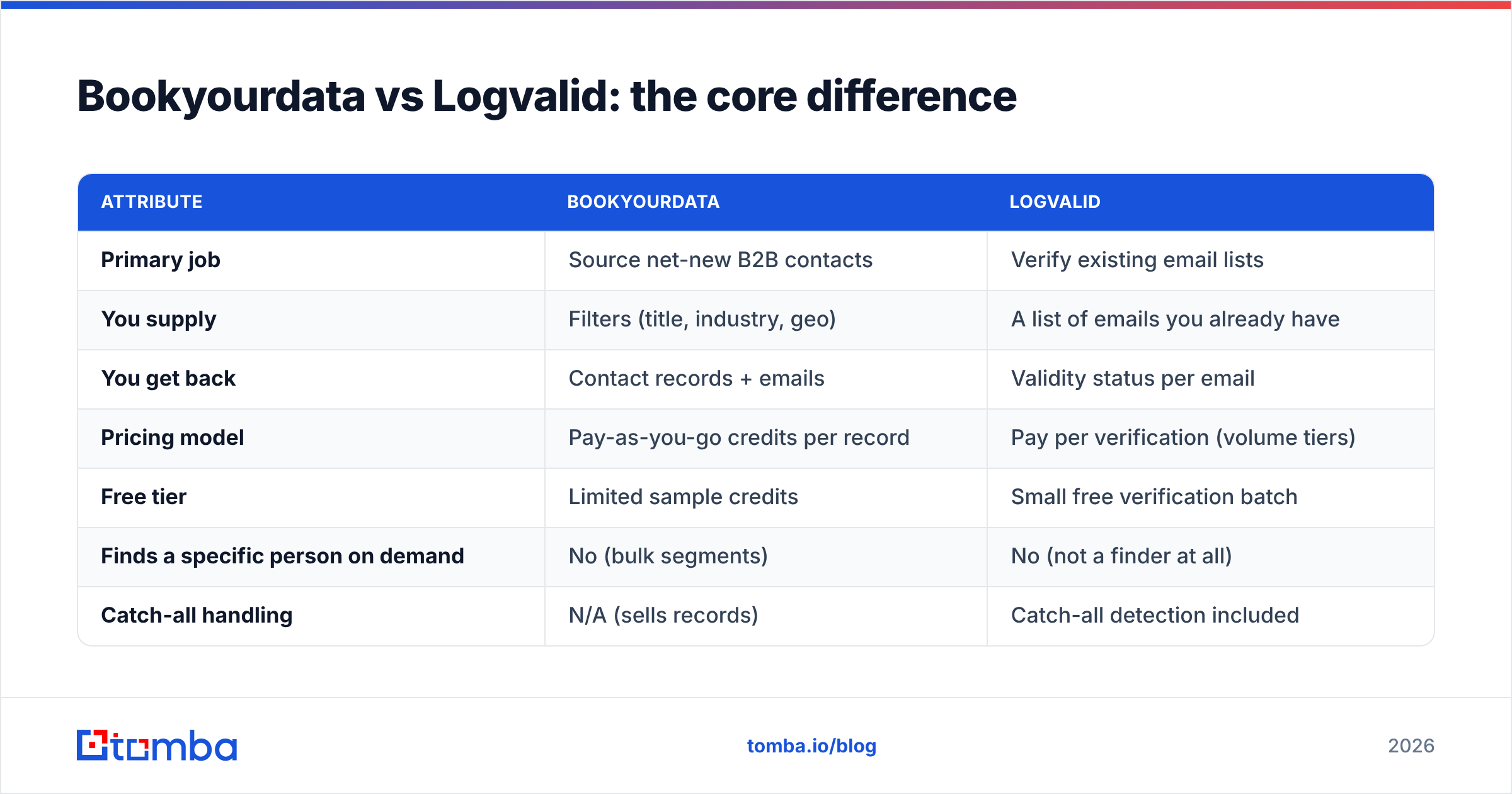
Here is the cleanest way to think about it: Bookyourdata answers "who do I email?" and Logvalid answers "will this email land?" They live in different phases of the same pipeline.
| Attribute | Bookyourdata | Logvalid |
|---|---|---|
| Primary job | Source net-new B2B contacts | Verify existing email lists |
| You supply | Filters (title, industry, geo) | A list of emails you already have |
| You get back | Contact records + emails | Validity status per email |
| Pricing model | Pay-as-you-go credits per record | Pay per verification (volume tiers) |
| Free tier | Limited sample credits | Small free verification batch |
| Finds a specific person on demand | No (bulk segments) | No (not a finder at all) |
| Catch-all handling | N/A (sells records) | Catch-all detection included |
| Best for | Cold-start list building | Cleaning before a send |
| Biggest risk | Stale / shared data | Useless without a data source |
The takeaway from that table: putting these two "versus" each other is the wrong frame. A team that buys from Bookyourdata still benefits from running the list through a verifier like Logvalid before sending, because purchased lists still bounce. They are sequential, not substitutes.
Do you actually need a list vendor at all?#
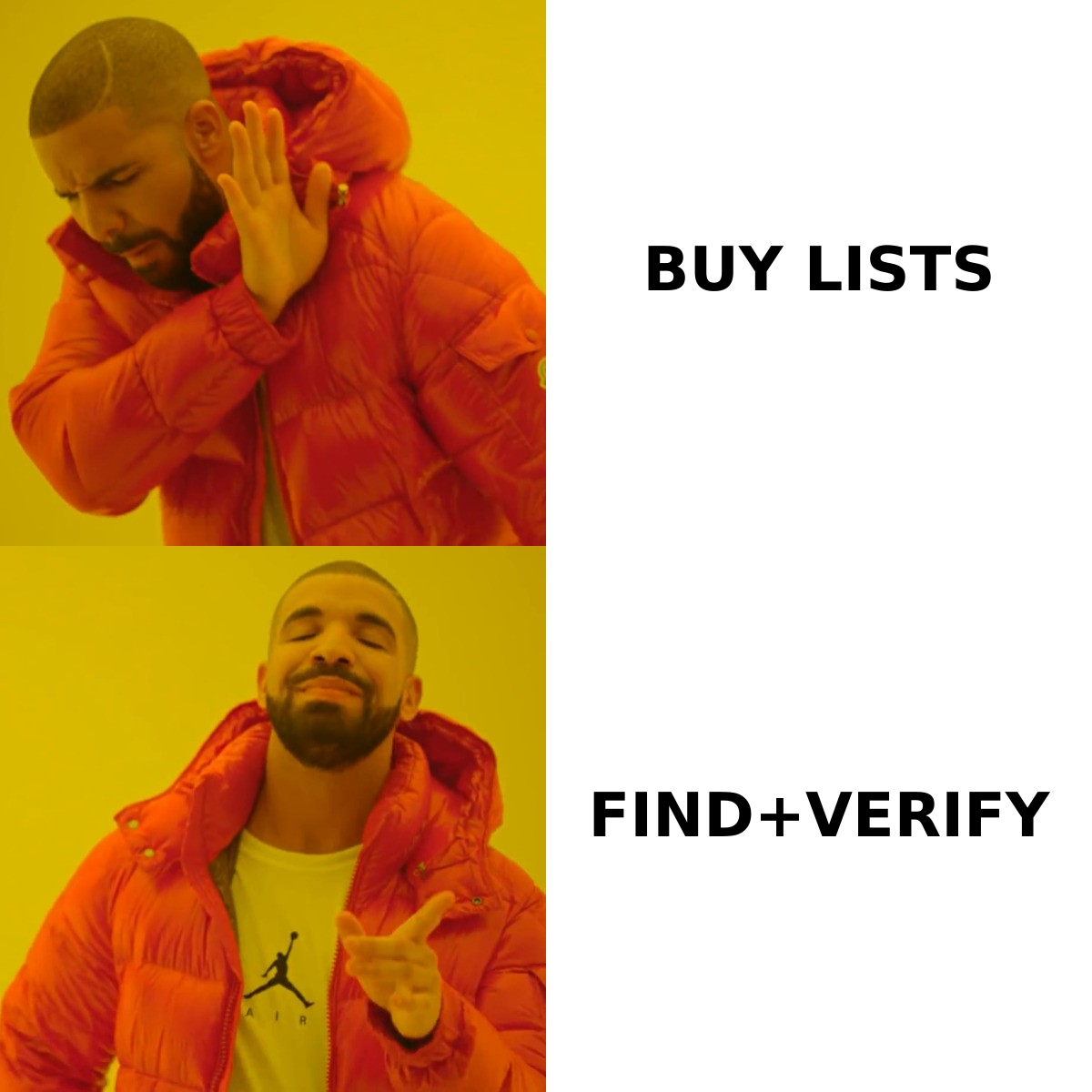
Often, no — and this is where the comparison gets interesting. The list-buying model assumes you want volume. But modern outbound increasingly rewards precision: a tightly researched 200-prospect campaign with personalized angles beats a 20,000-row blast in reply rate and in deliverability.
When your motion is precision-led, you don't want a pre-baked marketplace list at all. You want to:
- Find the exact decision-maker on a company you've already qualified.
- Verify that address in the same step so it never enters your sequence dirty.
- Enrich with role, LinkedIn, and phone so reps can personalize.
That three-step loop is exactly what an email finder plus built-in verification handles — without buying a bulk list you'll only use 5% of. This is the gap neither Bookyourdata nor Logvalid closes on its own.
How does Tomba compare to Bookyourdata and Logvalid?#
Tomba is a single platform that covers both jobs in the "bookyourdata vs logvalid" debate — sourcing and verification — plus the on-demand finding piece that neither does well.
- Find on demand: the email finder returns a verified professional email from a name + company or a domain, one prospect or in bulk.
- Verify in the same pass: every result is checked, with catch-all verification for the tricky domains that break naive validators.
- Source by company: domain search pulls every public email pattern at a target company — closer to "build me a list" but scoped to accounts you chose, not a shared marketplace.
- Enrich: add role, location, LinkedIn, and phone data so the contact is campaign-ready.
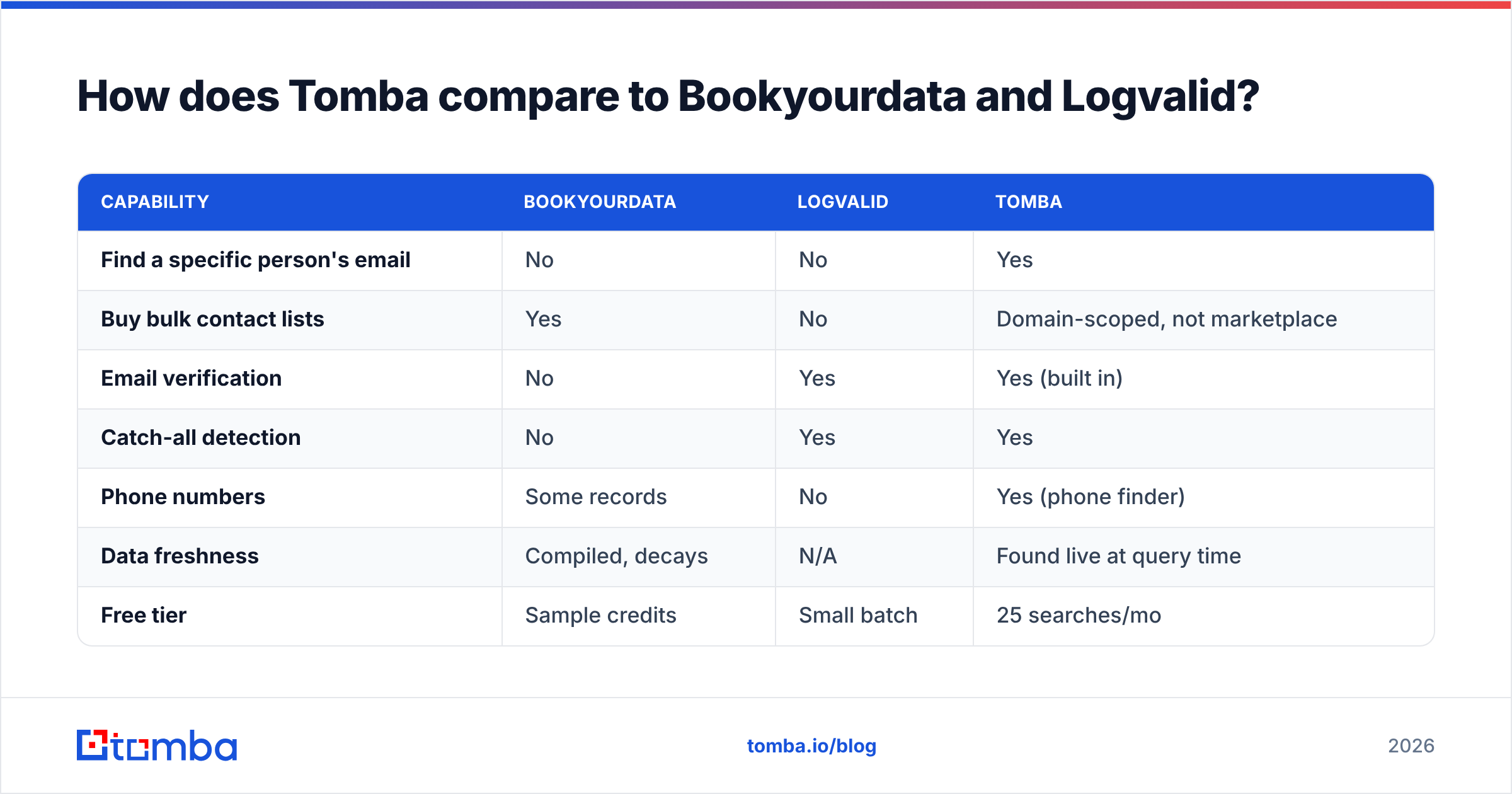
Here's the head-to-head across all three:
| Capability | Bookyourdata | Logvalid | Tomba |
|---|---|---|---|
| Find a specific person's email | No | No | Yes |
| Buy bulk contact lists | Yes | No | Domain-scoped, not marketplace |
| Email verification | No | Yes | Yes (built in) |
| Catch-all detection | No | Yes | Yes |
| Phone numbers | Some records | No | Yes (phone finder) |
| Data freshness | Compiled, decays | N/A | Found live at query time |
| Free tier | Sample credits | Small batch | 25 searches/mo |
| Starting paid price | Credit packs | Volume tiers | $49/mo (Starter) |
| API access | Yes | Yes | Yes |
Two honest caveats so this stays neutral. First, if your only need is to scrub a giant list you already inherited, a dedicated verifier — Logvalid or a Tomba-grade verifier — is the right tool, and you don't need a finder. Second, if you genuinely want to buy thousands of records in a vertical where you have zero footprint, a marketplace like Bookyourdata can jump-start you faster than finding one contact at a time. Match the tool to the motion.
What about pricing and value?#
Pricing models differ enough that a raw per-unit comparison is misleading, so weigh them by job.
- Bookyourdata charges per record on credit packs. Cost scales with list size, and the "value" question is really "how much of this bulk list will convert before it goes stale?"
- Logvalid charges per verification on volume tiers — cheap per email, but it's a recurring cost every time you clean a list, and it adds zero contacts.
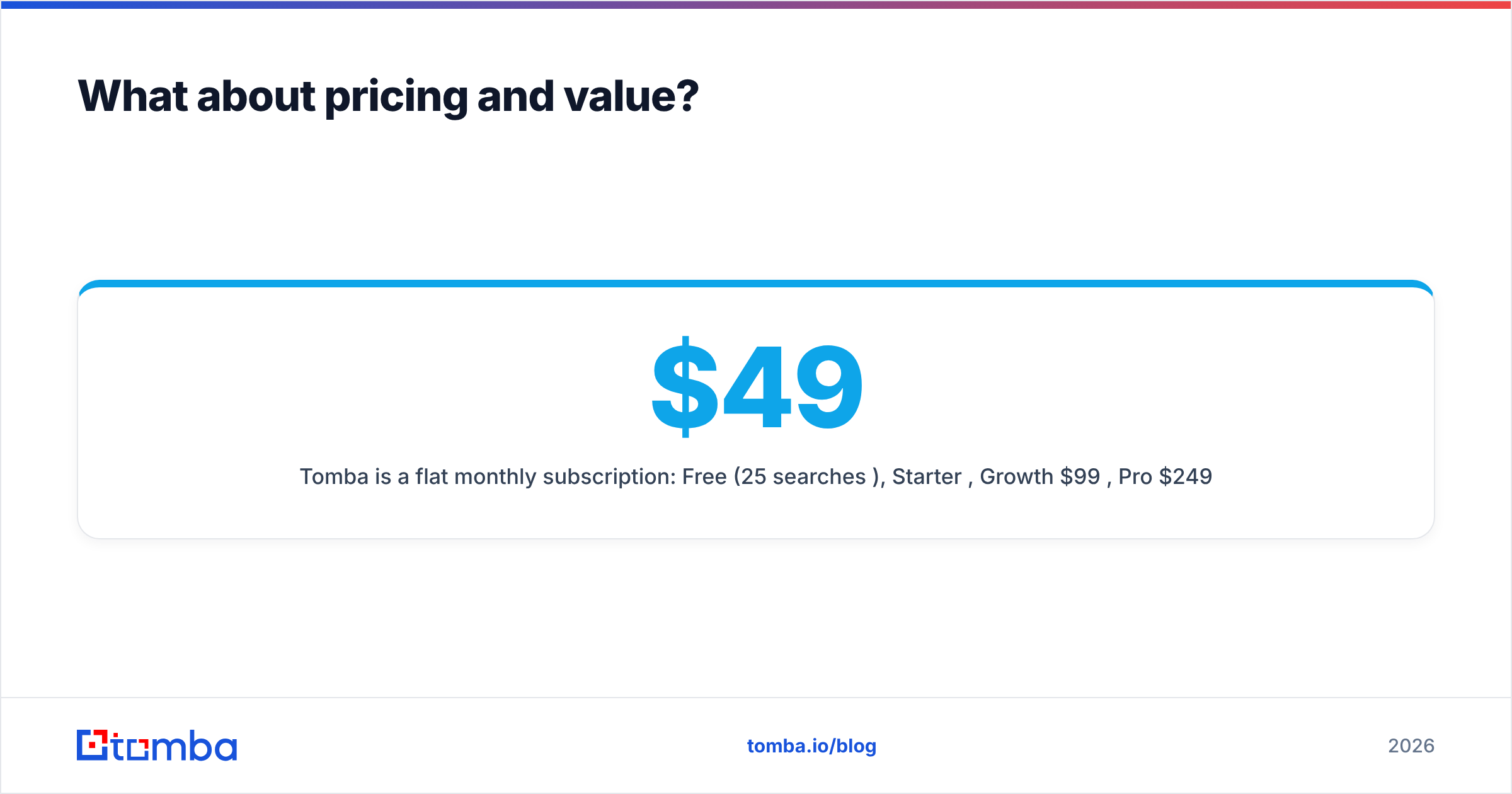
- Tomba is a flat monthly subscription: Free (25 searches/mo), Starter $49/mo, Growth $99/mo, Pro $249/mo, and Enterprise custom — with finding and verification bundled, so you're not paying two vendors for one workflow. Full Tomba pricing is public.
The strategic point: buying a list and then paying a separate verifier to clean it means two line items and two integrations to source a single deliverable contact. A bundled finder-plus-verifier collapses that into one. For a deeper look at how query-time discovery beats compiled lists, Tomba documents its data sources openly.
Which should you choose?#
Decide by the job you're actually doing today:
- "I have dirty lists and just need them clean." Use a verifier. Logvalid does this well; so does Tomba's verifier if you'd rather keep one vendor.
- "I have zero contacts in a new vertical and want volume fast." A marketplace like Bookyourdata gets you a list quickly — but budget a verification pass before you send, because purchased data bounces.
- "I qualify accounts first, then need the right person's verified email." Skip the static list entirely. Use an email finder with built-in verification so every contact enters your sequence already clean.
- "I want one tool for all of the above." That's the integrated-platform case, and it's where consolidating on Tomba removes a vendor and a hand-off.
Most growing outbound teams land on option 3 or 4, because deliverability in 2026 punishes stale, unverified, bulk-bought data harder than ever — and reply rates reward precision over volume.
The bottom line#
"Bookyourdata vs logvalid" isn't really a versus — it's a sequence. One sources contacts, the other verifies them, and a serious pipeline usually needs both functions covered. The question worth asking is whether you want to stitch a list vendor to a separate verifier, or run finding and verification in one place that also lets you scope contacts to the exact accounts you care about.
If your motion is precision outbound, start with the Tomba Email Finder. Find the right decision-maker on demand, get a verified address in the same step, enrich it for personalization, and skip the stale-list tax altogether. Spin up the free tier with 25 searches a month, test it against a segment you'd otherwise buy, and compare the deliverability yourself — evidence beats a guarantee.
// get started
Find, verify and enrich your first contacts today
Start on the free plan with 25 searches a month, then scale when your team is ready.
Free plan · No credit card required · GDPR & CCPA
// about the author