Bookyourdata vs MailerCheck: Data & Accuracy Compared 2026
Bookyourdata sells pay-as-you-go B2B contact lists; MailerCheck verifies the emails you already own. Here's which one fits your 2026 pipeline — and where a finder-plus-verifier combo beats both.
You are comparing two tools that solve different halves of the same problem, and the marketing pages make that easy to miss. Bookyourdata sells you contact records — names, emails, phones, titles — on a pay-as-you-go basis. MailerCheck doesn't sell you contacts at all; it checks whether the emails you already have are deliverable. Putting them head to head is less "which is better" and more "which job am I actually trying to do."
This guide breaks down where each one wins, what they cost in 2026, and why teams that care about both list quality and deliverability usually end up running a find-and-verify workflow instead of choosing one or the other.
TL;DR#
- Bookyourdata is a B2B data marketplace: buy contact records by industry, title, location, or tech stack, pay per credit, no subscription required.
- MailerCheck is an email verification service from the MailerLite team: it scrubs bounces, catch-alls, and spam traps from lists you already own.
- They are complementary, not competitive — one supplies contacts, the other validates them.
- Accuracy is the real battleground. Bought lists decay ~2–3% per month; verification is what keeps a list usable, and a verify-at-source workflow beats buy-then-clean.
- If you want fresh, verified emails in one motion, a finder-plus-verifier like Tomba Email Finder replaces the "buy a list, then pay to clean it" two-step.
What is Bookyourdata?#
Bookyourdata is a self-serve B2B contact database. You filter by job title, industry, company size, location, revenue, and technology used, then buy the matching records as credits. Its main pitch is a "no subscription" model — you top up credits and download contacts, each typically including a business email, phone number, company, and title.
The headline claim on its homepage is a 97%+ email accuracy guarantee, with credits refunded for records that bounce. In practice, "guaranteed accuracy" on a prebuilt database still means the data was collected at some point in the past, and B2B contacts churn fast — people change jobs, companies rebrand, domains migrate. That's the structural weakness of any bought-list model, regardless of the headline number.
Bookyourdata works best when you need volume quickly and don't already have a list: territory expansion, a new ICP you haven't prospected, or seeding an account-based campaign.
What is MailerCheck?#
MailerCheck is an email verification platform built by the team behind MailerLite. It takes a list you already have and tells you which addresses are safe to send to. Core checks include syntax, domain and MX records, mailbox existence, catch-all detection, role-based addresses (info@, sales@), disposable domains, and known spam traps.
It also leans into deliverability monitoring — blocklist checks, DMARC/SPF/DKIM inspection, and inbox placement tests — which makes it more of a "protect your sender reputation" tool than a "get me contacts" tool. If you run newsletters or large email sends, MailerCheck's value is keeping your bounce rate low so mailbox providers keep trusting you. You can read more about why this matters in any primer on email deliverability.
What MailerCheck does not do is find new contacts. Feed it an empty CRM and it has nothing to work with.

Bookyourdata vs MailerCheck: the core difference#
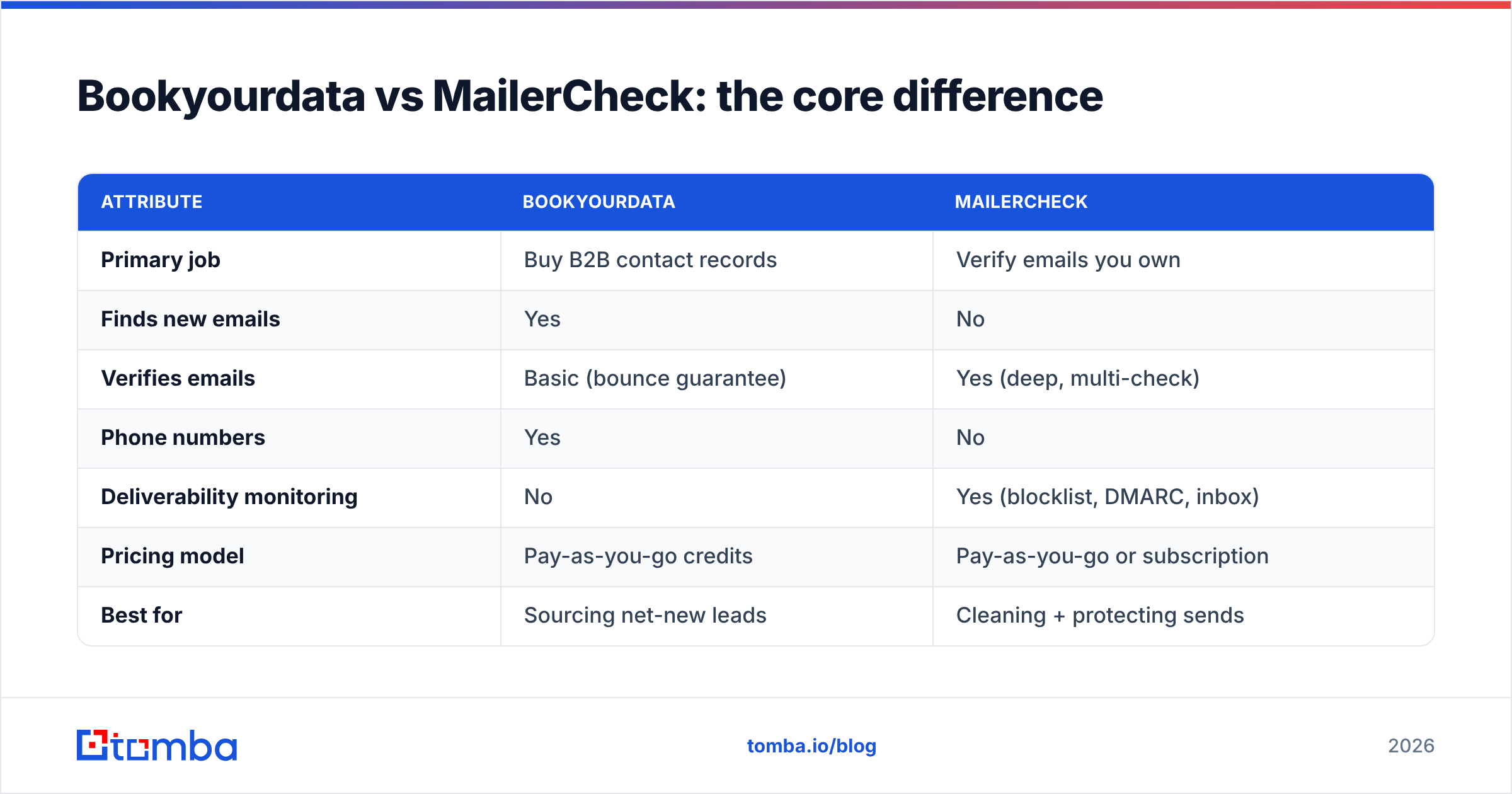
Here's the cleanest way to think about it: Bookyourdata fills the bucket, MailerCheck checks the bucket for holes. Confusing them leads to the classic mistake of buying a list and blasting it without verification, then watching your domain reputation crater.
| Attribute | Bookyourdata | MailerCheck |
|---|---|---|
| Primary job | Buy B2B contact records | Verify emails you own |
| Finds new emails | Yes | No |
| Verifies emails | Basic (bounce guarantee) | Yes (deep, multi-check) |
| Phone numbers | Yes | No |
| Deliverability monitoring | No | Yes (blocklist, DMARC, inbox) |
| Pricing model | Pay-as-you-go credits | Pay-as-you-go or subscription |
| Best for | Sourcing net-new leads | Cleaning + protecting sends |
| Data freshness risk | High (prebuilt database) | N/A (validates in real time) |
The takeaway: if you only buy one, you buy the one that matches the gap in your stack. No contacts? You need a source. Dirty list? You need a verifier. Most teams discover they need both — which is exactly where a combined platform changes the math.
How do they compare on pricing in 2026?#
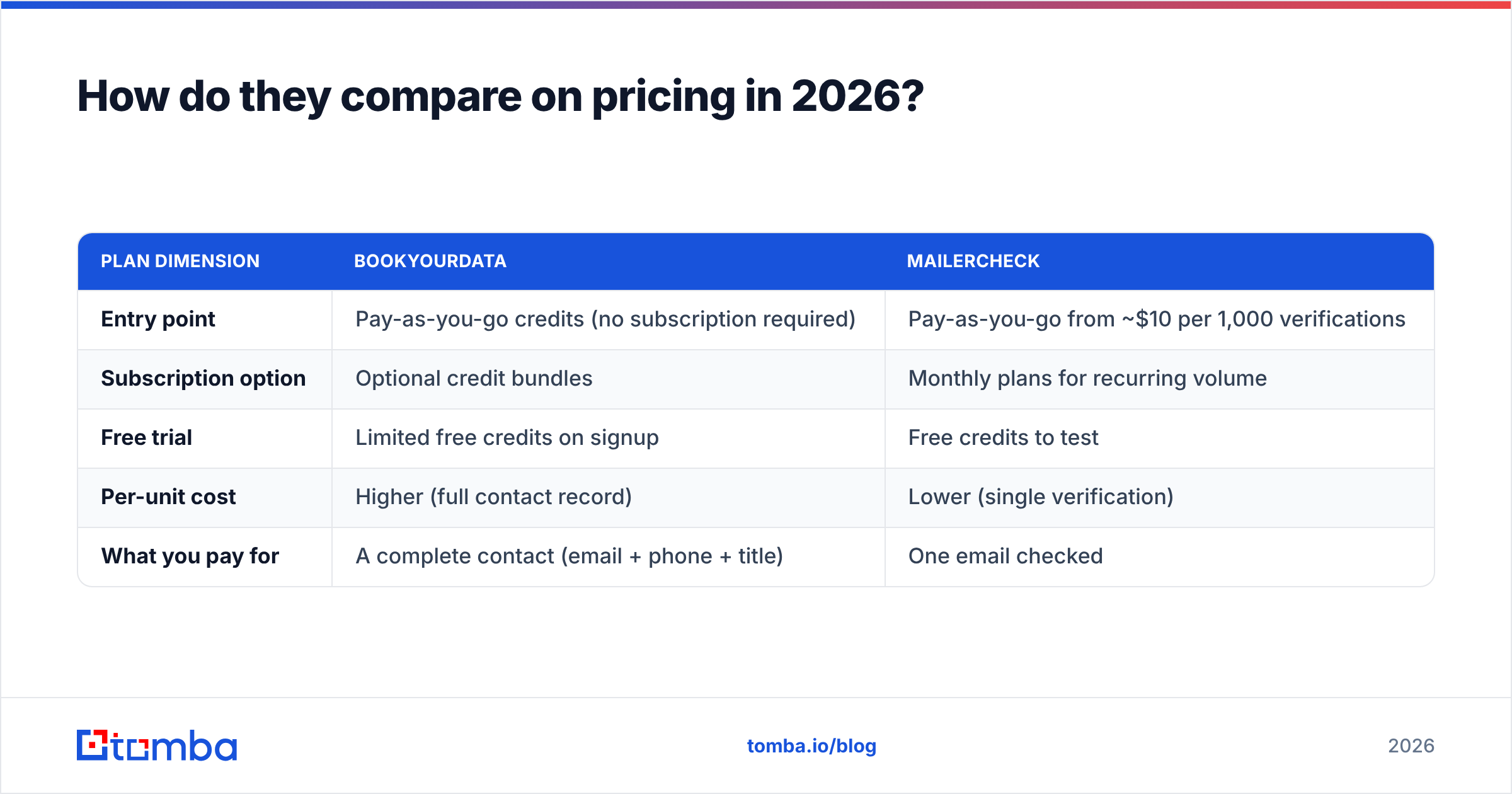
Both use credit-style pricing, but they're priced for different volumes and jobs.
| Plan dimension | Bookyourdata | MailerCheck |
|---|---|---|
| Entry point | Pay-as-you-go credits (no subscription required) | Pay-as-you-go from ~$10 per 1,000 verifications |
| Subscription option | Optional credit bundles | Monthly plans for recurring volume |
| Free trial | Limited free credits on signup | Free credits to test |
| Per-unit cost | Higher (full contact record) | Lower (single verification) |
| What you pay for | A complete contact (email + phone + title) | One email checked |
You can't compare the per-unit numbers directly because you're buying different things — a full enriched contact costs more than a single yes/no verification, and it should. The honest comparison is total cost to get a usable list: buying records and then verifying them separately stacks two bills. That's the cost argument for sourcing and verifying in one place, which we'll get to.
For reference on transparent tiered pricing in this category, Tomba pricing runs a free tier (25 searches/mo), Starter at $49/mo, Growth at $99/mo, and Pro at $249/mo — finder and verifier included in the same plan rather than billed as two products.
Which one is more accurate?#
Accuracy means two different things here, and that's the whole point.
Bookyourdata's accuracy is about whether the contact is real and current at the moment of purchase. Their bounce guarantee covers email validity, but it can't cover whether the person still works there or whether their priorities match your offer. Prebuilt databases are a snapshot; the more niche or senior your ICP, the faster that snapshot ages.
MailerCheck's accuracy is about whether an address will bounce right now. It's genuinely strong at this — catch-all handling and spam-trap detection are where it earns its keep. But it's only as good as the list you feed it. Verify a stale bought list and you'll correctly confirm that half of it is dead; the verification worked, the source didn't.
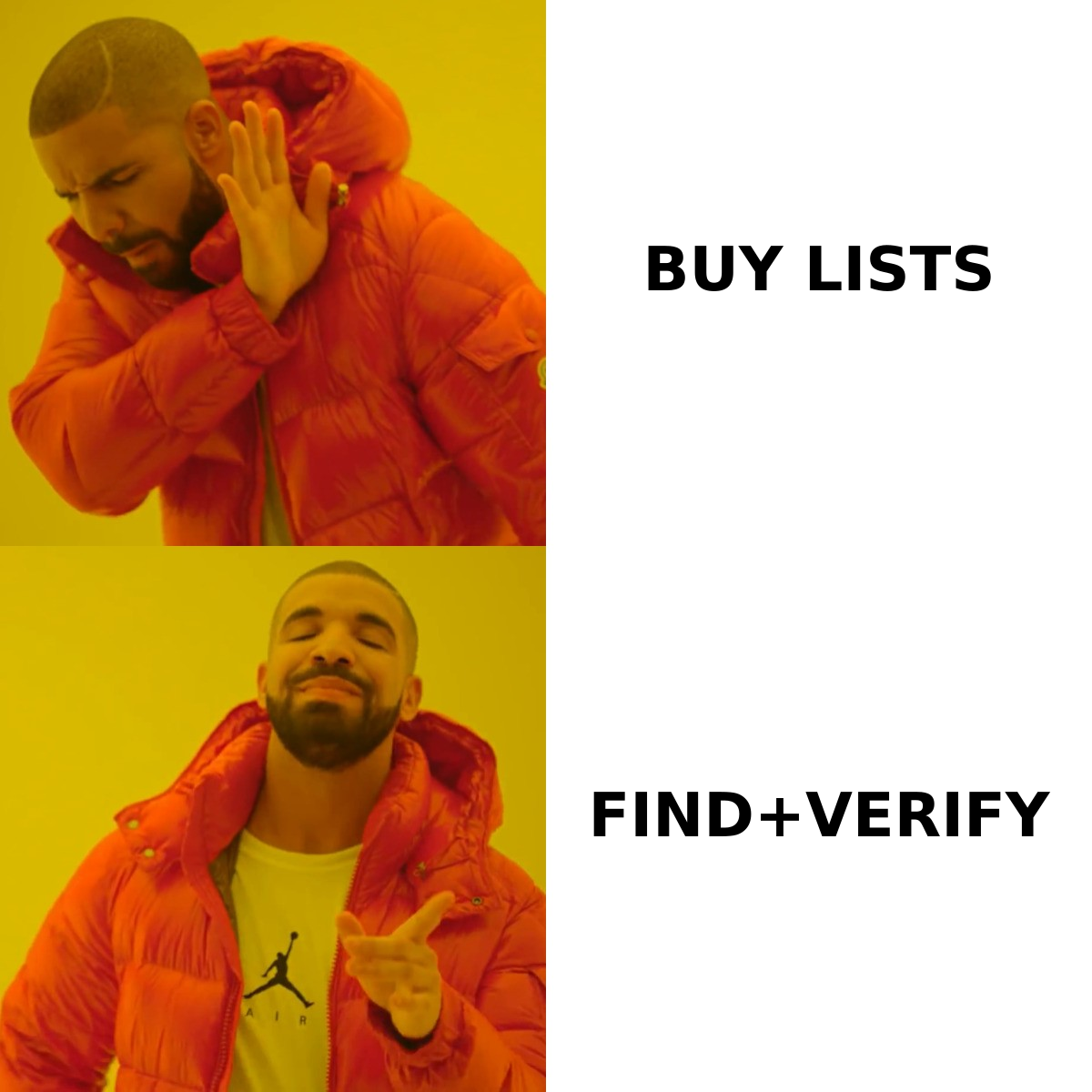
This is why a verify-at-source approach wins. When you find an email and validate it in the same workflow, you skip the decay window between "list was built" and "list was verified." A standalone email verifier is essential when you already hold a list, but pairing discovery and verification at the moment of capture is what actually keeps bounce rates low over time.
When should you use each tool?#
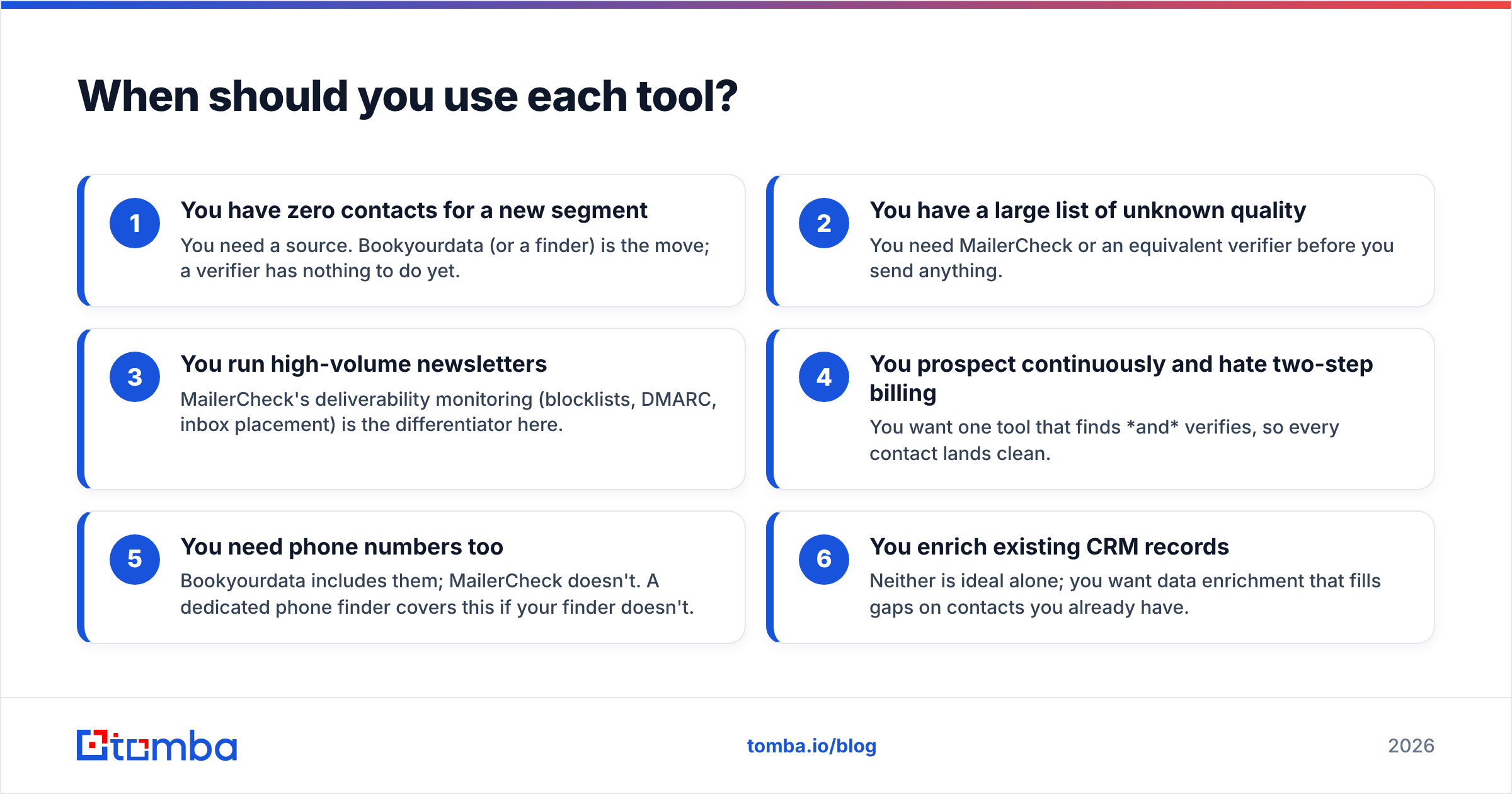
Pick based on the job in front of you:
- You have zero contacts for a new segment — You need a source. Bookyourdata (or a finder) is the move; a verifier has nothing to do yet.
- You have a large list of unknown quality — You need MailerCheck or an equivalent verifier before you send anything.
- You run high-volume newsletters — MailerCheck's deliverability monitoring (blocklists, DMARC, inbox placement) is the differentiator here.
- You prospect continuously and hate two-step billing — You want one tool that finds and verifies, so every contact lands clean.
- You need phone numbers too — Bookyourdata includes them; MailerCheck doesn't. A dedicated phone finder covers this if your finder doesn't.
- You enrich existing CRM records — Neither is ideal alone; you want data enrichment that fills gaps on contacts you already have.
Notice how often the honest answer is "you need a capability neither tool fully covers on its own." That's the gap a combined finder-and-verifier closes.
Is there a better alternative to running both?#
Yes — for most outbound teams, a single platform that finds and verifies emails replaces the buy-a-list-then-clean-it loop. Instead of paying Bookyourdata for records and MailerCheck to validate them, you search for the exact contacts you want and get verification baked into the result.
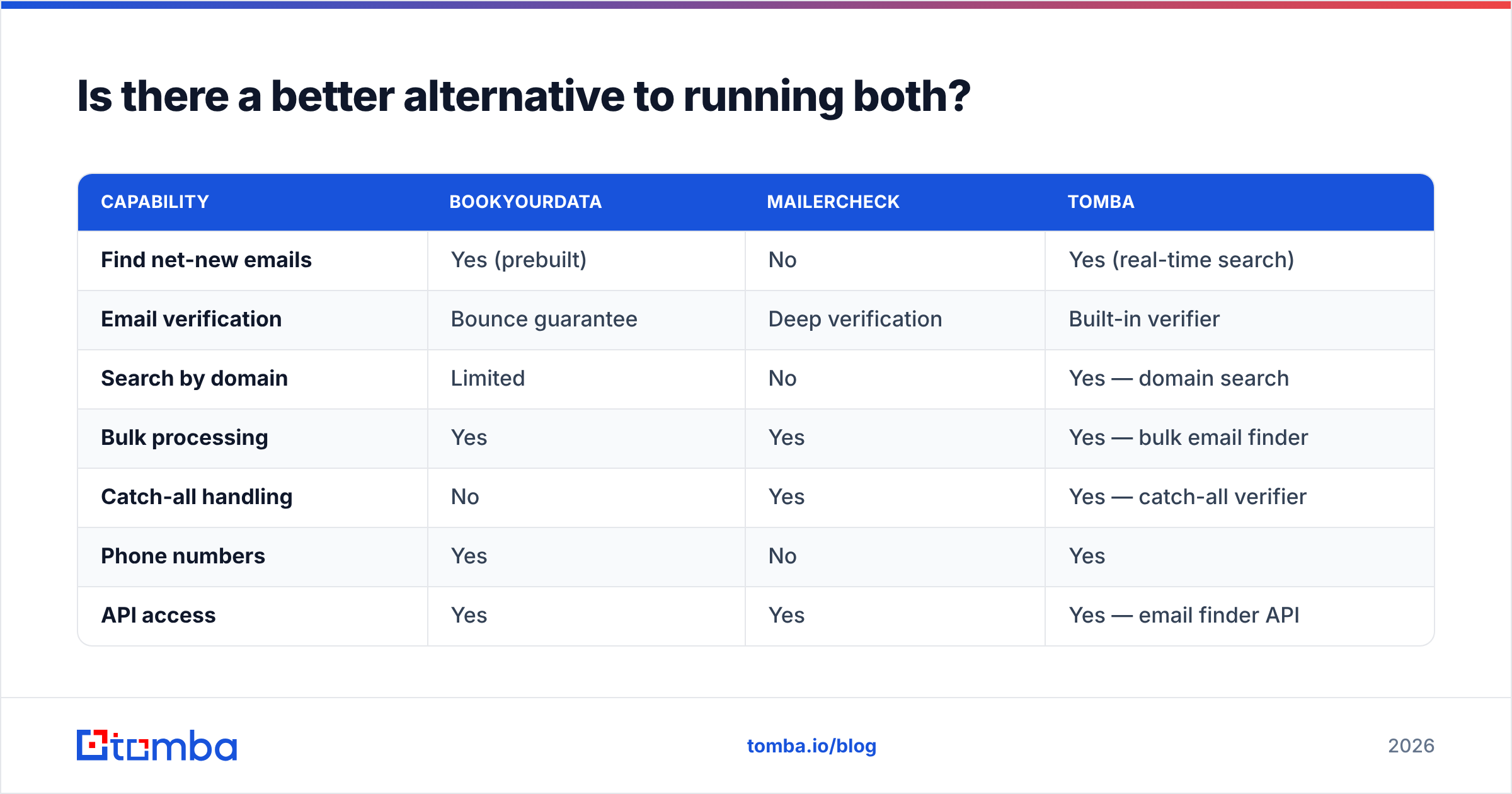
Here's how the three approaches stack up:
| Capability | Bookyourdata | MailerCheck | Tomba |
|---|---|---|---|
| Find net-new emails | Yes (prebuilt) | No | Yes (real-time search) |
| Email verification | Bounce guarantee | Deep verification | Built-in verifier |
| Search by domain | Limited | No | Yes — domain search |
| Bulk processing | Yes | Yes | Yes — bulk email finder |
| Catch-all handling | No | Yes | Yes — catch-all verifier |
| Phone numbers | Yes | No | Yes |
| API access | Yes | Yes | Yes — email finder API |
| Free tier | Limited credits | Free credits | 25 searches/mo free |
The structural advantage isn't a feature checkbox — it's the workflow. When discovery and verification happen together, your data is fresh by definition because it's pulled and checked at the moment you need it, not bought as a months-old snapshot and patched later. That's the difference between a list that's guaranteed accurate on paper and one that's actually deliverable today.
It's also worth being fair about where the dedicated tools still lead: MailerCheck's deliverability monitoring suite (inbox placement, blocklist tracking) is deeper than what most finders bundle, so high-volume senders may still want it alongside. And Bookyourdata's no-subscription credit model genuinely suits one-off bulk pulls. The point isn't that combined tools win every scenario — it's that for continuous prospecting, the two-step buy-and-clean model quietly costs you more in money, time, and bounce risk than it looks.
What about deliverability and sender reputation?#
No matter which tool you pick, the goal is the same: protect your sender reputation so your emails reach the inbox. A clean list is necessary but not sufficient — your authentication has to be right too. Before any campaign, confirm your domain has valid SPF, DKIM, and DMARC records; tools like Google Postmaster and the major mailbox providers all weigh these signals. Industry resources from vendors like HubSpot and peer reviews on G2 consistently rank list hygiene and authentication as the top two levers on deliverability.
The sequence that works: find verified contacts, confirm they're deliverable, warm your domain, authenticate properly, then send. Skip the verification step — as you would if you blasted a raw bought list — and the cleanest copy in the world won't save your open rates.
Final verdict: Bookyourdata vs MailerCheck#
They're not really competitors, so "winner" depends on your gap. Choose Bookyourdata when you need to source B2B contacts and phone numbers fast and don't already have a list. Choose MailerCheck when you have a list (or send high volume) and need to clean and protect it, especially with its deliverability monitoring.
But if your actual job is ongoing outbound — find the right people, confirm their emails work, and load them into a sequence — running two pay-as-you-go tools is more expensive and more brittle than it needs to be. A combined approach keeps your data fresh because it's found and verified in the same motion, not bought stale and patched.
Start with Tomba Email Finder to search net-new contacts by name, company, or domain and get verification built into every result — then layer in a dedicated verifier or deliverability monitor only if your volume truly demands it. You get the sourcing power of a data marketplace and the accuracy of a verifier in one workflow, on a free tier that lets you test it before you spend a credit. Run a few searches against your ICP this week and compare the bounce rate to your last bought list — the difference is usually the whole argument.
// get started
Find, verify and enrich your first contacts today
Start on the free plan with 25 searches a month, then scale when your team is ready.
Free plan · No credit card required · GDPR & CCPA
// about the author