Bookyourdata vs Market Location: B2B Data Compared 2026
Bookyourdata vs Market Location, compared on coverage, accuracy, pricing, and compliance — plus where a verified email finder beats a static list in 2026.
You are deciding where to source B2B contact data, and two names keep coming up: Bookyourdata, the pay-as-you-go email list marketplace, and Market Location, the German business directory and address database. They sound interchangeable. They are not. One sells you instant downloadable lists; the other sells curated firmographic records built around the DACH market. Picking wrong wastes budget and, worse, torches your sender reputation.
This guide breaks down how the two actually differ, where each one wins, and why a third approach — finding and verifying contacts on demand — often beats buying a static list at all.
TL;DR#
- Bookyourdata is best for fast, self-serve, global B2B email lists with a per-record credit model and a bounce guarantee marketed at ~95%+ deliverability.
- Market Location is best for deep, curated German/DACH firmographic and address data, often used for direct mail, market analysis, and enterprise data licensing.
- Neither is a live finder. Both sell snapshots of data that decay 22–30% per year, so a list bought in Q1 is materially worse by Q4.
- Accuracy is the real battleground. A "verified" list still needs re-verification before send; budget for it or expect bounces.
- If you target specific people at specific companies, an on-demand email finder plus verifier (like Tomba) usually beats both on freshness and cost-per-usable-contact.
What is Bookyourdata?#
Bookyourdata is a self-service B2B contact data platform. You filter by industry, job title, location, company size, and technology, then buy the resulting records as a one-time download — typically a CSV with names, emails, titles, and company fields. It runs on a credit/pay-as-you-go model rather than forcing an annual seat, which is why solo founders and small sales teams like it.
Its headline pitch is a deliverability guarantee — the company advertises a high accuracy threshold (commonly cited around 95–97%) and offers credit back for bounces above that line. That guarantee is the product. You can read user reactions on G2 and Capterra to see how that holds up in practice, which varies by segment and how stale the underlying record was at download.
The catch is structural: any downloaded list is a snapshot. The moment someone changes jobs — and roughly 1 in 4 B2B contacts do every year — your purchased record silently rots. The guarantee covers the day you bought it, not the day you send.

What is Market Location?#
Market Location (marketlocation.de) is a German B2B data house focused on firmographic and address intelligence, with particularly strong coverage of the DACH region (Germany, Austria, Switzerland). Where Bookyourdata leans toward instant email lists for outreach, Market Location leans toward curated company records — legal entity data, addresses, industry codes, employee counts, and decision-maker information — used for direct mail, territory planning, market sizing, and enterprise data licensing.
That positioning matters. Market Location's data is closer to a reference database than a quick-buy email export. Buyers tend to be marketing operations, agencies running postal campaigns, and analysts who need defensible firmographics for the German-speaking market. Its compliance posture is built for GDPR-heavy Europe, which is reassuring if your entire motion is EU-based.
The trade-off is the inverse of Bookyourdata's: more depth and regional rigor, but less of the click-filter-download-now speed, and email coverage that is narrower outside DACH.
Bookyourdata vs Market Location: how do they compare?#
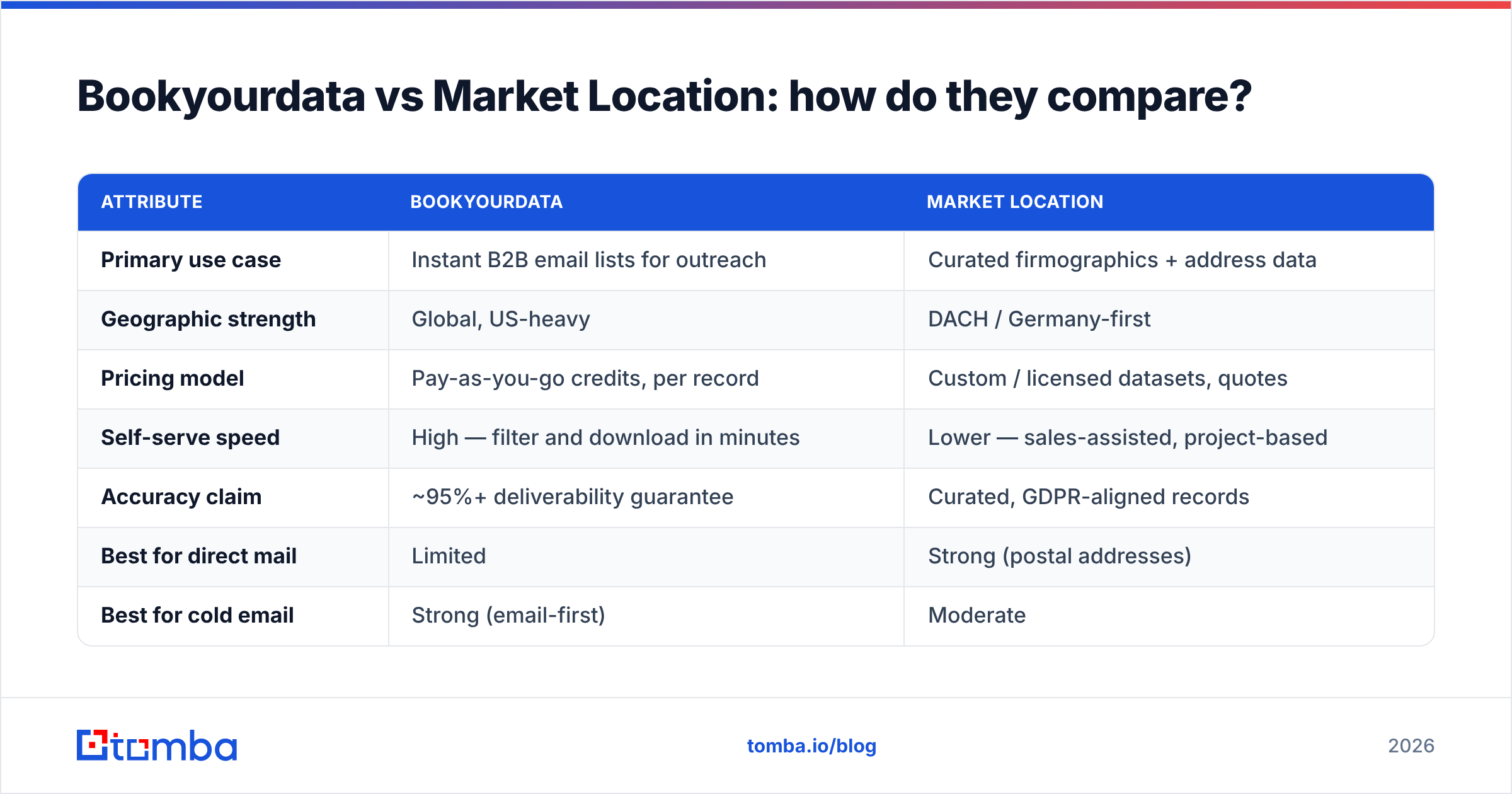
Here is the side-by-side on the attributes that actually change your buying decision.
| Attribute | Bookyourdata | Market Location |
|---|---|---|
| Primary use case | Instant B2B email lists for outreach | Curated firmographics + address data |
| Geographic strength | Global, US-heavy | DACH / Germany-first |
| Pricing model | Pay-as-you-go credits, per record | Custom / licensed datasets, quotes |
| Self-serve speed | High — filter and download in minutes | Lower — sales-assisted, project-based |
| Accuracy claim | ~95%+ deliverability guarantee | Curated, GDPR-aligned records |
| Best for direct mail | Limited | Strong (postal addresses) |
| Best for cold email | Strong (email-first) | Moderate |
| Data freshness | Snapshot at download | Snapshot, periodically refreshed |
| Compliance focus | Global, opt-in claims | GDPR / EU-centric |
| Re-verification needed before send | Yes | Yes |
The pattern is clear: Bookyourdata optimizes for speed and email volume, Market Location optimizes for regional depth and data quality. If you cold email globally and want a list today, Bookyourdata fits the workflow. If you run German-market campaigns, need postal addresses, or license firmographics for analysis, Market Location is the more serious tool.
Which one is more accurate?#
Both claim high quality, but "accurate at purchase" and "accurate at send" are different numbers. Independent studies and vendor disclosures consistently put B2B data decay at 22–30% per year. So even a genuinely 97%-clean list degrades measurably within a quarter or two of sitting in your CRM.
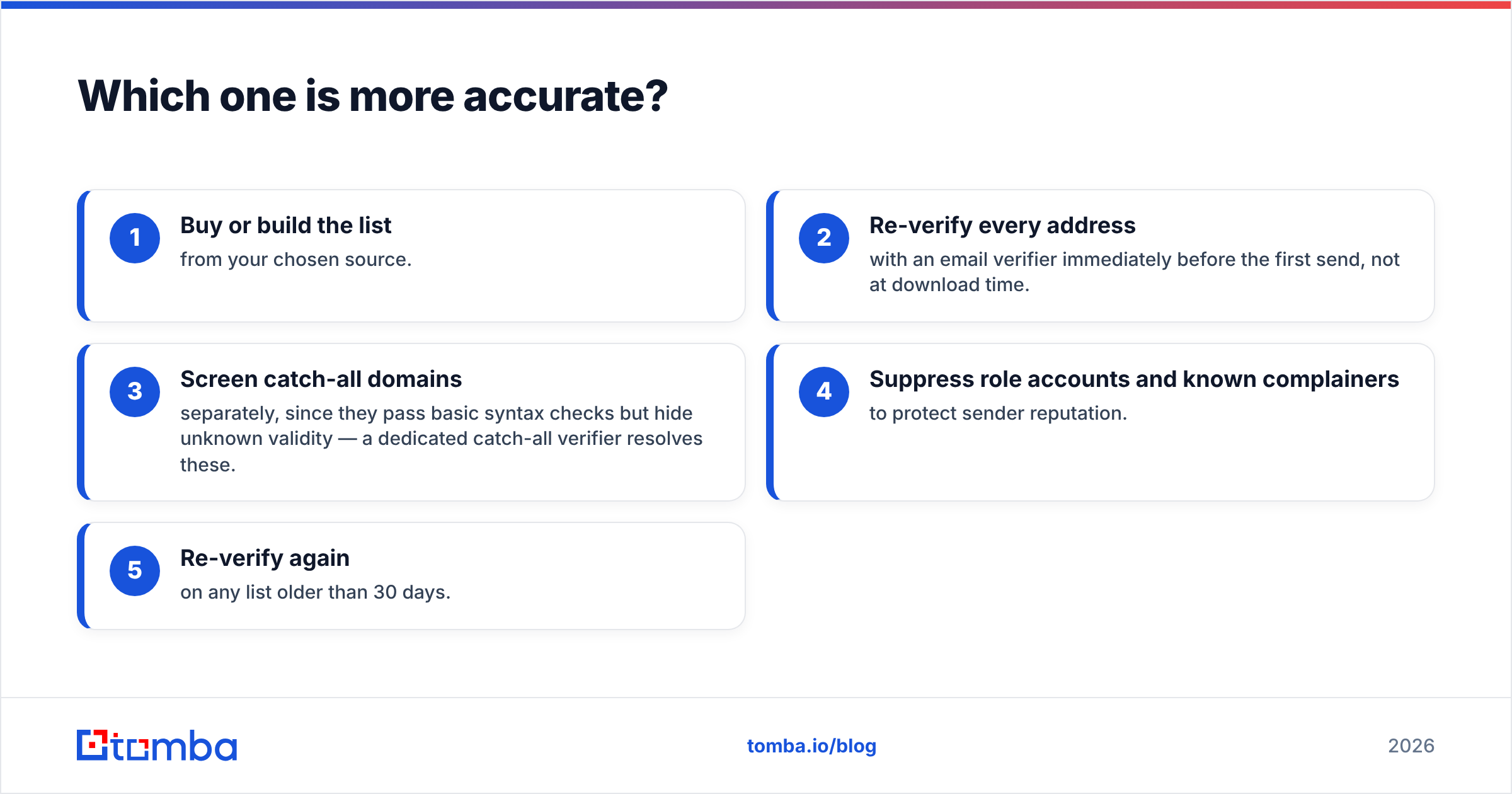
That is why the smartest buyers treat any purchased list — from either vendor — as raw material, not finished goods. The workflow that actually protects deliverability looks like this:
- Buy or build the list from your chosen source.
- Re-verify every address with an email verifier immediately before the first send, not at download time.
- Screen catch-all domains separately, since they pass basic syntax checks but hide unknown validity — a dedicated catch-all verifier resolves these.
- Suppress role accounts and known complainers to protect sender reputation.
- Re-verify again on any list older than 30 days.

Do this and a mediocre list performs well. Skip it and even a premium list from either vendor will produce hard bounces, spam folder placement, and the slow erosion of your domain's standing. The accuracy debate between Bookyourdata and Market Location matters far less than whether you verify before you press send.
How does pricing compare?#
Bookyourdata's pay-as-you-go credit model is its biggest practical advantage for small teams: you pay per record, with no annual commitment, and you can buy a few hundred contacts to test before scaling. That removes the seat-license friction common in enterprise data tools.
Market Location's pricing is closer to the traditional data-licensing world — custom quotes, project scoping, and dataset agreements rather than a public credit menu. That suits enterprise and agency buyers but slows down a founder who just wants 500 verified emails by Friday.
When you compare cost, do not compare price-per-record. Compare cost-per-usable-contact. If you buy 1,000 records at a low per-record price but 30% are stale or unverifiable, your real cost per deliverable contact is roughly 43% higher than the sticker. A cheaper list with worse data is frequently the more expensive choice once bounces and reputation damage are priced in.
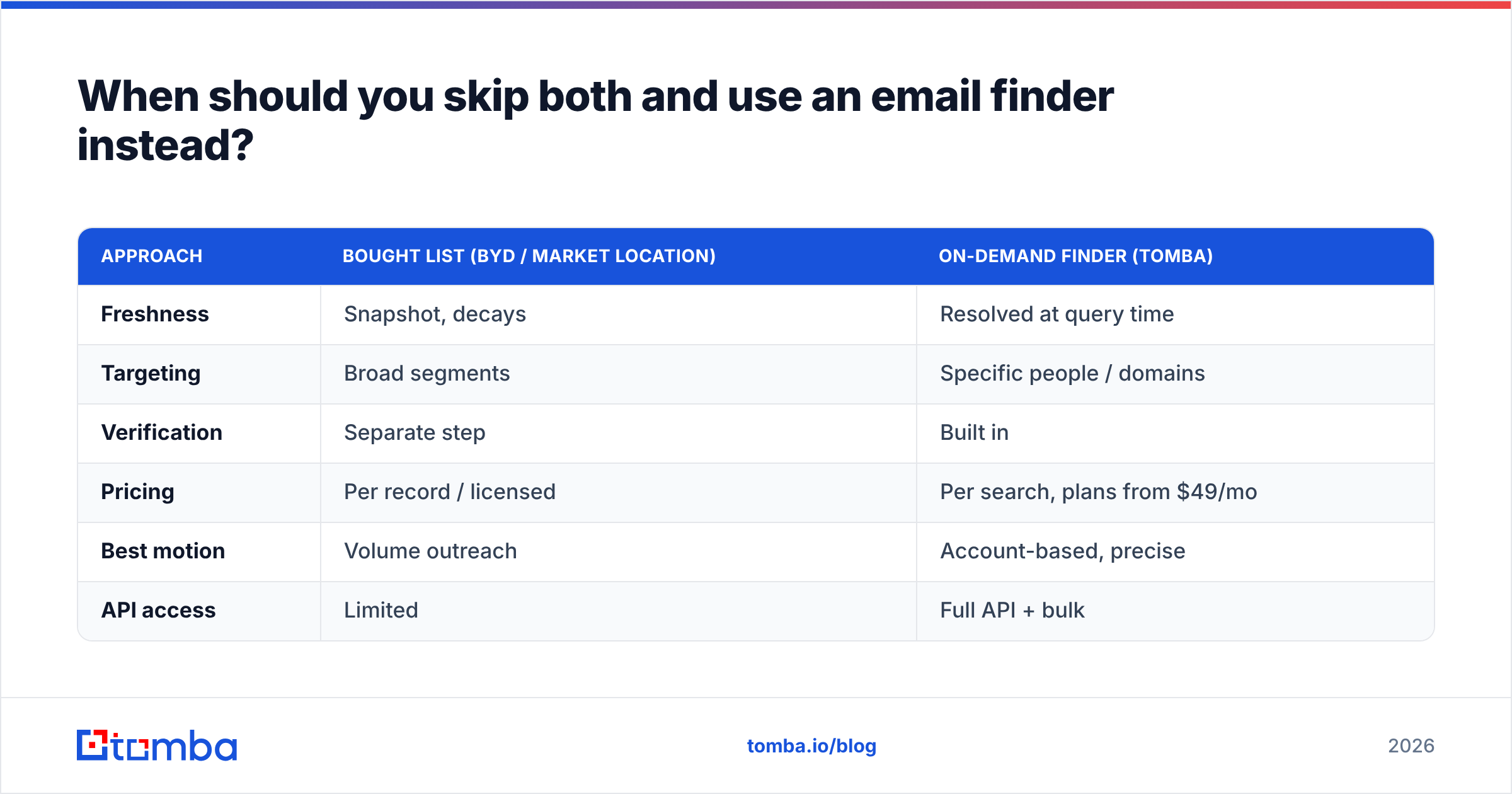
When should you skip both and use an email finder instead?#
Reach for a finder-plus-verifier stack when you target named people at named companies rather than buying broad segments. This is the everyday reality of most account-based outbound: you have a list of 200 target accounts and the titles you want, and you need the right person's current, verified email.
A static list cannot do this well, because it was assembled before you knew which accounts you cared about, and it has been decaying ever since. An on-demand finder resolves contacts at the moment you need them, against live sources.
| Approach | Bought list (BYD / Market Location) | On-demand finder (Tomba) |
|---|---|---|
| Freshness | Snapshot, decays | Resolved at query time |
| Targeting | Broad segments | Specific people / domains |
| Verification | Separate step | Built in |
| Pricing | Per record / licensed | Per search, plans from $49/mo |
| Best motion | Volume outreach | Account-based, precise |
| API access | Limited | Full API + bulk |
With Tomba you can run a domain search to pull every public email pattern at a target company, use the email finder to resolve a specific person from a name and domain, and verify the result in the same flow. For larger jobs, the bulk email finder processes thousands of records and returns confidence scores, so you are never sending blind. Pricing starts on a free tier (25 searches/month) and scales through Starter at $49/mo — see the full Tomba pricing breakdown.
The mental model: buy a list when you need breadth fast and don't know the names yet; use a finder when you need the right person, current and verified, right now.
What about compliance and GDPR?#
If your outreach touches the EU, compliance is not optional. Market Location's EU-first design is a genuine advantage here — its data practices are built around German and European norms, which matters for direct mail and B2B processing under legitimate-interest grounds. Bookyourdata operates globally and markets opt-in sourcing, but you remain the data controller and carry the obligation to document lawful basis, honor opt-outs, and keep suppression lists current.
Two practical rules regardless of vendor:
- Keep proof of source and consent basis for every record you import, so you can answer a data-subject request without scrambling.
- Maintain a live suppression list and re-check it before each campaign — this protects both compliance and email deliverability.
Whichever provider you choose, treat their compliance posture as a starting point, not a transfer of liability. The buyer is still on the hook.
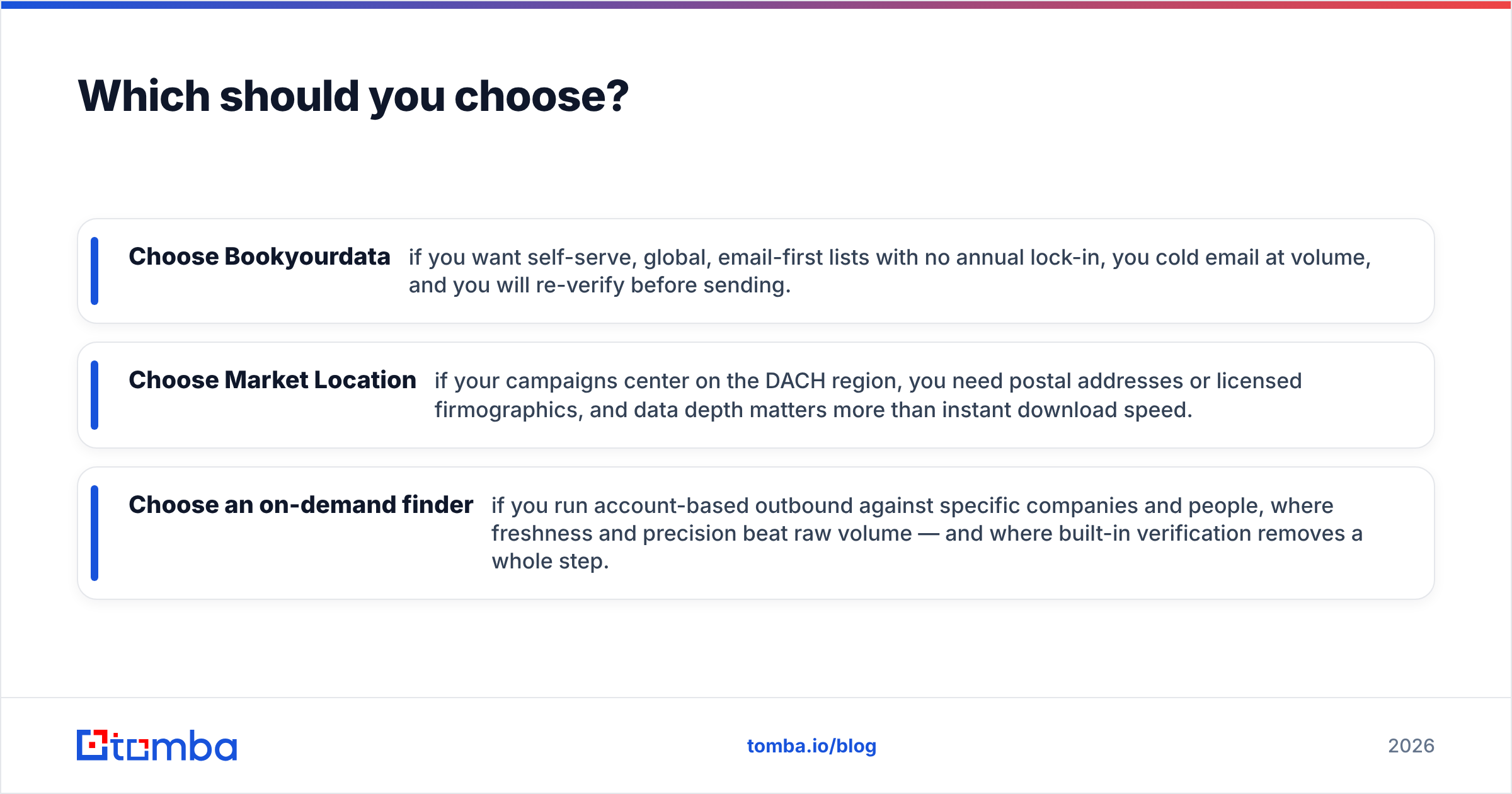
Which should you choose?#
Decide by motion, not by brand loyalty:
- Choose Bookyourdata if you want self-serve, global, email-first lists with no annual lock-in, you cold email at volume, and you will re-verify before sending.
- Choose Market Location if your campaigns center on the DACH region, you need postal addresses or licensed firmographics, and data depth matters more than instant download speed.
- Choose an on-demand finder if you run account-based outbound against specific companies and people, where freshness and precision beat raw volume — and where built-in verification removes a whole step.
Most teams end up blending: a curated source for breadth and a finder for precision targeting, with verification as the non-negotiable gate before every send. The vendor matters less than the verification discipline wrapped around it.
The bottom line#
Bookyourdata and Market Location solve adjacent but distinct problems — fast global email lists versus deep DACH firmographics — and both are legitimate choices inside their lane. But both also sell snapshots, and snapshots decay. The differentiator that protects your campaigns is not which list you buy; it is whether you resolve and verify contacts close to the moment you reach out.
If your outbound runs on hitting the right person at the right company with a current, verified address, start with the Tomba Email Finder. Find emails by name or domain, verify them in the same workflow, and push the results straight into your CRM through the API — no stale CSV, no waiting on a quote, no guessing whether the address still works. Spin up the free tier, test it against a handful of your target accounts, and compare the cost-per-usable-contact for yourself.
// get started
Find, verify and enrich your first contacts today
Start on the free plan with 25 searches a month, then scale when your team is ready.
Free plan · No credit card required · GDPR & CCPA
// about the author