BookYourData vs Mattermark: B2B Data Compared (2026)
BookYourData sells prebuilt B2B email lists; Mattermark tracks company growth signals. Here's which one fits your 2026 pipeline — and where a live finder beats both.
TL;DR
- BookYourData sells prebuilt, pay-as-you-go B2B email and contact lists you filter by industry, title, and geography, then download as CSV.
- Mattermark is a company-intelligence platform built around growth signals — funding, headcount, web traffic — not a contact-list vendor.
- They solve different jobs: BookYourData answers "who do I email?", Mattermark answers "which companies are heating up?"
- Both ship static snapshots. The moment you export, the data starts decaying — emails bounce, people change jobs, funding rounds close.
- If your real goal is reaching the right person today, a live finder-plus-verifier like Tomba beats a frozen list on accuracy and cost per usable contact.
If you're weighing bookyourdata vs mattermark, the honest first answer is that you may be comparing a hammer to a tape measure. This guide breaks down what each tool actually does, where each wins, the pricing reality, and when a third option serves your pipeline better.
What is BookYourData?#
BookYourData is a self-serve B2B contact database. You open a builder, stack filters (industry, job title, company size, country, technology used), see a live count of matching contacts, and buy exactly that many records. Pricing is credit-based and pay-as-you-go, so there's no forced annual contract for a one-time campaign.
The pitch is speed and ownership: in ten minutes you can walk out with a few thousand sales-ready emails and phone numbers, no sales call required. BookYourData also markets a deliverability guarantee, refunding or replacing records that bounce above a stated threshold.
The catch is the one every list vendor shares. A purchased list is a photograph, not a livestream. It was accurate when the database was last refreshed, which may have been weeks or months before you exported it. People quit, get promoted, and switch companies constantly, and every one of those moves quietly rots a row in your CSV.

What is Mattermark?#
Mattermark is a different animal. It's a market- and company-intelligence tool that scores and tracks companies on growth signals: funding raised, employee count trends, web traffic, mobile downloads, and "Mattermark Score" momentum. It was built for investors, business-development teams, and competitive researchers who need to spot which companies are accelerating.
Mattermark is excellent at answering "which 200 SaaS companies grew headcount 40% last quarter and just raised a Series B?" That's a research and prioritization question, not a contact-acquisition question. While Mattermark surfaces some company-level contact context, it is not designed to hand you a verified, person-level email list the way BookYourData is.
So the comparison is really about two stages of the same funnel. Mattermark helps you build a target account list. BookYourData helps you fill those accounts with contacts. Treating them as direct substitutes is where most buyers go wrong.
BookYourData vs Mattermark: side-by-side comparison#
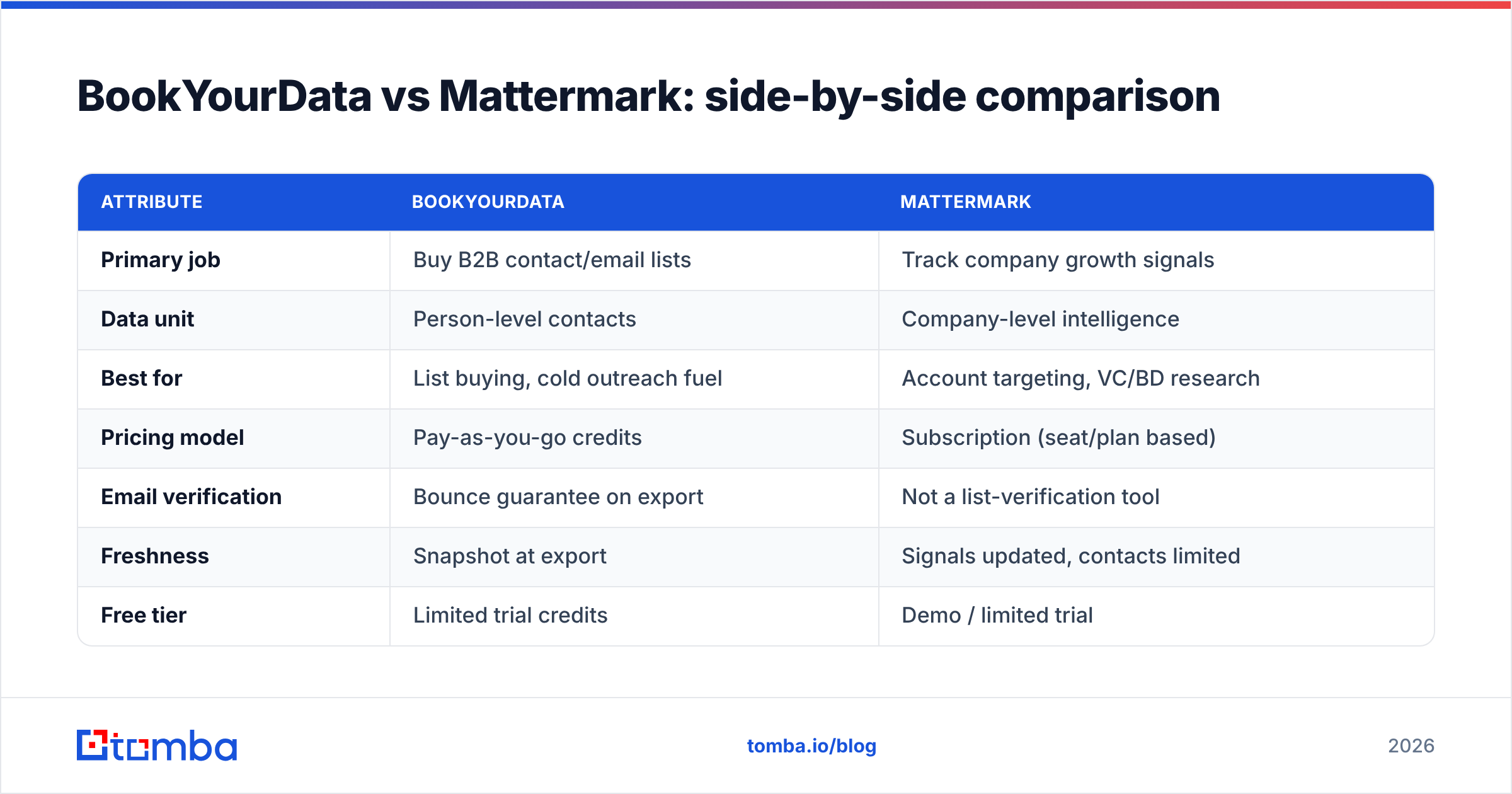
Here's the core breakdown across the attributes that actually change your buying decision.
| Attribute | BookYourData | Mattermark |
|---|---|---|
| Primary job | Buy B2B contact/email lists | Track company growth signals |
| Data unit | Person-level contacts | Company-level intelligence |
| Best for | List buying, cold outreach fuel | Account targeting, VC/BD research |
| Pricing model | Pay-as-you-go credits | Subscription (seat/plan based) |
| Email verification | Bounce guarantee on export | Not a list-verification tool |
| Freshness | Snapshot at export | Signals updated, contacts limited |
| Free tier | Limited trial credits | Demo / limited trial |
| Output | CSV download | Dashboards, exports, API |
| Weakness | Static data decays fast | Thin person-level contact data |
The pattern is clear: pick BookYourData when you need contacts to email this week, and Mattermark when you need to decide which companies deserve that effort in the first place.
Which one is more accurate?#
Accuracy depends on what you measure. For company-level signals — funding, headcount, traffic — Mattermark is the stronger source because that's its entire reason to exist. For person-level email deliverability, BookYourData is the better bet of the two, since it sells contacts with a bounce guarantee.
But "accurate at export" is the trap with both. A static list is only as good as its last refresh, and B2B data decays at roughly 2–3% per month as people change roles. Buy 5,000 contacts in January, start sending in March, and a meaningful slice are already wrong. That's not a knock on either vendor specifically — it's the physics of selling frozen data.
This is the gap a live workflow closes. Instead of trusting a months-old snapshot, you find or confirm the address at send time and run it through an email verifier before the message ever leaves your outbox. The same applies to enrichment: pulling fresh firmographic and contact fields with data enrichment at the moment of outreach beats re-buying a list every quarter.
Independent reviews on G2 reflect this split too — list vendors score well on volume and price, intelligence platforms score well on insight, and both draw complaints about stale or incomplete records. Read recent reviews, not the highlight reel.
How much do they cost?#
Pricing is where the two diverge most.
- BookYourData is pay-as-you-go. You buy credits, one credit per revealed contact, with volume discounts as you scale. Good for spiky, campaign-driven buying where you don't want a recurring bill.
- Mattermark is subscription-based, priced by plan tier and seats. You're paying for ongoing access to signals and dashboards, which makes sense if monitoring is continuous, not one-off.
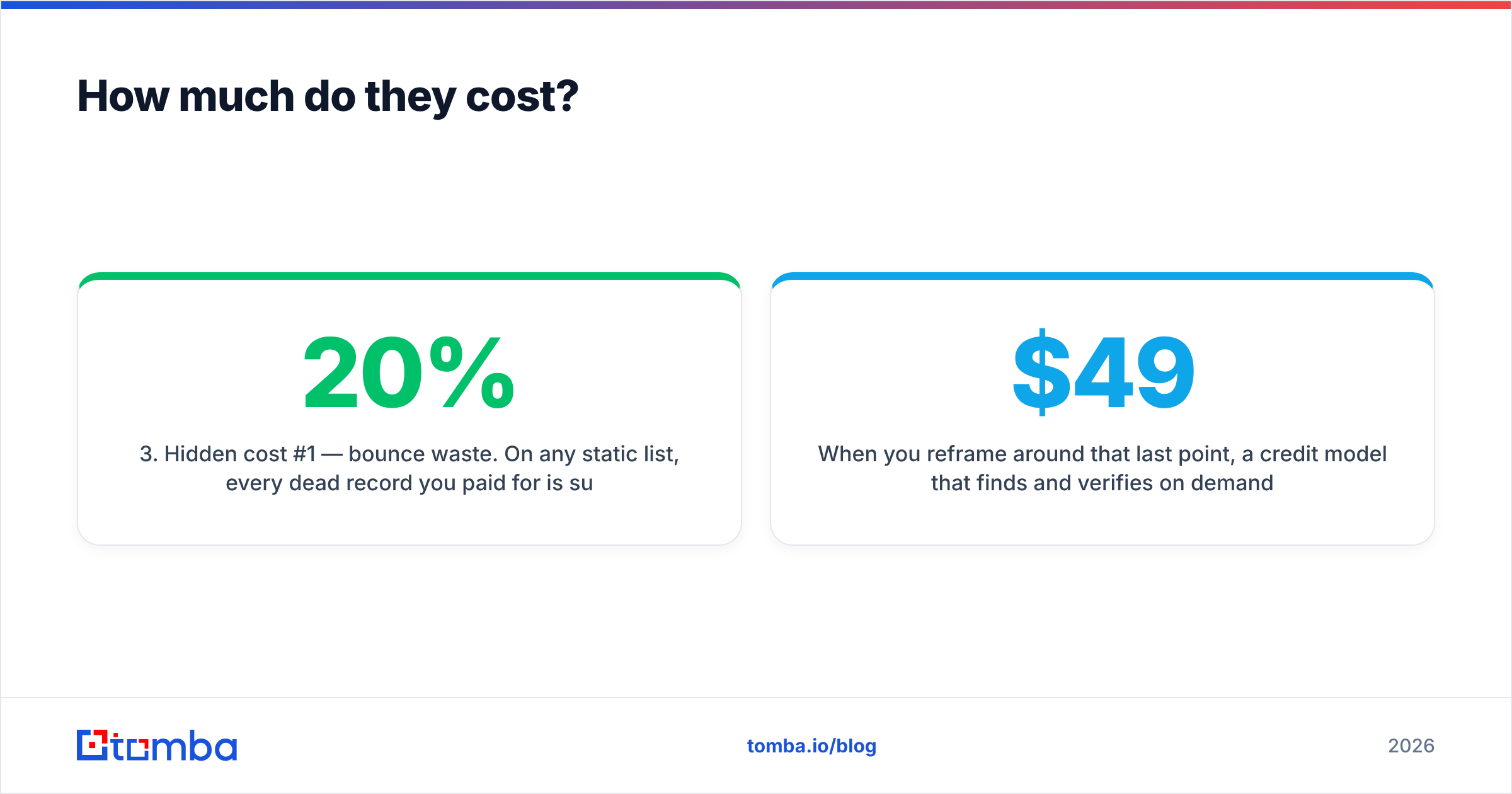
- Hidden cost #1 — bounce waste. On any static list, every dead record you paid for is sunk cost. A "cheap" list with 20% decay isn't cheap.
- Hidden cost #2 — re-buying. Because lists go stale, list-first teams pay again every quarter to refresh. Subscription intelligence has the same treadmill in a different shape.
- The metric that matters is cost per usable, verified contact reached — not the sticker price per record.
When you reframe around that last point, a credit model that finds and verifies on demand often beats both buying a bulk list and paying for a research subscription you only partly use. Compare it against transparent Tomba pricing — a Free tier (25 searches/mo), Starter at $49/mo, Growth at $99/mo, and Pro at $249/mo — and the cost-per-good-contact math frequently favors the live approach.

When should you pick each tool?#
Pick BookYourData if:
- You need a chunk of contacts now for a specific, time-boxed campaign.
- You want to own the data outright with no subscription.
- Your filters map cleanly to its taxonomy (industry, title, geo, tech).
Pick Mattermark if:
- Your bottleneck is targeting, not contact volume — you need to know which accounts are worth pursuing.
- You're in VC, business development, or competitive research.
- You'll use growth signals continuously, justifying a subscription.
Pick neither (use a live finder) if:
- You care most about deliverability and cost per usable contact.
- Your team sends ongoing outreach and can't afford quarterly list rot.
- You'd rather find the exact person at the exact account, verified, at send time.
That third path is worth a serious look, because it sidesteps the shared weakness of both products: the snapshot problem.
Is there a better alternative to both?#
For most outbound teams, yes — a find-and-verify workflow instead of a buy-and-pray list. Rather than purchasing a bulk file that decays, you identify your target accounts (Mattermark's strength, achievable with cheaper signal sources too), then pull verified contacts on demand.
Here's where that workflow lives in practice:
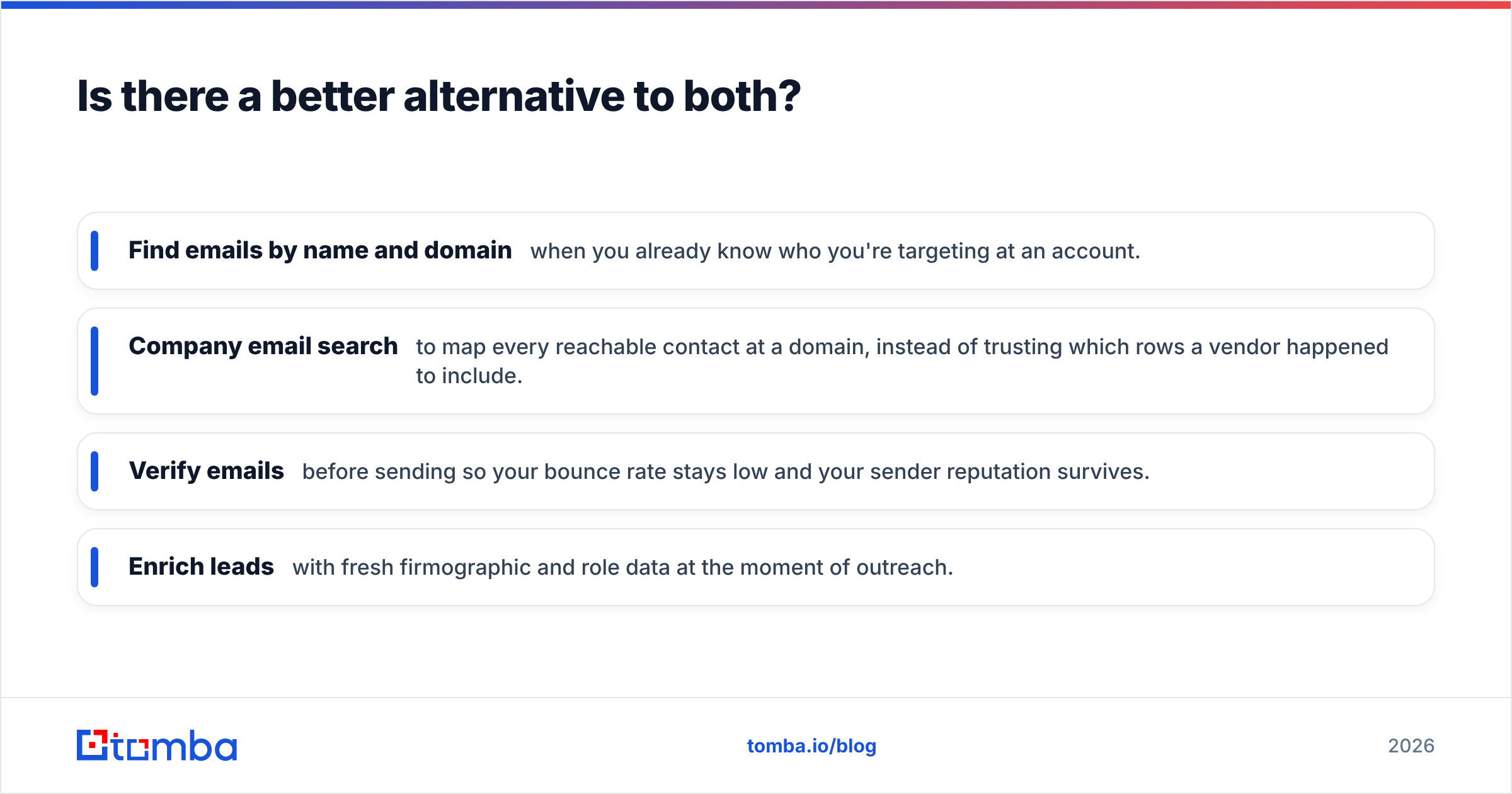
- Find emails by name and domain when you already know who you're targeting at an account.
- Company email search to map every reachable contact at a domain, instead of trusting which rows a vendor happened to include.
- Verify emails before sending so your bounce rate stays low and your sender reputation survives.
- Enrich leads with fresh firmographic and role data at the moment of outreach.
The difference is freshness. A purchased list answers "who was here last quarter." A live finder answers "who is here right now, and is this address valid today." For deliverability-sensitive cold email, that distinction is the whole game — a 2% bounce list keeps you in the inbox; a 15% bounce list gets your domain throttled.
This isn't to say lists never make sense. For a one-time event push or a market you'll never touch again, a quick BookYourData export can be the pragmatic choice. And for pure investment research, Mattermark's signals are genuinely useful. But for the repeatable, deliverability-critical outbound that drives most B2B pipeline, find-and-verify wins on accuracy and on cost per reply.
You can also explore vendor positioning directly on the BookYourData and Mattermark sites before deciding — just read their freshness and verification claims with a skeptical eye.
How do these tools fit a real workflow?#
A clean 2026 stack usually separates the two jobs they conflate:
- Targeting layer — decide which accounts matter (growth signals, ICP fit). Mattermark or comparable intel sits here.
- Contact layer — get the right person, verified. A live finder sits here, not a static list.
- Delivery layer — sequence, send, and protect deliverability with verified addresses only.
The mistake is letting a list vendor own all three layers with one frozen CSV. Split them, and you can swap the weakest piece without re-buying everything. Most teams find the contact layer is where stale data hurts most — and it's the easiest layer to upgrade to live data without disrupting the rest of the stack.
The bottom line#
BookYourData and Mattermark aren't really rivals; they're tools for different stages. BookYourData is a fast, ownable way to buy contacts. Mattermark is a sharp lens for spotting accelerating companies. Both ship snapshots, and both decay the second you export.
If your priority is reaching the right person with a deliverable message — and keeping your cost per usable contact low — skip the snapshot and go live. Try the Tomba Email Finder to find and verify professional emails by name, domain, or company in real time, with a free tier to test it before you commit. Pair it with the email verifier and you'll spend less, bounce less, and stop re-buying lists that were stale before you opened them.
// get started
Find, verify and enrich your first contacts today
Start on the free plan with 25 searches a month, then scale when your team is ready.
Free plan · No credit card required · GDPR & CCPA
// about the author