Bookyourdata vs Millionverifier 2026: Which B2B Tool Wins?
Bookyourdata sells ready-made B2B contact lists; MillionVerifier cleans the emails you already have. Here's which one fits your workflow in 2026 — and where a finder beats both.
Bookyourdata and MillionVerifier get lumped together in "best B2B data tools" lists, but they solve opposite halves of the same problem. One sells you contacts. The other tells you whether the contacts you have are real. Picking the wrong one wastes budget and tanks your sender reputation.
This breakdown shows exactly what each tool does, where it wins, where it fails, and which workflow each one belongs in.
TL;DR#
- Bookyourdata is a pay-as-you-go B2B contact list provider. You buy ready-made records (email, phone, title, company) by the credit. It claims a 97% accuracy guarantee.
- MillionVerifier is a bulk email verification tool. It does not give you new contacts — it cleans lists you already own, removing bounces and invalid addresses at very low cost.
- They are complements, not direct competitors. Buy data from one, scrub it with the other. Comparing them head-to-head only makes sense when you're deciding where to spend a limited budget first.
- Neither is a true email finder. If you want to find a specific person's verified work email from a name and domain, a dedicated email finder plus built-in verification is a tighter, cheaper loop.
- Verification is non-negotiable either way. Even a 97%-accurate purchased list degrades fast, so a verifier (or a finder with verification baked in) belongs in every stack.
What is Bookyourdata?#
Bookyourdata is a self-service B2B database. You filter by industry, job title, location, company size, and technology used, then buy the matching contact records on a credit basis. Each credit unlocks a full record: business email, direct or company phone, title, LinkedIn URL, and firmographic data.
The pitch is speed. You don't run outreach to find contacts — you download a finished list and start sending. Bookyourdata advertises a 97% accuracy guarantee and re-credits records that bounce beyond that threshold. Pricing is pay-as-you-go (no forced subscription), which appeals to teams that buy data in bursts rather than continuously.
The tradeoff is the tradeoff of all prebuilt databases: you're buying from a pool that everyone else can also buy from, and "accuracy at time of collection" is not the same as "accurate today." Job changes, company moves, and role churn quietly rot any static list. That's why purchased data and email verification almost always travel together.

What is MillionVerifier?#
MillionVerifier does one job and does it cheaply: it checks whether email addresses are deliverable. You upload a list, it runs syntax checks, domain/MX validation, SMTP probing, and catch-all detection, then returns each address tagged as valid, invalid, catch-all, or unknown.
It is genuinely good at the narrow thing it does. Pricing is among the lowest in the category, results are fast, and there's a free daily allowance plus a free-result policy on certain statuses (you're not charged for "unknown" results in some plans). For teams sitting on a big, aging list — newsletter subscribers, an old CRM export, scraped contacts — MillionVerifier is a low-risk way to cut the bounce rate before a send.
What it does not do is give you contacts. There is no database to search, no finder, no enrichment. If your list is empty, MillionVerifier has nothing to work on. It's the dish-washing step, not the grocery run.
Bookyourdata vs MillionVerifier: how do they actually differ?#
Here's the core distinction, because half the confusion comes from treating these as the same category of tool:
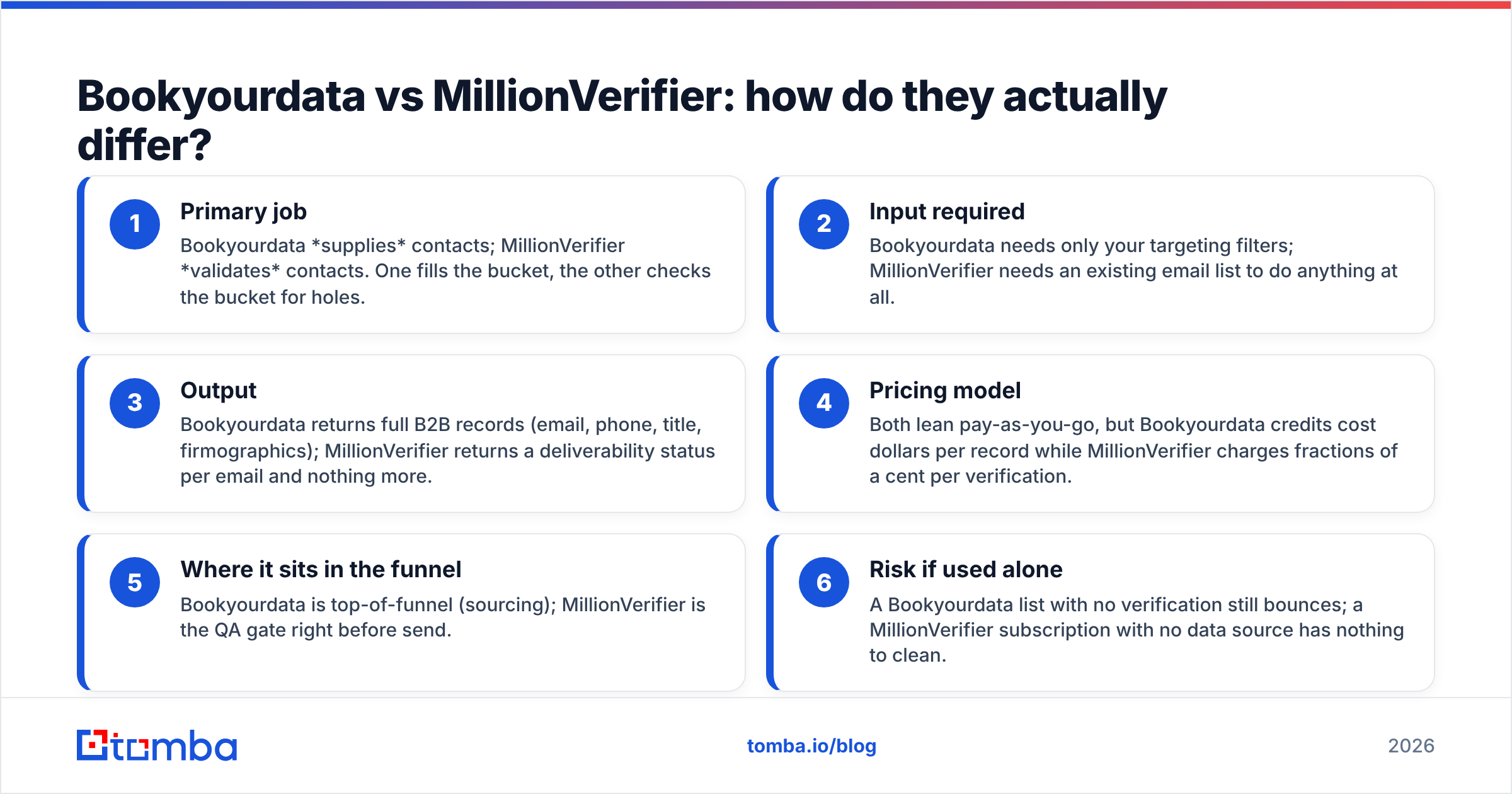
- Primary job — Bookyourdata supplies contacts; MillionVerifier validates contacts. One fills the bucket, the other checks the bucket for holes.
- Input required — Bookyourdata needs only your targeting filters; MillionVerifier needs an existing email list to do anything at all.
- Output — Bookyourdata returns full B2B records (email, phone, title, firmographics); MillionVerifier returns a deliverability status per email and nothing more.
- Pricing model — Both lean pay-as-you-go, but Bookyourdata credits cost dollars per record while MillionVerifier charges fractions of a cent per verification.
- Where it sits in the funnel — Bookyourdata is top-of-funnel (sourcing); MillionVerifier is the QA gate right before send.
- Risk if used alone — A Bookyourdata list with no verification still bounces; a MillionVerifier subscription with no data source has nothing to clean.
Which one has better data and accuracy?#
Short answer: they measure different things, so "accuracy" means different things for each.
Bookyourdata's 97% figure is a sourcing accuracy claim — the share of records correct when delivered. MillionVerifier's accuracy is verification accuracy — how reliably it labels an address valid vs invalid, especially on tricky catch-all domains. You can't directly rank them; they're scoring different exams.
What matters is that purchased-list accuracy decays and verification accuracy is your defense against that decay. Buying a 97%-accurate list and never re-verifying it means you're sending to a list that's 97% accurate on day one and meaningfully worse three months later. This is exactly why a strong catch-all verifier matters: catch-all domains accept everything at the SMTP layer, so a lazy verifier marks them "valid" and you bounce anyway.
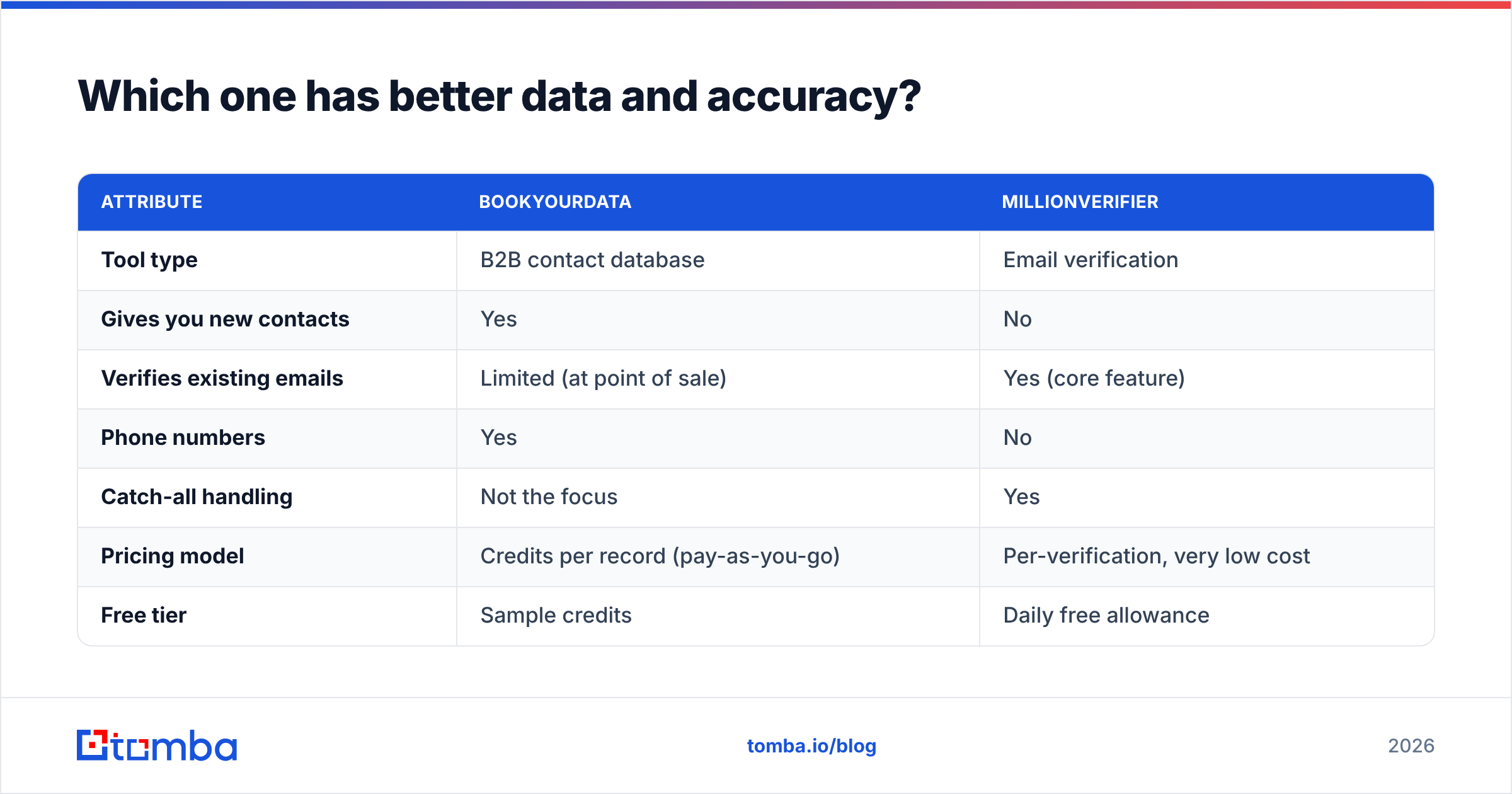
| Attribute | Bookyourdata | MillionVerifier |
|---|---|---|
| Tool type | B2B contact database | Email verification |
| Gives you new contacts | Yes | No |
| Verifies existing emails | Limited (at point of sale) | Yes (core feature) |
| Phone numbers | Yes | No |
| Catch-all handling | Not the focus | Yes |
| Pricing model | Credits per record (pay-as-you-go) | Per-verification, very low cost |
| Free tier | Sample credits | Daily free allowance |
| Best for | Sourcing a list fast | Cleaning a list before send |
What does each one cost?#
Pricing is where the "vs" framing finally makes sense, because both ask you to spend, and a finite budget forces a choice.
Bookyourdata charges per record. The exact rate scales with volume, but you're paying meaningfully more per contact than you'd pay to verify one — because you're buying the data itself, not just a yes/no on deliverability. The pay-as-you-go structure means no monthly lock-in, which is good for occasional buyers and bad for predictable budgeting.
MillionVerifier is cheap by design. Verifications run in the fractions-of-a-cent range, credits don't expire on most plans, and there's a free daily allowance. For pure list hygiene, it's one of the lowest-cost options on the market, and that's its strongest argument.
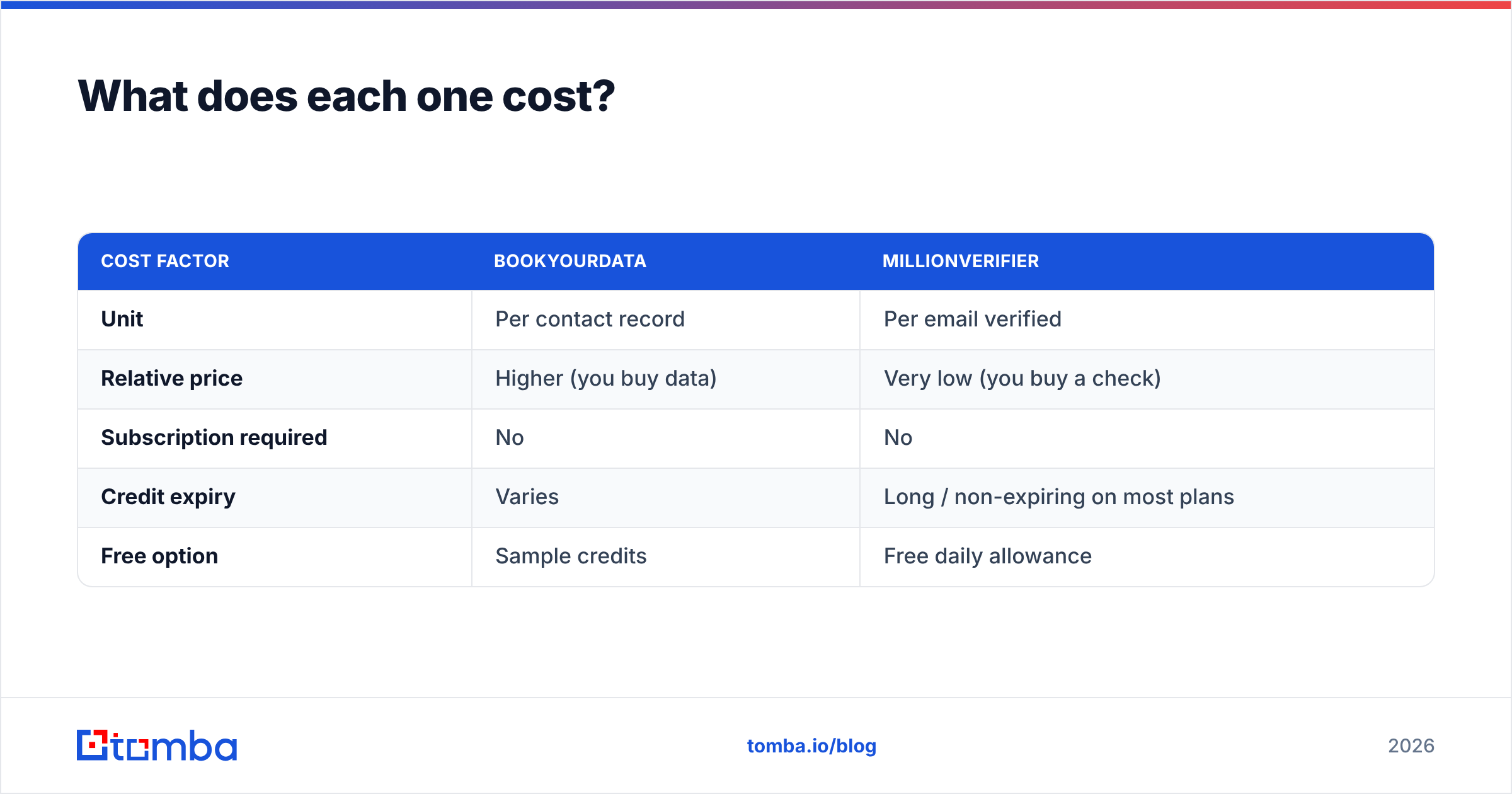
| Cost factor | Bookyourdata | MillionVerifier |
|---|---|---|
| Unit | Per contact record | Per email verified |
| Relative price | Higher (you buy data) | Very low (you buy a check) |
| Subscription required | No | No |
| Credit expiry | Varies | Long / non-expiring on most plans |
| Free option | Sample credits | Free daily allowance |
If your problem is "I have no contacts," paying MillionVerifier does nothing. If your problem is "my list bounces," paying Bookyourdata for more unverified data just moves the problem. Match the spend to the actual gap.
When should you use Bookyourdata vs MillionVerifier?#
Use Bookyourdata when:
- You need a targeted B2B list now and don't have time to build it manually.
- You want phone numbers and firmographics alongside emails.
- You buy data in occasional bursts and hate subscriptions.
Use MillionVerifier when:
- You already have a list (CRM export, scraped data, old subscribers) and need to cut bounces before sending.
- Cost-per-check is your main constraint.
- You care specifically about catch-all and unknown-status filtering.
The honest answer for most teams is both, in sequence: source, then verify. But that's two vendors, two bills, and two dashboards — which is exactly the friction the next section solves.
Is there a better third option than either?#
For a lot of teams, yes — because the real job is usually "get the right person's verified email," and neither a static database nor a standalone verifier nails that alone.
A dedicated email finder flips the model. Instead of buying a giant prebuilt list and hoping it's still accurate, you find the specific contacts you actually want — by domain, by name, by company — and verify them in the same pass. You skip the stale-list problem (records are fetched fresh) and you skip the second vendor (verification is built in).
That's the gap Tomba fills. It combines sourcing and verification in one workflow:
- Email finder — get a verified professional email from a name and company domain, on demand.
- Domain search — pull every public email pattern for a company in one query.
- Bulk email finder — run finding and verification across thousands of rows at once.
- Built-in verification — every result is checked, including catch-all logic, so you're not paying a separate tool to re-clean it.
Compared to a buy-then-scrub stack, the finder approach means fresher data, one bill, and one place to work. It won't replace a database when you genuinely need a broad, filtered list of 50,000 records — that's still list-buying territory. But for precise, accurate, ready-to-send contacts, it's a tighter loop.
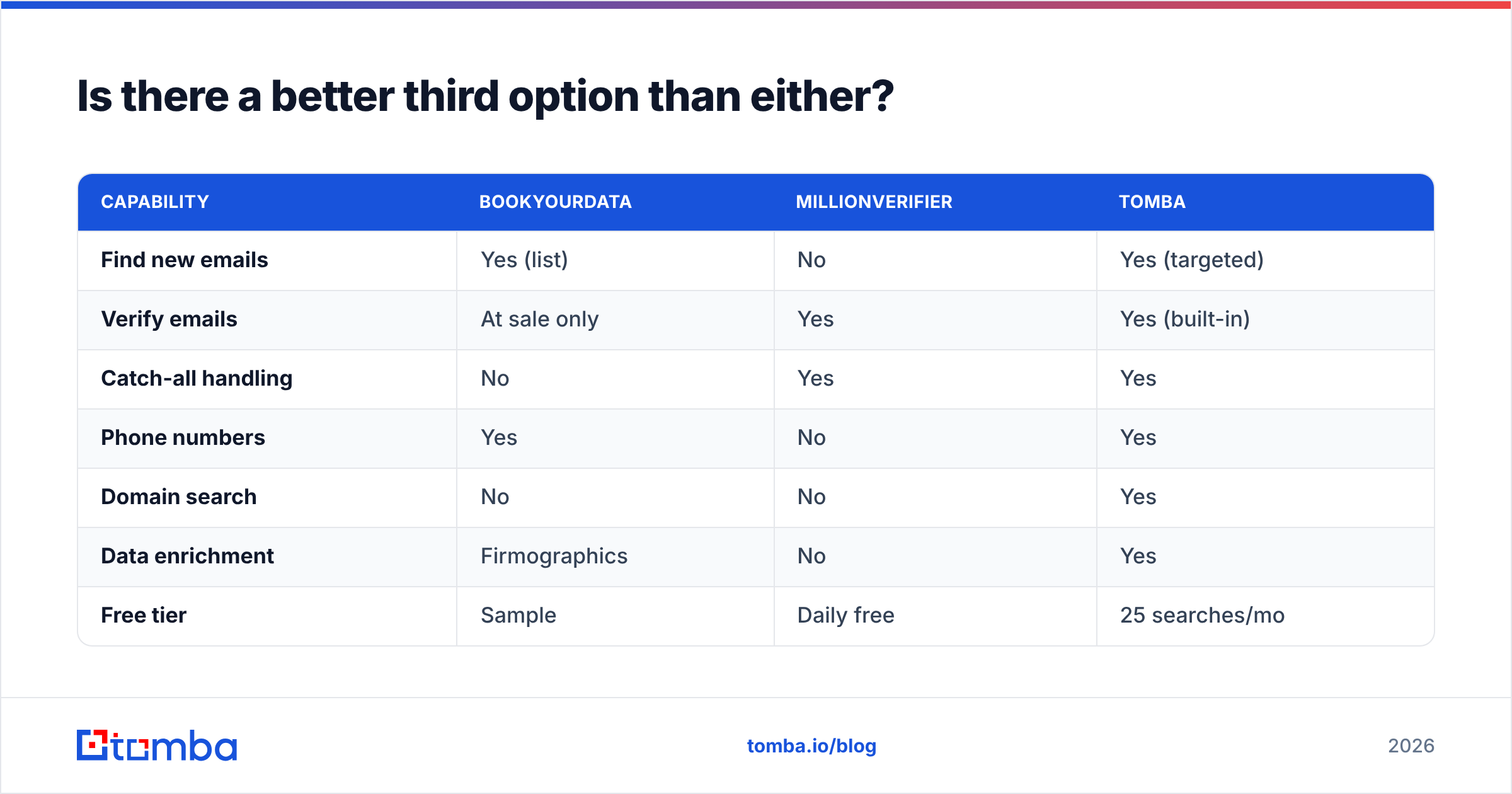
| Capability | Bookyourdata | MillionVerifier | Tomba |
|---|---|---|---|
| Find new emails | Yes (list) | No | Yes (targeted) |
| Verify emails | At sale only | Yes | Yes (built-in) |
| Catch-all handling | No | Yes | Yes |
| Phone numbers | Yes | No | Yes |
| Domain search | No | No | Yes |
| Data enrichment | Firmographics | No | Yes |
| Free tier | Sample | Daily free | 25 searches/mo |
| Entry paid plan | Pay-as-you-go | Low per-verify | $49/mo (Starter) |
You can see full Tomba pricing for the Starter ($49/mo), Growth ($99/mo), and Pro ($249/mo) tiers, all of which include verification.
How does deliverability tie all of this together?#
Whatever you buy or build, your sender reputation is what determines whether the email lands. Mailbox providers track bounce rates, spam complaints, and engagement, and a few bad sends can suppress an entire domain. According to Google's own Postmaster guidance, keeping spam complaint rates low and avoiding dead addresses is central to inbox placement.
That's why verification isn't optional and a database alone isn't enough. Bookyourdata gets you contacts but not ongoing freshness. MillionVerifier gets you hygiene but not contacts. A finder-plus-verification workflow gets you both in one motion — which is why, for cold outreach specifically, it tends to beat either single-purpose tool.
If you want to compare alternatives more broadly, third-party review sites like G2 list verified user feedback across all three categories — useful for sanity-checking vendor claims against real usage.
The verdict#
Bookyourdata and MillionVerifier aren't really rivals — they're two stages of the same pipeline. If you're list-poor, Bookyourdata fills the gap fast. If you're list-rich but bounce-heavy, MillionVerifier cleans cheaply. Run both and you've covered sourcing and hygiene, at the cost of two vendors.
But if your actual goal is to reach specific, real people without buying a stale bulk list or stitching tools together, a finder with built-in verification is the simpler, fresher answer.
Start with Tomba's email finder. Find verified professional emails by name, company, or domain — with catch-all verification and enrichment built into every result, so you skip the buy-a-list-then-scrub-it dance entirely. The free tier gives you 25 searches a month to test it against your current stack before you spend a cent.
// get started
Find, verify and enrich your first contacts today
Start on the free plan with 25 searches a month, then scale when your team is ready.
Free plan · No credit card required · GDPR & CCPA
// about the author