BookYourData vs Null Bounce: B2B Data Showdown for 2026
BookYourData sells static B2B lists; Null Bounce verifies them. We compare accuracy, pricing, and workflow fit so you pick the right tool — and avoid bounced campaigns in 2026.
You are choosing between two tools that sound similar but solve opposite halves of the same problem. BookYourData sells you a pre-built B2B contact list. Null Bounce checks whether the emails on a list are still alive. One fills the bucket; the other plugs the leaks. Picking the wrong one — or only one — is how outbound campaigns end up with a 20% bounce rate and a burned sending domain.
This guide breaks down what each does, where each fails, and which workflow actually keeps your emails landing in 2026.
TL;DR — BookYourData vs Null Bounce in one screen#
- BookYourData is a pay-as-you-go B2B contact database: you buy lists by job title, industry, and location. Good for volume, weak on freshness.
- Null Bounce is an email verification tool: it scrubs bounce-prone addresses from a list you already have. It finds emails for you — it only validates them.
- They are not direct competitors. BookYourData is a data source; Null Bounce is a data cleaner. Most teams need both functions, not one.
- The accuracy gap matters most. A purchased list decays ~2.5% per month, so even a "verified" BookYourData list bounces if it sat in your CRM for a quarter.
- The smarter play is a real-time email finder plus a built-in verifier — like Tomba Email Finder — so you source and validate in the same step instead of stitching two vendors together.
What is BookYourData?#
BookYourData is a self-service B2B contact database. You log in, filter by criteria — job title, company size, industry, geography — and download a list of contacts with email addresses, phone numbers, and company data. Pricing is credit-based and pay-as-you-go, so you are buying records in bulk rather than paying a monthly seat.
The pitch is speed and coverage. Need 5,000 marketing directors in SaaS companies with 50–200 employees? You can export that in minutes. BookYourData advertises a high deliverability guarantee and offers refunds on bounced records above a threshold.
The catch is the model itself. A static, pre-compiled list is a snapshot. The moment someone changes jobs — and roughly one in three professionals does every year — that record is dead weight. You are buying data that was accurate when it was scraped, not necessarily when you hit send. This is the structural weakness of every list-purchase vendor, not just this one.

What is Null Bounce?#
Null Bounce is an email verification service. You upload a list — from BookYourData, a scraper, a trade-show badge scan, wherever — and it runs each address through a series of checks: syntax validation, MX record lookup, SMTP handshake, catch-all detection, and spam-trap filtering. It returns each email tagged as valid, invalid, risky, or unknown.
Critically, Null Bounce does not find emails. It has no database of contacts. If you have no list, Null Bounce does nothing for you. It is the second stage of a pipeline, not the first.
Used correctly, a verifier is essential. Scrubbing a list before a send drops your bounce rate, protects your sender reputation, and keeps you out of spam folders. The question is never "do I need verification?" — you do. The question is whether you should pay a standalone tool for it or get it bundled with the rest of your stack.
Is BookYourData better than Null Bounce?#
Wrong question — they do different jobs, so "better" depends on what you are missing. The honest comparison is what function you lack:
- You have zero contacts → You need a data source. BookYourData (or a finder) is your tool. Null Bounce can't help you because there's nothing to verify.
- You have a raw, unverified list → You need a cleaner. Null Bounce is your tool. Buying more data from BookYourData just adds more unverified records.
- You have an aging CRM → You need re-verification and fresh sourcing. Neither single tool fully covers this — you need a refresh loop.
- You want one workflow → You need a combined finder-plus-verifier so sourcing and validation happen in one pass, not two invoices.
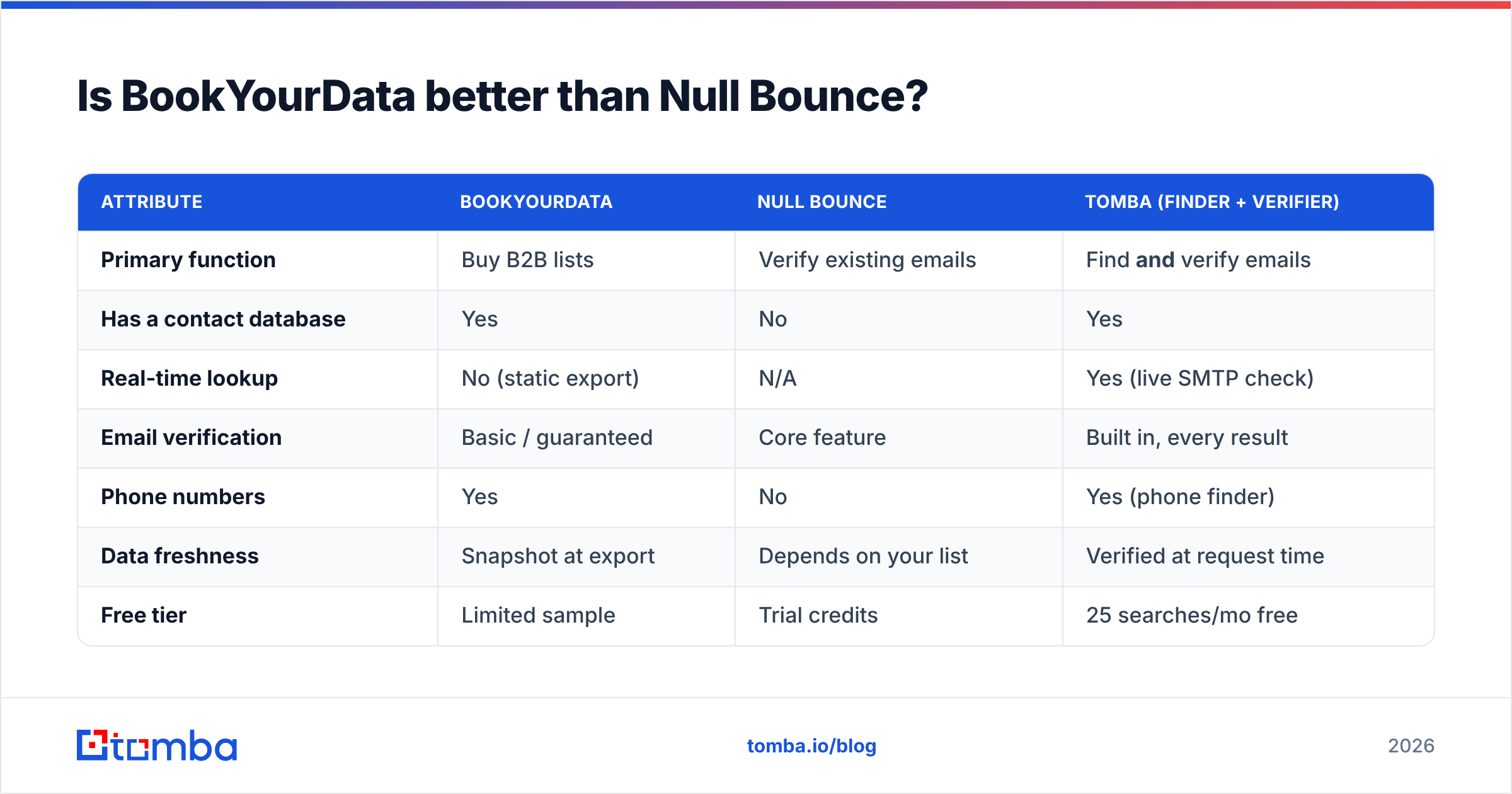
Here's how the two stack up on the attributes that actually decide campaign outcomes:
| Attribute | BookYourData | Null Bounce | Tomba (finder + verifier) |
|---|---|---|---|
| Primary function | Buy B2B lists | Verify existing emails | Find and verify emails |
| Has a contact database | Yes | No | Yes |
| Real-time lookup | No (static export) | N/A | Yes (live SMTP check) |
| Email verification | Basic / guaranteed | Core feature | Built in, every result |
| Phone numbers | Yes | No | Yes (phone finder) |
| Data freshness | Snapshot at export | Depends on your list | Verified at request time |
| Free tier | Limited sample | Trial credits | 25 searches/mo free |
| Pricing model | Pay-as-you-go credits | Per-verification | $49/mo Starter, scales up |
| API access | Limited | Yes | Full REST API |
| Best for | Bulk list buying | List hygiene | End-to-end prospecting |
The pattern is clear: BookYourData and Null Bounce each cover one column of what an outbound team actually needs. You either run both and reconcile them, or you use a platform that collapses the two into a single step.
Why does data freshness beat data volume?#
Because a bounced email costs more than a missing one. Conclusion first: a smaller, freshly verified list outperforms a giant stale one on every metric that matters — deliverability, reply rate, and domain health.
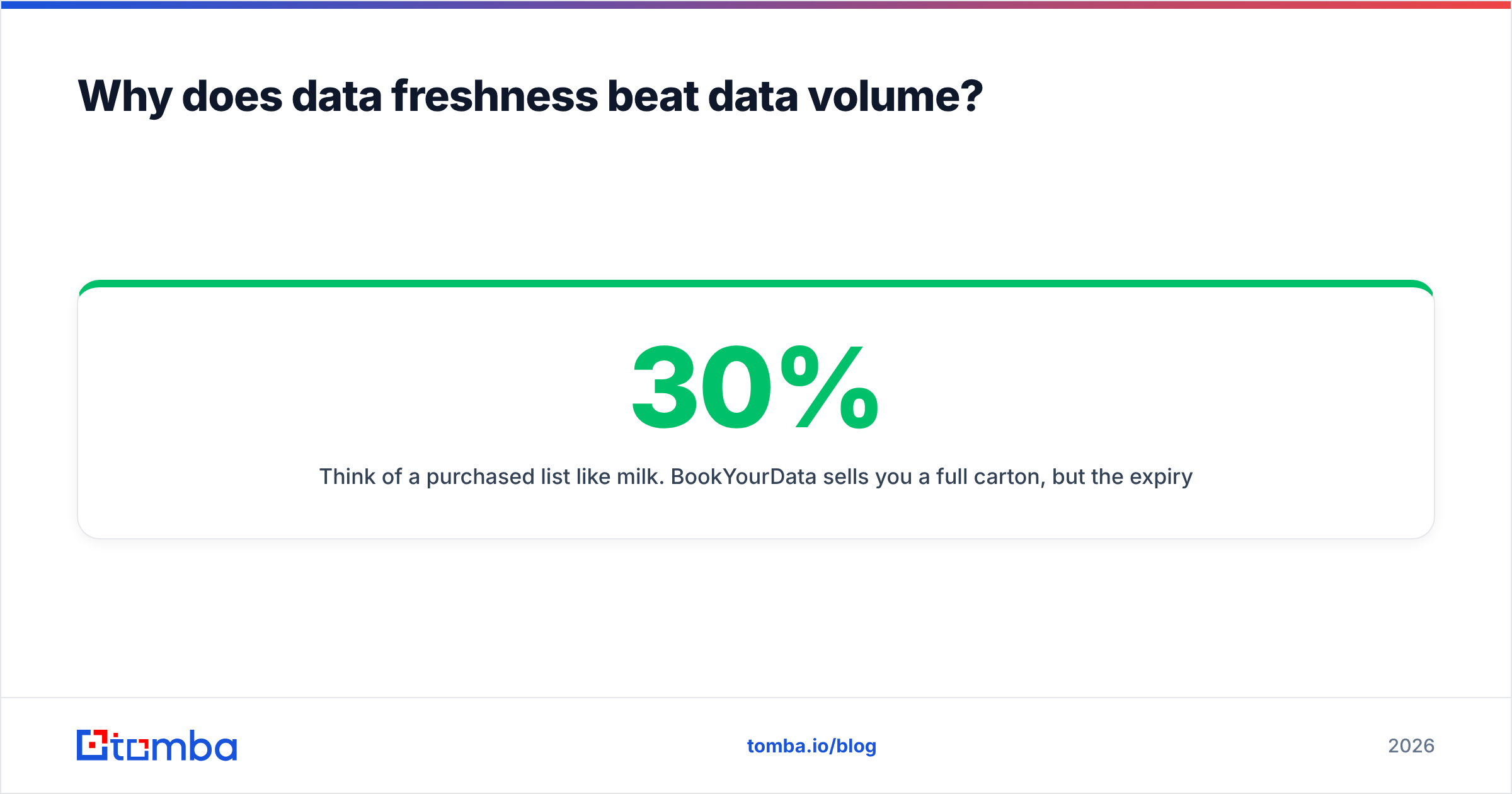
Think of a purchased list like milk. BookYourData sells you a full carton, but the expiry date was printed the day it was scraped, not the day you drink it. B2B data decays at roughly 22–30% per year as people switch jobs, companies rebrand, and domains change. A list that was 95% accurate at export can be 85% accurate three months later — and an 85% list means 15 bounces per 100 sends, which is well past the threshold where mailbox providers start throttling you.
This is why email deliverability hinges on when an address was verified, not just whether it was. A standalone verifier like Null Bounce helps, but it only tells you the email was valid at the moment you ran the check. If you then sit on the list for a month, you're back to guessing. Real-time verification at the moment of outreach is the only way to close that gap — and that's a finder-plus-verifier capability, not a list-purchase one.
Below is a representative accuracy view across the email-data category, so you can see how a real-time finder benchmarks against list-based and verify-only approaches.

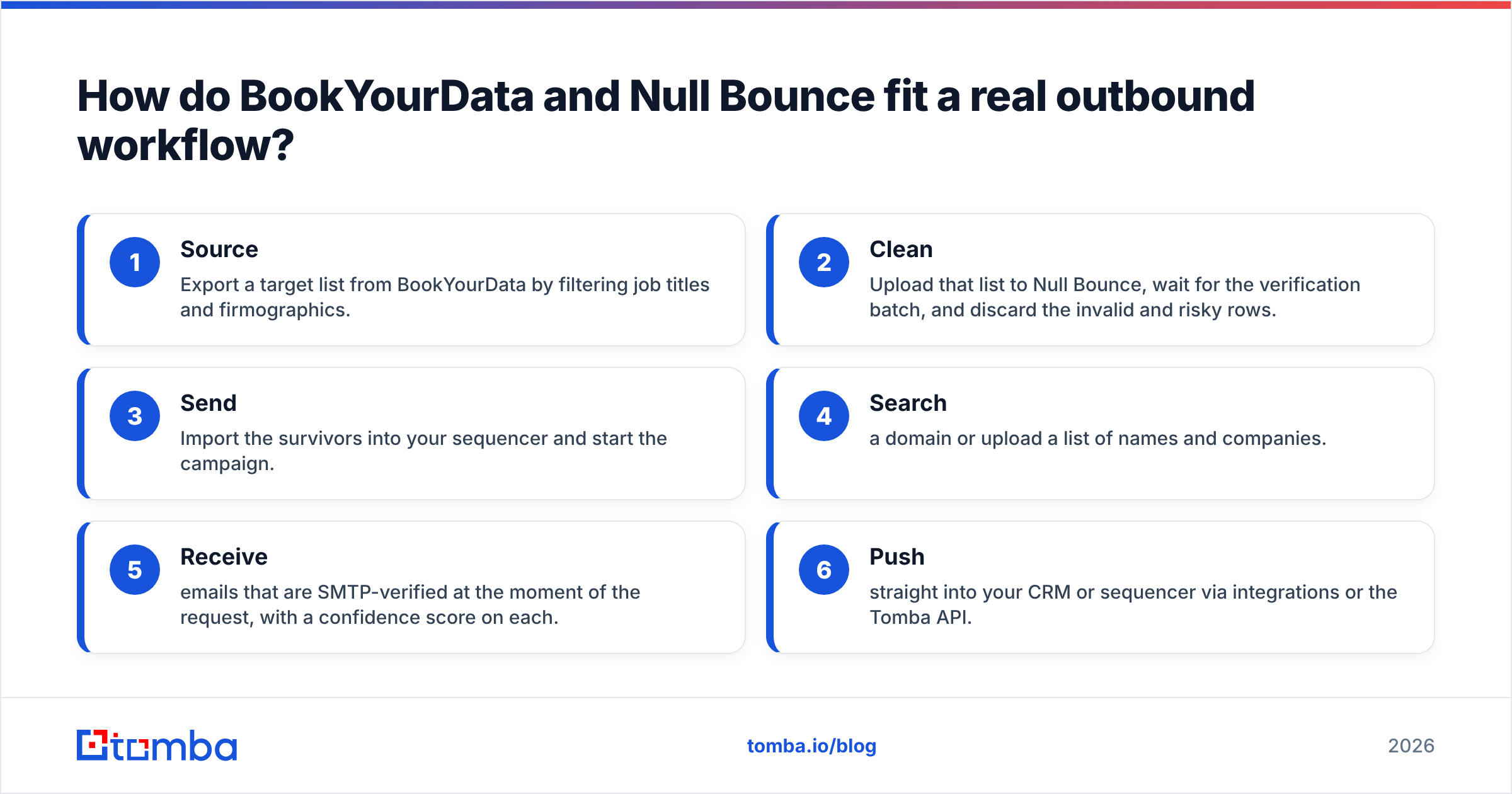
How do BookYourData and Null Bounce fit a real outbound workflow?#
A typical team using these two tools runs a three-stop relay:
- Source — Export a target list from BookYourData by filtering job titles and firmographics.
- Clean — Upload that list to Null Bounce, wait for the verification batch, and discard the invalid and risky rows.
- Send — Import the survivors into your sequencer and start the campaign.
It works, but notice the friction: two logins, two invoices, two data formats to reconcile, and a time lag between sourcing and sending during which the data keeps decaying. Every handoff is a place where records get lost, duplicated, or go stale.
A consolidated workflow removes the relay. With a tool that finds and verifies in one call, the steps collapse:
- Search a domain or upload a list of names and companies.
- Receive emails that are SMTP-verified at the moment of the request, with a confidence score on each.
- Push straight into your CRM or sequencer via integrations or the Tomba API.
You can run the same flow at scale with a bulk email finder when you need thousands of contacts, or pull company-wide patterns with domain search when you're targeting specific accounts. The sourcing and the verification are the same action, so there is no decay window between them.
What does each tool cost?#
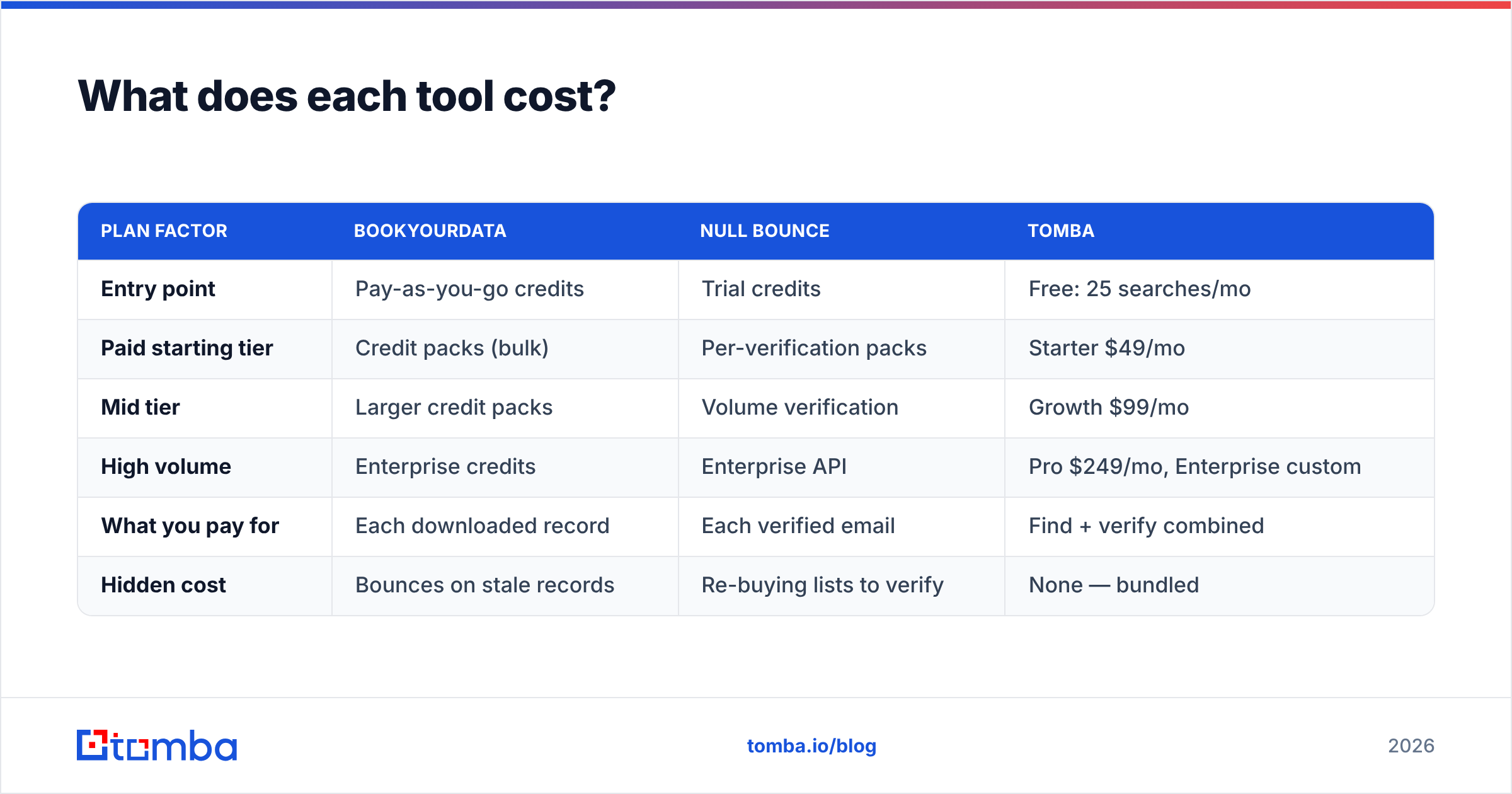
Pricing models differ enough that a flat comparison is misleading — BookYourData charges per record, Null Bounce per verification, and a combined platform charges per search/seat. Here's the practical breakdown:
| Plan factor | BookYourData | Null Bounce | Tomba |
|---|---|---|---|
| Entry point | Pay-as-you-go credits | Trial credits | Free: 25 searches/mo |
| Paid starting tier | Credit packs (bulk) | Per-verification packs | Starter $49/mo |
| Mid tier | Larger credit packs | Volume verification | Growth $99/mo |
| High volume | Enterprise credits | Enterprise API | Pro $249/mo, Enterprise custom |
| What you pay for | Each downloaded record | Each verified email | Find + verify combined |
| Hidden cost | Bounces on stale records | Re-buying lists to verify | None — bundled |
The hidden cost line is the one to watch. With the two-tool stack, you pay BookYourData for records and then pay Null Bounce to find out how many of those records were bad — effectively paying twice to discover you overpaid the first time. A bundled finder-verifier charges once for a result that's already validated. You can see the full breakdown on the Tomba pricing page; the free tier alone covers a small prospecting test before you commit a dollar.
Where do BookYourData and Null Bounce each genuinely win?#
Credit where it's due — neither tool is bad at its job.
BookYourData is a fair pick when you need raw volume fast, you're targeting broad firmographic segments rather than named accounts, and you have a verification step downstream to catch the decay. For one-off list pulls in a market you don't know well, the self-service filtering is genuinely quick.
Null Bounce is a fair pick when you already own a large, messy list — say an inherited CRM or years of webinar signups — and you need a dedicated, standalone scrub before a re-engagement campaign. As a pure hygiene layer with API access, it does the one thing it does competently.
Where both fall short is the modern prospecting motion: find a specific person at a specific company, confirm the email is live, and reach out — today, not after a two-tool relay. That's a real-time, per-contact job, and a static list plus a separate verifier is structurally the wrong shape for it. For that motion you want sourcing and verification fused, which is the gap a dedicated finder fills.
For teams comparing the broader market, here's how the email-data tools line up on the attributes buyers actually weigh.

How does Tomba compare as an alternative to both?#
Tomba covers both jobs in one platform: it sources emails and verifies them on every request. Instead of buying a static list and cleaning it separately, you look up contacts by name, company, or domain and get back addresses that were SMTP-checked at request time, each with a confidence score.
The pieces map directly onto what BookYourData and Null Bounce do separately:
- Sourcing — the email finder, domain search, and LinkedIn finder replace the list-purchase step with live lookups.
- Verification — the email verifier and catch-all verifier replace the standalone scrub, and run automatically on finder results.
- Enrichment and reach — phone finder and data enrichment add the channels a pure email tool can't.
Because it's one system, there's no decay window and no reconciliation. You can validate the approach against third-party reviews on G2 or Capterra rather than taking a vendor's word for it, and read how the underlying data sources are built before you trust them with a campaign. The same engine powers a Chrome extension, Google Sheets add-on, and a full API, so it slots into whatever workflow you already run.
Which should you choose?#
- Pick BookYourData if your only need is a fast bulk list pull and you have a separate verification step you trust to catch the decay.
- Pick Null Bounce if you already have a list and you only need standalone hygiene — no sourcing required.
- Pick a combined finder-verifier if you want to find specific, verified contacts in one step without paying two vendors and reconciling two exports.
For most outbound and demand-gen teams in 2026, the third option is the one that holds up. A purchased list ages the day you buy it, and a verifier alone can't source. Sourcing and verifying in the same call — with a confidence score on every result — is what keeps bounce rates low and domains healthy.
Start with the Tomba Email Finder free tier: 25 searches a month, every result verified at request time, no list to buy and no second tool to bolt on. Run a real campaign segment through it, watch the bounce rate, and compare it to whatever your BookYourData-plus-Null-Bounce stack returns. The numbers make the decision for you.
// get started
Find, verify and enrich your first contacts today
Start on the free plan with 25 searches a month, then scale when your team is ready.
Free plan · No credit card required · GDPR & CCPA
// about the author