Bookyourdata vs Postaga: B2B Data Tools Compared (2026)
Bookyourdata sells pay-as-you-go B2B contact lists; Postaga runs AI outreach campaigns. Here's which one actually fits your pipeline in 2026 — and where a verification-first finder beats both.
TL;DR
- Bookyourdata is a pay-as-you-go B2B contact database — you filter, buy, and download lists of emails and phone numbers. Postaga is an AI-powered outreach platform that finds contacts and runs multi-step cold email campaigns.
- They solve different halves of the same problem: Bookyourdata gives you data, Postaga gives you workflow. Comparing them head-to-head only makes sense if you're deciding where your prospecting budget goes.
- Bookyourdata's risk is stale, bought-in-bulk records that hurt deliverability. Postaga's risk is shallow data coverage and a learning curve on campaign building.
- If accuracy and clean deliverability matter most, a verification-first email finder like Tomba Email Finder often beats both — you pull fresh, verified contacts on demand instead of buying a static list.
- Read on for a full feature table, pricing breakdown, and a decision framework by team type.
What are Bookyourdata and Postaga?#
Here's the short version: Bookyourdata is a data vendor, Postaga is an outreach engine. They get lumped together in "best lead gen tool" searches, but they sit at opposite ends of the funnel.
Bookyourdata markets itself as a real-time B2B contact database with 250M+ records. You build a list by filtering on job title, industry, location, company size, and tech stack, then pay per contact you download. Think of it like a grocery store for leads — you fill a cart and check out. There's no campaign tooling; you export a CSV and take it wherever you send mail.
Postaga is the opposite. It's an all-in-one outreach platform that combines a contact finder, AI campaign generator, and email sequencer. You give it a target (a URL, a niche, a list of companies), it suggests contacts and writes personalized opening lines, and then it sends and follows up automatically. It leans heavily into link building, podcast outreach, and partnership campaigns — not just classic sales prospecting.
So when people type "bookyourdata vs postaga," they're usually asking a budget question: Do I buy a pile of data, or do I buy a machine that runs the outreach? The honest answer is that neither fully replaces the other, and both have a weak spot that a dedicated finder covers better.

How do Bookyourdata and Postaga compare feature by feature?#
The cleanest way to see the gap is side by side. Below, the two tools are scored on the things that actually move pipeline: data freshness, verification, outreach, and total cost of ownership.
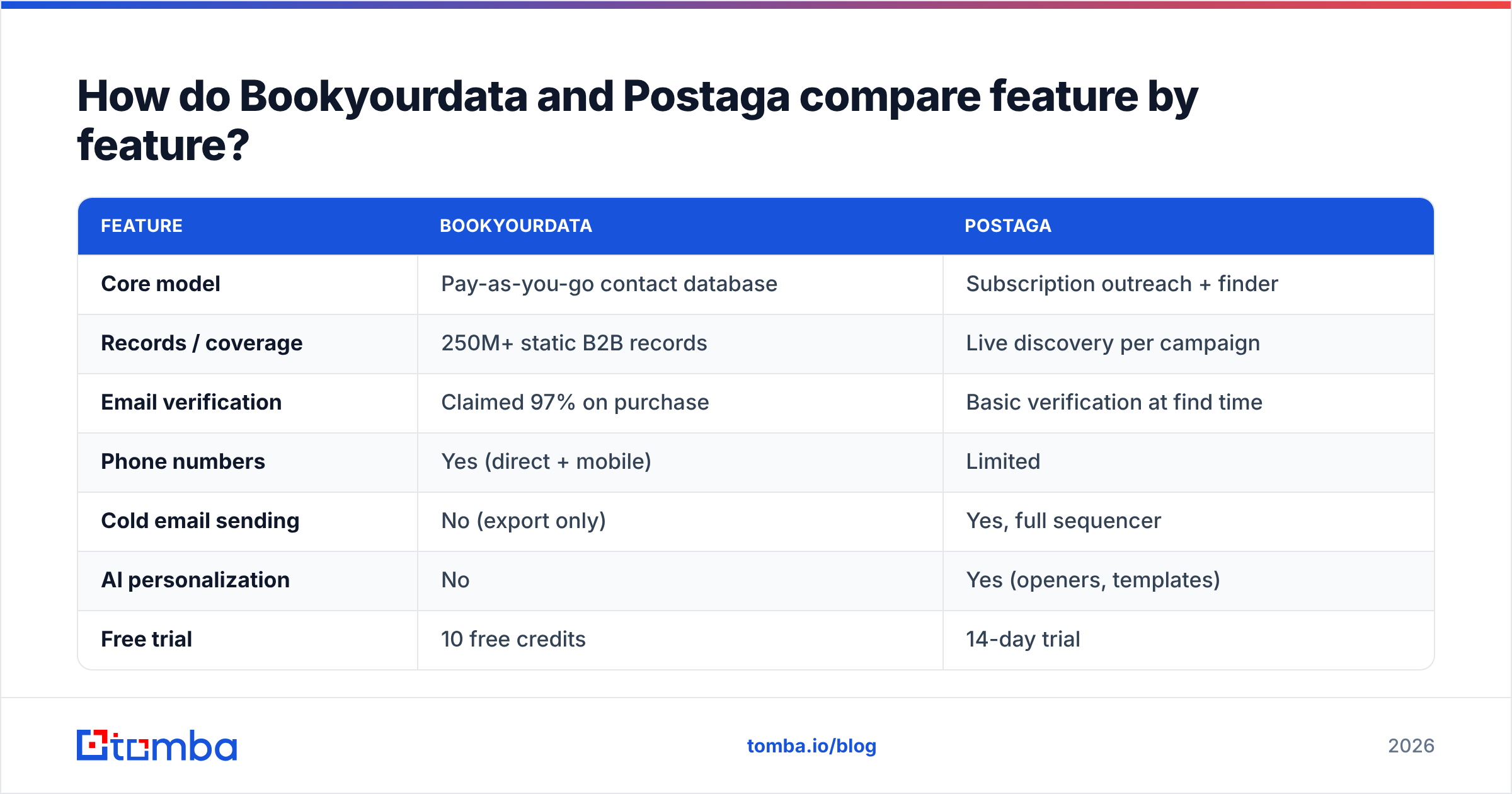
| Feature | Bookyourdata | Postaga |
|---|---|---|
| Core model | Pay-as-you-go contact database | Subscription outreach + finder |
| Records / coverage | 250M+ static B2B records | Live discovery per campaign |
| Email verification | Claimed 97% on purchase | Basic verification at find time |
| Phone numbers | Yes (direct + mobile) | Limited |
| Cold email sending | No (export only) | Yes, full sequencer |
| AI personalization | No | Yes (openers, templates) |
| Free trial | 10 free credits | 14-day trial |
| Entry pricing | ~$99 for 100 credits | ~$84/mo (Pro tier) |
| Best for | One-time list buys | Running campaigns end to end |
| Main risk | Stale / bought-in-bulk records | Thin data on niche targets |
A few things stand out. Bookyourdata wins on raw breadth and phone coverage — if you need a thousand CFOs in manufacturing by Friday, it delivers a file. Postaga wins on motion — it actually sends the mail and follows up, which Bookyourdata never does. Neither, though, is built around continuous verification, and that's where bought lists quietly bleed your sender reputation.
Is Bookyourdata's accuracy good enough for cold outreach?#
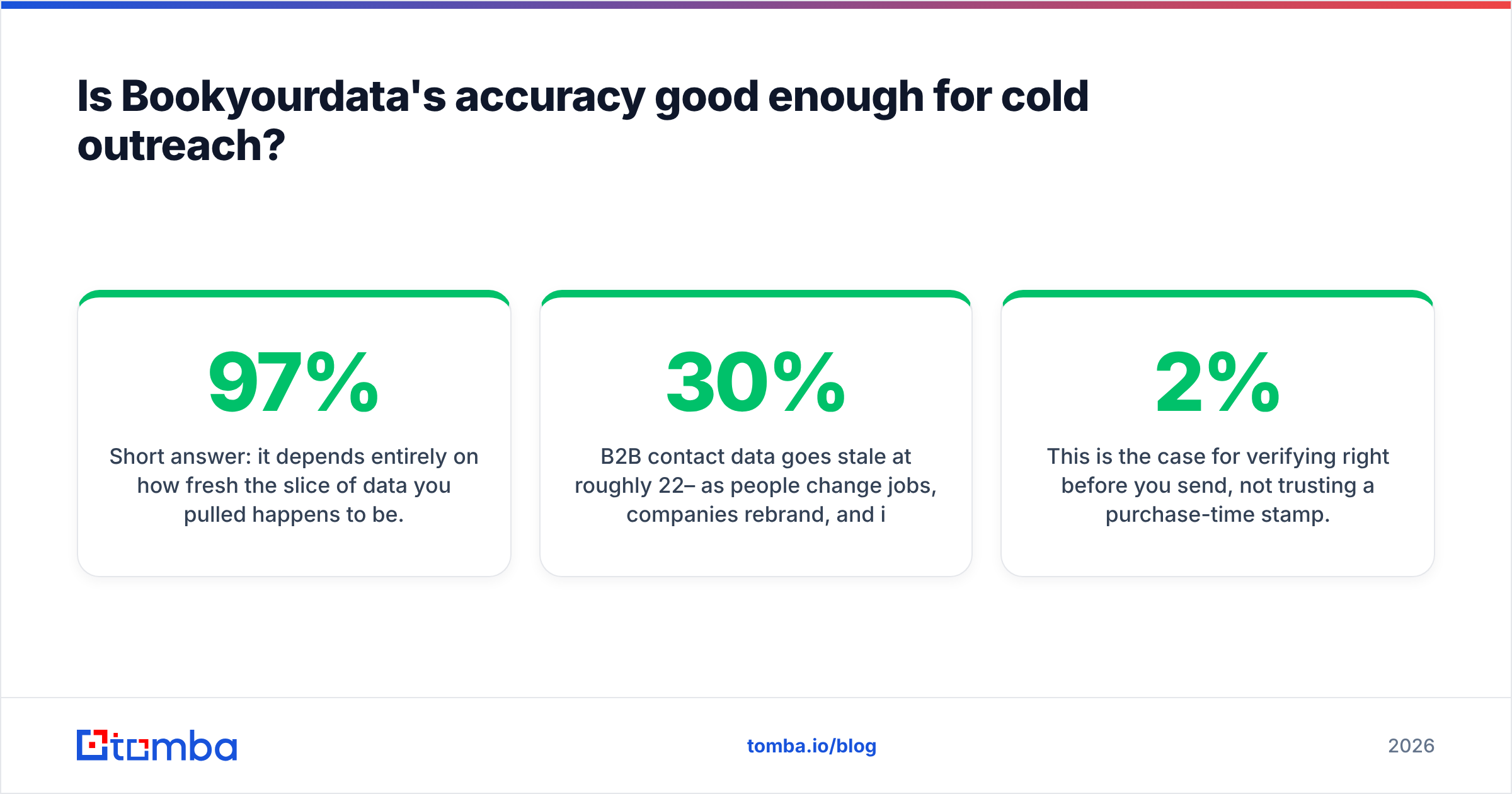
Short answer: it depends entirely on how fresh the slice of data you pulled happens to be. Bookyourdata advertises a 97% accuracy guarantee and offers credit refunds on bounces, which is genuinely better than the bargain-bin list brokers. But there's a structural problem with any bulk database: records decay.
B2B contact data goes stale at roughly 22–30% per year as people change jobs, companies rebrand, and inboxes get retired. A database with 250M records can't re-verify every one the moment you download it. So you can buy a "97% valid" list and still see bounce rates climb once those addresses hit a real send, because the verification timestamp might be months old.
That matters because bounce rate directly feeds sender reputation. Mailbox providers like Google and Microsoft treat a spike in hard bounces as a spam signal. Two or three bad sends from a stale list and your email deliverability tanks for every campaign — even the good ones.
This is the case for verifying right before you send, not trusting a purchase-time stamp. Running any bought list through an email verifier — or skipping the bulk buy entirely and pulling verified contacts on demand — is the difference between a 2% bounce rate and a 12% one. Postaga's built-in verification helps here, but it's lightweight; it confirms an address exists, not that it's the freshest record for that person.
Does Postaga replace a dedicated email finder?#
Not quite — Postaga is a campaign tool that happens to find some contacts, not a finder that happens to send mail. That distinction decides whether it's right for you.
Postaga's discovery works best when you point it at content-driven targets: blogs to pitch, podcasts to join, companies in a clear niche. Its AI is good at drafting a relevant opener from a prospect's recent article or page. For link building and partnership outreach, that's a genuinely strong workflow that neither Bookyourdata nor a pure finder offers.
Where it gets thin is depth and scale. If you need every decision-maker at 500 specific accounts, with verified direct emails and phone numbers, Postaga's per-campaign discovery isn't built for that volume. You'll hit gaps on niche roles and smaller companies. A dedicated domain search returns every known email pattern at a company in one pass, which is a different and deeper capability.
So the realistic picture for Postaga:
- Great at — automated multi-step sequences, AI personalization, content/link-building outreach, and being a single login for find-write-send.
- Okay at — small-to-mid sales prospecting where targets are loosely defined.
- Weak at — high-volume, high-precision account targeting and deep contact coverage on niche roles.
- Not designed for — being your system-of-record data source the way a database or API is.
Which tool fits which team?#
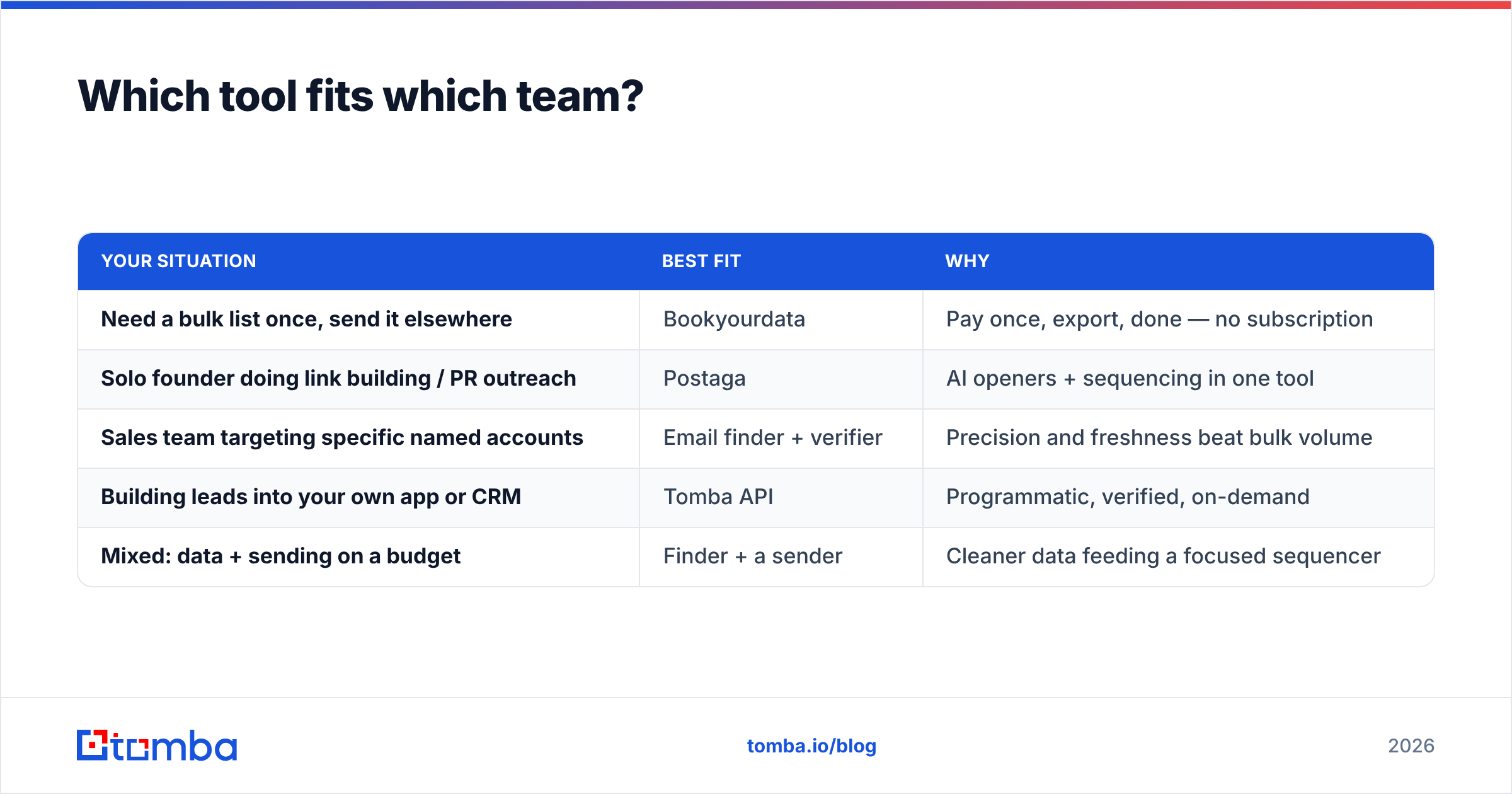
Match the tool to your motion, not the other way around. Here's how the three options — including a finder-first approach — break down by use case.
| Your situation | Best fit | Why |
|---|---|---|
| Need a bulk list once, send it elsewhere | Bookyourdata | Pay once, export, done — no subscription |
| Solo founder doing link building / PR outreach | Postaga | AI openers + sequencing in one tool |
| Sales team targeting specific named accounts | Email finder + verifier | Precision and freshness beat bulk volume |
| Building leads into your own app or CRM | Tomba API | Programmatic, verified, on-demand |
| Mixed: data + sending on a budget | Finder + a sender | Cleaner data feeding a focused sequencer |
The pattern is clear. Bookyourdata is a fit when you genuinely want a one-time bulk export and you'll handle verification and sending yourself. Postaga is a fit when outreach workflow is your bottleneck and your targeting is loose enough that per-campaign discovery suffices. But for the most common B2B case — a sales team chasing specific accounts where every bounce costs reputation — a verification-first finder is the stronger foundation, and you bolt a sender on top.
How much do Bookyourdata and Postaga cost in 2026?#
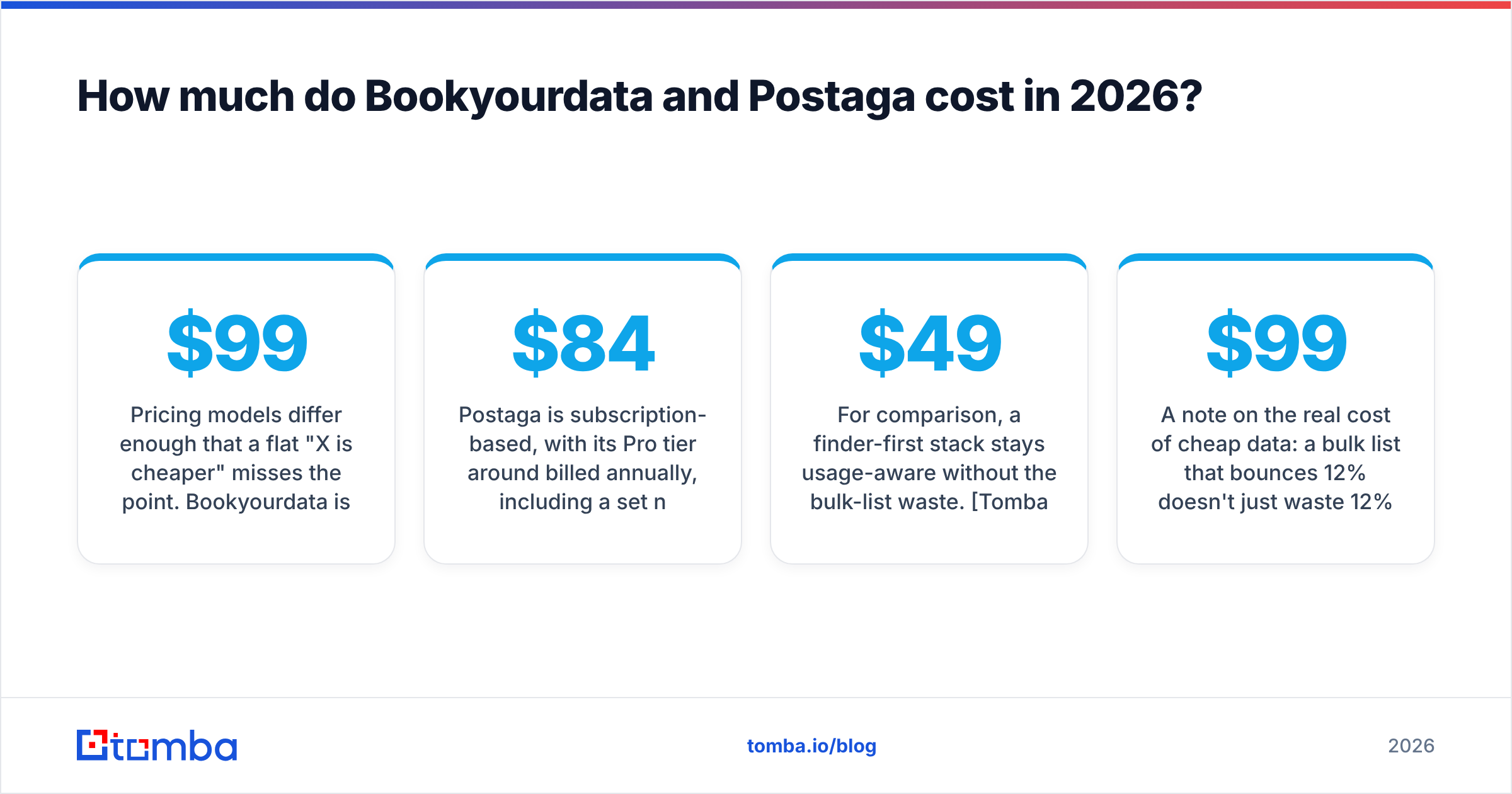
Pricing models differ enough that a flat "X is cheaper" misses the point. Bookyourdata is consumption-based: you pay per credit, and a credit roughly equals one revealed contact. Plans start around $99 for 100 credits and scale down in per-credit cost as you buy more. There's no monthly commitment, which suits sporadic list buys but gets expensive at volume.
Postaga is subscription-based, with its Pro tier around $84/month billed annually, including a set number of campaigns, contacts, and connected mailboxes. You're paying for the engine and a metered amount of discovery, so cost is predictable but recurring whether you send 10 emails or 10,000.
For comparison, a finder-first stack stays usage-aware without the bulk-list waste. Tomba pricing runs a Free tier at 25 searches/month, Starter at $49/month, Growth at $99/month, and Pro at $249/month — and every result is verified before it counts against you, so you're not paying to download dead records. If your pain is data quality rather than sequencing, that's a meaningfully lower cost of usable contacts.
A note on the real cost of cheap data: a $99 bulk list that bounces 12% doesn't just waste 12% of the spend. It can suppress deliverability across your whole domain for weeks. The cheapest contact is the one that lands and gets a reply — not the one with the lowest sticker price.
What's the verdict on Bookyourdata vs Postaga?#
Bookyourdata and Postaga aren't really rivals — they're two different purchases, and most teams over-buy on the wrong one. Bookyourdata is the better choice if you want a one-time, export-and-go bulk list and you'll own verification and sending downstream. Postaga is the better choice if your bottleneck is outreach workflow — sequencing, follow-ups, and AI-written openers for content or partnership campaigns.
But step back and the shared weakness is data freshness. Bookyourdata's records decay between verification and send. Postaga's discovery is shallow on precision targeting. Both make you choose between breadth and workflow while quietly under-delivering on accuracy — the one thing that protects your sender reputation and your reply rate.
That's the case for a finder-first stack. Pull verified, current contacts the moment you need them, feed them into whatever sequencer you like, and keep your bounce rate low enough that your good campaigns actually reach the inbox. You can read more about where Tomba gets its data if accuracy sourcing is your concern. On G2 and Capterra, the recurring complaint about bought-list vendors is exactly this — verify before you trust any database's accuracy claim.
Ready to stop buying stale lists? Start with the Tomba Email Finder — find professional email addresses by name, company, or domain, every result verified before it lands in your export. The free tier covers 25 searches a month so you can test accuracy against your own target accounts before spending a dollar. Find the right contacts, keep your deliverability clean, and let your outreach tool do what it's actually good at.
// get started
Find, verify and enrich your first contacts today
Start on the free plan with 25 searches a month, then scale when your team is ready.
Free plan · No credit card required · GDPR & CCPA
// about the author