Bookyourdata vs Quickenrich: B2B Data Tools Compared 2026
Bookyourdata vs Quickenrich, head to head on pricing, accuracy, verification, and coverage, so you can pick the right B2B data tool in 2026, without wasting credits.
Bookyourdata vs Quickenrich: Which B2B Data Tool Wins in 2026?
Choosing between two B2B contact data vendors usually comes down to one ugly question: how many of the emails you pay for actually land? Both Bookyourdata and Quickenrich promise large databases and "verified" records, but they sell that data in very different ways, and the difference shows up on your bounce rate and your invoice.
This guide breaks down Bookyourdata vs Quickenrich on the things that actually matter, pricing model, verification quality, coverage, and real cost per usable contact, then shows where a credit-based finder like Tomba fits if neither one is the right shape for your team.
TL;DR#
- Bookyourdata sells on a pay-per-record model with a 97% accuracy guarantee, good for one-off list pulls but expensive at scale and easy to over-buy.
- Quickenrich leans on bulk enrichment and a lower entry price, but published accuracy figures are thinner and catch-all handling is inconsistent.
- Neither tool verifies aggressively enough for cold outreach on its own, you still need a dedicated email verifier before you send.
- Cost per usable contact is the real metric. A cheap record that bounces costs you sender reputation, not just credits.
- If you want predictable monthly pricing plus built-in verification, a finder like Tomba ($49/mo Starter) often beats both on cost-per-valid-email.
What Are Bookyourdata and Quickenrich?#
Both are B2B contact data platforms, but they target slightly different buyers.
Bookyourdata is a list-building marketplace. You filter by industry, title, location, and company size, then buy the resulting contacts as a downloadable file. Its headline pitch is a 97% email accuracy guarantee with credits refunded for bounces. It is built for marketers who want a clean export now, not an ongoing data subscription.
Quickenrich positions itself as an enrichment-first tool. You feed it partial records, names, domains, LinkedIn URLs, and it fills in emails, phone numbers, and firmographics in bulk. It competes more directly with enrichment APIs than with one-off list sellers, and tends to undercut on entry price.
The core distinction in any bookyourdata vs quickenrich decision: Bookyourdata is "buy a finished list," Quickenrich is "complete the list you already have." That changes who each one is for.

How Do Bookyourdata and Quickenrich Compare at a Glance?#
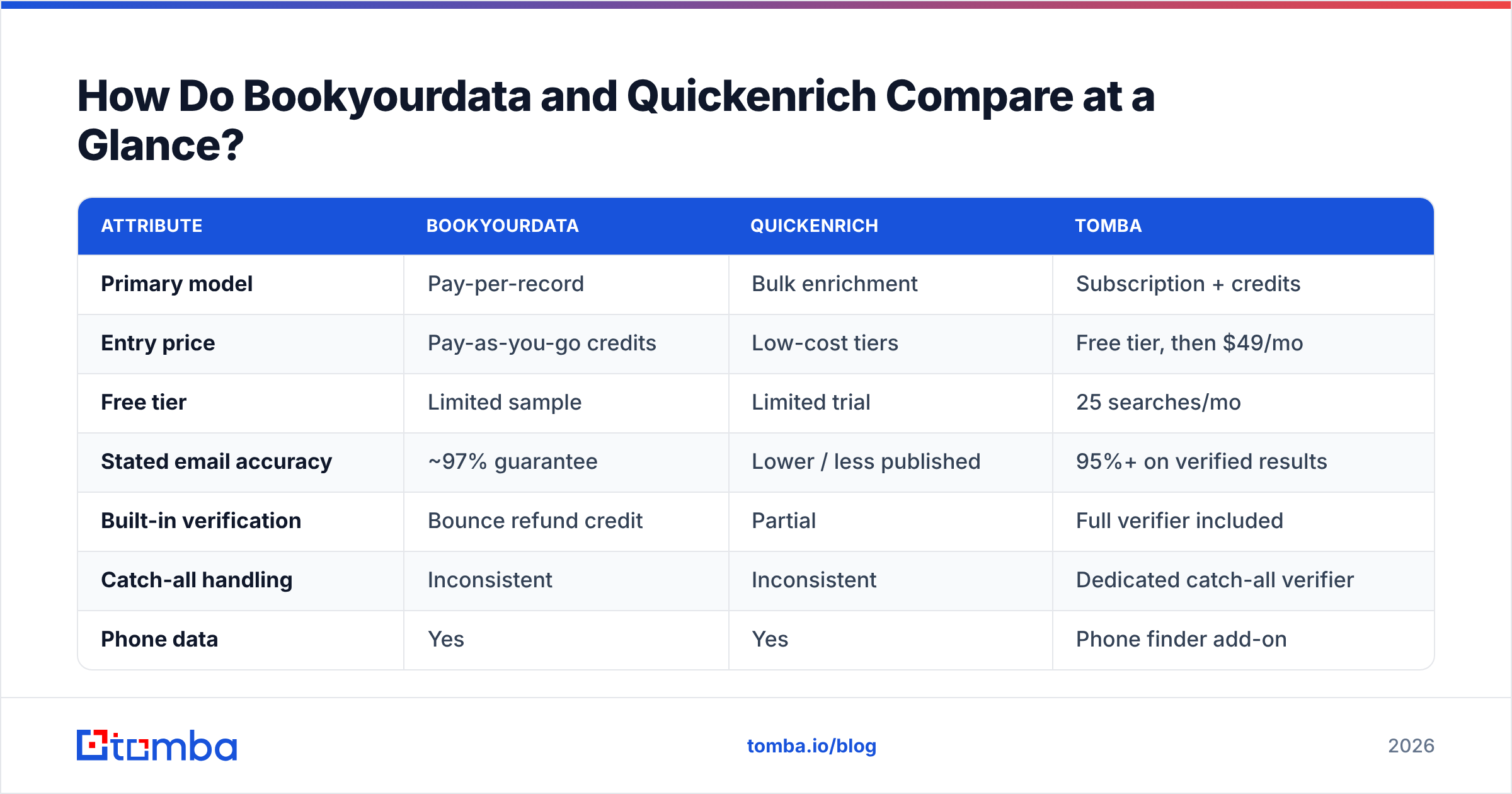
Here is the side-by-side before we go deeper on each dimension. Treat vendor-published accuracy numbers as marketing claims until you test them against your own sample.
| Attribute | Bookyourdata | Quickenrich | Tomba |
|---|---|---|---|
| Primary model | Pay-per-record | Bulk enrichment | Subscription + credits |
| Entry price | Pay-as-you-go credits | Low-cost tiers | Free tier, then $49/mo |
| Free tier | Limited sample | Limited trial | 25 searches/mo |
| Stated email accuracy | ~97% guarantee | Lower / less published | 95%+ on verified results |
| Built-in verification | Bounce refund credit | Partial | Full verifier included |
| Catch-all handling | Inconsistent | Inconsistent | Dedicated catch-all verifier |
| Phone data | Yes | Yes | Phone finder add-on |
| Best for | One-off lists | Enriching existing CRM | Ongoing prospecting + API |
The pattern most teams hit: each tool is strong in its lane and weak the moment you push it outside that lane. Bookyourdata gets pricey on recurring pulls; Quickenrich needs you to already have seed data; both leave verification gaps you have to close yourself.
Which One Has Better Data Accuracy?#
Accuracy is where this comparison gets decided, and where you should be most skeptical of marketing copy.
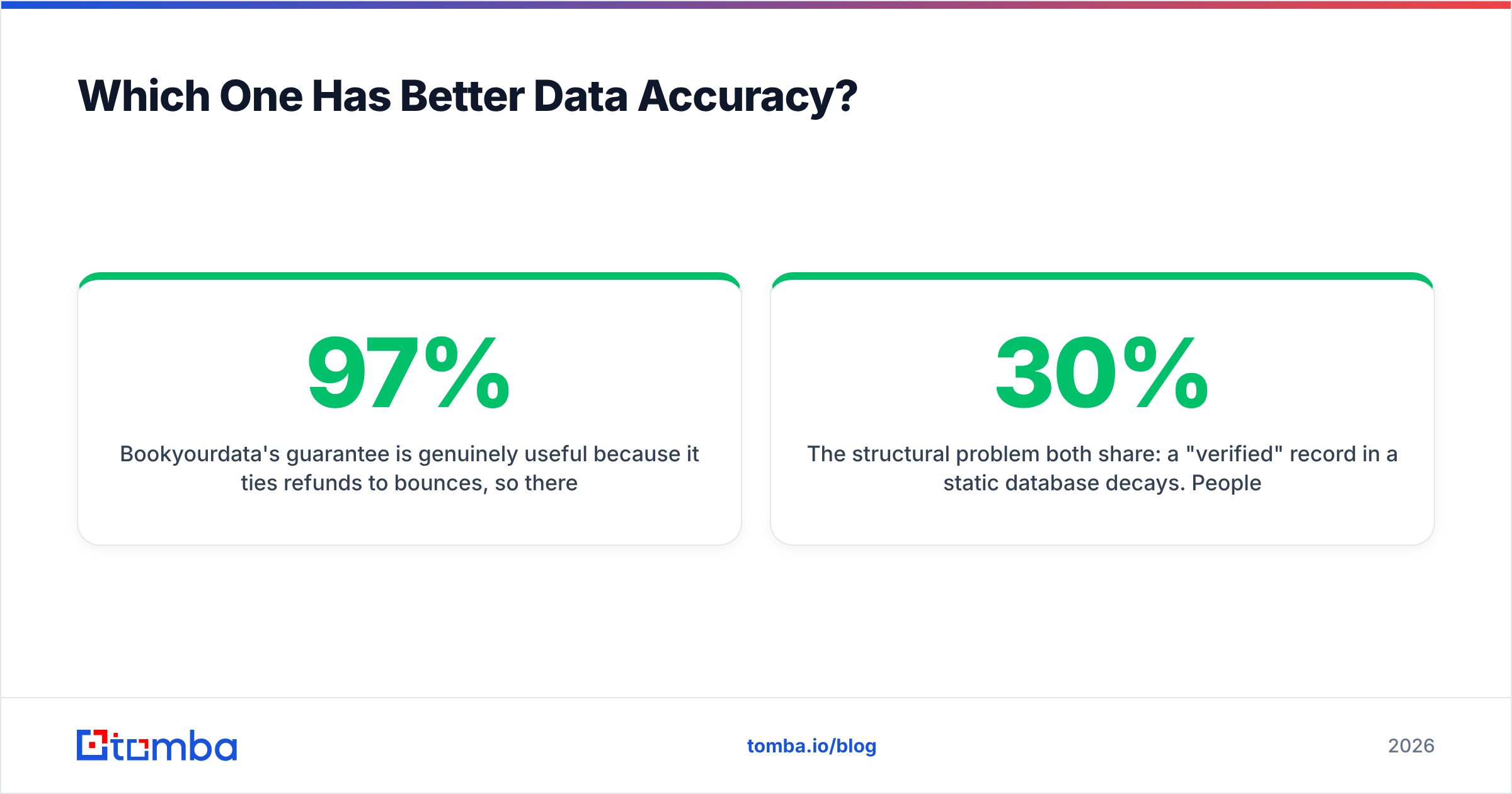
Bookyourdata's 97% guarantee is genuinely useful because it ties refunds to bounces, so there is a financial mechanism behind the number. The catch: a guarantee covers your credits, not your sender reputation. If 3% of a 5,000-record pull bounces, that is 150 hard bounces hitting your domain before any refund posts. At that volume you can trip spam filters regardless of the credit you get back.
Quickenrich publishes less granular accuracy data, and independent reviews on sites like G2 are thinner. Its enrichment approach also means accuracy depends heavily on the quality of the seed data you provide, garbage in, garbage out applies more here than with a curated list.
The structural problem both share: a "verified" record in a static database decays. People change jobs at roughly 25-30% per year in many B2B segments. A record verified six months ago is a coin flip today unless the vendor re-verifies at query time. This is why running results through a live email verification step matters no matter which vendor you pick.

Wait, that placeholder is wrong. Let me correct: 
How Does Pricing Really Compare?#
Sticker price and real price are different numbers. The metric that matters is cost per usable contact, what you pay for each email that is both deliverable and correctly targeted.
Use this framework to compare any two data vendors honestly:
- Take the raw price per record from the pricing page.
- Divide by the real deliverability rate you measure on a test batch, not the advertised one.
- Add the cost of re-verification if the vendor does not verify at query time.
- Subtract refunded credits, but remember refunds do not undo reputation damage.
- Multiply by how often you re-pull, monthly prospecting punishes pay-per-record models.
Bookyourdata's pay-per-record model is clean for a single campaign, you know exactly what 2,000 contacts cost. But run that monthly and the math compounds fast. Quickenrich's lower entry price looks better until you account for the seed data you must already own and the records that come back empty.
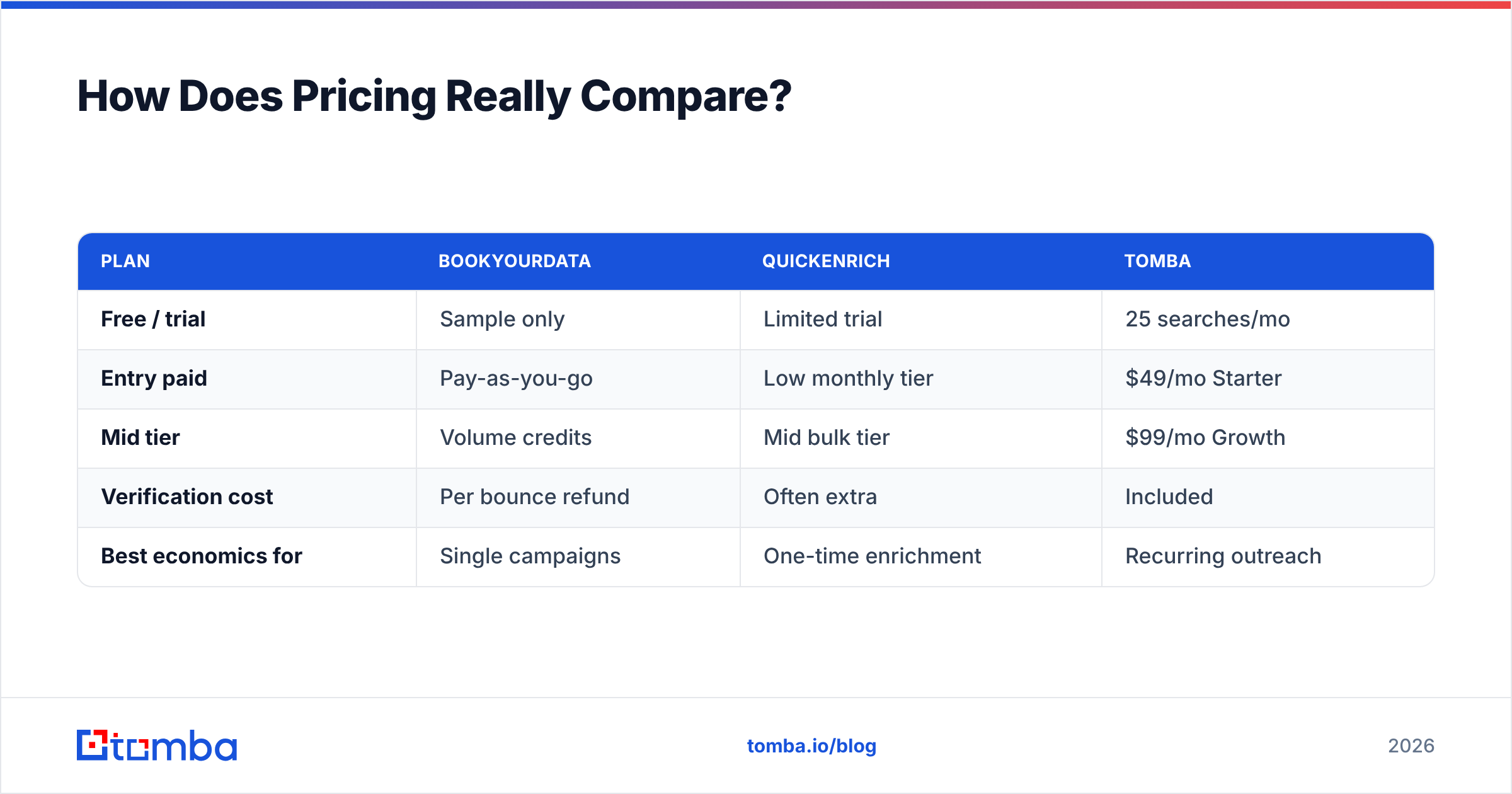
A credit-based subscription changes the curve. With transparent Tomba pricing, the Free tier gives you 25 searches to test accuracy on your own list before paying anything, then Starter is $49/mo, Growth $99/mo, and Pro $249/mo. For teams prospecting every week, a flat monthly rate with included verification usually beats per-record economics.
| Plan | Bookyourdata | Quickenrich | Tomba |
|---|---|---|---|
| Free / trial | Sample only | Limited trial | 25 searches/mo |
| Entry paid | Pay-as-you-go | Low monthly tier | $49/mo Starter |
| Mid tier | Volume credits | Mid bulk tier | $99/mo Growth |
| Verification cost | Per bounce refund | Often extra | Included |
| Best economics for | Single campaigns | One-time enrichment | Recurring outreach |
Which Tool Is Better for Cold Email Deliverability?#
Neither vendor is a deliverability tool, and treating a data vendor as one is how teams torch their domains.
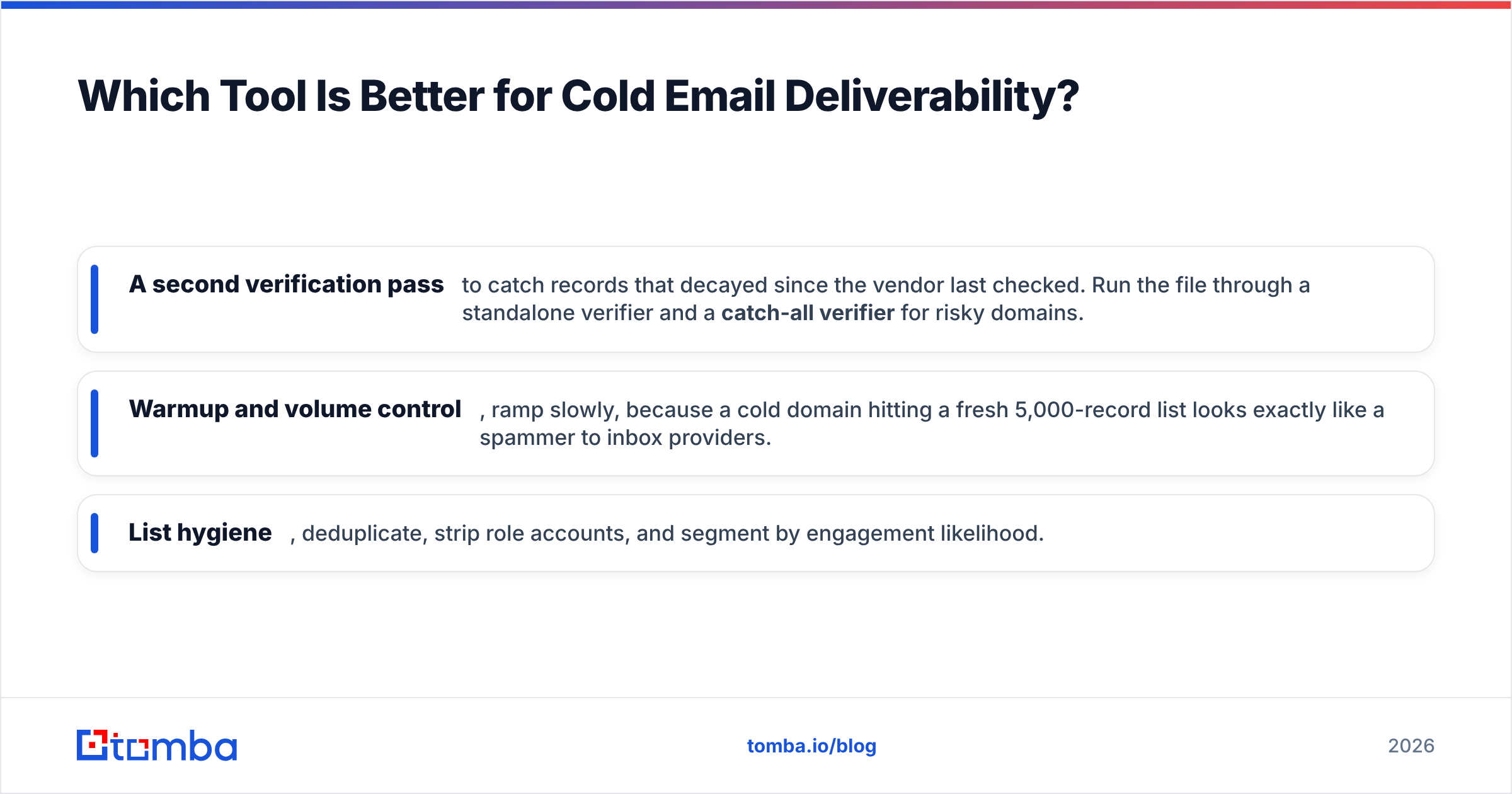
Buying a list, even a 97%-accurate one, and blasting it cold is the fastest route to the spam folder. Before any purchased or enriched list goes into a sequence, you need three things the data vendor does not give you:
- A second verification pass to catch records that decayed since the vendor last checked. Run the file through a standalone verifier and a catch-all verifier for risky domains.
- Warmup and volume control, ramp slowly, because a cold domain hitting a fresh 5,000-record list looks exactly like a spammer to inbox providers.
- List hygiene, deduplicate, strip role accounts, and segment by engagement likelihood.
Bookyourdata's bounce refund helps your wallet but does nothing for the reputation hit. Quickenrich's enrichment can introduce stale records if your seed data points at people who have moved on. In both cases, the verification and warmup work is on you. For the mechanics, HubSpot's email deliverability guidance and a disciplined verify-before-send habit matter more than which vendor you bought from.
When Should You Pick Each Tool?#
Match the tool to the job instead of looking for a universal winner.
Pick Bookyourdata if you need a one-time, well-targeted list for a specific campaign, you value the accuracy guarantee's refund mechanism, and you are not pulling new lists every week. Its filtering is genuinely good for narrow ICP segments.
Pick Quickenrich if you already have a CRM full of partial records, names without emails, domains without contacts, and your main job is filling gaps in bulk rather than building lists from scratch. Its enrichment-first design fits that workflow.
Pick a finder like Tomba if prospecting is continuous, you want predictable monthly cost, and you would rather verify at the moment of search than buy-then-clean. The combination of an email finder, built-in verifier, domain search, and a real email finder API covers the full prospecting loop instead of just one slice of it.
A practical hybrid many teams land on: enrich existing CRM records with one tool, and use a credit-based finder for net-new prospecting, with every result, regardless of source, passed through a single verification step before sending.
What About Catch-All and Risky Domains?#
Catch-all domains, servers that accept any address whether the mailbox exists or not, are the silent killer in purchased data, and both vendors handle them inconsistently.
A record on a catch-all domain can pass a basic "valid format and accepting" check and still bounce, because the server said yes to everything. If a meaningful share of your list sits on catch-all domains (common in enterprise and education), headline accuracy numbers overstate real deliverability.
This is exactly where a dedicated catch-all finder earns its keep, scoring those risky addresses so you can decide whether to send, verify further, or skip. Neither Bookyourdata's guarantee nor Quickenrich's enrichment fully solves this; you need a verification layer that treats catch-alls as their own category rather than lumping them into "valid."
Bottom Line: Bookyourdata vs Quickenrich#
There is no single winner, there is a winner per use case. Bookyourdata is the better one-off list builder with a real accuracy guarantee. Quickenrich is the better bulk enrichment tool if you already own seed data. Both leave the verification, catch-all, and deliverability work to you, and both punish recurring use through their pricing models.
If your motion is continuous outbound, the economics and workflow usually favor a credit-based finder with verification baked in. You stop paying per record, you verify at search time, and you keep prospecting, enrichment, and validation in one place instead of stitching three tools together.
Ready to test accuracy on your own list before paying a cent? Start with the Tomba Email Finder, it includes 25 free searches a month, built-in verification, domain search, and an API so you can find, verify, and export valid B2B emails without per-record sticker shock. Run the same 50 contacts through Tomba, Bookyourdata, and Quickenrich, then compare bounce rates. Let the deliverability numbers, not the marketing claims, pick your winner.
// get started
Find, verify and enrich your first contacts today
Start on the free plan with 25 searches a month, then scale when your team is ready.
Free plan · No credit card required · GDPR & CCPA
// about the author