Bookyourdata vs Removebounce (2026): Which B2B Data Tool Wins?
Bookyourdata sells pay-as-you-go B2B contact lists; Removebounce cleans the lists you already own. Here is which one fits your pipeline in 2026 — and the smarter third option.
Bookyourdata vs Removebounce: Which One Actually Belongs in Your 2026 Stack?
If you are comparing Bookyourdata vs Removebounce, you are likely trying to solve two different problems with one budget — and that confusion is exactly why outbound campaigns stall. These tools are not competitors in the strict sense. One sells you contacts; the other tells you which contacts are safe to email. Picking wrong means you either pay for data you can't trust, or you clean a list you never should have bought.
TL;DR#
- Bookyourdata is a pay-as-you-go B2B contact list marketplace — you buy emails, phone numbers, and firmographics by filtering a database.
- Removebounce is a bulk email verification service — it scrubs lists you already have to cut bounces and protect sender reputation.
- They solve opposite halves of the same workflow: sourcing vs cleaning. Most teams need both functions, not both tools.
- Bookyourdata's prepaid credits never expire, which suits low-volume buyers; Removebounce competes on cheap per-verification pricing.
- A single platform like Tomba covers finding, verifying, and enriching in one workflow — removing the need to stitch two vendors together.
What is Bookyourdata and what does it actually do?#
Bookyourdata is a self-service B2B contact database where you build a targeted list by filtering on job title, industry, company size, location, and technology, then pay only for the records you export. Think of it like a grocery store for leads: you walk the aisles (filters), put contacts in your cart, and pay at checkout with credits that don't expire.
The pitch is real-time verification at the point of export and a 97% accuracy guarantee, with credit refunds on bounces. For a founder running occasional campaigns, the no-subscription model is genuinely appealing — you are not locked into a monthly seat you forget to use.
The catch is the catch with every list marketplace: you are buying from a shared pool. The same fintech-director list you export may have been exported by three competitors last quarter. Static, pre-built databases also decay fast — roughly 30% of B2B contact data goes stale every year as people change jobs. A 97% claim measured at the database level rarely survives contact with a real send.
What is Removebounce and where does it fit?#
Removebounce is an email verification tool — it takes a list you already own and runs each address through syntax checks, MX-record lookups, SMTP pings, and spam-trap and catch-all detection, then hands back a cleaned file. It does not find you new contacts. It is the bouncer at the door deciding who gets in, not the promoter filling the room.
This matters because email deliverability lives and dies on bounce rate. Mailbox providers like Google and Microsoft read a high bounce rate as a signal that you are a careless or fraudulent sender, and they throttle you accordingly. Verifying before you send is the single cheapest insurance policy in outbound.
Removebounce competes mainly on price per verification and bulk throughput. If you have a 200,000-record list of unknown quality — say, from a trade show or an old CRM export — a dedicated verifier is the right tool. But it is a treatment, not a source. Feed it garbage and you get clean garbage: verified addresses for people who left the company two years ago.
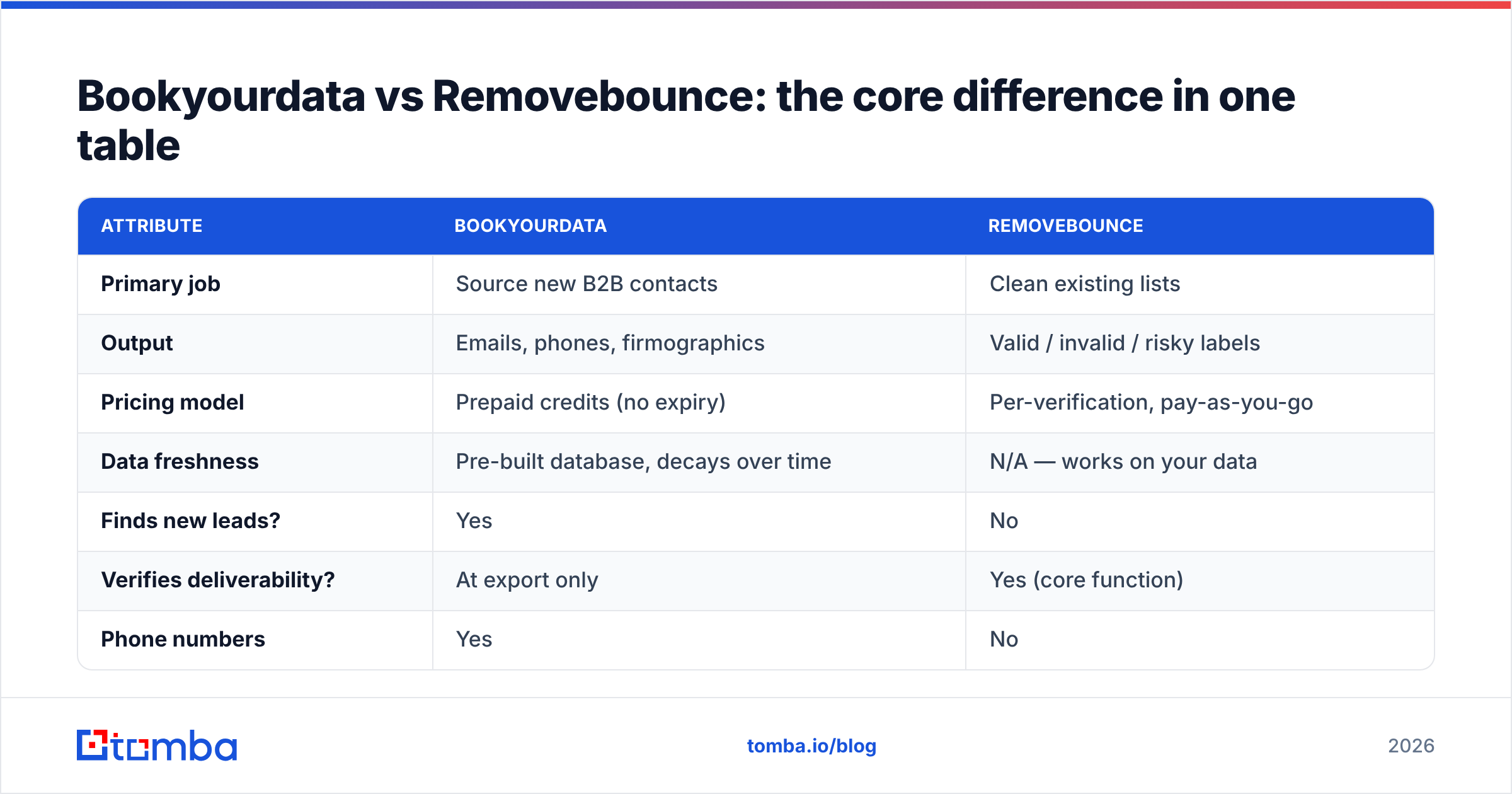
Bookyourdata vs Removebounce: the core difference in one table#
The fastest way to see why this comparison trips people up is to line the two tools against the jobs they actually do.
| Attribute | Bookyourdata | Removebounce |
|---|---|---|
| Primary job | Source new B2B contacts | Clean existing lists |
| Output | Emails, phones, firmographics | Valid / invalid / risky labels |
| Pricing model | Prepaid credits (no expiry) | Per-verification, pay-as-you-go |
| Data freshness | Pre-built database, decays over time | N/A — works on your data |
| Finds new leads? | Yes | No |
| Verifies deliverability? | At export only | Yes (core function) |
| Phone numbers | Yes | No |
| Best for | Buyers with no list | Teams with a dirty list |
| Risk | Shared/aged data | Verifies bad-fit contacts too |
Read that table top to bottom and the conclusion writes itself: these are sequential steps, not alternatives. You source with something like Bookyourdata, then you verify with something like Removebounce. Buying one and skipping the other leaves a hole in the workflow.
When should you choose Bookyourdata over Removebounce?#
Choose a list marketplace like Bookyourdata when your bottleneck is supply — you simply do not have enough names to work. Specific situations where it makes sense:
- You are entering a brand-new market and have zero existing contacts to verify in the first place.
- You need phone numbers, not just emails — verifiers like Removebounce don't supply them.
- You run sporadic campaigns and want credits that sit on the shelf without a monthly subscription bleeding out.
- You want firmographic filters (revenue, headcount, tech stack) to target precisely rather than scrubbing a generic blob.
But weigh the trade-off honestly. Pre-packaged lists are sold to many buyers, and the records age the moment they enter the database. If your deliverability and reply rates matter more than raw volume — and in 2026 they always do — sourced lists need a second verification pass anyway. You are back to needing both tools.
When should you choose Removebounce over Bookyourdata?#
Choose a verifier like Removebounce when your bottleneck is quality of a list you already control:
- You exported 50,000 contacts from an old marketing automation platform and have no idea how many still work.
- You merged two CRMs and need to dedupe and validate before the first send.
- Your bounce rate crept above 3% and your domain reputation is at risk.
- You collect signups through forms and want to catch typos and disposable addresses at the source.
Removebounce earns its keep here. What it cannot do is judge whether those contacts are the right people. An address can be 100% deliverable and 100% useless if it belongs to an intern who left, or a buyer outside your ICP. Verification confirms an inbox exists; it says nothing about fit. That gap is where a lot of "clean" lists still underperform.

Why most teams shouldn't have to choose at all#
Here is the uncomfortable truth behind the Bookyourdata vs Removebounce debate: you are evaluating two point solutions for a problem that wants one continuous workflow. Source → verify → enrich → export is a single motion. Splitting it across two vendors means two logins, two billing relationships, two data formats to reconcile, and a verification step that runs after you've already paid for records that might be junk.
The modern alternative is a platform that finds the contact and verifies it in the same step, from live sources rather than a static resold database. That is the core argument for a tool like Tomba.
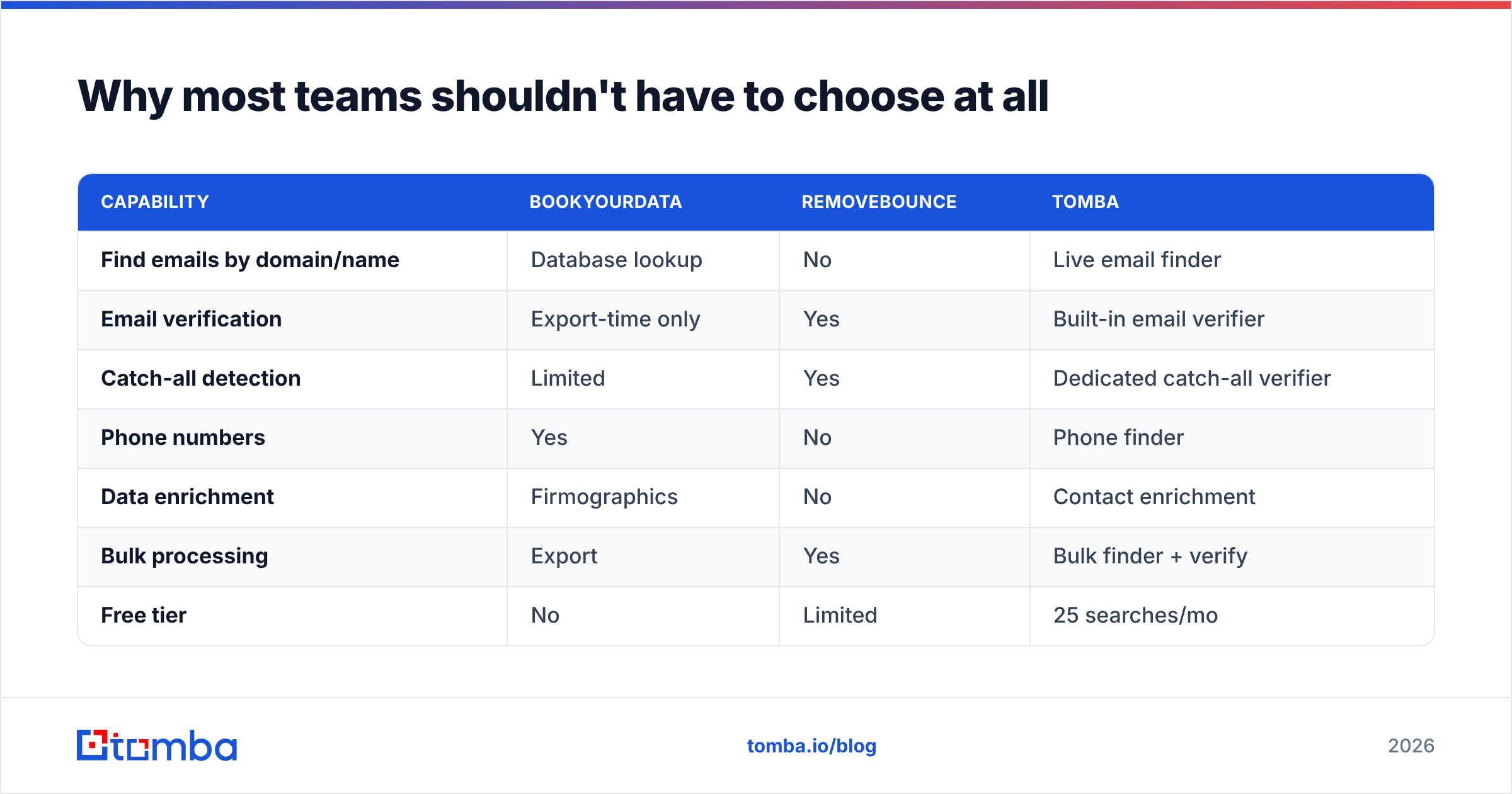
Here is how the three approaches stack up across the jobs that matter:
| Capability | Bookyourdata | Removebounce | Tomba |
|---|---|---|---|
| Find emails by domain/name | Database lookup | No | Live email finder |
| Email verification | Export-time only | Yes | Built-in email verifier |
| Catch-all detection | Limited | Yes | Dedicated catch-all verifier |
| Phone numbers | Yes | No | Phone finder |
| Data enrichment | Firmographics | No | Contact enrichment |
| Bulk processing | Export | Yes | Bulk finder + verify |
| Free tier | No | Limited | 25 searches/mo |
| Starter price | Credit packs | Per-verification | $49/mo |
With Tomba you find the address from a domain or name against fresh sources, the verifier confirms deliverability in the same call, and enrichment fills in the firmographics — so you never buy a contact you can't reach. You can read more on where the data comes from rather than trusting an opaque resold pool.
How does pricing really compare?#
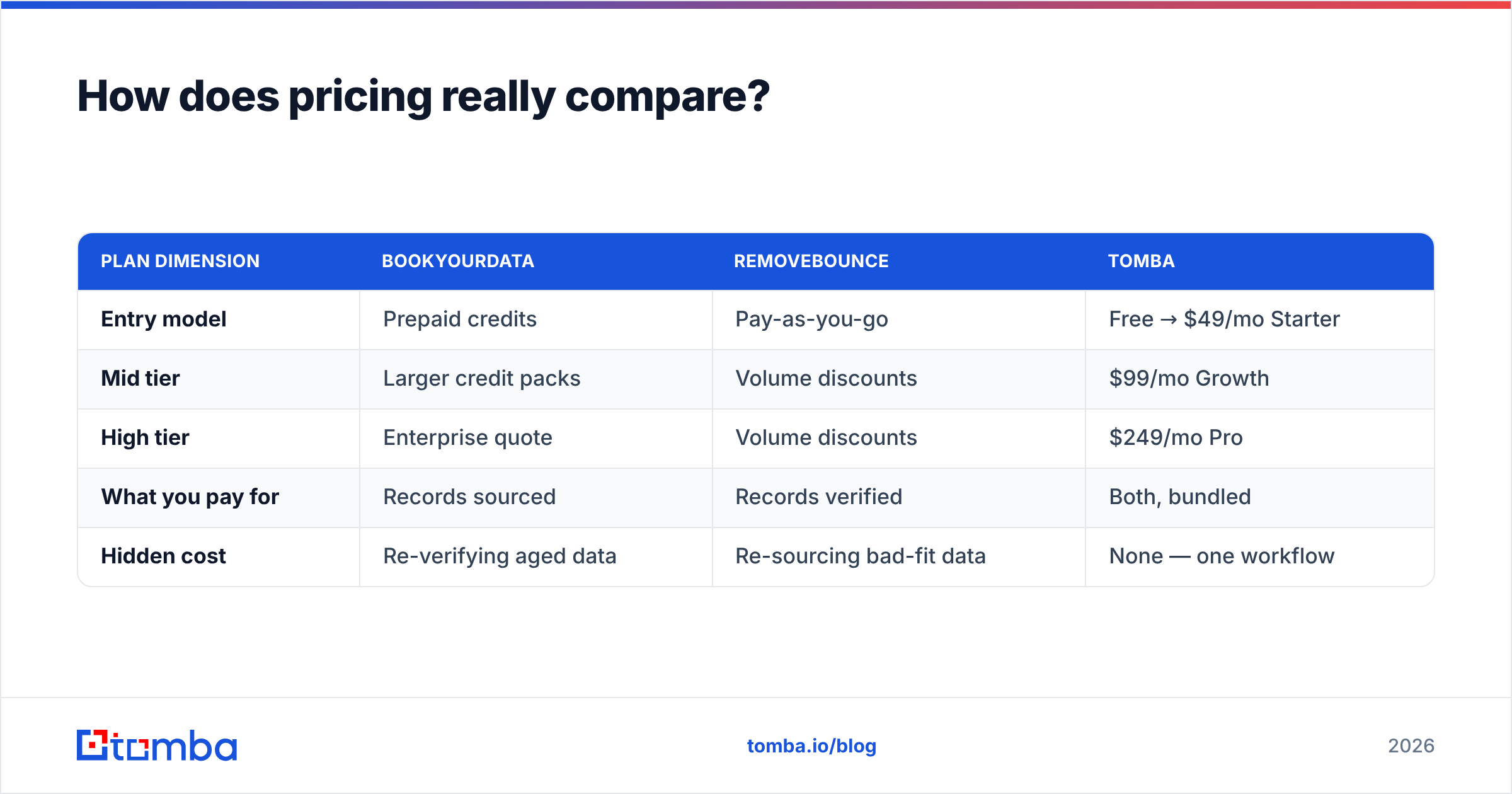
Pricing across these tools is apples-to-oranges, which is part of why buyers get confused. Bookyourdata sells credit packs — you pay per record exported, credits don't expire, and there is no monthly floor. Removebounce sells per-verification pricing, cheaper at volume, with no contact sourcing included. Tomba uses monthly tiers that bundle finding and verifying together.
| Plan dimension | Bookyourdata | Removebounce | Tomba |
|---|---|---|---|
| Entry model | Prepaid credits | Pay-as-you-go | Free → $49/mo Starter |
| Mid tier | Larger credit packs | Volume discounts | $99/mo Growth |
| High tier | Enterprise quote | Volume discounts | $249/mo Pro |
| What you pay for | Records sourced | Records verified | Both, bundled |
| Hidden cost | Re-verifying aged data | Re-sourcing bad-fit data | None — one workflow |
The "hidden cost" row is the one buyers miss. Pay Bookyourdata for records and you'll likely pay again to verify them. Pay Removebounce to verify and you still have to source the list somewhere first. Bundling the two functions — the way Tomba's pricing does — removes the second invoice entirely. For a full breakdown of how usage-based and subscription B2B tools compare, G2's data provider category is a useful neutral reference.
What about accuracy and deliverability?#
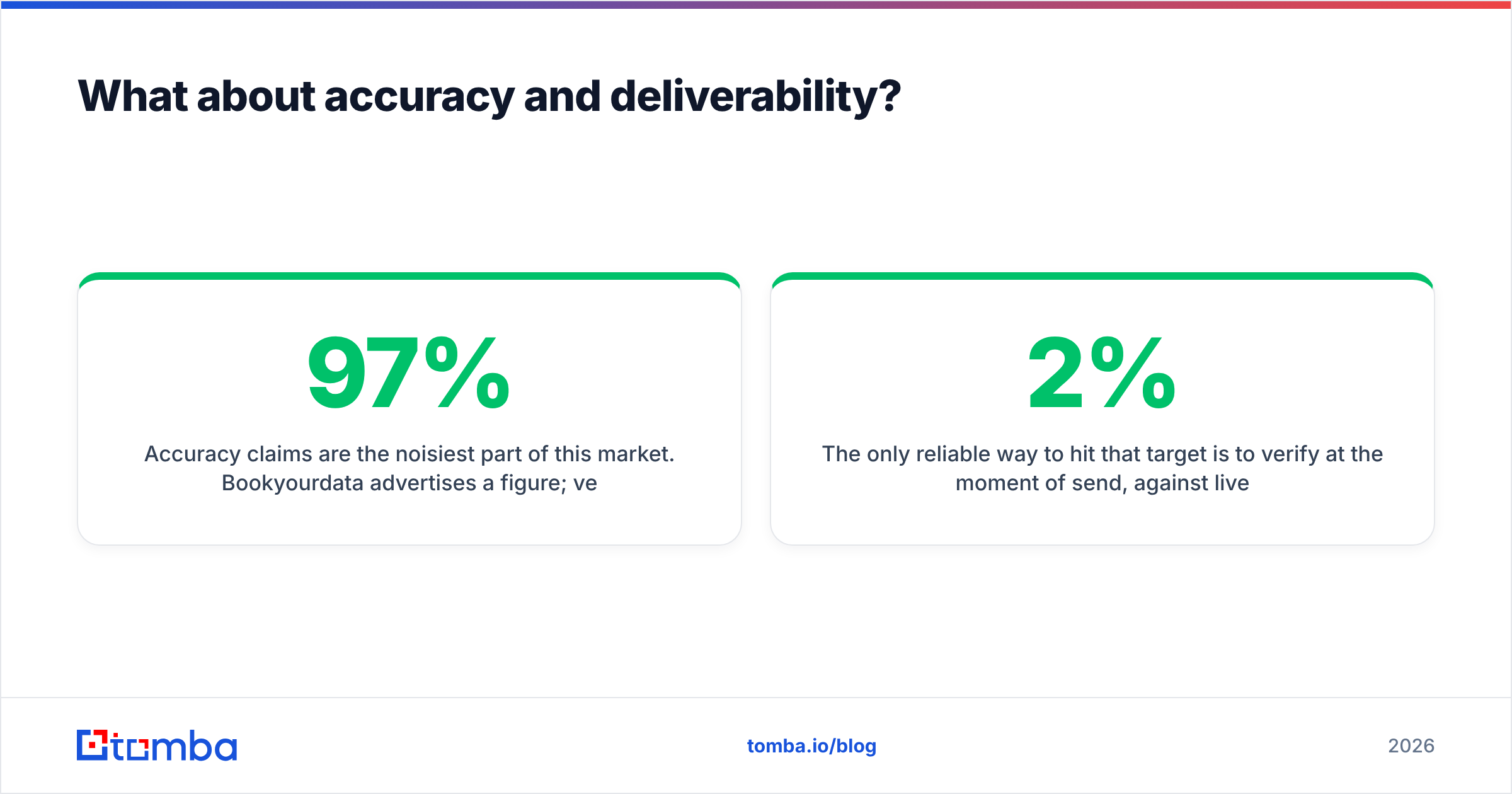
Accuracy claims are the noisiest part of this market. Bookyourdata advertises a 97% figure; verifiers advertise 98–99% on the records you feed them. Both numbers are technically defensible and practically misleading, because they measure different things at different moments.
A database accuracy number reflects the state of records in the vendor's pool, often when they were last touched — which could be months ago. A verifier's accuracy reflects how well it labels a list at the instant you run it. Neither tells you the metric you actually care about: will this specific message reach a real person who fits your ICP, today.
The only reliable way to hit that target is to verify at the moment of send, against live signals, not to trust a freshness stamp from a quarterly database refresh. Pair that with disciplined list hygiene — protecting your sender reputation, warming new domains, and keeping bounce rates under 2% — and accuracy stops being a vendor marketing claim and becomes something you control. HubSpot's guidance on email deliverability best practices is a solid baseline if you want to go deeper.
Bookyourdata vs Removebounce: the verdict#
If you only have budget for one and you have no list, Bookyourdata's pay-as-you-go sourcing is the more complete starting point — you cannot verify contacts you don't have. If you already own a large, messy list and just need it clean, Removebounce is the cheaper, more focused fix. They are different tools for different stages, and treating them as rivals is the mistake.
But the better question in 2026 is not which of the two to buy — it is whether you should be stitching two vendors together at all. Sourcing and verification are one workflow. Running them as one keeps your data fresh, your bounce rate low, and your invoice singular.
The bottom line#
Stop choosing between a list seller and a list cleaner. Tomba's email finder finds professional addresses by domain, name, or company from live sources, verifies them in the same step, and enriches them with the firmographics your reps need — all on a plan that starts free with 25 searches a month and scales to $49/mo when you're ready. Source and verify in one motion, skip the second invoice, and start building lists you can actually trust. Try Tomba's Email Finder and see the difference fresh, verified data makes on your next campaign.
// get started
Find, verify and enrich your first contacts today
Start on the free plan with 25 searches a month, then scale when your team is ready.
Free plan · No credit card required · GDPR & CCPA
// about the author