Bookyourdata vs Salesgenie 2026: Which B2B Data Wins?
A neutral, hands-on comparison of Bookyourdata vs Salesgenie in 2026 — pricing, data accuracy, coverage, and which B2B contact provider actually fits your outbound motion.
Choosing between Bookyourdata and Salesgenie comes down to one question: do you want a modern, pay-as-you-go list builder, or a legacy small-business database with deep U.S. roots? Both sell B2B contacts. They sell them very differently.
TL;DR — Bookyourdata vs Salesgenie at a glance#
- Bookyourdata is a credit-based, pay-as-you-go contact list builder with a real-time email verification promise and no forced subscription. Best for teams that want a quick, targeted export without a long contract.
- Salesgenie (by Data Axle) is a subscription sales-lead platform built on a large U.S. business and consumer database. Best for local SMB sellers, insurance, auto, and field sales who want phones plus mailing addresses.
- Accuracy is the real battleground. Bookyourdata markets a 97% deliverability guarantee; Salesgenie leans on Data Axle's compiled-record depth. Neither replaces your own verification step.
- Pricing models clash. Bookyourdata charges per credit; Salesgenie charges a recurring license. Your cost depends entirely on volume and cadence.
- If your priority is fresh, verified email at the point of export, a usage-based email finder like Tomba often beats both on cost-per-good-record — more on that below.
What is Bookyourdata?#
Bookyourdata is a self-serve B2B data platform where you filter by job title, industry, location, company size, and technology, then buy the resulting contacts with credits. The pitch is simple: no subscription, pay only for the records you pull, and get emails that are verified in real time at download.
Think of it like a vending machine for contacts. You select exactly what you want, drop in credits, and the list comes out — no monthly membership card required. That model appeals to founders, agencies, and lean sales teams running occasional campaigns rather than always-on prospecting.
Bookyourdata's headline claim is a 97% email deliverability guarantee, which it backs by re-verifying addresses when you export. Coverage skews toward business email and firmographic filters, with global reach across many countries.
)
The trade-off: a credit model can get expensive at scale, and like every compiled database, freshness varies by segment. Niche titles in fast-moving industries decay quickly, so a "verified" address from six months ago is not the same as one checked today.
What is Salesgenie?#
Salesgenie is a subscription sales and marketing platform from Data Axle (formerly Infogroup), one of the oldest names in U.S. compiled data. It bundles business leads, consumer leads, phone numbers, mailing addresses, and basic CRM-style list management into a recurring license.
Salesgenie's strength is breadth in the United States. If you sell to local businesses, run direct mail, do telemarketing, or work auto/insurance/home-services territories, the platform's depth of small-business records, phone coverage, and address data is hard to match. It also offers add-on services like direct mail and email campaign tools.
The catch is the subscription itself. You pay monthly or annually whether or not you pull lists that period, and download limits are tiered. For digital-first outbound teams that mostly need clean B2B email, a lot of that bundled value (phones, mailing addresses, consumer data) goes unused.
Bookyourdata vs Salesgenie: side-by-side comparison#
Here is how the two stack up on the attributes that actually change your buying decision.
| Attribute | Bookyourdata | Salesgenie |
|---|---|---|
| Pricing model | Pay-as-you-go credits, no subscription | Recurring subscription (monthly/annual) |
| Typical entry cost | Buy credits as needed | Tiered license, higher upfront commitment |
| Core data type | B2B emails + firmographics | U.S. business + consumer, phone, mailing |
| Email verification | Real-time at export, 97% claim | Compiled records, verification varies |
| Geographic strength | Global B2B coverage | Deep United States, weaker globally |
| Best for | Quick targeted exports, agencies | Local SMB, direct mail, telemarketing |
| Phone numbers | Limited | Strong, core feature |
| Contract lock-in | None | Yes, subscription term |
| Learning curve | Low, self-serve | Moderate, more features |
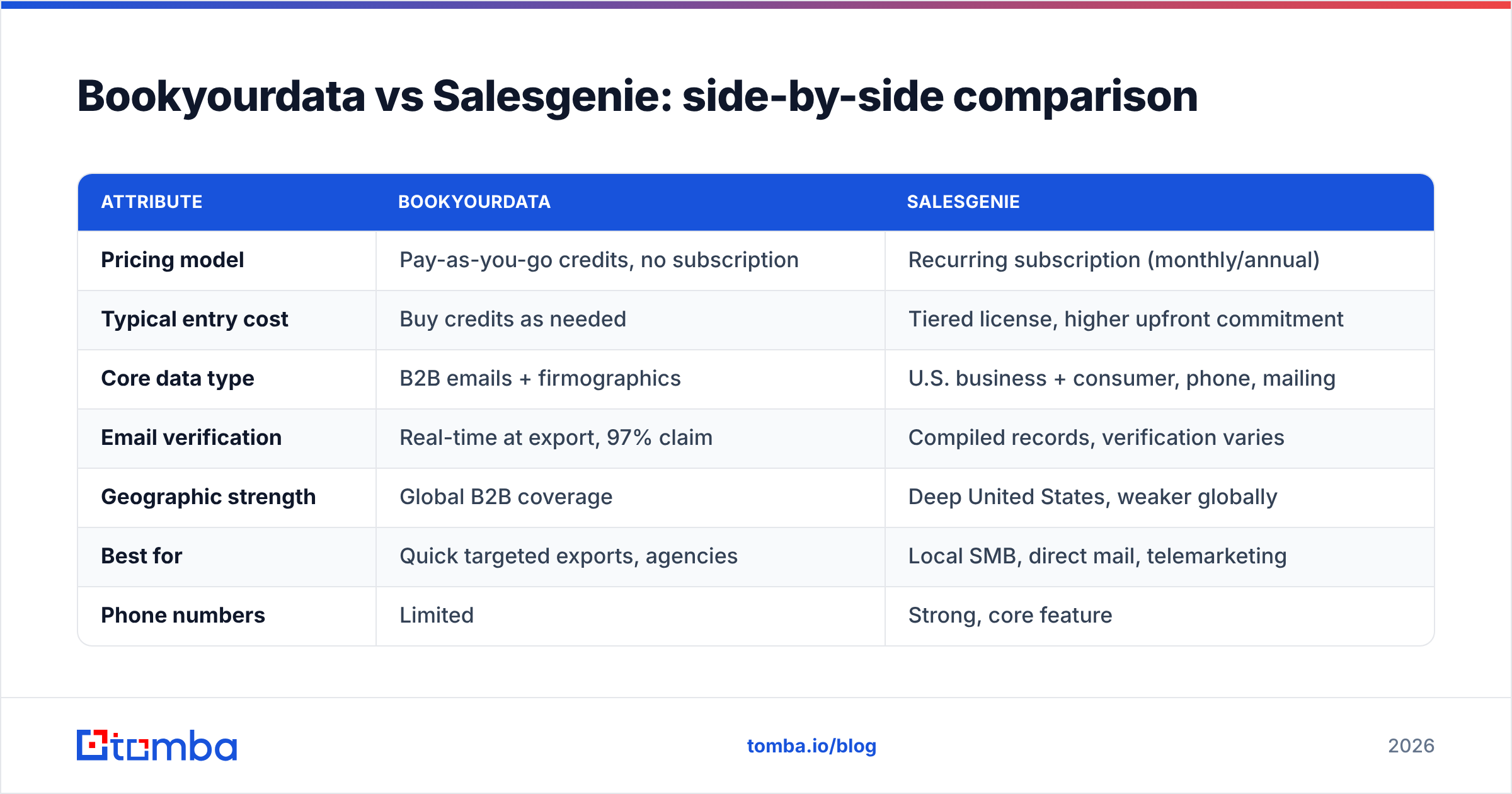
The pattern is clear: Bookyourdata optimizes for digital, on-demand, email-first buyers; Salesgenie optimizes for multichannel, U.S.-centric, always-on sellers. Neither is "better" in the abstract — they serve different motions.
Is Bookyourdata or Salesgenie more accurate?#
Accuracy is where most buyers get burned, so be precise about what each provider actually promises.
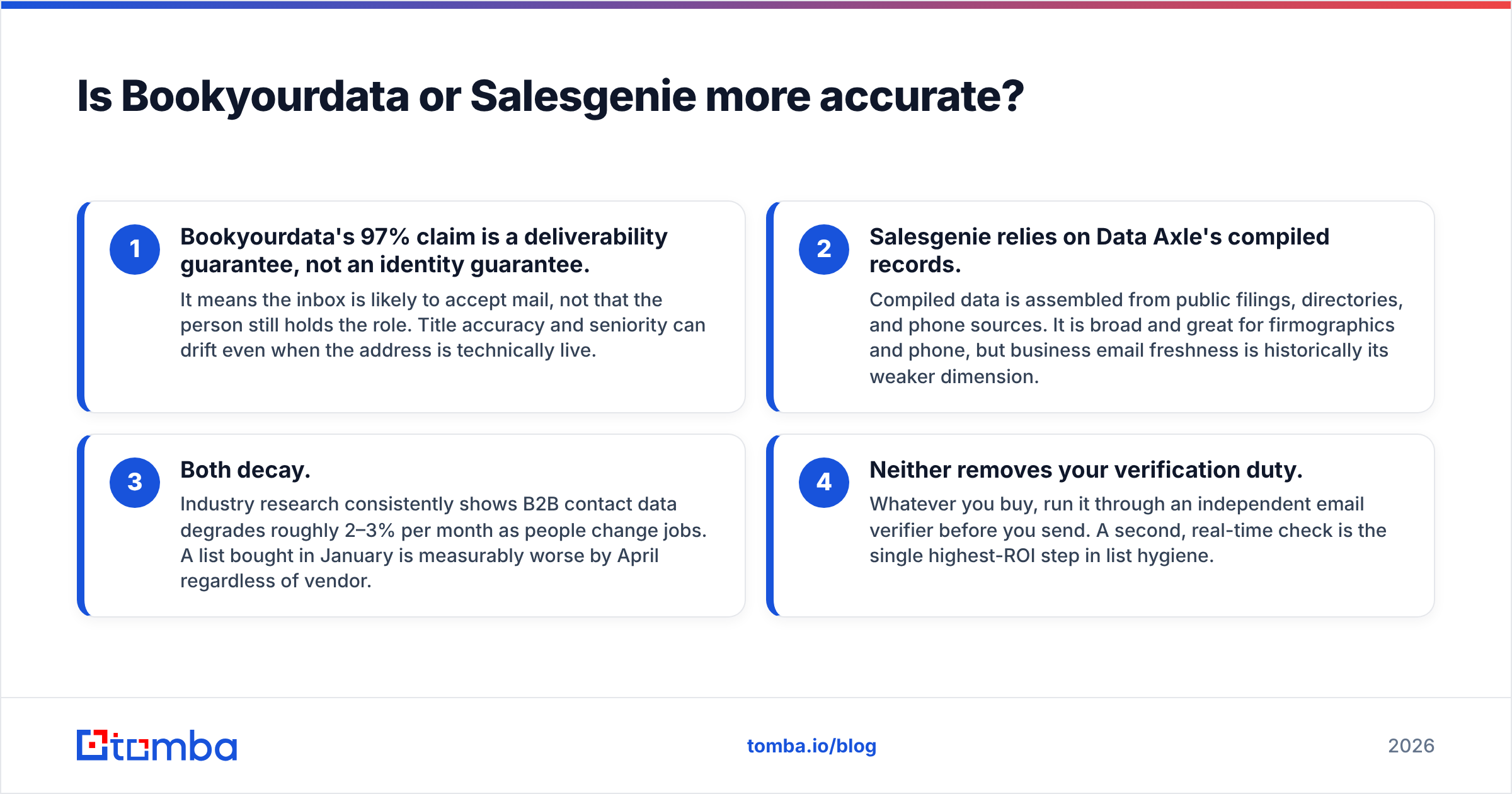
- Bookyourdata's 97% claim is a deliverability guarantee, not an identity guarantee. It means the inbox is likely to accept mail, not that the person still holds the role. Title accuracy and seniority can drift even when the address is technically live.
- Salesgenie relies on Data Axle's compiled records. Compiled data is assembled from public filings, directories, and phone sources. It is broad and great for firmographics and phone, but business email freshness is historically its weaker dimension.
- Both decay. Industry research consistently shows B2B contact data degrades roughly 2–3% per month as people change jobs. A list bought in January is measurably worse by April regardless of vendor.
- Neither removes your verification duty. Whatever you buy, run it through an independent email verifier before you send. A second, real-time check is the single highest-ROI step in list hygiene.
The honest takeaway: trust no single vendor's accuracy badge. Treat purchased data as a starting point and re-verify at send time. For deeper context on why inboxes reject mail, the concept of email deliverability is worth understanding before you blame the data.
How does pricing really compare?#
Cost depends on your cadence, and the two models reward opposite behaviors.
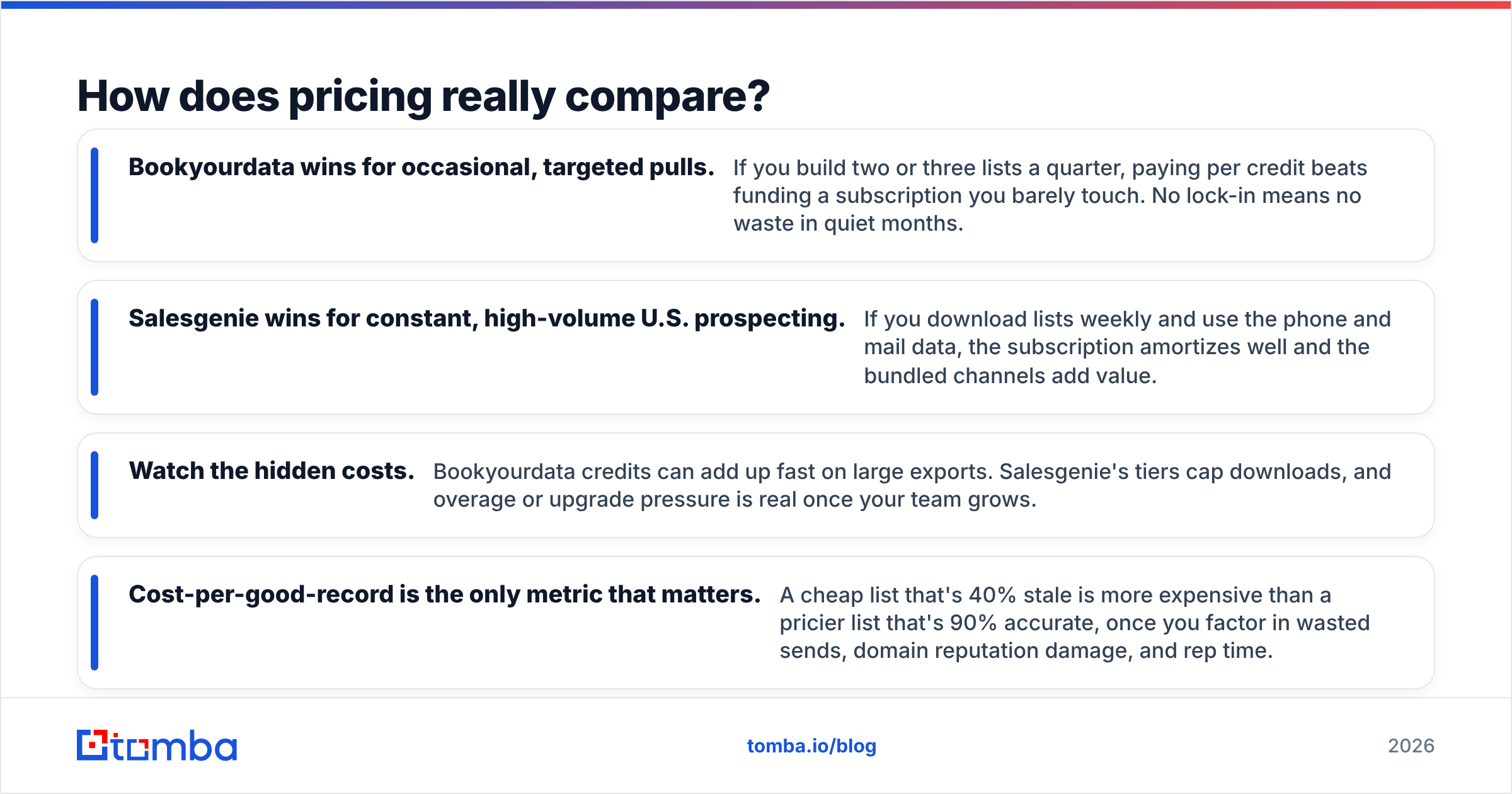
- Bookyourdata wins for occasional, targeted pulls. If you build two or three lists a quarter, paying per credit beats funding a subscription you barely touch. No lock-in means no waste in quiet months.
- Salesgenie wins for constant, high-volume U.S. prospecting. If you download lists weekly and use the phone and mail data, the subscription amortizes well and the bundled channels add value.
- Watch the hidden costs. Bookyourdata credits can add up fast on large exports. Salesgenie's tiers cap downloads, and overage or upgrade pressure is real once your team grows.
- Cost-per-good-record is the only metric that matters. A cheap list that's 40% stale is more expensive than a pricier list that's 90% accurate, once you factor in wasted sends, domain reputation damage, and rep time.
That last point is why usage-based tools that verify at the moment of lookup keep gaining share — you pay for results, not for a database you hope is current.
)
Who should choose which?#
Match the tool to your motion, not the marketing.
Choose Bookyourdata if you:
- Run occasional, sharply targeted email campaigns
- Hate subscriptions and want pay-as-you-go control
- Need global B2B coverage, not just the U.S.
- Want a fast, self-serve export without onboarding
Choose Salesgenie if you:
- Sell to local U.S. small businesses or consumers
- Rely on phone and direct mail alongside email
- Run always-on, high-volume territory prospecting
- Value Data Axle's compiled depth and don't mind a contract
Look beyond both if you:
- Care most about email freshness at the point of contact
- Want to enrich a name + company into a verified email on demand
- Prefer paying per successful find rather than per seat or per database
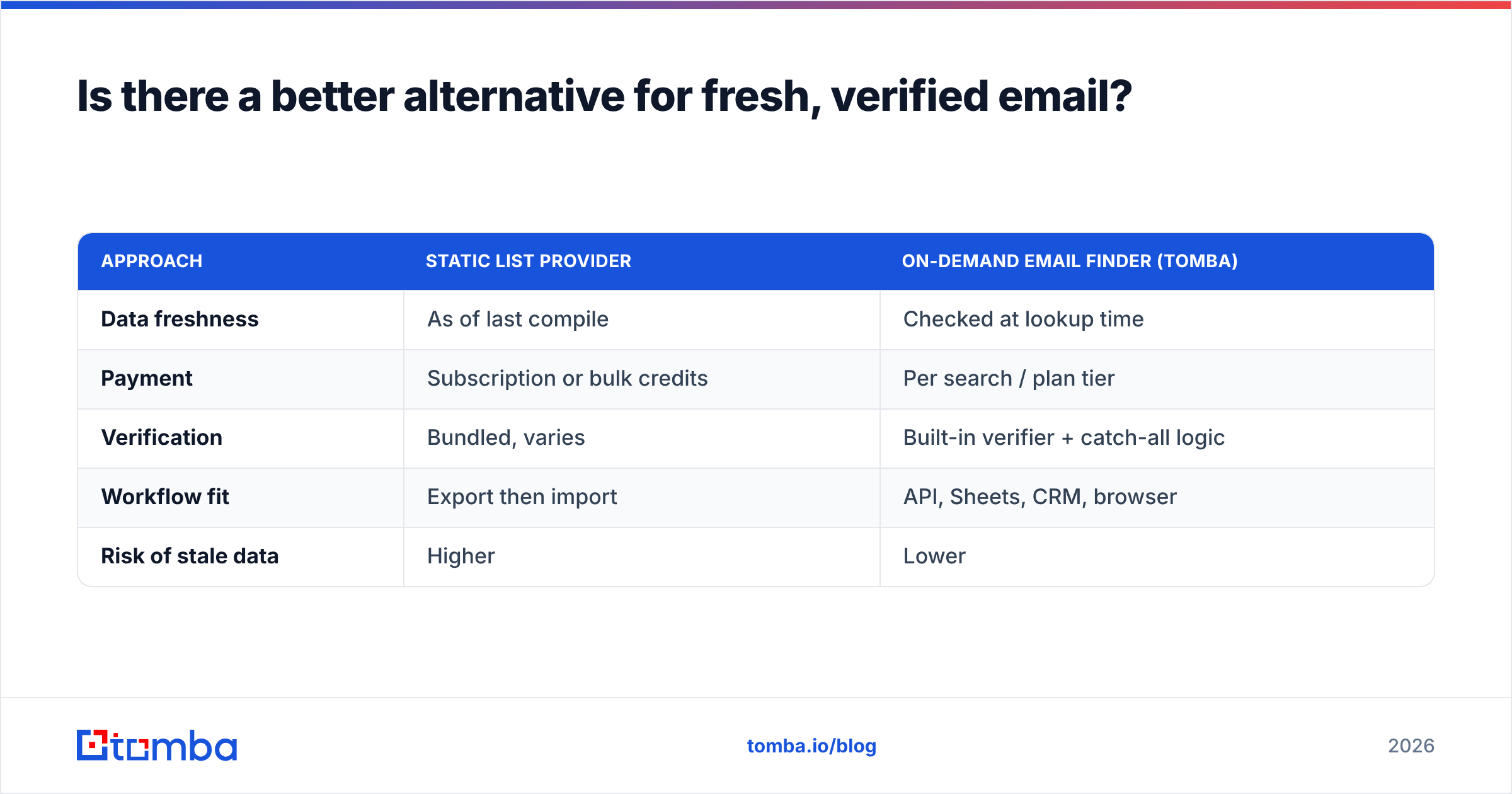
Is there a better alternative for fresh, verified email?#
If your core need is accurate B2B email — not phones, not mailing addresses, not consumer records — a dedicated email finder usually delivers a better cost-per-good-record than either list provider.
This is where Tomba fits. Instead of buying a static slab of data and hoping it's current, you look up exactly the contact you need and Tomba finds and verifies the address in real time. The difference matters: a database is a snapshot, while a finder is a live query.
Here's how the approaches differ in practice:
| Approach | Static list provider | On-demand email finder (Tomba) |
|---|---|---|
| Data freshness | As of last compile | Checked at lookup time |
| Payment | Subscription or bulk credits | Per search / plan tier |
| Verification | Bundled, varies | Built-in verifier + catch-all logic |
| Workflow fit | Export then import | API, Sheets, CRM, browser |
| Risk of stale data | Higher | Lower |
A few ways teams use Tomba alongside or instead of these platforms:
- Domain search to pull every reachable contact at a target company, then verify before outreach.
- Bulk email finder to process an account list without buying a whole subscription database.
- Tomba API to enrich records inside your own app or CRM the moment a lead enters the funnel.
- Data enrichment to fill gaps in a list you already own — including one exported from Bookyourdata or Salesgenie.
Tomba's pricing is transparent and usage-aligned: a free tier with 25 searches per month, then Starter at $49/mo, Growth at $99/mo, Pro at $249/mo, and custom Enterprise. You can see full Tomba pricing without talking to sales. That model rewards exactly the behavior list providers punish — paying for good contacts, not for storage of aging ones.
What about combining tools?#
Plenty of teams don't pick just one. A common, pragmatic stack looks like this:
- Use Salesgenie or Bookyourdata for discovery — find the companies and rough contact universe in your territory.
- Use a finder + verifier for the last mile — turn names and domains into verified, send-safe emails right before outreach.
- Re-verify at send time — because even a list bought last week has started to decay.
This hybrid respects what each tool is genuinely good at. The legacy databases give you reach and multichannel data; the modern finder gives you freshness and inbox safety. Skipping the verification layer is the mistake that quietly tanks campaigns — bounced sends erode your sender reputation, and once that drops, even perfect copy lands in spam.
For broader vendor research before you commit, third-party review sites like G2 and Capterra carry real user feedback on both Bookyourdata and Salesgenie, and Data Axle's own Salesgenie site documents current tiers and add-ons. Cross-check marketing claims against those sources rather than trusting any single landing page.
Final verdict: Bookyourdata vs Salesgenie#
There's no universal winner — there's a winner for your situation.
- Pick Bookyourdata for flexible, global, subscription-free email list building in bursts.
- Pick Salesgenie for deep, multichannel, U.S.-focused prospecting where phone and mail matter as much as email.
- Pick a dedicated finder when email accuracy at the moment of contact is the whole game and you'd rather pay per good record than per database.
Whatever you choose for discovery, do not skip verification. The cheapest list in the world is worthless if half of it bounces.
If your real goal is fresh, verified B2B email without a contract or a stale database, start with the Tomba Email Finder. The free tier gives you 25 searches a month to test accuracy against your own market — find the contact, verify it in real time, and send with confidence. Spin up a list, run a few of your toughest target accounts through it, and compare the deliverability against whatever you'd export from Bookyourdata or Salesgenie. The cost-per-good-record will make the decision for you.
// get started
Find, verify and enrich your first contacts today
Start on the free plan with 25 searches a month, then scale when your team is ready.
Free plan · No credit card required · GDPR & CCPA
// about the author