Bookyourdata vs Sellhack 2026: Which B2B Lead Tool Wins?
Bookyourdata sells a pay-as-you-go B2B contact database; Sellhack focuses on real-time email finding. Here's an honest 2026 breakdown of accuracy, pricing, and the better fit.
This Bookyourdata vs Sellhack guide compares two popular B2B lead tools. We rank them on accuracy, pricing, and data freshness. The goal is simple: help you pick the right one fast — and show a smarter 2026 alternative.
TL;DR
- Bookyourdata is a pay-as-you-go B2B contact database — you buy verified records by the credit, filtered by industry, title, and location. Sellhack is a real-time email finder that builds and verifies addresses on demand from names and domains.
- Bookyourdata wins on volume list-building and its 97%+ accuracy guarantee. Sellhack wins on lightweight, browser-based prospecting one contact at a time.
- Neither is the cheapest or the most accurate option in 2026. Both lean on bulk data that ages fast, and both charge for records you may never email.
- If you care about fresh, re-verified emails and a clean API, a dedicated finder-plus-verifier stack like Tomba usually beats either tool on cost-per-valid-contact.
- Pick by workflow: buy a list (Bookyourdata), grab the odd contact (Sellhack), or find-and-verify at scale through one API (Tomba).
Bookyourdata vs Sellhack: what are they?#
Short answer: they solve the same problem from opposite ends. Both get you business email addresses.
Bookyourdata is a database company. Think of it like a wholesale warehouse. You walk in, filter the shelves by job title, industry, company size, and location, then pay per record. It advertises a 97%+ email accuracy guarantee. It also uses a "pay only for what you use" credit model, which is rare for database vendors that lock you into annual seats.
Sellhack is a finder and verifier. Think of it like a metal detector. You point it at a name and a company domain. It then sweeps public sources and pattern-matching to surface the most likely email, then runs a verification pass. It started as a Chrome extension for LinkedIn prospecting. It still feels built for one-contact-at-a-time work.
The distinction matters because it changes what you pay for. With a database, you pay for stored records. They are accurate the day they were collected, but they decay every month after. With a finder, you pay for a fresh lookup at the moment you need it. That one difference drives most of the gaps below.

How do Bookyourdata and Sellhack compare on features?#
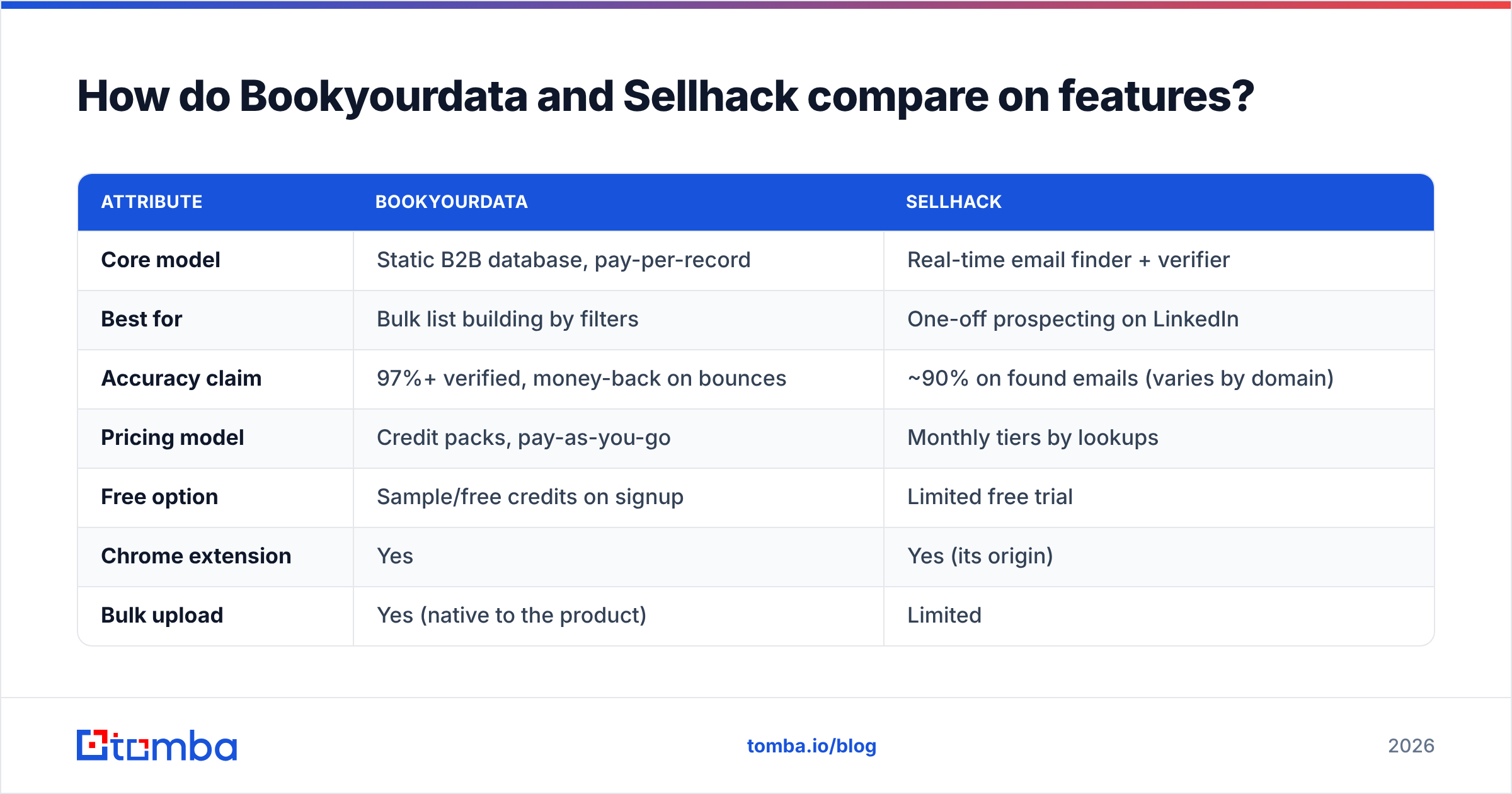
Here is the head-to-head on the attributes that decide real campaigns.
| Attribute | Bookyourdata | Sellhack |
|---|---|---|
| Core model | Static B2B database, pay-per-record | Real-time email finder + verifier |
| Best for | Bulk list building by filters | One-off prospecting on LinkedIn |
| Accuracy claim | 97%+ verified, money-back on bounces | ~90% on found emails (varies by domain) |
| Pricing model | Credit packs, pay-as-you-go | Monthly tiers by lookups |
| Free option | Sample/free credits on signup | Limited free trial |
| Chrome extension | Yes | Yes (its origin) |
| Bulk upload | Yes (native to the product) | Limited |
| Phone numbers | Yes (direct dials add-on) | No |
| API access | Available | Limited / dated |
| Data freshness | Depends on last DB refresh | Fresh at lookup time |
Two takeaways. First, Bookyourdata is the better choice when you want quantity now. Picture a filtered list of 5,000 marketing directors in SaaS, exported to CSV in minutes. Second, Sellhack is the better choice when you live in LinkedIn. You can grab this person's email without buying a list you'll mostly waste.
But both share a weakness. The data underneath them was collected before you asked for it. A title that was right at collection is wrong the moment someone changes jobs. Roughly a third of B2B contacts change roles each year. That is why verification at send-time, not just at purchase-time, is the part most teams underrate.
)
Which one is more accurate?#
Conclusion first: Bookyourdata posts the higher claimed number — 97%+ with a bounce guarantee. But a guarantee is a refund policy, not a deliverability strategy. Sellhack's found emails are solid on common domains. They get weaker on catch-all or small-company domains, where pattern-matching has to guess.
The honest framing is that accuracy is not one number. It splits into three:
- Was the email real when collected? Both tools do reasonably here.
- Is it still real today? This is where static databases lose. A record verified six months ago may now bounce, guarantee or not.
- Is the domain a catch-all that accepts everything? Catch-all domains fool simple verifiers into marking guesses as "valid." You need a dedicated catch-all check, not just an SMTP ping.
If your list is heavy on enterprise targets with predictable formats, both tools clear the bar. If you're hitting startups, agencies, and catch-all domains, re-verify before you send. Run every record through an independent email verifier — and a real catch-all verifier. That catches the bounces a purchase-time guarantee only reimburses you for after your sender reputation already took the hit. Protecting email deliverability is cheaper than recovering it.
How does pricing compare?#
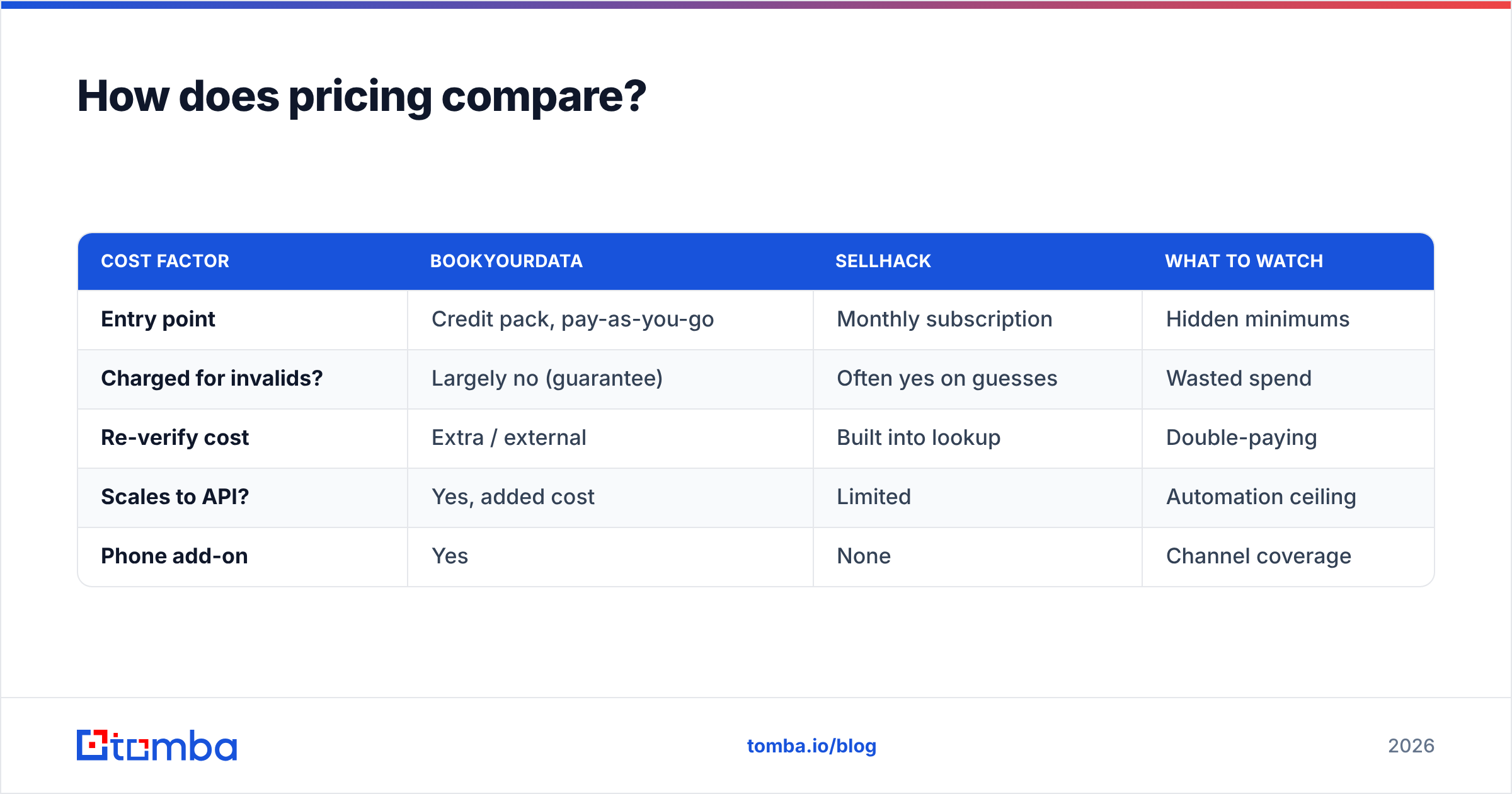
Bookyourdata's pay-as-you-go credit model is friendly for irregular buyers. There's no seat and no annual lock-in. You buy a pack and draw it down. Sellhack uses monthly tiers tied to lookup volume. That rewards steady users and penalizes the stop-start prospector.
The trap in both is paying for records you never email. A database charges you for the contact whether or not it's still valid. A finder charges for the lookup whether or not the result is usable. Your real metric isn't price per credit. It's cost per valid, deliverable contact.
| Cost factor | Bookyourdata | Sellhack | What to watch |
|---|---|---|---|
| Entry point | Credit pack, pay-as-you-go | Monthly subscription | Hidden minimums |
| Charged for invalids? | Largely no (guarantee) | Often yes on guesses | Wasted spend |
| Re-verify cost | Extra / external | Built into lookup | Double-paying |
| Scales to API? | Yes, added cost | Limited | Automation ceiling |
| Phone add-on | Yes | None | Channel coverage |
For reference, a finder-plus-verifier platform like Tomba starts free (25 searches/month). Starter is $49/mo and Growth is $99/mo — see full Tomba pricing. The point isn't that one number beats another. It's that bundling find, verify, and catch-all checks under one credit avoids the "pay twice" problem both Bookyourdata and Sellhack can create.
)
What are the real-world use cases for each?#
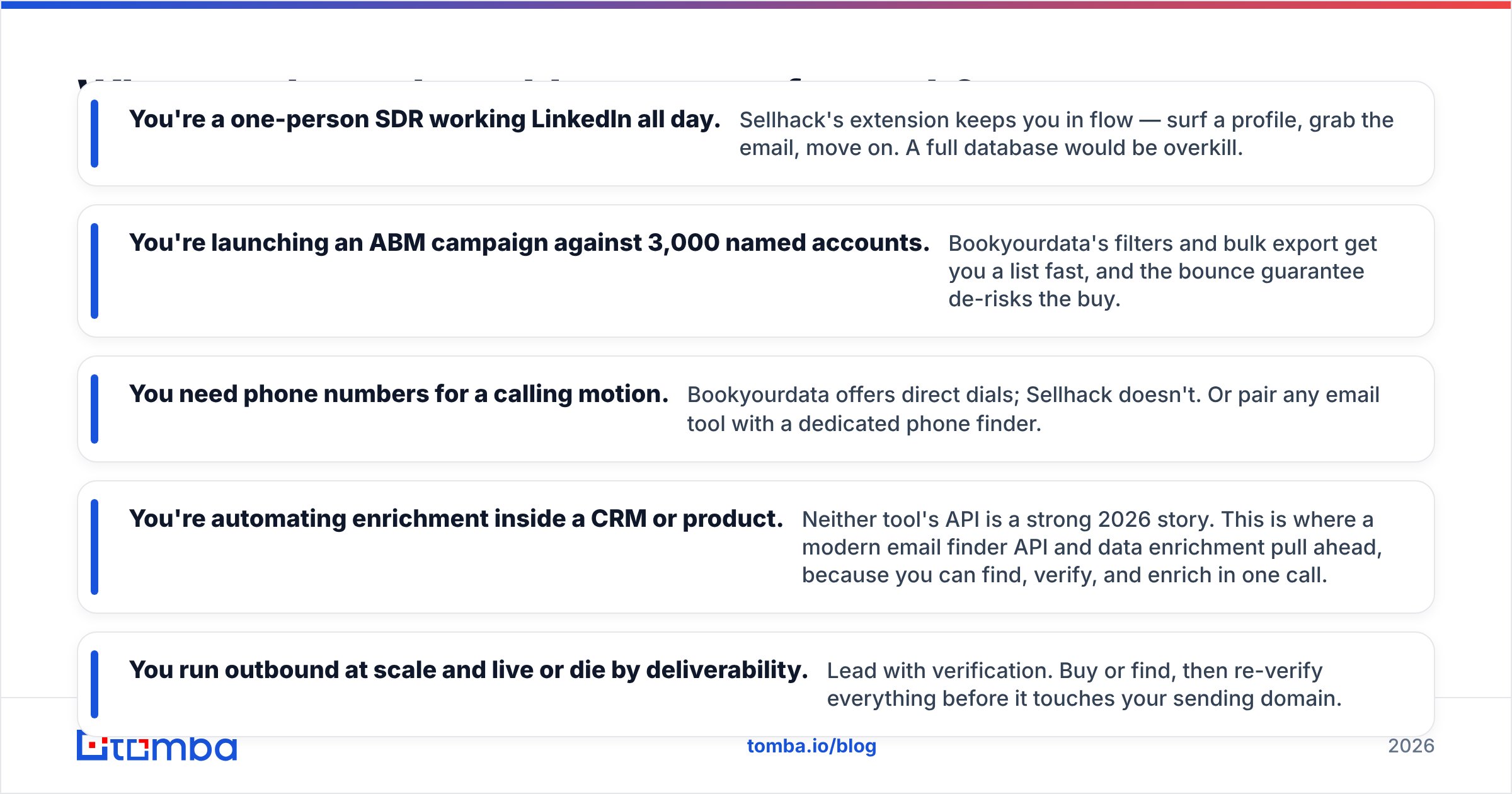
Match the tool to the motion, not the marketing.
- You're a one-person SDR working LinkedIn all day. Sellhack's extension keeps you in flow — surf a profile, grab the email, move on. A full database would be overkill.
- You're launching an ABM campaign against 3,000 named accounts. Bookyourdata's filters and bulk export get you a list fast, and the bounce guarantee de-risks the buy.
- You need phone numbers for a calling motion. Bookyourdata offers direct dials; Sellhack doesn't. Or pair any email tool with a dedicated phone finder.
- You're automating enrichment inside a CRM or product. Neither tool's API is a strong 2026 story. This is where a modern email finder API and data enrichment pull ahead, because you can find, verify, and enrich in one call.
- You run outbound at scale and live or die by deliverability. Lead with verification. Buy or find, then re-verify everything before it touches your sending domain.
A quick gut check: if your answer to "where does this data go next?" is "a CSV I'll babysit," a database tool is fine. If the answer is "an automated pipeline," you want an API-first stack.
Is there a better alternative to both in 2026?#
Honest take: for most teams that send cold email at scale, a find-and-verify platform beats both a static database and a lightweight finder. It attacks the freshness problem head-on.
Bookyourdata is excellent at volume. Sellhack is convenient for one-offs. But both hand you data and leave verification as your problem. Tomba bundles the email finder, domain search, verifier, and catch-all checks under one set of credits. You also get a clean Tomba API, a Chrome extension, a Google Sheets add-on, and a bulk email finder for list work. You're not choosing between "buy a list" and "grab one contact." You do both, fresh, in one place.

That said, no tool is magic. If your ICP is niche and you need pre-built filtered lists with phone numbers today, Bookyourdata's database depth is a real advantage. If you only need a handful of emails a week and live in LinkedIn, Sellhack's simplicity may be enough. Be honest about your volume before you pay for capability you won't use.
For independent reviews of all three, cross-check ratings on G2 and Capterra. Read each vendor's own claims at bookyourdata.com before deciding. Trust your own test sends over any guarantee.
How should you decide between Bookyourdata and Sellhack?#
Run a 100-contact bake-off before committing budget. Pull the same 100 target contacts through each tool. Then push every result through one neutral verifier. Measure four things: valid rate, catch-all rate, bounce rate on a small test send, and total cost. The winner is whichever delivers the lowest cost per deliverable contact — not the lowest sticker price and not the loudest accuracy claim.
A few decision rules that hold up:
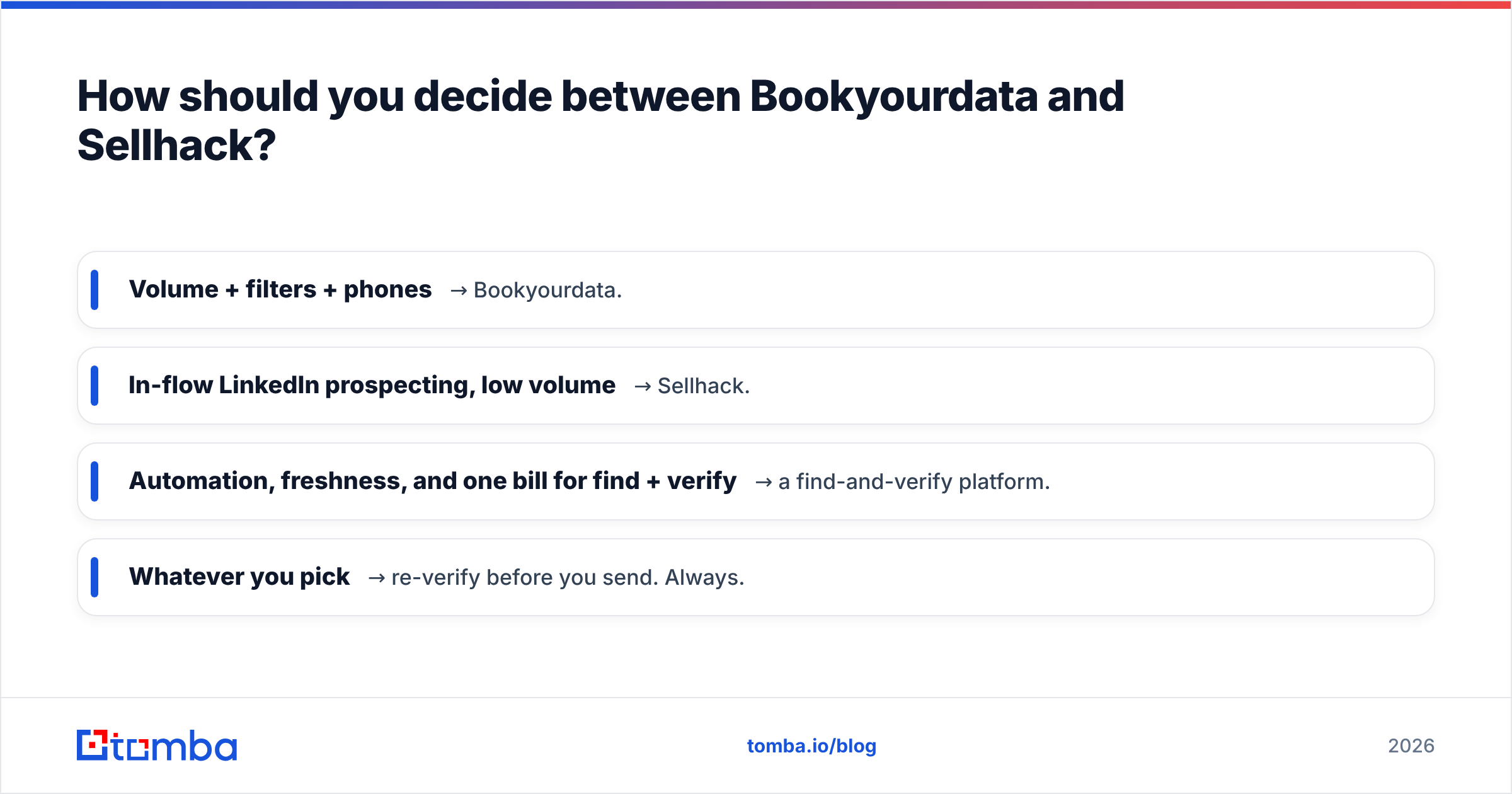
- Volume + filters + phones → Bookyourdata.
- In-flow LinkedIn prospecting, low volume → Sellhack.
- Automation, freshness, and one bill for find + verify → a find-and-verify platform.
- Whatever you pick → re-verify before you send. Always.
The bottom line#
In this Bookyourdata vs Sellhack matchup, each tool wins a different job. One sells you a warehouse of records. The other hands you a metal detector. Both leave the hardest part on your plate: keeping data fresh and deliverable. In 2026, the teams winning at outbound treat finding and verifying as one motion, not two purchases.
If you want fresh, verified B2B emails without buying a list you'll half-waste or paying twice to re-check it, start with the Tomba Email Finder. Find emails by domain, name, or company, and verify them in the same workflow. Plug it into your CRM through the API — free for your first 25 searches, no card required. Test it against your real ICP this week and let the deliverable-contact number decide.
// get started
Find, verify and enrich your first contacts today
Start on the free plan with 25 searches a month, then scale when your team is ready.
Free plan · No credit card required · GDPR & CCPA
// about the author