Bookyourdata vs Skrapp 2026: Which Email Tool Wins?
Bookyourdata sells pre-built B2B lists; Skrapp finds emails from LinkedIn and domains. We compare accuracy, pricing, and data freshness to show which fits your outbound — and where a third option beats both.
You are choosing between two very different ways to get B2B email addresses, and the marketing pages make them sound interchangeable. They are not. Bookyourdata sells you a pre-built list you download in bulk. Skrapp finds emails one prospect at a time from LinkedIn and company domains. Picking the wrong model wastes budget and tanks your deliverability.
This guide breaks down bookyourdata vs skrapp on the things that actually decide your reply rate: data accuracy, pricing, freshness, verification, and the real-world workflow each one fits.
TL;DR — Bookyourdata vs Skrapp at a glance#
- Bookyourdata is a pay-as-you-go contact database. You filter by industry, title, and geography, then buy records in bulk. Best for marketers who want volume fast.
- Skrapp is a prospecting email finder. It pulls verified emails off LinkedIn profiles and company domains, one lead or one list at a time. Best for reps building targeted outbound.
- Accuracy is the deciding factor, and both lose points: bought lists go stale quickly, and LinkedIn-scraped emails miss anyone who isn't active there.
- Pricing models differ completely — Bookyourdata charges per credit/record, Skrapp charges a monthly subscription tied to email-finding volume.
- If you want fresh, verified emails and predictable pricing without buying a stale list, a real-time finder like Tomba Email Finder beats both — more on that below.

What is Bookyourdata?#
Bookyourdata is a B2B contact-database vendor. You log in, apply filters (job title, industry, company size, location, technology used), and the platform shows how many matching records it holds. You then "unlock" or download those records on a pay-as-you-go credit basis — no long subscription required.
The appeal is speed and volume. If you need 5,000 marketing-manager contacts in SaaS companies by tomorrow, Bookyourdata hands you a spreadsheet. It markets a high accuracy guarantee and offers replacement credits for bounced records, which is reassuring on paper.
The catch is the list-buying model itself. A database snapshot is accurate the day it was compiled. People change jobs at roughly 20–30% per year in tech, so any static list decays continuously. You are also emailing people who never asked to be in a database, which raises both deliverability and compliance questions. See the official Bookyourdata site for current filter options.
What is Skrapp?#
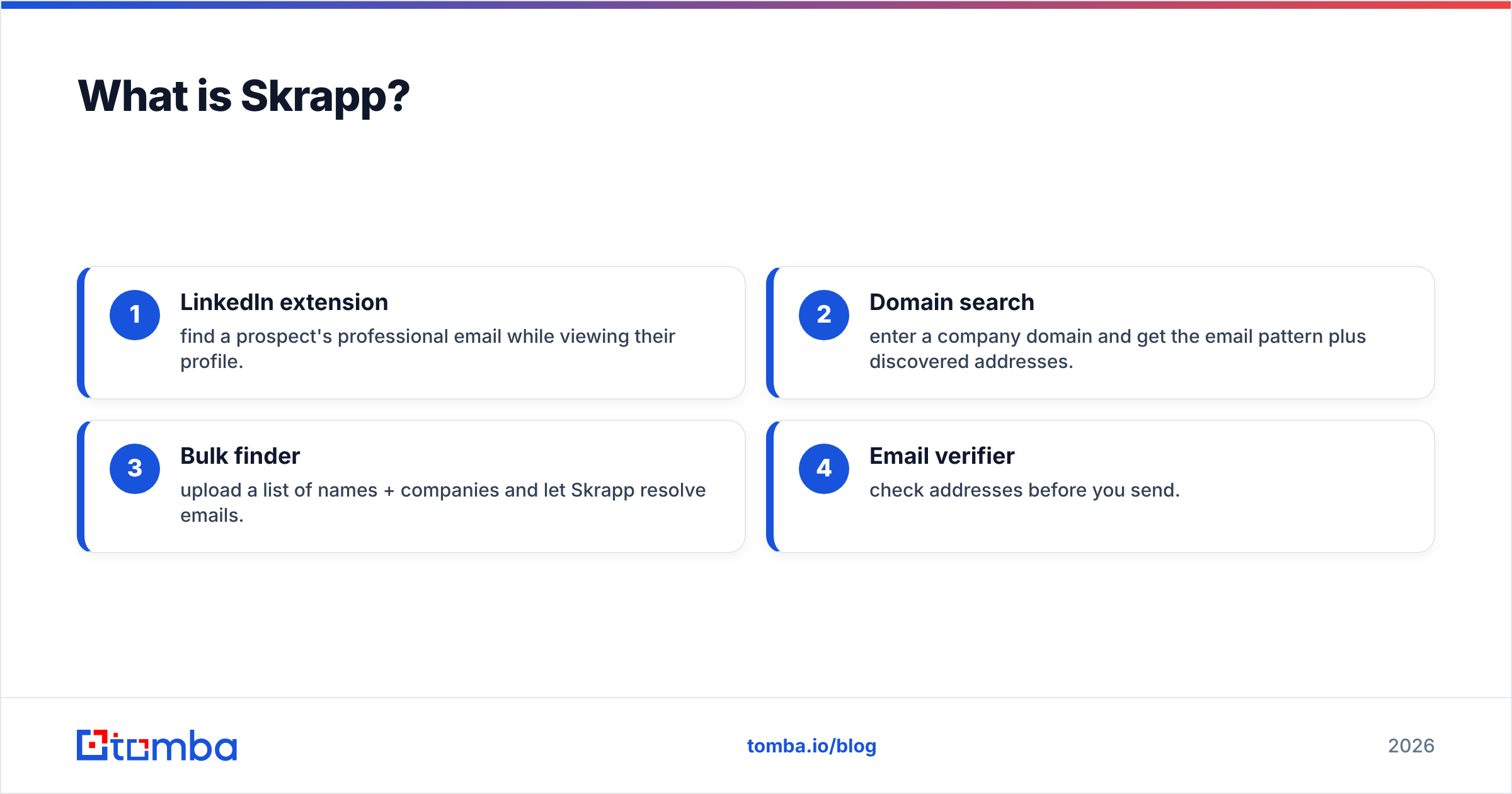
Skrapp is an email-finding tool built around LinkedIn and domain search. Its core workflows are:
- LinkedIn extension — find a prospect's professional email while viewing their profile.
- Domain search — enter a company domain and get the email pattern plus discovered addresses.
- Bulk finder — upload a list of names + companies and let Skrapp resolve emails.
- Email verifier — check addresses before you send.
Skrapp's strength is intent. You target specific people you already researched, so the contacts are relevant rather than bulk-bought. It sells on a monthly subscription where your plan caps how many emails you can find and verify. Check the Skrapp.io homepage for current limits.
The limitation: Skrapp leans heavily on LinkedIn data. If your prospect keeps a thin profile or isn't on LinkedIn, coverage drops. And LinkedIn-derived guesses still need verification — an email pattern is a hypothesis, not a confirmed inbox.
How accurate is each one?#
Accuracy is where this comparison is won or lost, because a bounced email hurts your sender reputation far more than a missed contact does.

Two different failure modes apply:
- Bookyourdata (list model): records are accurate at compile time but decay. A "95% accurate" guarantee describes the moment of purchase, not the moment you send three weeks later. Replacement credits help with bounces but don't fix the relevance problem — you still contact people who moved on.
- Skrapp (finder model): accuracy depends on the source profile and on whether each address is verified, not just generated. Pattern-matched emails (
first.last@company.com) bounce when the company uses a non-standard format or a catch-all domain.
The honest takeaway: neither model gives you "set and forget" accuracy. Whatever you use, run every address through an email verifier immediately before sending, and treat catch-all domains with extra caution.
Bookyourdata vs Skrapp: full comparison table#
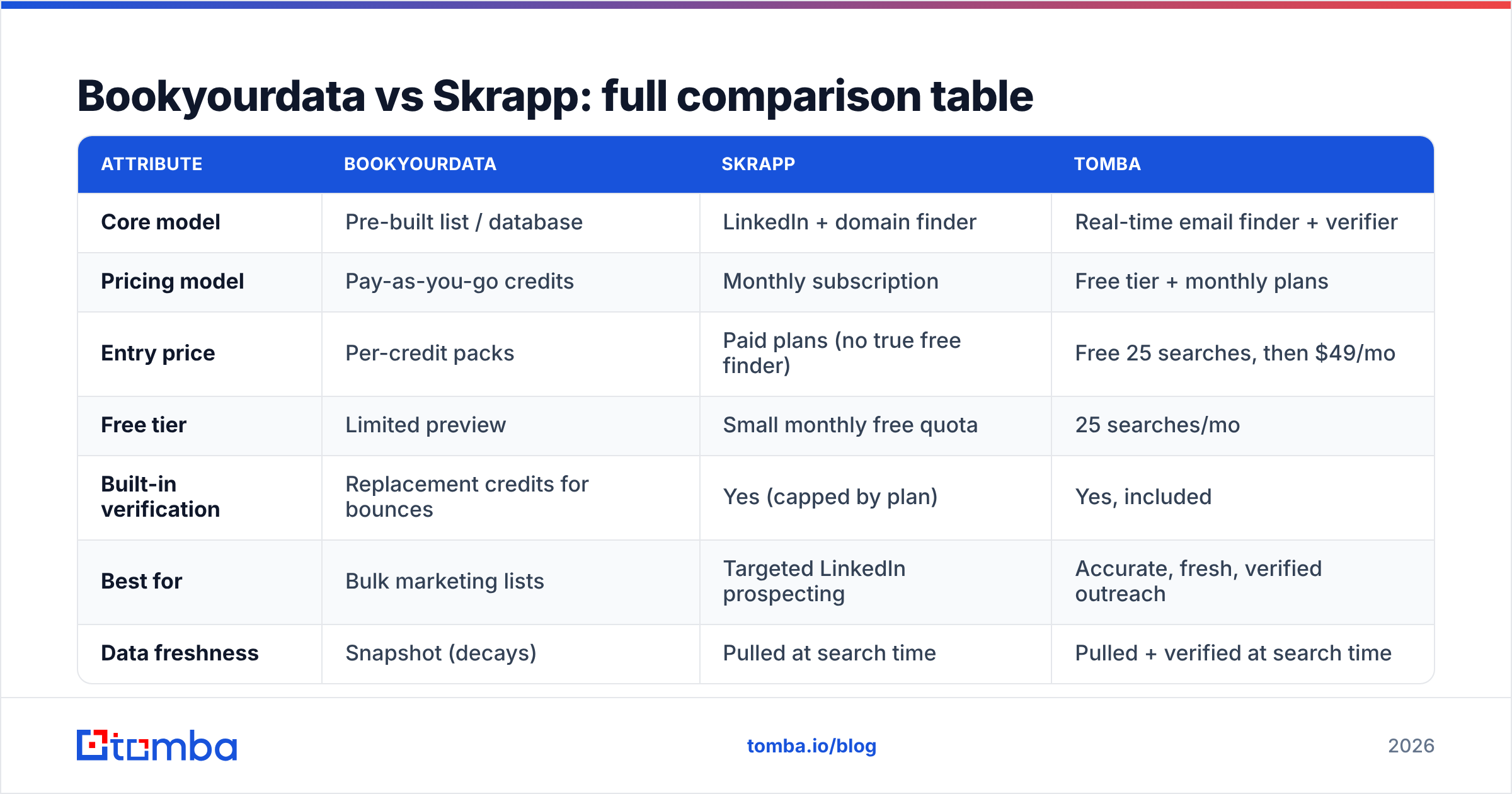
| Attribute | Bookyourdata | Skrapp | Tomba |
|---|---|---|---|
| Core model | Pre-built list / database | LinkedIn + domain finder | Real-time email finder + verifier |
| Pricing model | Pay-as-you-go credits | Monthly subscription | Free tier + monthly plans |
| Entry price | Per-credit packs | Paid plans (no true free finder) | Free 25 searches, then $49/mo |
| Free tier | Limited preview | Small monthly free quota | 25 searches/mo |
| Built-in verification | Replacement credits for bounces | Yes (capped by plan) | Yes, included |
| Best for | Bulk marketing lists | Targeted LinkedIn prospecting | Accurate, fresh, verified outreach |
| Data freshness | Snapshot (decays) | Pulled at search time | Pulled + verified at search time |
| Catch-all handling | Not transparent | Limited | Dedicated catch-all verifier |
| API access | Limited | Yes | Full REST API |
How does pricing compare?#
The pricing models aren't just different numbers — they're different philosophies.
- Bookyourdata charges for records. You pay per contact you unlock or download. This rewards bulk buying and punishes precision: filtering tightly leaves credits on the table, while buying broad inflates your bounce risk.
- Skrapp charges a monthly subscription tied to how many emails you can find and verify. Predictable, but you pay even in slow months, and overage means upgrading tiers.
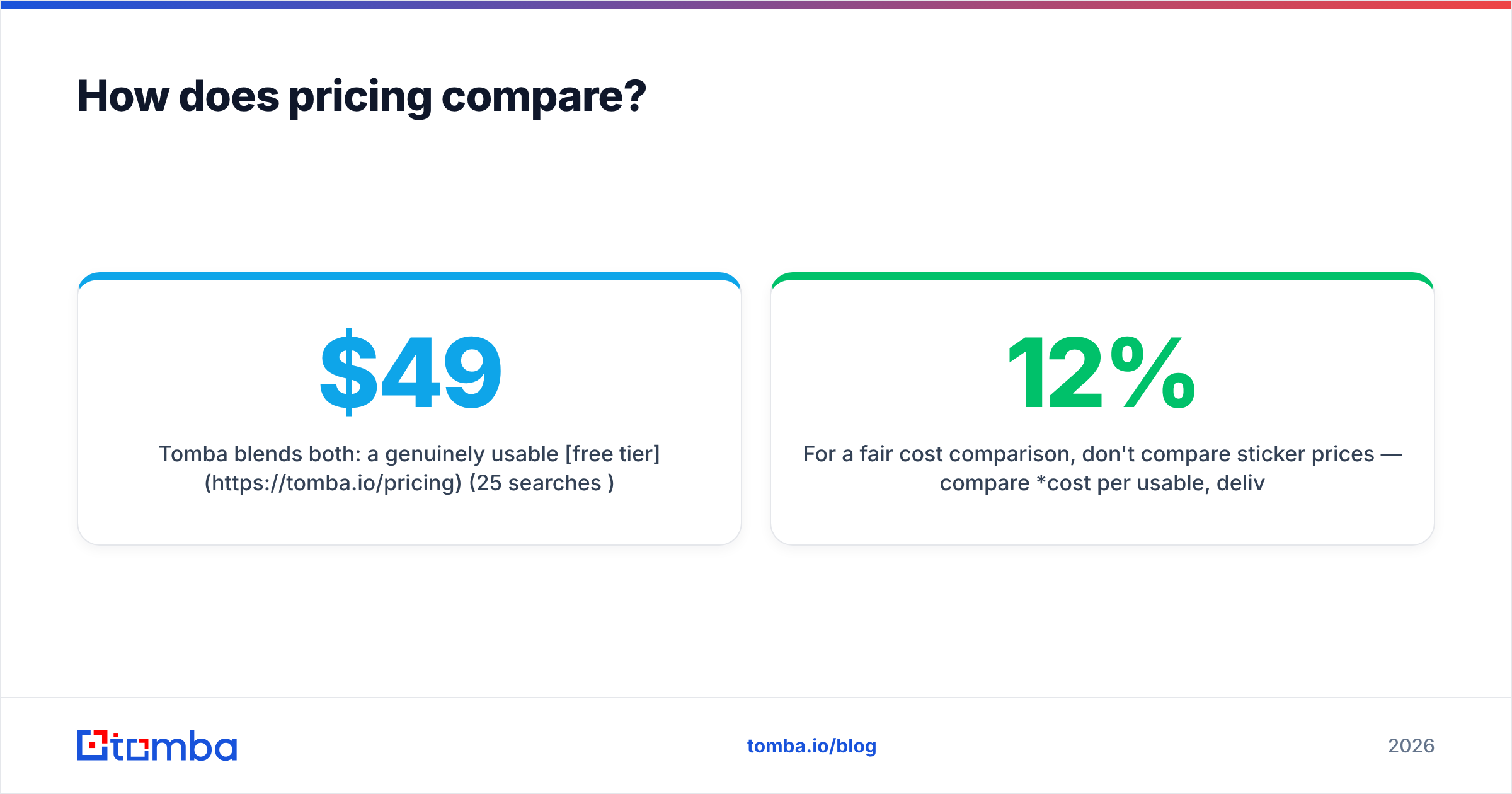
- Tomba blends both: a genuinely usable free tier (25 searches/month) and flat monthly plans — Starter at $49/mo, Growth at $99/mo, Pro at $249/mo, and custom Enterprise. You're paying for verified finds, not for a stale list you hope converts.
For a fair cost comparison, don't compare sticker prices — compare cost per usable, deliverable contact. A cheap bulk list with a 12% bounce rate is more expensive than verified finds at a higher per-record price once you factor in burned domain reputation.

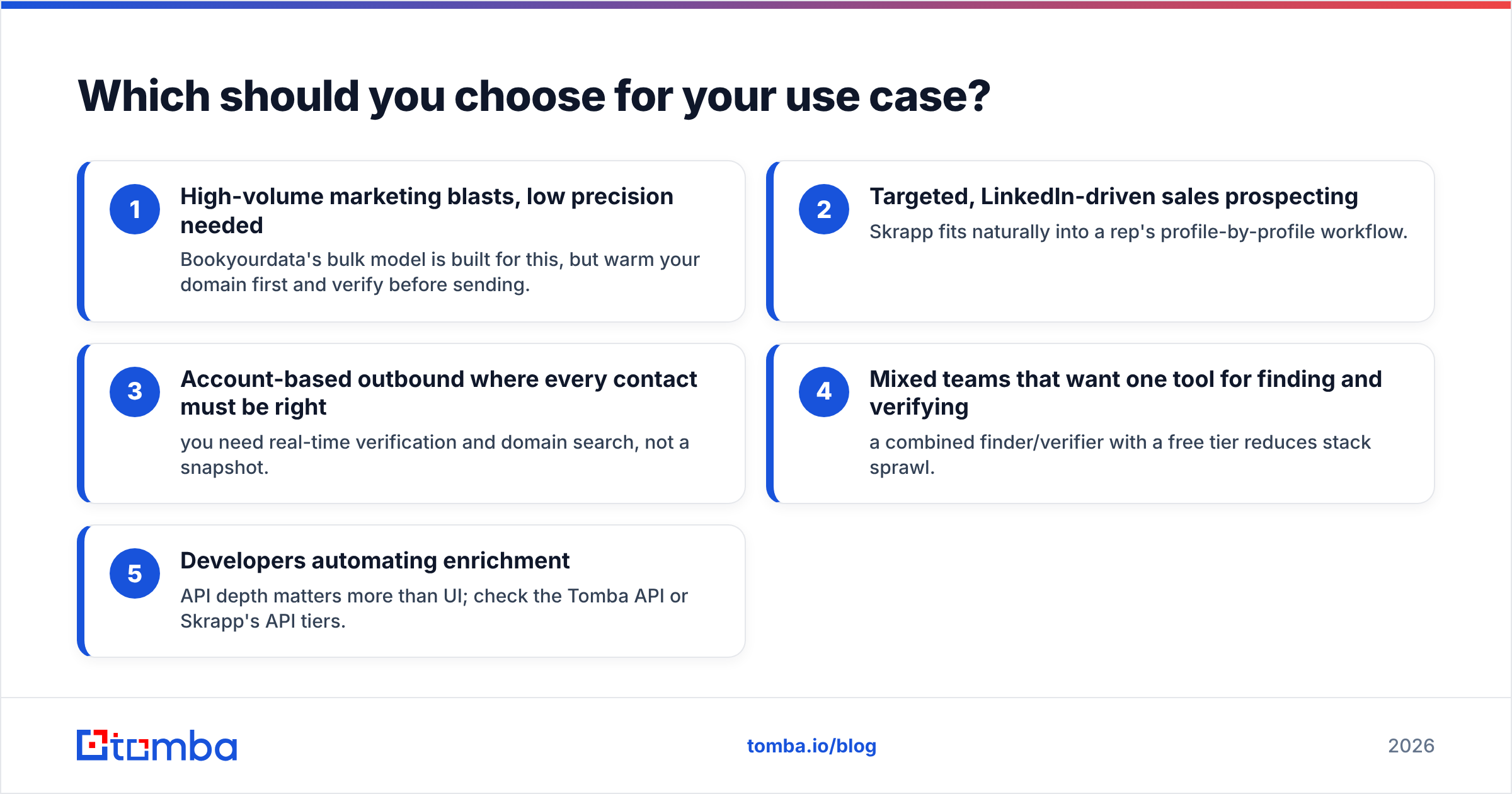
Which should you choose for your use case?#
Match the tool to the job rather than chasing the cheapest credit:
- High-volume marketing blasts, low precision needed — Bookyourdata's bulk model is built for this, but warm your domain first and verify before sending.
- Targeted, LinkedIn-driven sales prospecting — Skrapp fits naturally into a rep's profile-by-profile workflow.
- Account-based outbound where every contact must be right — you need real-time verification and domain search, not a snapshot.
- Mixed teams that want one tool for finding and verifying — a combined finder/verifier with a free tier reduces stack sprawl.
- Developers automating enrichment — API depth matters more than UI; check the Tomba API or Skrapp's API tiers.
Is there a better alternative to both?#
Yes — and it comes down to combining what each tool does well while dropping the weaknesses.
Bookyourdata gives you scale but stale data. Skrapp gives you targeting but LinkedIn dependence. The gap both leave open is fresh + verified + flexible pricing in one place. That's where Tomba fits:
- Real-time finding, not a snapshot — addresses are resolved and verified when you search, so freshness isn't a guessing game.
- Built-in verification and catch-all handling — no separate tool to bolt on; the catch-all verifier handles the domains that bounce silently.
- A free tier that actually works — 25 searches a month before you pay anything, then transparent plans from $49/mo.
- Bulk when you need it — the bulk email finder covers list-style volume without buying a static list.
It's not magic — no tool hits 100%, and you should still verify before every send. But the combination of fresh data, included verification, and a free starting point removes the two biggest weaknesses in the bookyourdata vs skrapp matchup.
You can sanity-check any vendor's reputation on independent review sites like G2 before committing budget.
How do you keep deliverability high with any of these tools?#
The tool only gets you the address. Whether it lands in the inbox depends on your sending hygiene:
- Verify every list before sending, even from a "guaranteed accurate" source. Bounce rate above 3% signals mailbox providers to filter you.
- Warm up new sending domains gradually rather than blasting 5,000 cold contacts on day one.
- Segment by relevance, not by what you happened to buy — irrelevant sends trigger spam complaints that outlast any single campaign.
- Watch catch-all domains. They accept everything at the server, so a "valid" result can still be a black hole. Treat them as a separate risk tier.
Doing the finding well and the sending badly still ends in the spam folder. Pair an accurate finder with disciplined sending and you protect the asset that matters most: your domain reputation.
Final verdict#
Bookyourdata wins on raw volume; Skrapp wins on targeted LinkedIn prospecting — but both leave a freshness-and-verification gap that costs you on deliverability. If your outbound depends on emails actually landing, buying a static list or relying on LinkedIn-only coverage is a compromise you don't have to make.
Start with verified, real-time data and a free tier so you can test before you spend: try the Tomba Email Finder free for 25 searches, run your existing list through the verifier, and compare deliverability against whatever you're using now. If the numbers don't beat your current tool, you've lost nothing but a few minutes — and if they do, you've fixed the most expensive leak in your funnel.
// get started
Find, verify and enrich your first contacts today
Start on the free plan with 25 searches a month, then scale when your team is ready.
Free plan · No credit card required · GDPR & CCPA
// about the author