BookYourData vs SMARTe 2026: B2B Data Tools Compared
BookYourData sells verified email lists; SMARTe sells live sales intelligence. Here's an honest 2026 breakdown of accuracy, pricing, coverage, and which one actually fits your outbound motion.
Picking between BookYourData and SMARTe usually comes down to one question you rarely see asked out loud: do you want a list you buy once, or a data layer that updates as your prospects change jobs? These two tools answer that question very differently, and choosing the wrong one wastes both budget and sender reputation.
This is a neutral breakdown — where each tool wins, where each one frustrates teams, and where a real-time finder beats both for the part of outbound that actually matters: hitting a live inbox.
TL;DR: BookYourData vs SMARTe at a glance#
- BookYourData is a self-serve B2B email list builder. You filter, you see counts, you pay per record or per credit, and you download a CSV. Best for fast one-off list pulls.
- SMARTe is a sales-intelligence platform built around enrichment, mobile numbers, and CRM/extension workflows. Best for revenue teams that live inside Salesforce or HubSpot.
- Accuracy is the real differentiator: a downloaded list decays the moment you export it, while live enrichment re-checks contacts on demand.
- Pricing models clash: BookYourData leans pay-as-you-go list purchases; SMARTe leans annual platform contracts with custom quotes.
- The gap both share: neither is a true find-and-verify-on-the-fly email finder. If your priority is deliverability at send time, you pair either tool — or replace it — with a verification-first finder like Tomba.
What is BookYourData?#
BookYourData is a pay-as-you-go B2B contact database aimed at marketers and SDRs who want to build a targeted email list without a sales call. You open the builder, stack filters (industry, job title, location, company size, technology), watch the live record count update, and buy exactly the slice you need.
Its main selling points are a self-serve checkout, a published "95% accuracy" guarantee, and credits that don't force you into an annual contract. For a small team that needs 2,000 marketing-director emails in Germany by Friday, that simplicity is the whole pitch.
The trade-off is that BookYourData is fundamentally a static export product. Once the CSV lands on your drive, it stops aging gracefully. B2B data degrades fast — people change roles, companies rebrand, domains get retired — so a list that was 95% accurate at purchase is meaningfully worse three months later. That's not a knock on one vendor; it's physics for every list-download model.
Swap the line above mentally: a one-time CSV is a photograph; a live API is a video feed. Both show your prospects — only one keeps up when they move.
What is SMARTe?#
SMARTe is a sales-intelligence and data-enrichment platform that positions itself against the Apollo/ZoomInfo tier. Instead of selling you a list to download, it's built to enrich records you already have and to surface contacts inside the tools your reps use — a Chrome extension over LinkedIn, CRM sync, and a strong emphasis on mobile/direct-dial numbers for callers.
SMARTe leans into GDPR/CCPA-compliant sourcing and international coverage (notably EMEA and APAC), which makes it attractive to teams running outbound outside North America. Its workflow assumes you have a CRM as the system of record and want data flowing into it continuously, not a one-and-done file.
The trade-off here is the opposite of BookYourData's: SMARTe is heavier. Expect a demo, a custom quote, and an annual commitment for the good tiers. That's fine for a funded revenue org; it's overkill for a founder doing a 1,500-contact campaign this quarter.
BookYourData vs SMARTe: full comparison table#
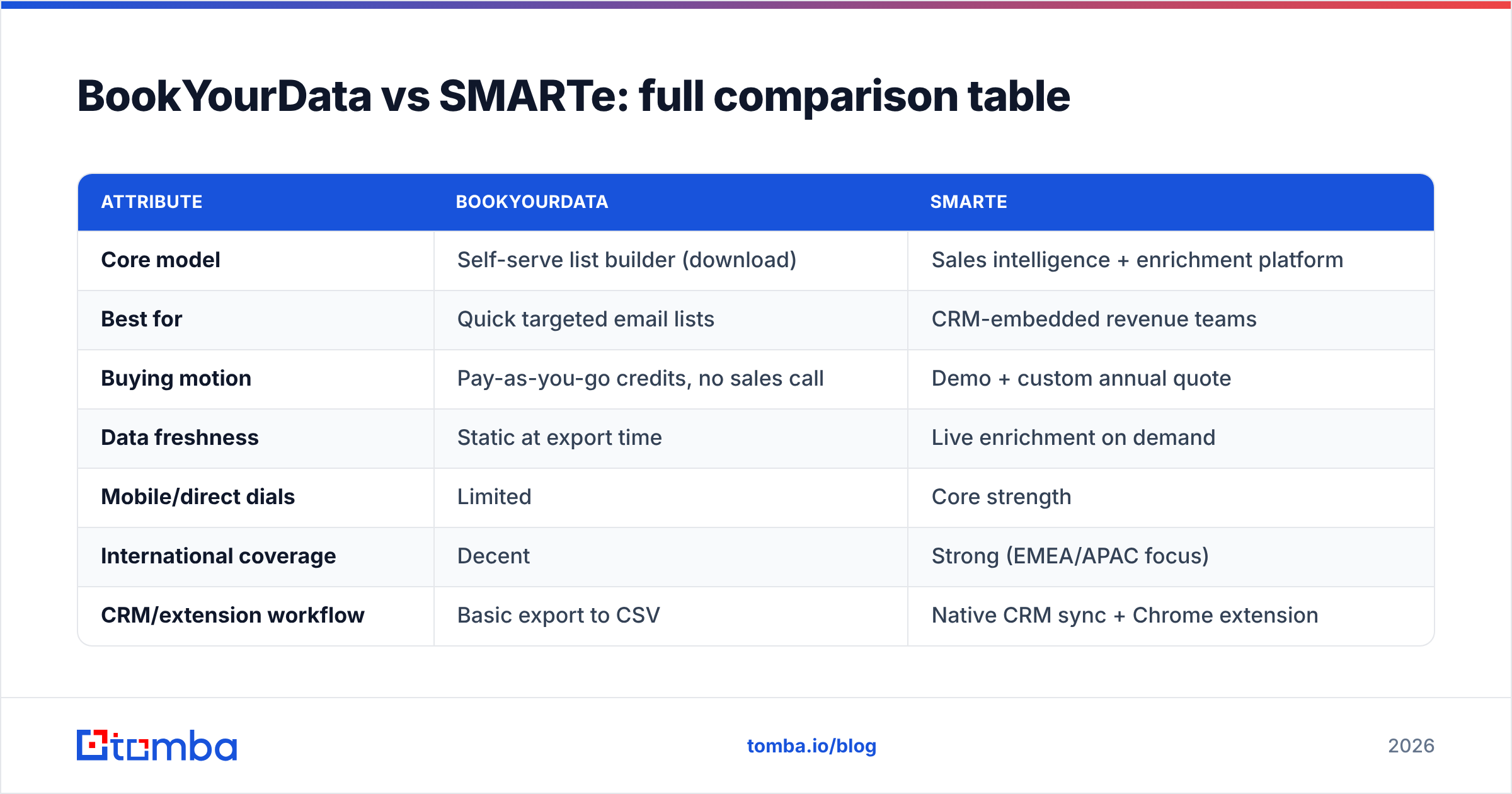
| Attribute | BookYourData | SMARTe |
|---|---|---|
| Core model | Self-serve list builder (download) | Sales intelligence + enrichment platform |
| Best for | Quick targeted email lists | CRM-embedded revenue teams |
| Buying motion | Pay-as-you-go credits, no sales call | Demo + custom annual quote |
| Data freshness | Static at export time | Live enrichment on demand |
| Mobile/direct dials | Limited | Core strength |
| International coverage | Decent | Strong (EMEA/APAC focus) |
| CRM/extension workflow | Basic export to CSV | Native CRM sync + Chrome extension |
| Compliance positioning | Standard | GDPR/CCPA-forward |
| Entry friction | Very low | Moderate to high |
| Email verification at send | Not built for it | Not built for it |
Is BookYourData or SMARTe more accurate?#
Accuracy depends less on the headline percentage and more on when the data was checked. This is where most buyers get burned.
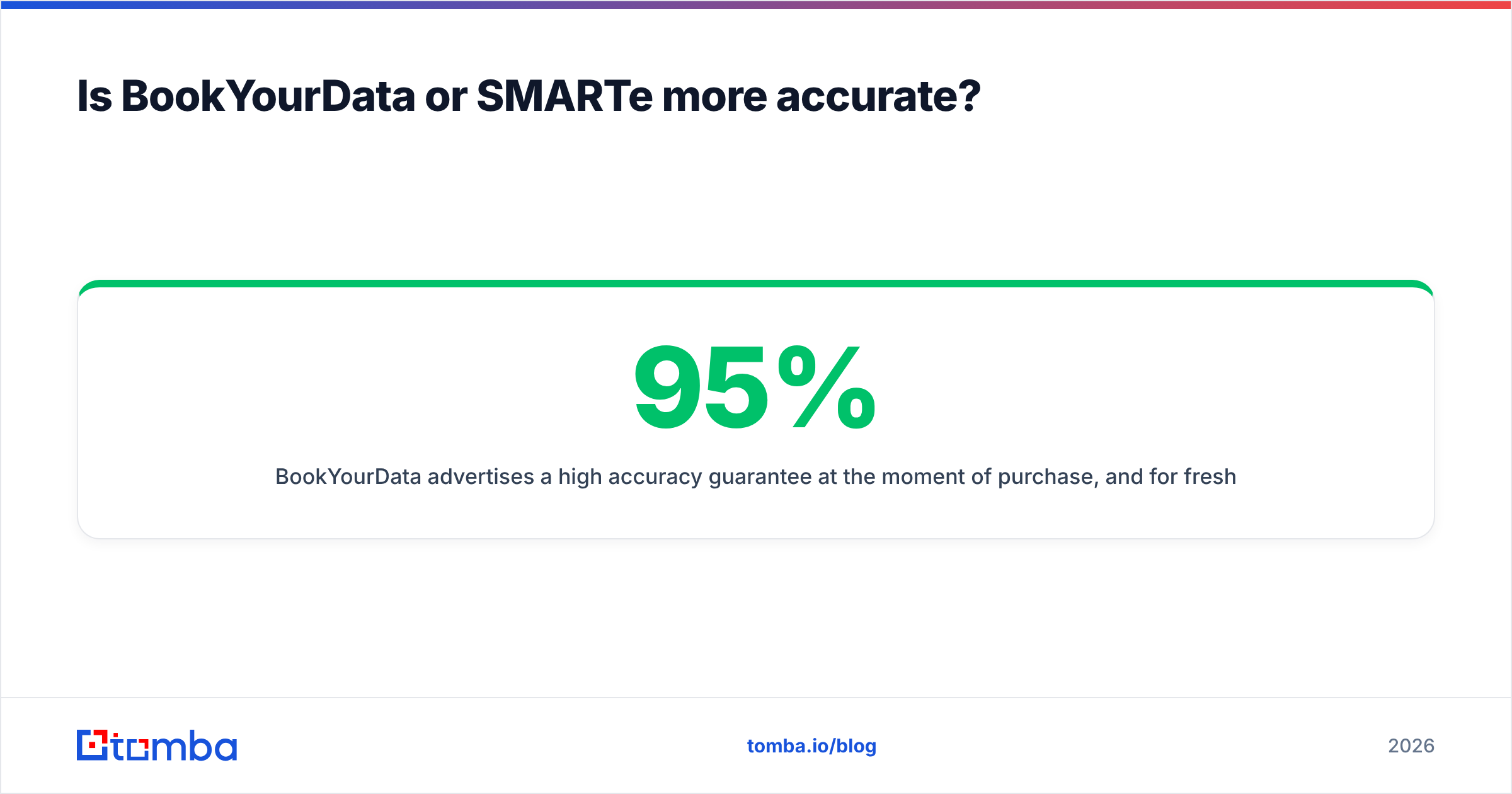
BookYourData advertises a high accuracy guarantee at the moment of purchase, and for fresh pulls that holds up reasonably well. But because you download and then send over the following weeks, your real-world accuracy is whatever's left after decay. A 95% list that sits two months can easily bounce 8–12% on send — and 12% hard bounces is the kind of number that quietly torches your domain reputation.
SMARTe's enrichment model fights decay better because records can be re-pulled and refreshed, but enrichment quality varies by region and seniority. Direct dials are a genuine strength; long-tail SMB emails outside its core geographies are weaker.
Here's the uncomfortable truth for both: a database tells you what it believes about a contact. It does not perform a fresh SMTP-level check against the mail server at the moment you're about to send. That last step — catch-all detection, MX validation, real-time syntax and deliverability scoring — is the job of a dedicated email verifier, not a list vendor.
So the honest ranking on accuracy is: fresh SMARTe enrichment ≥ fresh BookYourData export > either one a month later, and all of them benefit from a verification pass before the first email goes out.
How do BookYourData and SMARTe price their data?#
These two tools sit at opposite ends of the pricing spectrum, which is often the deciding factor.
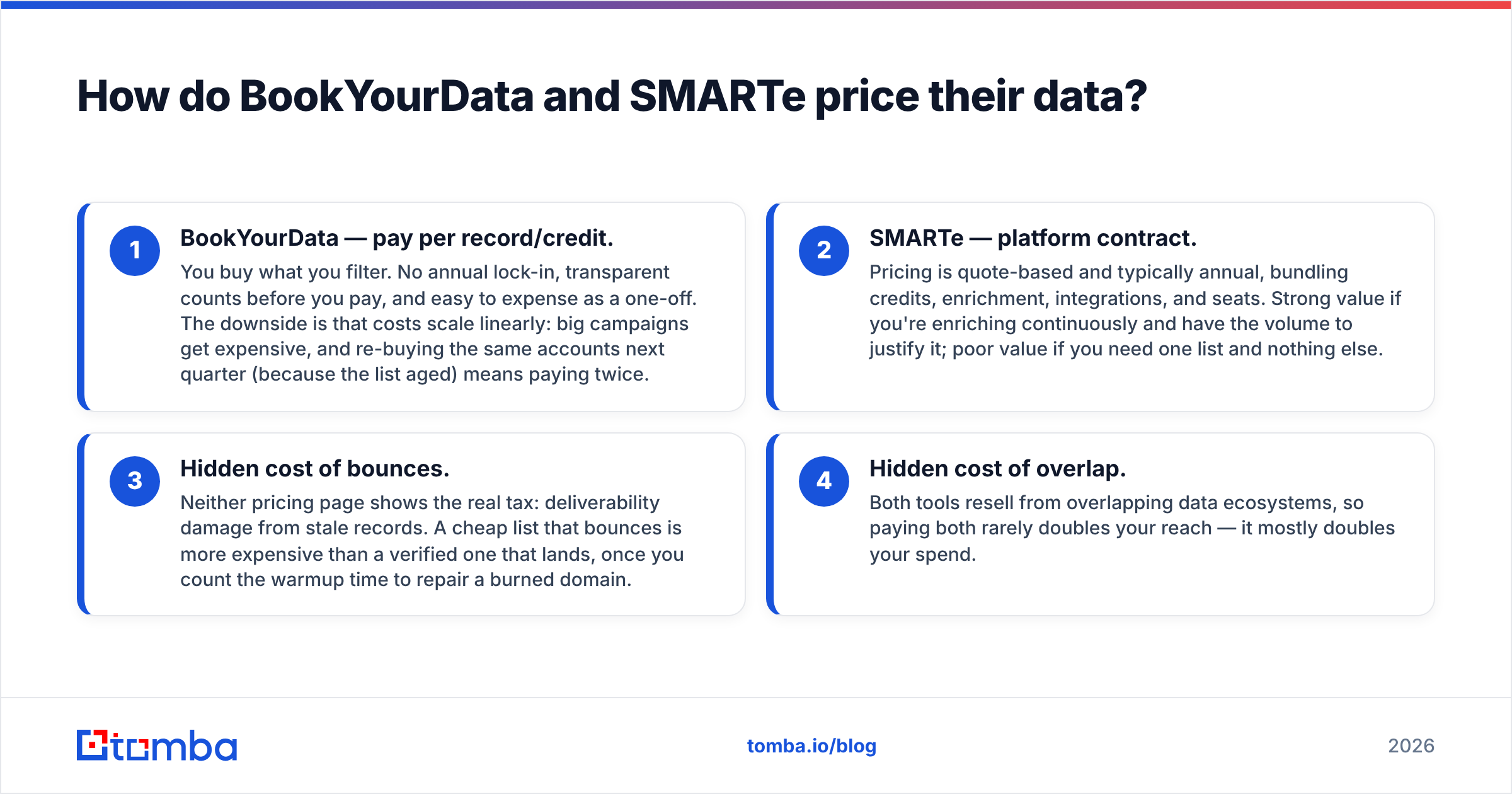
BookYourData — pay per record/credit. You buy what you filter. No annual lock-in, transparent counts before you pay, and easy to expense as a one-off. The downside is that costs scale linearly: big campaigns get expensive, and re-buying the same accounts next quarter (because the list aged) means paying twice.
SMARTe — platform contract. Pricing is quote-based and typically annual, bundling credits, enrichment, integrations, and seats. Strong value if you're enriching continuously and have the volume to justify it; poor value if you need one list and nothing else.
Hidden cost of bounces. Neither pricing page shows the real tax: deliverability damage from stale records. A cheap list that bounces is more expensive than a verified one that lands, once you count the warmup time to repair a burned domain.
Hidden cost of overlap. Both tools resell from overlapping data ecosystems, so paying both rarely doubles your reach — it mostly doubles your spend.
For reference on how a usage-based model can stay simple without an annual commitment, compare against transparent Tomba pricing, where a free tier (25 searches/mo) and a $49/mo Starter plan let you test accuracy before scaling.
Which one fits your outbound motion?#
Match the tool to how your team actually works, not to the feature list.
- Choose BookYourData if: you're a lean team or marketer who needs a specific, filterable email list right now, you want self-serve checkout, and you'll verify the list yourself before sending. It's the better "I just need the data and I'm gone" option.
- Choose SMARTe if: you're a funded revenue org running outbound inside a CRM, you need mobile numbers for cold calling, you sell into EMEA/APAC, and you want enrichment running continuously rather than a one-time pull.
- Choose a finder-first stack if: your bottleneck is reaching a verified inbox for specific people or companies you already identified — founders, hiring managers, named accounts — rather than buying broad lists.
That third path is where most teams under-invest. You often don't need 50,000 records; you need the right 500 emails, confirmed live, mapped to the companies on your target list. For that, a domain search that returns every public address at a company — plus the pattern behind them — beats scrolling a database UI.
Where does a dedicated email finder beat both?#
Both BookYourData and SMARTe are databases. A finder is a different tool with a different job: take a name and a domain (or just a domain) and return a verified, send-ready address on demand. The distinction matters most at the moment of truth — when your sequence fires.
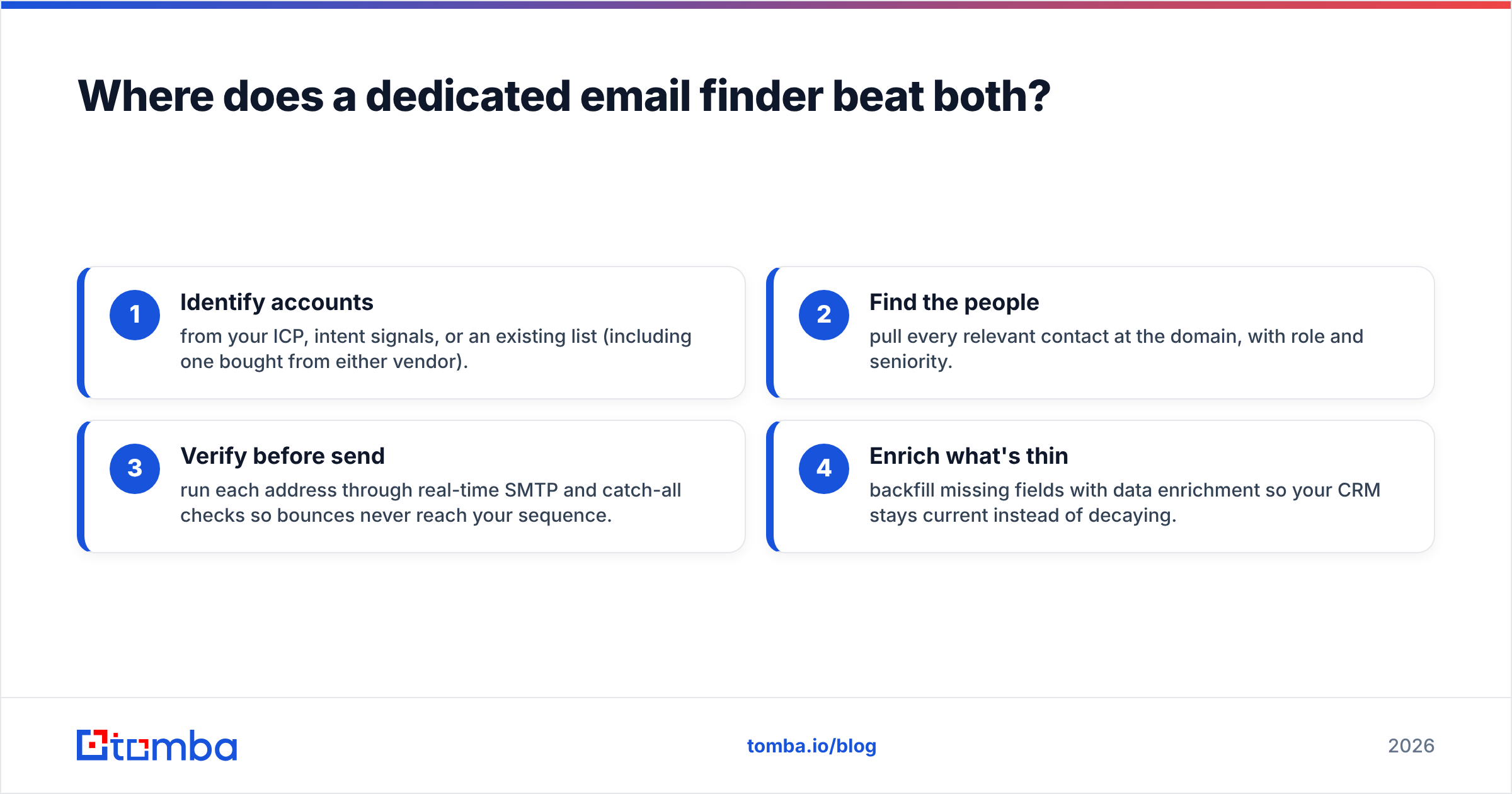
A finder-first workflow looks like this:
- Identify accounts from your ICP, intent signals, or an existing list (including one bought from either vendor).
- Find the people — pull every relevant contact at the domain, with role and seniority.
- Verify before send — run each address through real-time SMTP and catch-all checks so bounces never reach your sequence.
- Enrich what's thin — backfill missing fields with data enrichment so your CRM stays current instead of decaying.
This is the layer that turns "data you bought" into "emails that land." It's also why pairing a finder with either platform usually outperforms buying a bigger database tier. Independent reviews on G2 and Capterra repeatedly show the same pattern: buyers rate raw record volume highly until their first bounce-driven blacklisting, then rank verification and freshness above database size.
You can sanity-check vendor claims yourself: pull a sample from BookYourData or SMARTe, then re-verify that same sample with an independent verifier. The delta between the advertised accuracy and your verified accuracy is the number that should drive your decision — not the marketing percentage.
What about compliance and international data?#
If you sell into Europe or APAC, this section may outweigh everything above.
SMARTe markets GDPR/CCPA-aligned sourcing and has invested in international coverage, which gives it an edge for regulated, cross-border outbound. BookYourData provides global lists too, but the compliance burden lands more on you once a static file is in your hands — you own consent, suppression, and data hygiene from the moment you download.
Whichever you pick, the operational rule is the same: keep a live suppression list, re-verify before each major send, and never reuse a months-old export as if it were fresh. Verification isn't just a deliverability tactic; it's part of demonstrating you're emailing valid, current business contacts rather than blasting a decayed file.
BookYourData vs SMARTe: the verdict#
There's no single winner — there's a winner for your situation:
- Need a fast, self-serve, targeted list and you'll verify it yourself? BookYourData.
- Need CRM-embedded enrichment, mobile dials, and strong EMEA/APAC coverage with a platform contract? SMARTe.
- Need verified emails for specific people and accounts, on demand, with deliverability protected at send time? Neither alone — add a finder.
The mistake to avoid is treating a database as a deliverability tool. Both of these products are good at what they're built for, and neither is built to guarantee your message reaches a live inbox three weeks after purchase. That guarantee comes from finding and verifying at the moment you send.
Get verified emails without the list-decay tax#
If your real goal is reaching the right people at the right companies — not stockpiling records that age out — start with the Tomba Email Finder. Give it a name and domain (or just a domain) and get a verified, send-ready address back, with catch-all detection and SMTP checks built in so bounces never hit your sequence. Use the free tier (25 searches/mo) to benchmark it against your last BookYourData or SMARTe pull, then scale on a transparent $49/mo Starter plan when the accuracy convinces you. Buy fewer lists, send to more real inboxes, and keep your domain reputation intact.
// get started
Find, verify and enrich your first contacts today
Start on the free plan with 25 searches a month, then scale when your team is ready.
Free plan · No credit card required · GDPR & CCPA
// about the author