BookYourData vs SMTP Ghost: Data & Sending Compared 2026
BookYourData sells B2B contact lists; SMTP Ghost sends cold email at scale. Here's how the two actually compare in 2026 — and where a verified data layer fits.
BookYourData vs SMTP Ghost: What You're Actually Comparing
If you're weighing BookYourData vs SMTP Ghost, you're really comparing two different layers of the same cold outreach machine — not two versions of the same tool. One sells you contacts. The other sends to them. Picking "the winner" without understanding that split is how teams end up paying twice for half a workflow.
This guide breaks down what each tool does, where they overlap, what they cost in 2026, and how to assemble a stack that doesn't burn your sending domain on stale data.
TL;DR#
- BookYourData is a pay-as-you-go B2B contact database — you buy verified email lists by filtering job title, industry, location, and tech stack. It is a data source, not a sender.
- SMTP Ghost is a cold email sending and automation platform — multi-inbox rotation, warmup, and sequences. It is a sending engine, not a data source.
- They are complementary, not interchangeable: most teams need both a list and a sender, plus a verification step between them.
- The weak link in either path is data freshness. A purchased list decays ~2-3% per month; sending to it tanks deliverability fast.
- A real-time finder + verifier like Tomba Email Finder keeps the data layer current instead of shipping a one-time static CSV.
What is BookYourData?#
BookYourData is a self-serve B2B contact data platform. You build a list inside its filter UI — pick industries, seniority, departments, company size, geography, sometimes installed technologies — and it returns matching contacts you pay for per record. It advertises a high email accuracy guarantee and credits back bounces above the promised threshold.
The model is buy-the-list: you export a CSV (or push to a CRM) and own those records. There's no sending, no warmup, no sequencing. It's the gas station, not the car.
Where BookYourData fits well:
- One-time list builds — you need 5,000 marketing directors in fintech, today, without scraping.
- Pay-as-you-go budgets — no monthly seat commitment; you buy credits as campaigns demand.
- Filter-first prospecting — when your ICP is defined by firmographics more than by specific named accounts.
Its main limitation is the same as every static database: the moment you export, the data starts aging. People change jobs, companies rebrand domains, and catch-all servers mask whether an address is even real. That's why a separate email verifier step matters before anything hits a sequence.
)
What is SMTP Ghost?#
SMTP Ghost is a cold email sending platform built for volume outreach. Its core jobs are inbox rotation across many connected mailboxes, automated warmup to build sender reputation, sequence building with follow-ups, and reply detection. It belongs in the same category as Instantly or Smartlead — the deliverability-and-automation layer.
SMTP Ghost does not sell you contacts. You bring your own list (from a provider like BookYourData, a scraper, or a finder) and SMTP Ghost handles getting those messages into inboxes without torching your domain.
Where SMTP Ghost fits well:
- High-volume cold campaigns — spreading send load across dozens of inboxes to stay under per-mailbox limits.
- Deliverability-sensitive teams — built-in warmup and rotation are the whole point.
- Agencies running many clients — multi-workspace sending at scale.
Its limitation is the mirror image of BookYourData's: world-class sending infrastructure is worthless if you feed it a dirty list. Garbage in, spam folder out.
BookYourData vs SMTP Ghost: How do they compare head-to-head?#
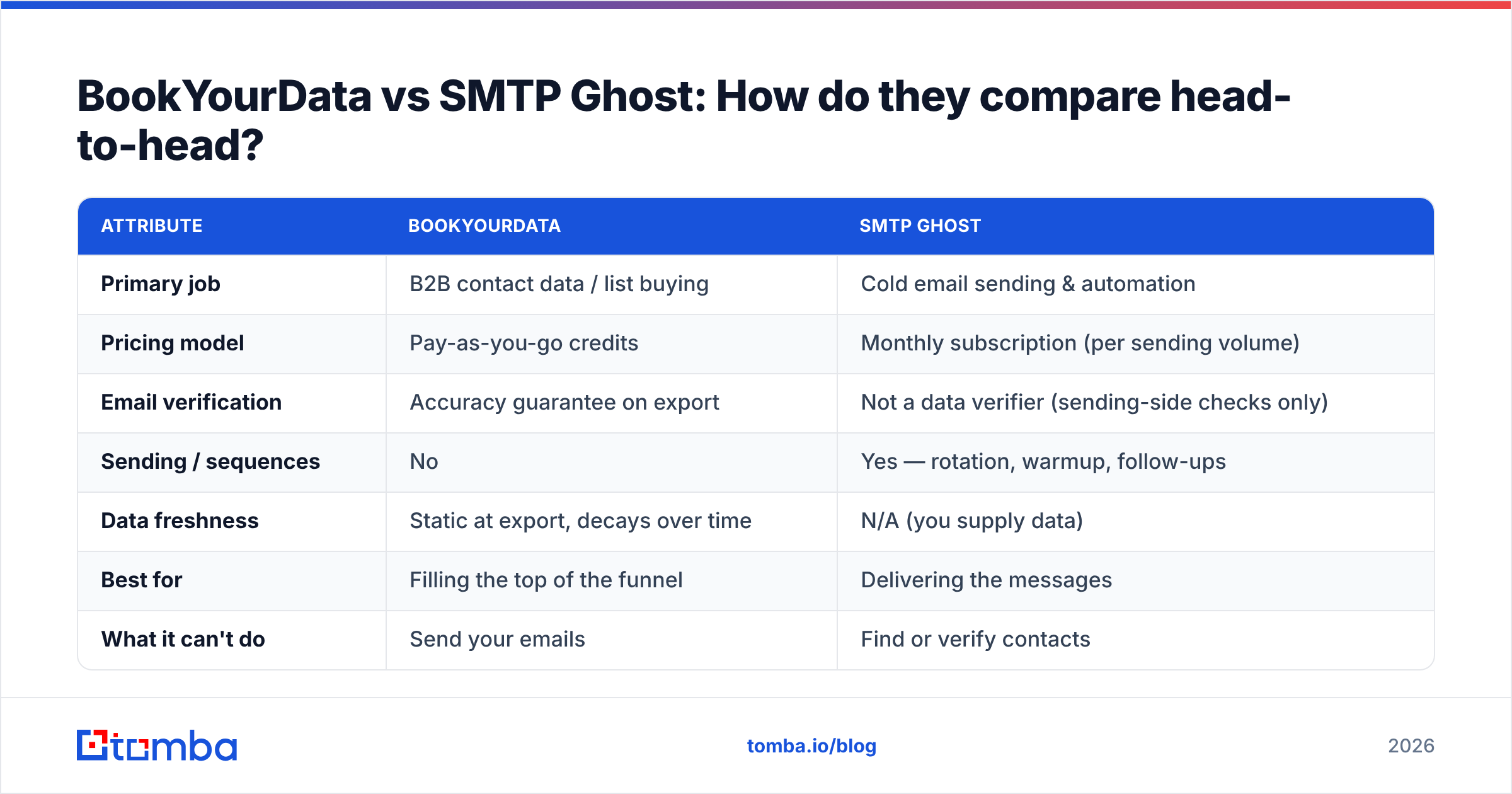
Because these tools sit at different stages, a feature table is less "who wins" and more "who does what." Here's the honest split:
| Attribute | BookYourData | SMTP Ghost |
|---|---|---|
| Primary job | B2B contact data / list buying | Cold email sending & automation |
| Pricing model | Pay-as-you-go credits | Monthly subscription (per sending volume) |
| Email verification | Accuracy guarantee on export | Not a data verifier (sending-side checks only) |
| Sending / sequences | No | Yes — rotation, warmup, follow-ups |
| Data freshness | Static at export, decays over time | N/A (you supply data) |
| Best for | Filling the top of the funnel | Delivering the messages |
| What it can't do | Send your emails | Find or verify contacts |
The takeaway: this is not an either/or decision. A working stack needs a data source, a verification gate, and a sender. BookYourData covers the first slot, SMTP Ghost covers the third, and the middle slot — verification and freshness — is where most campaigns quietly fail.
)
Which one do you actually need?#
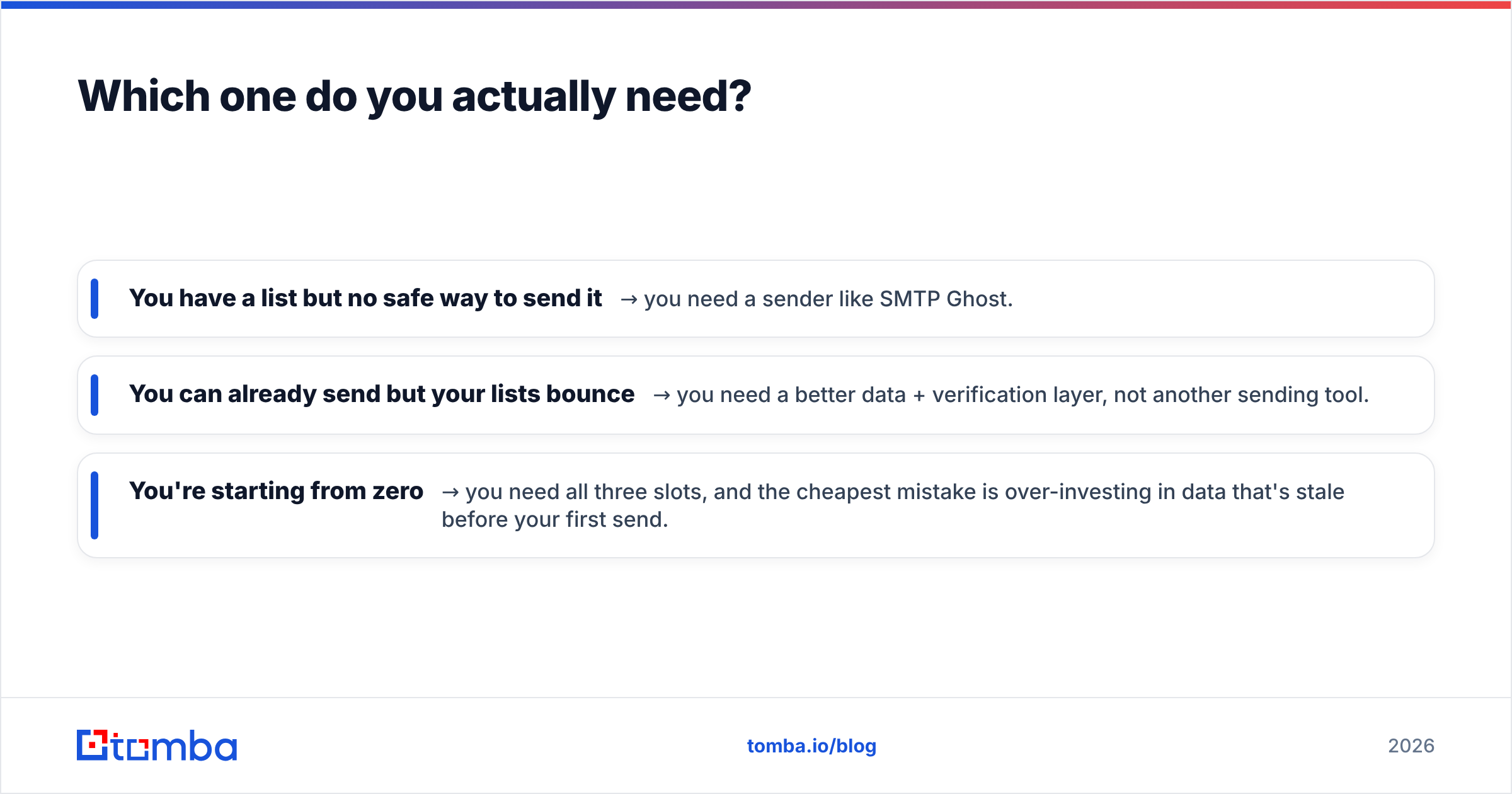
Conclusion first: if you only have budget for one, buy the layer you can't replicate cheaply. Sending infrastructure (SMTP Ghost) is hard to DIY safely — domain warmup and inbox rotation are genuinely specialized. Data, by contrast, has more flexible options, including real-time finders that beat static lists on freshness.
Use this quick decision frame:
- You have a list but no safe way to send it → you need a sender like SMTP Ghost.
- You can already send but your lists bounce → you need a better data + verification layer, not another sending tool.
- You're starting from zero → you need all three slots, and the cheapest mistake is over-investing in data that's stale before your first send.
For account-based or precise targeting, a static filtered list often misses the specific people you want. That's where building lists on demand with a domain search or pulling exact contacts with a finder outperforms a bulk export — you get the right person at the company, verified at the moment you need them.
What does BookYourData vs SMTP Ghost cost in 2026?#
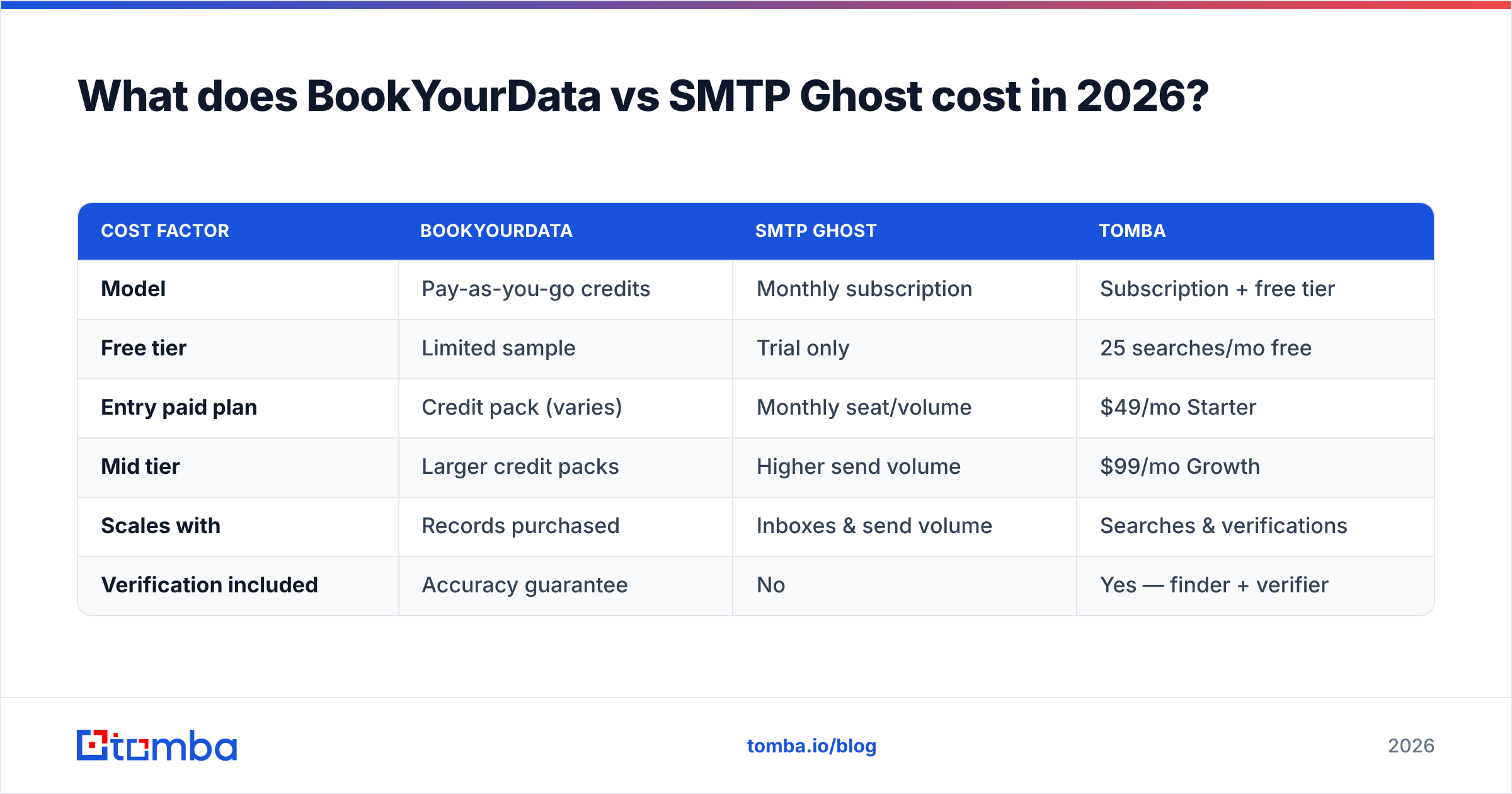
Pricing structures differ enough that a per-month comparison is misleading. BookYourData charges per record (credit packs), so cost scales with list size and tends to spike on big one-time pulls. SMTP Ghost charges a recurring subscription tied to sending volume and connected inboxes.
| Cost factor | BookYourData | SMTP Ghost | Tomba |
|---|---|---|---|
| Model | Pay-as-you-go credits | Monthly subscription | Subscription + free tier |
| Free tier | Limited sample | Trial only | 25 searches/mo free |
| Entry paid plan | Credit pack (varies) | Monthly seat/volume | $49/mo Starter |
| Mid tier | Larger credit packs | Higher send volume | $99/mo Growth |
| Scales with | Records purchased | Inboxes & send volume | Searches & verifications |
| Verification included | Accuracy guarantee | No | Yes — finder + verifier |
A few honest notes:
- Pay-as-you-go (BookYourData) is great for unpredictable, bursty list needs and bad for steady monthly prospecting, where credits add up fast.
- Subscription sending (SMTP Ghost) is predictable but you pay whether or not your lists are any good.
- A finder-plus-verifier model — see full Tomba pricing — bundles the data and the cleaning into one predictable line item, with a genuine free tier (25 searches/month) to test accuracy before committing.
Where does data accuracy break the whole stack?#
Here's the part both tool categories gloss over: deliverability is a data problem before it's a sending problem. You can run perfect warmup on SMTP Ghost and still land in spam if 8% of a BookYourData export bounces, because mailbox providers read high bounce rates as a spammer signal.
The decay math is unforgiving. B2B contact data goes stale at roughly 2-3% per month as people switch jobs and companies change domains. A list you bought in January is meaningfully worse by April. Static lists don't refresh themselves.
Three guardrails keep a stack healthy:
- Verify every list before it sends — even a guaranteed list should pass through a bulk email verifier so catch-all and risky addresses get flagged.
- Prefer real-time over static where you can — finding and verifying a contact at send time beats trusting a months-old export.
- Enrich, don't just collect — pairing addresses with current role and company data via data enrichment cuts the "wrong person" bounce that no warmup can fix.
This is exactly why the BookYourData-vs-SMTP-Ghost framing is incomplete. The decision that actually moves your reply rate is what sits between the list and the sender.
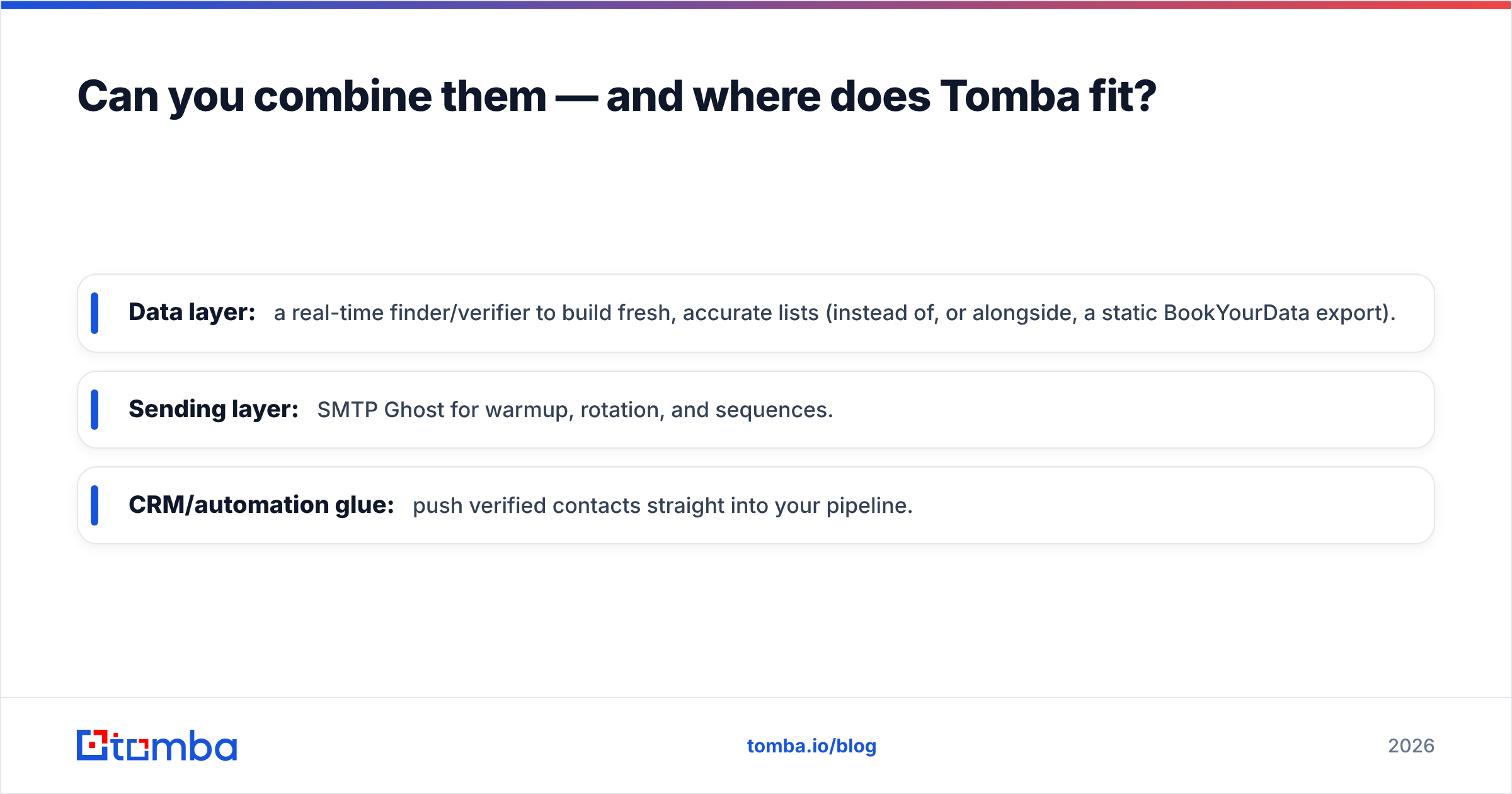
Can you combine them — and where does Tomba fit?#
Yes, and the strongest stacks do exactly that. A common 2026 setup looks like:
- Data layer: a real-time finder/verifier to build fresh, accurate lists (instead of, or alongside, a static BookYourData export).
- Sending layer: SMTP Ghost for warmup, rotation, and sequences.
- CRM/automation glue: push verified contacts straight into your pipeline.
Tomba slots into the data layer. Instead of a static CSV that ages from day one, you find professional emails by domain, name, or company and verify them on the spot, then sync via the Tomba API or native integrations into whatever sender you run. The result is fewer bounces hitting SMTP Ghost, a cleaner sender reputation, and lists that reflect reality the day you send — not the day you bought them.
If your current pain is "BookYourData lists bounce too much" or "SMTP Ghost delivers fine but replies are low," the fix is almost always the data layer, not another sending tool.
Verdict: BookYourData vs SMTP Ghost#
There's no single winner because they're not competing for the same job:
- Choose BookYourData when you need a fast, filterable, pay-as-you-go list and accept that you'll verify and refresh it yourself.
- Choose SMTP Ghost when you have lists to send and need safe, high-volume delivery with warmup and rotation.
- Add a real-time data layer either way — it's the difference between sending infrastructure that performs and one that quietly drifts into spam.
For independent perspective on both categories, check user reviews on G2 and compare BookYourData's own claims on bookyourdata.com before you commit credits. And if deliverability is the goal, HubSpot's research on email engagement is a useful reminder that list quality, not volume, drives replies.
Start with a data layer that doesn't go stale#
Whatever you decide on the sending side, your campaigns live or die on the freshness of your contacts. Skip the months-old static export and build verified, current lists on demand with the Tomba Email Finder — find professional emails by domain, name, or company, verify them before they ever reach SMTP Ghost, and start free with 25 searches a month. Feed your sender clean data, and let your warmup do what it's actually good at.
// get started
Find, verify and enrich your first contacts today
Start on the free plan with 25 searches a month, then scale when your team is ready.
Free plan · No credit card required · GDPR & CCPA
// about the author