Bookyourdata vs Snappy Leads: B2B Data Compared (2026)
Bookyourdata vs Snappy Leads, broken down on accuracy, pricing, verification, and fit. See which B2B data tool actually fills your pipeline in 2026 — and where a finder beats a list.
Choosing between Bookyourdata and Snappy Leads usually comes down to one question: do you want a pay-as-you-go contact list, or a tool that keeps feeding your pipeline as it changes? Both promise B2B emails and direct dials. They get there very differently, and the gap shows up the moment your reps start emailing.
TL;DR#
- Bookyourdata sells pay-as-you-go B2B contact lists with a 97% accuracy claim and a credit model that never expires — strong for one-off list pulls.
- Snappy Leads leans on a Chrome-extension workflow to pull emails and phone numbers from LinkedIn and company pages, aimed at reps prospecting in real time.
- Neither is built primarily as a live email finder with verification baked into every lookup — that is where a tool like Tomba changes the math.
- If you buy a static list, expect 20–30% decay per year; if you scrape one contact at a time, expect inconsistent coverage.
- Pick by workflow: bulk list buyer, live prospector, or API-driven enrichment. The right answer is rarely "just one CSV."
What are Bookyourdata and Snappy Leads?#
Bookyourdata is a B2B contact database you buy from. You filter by industry, title, location, and company size, preview the count, then spend credits to unlock records. Its headline pitch is a 97% accuracy guarantee and credits that don't expire, so a list you buy today can sit in your account until you need it. You can read their own positioning on the Bookyourdata homepage.
Snappy Leads is a lighter, prospecting-first tool. Its core surface is a browser extension that reveals work emails and phone numbers while you browse LinkedIn profiles or company sites. The idea is speed: a rep finds a person, clicks, and drops the contact straight into a sequence or CRM without leaving the page.
The difference in philosophy matters more than any single feature. Bookyourdata is a list product — you pull data in batches. Snappy Leads is a moment-of-need product — you grab one contact at a time. Each is good at its own job and frustrating when you force it into the other role.

How accurate is the data, really?#
Accuracy is the whole game, so treat vendor numbers skeptically. Bookyourdata's 97% figure refers to deliverability at the time the record is verified — not a guarantee that the contact still works there next quarter. B2B data decays fast: people change jobs, companies rebrand, and domains migrate. Industry estimates put email list decay around 22–30% per year, which means a "97% accurate" list can drift well below 80% within months if you don't re-verify.
Snappy Leads sidesteps part of that problem by pulling data at the moment you need it, so the record is fresh when captured. The trade-off is coverage: extension-based capture depends on what is visible on the page and what the underlying database holds for that specific person. You will hit profiles where it returns nothing, or returns a personal Gmail instead of the work address you actually want.
This is the core reason serious outbound teams pair any list with a real-time email verifier. Buying or scraping is step one; confirming the mailbox still accepts mail is step two, and skipping it is how sender reputation gets wrecked. A high bounce rate signals spam filters faster than almost anything else.
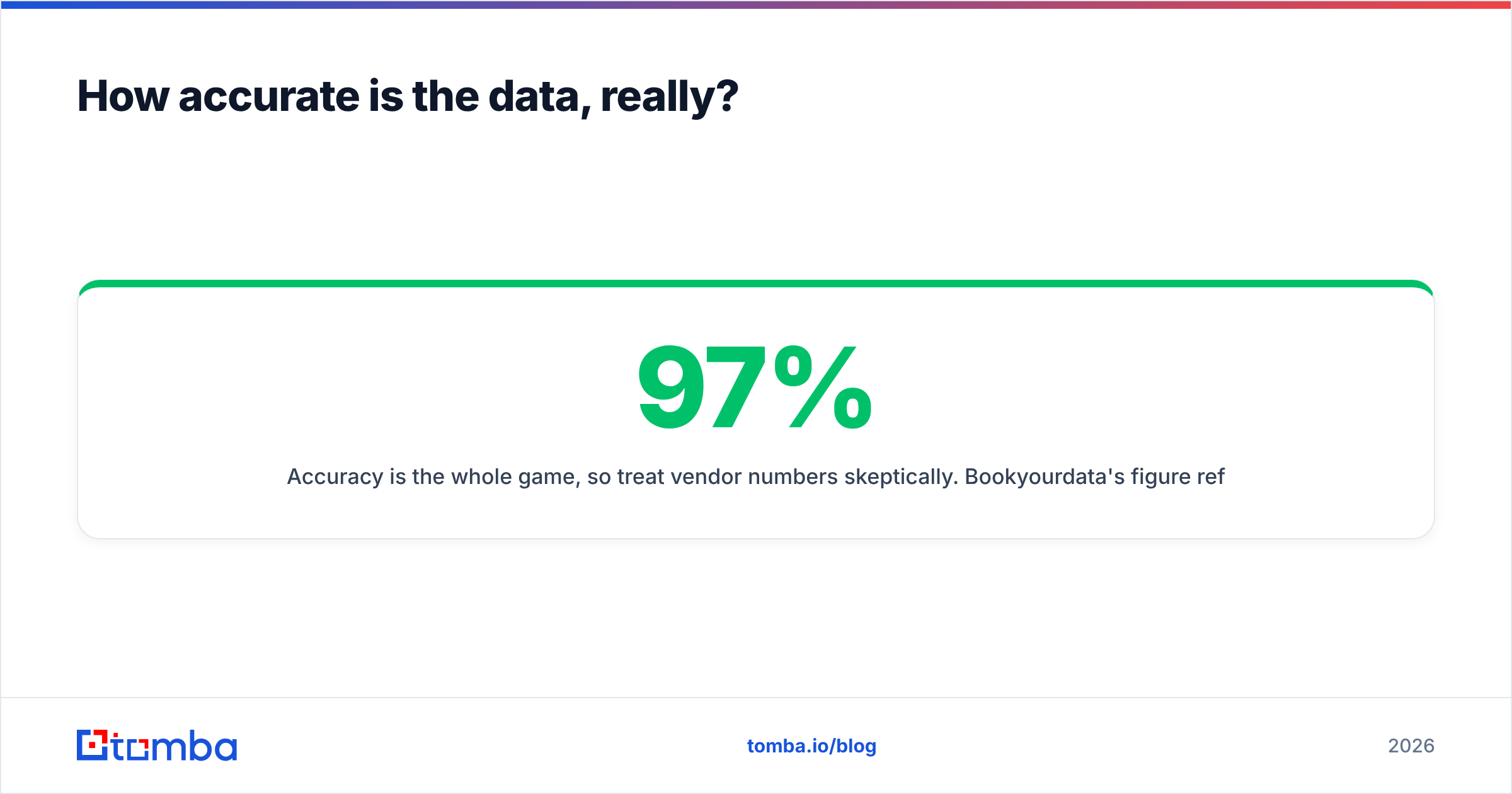
Bookyourdata vs Snappy Leads: side-by-side comparison#
Here is the practical breakdown. Pricing and limits shift, so confirm current terms on each vendor's site and on review platforms like G2 before you commit budget.
| Attribute | Bookyourdata | Snappy Leads | Tomba |
|---|---|---|---|
| Primary model | Pay-as-you-go list buying | Chrome extension capture | Email finder + verifier (API + UI) |
| Best for | Bulk targeted lists | Live LinkedIn prospecting | On-demand finding at scale |
| Accuracy claim | ~97% at verification | Fresh-at-capture, variable coverage | Verified per lookup, sources shown |
| Credits | Never expire | Subscription-based | Plan credits, monthly |
| Verification built in | Add-on / at export | Limited | Yes, every result |
| Bulk processing | Yes (list export) | Manual, per profile | Yes (bulk + API) |
| API access | Limited | Limited | Full REST API |
| Free tier | Sample credits | Trial | 25 searches/mo free |
| Entry price | Per-credit packs | Subscription | $49/mo Starter |
A few takeaways. Bookyourdata wins on never-expiring credits if you buy infrequently. Snappy Leads wins on speed inside the browser for reps who live on LinkedIn. Neither was architected as a developer-friendly finder with verification on every call — which is the lane Tomba sits in.
)
Which pricing model fits your team?#
Pricing is where the two tools diverge most, and where buyers get surprised.
Bookyourdata — credit packs that don't expire. You pay per record, buy in bulk for a lower per-unit cost, and the credits sit in your account indefinitely. Great if your buying is bursty: a campaign every quarter, an event list, a one-time ICP pull. The risk is that "never expires" tempts you to hoard data that decays while it waits.
Snappy Leads — subscription seats. You pay monthly for access and a capture allowance. Predictable for a team that prospects daily, wasteful if half your seats prospect twice a month.
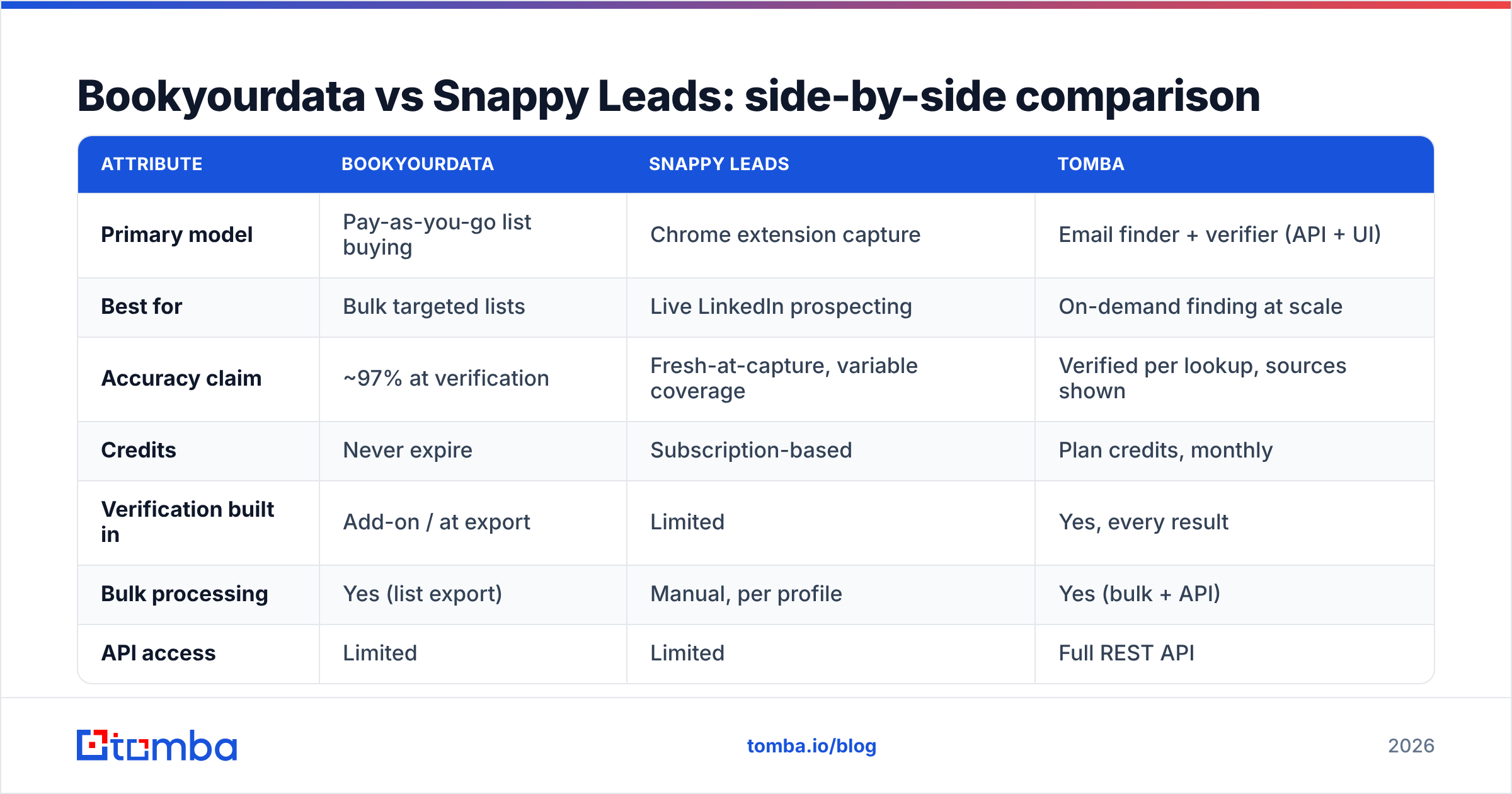
Tomba — transparent monthly tiers with a real free plan. The Tomba pricing ladder runs Free (25 searches/mo), Starter $49/mo, Growth $99/mo, Pro $249/mo, and Enterprise custom. Every paid tier includes finding and verification, plus API access, so you are not bolting on a second tool to clean what the first one gave you.
The honest framing: a never-expiring credit balance sounds like savings, but stale data is a hidden cost. Re-verification, bounce handling, and damaged domain reputation all eat into whatever you saved by buying once. Recurring, verified access usually beats a discount on data that ages in storage.
Is a static list or a live finder better for outbound?#
Short answer: for active outbound, a live finder beats a static list almost every time.
A purchased list is a snapshot. The day you export it, the clock starts. By the time your sequence finishes, a meaningful slice of those mailboxes have moved or gone dark. You can mitigate this by re-verifying before each send, but at that point you are doing the finder's job manually.
A live finder flips the order: you confirm the email exists and accepts mail at the moment you reach out. That is the difference between finding email addresses on demand and renting a list that quietly rots. For teams running continuous campaigns, the finder model keeps deliverability healthy because every send starts from a fresh, verified record.
There is also the catch-all problem. Many B2B domains accept any address, so a naive verifier marks them "valid" when they may not be. A real workflow needs catch-all handling, not just a green checkmark — something generic list exports rarely provide.
Where does each tool break down?#
Bookyourdata limitations. The pay-as-you-go model rewards bulk buying, which encourages large pulls you may never fully work. Filtering is solid but the data is only as fresh as the last verification pass, and re-verification of an old list is on you. Reviewers on Capterra and similar platforms frequently flag the gap between purchase-time accuracy and real-world deliverability weeks later — a normal trait of any list vendor, not a unique flaw.
Snappy Leads limitations. Extension-first tools shine for one-off captures and stall on volume. You cannot realistically prospect 5,000 accounts by clicking profiles by hand. Coverage is uneven across regions and seniority levels, and there is no robust bulk or API path for engineering teams that want to enrich records programmatically.
The shared gap. Neither tool is designed as an end-to-end finder-plus-verifier with a documented API. If your motion is "enrich this list of 10,000 domains overnight and verify each result," you will be stitching together exports, spreadsheets, and a separate verification tool. That glue work is exactly what a purpose-built finder removes.
How does Tomba compare as an alternative?#
Tomba approaches the same problem — get me a correct, reachable B2B email — from the finder-and-verifier angle rather than the list angle.
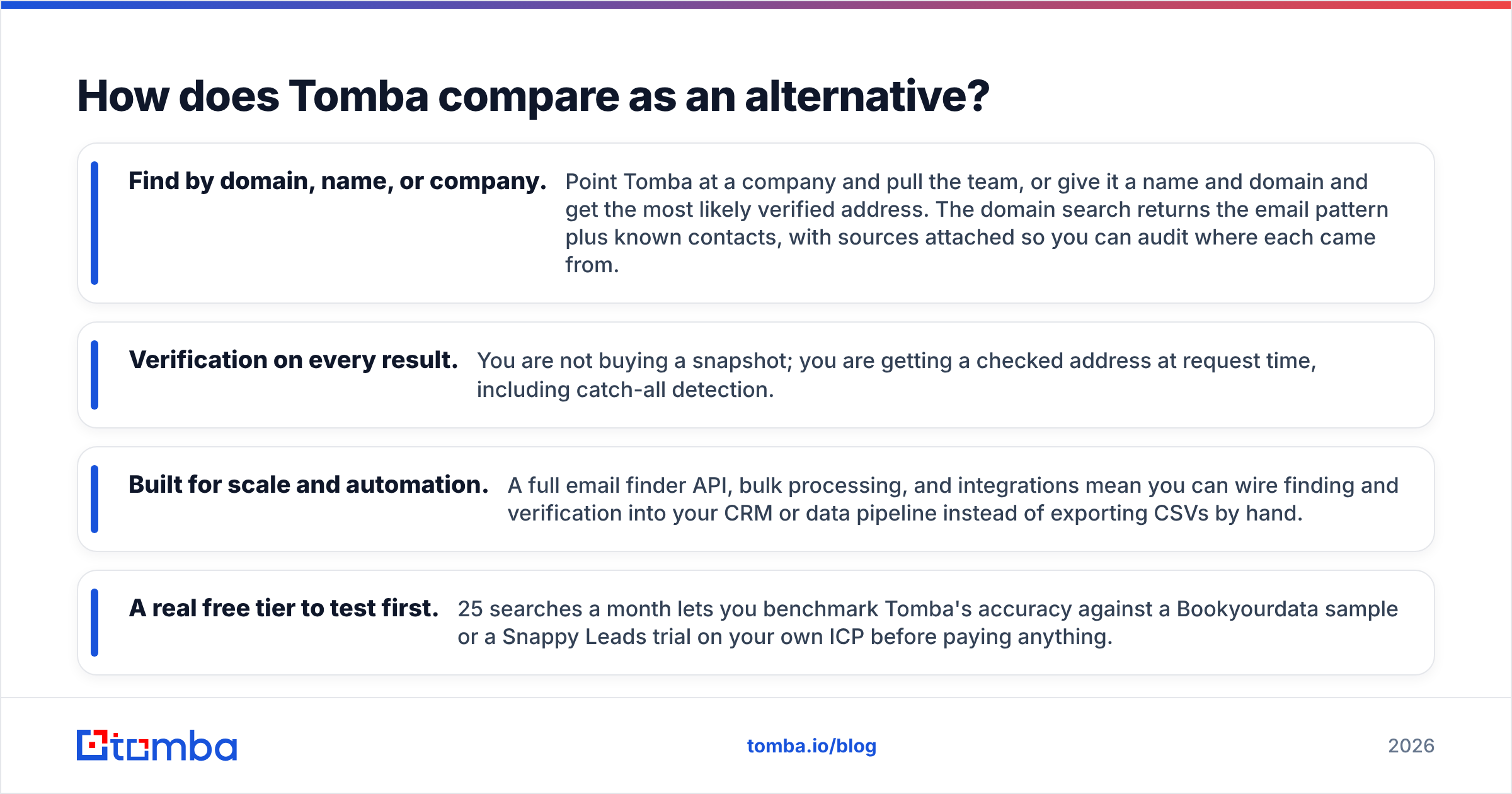
- Find by domain, name, or company. Point Tomba at a company and pull the team, or give it a name and domain and get the most likely verified address. The domain search returns the email pattern plus known contacts, with sources attached so you can audit where each came from.
- Verification on every result. You are not buying a snapshot; you are getting a checked address at request time, including catch-all detection.
- Built for scale and automation. A full email finder API, bulk processing, and integrations mean you can wire finding and verification into your CRM or data pipeline instead of exporting CSVs by hand.
- A real free tier to test first. 25 searches a month lets you benchmark Tomba's accuracy against a Bookyourdata sample or a Snappy Leads trial on your own ICP before paying anything.
The point is not that lists are useless — Bookyourdata is genuinely good at targeted bulk pulls, and Snappy Leads is quick for browser prospecting. It is that most outbound teams need fresh, verified, automatable data, and a finder delivers that as a continuous service rather than a one-time file.
Which should you choose in 2026?#
Match the tool to your motion, not to the marketing:
- Buy Bookyourdata if you need infrequent, large, tightly filtered lists and value credits that never expire — and you are disciplined about re-verifying before you send.
- Use Snappy Leads if your reps prospect inside LinkedIn all day and want one-click capture more than they want bulk volume or an API.
- Use Tomba if you want one system that finds and verifies on demand, scales to bulk and API workflows, and gives you a free tier to prove accuracy before committing. It is the most natural fit when deliverability and automation matter more than owning a static file.
A practical hybrid many teams land on: pull a targeted seed list from a database vendor, then run every record through a finder-grade verifier before the first send. That combination — good targeting plus fresh verification — beats trusting any single snapshot.
The bottom line#
Bookyourdata and Snappy Leads solve real but narrow problems: bulk list buying and in-browser capture. Both leave you holding the verification and automation work that determines whether your campaigns actually land. If you would rather start from data that is found and confirmed at the moment you need it — and wire it into your stack through an API — try the Tomba Email Finder free. Run 25 searches against your own target accounts, compare the hit rate to any list you currently buy, and let deliverability make the decision for you.
// get started
Find, verify and enrich your first contacts today
Start on the free plan with 25 searches a month, then scale when your team is ready.
Free plan · No credit card required · GDPR & CCPA
Get the Tomba newsletter
Product and data updates
// about the author