Bookyourdata vs Spherescout: Which B2B Data Wins in 2026?
Bookyourdata sells static prepaid lists; Spherescout pushes real-time scraping. We compare accuracy, pricing, and compliance to show which B2B data source actually fits your outbound in 2026.
Choosing a B2B data vendor usually comes down to a single quiet question: do you trust the records you just paid for? Bookyourdata and Spherescout answer that question in opposite ways. One sells you a prepaid, pre-built list you download today. The other promises live, scraped-on-demand contacts that are "fresh" the moment you query. Both can fill a CRM. Only one fits how your team actually prospects.
This guide breaks down both tools on accuracy, pricing, compliance, and real workflows — then shows where a verification-first option like Tomba lands against them.
TL;DR — Bookyourdata vs Spherescout at a glance#
- Bookyourdata is a prepaid, pay-as-you-go email list marketplace. You filter by industry, title, and geography, then download a static CSV. Good for one-off blasts, weaker for ongoing outbound because lists decay fast.
- Spherescout leans on real-time scraping and enrichment. Records feel fresher, but coverage is uneven, pricing is opaque, and you carry more compliance risk on scraped data.
- Accuracy is the real battleground: static lists rot at roughly 22–30% per year, while scraped data is only as good as its last crawl and verification step.
- Neither tool verifies aggressively by default. If you skip a dedicated email verifier, bounce rates eat your sender reputation regardless of which vendor you pick.
- Best-value play: pair a precise email finder with verification on every send instead of buying decaying bulk lists.
What is Bookyourdata?#
Bookyourdata is a self-service B2B contact database built around prepaid credits. You log in, apply filters — job title, industry, company size, location, technology — and the platform shows a count of matching contacts. You buy the credits, download the list, and the data is yours to keep. There's no subscription lock-in, which is the main reason marketers like it for a quick campaign.
The catch is structural. A downloaded CSV is a snapshot. The day you export it, the data starts aging: people change jobs, companies rebrand, and inboxes get retired. Bookyourdata advertises a high accuracy guarantee at the moment of export, but that guarantee says nothing about week six of your sequence. For a single, time-boxed event invite, that's fine. For a quarter-long outbound motion, you're emailing ghosts.

Where Bookyourdata genuinely shines is transparency on volume. You see the count before you pay, you pay only for what you take, and you avoid annual contracts. For agencies juggling many client campaigns with unpredictable demand, that pay-as-you-go model is honest and easy to budget.
What is Spherescout?#
Spherescout positions itself as the "fresh data" answer to static list vendors. Instead of selling you a pre-built database, it scrapes and enriches contact records closer to the moment you request them. The pitch is intuitive: if the data is gathered now, it should be more current than a list assembled months ago.
In practice, real-time scraping trades one problem for another. Freshness improves, but coverage becomes inconsistent — niche industries, smaller companies, and non-US regions often return thin results. And scraped data raises the compliance stakes. When a record's provenance is "we crawled it," your legal basis under GDPR and CCPA gets murkier than when data comes from disclosed, opt-in, or publicly professional sources. Spherescout also tends to keep pricing behind a sales conversation, which makes quick comparison harder for smaller teams.

Bookyourdata vs Spherescout: the core comparison#
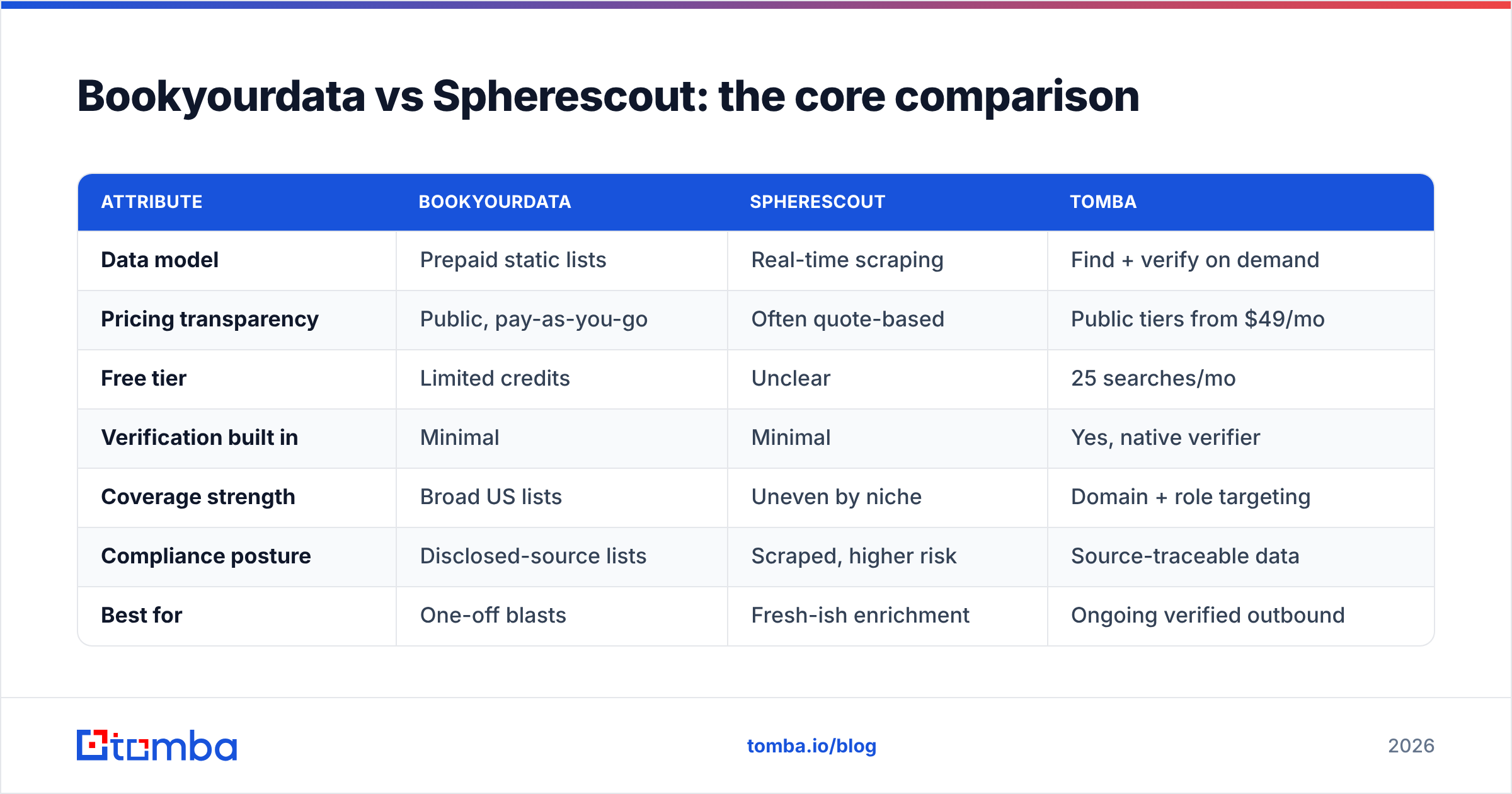
Here's the head-to-head on the attributes that actually change your results. Treat the figures as representative of each model's typical behavior rather than a contractual promise from either vendor.
| Attribute | Bookyourdata | Spherescout | Tomba |
|---|---|---|---|
| Data model | Prepaid static lists | Real-time scraping | Find + verify on demand |
| Pricing transparency | Public, pay-as-you-go | Often quote-based | Public tiers from $49/mo |
| Free tier | Limited credits | Unclear | 25 searches/mo |
| Verification built in | Minimal | Minimal | Yes, native verifier |
| Coverage strength | Broad US lists | Uneven by niche | Domain + role targeting |
| Compliance posture | Disclosed-source lists | Scraped, higher risk | Source-traceable data |
| Best for | One-off blasts | Fresh-ish enrichment | Ongoing verified outbound |
A few things stand out. Bookyourdata wins on pricing clarity and ease of a single purchase. Spherescout wins on perceived freshness but loses on transparency and compliance comfort. Both share the same weakness: verification is an afterthought, so the burden of clean sends falls on you.
Which has more accurate B2B data?#
Accuracy depends less on the vendor's headline number and more on when you use the data. A static list from Bookyourdata can be 95% accurate the day you export it and 70% accurate ninety days later — that's just email decay math, not a knock on their sourcing. Spherescout's scraped records start fresher, but a crawl that didn't actually verify deliverability can return plausible-looking addresses that still bounce.
The decisive factor in both cases is the same: did anyone confirm the mailbox accepts mail before you hit send? Scraping a pattern like first.last@company.com is easy. Confirming it resolves, isn't a catch-all, and isn't a spam trap is the hard part — and it's the part that protects your sender reputation.
This is why a finder-plus-verifier workflow consistently beats buying raw lists. You target a specific company with domain search, find the exact role you need, and verify the address in the same pass. You're not inheriting someone else's six-month-old snapshot.

How does pricing compare?#
Pricing philosophy splits these two cleanly. Bookyourdata is prepaid and visible — you know the per-record cost before you commit. Spherescout typically routes you through sales, which suits enterprise procurement but frustrates a founder who just wants to test 200 leads this week.
The hidden cost in both models is waste. If 25% of a purchased list is undeliverable, your effective cost per usable contact is a third higher than the sticker price — and that's before counting the deliverability damage from bouncing those addresses. A subscription that bundles finding and verification often ends up cheaper per usable lead, even when the headline price looks similar.
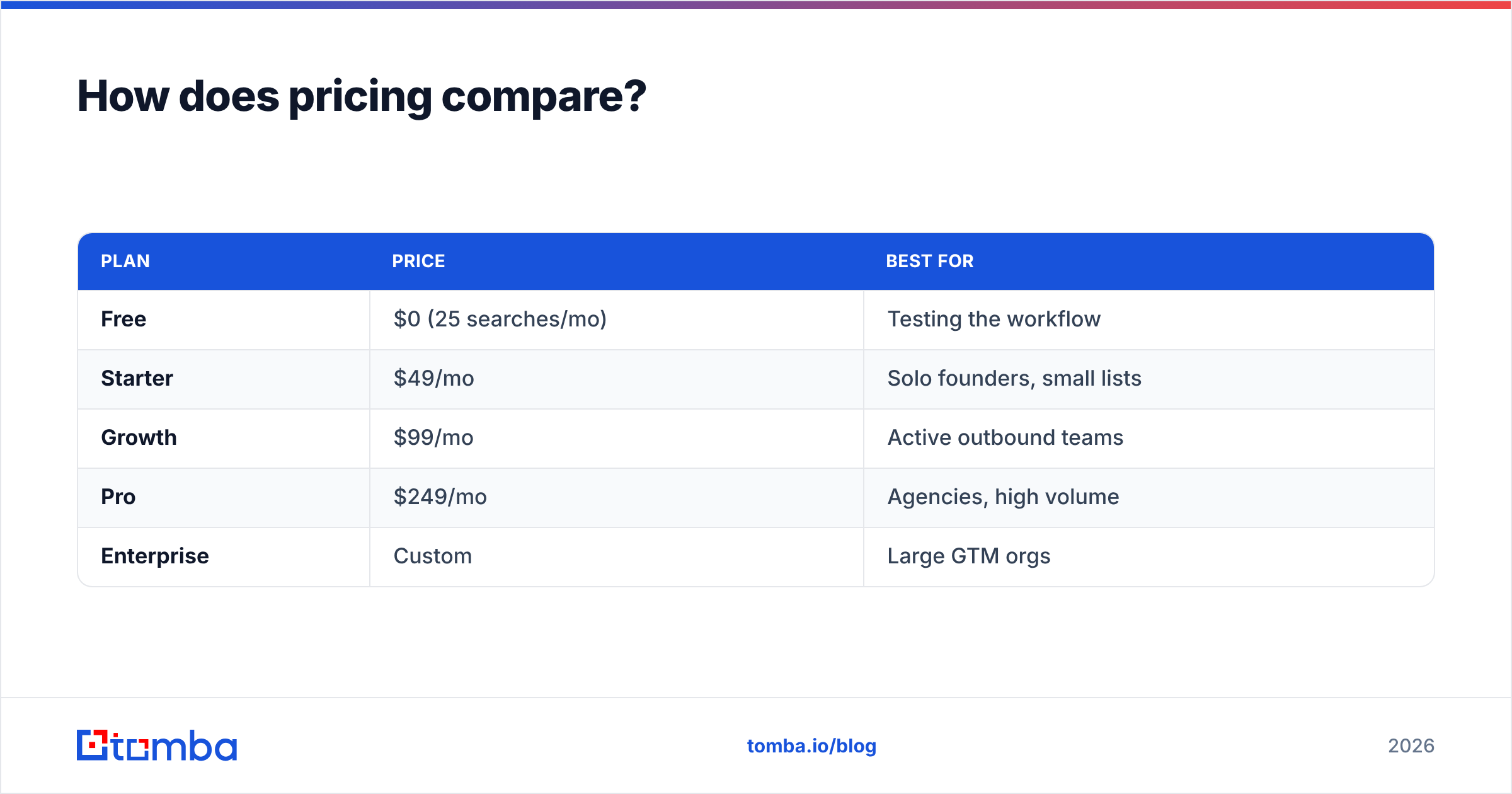
For reference, here's how a transparent verified-data model is structured. You can see the full Tomba pricing breakdown, but the shape matters more than the exact dollars:
| Plan | Price | Best for |
|---|---|---|
| Free | $0 (25 searches/mo) | Testing the workflow |
| Starter | $49/mo | Solo founders, small lists |
| Growth | $99/mo | Active outbound teams |
| Pro | $249/mo | Agencies, high volume |
| Enterprise | Custom | Large GTM orgs |
The point isn't that one number beats another. It's that you can compare it at all — without a sales call — and that verification is included rather than billed as a separate fix for the bounces you'll inevitably hit.

What about compliance and data sourcing?#
Compliance is where the scraping-versus-disclosed debate gets real. Under GDPR and CCPA, you need a defensible answer to "where did this contact come from and what's your legal basis for emailing them?" Disclosed-source and publicly professional data gives you a cleaner story than "we scraped it from wherever."
- Bookyourdata sources from compiled and disclosed lists, which generally gives a more documentable provenance — though you still own the responsibility to honor opt-outs.
- Spherescout's real-time scraping makes freshness its selling point but provenance its liability. Scraped personal data with no opt-in trail is exactly what regulators scrutinize.
- A verification-first tool lets you check addresses against data sources you can actually point to, which matters when a prospect — or a regulator — asks.
If your outbound touches EU or California contacts at any scale, weight this category heavily. A cheaper list that creates legal exposure isn't cheaper.
Bookyourdata vs Spherescout: which should you choose?#
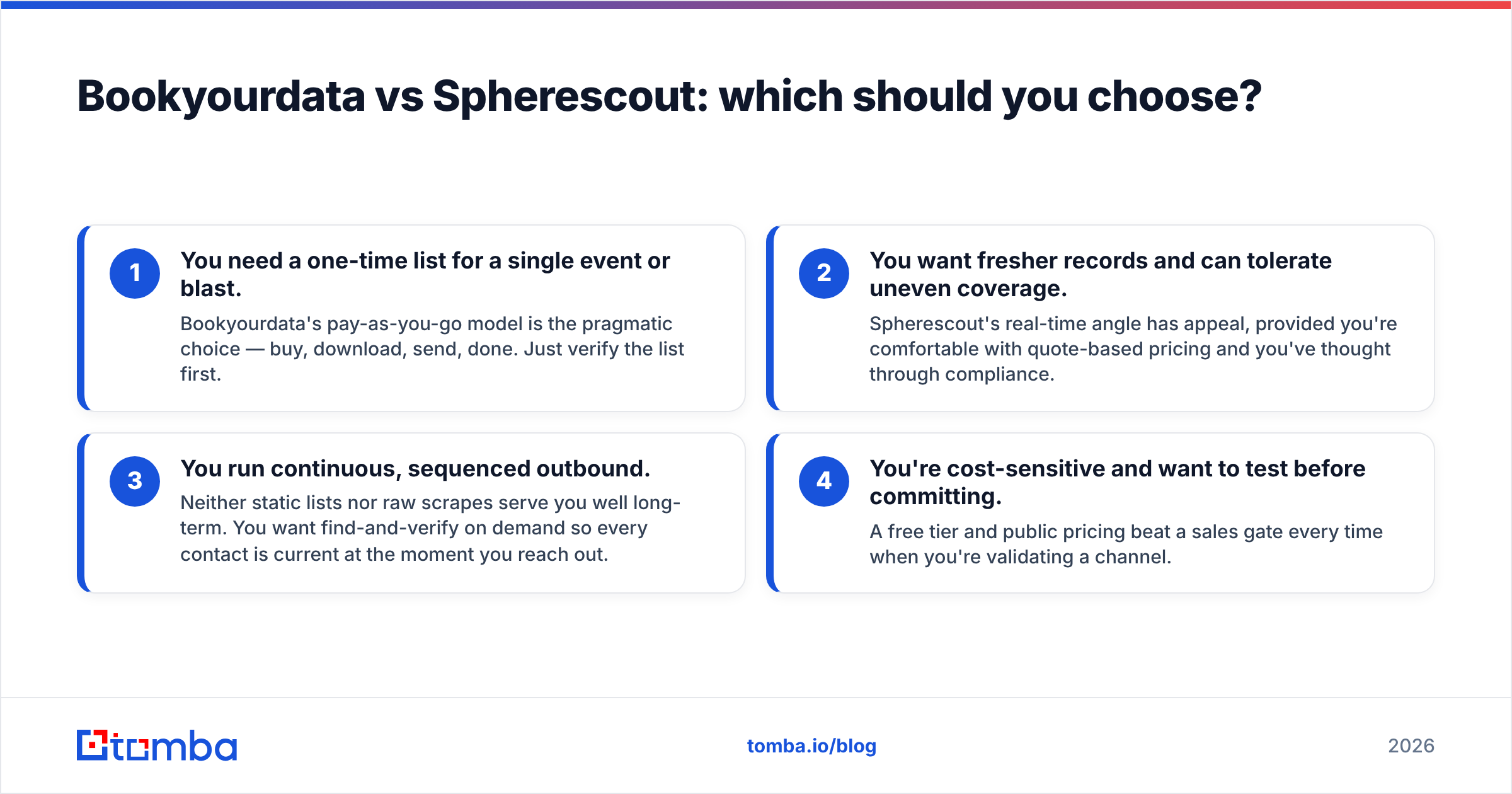
Pick based on your motion, not the marketing:
- You need a one-time list for a single event or blast. Bookyourdata's pay-as-you-go model is the pragmatic choice — buy, download, send, done. Just verify the list first.
- You want fresher records and can tolerate uneven coverage. Spherescout's real-time angle has appeal, provided you're comfortable with quote-based pricing and you've thought through compliance.
- You run continuous, sequenced outbound. Neither static lists nor raw scrapes serve you well long-term. You want find-and-verify on demand so every contact is current at the moment you reach out.
- You're cost-sensitive and want to test before committing. A free tier and public pricing beat a sales gate every time when you're validating a channel.
For most B2B teams running ongoing campaigns, option three is the honest recommendation — and it's where buying decaying bulk data stops making sense. You can dig deeper into vendor trade-offs in our guides on Clearbit alternatives and RocketReach alternatives, which face the same static-versus-live tension.
How does Tomba compare to both?#
Tomba sidesteps the static-versus-scraped argument by making verification the default, not an upsell. Instead of buying a snapshot or trusting a raw crawl, you find the specific people you need and confirm deliverability in the same workflow.
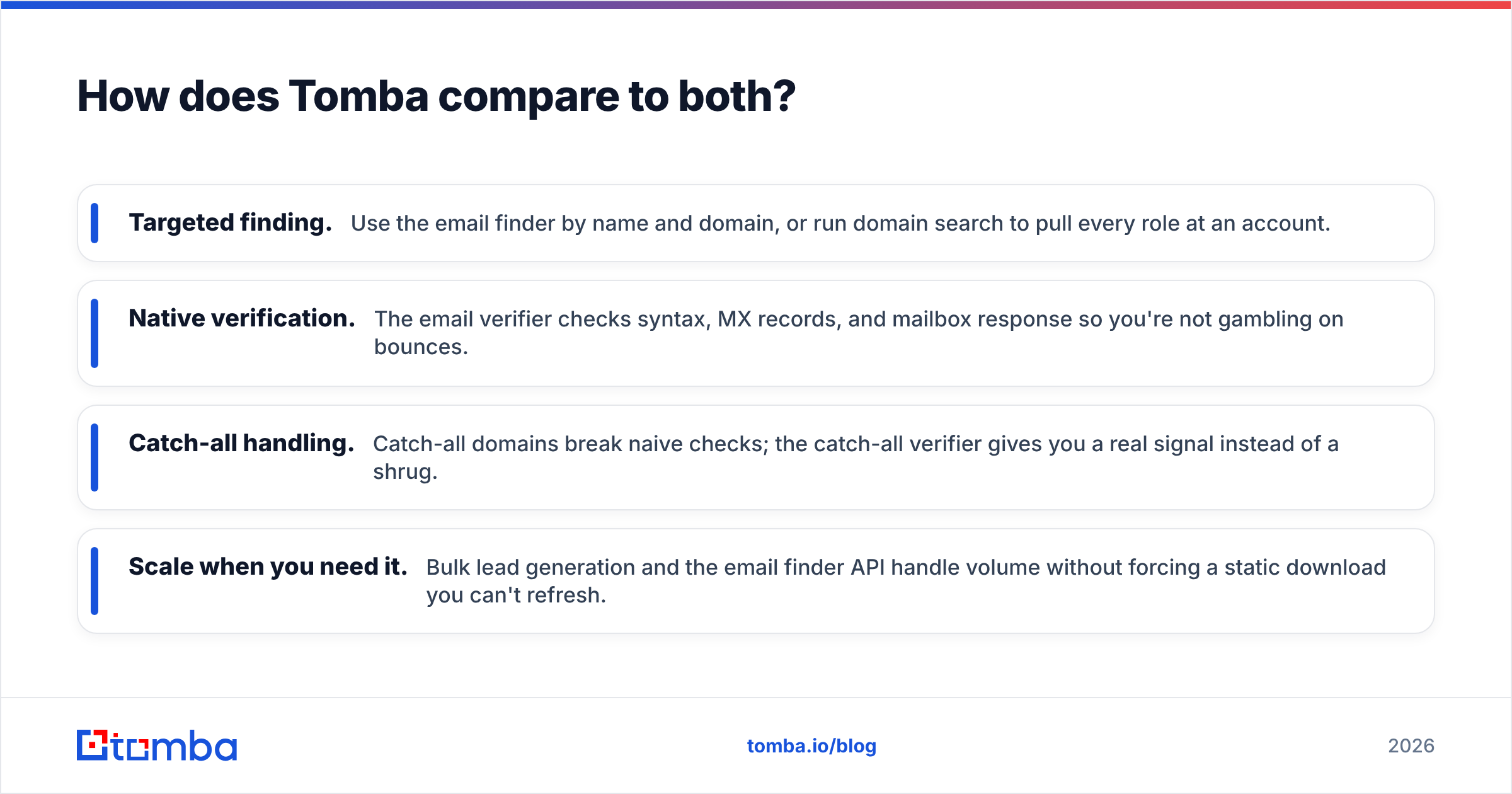
- Targeted finding. Use the email finder by name and domain, or run domain search to pull every role at an account.
- Native verification. The email verifier checks syntax, MX records, and mailbox response so you're not gambling on bounces.
- Catch-all handling. Catch-all domains break naive checks; the catch-all verifier gives you a real signal instead of a shrug.
- Scale when you need it. Bulk lead generation and the email finder API handle volume without forcing a static download you can't refresh.
The result is data that's current the moment you use it, sourced traceably, and priced in public. That's the gap both Bookyourdata and Spherescout leave open — one through aging lists, the other through opaque scraping. For the broader market context, independent review sites like G2 and Capterra are useful for cross-checking how each vendor's users describe accuracy and support in their own words. And if you're formalizing a compliance posture, the official GDPR text is worth a read before you commit to any scraped-data vendor.
Final verdict#
Bookyourdata wins on transparent, no-commitment buying; Spherescout wins on perceived freshness — but both leave verification and compliance largely on you. If your outbound is a single campaign, Bookyourdata is the simpler call. If you need ongoing, verified, defensible data, a find-and-verify workflow beats either static lists or raw scraping.
Stop paying for records that bounce. Start with the Tomba Email Finder — find the exact contacts you need, verify them in the same pass, and test it free with 25 searches a month before you spend a dollar. Your sender reputation, and your reply rate, will thank you.
// get started
Find, verify and enrich your first contacts today
Start on the free plan with 25 searches a month, then scale when your team is ready.
Free plan · No credit card required · GDPR & CCPA
Get the Tomba newsletter
Product and data updates
// about the author