Bookyourdata vs The Data City: B2B Data Compared (2026)
Bookyourdata sells pay-as-you-go contact lists; The Data City maps company intelligence. Here's how they differ on pricing, accuracy, and coverage in 2026—and when a leaner email-finder beats both.
TL;DR
- Bookyourdata is a pay-as-you-go B2B contact database: you filter, buy, and download verified email lists by job title, industry, and location.
- The Data City is a UK-focused market-intelligence platform that classifies and tracks companies in real time—built for analysts, economic-development teams, and market researchers, not list-buying SDRs.
- They barely compete. Bookyourdata answers "give me contacts to email." The Data City answers "show me which companies exist in this emerging sector."
- Neither is ideal if your real job is finding and verifying a specific person's work email on demand—that's where an email finder like Tomba fits.
- Below: side-by-side pricing, accuracy, coverage, and a decision framework so you stop overpaying for the wrong data shape.
What is Bookyourdata?#
Bookyourdata is a self-serve B2B contact data marketplace. You open the dashboard, apply filters—industry, job title, seniority, company size, country—and the platform shows a live count of matching contacts. You buy credits, download the list as CSV, and import it into your CRM or sequencer.
The pitch is speed and a "pay only for what you use" model. There are no annual seats to negotiate before you can pull 500 contacts. Bookyourdata advertises a 97%+ accuracy guarantee and offers credit replacement for bounced records, which matters because list data decays fast—people change jobs, domains migrate, and inboxes get retired.
Its core buyers are outbound sales teams, demand-gen marketers, and agencies that need volume contacts quickly. You can see its positioning on the official Bookyourdata site and read operator reviews on G2.
The trade-off with any pre-built list provider is the same: you're buying a snapshot. The moment you download, the data starts aging, and you have no signal about whether a specific record is still valid until you send—or verify—it yourself.
What is The Data City?#
The Data City is a different animal entirely. It's a UK company-intelligence and economic-mapping platform that uses real-time classification (its "Real-Time Industrial Classification," or RTICS) to group companies by what they actually do—scraped and modeled from websites and filings rather than dated SIC codes.
Its users are economists, local-government and economic-development bodies, investors, and market researchers trying to size emerging sectors like net-zero, AI, or quantum. If you want to know "how many active companies in Manchester work on battery technology, and how fast is that cohort growing," The Data City is purpose-built for that. You can explore its approach on the official Data City site.
What it is not built for: handing an SDR a downloadable list of verified personal email addresses to cold-email tomorrow morning. The contact-level, send-ready email layer that outbound teams live on is not its focus.
So when you search "bookyourdata vs the data city," you're usually comparing two tools that were never designed for the same job. The useful question isn't "which is better"—it's "which problem am I actually solving?"
How do Bookyourdata and The Data City compare head to head?#
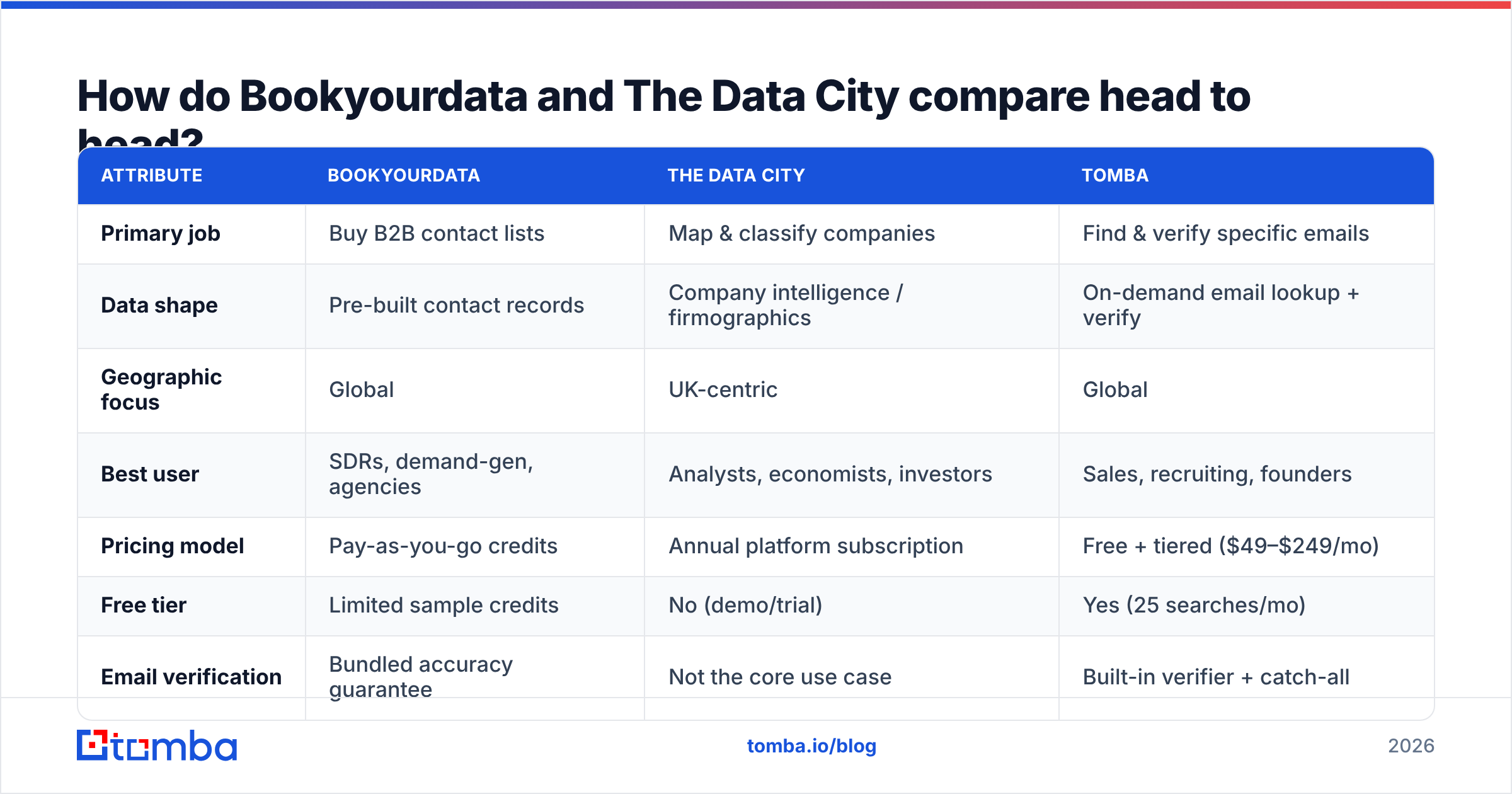
Here's the core comparison across the attributes that decide a purchase. Treat accuracy figures as vendor-stated rather than independently audited.
| Attribute | Bookyourdata | The Data City | Tomba |
|---|---|---|---|
| Primary job | Buy B2B contact lists | Map & classify companies | Find & verify specific emails |
| Data shape | Pre-built contact records | Company intelligence / firmographics | On-demand email lookup + verify |
| Geographic focus | Global | UK-centric | Global |
| Best user | SDRs, demand-gen, agencies | Analysts, economists, investors | Sales, recruiting, founders |
| Pricing model | Pay-as-you-go credits | Annual platform subscription | Free + tiered ($49–$249/mo) |
| Free tier | Limited sample credits | No (demo/trial) | Yes (25 searches/mo) |
| Email verification | Bundled accuracy guarantee | Not the core use case | Built-in verifier + catch-all |
| API access | Yes | Yes | Yes |
A few things stand out. Bookyourdata and Tomba both serve the contact-data side but from opposite directions: one sells you a bulk snapshot, the other finds and verifies records as you need them. The Data City sits in a separate category—strategic market mapping—and competes more with firmographic intelligence platforms than with either of the other two.
Which one fits your use case?#
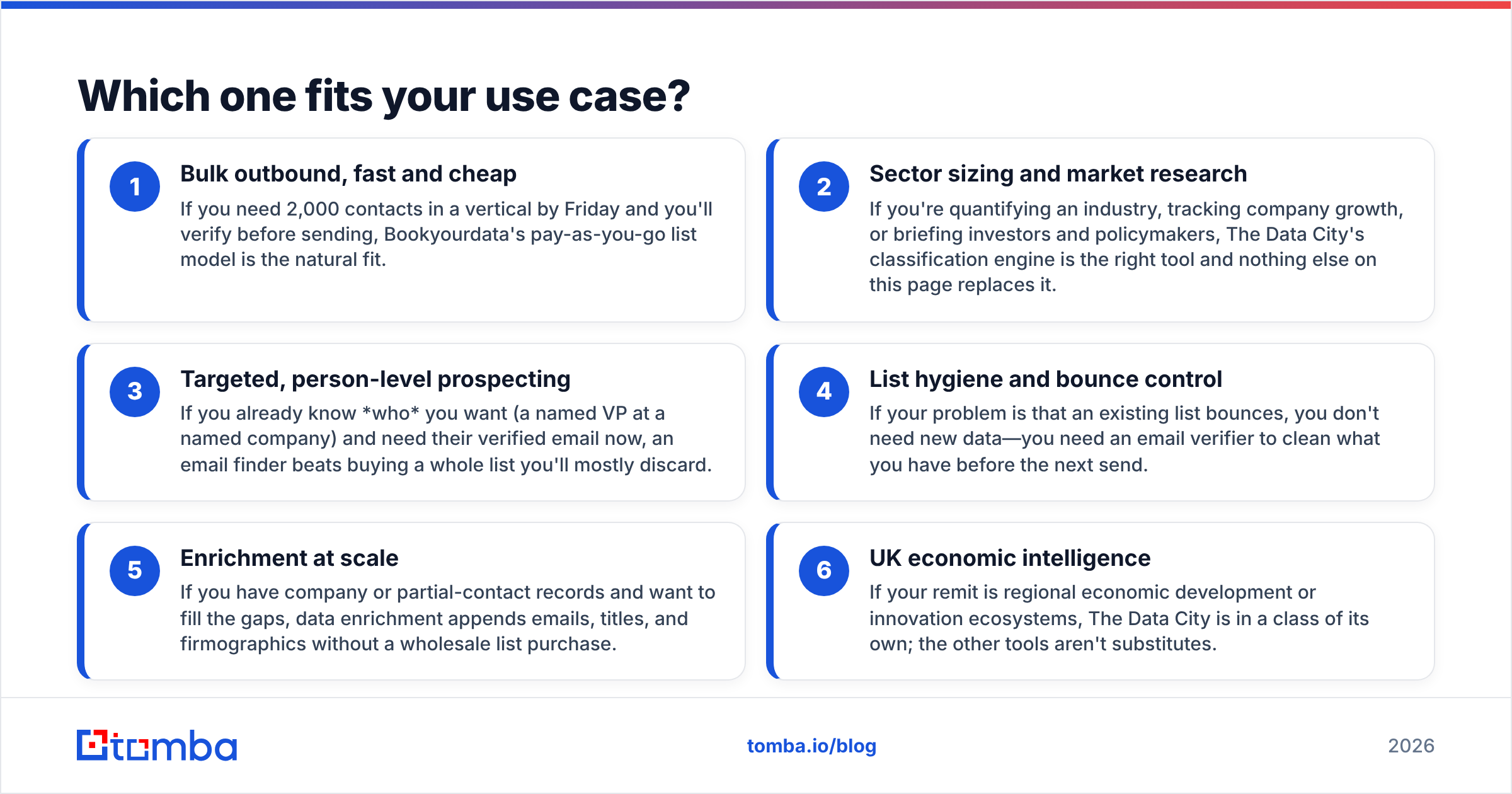
Match the tool to the job. Here's the decision framework, with the bold lead telling you who should pick what.
- Bulk outbound, fast and cheap — If you need 2,000 contacts in a vertical by Friday and you'll verify before sending, Bookyourdata's pay-as-you-go list model is the natural fit.
- Sector sizing and market research — If you're quantifying an industry, tracking company growth, or briefing investors and policymakers, The Data City's classification engine is the right tool and nothing else on this page replaces it.
- Targeted, person-level prospecting — If you already know who you want (a named VP at a named company) and need their verified email now, an email finder beats buying a whole list you'll mostly discard.
- List hygiene and bounce control — If your problem is that an existing list bounces, you don't need new data—you need an email verifier to clean what you have before the next send.
- Enrichment at scale — If you have company or partial-contact records and want to fill the gaps, data enrichment appends emails, titles, and firmographics without a wholesale list purchase.
- UK economic intelligence — If your remit is regional economic development or innovation ecosystems, The Data City is in a class of its own; the other tools aren't substitutes.
The mistake teams make is buying a bulk list (Bookyourdata) when they have 50 named accounts, or buying a market-intelligence subscription (The Data City) when they actually just need send-ready emails. Wrong shape, wasted budget.
How accurate is the data?#
Accuracy is where list providers live or die, because a B2B email database degrades roughly 22–30% per year as people switch jobs. Bookyourdata leans on a stated 97%+ accuracy claim plus a bounce-replacement guarantee—a reasonable hedge, but the guarantee only helps after a bounce has already cost you a send and a sliver of sender reputation.
The Data City's accuracy question is different. Its value is in classification accuracy—does it correctly identify a company as "green hydrogen" versus "general engineering"—not in whether a contact's mailbox is live. Judge it on how well its real-time model maps a sector, not on bounce rates.
For person-level work, the most reliable pattern is verify-at-the-moment-you-need-it rather than trusting a snapshot. Real-time SMTP checks, catch-all verification, and confidence scoring tell you whether this address is deliverable today, not whether it was valid whenever the list was last refreshed. That's the structural advantage of finding and verifying on demand over buying a static file.

What about pricing and total cost?#
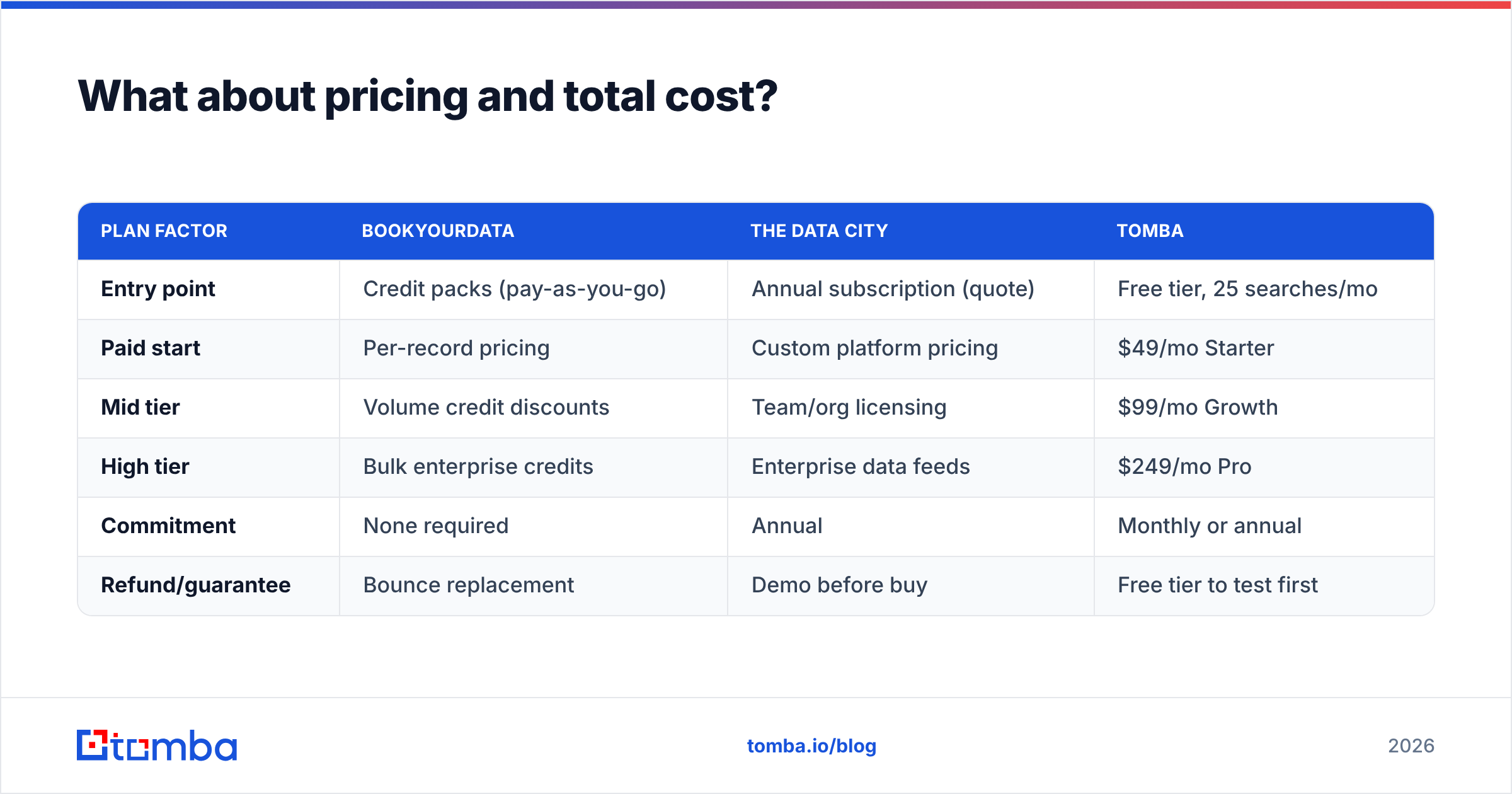
Pricing models differ enough that a sticker-price comparison misleads. Bookyourdata charges per record via credits—great when you need a known quantity, less predictable when your targeting is broad. The Data City sells annual platform access, which makes sense for a team that uses it daily but is overkill for an occasional pull. And Tomba pricing is a tiered SaaS subscription with a genuine free tier.
| Plan factor | Bookyourdata | The Data City | Tomba |
|---|---|---|---|
| Entry point | Credit packs (pay-as-you-go) | Annual subscription (quote) | Free tier, 25 searches/mo |
| Paid start | Per-record pricing | Custom platform pricing | $49/mo Starter |
| Mid tier | Volume credit discounts | Team/org licensing | $99/mo Growth |
| High tier | Bulk enterprise credits | Enterprise data feeds | $249/mo Pro |
| Commitment | None required | Annual | Monthly or annual |
| Refund/guarantee | Bounce replacement | Demo before buy | Free tier to test first |
The honest read: if you buy lists constantly, Bookyourdata's per-record model can get expensive at volume, and you still pay to re-buy data that ages out. If you only need targeted lookups and verification, a subscription with a free tier and predictable monthly cost—plus a bulk email finder for the occasional batch—usually wins on cost-per-usable-contact.
Where does Tomba fit between them?#
Tomba sits in the gap neither tool fully covers: finding and verifying specific professional emails on demand, globally, without committing to a bulk list or an annual intelligence platform.
The workflow looks like this. Use domain search to pull every discoverable email at a target company, find an individual by name with the email finder, then run the built-in verifier to confirm deliverability before a single message goes out. Need firmographic context? Enrichment appends it. Need 5,000 at once? The bulk tools handle batches with the same verification layer.
Compared to Bookyourdata, you're not buying a decaying snapshot—you're pulling fresh records and verifying them at send time. Compared to The Data City, you're getting the contact-level, send-ready email layer that market-intelligence platforms intentionally leave out. And against both, the free tier (25 searches/mo) lets you test accuracy on your own target accounts before paying anything.
That's not to say Tomba replaces The Data City for economic research—it doesn't, and pretending otherwise would be dishonest. If your job is sizing the UK quantum sector, use The Data City. If your job is emailing the right people at the companies you've already identified, Tomba is the tighter fit.
Common questions#
Is Bookyourdata better than The Data City? Neither is "better"—they solve different problems. Bookyourdata is for buying contact lists; The Data City is for classifying and tracking companies. Pick by job, not by brand.
Can The Data City give me emails to cold-email? Not as its core function. It's market intelligence, not a send-ready contact provider. For that, use a dedicated email finder and verifier.
Why verify emails if a list is "97% accurate"? Because accuracy is a point-in-time average across the whole database, not a guarantee about your specific 500 records today. Verifying at send time protects deliverability and your domain reputation.
Is pay-as-you-go cheaper than a subscription? Only if you buy infrequently. At steady volume, per-record pricing plus re-buying decayed data often costs more than a flat monthly tool with on-demand lookups.
The bottom line#
Stop comparing two tools that were built for different jobs. Bookyourdata is a fast pay-as-you-go list source for high-volume outbound. The Data City is a UK market-intelligence platform for analysts and economists. If what you actually need is the right person's verified work email—found fresh, confirmed deliverable, and ready to send—neither snapshot nor sector map is the cleanest answer.
Start free with the Tomba Email Finder: find emails by name, company, or domain, verify them in the same flow, and only upgrade when you've proven the accuracy on your own accounts. Test 25 searches a month at no cost, then scale on the $49/mo Starter plan when you're ready—no decaying list, no annual lock-in, just contacts you can actually reach.
// get started
Find, verify and enrich your first contacts today
Start on the free plan with 25 searches a month, then scale when your team is ready.
Free plan · No credit card required · GDPR & CCPA
// about the author