Bookyourdata vs Truelist: Which B2B Data Tool Wins in 2026?
Bookyourdata sells targeted B2B lists; Truelist verifies them. We compare accuracy, pricing, and workflow fit in 2026 — plus where a find-and-verify tool beats both.
You searched "bookyourdata vs truelist" because you need clean B2B contacts — but these two tools solve different halves of that problem. Picking wrong means either buying a list you can't trust or verifying a list you never built.
TL;DR#
- Bookyourdata is a pay-as-you-go B2B contact database — you buy targeted email lists by industry, title, and geography. Credits never expire.
- Truelist is an email verification service — you upload a list you already have, and it flags invalid, risky, and catch-all addresses.
- They are not direct competitors. One builds lists; the other cleans them. Most teams end up needing both functions.
- Bookyourdata advertises a ~97% accuracy guarantee on delivered records; Truelist focuses on bulk and real-time SMTP validation.
- If you want one workflow that finds and verifies in the same place, a dedicated email finder plus email verifier stack closes the gap neither tool covers alone.
What is Bookyourdata?#
Bookyourdata is a self-service B2B data marketplace. You filter a database of 250M+ contacts by attributes — job title, industry, company size, technology used, location — preview the count, and pay per record you download. The pitch is speed: you can stand up a targeted prospect list in minutes without a sales call or annual contract.
Its headline feature is a stated accuracy guarantee (around 97% on email deliverability for delivered records), with credit refunds for hard bounces beyond that threshold. Credits don't expire, which suits teams that buy in bursts rather than on a monthly cadence.
What you're buying is net-new contacts. You don't bring your own data — you acquire someone else's. That's powerful for cold market entry, but it also means the data is only as fresh as the last time their database was refreshed, and B2B data decays fast (roughly 22–30% per year as people change jobs).
What is Truelist?#
Truelist is an email verification platform. You bring a list — from a CRM export, a webform, a scraped source, or a purchased file — and Truelist checks each address through syntax validation, domain/MX record checks, and SMTP-level mailbox probing. It returns a status per address: valid, invalid, risky, catch-all, or unknown.
The goal is deliverability protection. Sending to a stale or invalid list spikes your bounce rate, which damages your sender reputation and lands future mail in spam. Truelist sits between your list and your sending tool as a quality gate.
Crucially, Truelist does not find contacts. It has no database of prospects to draw from. If your list is empty, Truelist has nothing to do.

Bookyourdata vs Truelist: what's the real difference?#
The core distinction is acquisition versus validation. Confusing them is the most expensive mistake in this comparison — buying a verification tool when you have no list, or a list tool when your problem is bounce rate.
Here's how the two map across the attributes that actually affect a campaign:
| Attribute | Bookyourdata | Truelist |
|---|---|---|
| Primary job | Build / buy targeted B2B lists | Verify existing email lists |
| Bring your own data? | No — you acquire new contacts | Yes — you upload your own |
| Database size | 250M+ contacts | None (no database) |
| Pricing model | Pay-as-you-go credits, no expiry | Pay-as-you-go verification credits |
| Accuracy claim | ~97% deliverability guarantee | Validation accuracy, not list sourcing |
| Catch-all handling | Included in delivered records | Flags catch-all as "risky" |
| Real-time API | Limited | Yes (verification API) |
| Best for | Cold market entry, net-new TAM | Cleaning lists before send |
| What it won't do | Verify your existing CRM at scale | Find new prospects |
Read the bottom two rows carefully. The thing each tool won't do is exactly the thing the other one does. That's why "vs" is slightly misleading — in practice these are sequential steps, not alternatives.
Which is more accurate?#
Different definitions of accuracy, so judge them on different evidence.
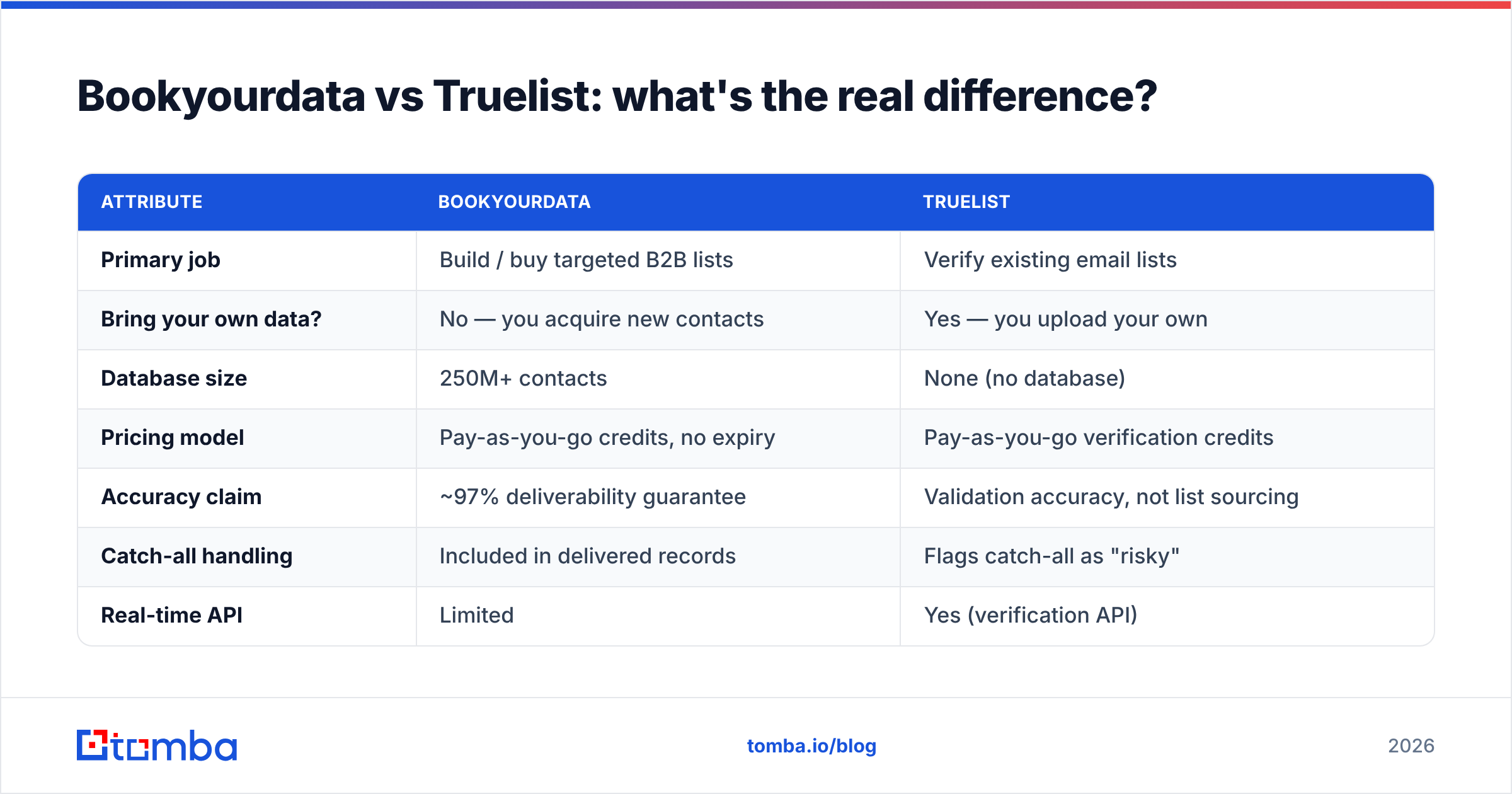
Bookyourdata's accuracy is about sourcing — were the records correct and deliverable at the moment you downloaded them? A 97% guarantee is strong on paper, but two caveats matter. First, guarantees usually cover hard bounces, not whether the person still works there or whether the address is a generic info@ catch-all. Second, the clock starts ticking the day you download; a list that was 97% valid in January can drift well below 90% by Q3.
Truelist's accuracy is about detection — did it correctly classify each address? The hard case for every verifier is the catch-all domain, where the mail server accepts everything and reveals nothing on an SMTP probe. Truelist marks these "risky," which is honest but leaves you to decide. A dedicated catch-all verifier that runs deeper pattern checks recovers more of those addresses than a binary risky/valid flag.
The practical takeaway: a purchased list still needs verification before you send. Even a 97% source should be re-validated if it's been sitting in a spreadsheet for a month. Independent review sites like G2 are a useful reality check on both vendors' real-world numbers versus their marketing.
How does pricing compare?#
Both run on pay-as-you-go credits, which is the right model for spiky B2B work — you're not locked into a monthly minimum you won't use.
- Bookyourdata charges per contact record downloaded, with volume tiers and non-expiring credits. You pay more per record but get a full contact profile (name, title, email, often phone and company data).
- Truelist charges per email verified, which is far cheaper per unit because you're checking data you already own, not buying it.
Comparing their sticker prices directly is apples to oranges: one price includes the contact, the other only the check. The honest way to budget is to add them: cost-to-acquire plus cost-to-verify equals your true cost per usable contact. When you model it that way, a combined find-and-verify platform often wins on total cost because it dedupes the two steps and doesn't charge you twice for the same record.
Where does a combined find-and-verify tool fit?#
Short answer: it replaces the seam between the two tools. The gap in the Bookyourdata-vs-Truelist debate is the handoff — exporting from one, importing to the other, reconciling formats, and paying two vendors for one usable lead.
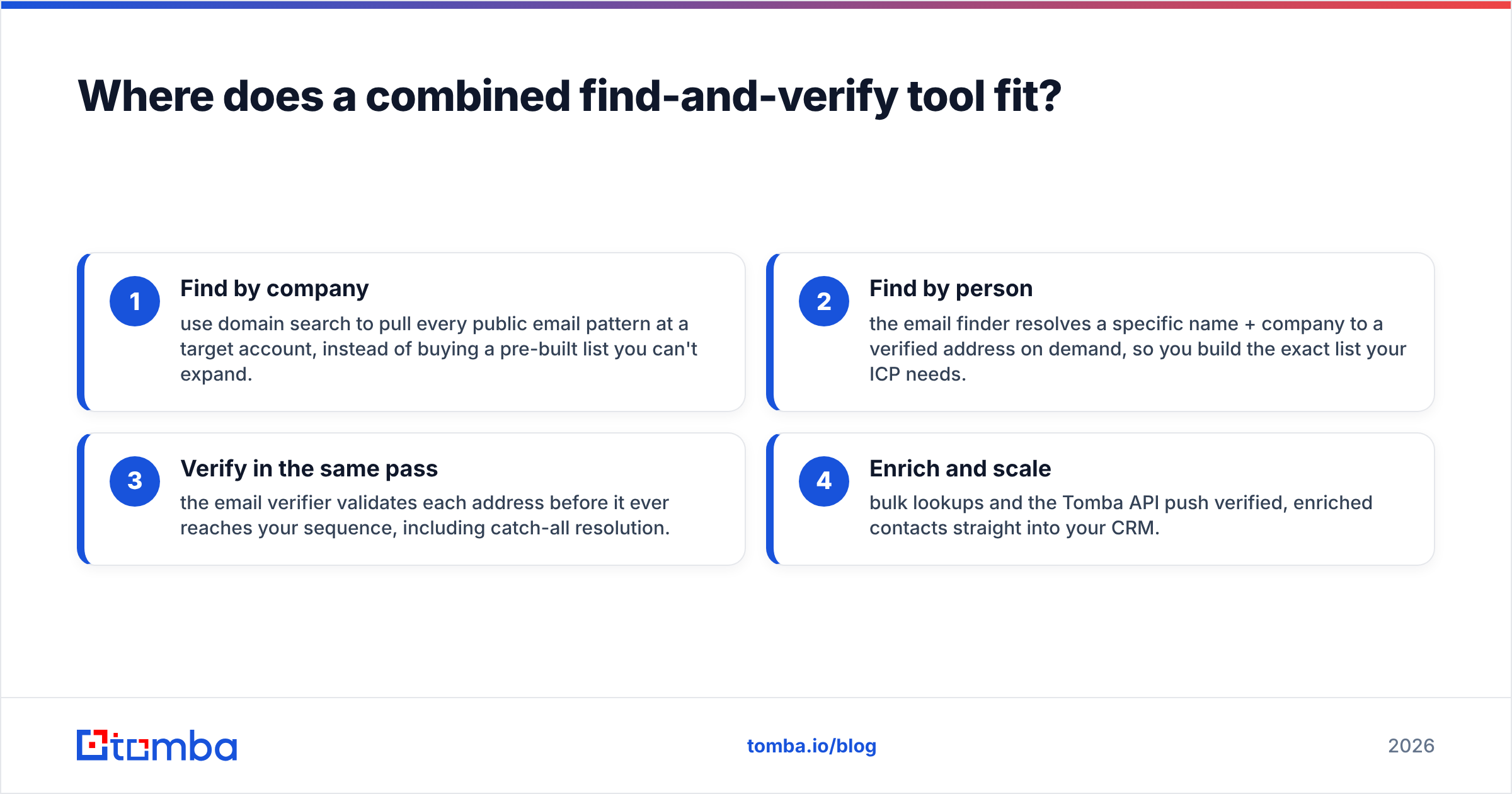
A platform like Tomba collapses that workflow:
- Find by company — use domain search to pull every public email pattern at a target account, instead of buying a pre-built list you can't expand.
- Find by person — the email finder resolves a specific name + company to a verified address on demand, so you build the exact list your ICP needs.
- Verify in the same pass — the email verifier validates each address before it ever reaches your sequence, including catch-all resolution.
- Enrich and scale — bulk lookups and the Tomba API push verified, enriched contacts straight into your CRM.
This isn't an argument that databases are obsolete — Bookyourdata's net-new reach is genuinely useful for entering a market cold. It's that for targeted outbound against named accounts, finding-on-demand beats buying-in-bulk because every record is fresh at the moment of use, not the moment of the last database refresh.
Bookyourdata vs Truelist: which should you choose?#
Match the tool to the problem you actually have:
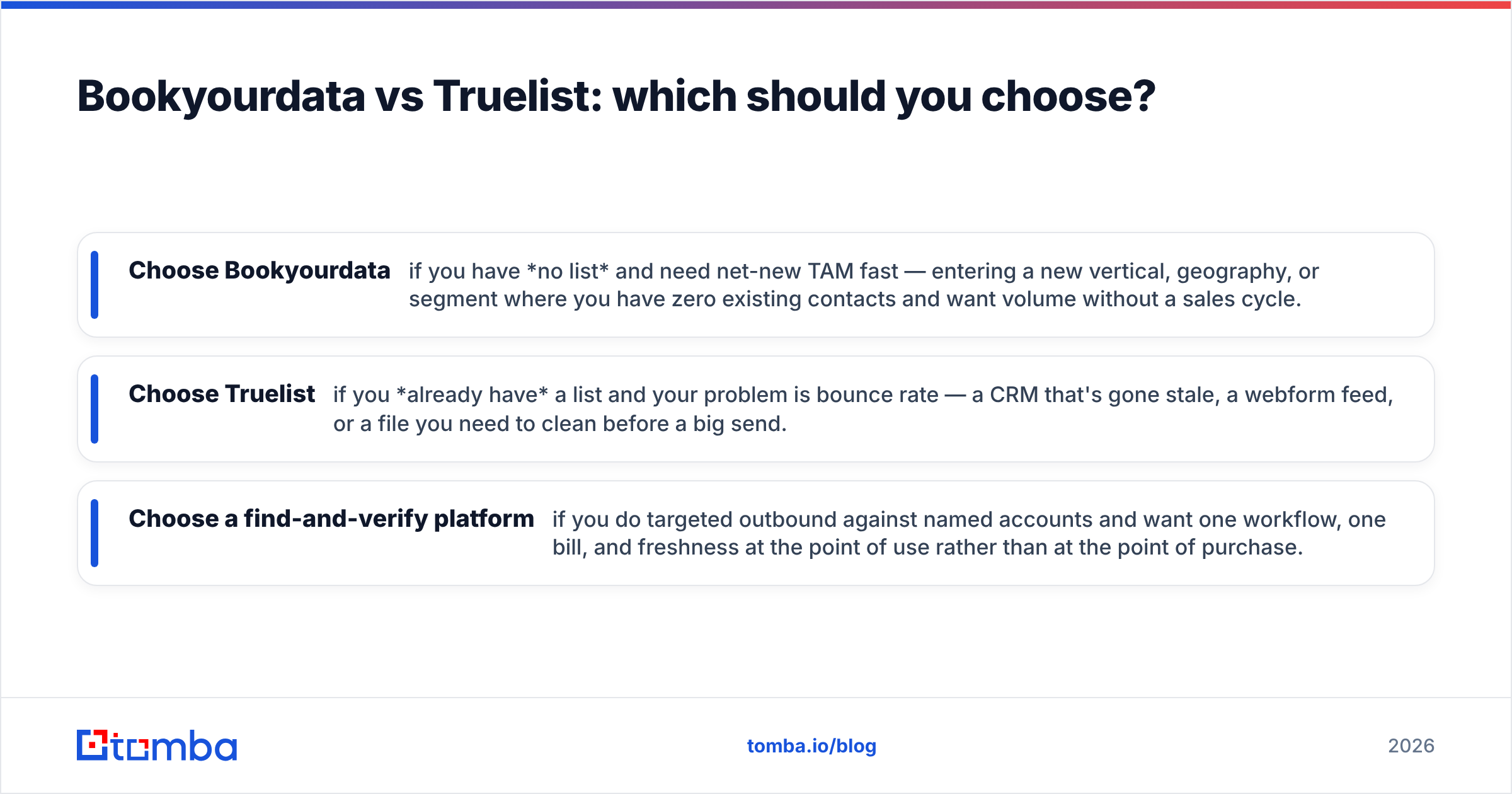
- Choose Bookyourdata if you have no list and need net-new TAM fast — entering a new vertical, geography, or segment where you have zero existing contacts and want volume without a sales cycle.
- Choose Truelist if you already have a list and your problem is bounce rate — a CRM that's gone stale, a webform feed, or a file you need to clean before a big send.
- Choose a find-and-verify platform if you do targeted outbound against named accounts and want one workflow, one bill, and freshness at the point of use rather than at the point of purchase.
Most growing teams cycle through all three needs. The mistake is buying a single tool and assuming it covers the others — it won't, and the cracks show up as bounces, wasted credits, and reps hand-cleaning spreadsheets.
A quick gut check before you commit: if your bounce rate is your pain, you need verification, not more data. If your pipeline is your pain, you need finding, not just cleaning. Read both vendors' own docs and a neutral directory like Capterra before you put money down — feature lists change quarterly, and the "vs" framing flattens real differences.
What about phone numbers and enrichment?#
One more axis the basic comparison ignores: multichannel data. Email-only outbound is increasingly crowded, and cold calling still converts when the email lands flat.
Bookyourdata bundles phone data into many records. Truelist doesn't touch phone at all — it's email-only by design. If your motion is multichannel, that's a real factor. A stack that adds a phone finder and broader data enrichment on top of email lets you layer call and email touches against the same verified contact, rather than sourcing phone data from yet a third vendor. Check current Tomba pricing to see where verified email, phone, and enrichment land in a single plan versus stitching together two or three point tools.
The bottom line#
Bookyourdata and Truelist aren't really rivals — they're two stages of one job. Bookyourdata acquires contacts; Truelist validates them. Buy the wrong one and you'll feel the gap immediately: a list with no verification, or a verifier with no list.
If your work is targeted outbound against accounts you can name, skip the seam entirely. Find the exact contacts you need and verify them in the same workflow with the Tomba Email Finder — fresh at the moment of use, validated before they hit your sequence, and enriched with phone and company data so every record is ready to work. Start on the free tier (25 searches/month), then scale on the Starter plan at $49/mo when your pipeline does.
// get started
Find, verify and enrich your first contacts today
Start on the free plan with 25 searches a month, then scale when your team is ready.
Free plan · No credit card required · GDPR & CCPA
// about the author