Bookyourdata vs TrueVerify 2026: Which B2B Data Tool Wins?
Bookyourdata sells ready-made B2B contact lists; TrueVerify cleans the emails you already have. Here's how the two compare on data, pricing, and accuracy in 2026 — and when a live email finder beats both.
You are picking between two tools that look similar on the surface but solve opposite halves of the same problem. Bookyourdata hands you a pre-built list of B2B contacts. TrueVerify checks whether the emails on a list you already own are still deliverable. One fills the bucket; the other plugs the leaks. This guide breaks down where each wins, where each falls short, and why a live-search email tool often beats buying or scrubbing a static list in 2026.
TL;DR#
- Bookyourdata is a pay-as-you-go B2B contact database — you filter by title, industry, and geography, then export ready-to-email lists with a claimed accuracy guarantee.
- TrueVerify is an email verification service — it validates syntax, domain, and mailbox status for lists you already have so you stop bouncing.
- They are complementary, not interchangeable: buying a list (Bookyourdata) and cleaning a list (TrueVerify) are different jobs.
- Both share the core weakness of static data — B2B contacts decay roughly 22-30% per year, so any purchased or one-time-verified list rots fast.
- A live email finder like Tomba's Email Finder resolves addresses at the moment you need them and verifies them in the same step — closer to the real fix.
What is Bookyourdata?#
Bookyourdata is a self-service B2B data marketplace. You log in, apply filters (job title, seniority, company size, industry, location, technology used), preview the count, and buy credits to unlock and export the contacts. Each export is a CSV or a push to your CRM.
Its pitch is instant volume: you can assemble a few thousand targeted contacts in minutes without running outreach campaigns to collect them yourself. The company advertises a high deliverability guarantee and offers credit refunds on emails that hard-bounce above a stated threshold.
The catch is the same one every list vendor lives with. The records are pulled from aggregated public and licensed sources, snapshotted at a point in time. The moment a prospect changes jobs — and in B2B that happens constantly — the row you paid for is wrong, even if it was accurate when scraped. A bounce refund returns the credit; it does not return the missed opportunity or protect your sender reputation after a spike of dead addresses.
What is TrueVerify?#
TrueVerify sits on the other side of the workflow. You bring a list — exported from a webinar, a trade show, an old CRM, or yes, a data vendor — and TrueVerify runs each address through a validation pipeline:
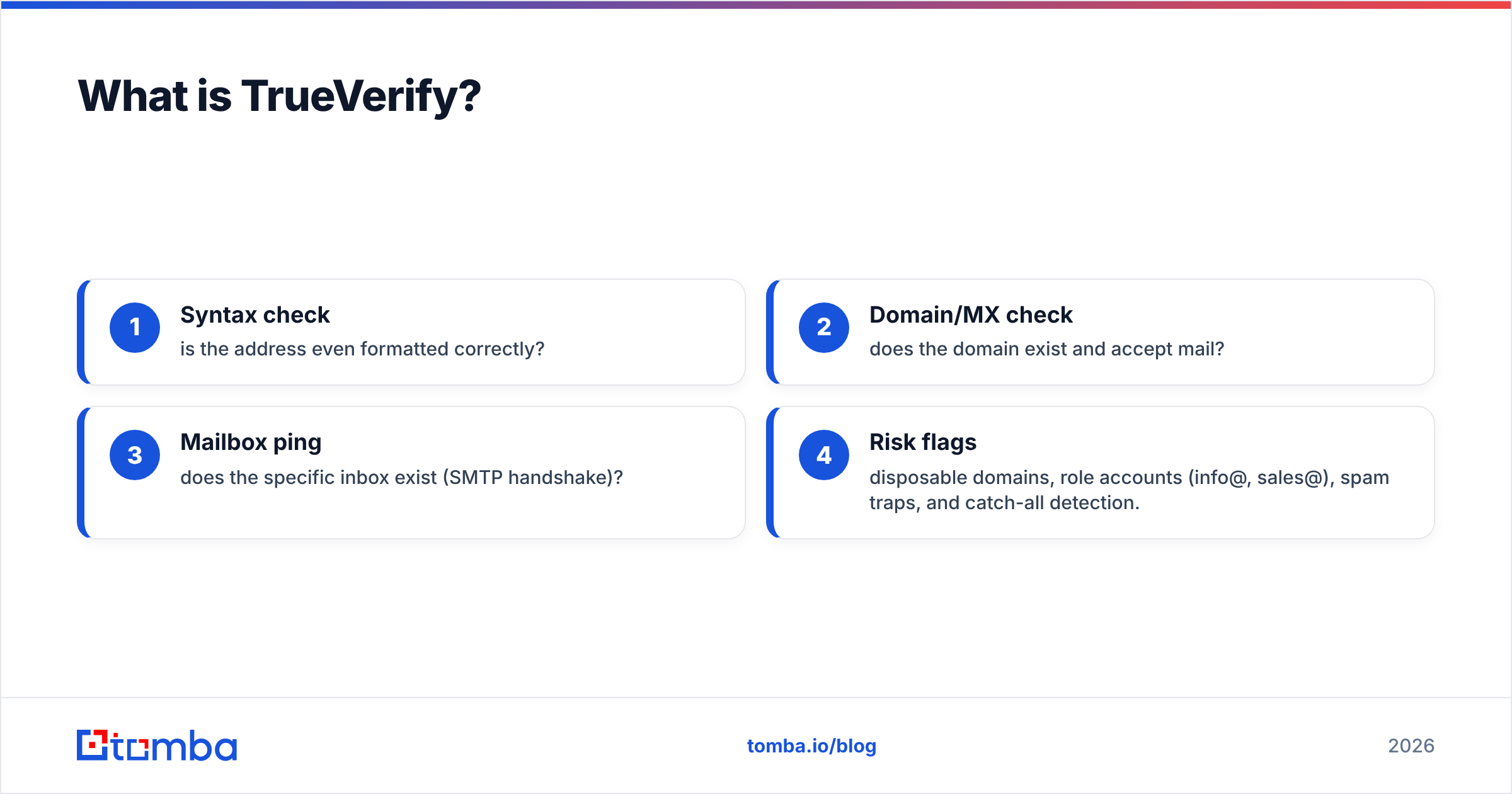
- Syntax check — is the address even formatted correctly?
- Domain/MX check — does the domain exist and accept mail?
- Mailbox ping — does the specific inbox exist (SMTP handshake)?
- Risk flags — disposable domains, role accounts (info@, sales@), spam traps, and catch-all detection.
The output is a status per row: valid, invalid, risky, or unknown. You then suppress the bad ones before you send. This is genuinely useful — verification is the single cheapest way to cut bounce rate and protect email deliverability.
But verification is a filter, not a source. TrueVerify cannot tell you the email of a prospect you don't already have. It can only grade the addresses you feed it. And it can't beat the catch-all problem cleanly — many corporate domains accept every address at the SMTP layer, so a "valid" verdict on a catch-all domain is really a "maybe." That's where a dedicated catch-all verifier earns its keep.
Bookyourdata vs TrueVerify: how do they compare?#
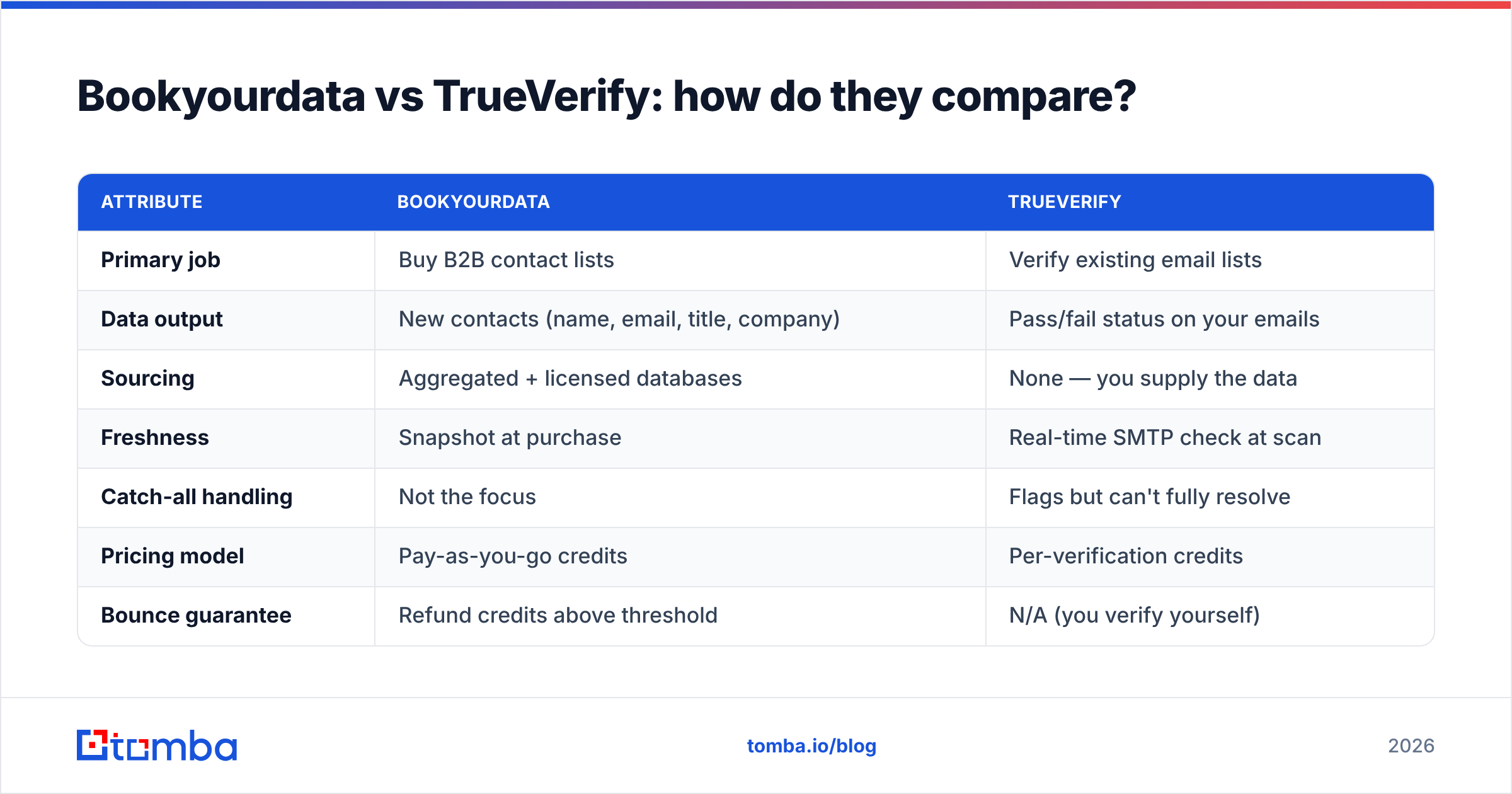
Here's the head-to-head on the attributes that actually drive a buying decision.
| Attribute | Bookyourdata | TrueVerify |
|---|---|---|
| Primary job | Buy B2B contact lists | Verify existing email lists |
| Data output | New contacts (name, email, title, company) | Pass/fail status on your emails |
| Sourcing | Aggregated + licensed databases | None — you supply the data |
| Freshness | Snapshot at purchase | Real-time SMTP check at scan |
| Catch-all handling | Not the focus | Flags but can't fully resolve |
| Pricing model | Pay-as-you-go credits | Per-verification credits |
| Bounce guarantee | Refund credits above threshold | N/A (you verify yourself) |
| Best for | Filling an empty pipeline fast | Cleaning a list before sending |
| Core weakness | Data decays after purchase | Can't find new contacts |
The table makes the real takeaway obvious: these tools answer different questions. "Where do I get contacts?" points to Bookyourdata. "Are my contacts still good?" points to TrueVerify. Choosing between them only makes sense if you've already decided which problem you have.
Which one is more accurate?#
Accuracy means two different things here, so compare them on their own terms.
Bookyourdata's accuracy is about correctness at the source. The question is whether the email it sold you belongs to the person it claims. Bookyourdata stakes its reputation on a deliverability guarantee, and for recently-updated records in large, stable industries the hit rate is respectable. Where it falls apart is the long tail: small companies, fast-moving startups, and anyone who switched roles since the last data refresh. You only discover those misses after you send.
TrueVerify's accuracy is about deliverability prediction. The question is whether a "valid" verdict actually lands in an inbox. Standard SMTP verification is reliable on conventional mailboxes and weak on catch-all domains, which now cover a large share of corporate email. A verifier that returns "valid" on a catch-all is guessing politely.
The structural problem both share: point-in-time data. Reviews on G2 for every list and verification vendor repeat the same complaint — the data was fine the day it was pulled and degraded from there. Independent estimates put B2B contact decay around 22-30% annually as people change jobs, companies rebrand, and domains migrate. Neither a purchased list nor a one-time scrub survives that decay.
How does a live email finder change the math?#
A live email finder attacks the decay problem at its root by resolving the address when you ask, not months earlier. Instead of buying a frozen list or scrubbing a stale one, you give the tool a name plus a company domain (or just the domain), and it returns the current address along with a confidence score and verification status in the same call.
This collapses two steps — sourcing and verifying — into one. Consider what each approach actually requires:
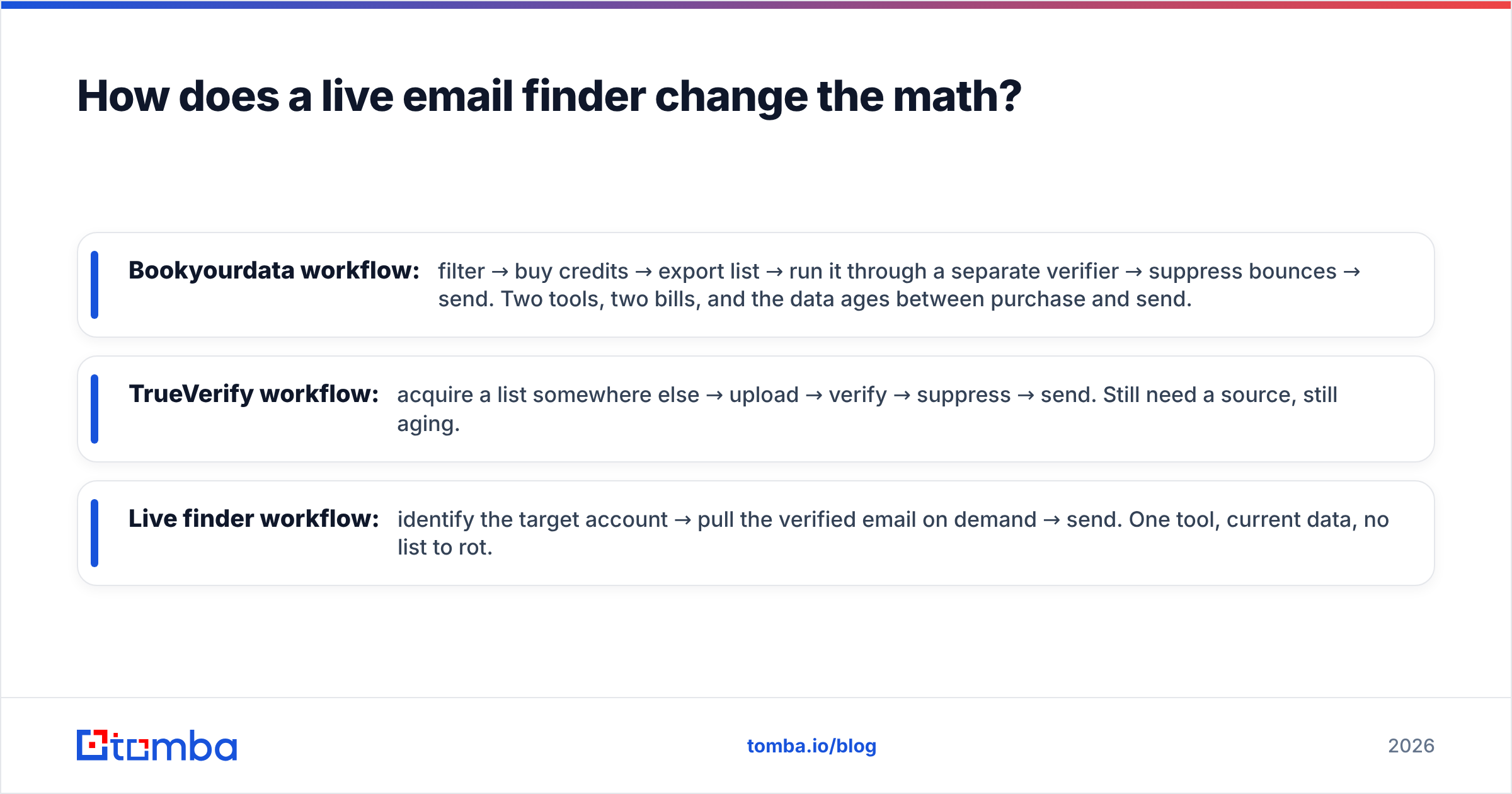
- Bookyourdata workflow: filter → buy credits → export list → run it through a separate verifier → suppress bounces → send. Two tools, two bills, and the data ages between purchase and send.
- TrueVerify workflow: acquire a list somewhere else → upload → verify → suppress → send. Still need a source, still aging.
- Live finder workflow: identify the target account → pull the verified email on demand → send. One tool, current data, no list to rot.
Tomba runs this as a single platform. The email verifier and catch-all finder handle the deliverability side that TrueVerify covers, while domain search and the email finder handle the sourcing side that Bookyourdata covers — but live, with transparent data sources you can audit. For teams that still need volume, the bulk email finder processes thousands of name/domain pairs at once, so you get list-scale output without buying a static list.
When should you actually pick each tool?#
Be honest about your situation. Each tool has a legitimate sweet spot.
Pick Bookyourdata if:
- You have an empty pipeline and need targeted contacts today.
- You're entering a brand-new market segment where you have zero existing data.
- You're comfortable re-buying as data ages and budgeting for bounce churn.
- You want filter-and-export simplicity over building your own sourcing motion.
Pick TrueVerify if:
- You already own lists (CRM exports, event leads, legacy databases) and just need them cleaned.
- Your bounce rate is creeping up and threatening your sending domain.
- You don't need new contacts, only confidence in the ones you have.
- You want a lightweight, single-purpose verification step in an existing stack.
Pick a live email finder (Tomba) if:
- You want sourcing and verification in one workflow without a second subscription.
- Data freshness matters more than buying in bulk — you'd rather pull current than store stale.
- You need to enrich records as you go, via data enrichment, a Chrome extension, or the Tomba API.
- You care about auditable sourcing and predictable pricing rather than per-list refunds.
What about pricing?#
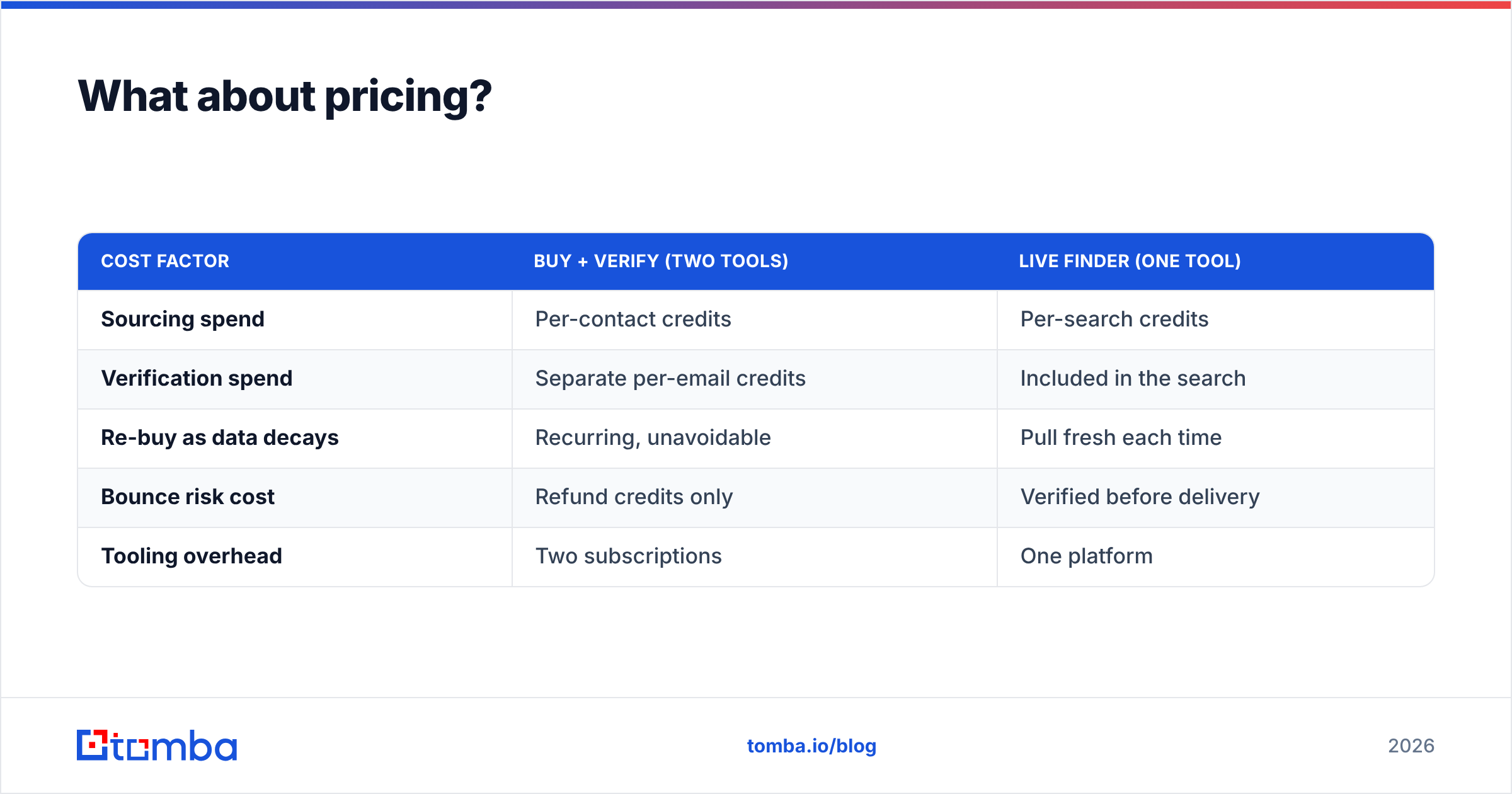
Cost comparison is tricky because the models differ. Bookyourdata and TrueVerify both sell credits, but a Bookyourdata credit unlocks a contact while a TrueVerify credit checks an address you already have. You can't compare the two numbers directly — you'd often pay for both.
That stacking is where a combined platform changes the total. Here's how the spend logic compares.
| Cost factor | Buy + verify (two tools) | Live finder (one tool) |
|---|---|---|
| Sourcing spend | Per-contact credits | Per-search credits |
| Verification spend | Separate per-email credits | Included in the search |
| Re-buy as data decays | Recurring, unavoidable | Pull fresh each time |
| Bounce risk cost | Refund credits only | Verified before delivery |
| Tooling overhead | Two subscriptions | One platform |
Tomba's plans run from a Free tier (25 searches/month) to Starter at $49/mo, Growth at $99/mo, Pro at $249/mo, and custom Enterprise — with finding and verification under one roof, so you're not paying a sourcing vendor and a verification vendor in parallel. Check the live Tomba pricing for current credit allowances.
Can you use them together?#
Yes — and for some teams that's the pragmatic answer in the short term. If you've already committed to Bookyourdata for sourcing, running its exports through TrueVerify (or any verifier) before you send is smart hygiene; never trust a purchased list's deliverability blindly, even with a guarantee. You can read more on why verification matters in any list workflow at Capterra's email verification category or the broader concept on Wikipedia's email verification overview.
But "use both" means two contracts, two credit pools, and a list that still ages between the day you buy it and the day you send. The combined-tool approach exists precisely to remove that gap: find the current address and confirm it's deliverable in one motion. If you're evaluating fresh, it's worth pricing the single-platform path before you lock into a buy-then-scrub stack.
The bottom line#
Bookyourdata and TrueVerify aren't really rivals — they're two stages of the same pipeline. Bookyourdata fills your list; TrueVerify cleans it. Both inherit the fundamental flaw of static B2B data: it decays the moment it's captured, and no refund policy or verification pass reverses that.
If your goal is current, verified contacts without juggling a sourcing vendor and a verification vendor, start with a live email finder. Tomba's Email Finder pulls professional email addresses by name, domain, or company and verifies them in the same step — sourcing and deliverability in one workflow, with transparent data sources and a free tier to test it on your own target accounts. Run a few searches against the prospects you actually want to reach, compare the results to any list you'd buy or scrub, and let the hit rate decide.
// get started
Find, verify and enrich your first contacts today
Start on the free plan with 25 searches a month, then scale when your team is ready.
Free plan · No credit card required · GDPR & CCPA
// about the author