Bookyourdata vs Verifalia: Data vs Verification (2026)
Bookyourdata sells B2B contact lists; Verifalia verifies email lists. Here's which one you actually need in 2026 — and why the answer is often both.
Most people who type "bookyourdata vs verifalia" into Google are comparing two tools that don't actually do the same job. That confusion is the whole problem — and it costs teams money every month.
TL;DR#
- Bookyourdata is a data seller. It hands you pre-built or filtered B2B contact lists (emails, titles, phone numbers) on a pay-as-you-go credit model.
- Verifalia is a verifier. It takes a list you already have and tells you which addresses are deliverable, risky, or dead. It does not source new contacts.
- They are complementary, not competitors. Buying a list from Bookyourdata and then cleaning it through Verifalia is a common two-tool workflow.
- If you want one platform that finds and verifies contacts from fresh data, a combined tool like Tomba Email Finder replaces both line items.
- Bottom line: pick Bookyourdata for raw contacts, Verifalia for hygiene — or skip the stack and use a find-plus-verify platform.
What is Bookyourdata?#
Bookyourdata is a B2B contact database you buy from. You filter by industry, job title, company size, location, and technology, then pay per record to download a list of emails and phone numbers. Their pitch centers on a large database (200M+ contacts) and a deliverability guarantee — they advertise refunds or credits for addresses that bounce above a stated threshold.
The model is pay-as-you-go credits rather than a forced subscription, which appeals to teams that buy lists in bursts. You're essentially renting access to a static dataset and exporting slices of it. You can see their positioning on bookyourdata.com and read user experiences on G2.
The catch with any list seller is freshness. B2B data decays fast — people change jobs, companies get acquired, domains get retired. A "97% deliverable" guarantee at the moment of purchase says nothing about the list you exported three months ago. That decay is exactly why a verification step exists at all.
What is Verifalia?#
Verifalia is an email verification service. You upload a list (or call its API in real time), and it runs each address through syntax checks, DNS and MX record lookups, SMTP probing, role-account detection, disposable-domain filtering, and catch-all classification. The output is a status per address: deliverable, undeliverable, risky, or unknown.
Verifalia has been around since the mid-2000s, runs as both a web app and a developer API, and is well regarded for verification depth — especially its handling of catch-all domains and its tiered confidence ratings. You can review the product at verifalia.com.
What Verifalia does not do is find anyone. It has no contact database. If you have zero emails, Verifalia gives you zero results. It is a hygiene layer that sits on top of a data source you supply yourself — whether that source is a scraped list, a CRM export, a signup form, or a purchase from a vendor like Bookyourdata.
Is Bookyourdata better than Verifalia?#
Wrong question. They occupy different stages of the same pipeline:
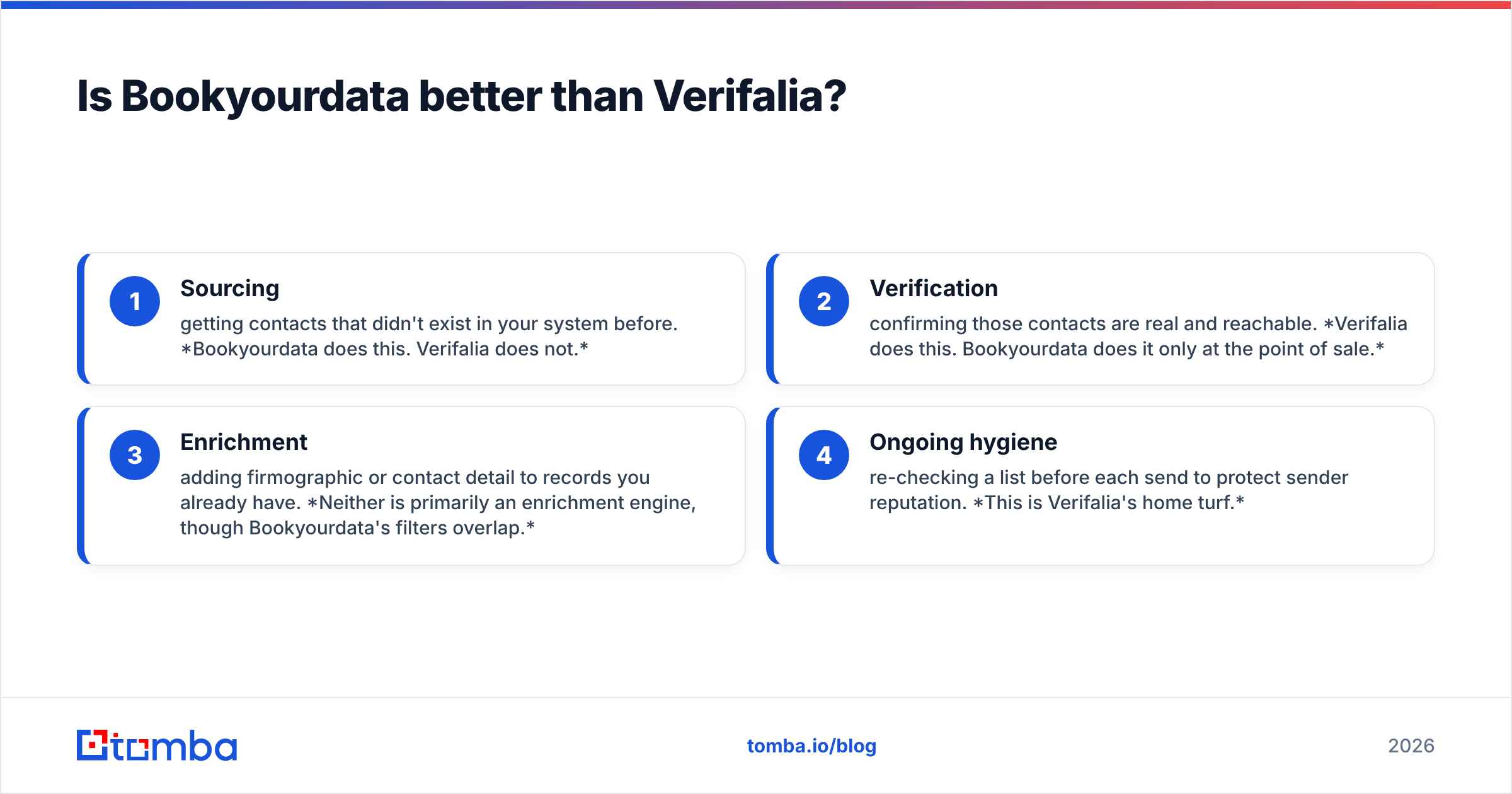
- Sourcing — getting contacts that didn't exist in your system before. Bookyourdata does this. Verifalia does not.
- Verification — confirming those contacts are real and reachable. Verifalia does this. Bookyourdata does it only at the point of sale.
- Enrichment — adding firmographic or contact detail to records you already have. Neither is primarily an enrichment engine, though Bookyourdata's filters overlap.
- Ongoing hygiene — re-checking a list before each send to protect sender reputation. This is Verifalia's home turf.
Asking which is "better" is like asking whether a grocery store is better than a refrigerator. One supplies the food; the other keeps it from spoiling. You typically need both — or a single appliance that does the job end to end.
How do Bookyourdata and Verifalia compare?#
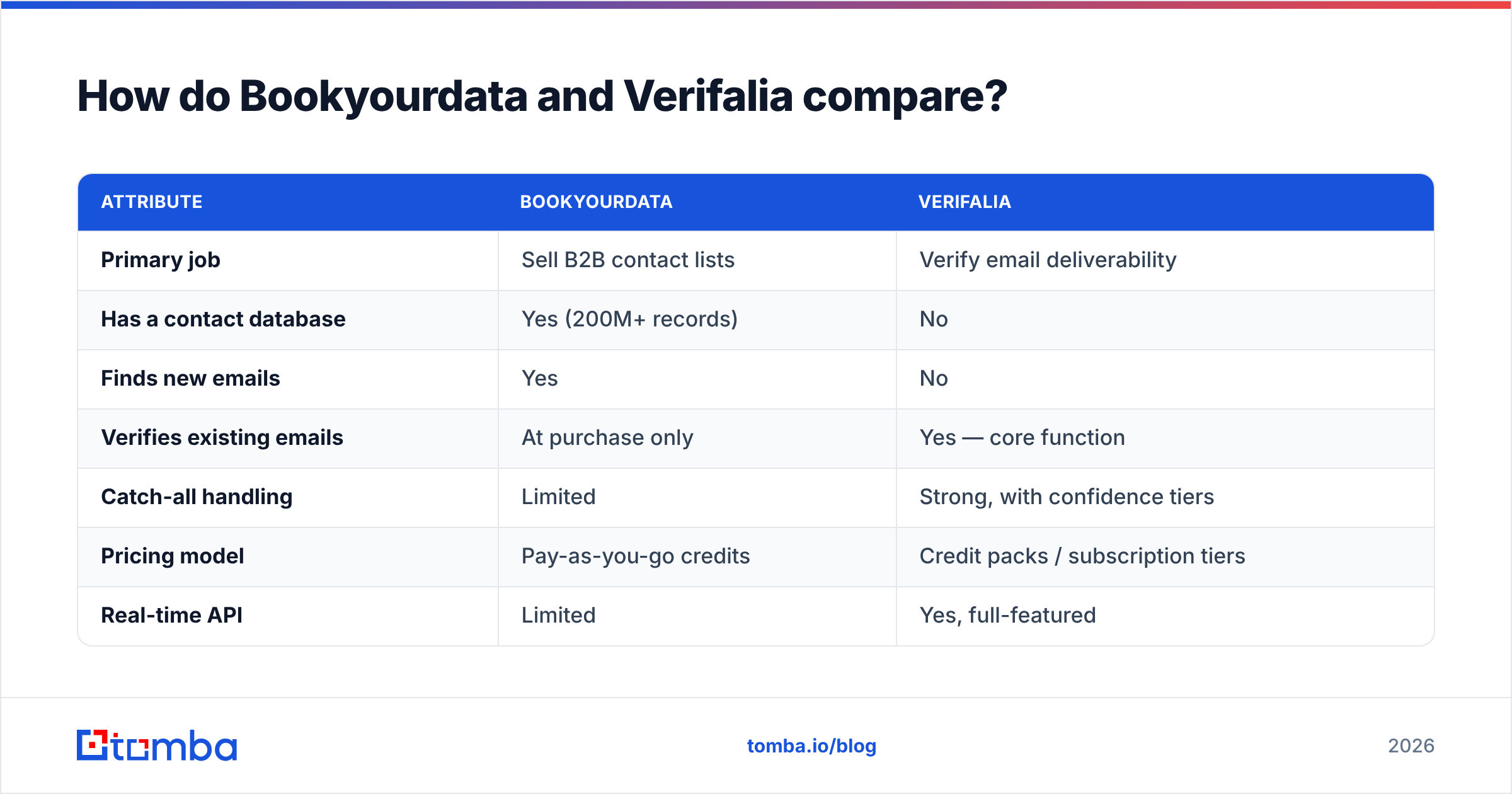
Here's the head-to-head on what each tool actually delivers:
| Attribute | Bookyourdata | Verifalia |
|---|---|---|
| Primary job | Sell B2B contact lists | Verify email deliverability |
| Has a contact database | Yes (200M+ records) | No |
| Finds new emails | Yes | No |
| Verifies existing emails | At purchase only | Yes — core function |
| Catch-all handling | Limited | Strong, with confidence tiers |
| Pricing model | Pay-as-you-go credits | Credit packs / subscription tiers |
| Real-time API | Limited | Yes, full-featured |
| Best for | Buying targeted lists | Cleaning any list before send |
| Weak spot | Data decay after export | Useless without a source list |
The pattern is clear: their strengths are each other's blind spots. That's why so many teams run them together — and why running two subscriptions is rarely the most efficient setup.
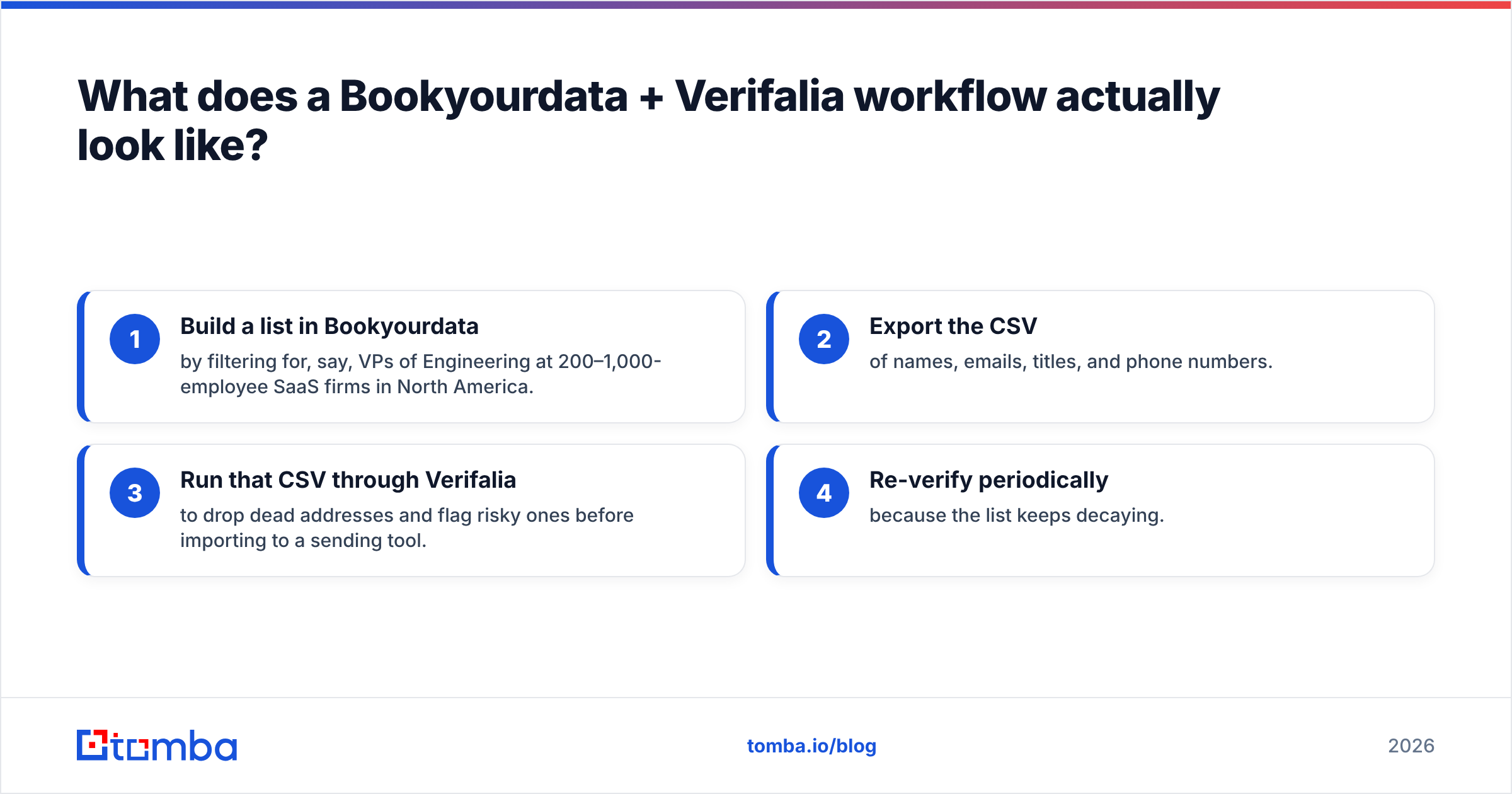
What does a Bookyourdata + Verifalia workflow actually look like?#
A typical outbound team using both tools does this:
- Build a list in Bookyourdata by filtering for, say, VPs of Engineering at 200–1,000-employee SaaS firms in North America.
- Export the CSV of names, emails, titles, and phone numbers.
- Run that CSV through Verifalia to drop dead addresses and flag risky ones before importing to a sending tool.
- Re-verify periodically because the list keeps decaying.
It works. But you're paying two vendors, managing two exports, and stitching the data by hand in a spreadsheet. Every CSV hop is a chance for column mismatches, duplicates, and stale rows to creep in. If you do this weekly, the operational tax adds up fast.
Can one tool replace both?#
Yes — and that's the honest reason to look past this matchup. A platform that finds emails from live sources and verifies them in the same step collapses the two-vendor workflow into one.
This is where Tomba fits. Instead of buying a static list and cleaning it elsewhere, you search by company domain or by name, and Tomba returns professional addresses that are scored and checked at the moment you pull them. The built-in email verifier and catch-all verifier handle the hygiene layer Verifalia would otherwise own, and bulk lookups cover the list-building that Bookyourdata would otherwise own.
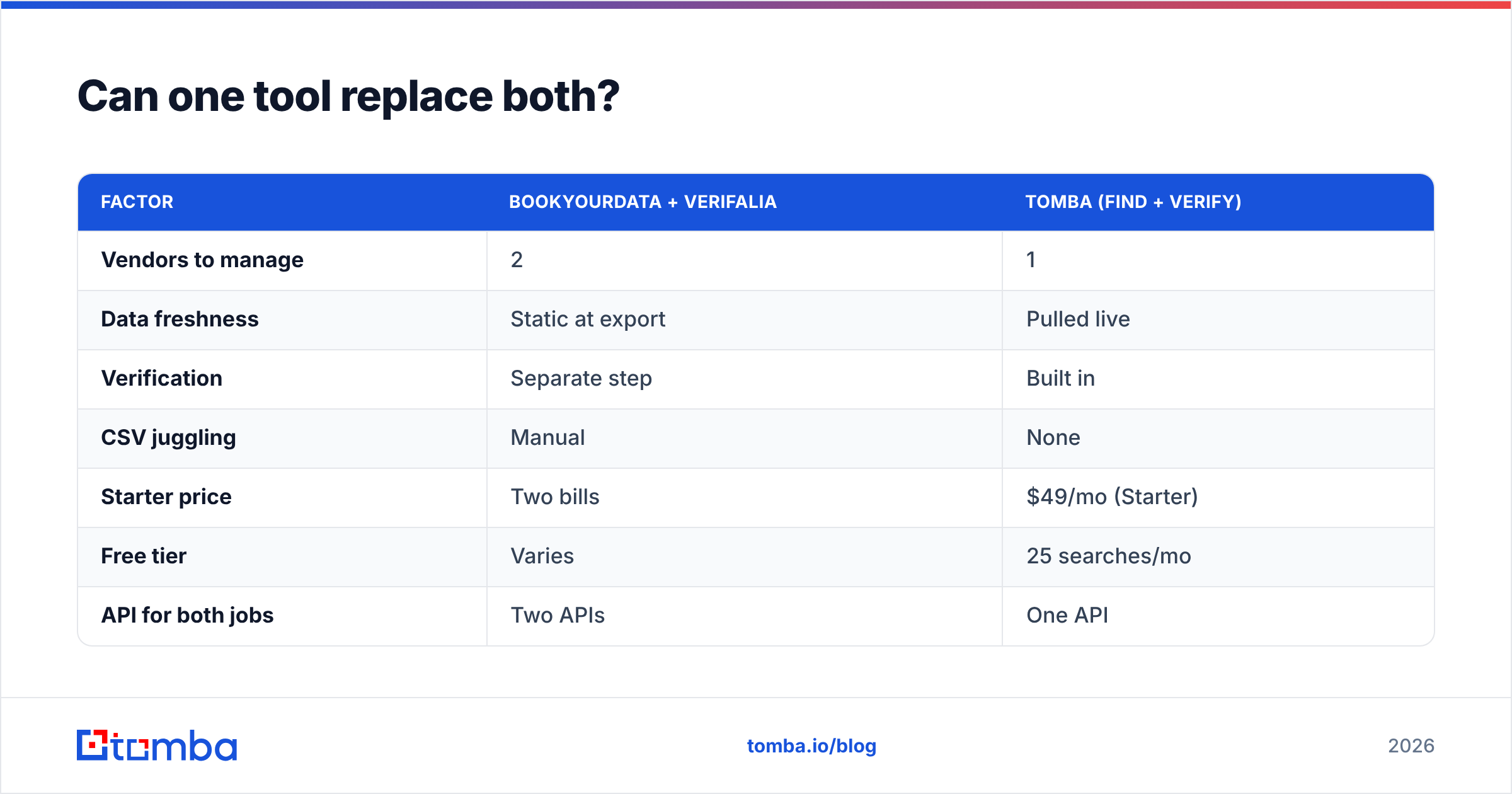
Here's how the single-platform approach stacks up against running the two-tool stack:
| Factor | Bookyourdata + Verifalia | Tomba (find + verify) |
|---|---|---|
| Vendors to manage | 2 | 1 |
| Data freshness | Static at export | Pulled live |
| Verification | Separate step | Built in |
| CSV juggling | Manual | None |
| Starter price | Two bills | $49/mo (Starter) |
| Free tier | Varies | 25 searches/mo |
| API for both jobs | Two APIs | One API |
You can compare full Tomba pricing against stacking two subscriptions, but the structural win is fewer moving parts: one search returns a verified contact, no export-import shuffle.
How accurate is each tool?#
Accuracy means different things for each. Bookyourdata's accuracy is a snapshot — how deliverable the list was the day it was sold. Their guarantee is real, but it's bounded by that timestamp and by how recently their underlying records were refreshed. Verifalia's accuracy is procedural — how reliably its SMTP and catch-all logic classifies an address you hand it right now.
For deliverability protection, procedural verification wins, because it reflects the address's current state, not its state at some past purchase. That's also why a find-and-verify tool that checks on retrieval tends to beat a buy-then-clean stack: the verification timestamp matches the day you actually send.
If your real concern is protecting email deliverability and inbox placement, the freshest possible verification is the one that happens closest to send time — not at a vendor's last database refresh.
Which should you choose?#
Decide by what you're missing:
- You have no contacts and need targeted lists fast → Bookyourdata gives you sourcing. Plan to verify before you send.
- You already have lists (CRM exports, signups, scrapes) that need cleaning → Verifalia is the focused, reliable choice. It won't find anyone, but it cleans well.
- You need both finding and verifying, and don't want two bills or two CSVs → a combined platform like Tomba is the simpler path, with a free tier to test before committing.
- You're a developer wiring this into a product → compare Verifalia's verification API against Tomba's single email finder API that does both jobs in one call.
There's no shame in running Bookyourdata and Verifalia together if they each genuinely fit a stage you can't consolidate. But for most outbound and growth teams, the two-tool tax is avoidable.
Frequently asked questions#
Is Verifalia a Bookyourdata competitor? Not really. Bookyourdata sells contacts; Verifalia verifies them. They're more often used together than chosen one-over-the-other.
Does Bookyourdata verify its own data? It verifies at the point of sale and offers a deliverability guarantee, but it doesn't re-verify lists you've already exported. Data decays after download.
Can Verifalia find new email addresses? No. Verifalia has no contact database. You must supply the addresses you want checked.
What's the cheapest way to cover both jobs? A single platform that finds and verifies — like Tomba's Starter plan at $49/mo — usually beats paying two vendors, and the free tier lets you test the workflow first.
The bottom line#
Bookyourdata and Verifalia aren't rivals — they're two stages of one pipeline, and treating them as an either/or comparison misses the point. Bookyourdata sources contacts; Verifalia keeps them clean. If you genuinely need only sourcing or only hygiene, pick the matching tool. But if you need both, stacking two subscriptions and shuttling CSVs between them is the expensive way to do it.
Try Tomba's Email Finder instead: search by name or domain, get professional emails that are verified the moment you pull them, and run the whole find-plus-verify motion from one dashboard or one API call. Start free with 25 searches a month and see whether one tool can quietly replace your two-vendor stack.
// get started
Find, verify and enrich your first contacts today
Start on the free plan with 25 searches a month, then scale when your team is ready.
Free plan · No credit card required · GDPR & CCPA
// about the author