Bookyourdata vs Verifyemailio: 2026 B2B Data Comparison
Bookyourdata sells contact lists; Verifyemailio cleans them. We compare pricing, accuracy, and use cases to show which fits your 2026 outbound stack.
You typed "bookyourdata vs verifyemailio" into a search bar because you are about to spend money on B2B data and you do not want to torch your sender reputation doing it. Good instinct. The two tools sit on opposite ends of the same workflow, and picking the wrong one — or buying one when you needed the other — is how teams end up with a 14% bounce rate and a blocklisted domain.
This is a neutral breakdown of what each tool actually does, where each one is strong, and how to assemble a stack that gets you accurate inboxes without overpaying.
TL;DR#
- Bookyourdata is a pay-as-you-go B2B contact list provider. You buy records (emails, titles, phones) by the credit and download a CSV. It claims a 97% accuracy guarantee.
- Verifyemailio (Verifyemail.io) is an email verification tool. It does not give you new contacts — it tells you whether an address you already have is deliverable.
- They are complementary, not competitors. One sources data; the other cleans it. Comparing them head-to-head only makes sense if you are deciding which problem to solve first.
- If your real need is finding verified emails by name or domain (not buying bulk lists), a dedicated email finder with built-in verification covers both jobs in one pass.
- Skip to the comparison table if you just want the verdict.
What is Bookyourdata?#
Bookyourdata is a self-serve B2B database. You filter by industry, job title, location, company size, and technology, then pay per record to export a contact list — typically name, business email, phone, LinkedIn, and firmographics. Pricing is credit-based rather than a flat subscription, which appeals to teams that buy data in bursts (a one-off ABM campaign, a conference follow-up push) rather than continuously.
Its headline pitch is a 97% accuracy guarantee with credit refunds on bad records. That guarantee is doing a lot of marketing work, so treat it the way you treat any vendor's self-reported number: a starting point, not gospel. You can read their own framing on the Bookyourdata site and cross-check real buyer sentiment on G2 before committing budget.
The trade-off with any prepackaged list provider is freshness. People change jobs every ~2-3 years on average, so a record that was accurate when it entered the database decays whether or not you ever email it. That is exactly why verification exists.
What is Verifyemailio?#
Verifyemail.io is a single-purpose email verification service. You feed it addresses — one at a time via API or in bulk via CSV — and it returns a deliverability verdict: valid, invalid, risky, catch-all, disposable, role-based, and so on. It performs syntax checks, MX/DNS lookups, and SMTP handshakes without sending a real message.
What it does not do is generate contacts. If your CRM is empty, Verifyemailio cannot fill it. Its job starts the moment you already have addresses and ends with a clean, send-safe list. Think of it as a water filter: indispensable, but it does not dig the well.
This is the core reason "bookyourdata vs verifyemailio" is a slightly misframed question. One is the well; the other is the filter. The honest comparison is which gap you have, then whether either tool — or a third option — closes it best.
How do Bookyourdata and Verifyemailio compare side by side?#
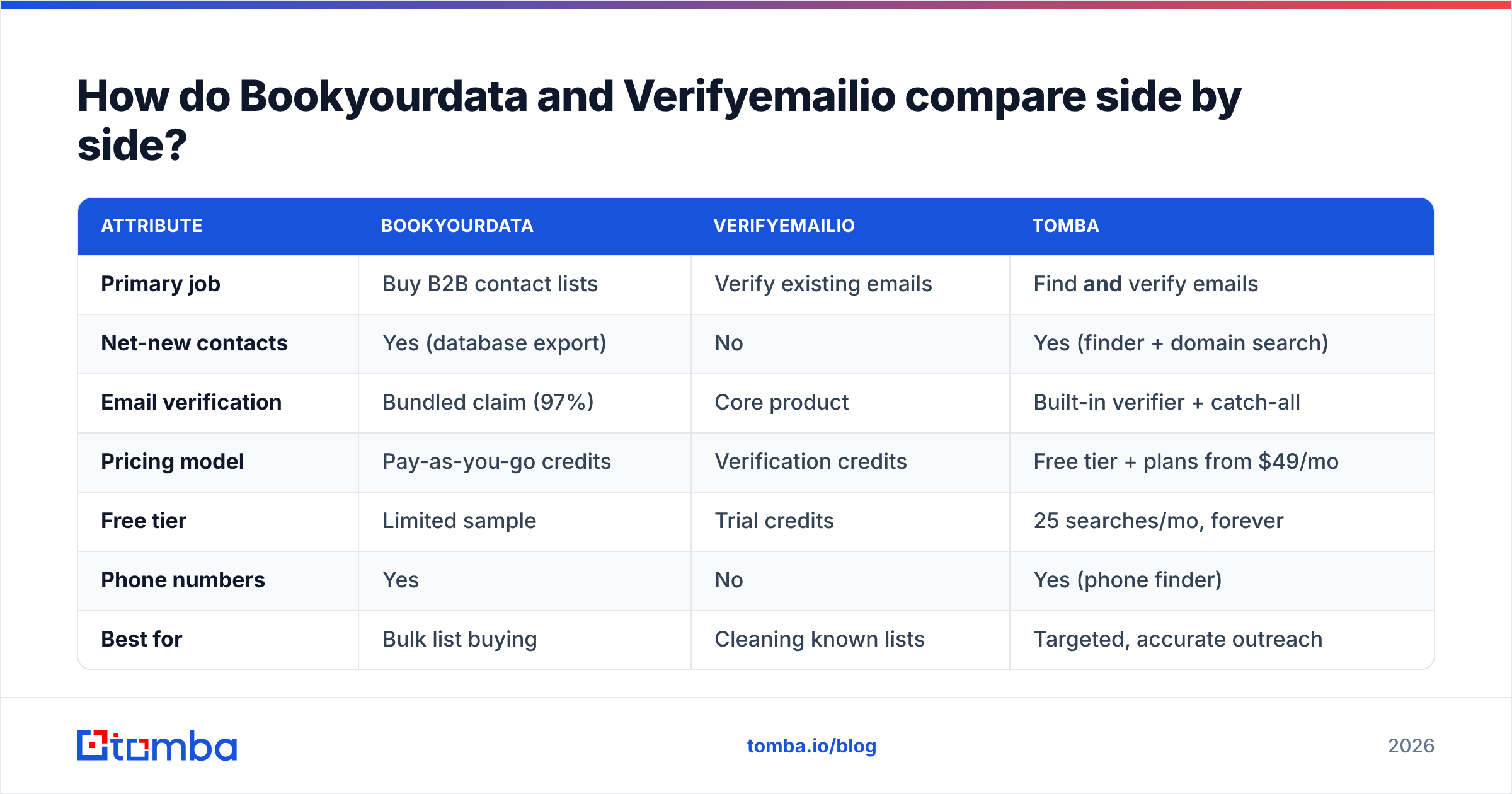
Here is the head-to-head on the attributes that actually drive a buying decision.
| Attribute | Bookyourdata | Verifyemailio | Tomba |
|---|---|---|---|
| Primary job | Buy B2B contact lists | Verify existing emails | Find and verify emails |
| Net-new contacts | Yes (database export) | No | Yes (finder + domain search) |
| Email verification | Bundled claim (97%) | Core product | Built-in verifier + catch-all |
| Pricing model | Pay-as-you-go credits | Verification credits | Free tier + plans from $49/mo |
| Free tier | Limited sample | Trial credits | 25 searches/mo, forever |
| Phone numbers | Yes | No | Yes (phone finder) |
| Best for | Bulk list buying | Cleaning known lists | Targeted, accurate outreach |
| API access | Yes | Yes | Yes (finder + verifier API) |
The pattern is clear: Bookyourdata and Verifyemailio each own one column of the workflow, while a finder-plus-verifier platform spans both. Whether that consolidation is worth it depends on how you source contacts in the first place.
Which problem are you actually solving?#
Pick the row that sounds like you:
- "I have no contacts and need a list fast." You need a data source. Bookyourdata fits, but budget for verification on top — never email a freshly bought list raw.
- "I already have a messy list and bounces are climbing." You need verification. Verifyemailio fits, and so does a standalone email verifier.
- "I know who I want but not their email." You need an email finder — search by name and company domain. Neither Bookyourdata's bulk export nor Verifyemailio's filter is built for this.
- "I want net-new contacts that are already verified." You need a finder with verification baked in, so you skip the buy-then-clean two-step entirely.
- "I scrape leads from LinkedIn or my website." You need enrichment plus verification at the point of capture, not a quarterly list purchase.
Most teams that think they need a bulk list actually live in rows 3 or 4 — they have target accounts and personas, just not the addresses. That is a finder job, not a list-buying job.
Is buying a list better than finding emails?#
Short answer: for precision outbound, finding beats buying more often than vendors admit.
A purchased list is a snapshot of a database on the day you exported it. You inherit every stale record, every job-changer, and every catch-all domain in the set. The 97% guarantee covers refunds on provably-bad records, but a refunded credit does not undo a hard bounce that already dinged your sender reputation.
Finding emails on demand flips the model. You pull the address for a specific person at a specific company now, verify it in the same step, and only then send. Fewer records, fresher data, lower bounce risk. When you do need volume, a bulk email finder runs the same find-and-verify logic across a whole upload instead of handing you a pre-aged CSV.
What does each option cost?#
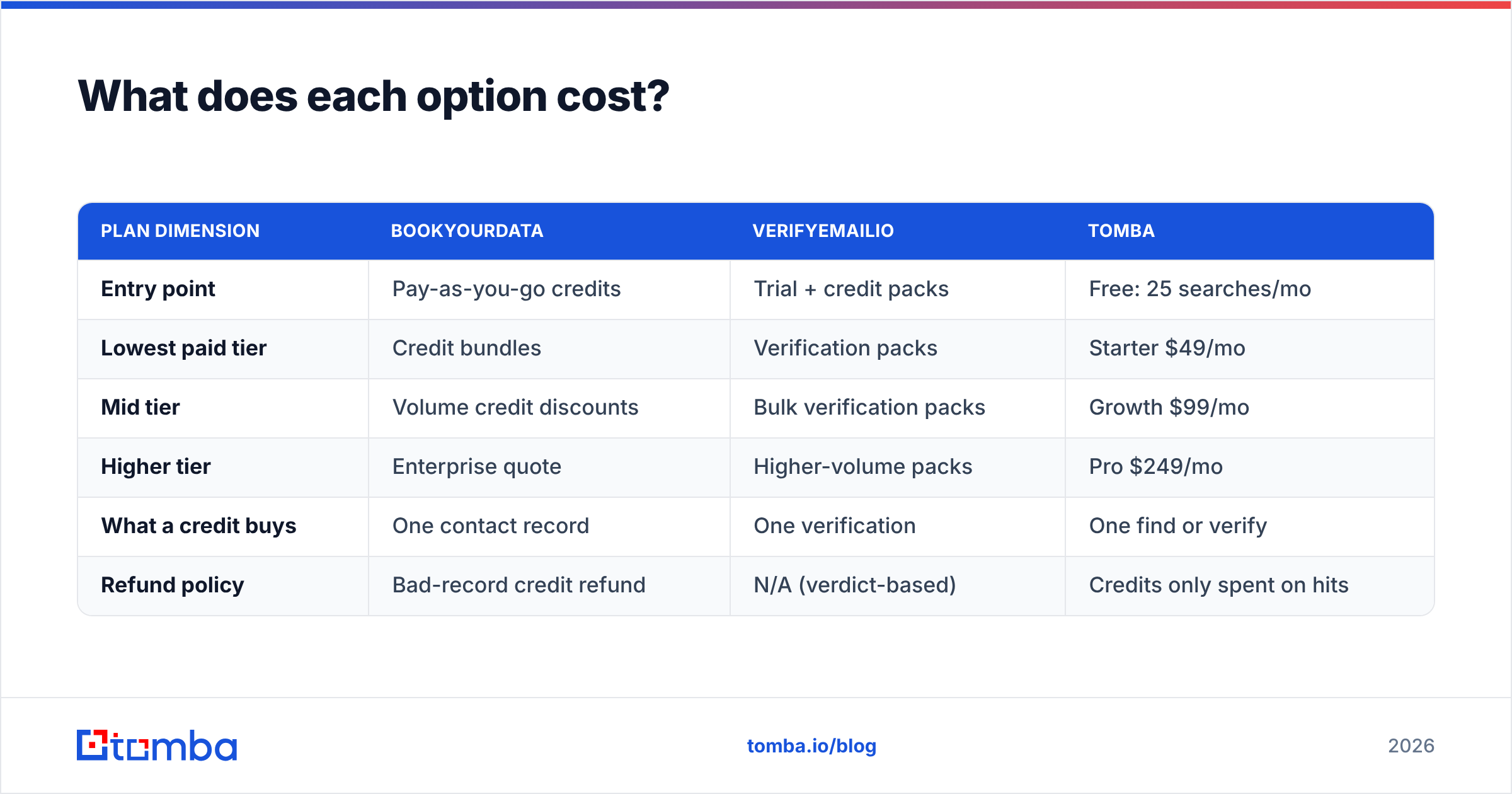
Bookyourdata and Verifyemailio both price on consumption, which makes apples-to-apples math hard until you know your volume. Here is the shape of it.
| Plan dimension | Bookyourdata | Verifyemailio | Tomba |
|---|---|---|---|
| Entry point | Pay-as-you-go credits | Trial + credit packs | Free: 25 searches/mo |
| Lowest paid tier | Credit bundles | Verification packs | Starter $49/mo |
| Mid tier | Volume credit discounts | Bulk verification packs | Growth $99/mo |
| Higher tier | Enterprise quote | Higher-volume packs | Pro $249/mo |
| What a credit buys | One contact record | One verification | One find or verify |
| Refund policy | Bad-record credit refund | N/A (verdict-based) | Credits only spent on hits |
Two budgeting notes. First, if you buy a list and verify it separately, you are paying twice for one usable contact — once to acquire it, once to confirm it. Second, a platform that bundles both into one credit is usually cheaper per deliverable contact even when the sticker price looks similar. Compare the full Tomba pricing against your projected Bookyourdata-plus-verification spend, not against either one alone.
How accurate is each tool, really?#
Accuracy claims need translating, because vendors measure different things.
Bookyourdata's "97%" refers to its database records at export time. Verifyemailio's accuracy refers to its verdict on a given address — how often "valid" actually delivers. Those are not the same metric, and neither one predicts your campaign bounce rate by itself. Your real-world deliverability is a product of both: data freshness at source and verification quality before send.
The failure mode to watch for is catch-all domains — servers that accept any address, so an SMTP check can't confirm the specific mailbox exists. List providers happily include catch-all records; basic verifiers flag them "risky" and leave you guessing. Handling them well needs a dedicated catch-all verifier that probes deeper, which is where thin single-purpose tools tend to fall short.
A practical rule: never trust a single accuracy number. Run a small test batch through your full pipeline, measure the actual bounce rate, and let that decide your spend.
When should you use Bookyourdata or Verifyemailio anyway?#
They are genuinely the right call in specific cases. Be honest about whether you are in one:
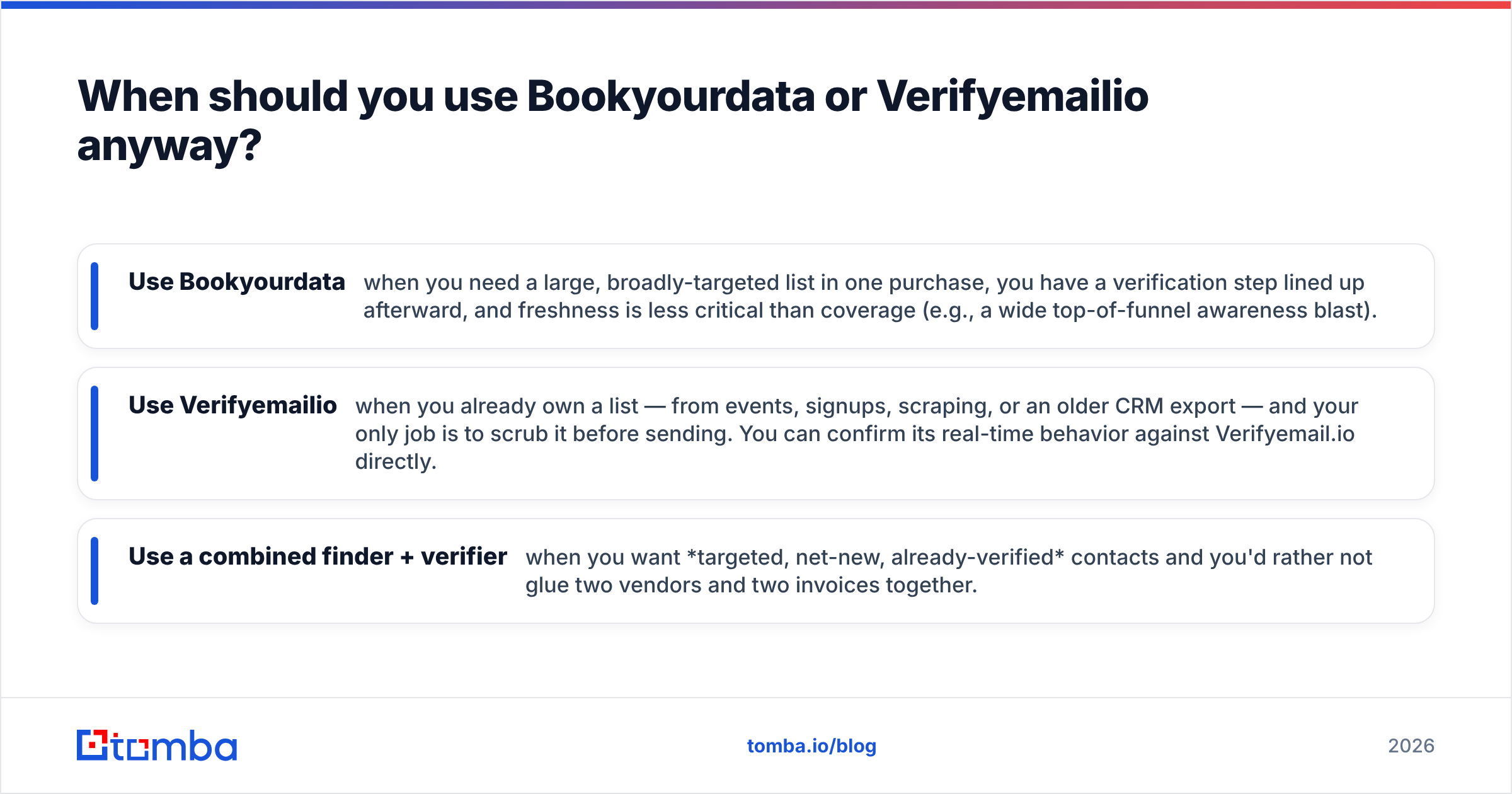
- Use Bookyourdata when you need a large, broadly-targeted list in one purchase, you have a verification step lined up afterward, and freshness is less critical than coverage (e.g., a wide top-of-funnel awareness blast).
- Use Verifyemailio when you already own a list — from events, signups, scraping, or an older CRM export — and your only job is to scrub it before sending. You can confirm its real-time behavior against Verifyemail.io directly.
- Use a combined finder + verifier when you want targeted, net-new, already-verified contacts and you'd rather not glue two vendors and two invoices together.
There is no shame in stacking tools. The mistake is buying a list and skipping verification, or verifying endlessly without a way to source fresh contacts in the first place.
So which one wins for 2026?#
It depends on the gap you're closing — but for most outbound and demand-gen teams, the highest-ROI move in 2026 is find-and-verify in one pass, not buy-then-clean across two vendors.
- Choose Bookyourdata if bulk list acquisition is your bottleneck and you'll verify separately.
- Choose Verifyemailio if you only need to clean lists you already have.
- Choose a combined platform if you want accurate, fresh, verified contacts without paying twice per usable lead or managing two tools.
The reason "bookyourdata vs verifyemailio" is the wrong framing for most readers: you're usually not choosing between a database and a filter — you're trying to get verified emails into your sequence as cheaply and cleanly as possible. That's a single job, and it's worth using a single tool for it.
Get verified B2B emails without buying stale lists#
If your goal is fresh, accurate, ready-to-send contacts — not a pre-aged CSV and a separate cleanup bill — start with the Tomba Email Finder. Search by name, company, or domain; every result is verified before it lands in your export, with catch-all detection and bulk processing built in. The free tier gives you 25 searches a month to test it against your own target accounts, and paid plans start at $49/mo when you're ready to scale. Run a real list through it, measure your bounce rate, and let the data pick the winner.
// get started
Find, verify and enrich your first contacts today
Start on the free plan with 25 searches a month, then scale when your team is ready.
Free plan · No credit card required · GDPR & CCPA
// about the author