Bookyourdata vs Vulcan7 (2026): Which B2B Data Tool Wins?
Bookyourdata sells pay-as-you-go email lists; Vulcan7 powers real estate cold calling. Here's an honest 2026 breakdown of accuracy, pricing, and the better fit for your pipeline.
Two tools, two completely different jobs — yet "Bookyourdata vs Vulcan7" gets typed into search every week by people trying to pick one. If that's you, the short answer is that they barely compete, and the right choice depends entirely on whether you sell to businesses by email or to homeowners by phone.
This breakdown cuts through the marketing on both sites, lays out pricing and data quality side by side, and shows where a precision email finder beats either one for modern B2B outbound.
TL;DR#
- Bookyourdata is a pay-as-you-go B2B contact list builder. You filter by industry, title, and geography, then buy verified business emails by the credit. Best for one-off list pulls.
- Vulcan7 is a real estate prospecting platform — expired and FSBO seller leads bundled with a power dialer. It is built for agents cold calling homeowners, not B2B teams.
- They solve different problems. If you sell B2B, Bookyourdata is the relevant option; if you're a real estate agent, Vulcan7 is.
- Accuracy is the real battleground. Static purchased lists decay 2–3% per month, so even a "95% verified" list rots fast.
- For repeatable, fresh B2B contact data, an on-demand email finder plus a email verifier usually beats buying a one-time list.
What is Bookyourdata?#
Bookyourdata is a self-serve B2B data marketplace. You log in, filter a database of business contacts by job title, industry, company size, location, and a handful of technographic fields, then pay per record to download verified emails (and sometimes direct dials). The pitch is a "95% deliverability guarantee" with pay-as-you-go credits that never expire.
The model is straightforward: it's a list-buying tool. You're not running live lookups against a person you found on LinkedIn — you're pulling a slice of a pre-built database. That's great when you want 2,000 marketing directors in SaaS today and don't want a subscription. It's weaker when you need the one specific person at an account, because that contact may or may not sit in their database.
You can read their own positioning on the Bookyourdata homepage, and cross-check user sentiment on G2.
What is Vulcan7?#
Vulcan7 is not a B2B tool at all — it's a real estate lead-generation and dialer platform. Agents subscribe to get daily feeds of expired listings, for-sale-by-owner (FSBO), pre-foreclosure, and "FRBO" (for-rent-by-owner) leads, complete with homeowner phone numbers, then dial them through a built-in power dialer that calls multiple lines at once.
Its whole reason to exist is helping listing agents reach motivated home sellers by phone before the competition does. If your "outbound" means calling homeowners about their expired listing, Vulcan7 is purpose-built. If it means emailing a VP of Engineering about your API product, Vulcan7 has nothing for you. See the Vulcan7 homepage for the real estate framing.
So why do people compare them? Both get tagged as "lead data" or "sales prospecting" tools in directories like Capterra, and the names surface together. But choosing between them is mostly choosing your channel and audience, not your software.
)
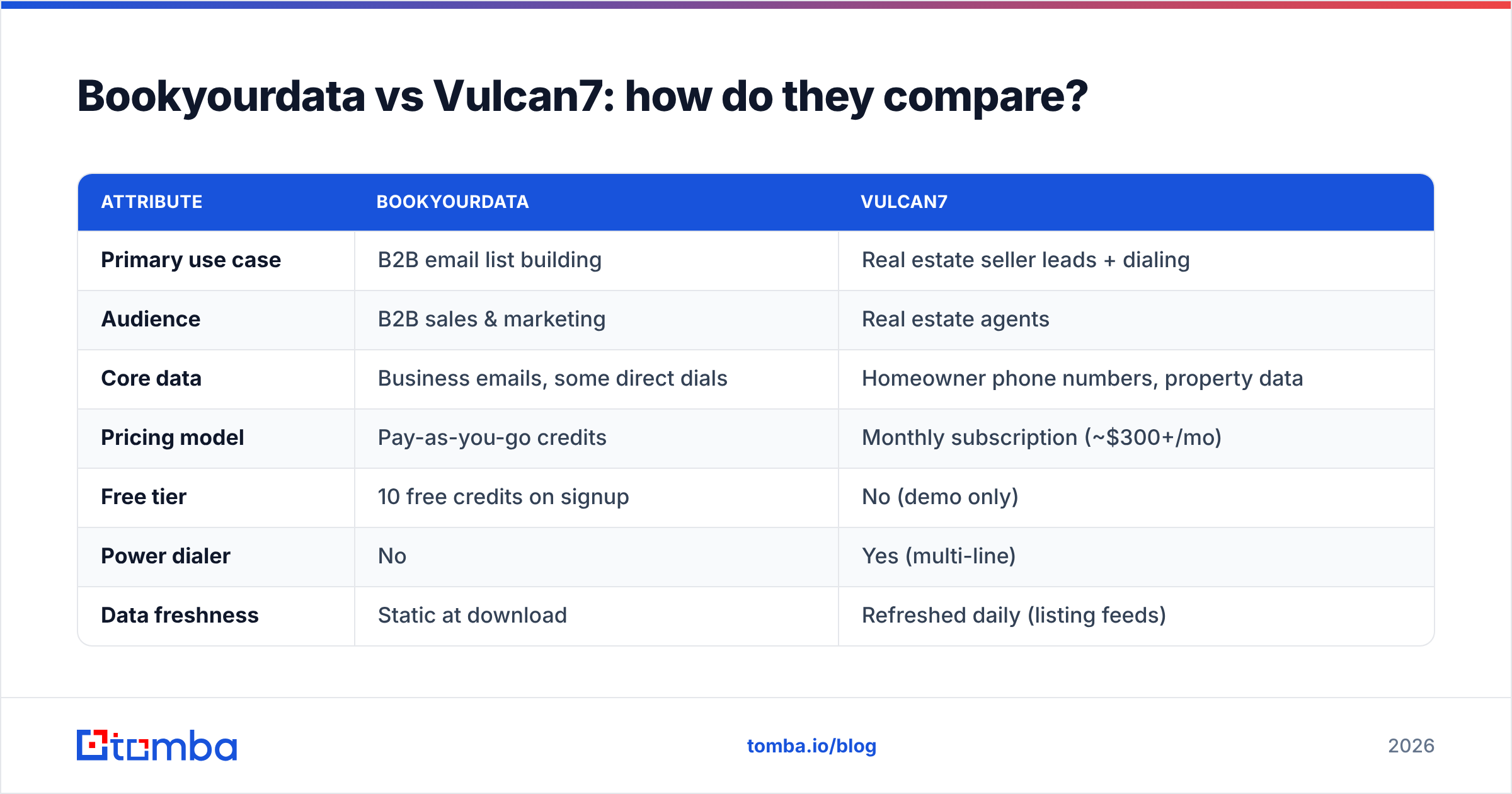
Bookyourdata vs Vulcan7: how do they compare?#
Here's the honest side-by-side. Notice how little overlap there actually is.
| Attribute | Bookyourdata | Vulcan7 |
|---|---|---|
| Primary use case | B2B email list building | Real estate seller leads + dialing |
| Audience | B2B sales & marketing | Real estate agents |
| Core data | Business emails, some direct dials | Homeowner phone numbers, property data |
| Pricing model | Pay-as-you-go credits | Monthly subscription (~$300+/mo) |
| Free tier | 10 free credits on signup | No (demo only) |
| Power dialer | No | Yes (multi-line) |
| Data freshness | Static at download | Refreshed daily (listing feeds) |
| Best for | One-off targeted lists | Daily cold-calling workflows |
| Not good for | Real estate phone outreach | Any B2B email outreach |
The takeaway in one line: these tools don't beat each other — they serve different buyers. The real question isn't "which one," it's "which channel and audience am I working," and then whether a list is even the right format.
Which one is better for B2B sales?#
Bookyourdata, by default — but with a caveat about freshness. If you're a B2B seller, Vulcan7 is irrelevant, so Bookyourdata wins the matchup automatically. The harder question is whether any static list is the right tool in 2026.
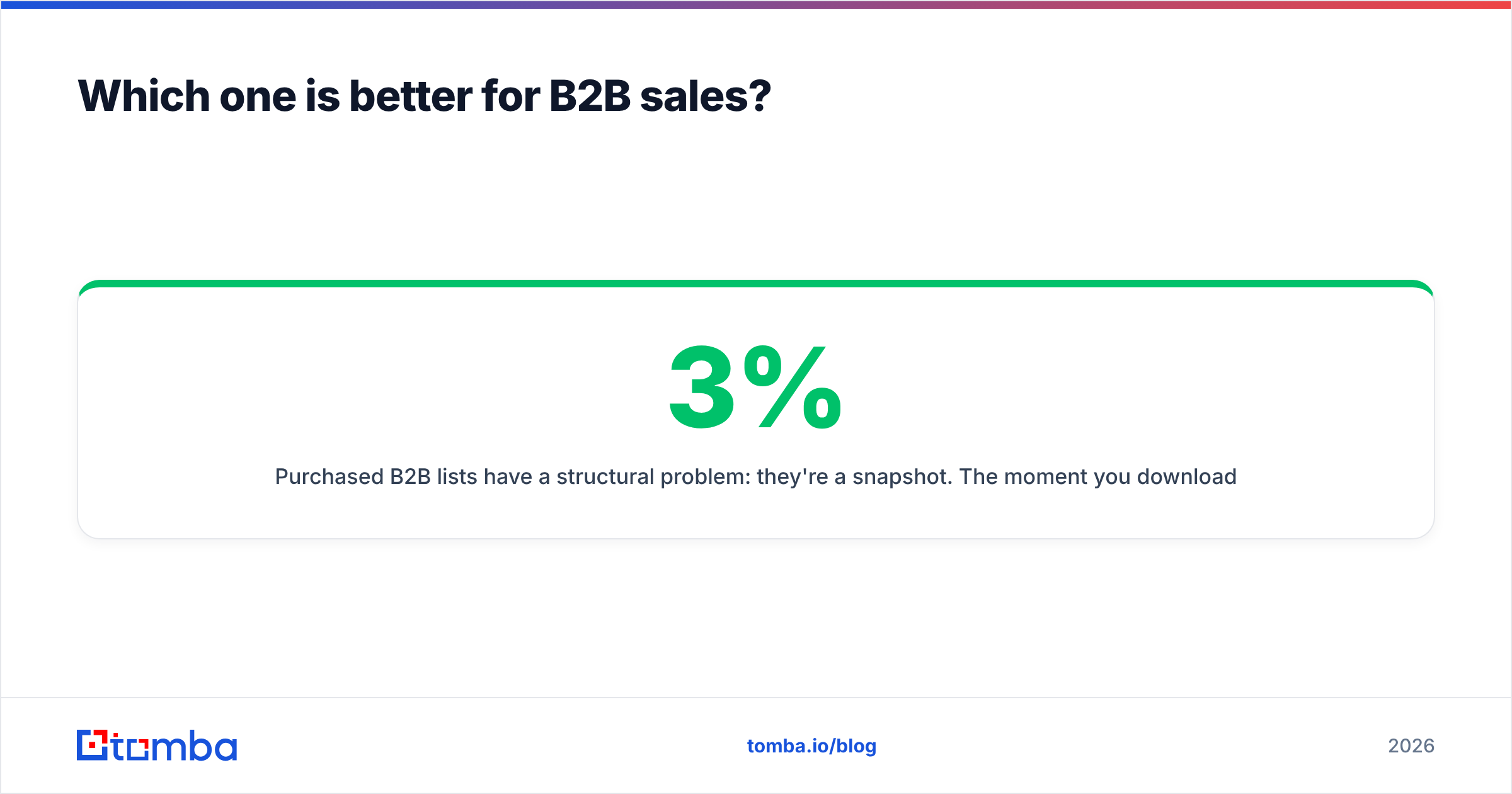
Purchased B2B lists have a structural problem: they're a snapshot. The moment you download, decay starts. Industry data on email database decay runs around 2–3% per month from job changes, departures, and domain switches — roughly 25–30% of a list goes stale in a year. A "95% verified at export" list can drift toward 70% deliverable within months sitting in your CRM.
That's why high-performing teams increasingly skip bulk purchases for on-demand finding plus verification at the moment of outreach:
- Build the target list from intent — find the exact accounts and people you want to reach this week, not a generic database slice.
- Find emails on demand — run names and domains through an email finder so every address is pulled fresh.
- Verify before sending — pass each one through an email verifier to drop catch-alls and dead inboxes that wreck deliverability.
- Enrich the record — add firmographics and role data via data enrichment so reps personalize, not spray.
- Sync, don't dump — push verified contacts into your sequencer in small, current batches instead of a 50k static import.
This is the difference between renting a list and owning a repeatable pipeline. A list is a one-time asset that depreciates; a finder-plus-verifier workflow is a process you re-run whenever you need fresh contacts.
How accurate is the data?#
Both claim high accuracy at the point of delivery — the gap is what happens after. Bookyourdata markets a 95% deliverability guarantee; Vulcan7's value is that its listing feeds refresh daily, so its homeowner data is genuinely fresher than a static B2B list because the source updates constantly.
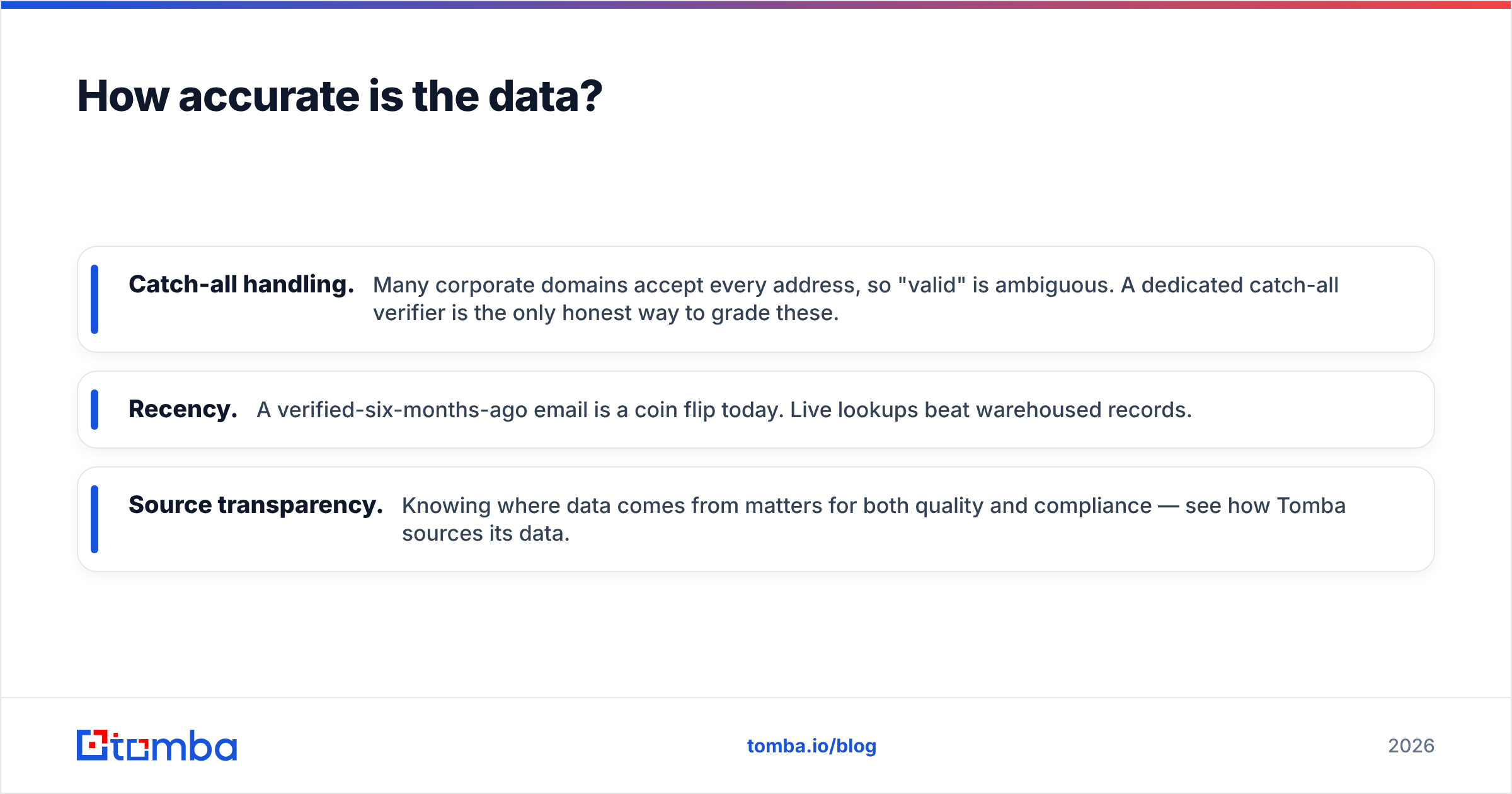
For B2B email specifically, the accuracy you care about is at send time, not export time. Three things separate good data from costly bounces:
- Catch-all handling. Many corporate domains accept every address, so "valid" is ambiguous. A dedicated catch-all verifier is the only honest way to grade these.
- Recency. A verified-six-months-ago email is a coin flip today. Live lookups beat warehoused records.
- Source transparency. Knowing where data comes from matters for both quality and compliance — see how Tomba sources its data.
If you buy a Bookyourdata list, re-verify it right before your first send. Don't trust the export-day percentage on outreach day — that single step prevents the bounce spike that lands you in spam folders.
What about pricing?#
Different models entirely, which makes raw price comparison misleading. Bookyourdata is consumption-based — you buy credits and spend them per record, and unused credits don't expire. Vulcan7 is a recurring subscription, typically a few hundred dollars a month, because you're paying for a continuously refreshed lead feed plus dialer software, not a one-time download.
| Plan dimension | Bookyourdata | Vulcan7 | Tomba |
|---|---|---|---|
| Entry model | Pay-as-you-go credits | Monthly subscription | Free + monthly plans |
| Free to start | 10 credits | Demo only | 25 searches/mo |
| Paid entry | Per-credit packs | ~$300+/mo | $49/mo Starter |
| Mid tier | Larger credit packs | Add-on lead types | $99/mo Growth |
| Higher tier | Volume discounts | Multi-line dialer add-ons | $249/mo Pro |
| Credits expire? | No | N/A (subscription) | Monthly reset |
If you want the full ladder for the finder-plus-verifier approach, the Tomba pricing page lays out each tier — the free plan gives you 25 searches a month to test accuracy before paying anything.
A practical rule: pay-as-you-go (Bookyourdata or Tomba's credit-style usage) wins for sporadic, bursty list needs; a subscription wins only when you consume data every single day, which is exactly Vulcan7's real estate dialing use case.
)
When should you pick each tool?#
Match the tool to the job, not the hype:
- Pick Vulcan7 if you're a real estate agent or team whose day is built around calling expired and FSBO sellers, and you need a dialer wired to fresh homeowner leads. Nothing on the B2B side replaces it for that workflow.
- Pick Bookyourdata if you need a quick, one-off B2B list — say a few thousand targeted contacts for a single campaign — and you don't want a subscription. Just re-verify before you send.
- Pick a finder + verifier (like Tomba) if B2B email is an ongoing motion: you want fresh addresses on demand, want to verify at send time, and want an Tomba API or bulk email finder to wire data straight into your stack instead of importing static CSVs.
Many teams run a hybrid: a list tool for a fast cold start, then a finder-plus-verifier as the durable engine. You can also layer in a phone finder when you need B2B direct dials — the equivalent of what Vulcan7 gives real estate agents, but for business contacts.
What are the main limitations to watch?#
No tool is free of trade-offs, so go in clear-eyed:
- Bookyourdata: static data decays after purchase; coverage depends on whether your exact targets sit in their database; you re-buy for every refresh.
- Vulcan7: locked to real estate; useless for B2B; subscription runs whether you dial that month or not.
- Finder + verifier: you need names or domains to start (it finds emails for known targets rather than handing you a pre-built audience), so pair it with a list source or prospecting workflow when you need net-new accounts.
Knowing the ceiling of each tool up front saves you the "why is half my list bouncing" conversation three weeks into a campaign.
The bottom line#
Bookyourdata vs Vulcan7 isn't really a duel — it's a fork in the road. Vulcan7 is the answer for real estate agents dialing sellers. Bookyourdata is the answer for a quick B2B list pull. And for B2B teams that treat outbound as an ongoing engine rather than a one-time buy, neither static-list nor real-estate-dialer model fits as well as finding and verifying contacts on demand.
If your problem is "I need accurate, fresh business emails whenever I want them — not a list that's stale by next quarter," start with the Tomba Email Finder. Use the free 25-searches-a-month tier to test accuracy against your own target accounts, verify every address before you send, and keep your pipeline running on current data instead of a depreciating CSV. That's the difference between buying leads once and building a system that produces them on repeat.
// get started
Find, verify and enrich your first contacts today
Start on the free plan with 25 searches a month, then scale when your team is ready.
Free plan · No credit card required · GDPR & CCPA
// about the author