Bookyourdata vs Webbula 2026: B2B Data Provider Compared
Bookyourdata sells ready-made B2B contact lists; Webbula cleans and validates them. Here's how the two stack up on accuracy, pricing, and real use cases in 2026 — plus where a live API beats both.
Choosing between Bookyourdata and Webbula feels like a head-to-head, but it's closer to comparing a grocery store with a water filter. One sells you contact data in bulk; the other cleans the data you already have. Knowing which job you actually need done is the whole decision.
TL;DR — Bookyourdata vs Webbula in one screen#
- Bookyourdata is a list-building platform. You filter by industry, title, and geography, then buy a downloadable B2B contact list with emails and phone numbers.
- Webbula is an email hygiene and data-intelligence service. It validates, scores, and enriches lists you upload — it does not sell you net-new contacts the same way.
- They solve different problems. Bookyourdata answers "where do I get contacts?"; Webbula answers "are the contacts I have safe to email?"
- Both leave a gap: static lists decay ~2–3% per month, and one-time hygiene doesn't keep them fresh. A live finder-and-verifier API closes that gap.
- Best combined play: treat list buying and verification as a pipeline, not a single purchase — or replace both with on-demand lookups when you only need targeted contacts.
What is Bookyourdata?#
Bookyourdata is a self-service B2B database where you build a targeted list and pay for the records you export. You pick filters — job title, industry, company size, location, technology used — and the platform returns matching business contacts with email addresses, direct dials, and firmographic fields.
Its pitch is speed and a pay-as-you-go credit model. You can assemble a few hundred marketing or sales contacts in minutes without an annual contract, which is why smaller teams and agencies like it for one-off campaigns. The platform advertises a high deliverability guarantee and refunds credits for hard bounces above its stated threshold.
The trade-off is the trade-off of every list product: the data is a snapshot. The moment someone changes jobs, the record you bought starts to rot. You can read how a B2B database is structured and where the freshness risk hides before committing budget to bulk exports.

What is Webbula?#
Webbula sits on the opposite side of the workflow. It's an email hygiene and data-quality company focused on cleaning, validating, and enriching contact data you already own. Its core product detects invalid addresses, spam traps, bots, complainers, and other risky records before they damage your sender reputation.
Webbula's differentiator is its "MultiVerify" approach and its emphasis on threat detection — catching the toxic addresses that simple syntax checks miss. Marketers with large legacy databases use it to scrub lists before a big send, protecting email deliverability and inbox placement.
What Webbula generally does not do is hand you a fresh list of net-new prospects who match a buyer persona. It makes the data you bring better; it isn't primarily a source of new contacts. That distinction is the heart of the Bookyourdata vs Webbula question.
Bookyourdata vs Webbula: how do they compare?#
Here's the side-by-side on the attributes that actually change your decision.
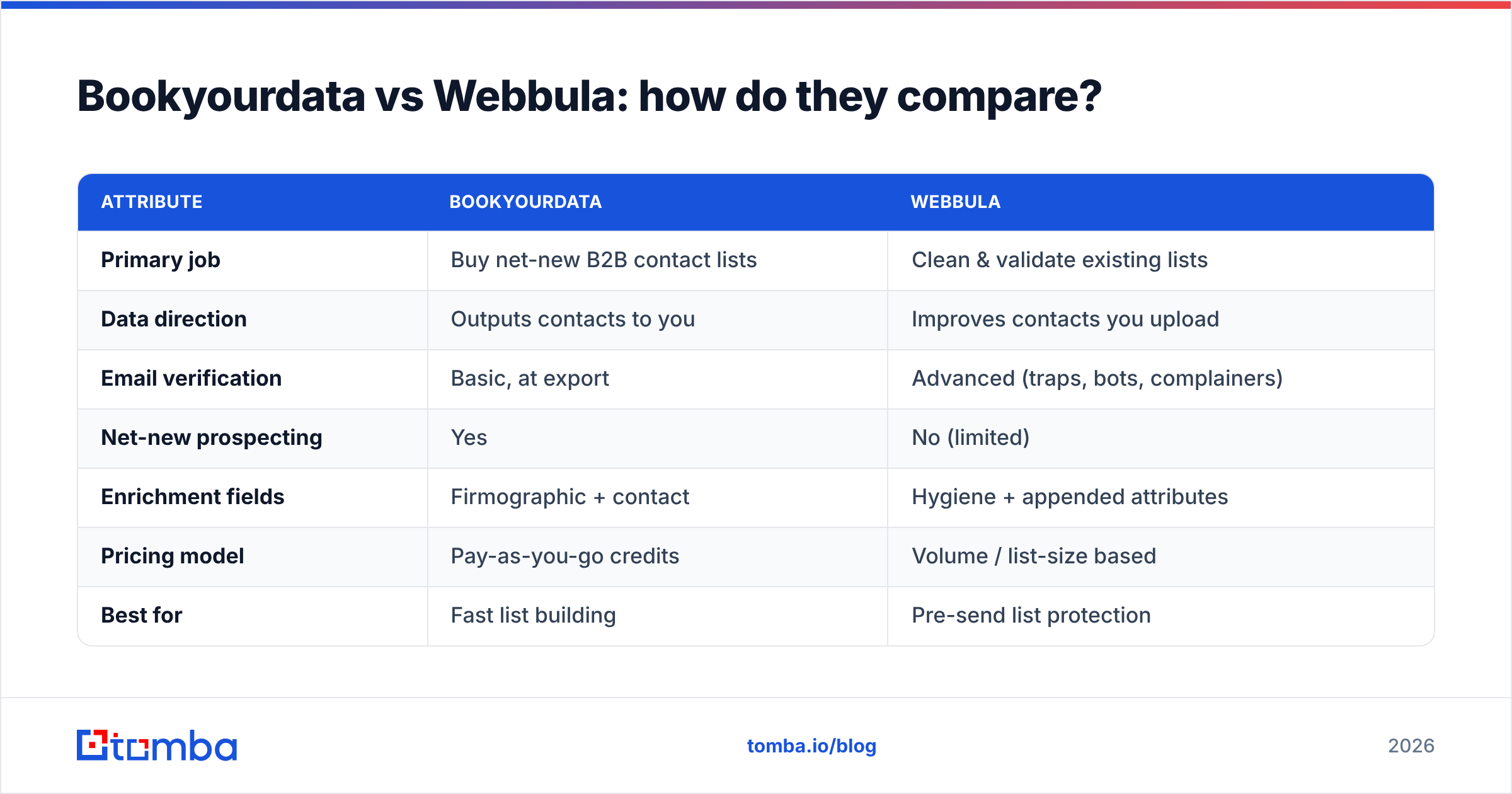
| Attribute | Bookyourdata | Webbula |
|---|---|---|
| Primary job | Buy net-new B2B contact lists | Clean & validate existing lists |
| Data direction | Outputs contacts to you | Improves contacts you upload |
| Email verification | Basic, at export | Advanced (traps, bots, complainers) |
| Net-new prospecting | Yes | No (limited) |
| Enrichment fields | Firmographic + contact | Hygiene + appended attributes |
| Pricing model | Pay-as-you-go credits | Volume / list-size based |
| Best for | Fast list building | Pre-send list protection |
| Freshness over time | Decays after export | One-time scrub, not continuous |
Read the table as a flow, not a fight. A realistic pipeline is: source a list (Bookyourdata's job) → scrub it (Webbula's job) → send. Picking "the winner" only makes sense once you know which step you're missing.
When Bookyourdata is the better pick#
- You have no list at all. You need contacts for a specific persona this week and don't have an internal source.
- You run short, campaign-based outreach. Pay-as-you-go credits beat annual seats for occasional use.
- You want firmographic filtering. Title, industry, and tech-stack filters get you a focused segment fast.
- You're an agency serving many clients. Buying per-project lists is cleaner than maintaining one giant database.
When Webbula is the better pick#
- You already own a large database. Years of signups, event scans, and CRM imports that need a safety check.
- Deliverability is on the line. You're seeing rising bounces or spam-folder placement and need to remove toxic records.
- Compliance and reputation matter. Removing spam traps and known complainers protects your domain before a major send.
- You enrich more than you acquire. Your problem is data quality, not data volume.
Which one is more accurate?#
Accuracy means two different things here, so compare them honestly. Bookyourdata's accuracy is about coverage and correctness at the moment of export — did it give you a real, reachable person matching your filter? Webbula's accuracy is about risk detection — did it correctly flag the addresses that will bounce or trip a trap?
Neither metric solves the other's blind spot. A list that's 95% deliverable on export day can drop below 85% within six months as people switch jobs. And a perfectly scrubbed list of stale contacts is still stale — hygiene confirms an address is technically valid, not that the person still works there.
This is why a standalone email verifier and a list source are complementary, not interchangeable. If you only buy lists, you skip the safety net. If you only scrub, you have nothing new to reach. Independent reviews on G2 and Capterra show both tools praised for their core job and dinged for the job they don't do.

How much do they cost?#
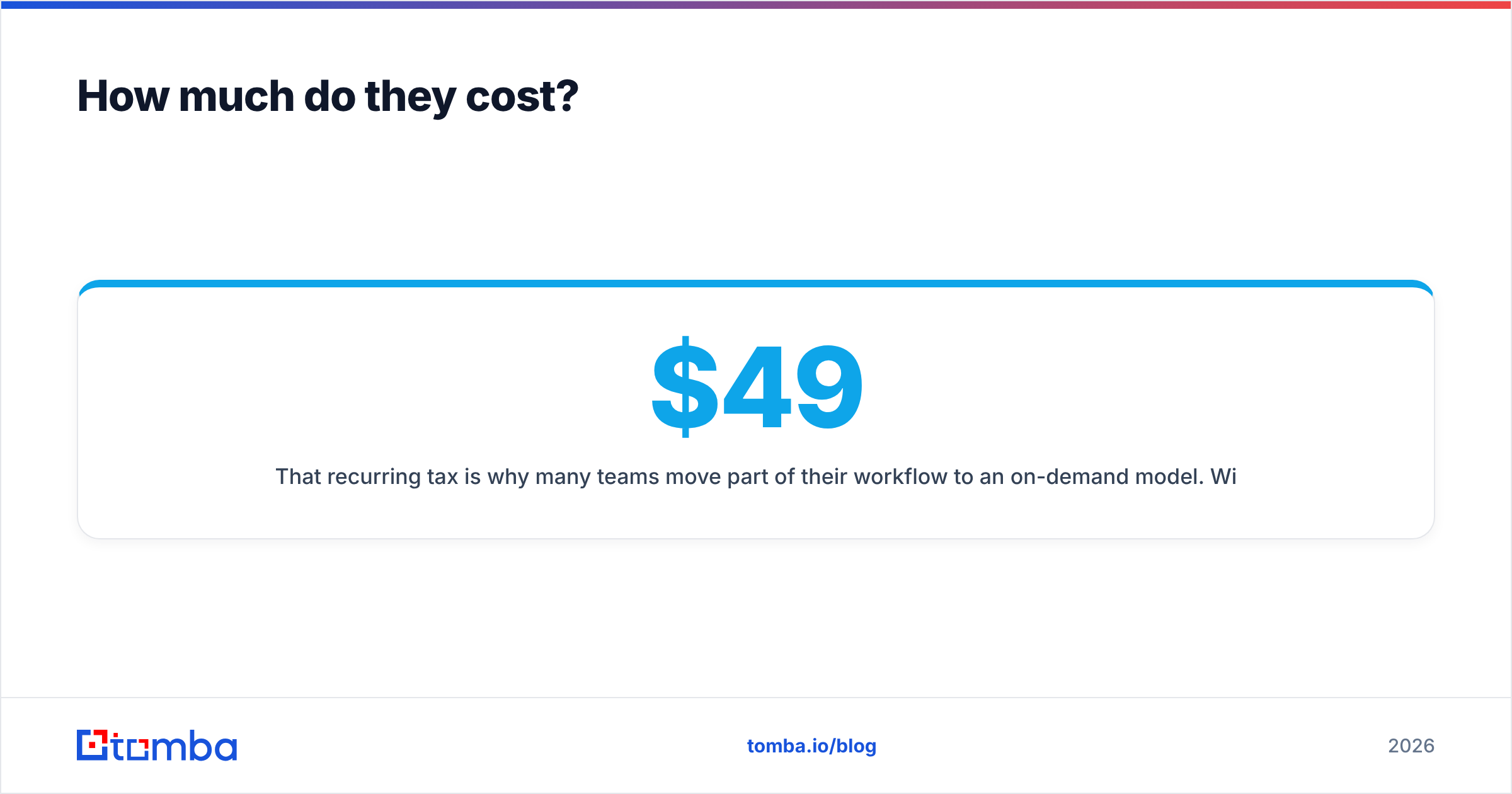
Pricing structures differ enough that a flat "X is cheaper" misleads. Bookyourdata uses pay-as-you-go credits, where each exported contact costs a credit — attractive when you need a few hundred records and nothing more. Webbula prices around list volume and the depth of hygiene checks, which favors large, infrequent cleans over constant small lookups.
The hidden cost in both is re-buying and re-cleaning. Because static data decays, the true annual spend isn't the sticker price — it's the sticker price times how often you refresh. A team that buys a list, scrubs it, then repeats every quarter pays for the same contact several times a year.
That recurring tax is why many teams move part of their workflow to an on-demand model. With a usage-based email finder you pull a verified contact at the moment you need it, instead of buying thousands you may never email. Compare the credit math against transparent Tomba pricing — Free (25 searches/mo), Starter $49/mo, Growth $99/mo, Pro $249/mo — before assuming bulk is cheaper.
Where do both tools fall short?#
Both products are good at their narrow job and structurally weak at the same thing: time.
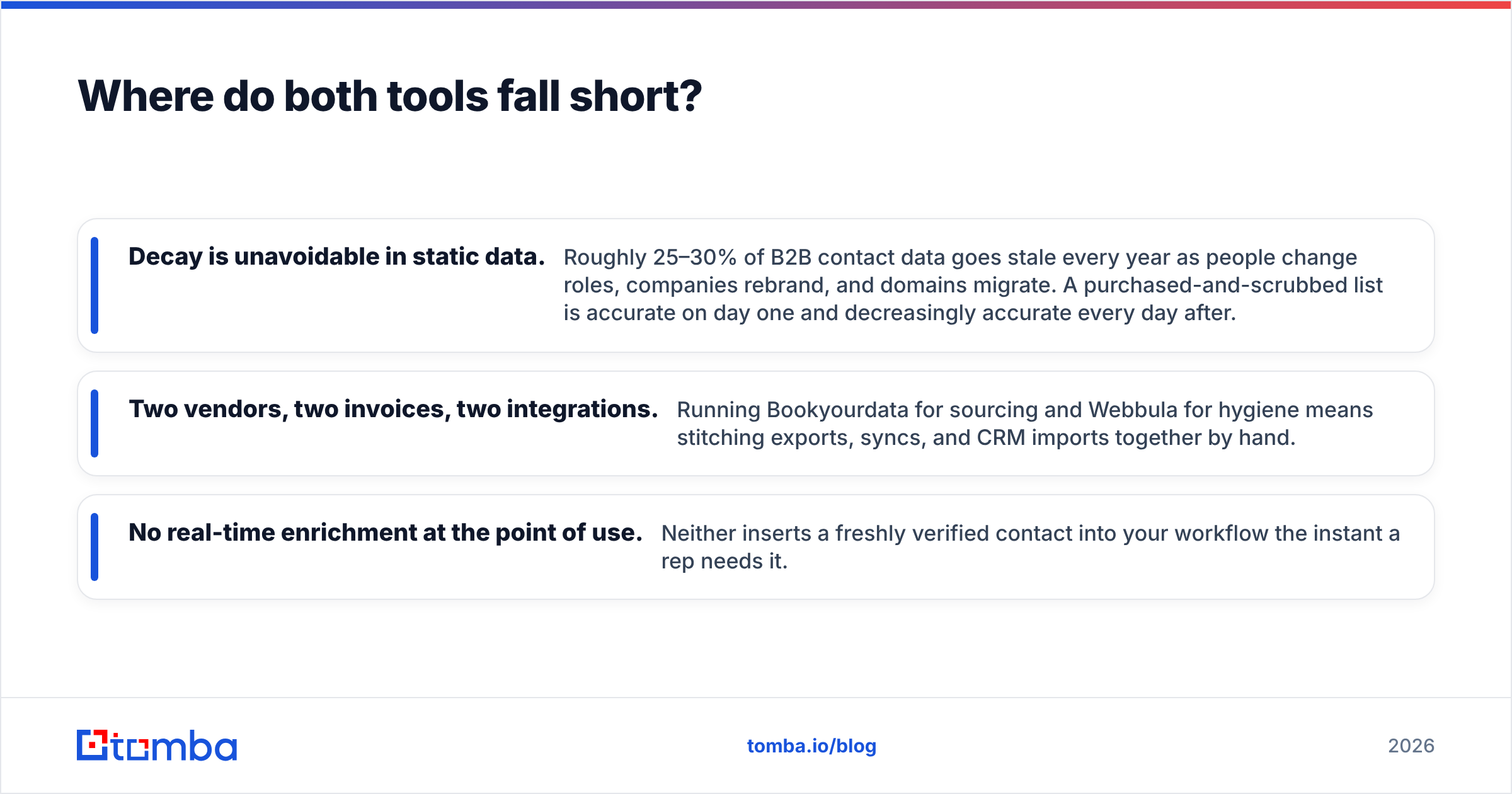
- Decay is unavoidable in static data. Roughly 25–30% of B2B contact data goes stale every year as people change roles, companies rebrand, and domains migrate. A purchased-and-scrubbed list is accurate on day one and decreasingly accurate every day after.
- Two vendors, two invoices, two integrations. Running Bookyourdata for sourcing and Webbula for hygiene means stitching exports, syncs, and CRM imports together by hand.
- No real-time enrichment at the point of use. Neither inserts a freshly verified contact into your workflow the instant a rep needs it.
The modern alternative is to verify and enrich on demand. Instead of a quarterly buy-and-scrub cycle, you call a domain search for a target company, pull the right person, verify the address, and push it straight into your sequence — no decaying spreadsheet in between. For large jobs, a bulk email finder handles thousands of lookups while keeping each result fresh and verified at run time.
Bookyourdata vs Webbula vs a live finder API#
| Capability | Bookyourdata | Webbula | Tomba |
|---|---|---|---|
| Source net-new contacts | Yes | Limited | Yes |
| Verify before sending | Basic | Advanced | Yes |
| Real-time / on-demand | No | No | Yes |
| Data enrichment | Firmographic | Hygiene + append | Full enrichment |
| API access | Limited | Yes | Yes (full) |
| Free tier | No | No | 25 searches/mo |
| Starter price | Credit packs | Volume quote | $49/mo |
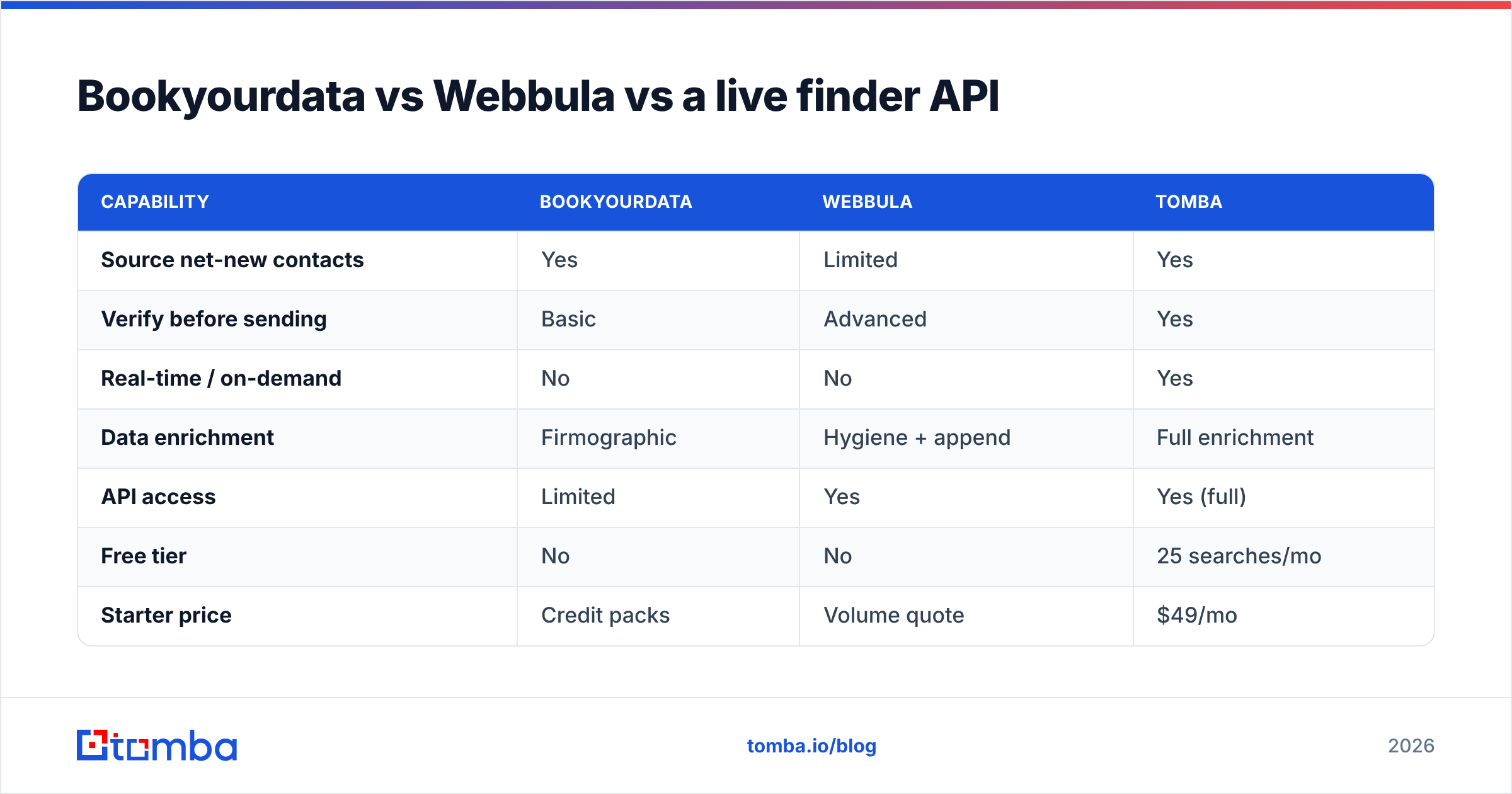
The point isn't that one tool beats the other on every row — it's that "buy a list" and "clean a list" are two phases of one job, and a live API can collapse both into a single, always-fresh step. If your real need is "reach the right person at company X right now," you may not need a bulk list or a separate hygiene pass at all.
So which should you choose?#
Pick by the gap you actually have, not the brand:
- No contacts, need them fast → start with Bookyourdata for sourcing.
- Big legacy database, deliverability slipping → start with Webbula for hygiene.
- You want fresh, verified contacts at the moment of outreach → use a finder-plus-verifier API and skip the decay tax.
For most outbound and RevOps teams in 2026, the winning move is targeted, on-demand lookups backed by built-in verification and data enrichment — so the contact is correct when you send, not when you bought it months ago.
Find verified contacts on demand with Tomba#
If the real problem behind your Bookyourdata vs Webbula search is "I want accurate B2B contacts without buying lists that rot," start with the Tomba Email Finder. Search by domain, name, or company; get an email that's verified at the moment of lookup; and enrich it with firmographic and contact data in the same call. Begin free with 25 searches a month, scale to Starter at $49/mo when you're ready, and pay for fresh data you'll actually use — not a spreadsheet you'll re-clean next quarter.
// get started
Find, verify and enrich your first contacts today
Start on the free plan with 25 searches a month, then scale when your team is ready.
Free plan · No credit card required · GDPR & CCPA
// about the author