Bookyourdata vs Winmo 2026: B2B Data Platform Compared
Bookyourdata sells verified contact lists; Winmo sells ad-sales intelligence. Here's how the two B2B data platforms compare on pricing, accuracy, and fit in 2026 — and where a pay-as-you-go finder beats both.
Choosing between Bookyourdata and Winmo feels like a head-to-head, but it's closer to comparing a bulk grocery order to a specialty butcher. Both sell "B2B data," yet they solve different problems, charge in different ways, and fail in different places. This guide breaks down exactly what each platform does, where each one wins, and how to decide — without the marketing gloss either vendor puts on its own homepage.
TL;DR — Bookyourdata vs Winmo at a glance#
- Bookyourdata is a pay-as-you-go contact list builder: you filter a database of business contacts, buy verified emails and phone numbers in credits, and export a CSV. Best for fast list-building across many industries.
- Winmo is a sales-intelligence subscription aimed at advertising, media, and agency sellers. It maps brands, agencies, and the decision-makers behind ad spend — plus predictive "WinmoEdge" signals on which accounts are about to move budget.
- They rarely compete directly. Bookyourdata is horizontal contact data; Winmo is a vertical intelligence tool for people who sell to marketers.
- Pricing models clash: Bookyourdata is credit-based and transparent per record; Winmo is an annual seat-based contract with quote-only pricing.
- If you mostly need accurate emails on demand, a real-time finder like Tomba Email Finder often beats a static list from either tool — you verify at the moment of outreach instead of buying data that decays.
What is Bookyourdata?#
Bookyourdata is a self-serve B2B contact database. You log in, apply filters (industry, job title, location, company size, technology used), preview the count, and pay credits to unlock the records. Each unlocked contact typically includes a business email, and depending on the record, a direct or company phone, job title, and company firmographics.
The headline pitch is a 95%+ email deliverability guarantee with pay-as-you-go credits, so you're not locked into an annual contract to pull a few thousand contacts. That model appeals to founders, agencies, and lean sales teams who want a list this week, not a procurement cycle. You can review their plans on the Bookyourdata pricing page directly.
The trade-off is the one every prebuilt-list vendor carries: the data is a snapshot. The moment you export, it starts aging. People change jobs, companies rebrand, and emails bounce. Buying 10,000 records means you own 10,000 records that were accurate on purchase day — not on send day three weeks later.

What is Winmo?#
Winmo is a different animal. It's a sales-intelligence platform built for one audience: people who sell advertising, marketing services, sponsorships, and media. Instead of a generic firmographic filter, Winmo organizes the world by brand → agency → decision-maker → ad spend.
If you sell to CMOs, brand managers, and agency media buyers, Winmo's value is the relationship graph: which agency handles which brand's account, who owns the budget, when contracts come up for review, and — through its WinmoEdge predictive alerts — which accounts show signals of moving spend or switching partners. You can see the positioning on the Winmo site.
That focus is also the limit. Winmo is shallow outside its lane. If you sell SaaS to IT directors, logistics software to ops leaders, or services to manufacturers, Winmo's advertising-centric graph won't cover your market. It's a scalpel, not a Swiss Army knife — and it's priced like a scalpel, via annual contracts and quote-only seats.
Bookyourdata vs Winmo: the core comparison#
Here's the side-by-side that matters before you talk to either sales team.
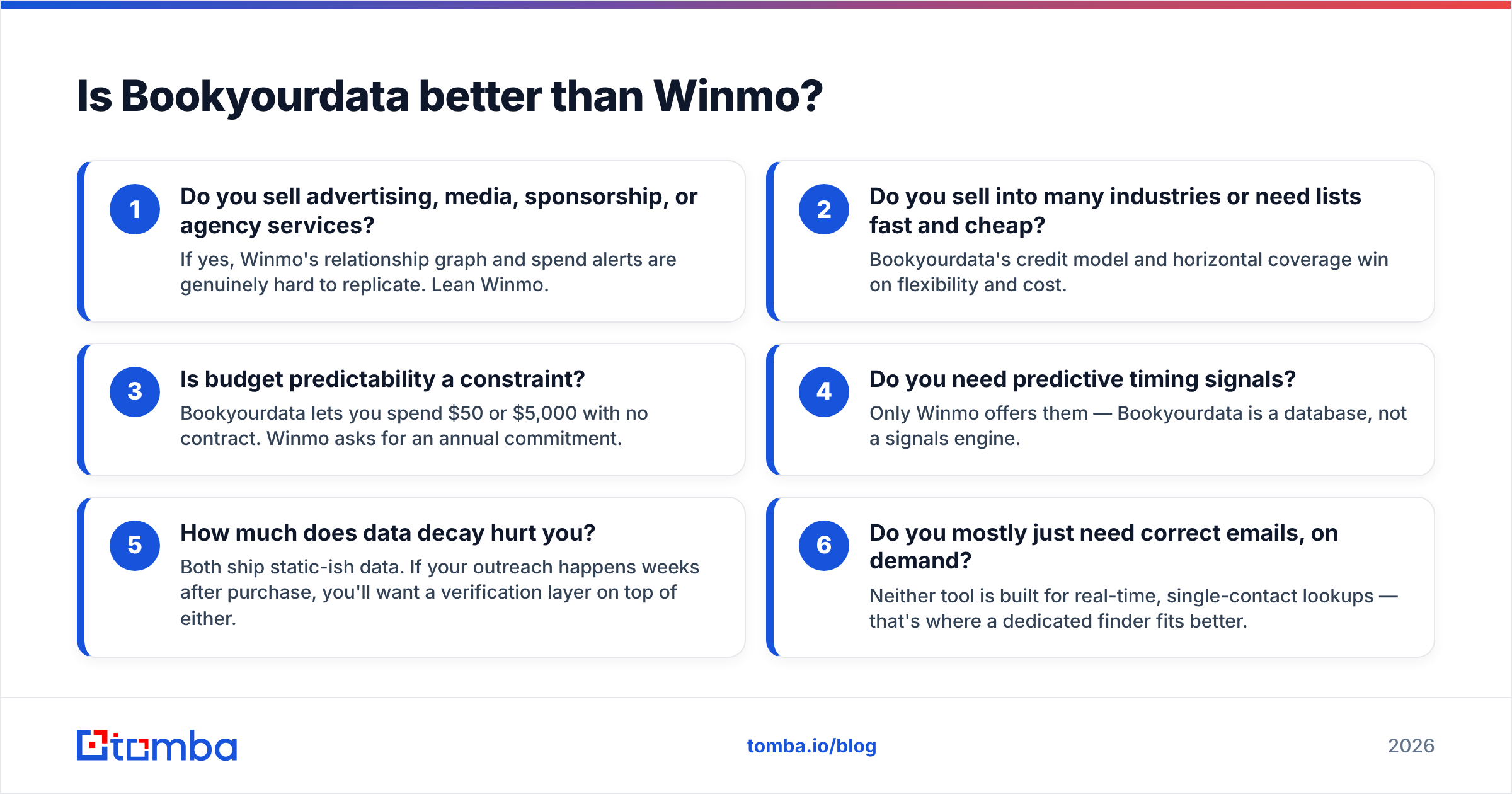
| Attribute | Bookyourdata | Winmo |
|---|---|---|
| Primary use case | Build contact lists across any industry | Sell ads/media to brands & agencies |
| Data model | Horizontal B2B contact database | Brand–agency–budget relationship graph |
| Pricing | Pay-as-you-go credits (transparent per record) | Annual subscription, seat-based, quote-only |
| Free trial | Free sample credits to test | Demo only, no self-serve trial |
| Best fit | Founders, agencies, lean SDR teams | Ad-sales, sponsorship, media sellers |
| Predictive signals | No | Yes (WinmoEdge spend alerts) |
| Phone numbers | Yes (varies by record) | Yes (decision-maker direct) |
| Data freshness | Snapshot at export | Refreshed, but vertical-only |
| Export | CSV / list download | CRM sync + exports |
The pattern is clear: Bookyourdata optimizes for breadth and price; Winmo optimizes for depth in one vertical. Picking the "winner" only makes sense once you know which problem you have.
Is Bookyourdata better than Winmo?#
It depends entirely on what you sell — but here's a decision framework you can run in five minutes.
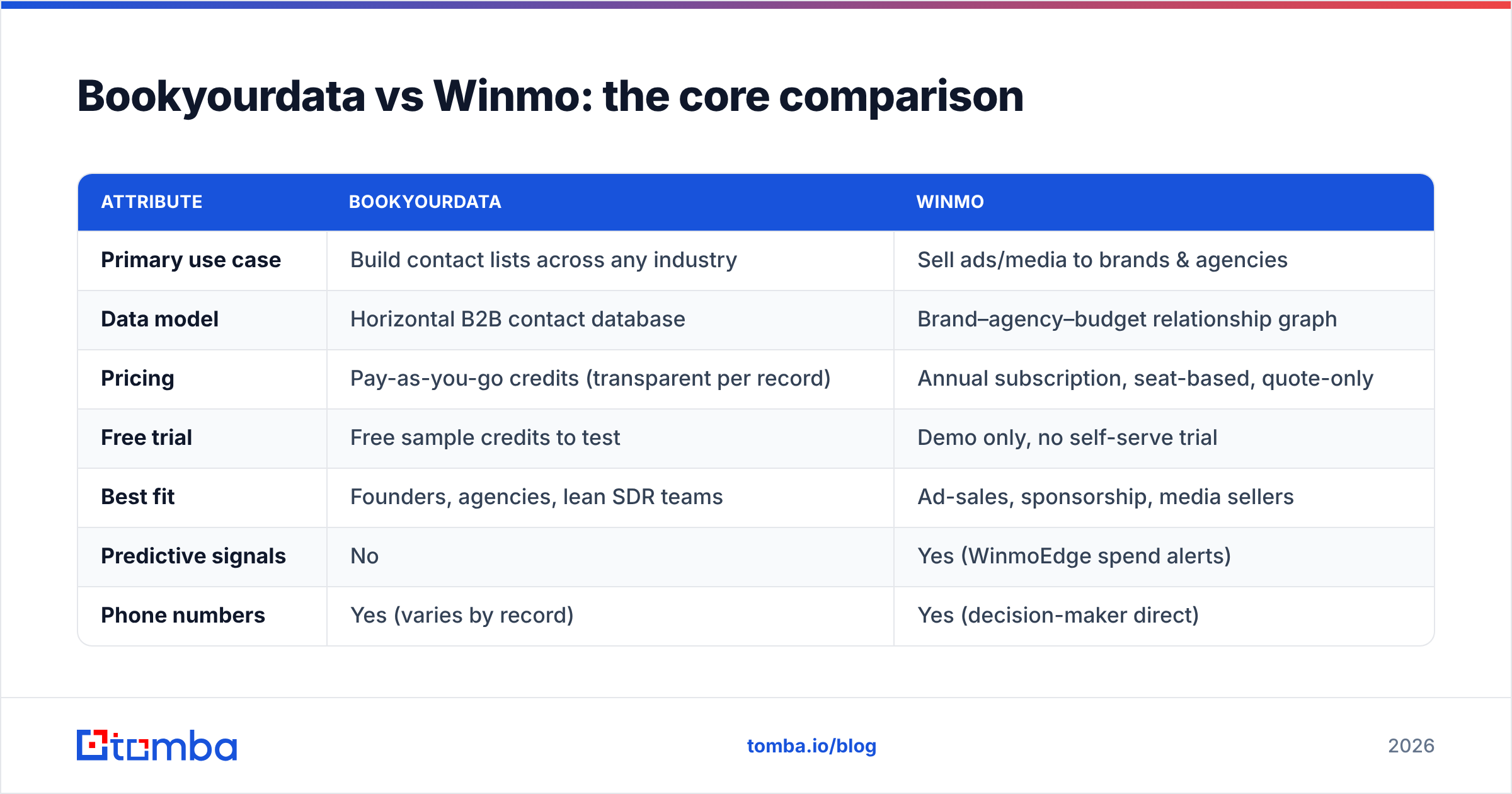
- Do you sell advertising, media, sponsorship, or agency services? If yes, Winmo's relationship graph and spend alerts are genuinely hard to replicate. Lean Winmo.
- Do you sell into many industries or need lists fast and cheap? Bookyourdata's credit model and horizontal coverage win on flexibility and cost.
- Is budget predictability a constraint? Bookyourdata lets you spend $50 or $5,000 with no contract. Winmo asks for an annual commitment.
- Do you need predictive timing signals? Only Winmo offers them — Bookyourdata is a database, not a signals engine.
- How much does data decay hurt you? Both ship static-ish data. If your outreach happens weeks after purchase, you'll want a verification layer on top of either.
- Do you mostly just need correct emails, on demand? Neither tool is built for real-time, single-contact lookups — that's where a dedicated finder fits better.
Run those six and the answer usually picks itself. Most teams discover they don't actually need "Bookyourdata or Winmo" — they need a reliable way to get verified contact details at the moment of outreach.
)
How accurate is the data from each platform?#
Accuracy is where prebuilt B2B data lives or dies, and it's the question both vendors answer with confidence and caveats.
Bookyourdata advertises a 95%+ deliverability guarantee and re-verifies records, which is strong for a self-serve list tool. But "deliverability at time of verification" is not the same as "deliverable when you hit send." If a record was verified 30 days before you bought it and you mail it 20 days after that, you're working with seven-week-old data on a population that churns roughly 2–3% per month. According to G2 reviews, buyers of bulk B2B lists consistently cite bounce creep over time as the main complaint — not initial accuracy.
Winmo's accuracy is high within its vertical because the dataset is narrower and human-curated for ad-spend relationships. The flip side: ask it for contacts outside advertising and you'll find gaps, because that's not what it's built to track.
The durable fix for either is the same: verify immediately before you send. That's why many teams pair any purchased list with an email verifier to scrub bounces, and use a live finder to fill gaps the list left behind. Where your data comes from and how it's validated matters more than any single headline percentage — it's worth understanding where Tomba gets its data before you trust any vendor's number.
What does each one cost in 2026?#
The pricing models are almost opposites, and that difference often decides the purchase more than features do.
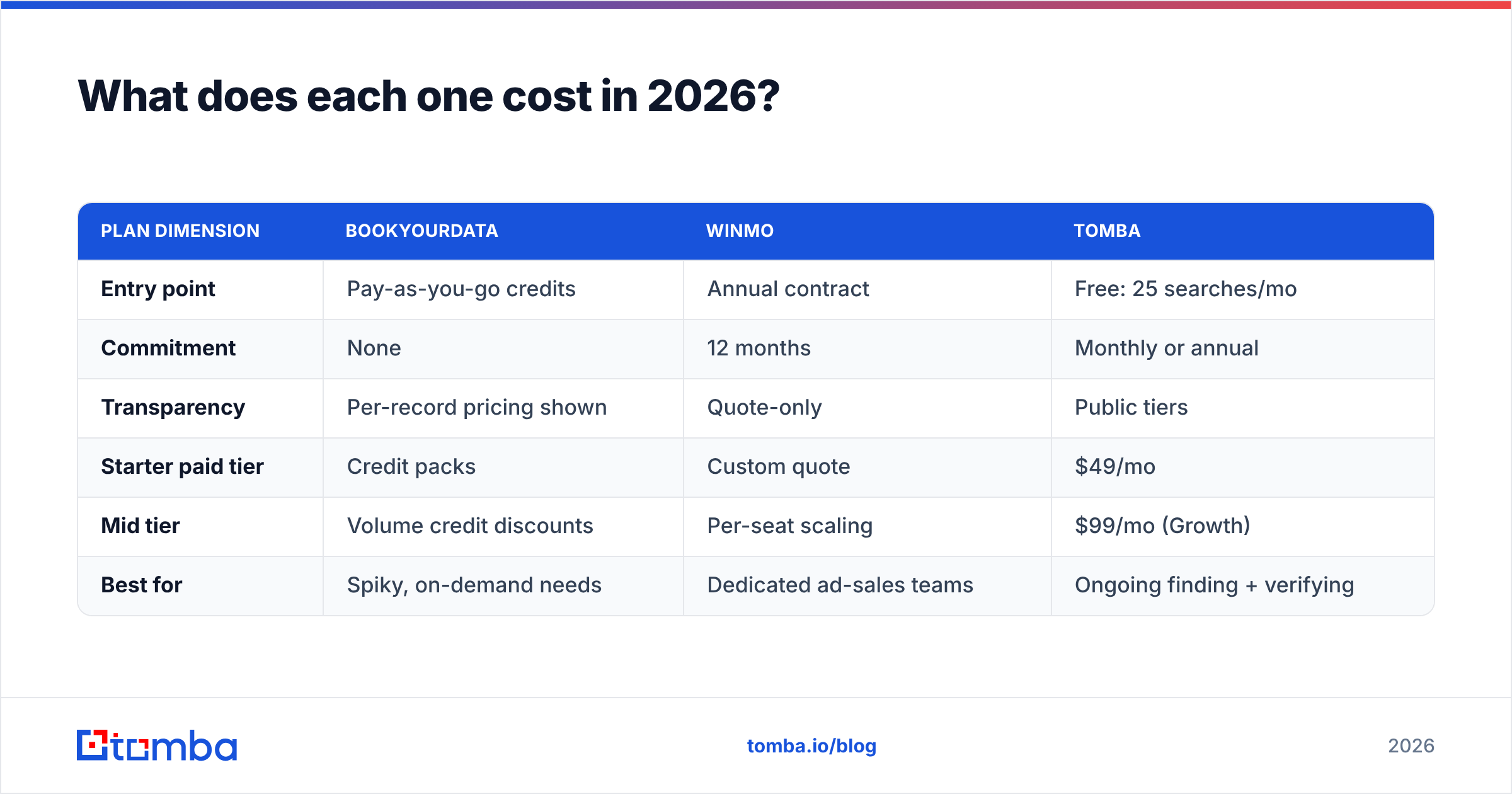
| Plan dimension | Bookyourdata | Winmo | Tomba |
|---|---|---|---|
| Entry point | Pay-as-you-go credits | Annual contract | Free: 25 searches/mo |
| Commitment | None | 12 months | Monthly or annual |
| Transparency | Per-record pricing shown | Quote-only | Public tiers |
| Starter paid tier | Credit packs | Custom quote | $49/mo |
| Mid tier | Volume credit discounts | Per-seat scaling | $99/mo (Growth) |
| Best for | Spiky, on-demand needs | Dedicated ad-sales teams | Ongoing finding + verifying |
Bookyourdata's credit model is friendly to unpredictable demand — buy when you need a list, stop when you don't. Winmo's annual seat model only pencils out if you have full-time sellers living in the tool daily.
For comparison, Tomba pricing starts with a free tier (25 searches/month), then $49/mo Starter, $99/mo Growth, $249/mo Pro, and custom Enterprise. The model is different on purpose: you pay to find and verify contacts continuously, rather than buying a one-time block of records that ages on your hard drive.
)
When should you use a real-time email finder instead?#
Reach for a finder over a purchased list whenever your outreach is targeted rather than blast-volume, or whenever data freshness is non-negotiable.
A real-time finder works the opposite way to a list vendor. Instead of buying 10,000 records and hoping most still work, you look up the specific people you actually want to contact, right when you want to contact them, and verify the result on the spot. That eliminates the decay problem at the root — there's no shelf life on a lookup you just ran.
This approach shines in a few scenarios:
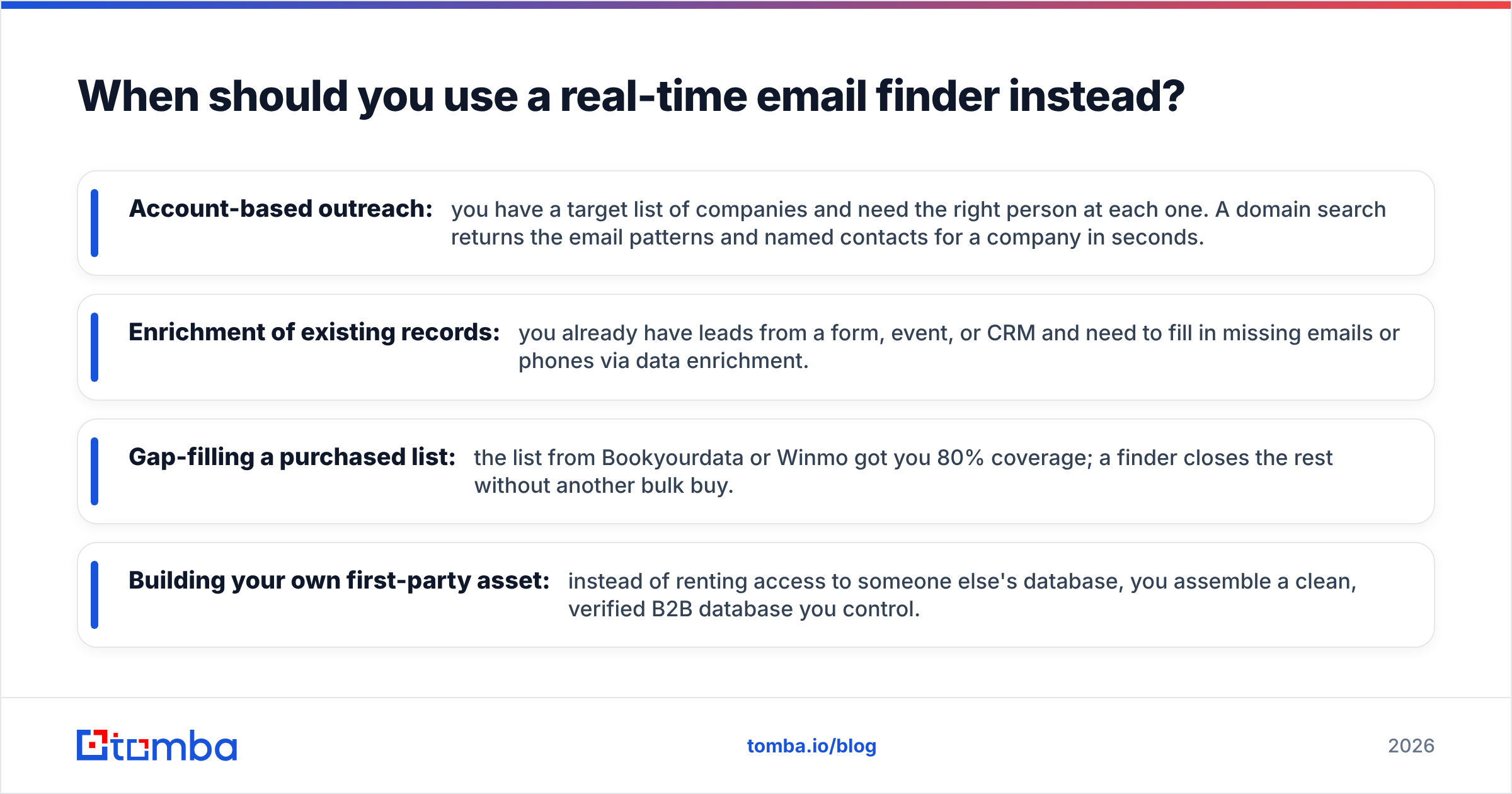
- Account-based outreach: you have a target list of companies and need the right person at each one. A domain search returns the email patterns and named contacts for a company in seconds.
- Enrichment of existing records: you already have leads from a form, event, or CRM and need to fill in missing emails or phones via data enrichment.
- Gap-filling a purchased list: the list from Bookyourdata or Winmo got you 80% coverage; a finder closes the rest without another bulk buy.
- Building your own first-party asset: instead of renting access to someone else's database, you assemble a clean, verified B2B database you control.
The mental model: lists are like buying bottled water by the pallet — convenient, but it sits in the garage and you're never sure how fresh it is. A finder is like a tap: you pour exactly what you need, exactly when you're thirsty, and it's always running.
Which platform fits which team?#
Map the tool to the team and the decision stops being abstract.
Choose Bookyourdata if you're an agency, founder, or small SDR team that needs broad contact lists across industries, wants transparent pay-as-you-go pricing, and can live with periodic re-verification to manage decay. It's the pragmatic choice for "I need a list this week and don't want a contract."
Choose Winmo if you sell advertising, media, sponsorships, or agency services and your entire revenue motion depends on knowing which brands spend with which agencies and when budgets move. Nothing horizontal replaces that vertical depth, and the annual cost is justified by the deal sizes in ad sales.
Choose a finder-first stack (like Tomba) if your outreach is targeted, you value freshness over raw volume, and you'd rather verify a contact at send time than maintain an aging spreadsheet. Many teams run this alongside a list tool — buy breadth, then find-and-verify for precision. Tomba plugs into the same workflow with a Chrome extension, a bulk email finder for volume jobs, and an email finder API when you want lookups inside your own product or CRM.
The verdict: it's not really Bookyourdata vs Winmo#
The honest conclusion is that these two tools barely belong in the same ring. Bookyourdata is a horizontal, pay-as-you-go list builder. Winmo is a vertical, subscription-priced intelligence platform for ad-sales professionals. If you're choosing between them, you're probably solving two different problems and should pick based on what you sell, not on a feature scoreboard.
What both share is the structural weakness of prebuilt data: it decays, and you pay for records whether or not they still work on send day. The most resilient setup in 2026 isn't "list vendor A vs list vendor B" — it's a finder-and-verifier layer that keeps your data accurate at the moment it matters, optionally topped up with bulk lists when you genuinely need volume.
Get accurate contacts without the decay tax#
If your real goal is reaching the right people with emails that actually land, skip the static-list gamble and find contacts the moment you need them. Tomba Email Finder lets you look up professional emails by name, company, or domain, verify them on the spot, and enrich what you already have — starting free with 25 searches a month, then scaling at a transparent $49/mo. Build a clean, current pipeline instead of renting someone else's aging database. Start finding verified emails free and keep your outreach landing in 2026.
// get started
Find, verify and enrich your first contacts today
Start on the free plan with 25 searches a month, then scale when your team is ready.
Free plan · No credit card required · GDPR & CCPA
// about the author