How to Boost Email Open Rates With Emojis: 2026 Guide
Emojis can lift open rates 5-30% — or tank them into spam. Here's the data-backed playbook for using emojis in subject lines without wrecking deliverability in 2026.
You can boost email open rates with emojis — it's one of the cheapest open-rate levers you have. It's also one of the easiest to misuse. A single 🚀 can pull a subscriber's eye in a crowded inbox. Or it can trip a spam filter and bury your whole campaign. The difference is method, not luck.
This guide gives you the data-backed playbook to boost email open rates with emojis in 2026. You'll lift opens without wrecking deliverability or sounding like a discount-coupon blast.
TL;DR#
- Emojis can lift open rates by roughly 5–30% in the right segments. But the effect is inconsistent and audience-dependent — never assume.
- One emoji, placed at the front or end of a subject line, outperforms two or more. Emoji spam reads as promotional and drags engagement down.
- B2B and senior decision-makers tolerate fewer emojis than B2C or community audiences. Test before you commit.
- Emojis affect opens, not deliverability directly. But low engagement from bad subject lines will hurt your sender reputation over time.
- The only reliable strategy is A/B testing on a clean, verified list. Garbage contacts make your test data meaningless.
Can you really boost email open rates with emojis?#
Short answer: sometimes, and the lift is real but modest. Emojis work because they break the visual monotony of an inbox. A row of plain-text subject lines with one colorful glyph draws the eye like a highlighter on a gray page.
Multiple vendor studies (Mailchimp, HubSpot, Campaign Monitor) report open-rate changes from a few points of lift to a slight decline. The result depends on industry and audience. That spread is the whole story: there is no universal "emoji boost." There is only what your specific list responds to.
What's consistent across the research:
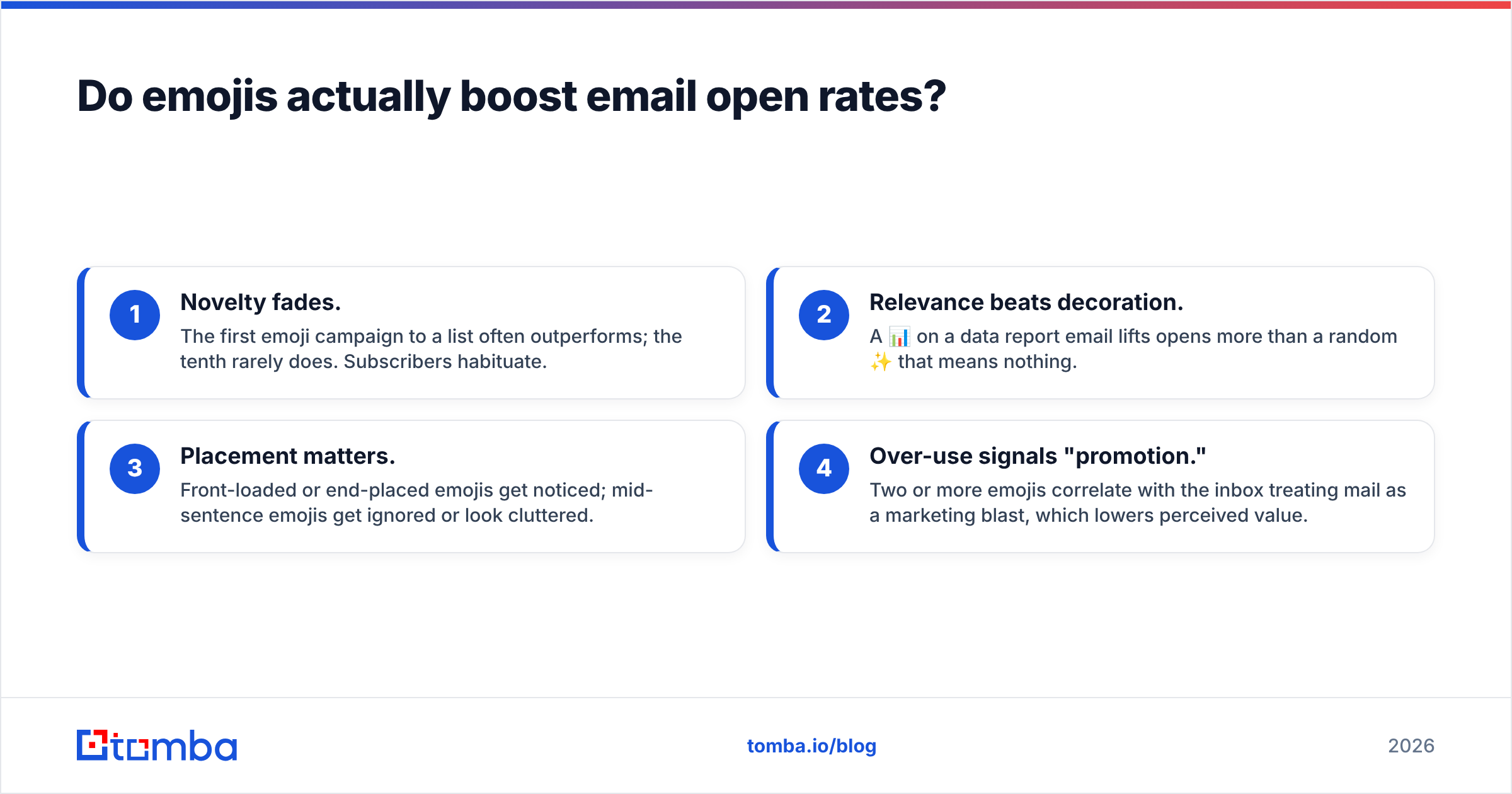
- Novelty fades. The first emoji campaign to a list often wins. The tenth rarely does. Subscribers habituate.
- Relevance beats decoration. A 📊 on a data report email lifts opens more than a random ✨ that means nothing.
- Placement matters. Front-loaded or end-placed emojis get noticed. Mid-sentence emojis get ignored or look cluttered.
- Over-use signals "promotion." Two or more emojis make the inbox treat mail as a marketing blast, which lowers perceived value.
Which emojis lift opens and which ones backfire?#
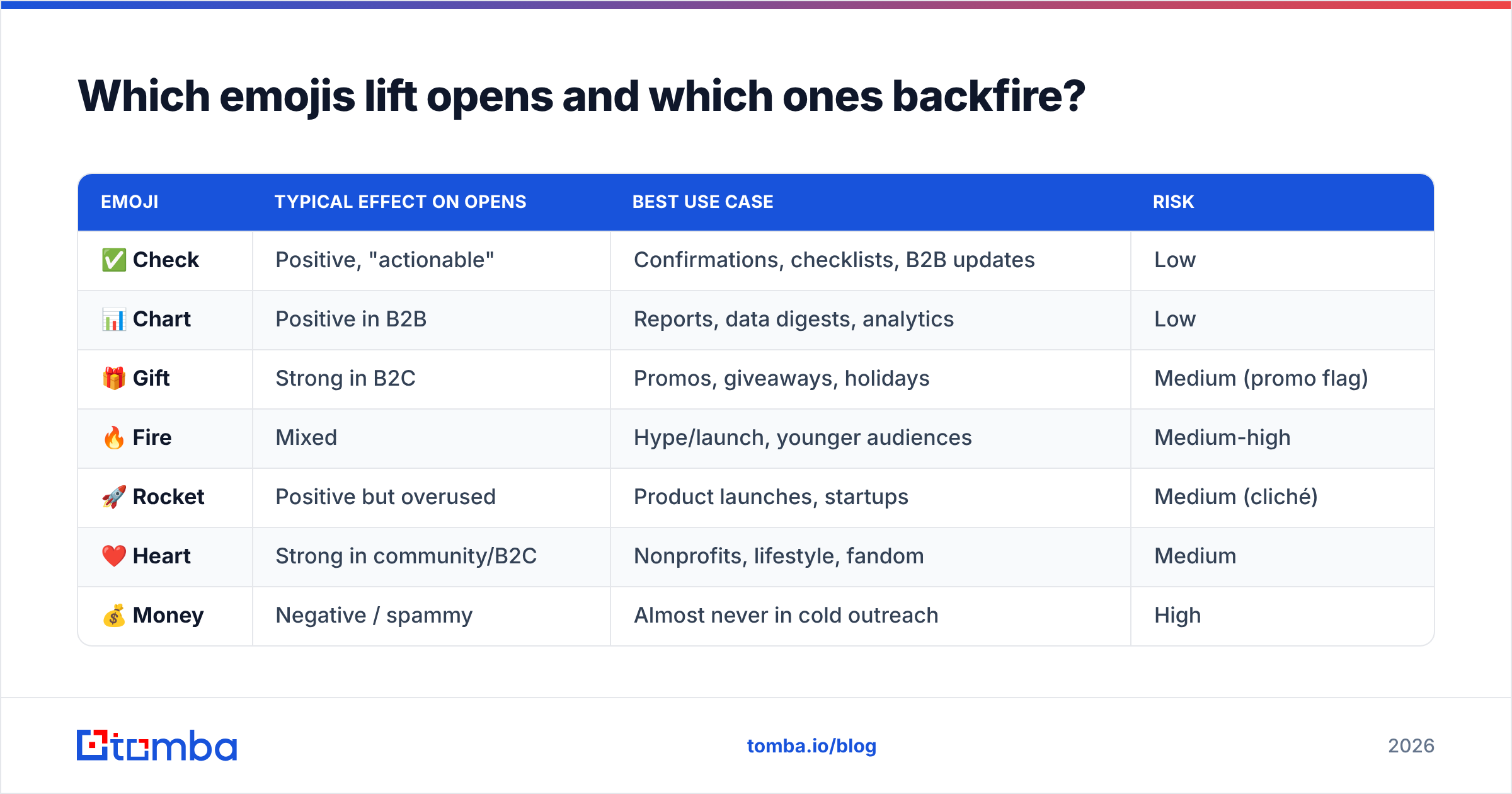
Not all emojis are equal. Some carry positive, professional-safe connotations. Others scream "spam" or feel manipulative. Here's a working reference based on aggregated subject-line performance data.
| Emoji | Typical effect on opens | Best use case | Risk |
|---|---|---|---|
| ✅ Check | Positive, "actionable" | Confirmations, checklists, B2B updates | Low |
| 📊 Chart | Positive in B2B | Reports, data digests, analytics | Low |
| 🎁 Gift | Strong in B2C | Promos, giveaways, holidays | Medium (promo flag) |
| 🔥 Fire | Mixed | Hype/launch, younger audiences | Medium-high |
| 🚀 Rocket | Positive but overused | Product launches, startups | Medium (cliché) |
| ❤️ Heart | Strong in community/B2C | Nonprofits, lifestyle, fandom | Medium |
| 💰 Money | Negative / spammy | Almost never in cold outreach | High |
| ‼️ Double bang | Negative / spammy | Avoid | High |
The rule of thumb: emojis that add meaning win; emojis that add noise lose. Try deleting the emoji. If the subject line means exactly the same thing, the emoji is decoration — and decoration habituates fast.
How many emojis should a subject line have?#
One. Occasionally zero. Almost never two or more.
Inbox-rendering studies and spam-filter heuristics point the same way. A single, well-placed emoji reads as a human touch. A cluster of emojis reads as a coupon. Some corporate spam filters even weight emoji density as a promotional signal. And emoji-heavy subject lines are more likely to be truncated awkwardly on mobile.
Here's a quick decision flow for emoji count:
- Is the email transactional or a personal cold email? Use zero emojis. Personal-looking mail wins in 1:1 outreach.
- Is it a newsletter or B2C promo? Use one emoji, front or end, that reinforces the topic.
- Is it a launch or seasonal blast to an engaged B2C list? One emoji is still the ceiling. Test a second only if your list has shown tolerance.
- Are you sending to senior B2B buyers? Default to zero. Test one cautiously on warm segments.
Is it better to use emojis in B2B or B2C email?#
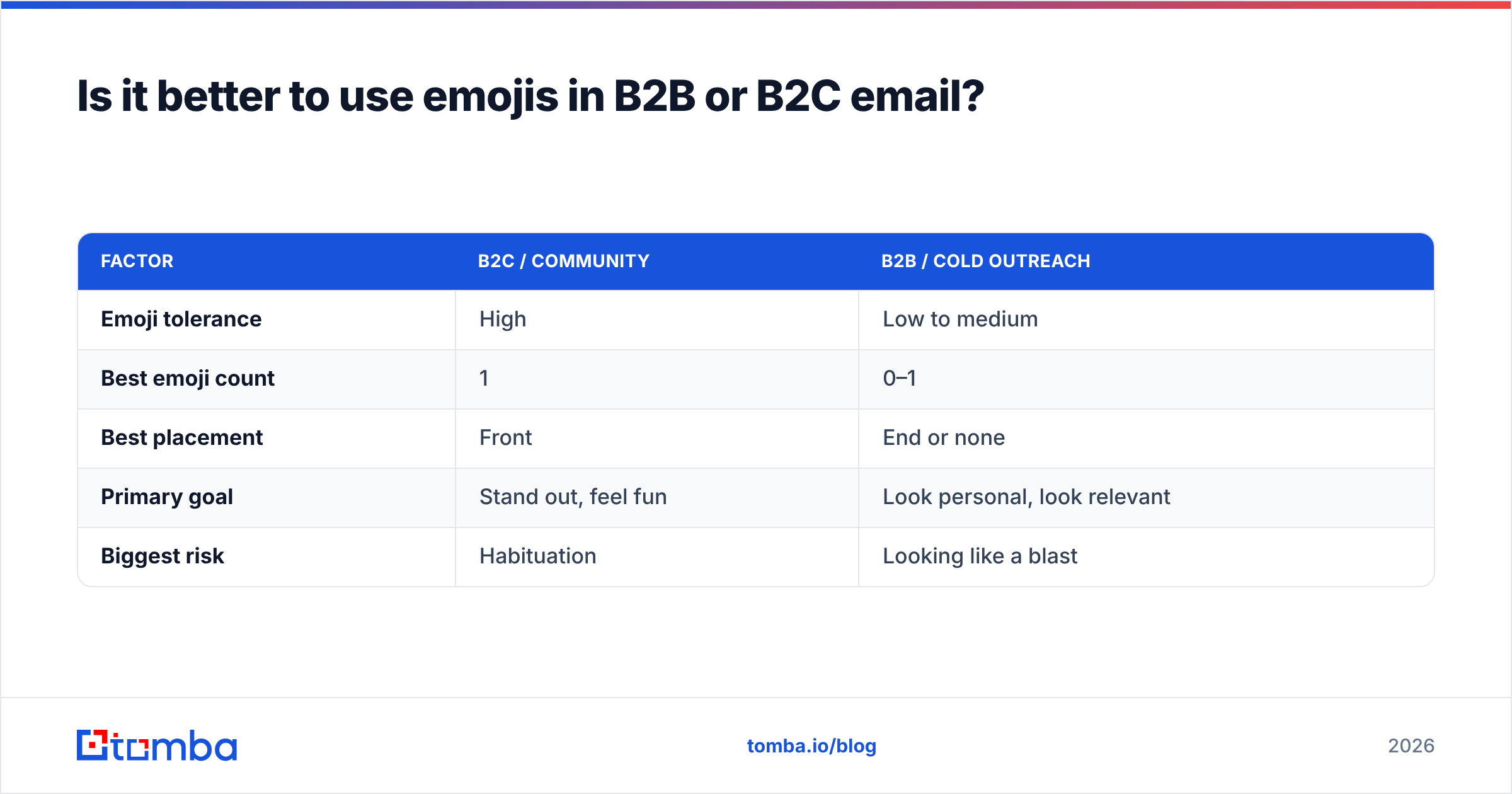
B2C tolerates emojis far better than B2B. But "tolerates" is not "requires." The audience's expectation of formality is the deciding variable.
In B2C and community email (lifestyle, retail, nonprofits, fandom), emojis match the medium and the relationship. Subscribers opted in for personality, so a 🎁 or ❤️ feels native. In B2B, the story flips. A plain, specific subject line that looks like it came from a colleague usually beats anything decorated. Senior buyers link emoji-heavy subjects with mass marketing, and mass marketing gets archived.
| Factor | B2C / community | B2B / cold outreach |
|---|---|---|
| Emoji tolerance | High | Low to medium |
| Best emoji count | 1 | 0–1 |
| Best placement | Front | End or none |
| Primary goal | Stand out, feel fun | Look personal, look relevant |
| Biggest risk | Habituation | Looking like a blast |
If you run cold campaigns, the bigger lever is almost always list quality, not glyphs. Decorated subject lines sent to stale addresses just decorate your bounce rate. Clean the list first with an email verifier, then optimize the subject line. For a deeper look at how subject lines interact with inbox placement, see Tomba's email deliverability glossary entry.
Do emojis hurt deliverability or land you in spam?#
Emojis alone rarely send mail to spam. But they can contribute indirectly, and the mechanism matters.
Direct effect: minimal. Modern filters at Gmail, Outlook, and Yahoo don't blacklist an inbox just because the subject contains 🚀. Unicode emojis are normal text. The myth that "any emoji = spam folder" is outdated.
Indirect effect: real. Here's the chain that actually hurts you:
- A gimmicky or misleading emoji subject line gets lower open and engagement rates.
- Mailbox providers read low engagement as a signal that your mail is unwanted.
- Repeated low engagement erodes your sender reputation.
- A damaged reputation pushes all your mail — emoji or not — toward the spam folder.
So emojis don't poison deliverability. Bad subject-line decisions that lower engagement do. The fix is the same discipline as everything else in email: send relevant content to people who want it, and measure.
A few hard rules to keep emojis on the safe side of the filter:
- Never use emojis to fake urgency you can't back up (the ‼️ / 🔥 / 💰 trap).
- Don't combine an emoji with all-caps and exclamation marks. That triple is a classic spam fingerprint.
- Test rendering. Some emojis show as empty boxes (□) on older clients, which looks broken and kills trust.
- Keep your authentication clean. Emojis won't save mail sent from a domain with a broken SPF record.
How do you A/B test emojis the right way?#
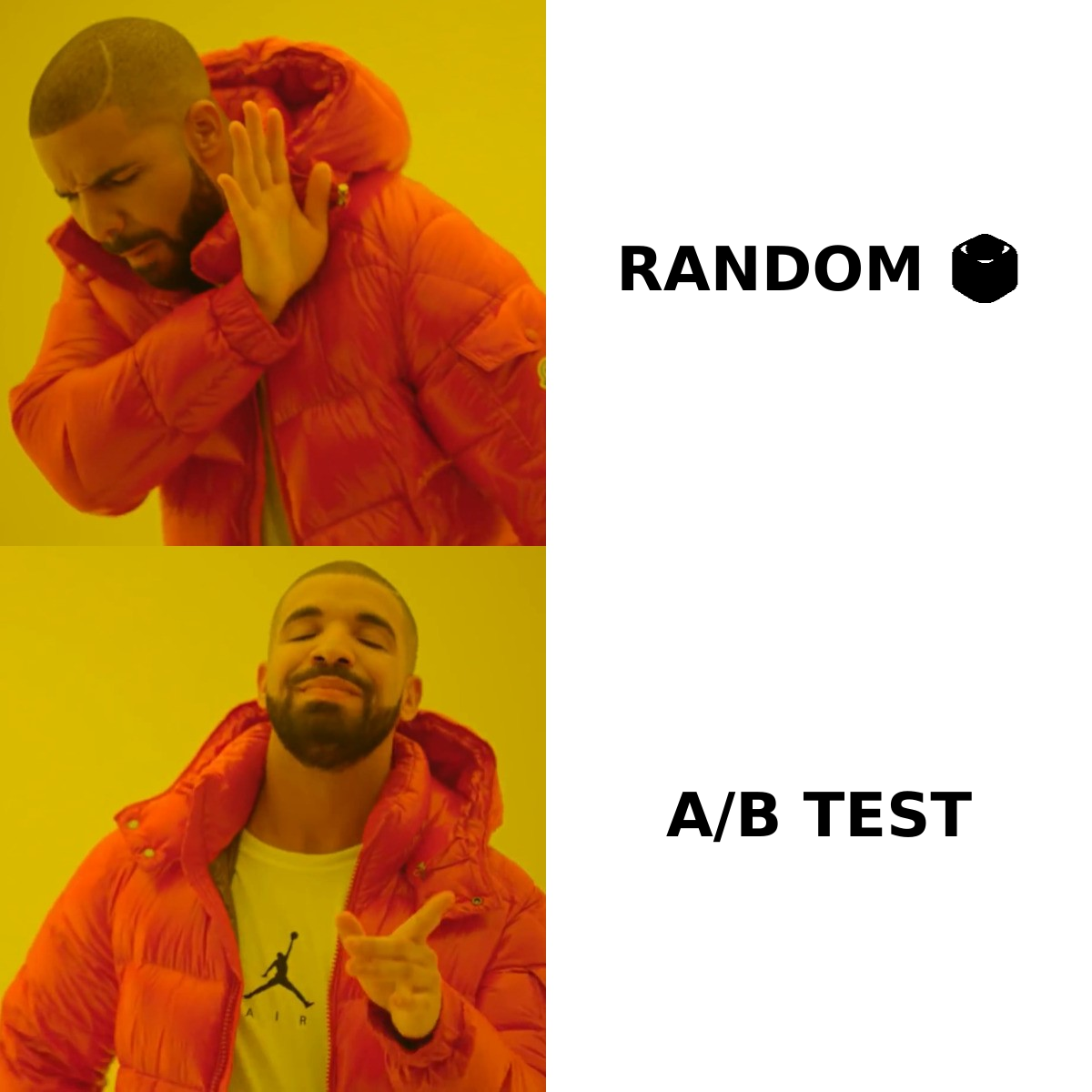
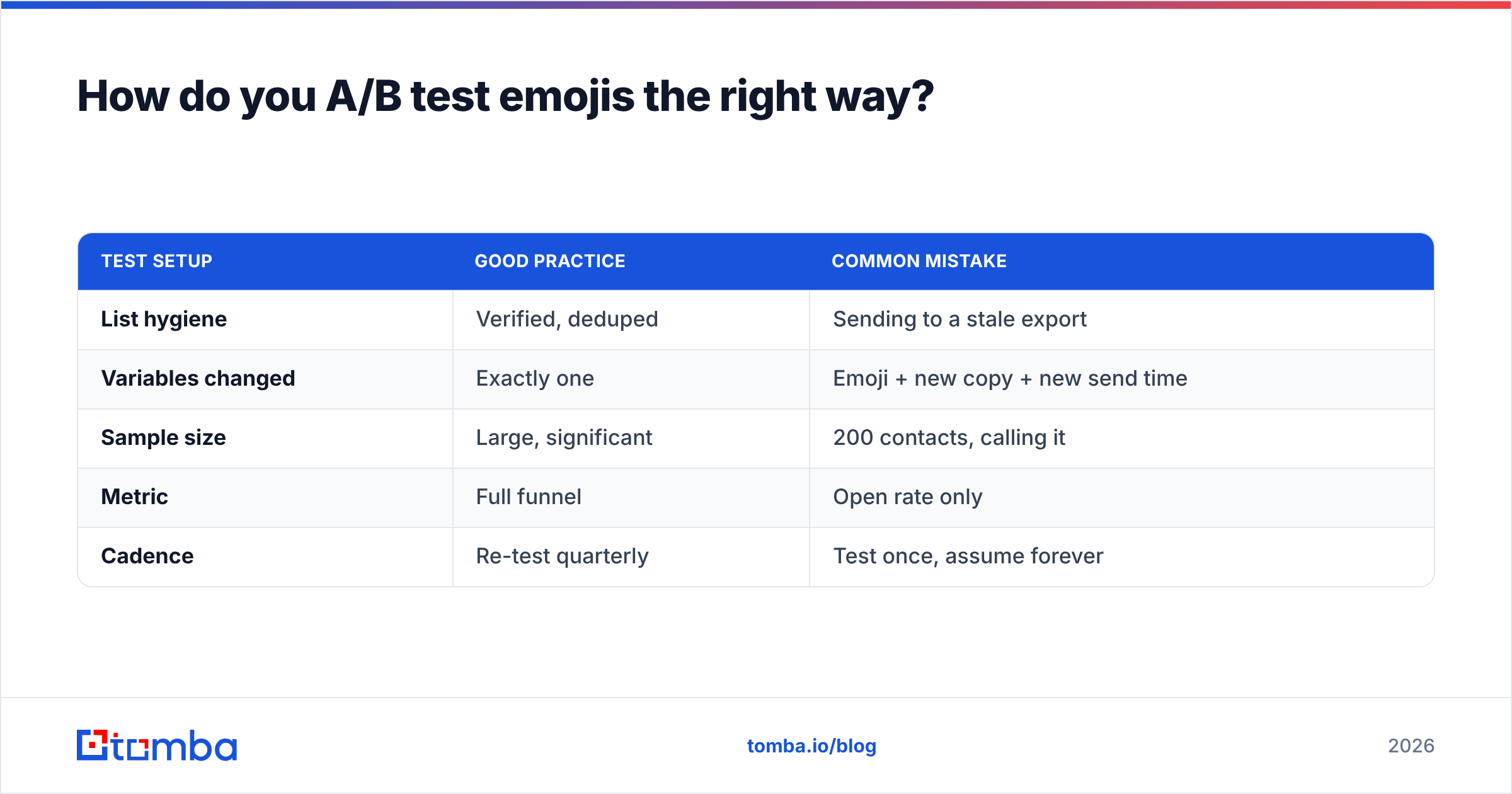
A/B testing is the only honest answer to "will emojis work for my list." Everything above is a prior; your test is the evidence. Here's the method that produces trustworthy results.
1. Start with a clean, verified list. This is non-negotiable. If 12% of your addresses are dead, your open-rate denominator is wrong and your "winner" is noise. Verify before you test. And if you're building the list from scratch, find accurate contacts with an email finder and validate them before the first send.
2. Change one variable. Test "emoji vs no emoji" or "emoji A vs emoji B." Never both at once plus a reworded subject. One variable per test, or you can't attribute the result.
3. Use a large enough sample. Small lists produce random-looking winners. Aim for a segment big enough that a 5-point difference is meaningful. Let the test run long enough to capture your normal open window.
4. Measure the full funnel, not just opens. An emoji can lift opens while lowering clicks or replies (curiosity without substance). Track open → click → reply, not the vanity metric alone.
5. Re-test periodically. Emoji effects decay as your audience habituates. A winner from Q1 may be a loser by Q4.
| Test setup | Good practice | Common mistake |
|---|---|---|
| List hygiene | Verified, deduped | Sending to a stale export |
| Variables changed | Exactly one | Emoji + new copy + new send time |
| Sample size | Large, significant | 200 contacts, calling it |
| Metric | Full funnel | Open rate only |
| Cadence | Re-test quarterly | Test once, assume forever |
What does a high-performing emoji subject line look like?#
The best emoji subject lines are specific, single-emoji, and front- or end-weighted. Decoration is invisible; meaning is magnetic.
Strong patterns:
- ✅ Your March report is ready — the emoji reinforces "done/actionable," and the topic is concrete.
- Quick question about your Q3 roadmap 👋 — end-placed, human, B2B-safe.
- 📊 The 3 metrics that predicted churn last quarter — emoji matches a data payload.
Weak patterns:
- 🚀🔥 HUGE NEWS!! Don't miss this 💰💰 — emoji spam + caps + bangs = spam fingerprint.
- ✨ Newsletter ✨ — decoration with zero added meaning.
- ❤️ We miss you ❤️ to a cold B2B list — wrong tone for the audience.
Want to systematize this? Build a swipe file. Tomba's free email templates and subject line tester let you draft variants and gut-check them before they hit a real segment. For broader benchmarks on a healthy open and response rate, HubSpot publishes annual email marketing statistics, and you can cross-check spam-trigger guidance against Litmus rendering data.
Quick-reference checklist before you hit send#
Run every emoji subject line through this list:
- Does the emoji add meaning? If deleting it changes nothing, cut it.
- Is there exactly one? Two or more, reconsider.
- Is it audience-appropriate? B2B executive vs B2C fan — adjust.
- Does it render on mobile and older clients? Preview it, don't assume.
- Is the list verified? Decorated subject lines to dead contacts waste sends.
- Are you A/B testing? No test, no claim of "it works."
- Is your authentication clean? SPF, DKIM, and reputation come first.
Get those seven right and emojis become a small, reliable edge instead of a gamble.
Final word: the emoji is the garnish, the list is the meal#
You can boost email open rates with emojis in 2026 — usually single digits to low double digits, in the right segment, used sparingly and tested honestly. But emojis are a finishing touch, not a foundation. The biggest, most durable gains come from sending relevant mail to real, verified people from a domain with a healthy reputation.
That's where your effort should start. Before you obsess over whether 📊 beats ✅, make sure every address on your list is a genuine, deliverable contact. Tomba's Email Finder helps you build accurate, verified prospect lists by domain, name, or company. Your subject-line experiments then run on clean data, and your emojis decorate emails that actually reach the inbox. Start free with 25 searches a month, and scale up on the Starter plan at $49/mo when your testing proves what works.
// get started
Find, verify and enrich your first contacts today
Start on the free plan with 25 searches a month, then scale when your team is ready.
Free plan · No credit card required · GDPR & CCPA
// about the author