Botphonic Pricing, Reviews, Pros and Cons (2026 Guide)
A neutral 2026 breakdown of Botphonic pricing, real-world reviews, and the honest pros and cons before you commit budget to an AI voice agent.
TL;DR
- Botphonic is an AI voice-agent platform that automates outbound and inbound phone calls — think of it as a tireless SDR that dials, qualifies, and books without a human on the line.
- Pricing is usage-based (minutes/credits plus a monthly platform fee), so your real cost depends on call volume, not just the sticker tier. Always confirm current numbers on the official pricing page.
- The biggest strength is speed-to-lead and 24/7 coverage; the biggest weakness is that an AI agent is only as good as the phone data and intent you feed it.
- It competes with other AI callers and with human-dialer stacks. The right choice depends on call complexity and compliance tolerance.
- No voice agent fixes bad contact data. Pair any caller with verified numbers from a tool like Tomba's phone finder before you spend a cent on minutes.
What is Botphonic?#
Botphonic is an AI voice-agent product: software that places and answers phone calls using a synthetic voice, follows a conversation script, and reacts to what the prospect says in real time. Instead of a rep manually dialing through a list, you configure an agent — its script, voice, objection handling, and handoff rules — and it runs the calls for you.
The everyday analogy: it is like swapping a single cashier for a bank of self-checkout lanes. Throughput goes up and the lanes never take lunch, but you still need someone watching for the edge cases the machine cannot handle. Technically, Botphonic chains speech-to-text, an LLM for dialogue, and text-to-speech, wired into a telephony layer that handles the actual call legs.
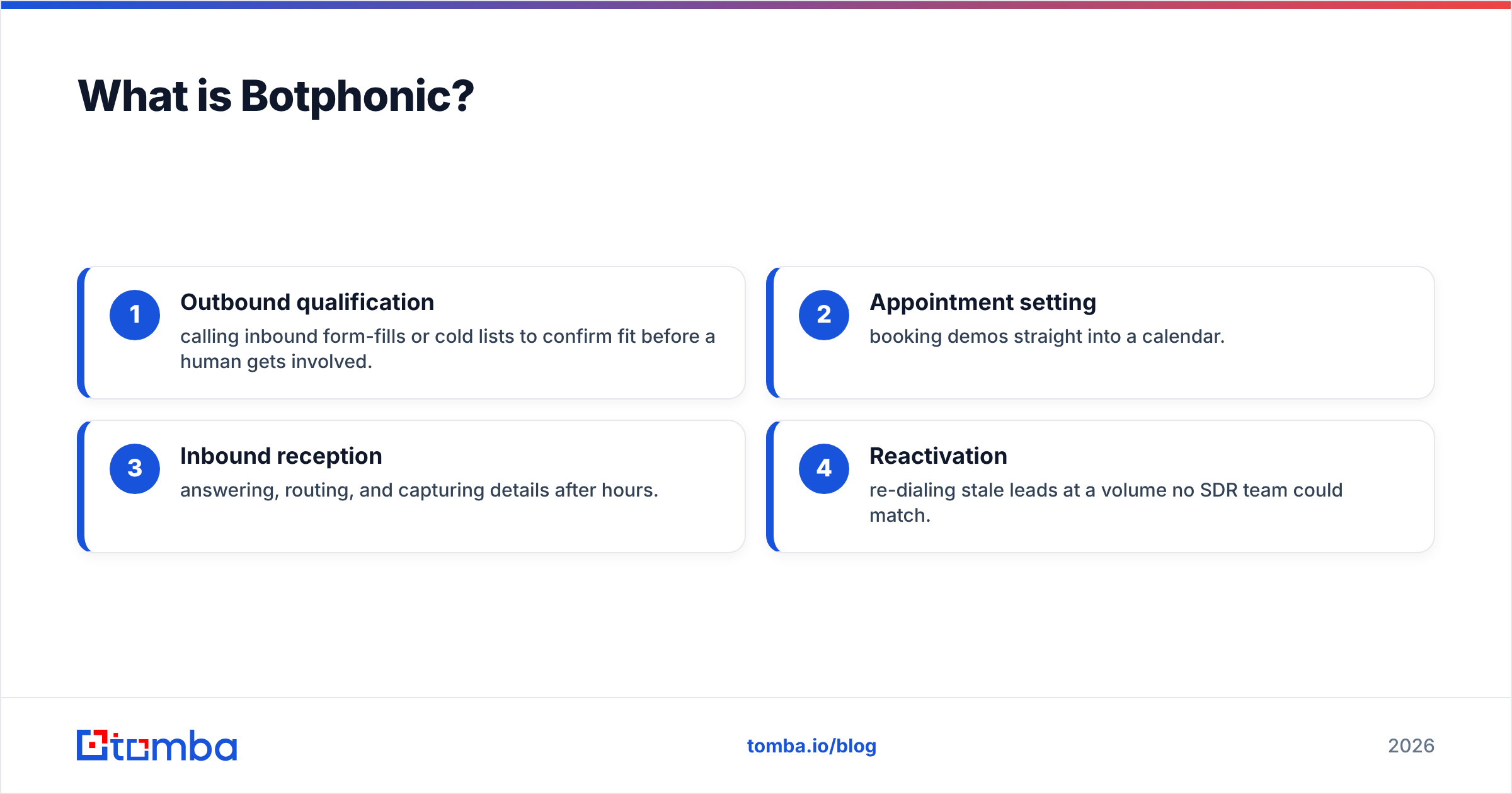
People evaluate Botphonic for a few jobs:
- Outbound qualification — calling inbound form-fills or cold lists to confirm fit before a human gets involved.
- Appointment setting — booking demos straight into a calendar.
- Inbound reception — answering, routing, and capturing details after hours.
- Reactivation — re-dialing stale leads at a volume no SDR team could match.
If your funnel depends on phone touches, an AI caller is tempting. But "can it dial" is the easy question. "Should you route real budget through it" depends on pricing, reliability, and data quality — which is what the rest of this guide covers.
How does Botphonic pricing work in 2026?#
Short answer: Botphonic uses a usage-based model — a recurring platform fee plus consumption (call minutes or credits) — so two teams on the "same plan" can pay very different amounts. This is normal for AI voice tools because the underlying telephony and model inference cost scales with talk time.
When you read any AI-caller pricing page, separate the costs into three buckets:
- Platform / subscription fee — the flat monthly cost for access, seats, and a baseline allotment.
- Usage — per-minute or per-credit charges once you exceed the allotment. This is usually where the real bill lives.
- Add-ons — extra phone numbers, premium voices, integrations, dedicated support, or higher concurrency.
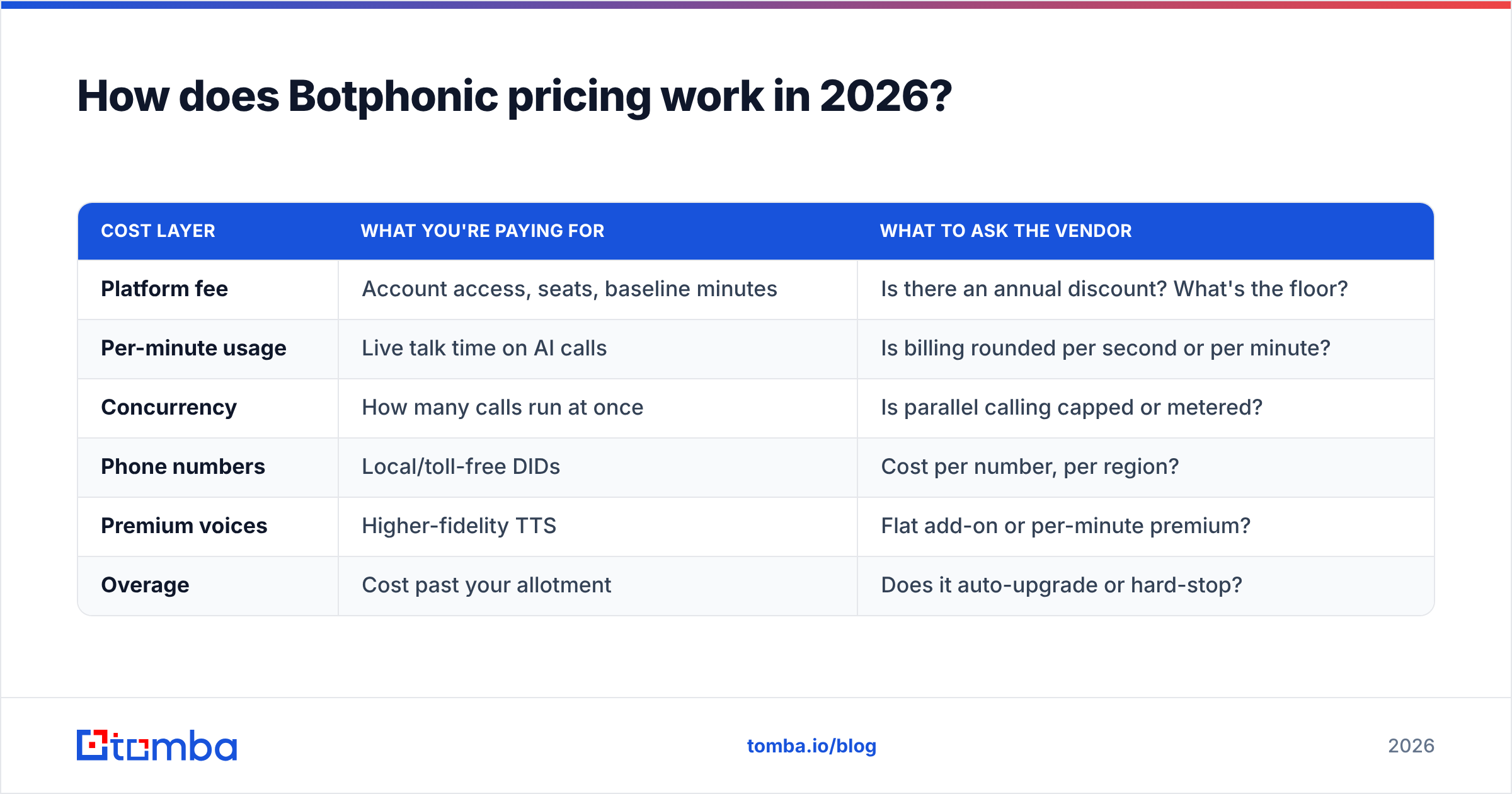
Because vendors adjust these often, treat the table below as a structure to interrogate, not a quote. Confirm live figures on the official Botphonic site before budgeting.
| Cost layer | What you're paying for | What to ask the vendor |
|---|---|---|
| Platform fee | Account access, seats, baseline minutes | Is there an annual discount? What's the floor? |
| Per-minute usage | Live talk time on AI calls | Is billing rounded per second or per minute? |
| Concurrency | How many calls run at once | Is parallel calling capped or metered? |
| Phone numbers | Local/toll-free DIDs | Cost per number, per region? |
| Premium voices | Higher-fidelity TTS | Flat add-on or per-minute premium? |
| Overage | Cost past your allotment | Does it auto-upgrade or hard-stop? |
The trap with usage-based pricing is the demo. A 50-call pilot feels cheap; 50,000 calls a month is a different invoice. Model your expected monthly minutes (average call length × call volume) and multiply by the per-minute rate before you fall for the headline platform fee.
For comparison, Tomba's own pricing is flat and credit-based — Free (25 searches/mo), Starter $49/mo, Growth $99/mo, Pro $249/mo, Enterprise custom — which is a different model entirely. Data tools charge per lookup; voice tools charge per minute talked. Knowing which lever drives your bill is half the battle.
What do Botphonic reviews say — the pros?#
Pulling together the themes that recur in user reviews on directories like G2 and Capterra, the consistent positives for AI voice agents in Botphonic's class look like this:
- Speed-to-lead is unbeatable. An AI agent can call a fresh inbound lead in seconds, around the clock. Human SDR teams simply cannot match sub-minute response at scale, and speed-to-lead is one of the strongest predictors of conversion.
- Cost per conversation drops at volume. Once the workflow is dialed in, the marginal cost of one more call is minutes, not salary. Reactivation campaigns that were never worth a rep's time suddenly pencil out.
- Consistency. The agent delivers the same qualified script every time, with no bad-day variance, no skipped disclosures, and clean logging of every call.
- Always-on coverage. Inbound calls at 2 a.m. get answered and captured instead of going to voicemail.
- Fast iteration. Changing a script or objection path is a config edit, not a week of retraining a team.
Reviewers who are happy tend to share one trait: they pointed the agent at a narrow, well-defined job — booking, qualifying, or reactivating — rather than expecting it to run a nuanced enterprise deal. Scope discipline is the difference between a glowing review and a refund request.
What are the cons and complaints?#
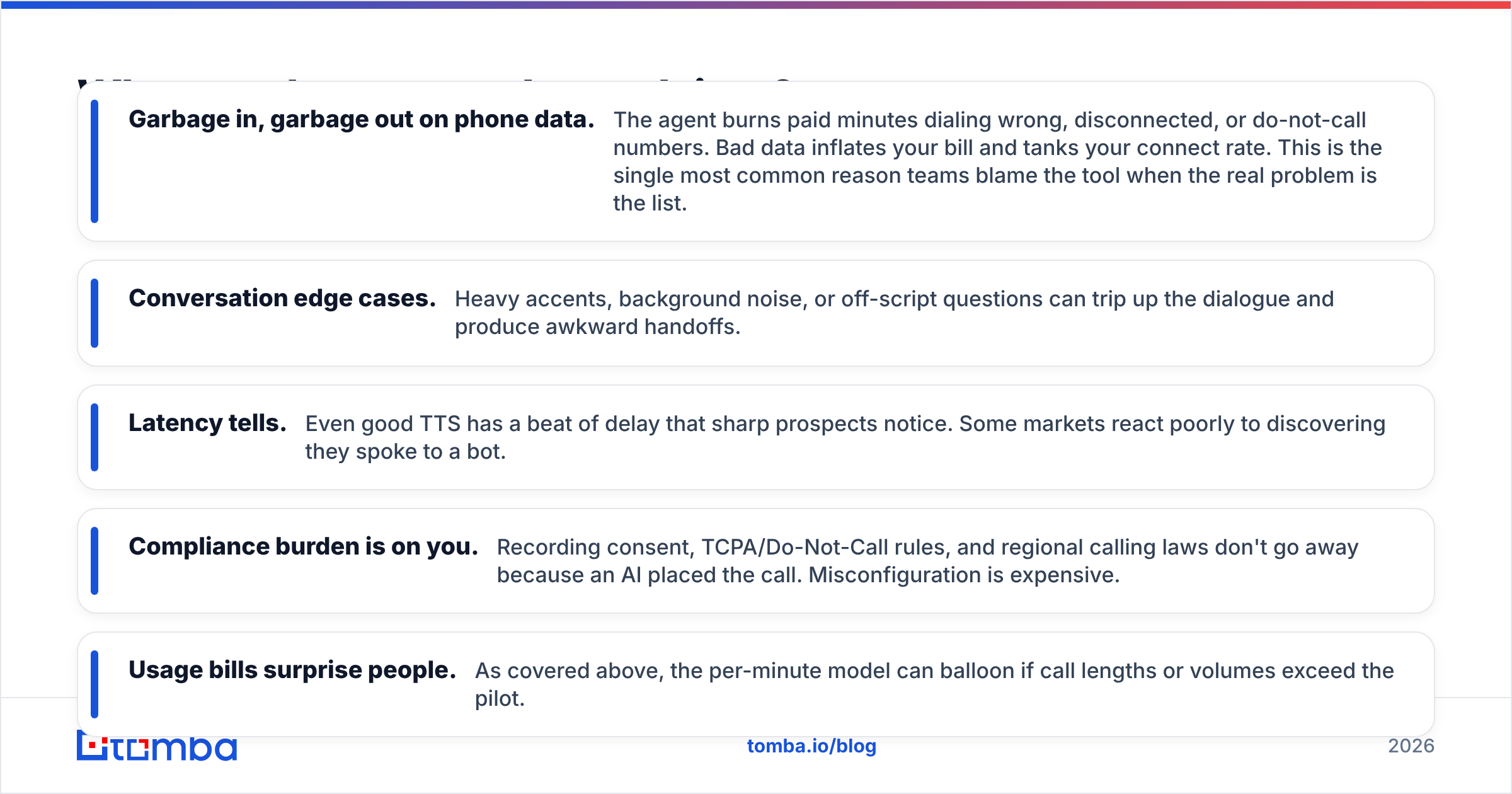
No tool is all upside, and honest reviews surface real friction. The recurring complaints across AI voice platforms:
- Garbage in, garbage out on phone data. The agent burns paid minutes dialing wrong, disconnected, or do-not-call numbers. Bad data inflates your bill and tanks your connect rate. This is the single most common reason teams blame the tool when the real problem is the list.
- Conversation edge cases. Heavy accents, background noise, or off-script questions can trip up the dialogue and produce awkward handoffs.
- Latency tells. Even good TTS has a beat of delay that sharp prospects notice. Some markets react poorly to discovering they spoke to a bot.
- Compliance burden is on you. Recording consent, TCPA/Do-Not-Call rules, and regional calling laws don't go away because an AI placed the call. Misconfiguration is expensive.
- Usage bills surprise people. As covered above, the per-minute model can balloon if call lengths or volumes exceed the pilot.

The throughline of the negative reviews is data and scope — not the AI's voice quality, which most reviewers find acceptable. Which is exactly why the data layer deserves its own section.
Why does contact data decide whether Botphonic is worth it?#
The verdict on any AI caller is set before the first call connects: by the quality of the phone numbers and the targeting behind them. An AI that dials flawlessly through a list of dead numbers is an efficient way to waste money.
Here is the math that reviewers learn the hard way. If 30% of your numbers are invalid, then in a usage-based model nearly a third of your platform's connect attempts, retries, and partial-minute charges are pure waste — plus the opportunity cost of an agent tied up on calls that can never convert. Clean data is not a nice-to-have; it directly lowers your effective cost per booked meeting.
That is where your front-of-funnel stack matters more than the caller:
- Source and validate B2B numbers with a dedicated phone finder instead of scraping unverifiable lists.
- Run numbers through a phone validator so you stop paying to dial disconnected lines.
- Enrich each record with role, company, and intent signals via data enrichment so the agent personalizes instead of reading a generic script.
- For email-led plays that feed the same accounts, pair calls with a verified email finder for multi-channel follow-up.
Think of the AI agent as the engine and verified contact data as the fuel. A great engine on bad fuel still sputters. This is the part most pricing reviews skip — and it is the part that actually determines ROI.
Botphonic vs the alternatives: how do you choose?#
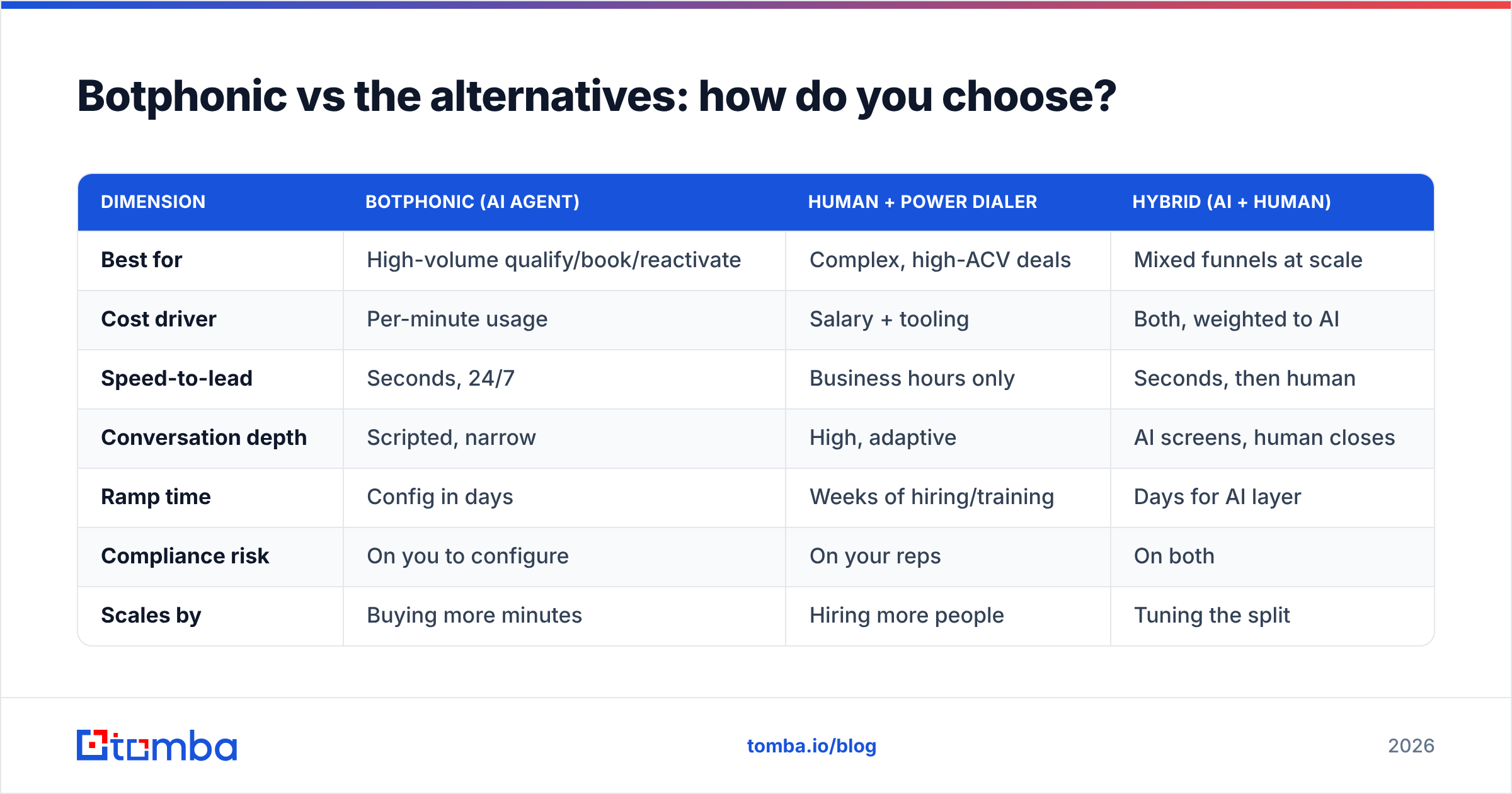
You have three broad paths for phone outreach in 2026: an AI voice agent like Botphonic, a human-dialer stack (reps plus a power dialer), or a hybrid where AI handles tier-1 qualification and humans take the warm handoffs. Here is how they compare on the dimensions that matter.
| Dimension | Botphonic (AI agent) | Human + power dialer | Hybrid (AI + human) |
|---|---|---|---|
| Best for | High-volume qualify/book/reactivate | Complex, high-ACV deals | Mixed funnels at scale |
| Cost driver | Per-minute usage | Salary + tooling | Both, weighted to AI |
| Speed-to-lead | Seconds, 24/7 | Business hours only | Seconds, then human |
| Conversation depth | Scripted, narrow | High, adaptive | AI screens, human closes |
| Ramp time | Config in days | Weeks of hiring/training | Days for AI layer |
| Compliance risk | On you to configure | On your reps | On both |
| Scales by | Buying more minutes | Hiring more people | Tuning the split |
A few rules of thumb from the data:
- Simple, repetitive, high-volume calls (lead qualification, appointment reminders, reactivation) favor the AI agent.
- Complex, consultative, six-figure deals still favor humans — the nuance and trust-building outweigh the efficiency.
- If you're unsure, start hybrid. Let the AI screen and book, route the genuinely interested to a rep, and measure the handoff quality.
- Whichever you pick, the data layer is shared. Every path above gets better with verified numbers and enriched records.
Botphonic is a credible option in the AI-agent column. Whether it beats its direct AI competitors comes down to voice quality in your language, concurrency limits, integration with your CRM, and — again — your per-minute rate at your volume. Run a paced pilot with real numbers and a real script before signing an annual contract.
How should you run a Botphonic pilot?#
Treat the trial like an experiment with a control, not a vibe check. A disciplined pilot answers the pricing-and-fit question in two weeks:
- Fix the scope. One use case (e.g., inbound qualification), one script, one segment.
- Feed it verified data only. Use validated numbers so you measure the agent, not your list rot.
- Track the real unit economics. Cost per connect, cost per qualified conversation, cost per booked meeting — not just minutes used.
- Test the handoff. What happens when a prospect is hot? Does the transfer feel smooth?
- Stress the edge cases. Throw accents, objections, and silence at it and watch the transcripts.
- Project to full volume. Multiply pilot per-minute cost by your real monthly volume before celebrating.
If the numbers hold and the transcripts are clean, you have evidence — not a hunch — that Botphonic fits. If connect rates are low, check your data before blaming the agent; that is usually the culprit.
Final verdict: is Botphonic worth it?#
Botphonic is a legitimate AI voice agent that earns its keep on narrow, high-volume calling jobs — qualification, booking, reactivation, and after-hours reception — provided you go in clear-eyed about usage-based pricing and you feed it clean data. The pros (speed, consistency, 24/7 coverage, low marginal cost) are real. The cons (data sensitivity, conversation edge cases, compliance, bill surprises) are equally real and mostly manageable with discipline.
The honest bottom line: the tool rarely fails on voice quality. It fails when teams point it at bad numbers and unclear scope. Get those two things right and the pricing math usually works.
Before you route a single dollar through any AI caller, fix the input. Build a verified, enriched contact list first — accurate B2B numbers, validated lines, and enriched profiles — so every paid minute lands on a real prospect. Start with Tomba's Email Finder and its companion phone finder and data enrichment tools to make sure the contacts you hand to Botphonic — or any dialer — are worth calling. The agent dials; your data decides whether it pays off.
// get started
Find, verify and enrich your first contacts today
Start on the free plan with 25 searches a month, then scale when your team is ready.
Free plan · No credit card required · GDPR & CCPA
// about the author