BounceBan Pricing and Reviews 2026: Real Pros and Cons
A no-fluff look at BounceBan pricing and reviews in 2026: how the plans really work, the standout pros, the dealbreaker cons, and the alternatives worth testing before you commit.
BounceBan markets itself as the verifier that finally "solves" catch-all emails. These are the addresses most tools shrug at and label "unknown." It's a bold promise. If you run cold outbound at any volume, it's the exact promise you've waited for. But promises aren't pricing, and ad copy isn't a real review. This BounceBan pricing and reviews guide cuts through both.
Here's the honest breakdown. We'll cover what BounceBan actually charges. We'll show where it shines and where it frustrates real users. And we'll name the alternatives worth a spot on your shortlist before you put a card down.
BounceBan Pricing and Reviews: TL;DR for 2026#
- BounceBan is a verification-first tool. Its headline feature is real-time catch-all (accept-all) email verification, which most rivals can't confirm.
- Pricing is credit-based. You get a free trial, pay-as-you-go packs, and monthly plans. That's flexible, but the per-credit math gets pricey at scale and needs watching.
- Biggest pro: strong catch-all resolution plus a usable Chrome extension for LinkedIn prospecting.
- Biggest con: it's narrow. It verifies well, but it isn't a full finder-plus-enrichment-plus-database platform. Most teams still pay for a second tool.
- Best move: test BounceBan against an all-in-one like Tomba on your own list first. Accuracy claims only matter on your data.
What Is BounceBan and Who Is It For?#
BounceBan is an email verification and finding tool. Its calling card is catch-all verification. A catch-all (or "accept-all") domain accepts mail sent to any address at that domain, even if the mailbox doesn't exist. That's why most verifiers return "unknown" or "risky." They genuinely can't tell whether jane@company.com lands in an inbox or a black hole.
BounceBan's pitch is simple. It resolves a large share of those catch-alls into a clear valid or invalid verdict. That shrinks the "unknown" bucket that quietly tanks your bounce rate. You can read the full claim on the official BounceBan site. The short version: it's built for cold-email senders, agencies, and SDR teams. These are the people who live and die by email deliverability and need clean lists before they hit send.
It is not trying to be a B2B data warehouse. Do you want a giant contact database, firmographic enrichment, phone numbers, and a finder in one login? BounceBan alone won't cover it.
How Does BounceBan Pricing Work?#
BounceBan uses a credit model, not flat seat pricing. In practice it breaks down into four motions:
- Free trial credits. A small allotment lets you test catch-all accuracy on your own list before paying. Use it. It's the whole point.
- Pay-as-you-go packs. These are one-time bundles. They don't expire as fast as subscription credits. They suit spiky, project-based verification.
- Monthly subscriptions. Recurring tiers carry a lower effective per-credit cost. They're aimed at teams verifying all the time.
- Catch-all credits priced separately. Hard catch-all checks usually cost more than a standard syntax or MX check. They're doing more work.
The flexibility is genuinely nice. But the credit math is sneaky. A "10,000 credit" plan is not the same as 10,000 verified contacts. If a chunk of your list is catch-all, it burns premium credits fast. So price your actual list composition, not the headline number. Confirm current rates on BounceBan's live pricing page too, since tiers shift.
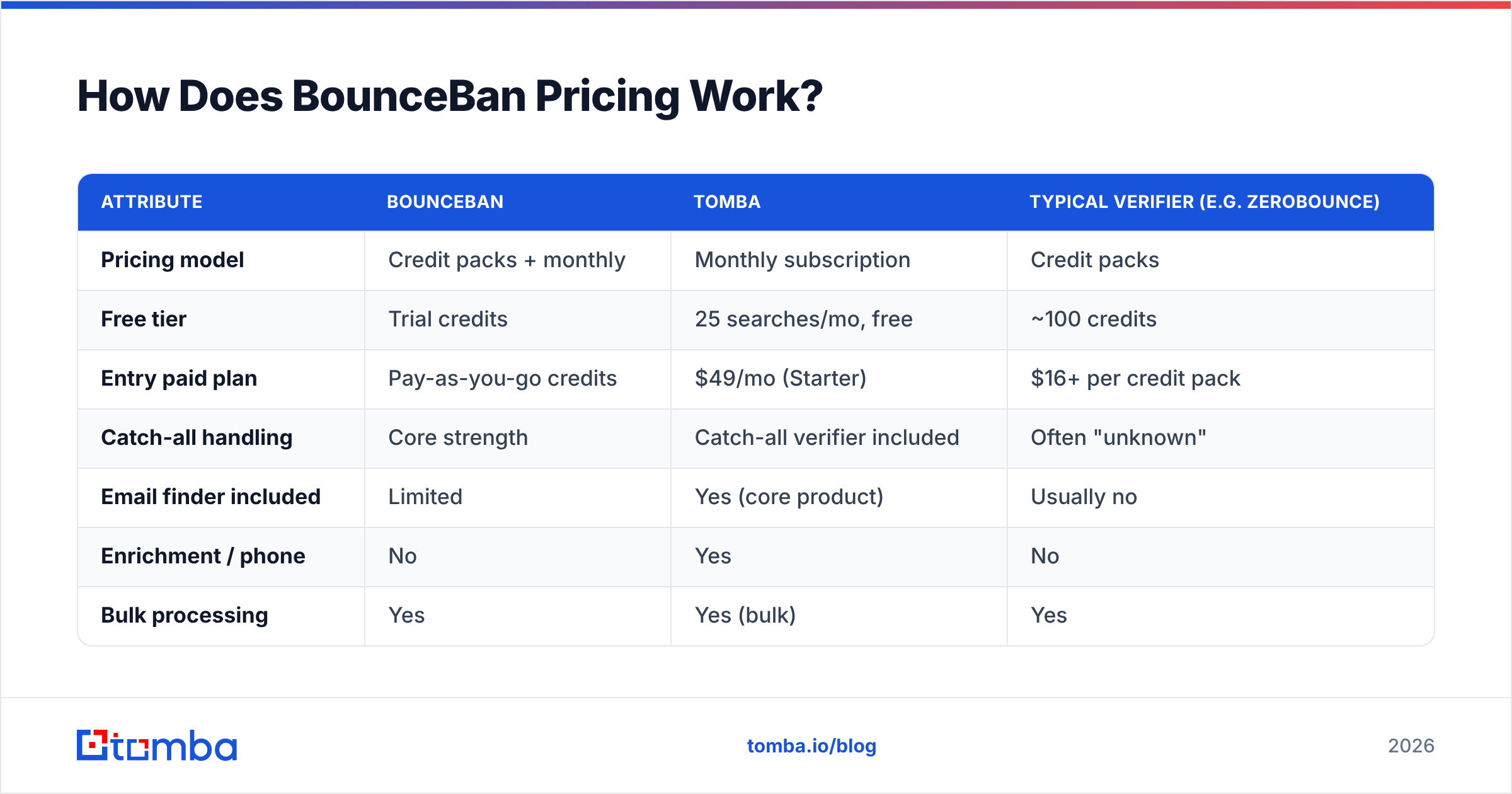
Here's how the model compares to a subscription-based all-in-one. For Tomba, see the published Tomba pricing tiers:
| Attribute | BounceBan | Tomba | Typical verifier (e.g. ZeroBounce) |
|---|---|---|---|
| Pricing model | Credit packs + monthly | Monthly subscription | Credit packs |
| Free tier | Trial credits | 25 searches/mo, free | ~100 credits |
| Entry paid plan | Pay-as-you-go credits | $49/mo (Starter) | $16+ per credit pack |
| Catch-all handling | Core strength | Catch-all verifier included | Often "unknown" |
| Email finder included | Limited | Yes (core product) | Usually no |
| Enrichment / phone | No | Yes | No |
| Bulk processing | Yes | Yes (bulk) | Yes |
The takeaway isn't "BounceBan is overpriced." It's that you're comparing a focused verifier against platforms that bundle finding, verifying, and enrichment for one predictable monthly fee. Your cost-per-outcome depends on how many tools you'd otherwise stack.
What Are the Pros of BounceBan?#
Credit where it's due. The reviews highlight real strengths.
- Catch-all verification that returns verdicts. This is the headline, and it mostly holds up. If your lists are heavy on corporate domains (which are often catch-all), BounceBan recovers contacts that other tools quietly discard.
- Real-time API verification. You can verify at the point of capture. Think form fills, signups, and list imports, instead of batch-cleaning after the damage is done.
- A practical Chrome extension. Prospect from LinkedIn and verify on the spot. It's a smooth workflow for SDRs who don't want to bounce between tabs.
- Clear status codes. Valid, invalid, accept-all, and risky labels help you segment sends by confidence. You don't have to treat every address as equal.
- Pay-as-you-go option. For agencies with irregular volume, skipping a subscription is a real plus.
On peer-review sites like G2, the recurring praise is accuracy on tricky domains and responsive support. Those are the two things that matter most here.
What Are the Cons and Common Complaints?#
No tool is all upside. The gaps here are worth naming plainly.
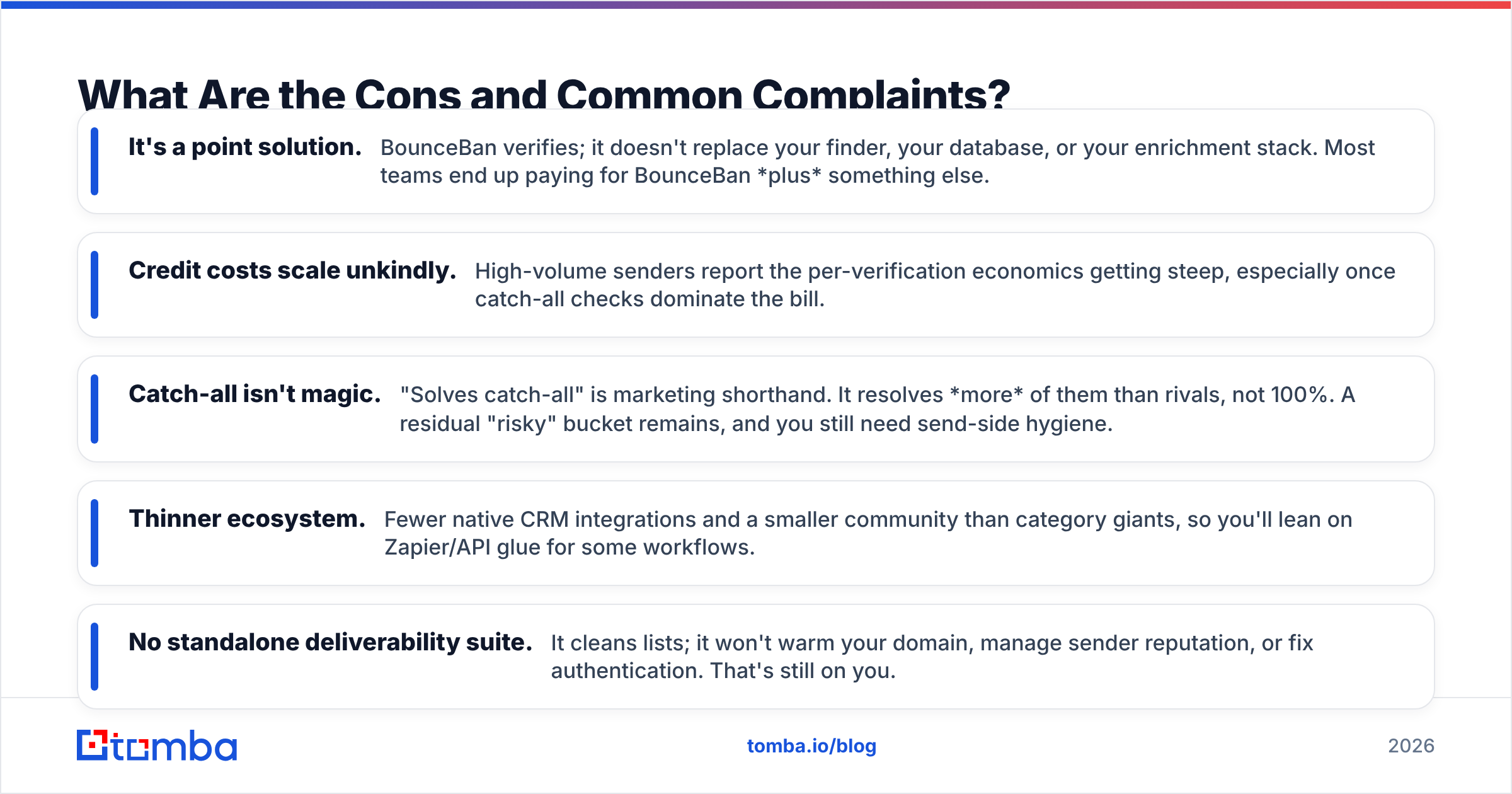
- It's a point solution. BounceBan verifies. It doesn't replace your finder, your database, or your enrichment stack. Most teams pay for BounceBan plus something else.
- Credit costs scale unkindly. High-volume senders report the per-verification economics getting steep. That's especially true once catch-all checks dominate the bill.
- Catch-all isn't magic. "Solves catch-all" is marketing shorthand. It resolves more of them than rivals, not 100%. A residual "risky" bucket remains, and you still need send-side hygiene.
- Thinner ecosystem. There are fewer native CRM integrations and a smaller community than the category giants. You'll lean on Zapier or API glue for some workflows.
- No standalone deliverability suite. It cleans lists. It won't warm your domain, manage sender reputation, or fix authentication. That's still on you.
None of these are dealbreakers on their own. Together they explain why BounceBan tends to be part of a stack rather than the whole thing.

Is BounceBan Accurate Enough for Cold Email?#
Accuracy is the only metric that matters for a verifier. BounceBan's is competitive, especially on catch-all domains where the bar is low industry-wide. But "accurate" is contextual. A tool that's 99% right on consumer Gmail addresses and one that's 90% right on locked-down corporate catch-alls are solving different difficulty levels.
Here's the practical test. Take a known sample: addresses you've already emailed and gotten replies from, plus a batch of known-dead ones. Run it through any tool. Then measure false positives (dead addresses marked valid) and false negatives (good addresses marked risky). False positives are the ones that hurt. They're the bounces that erode your email deliverability and sender score.
Pair whatever verifier you choose with disciplined sending. Even perfect data can't save a cold domain. Not with no warmup, missing SPF/DKIM, and aggressive volume. Verification is necessary, but it isn't sufficient.
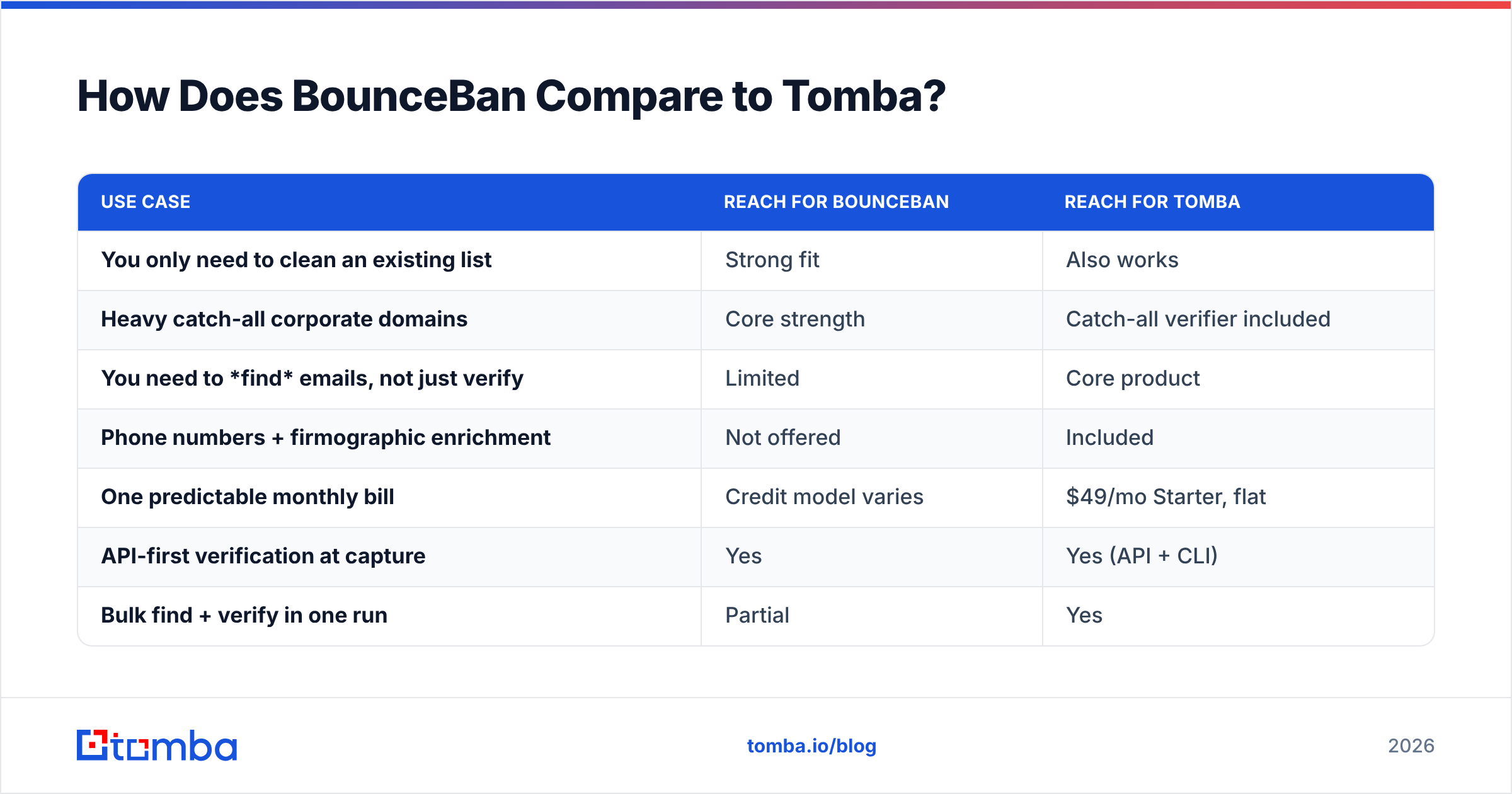
How Does BounceBan Compare to Tomba?#
These are different shapes of product. BounceBan is a sharp, single-purpose verifier. Tomba is an all-in-one finder-plus-verifier-plus-enrichment platform, where verification is one capability among several.
| Use case | Reach for BounceBan | Reach for Tomba |
|---|---|---|
| You only need to clean an existing list | Strong fit | Also works |
| Heavy catch-all corporate domains | Core strength | Catch-all verifier included |
| You need to find emails, not just verify | Limited | Core product |
| Phone numbers + firmographic enrichment | Not offered | Included |
| One predictable monthly bill | Credit model varies | $49/mo Starter, flat |
| API-first verification at capture | Yes | Yes (API + CLI) |
| Bulk find + verify in one run | Partial | Yes |
If your only job is verification and your lists are catch-all-heavy, BounceBan is a strong pick. But say you're building lists from scratch. Then Tomba's email finder, built-in email verifier, and dedicated catch-all verifier collapse two or three subscriptions into one. The real question isn't "which tool verifies better." It's "how many tools do I want to pay for and stitch together?"
What Are the Best BounceBan Alternatives in 2026?#
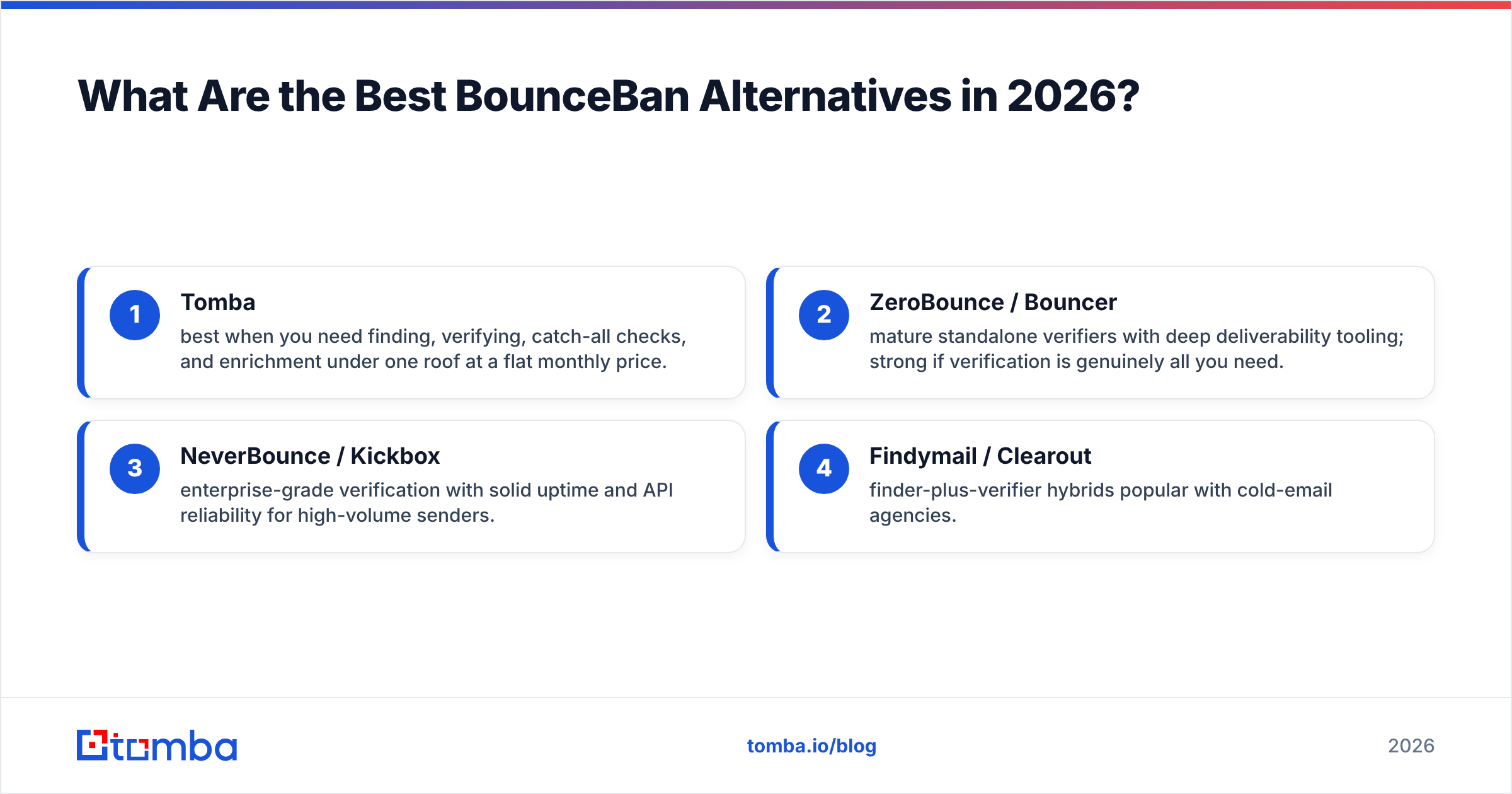
Build a shortlist around your real workflow, not the flashiest feature:
- Tomba — best when you need finding, verifying, catch-all checks, and enrichment under one roof at a flat monthly price.
- ZeroBounce / Bouncer — mature standalone verifiers with deep deliverability tooling. Strong if verification is genuinely all you need.
- NeverBounce / Kickbox — enterprise-grade verification with solid uptime and API reliability for high-volume senders.
- Findymail / Clearout — finder-plus-verifier hybrids popular with cold-email agencies.
Compare each on a sample of your data, not on G2 averages. Most of these tools, Tomba included, offer a free tier or trial. So the test costs you nothing but an afternoon. Cross-check claims on a neutral directory like Capterra before you decide.
How Should You Decide?#
Conclusion first. Pick BounceBan if verification, especially catch-all, is your single biggest pain and you're fine running it alongside other tools. Pick an all-in-one like Tomba if you'd rather find, verify, and enrich in one place without juggling credits across vendors. That trade-off is the heart of any BounceBan pricing and reviews decision.
Use this simple filter:
- Verification only, catch-all-heavy, irregular volume? BounceBan's pay-as-you-go fits.
- Building lists from zero and want clean data now? An integrated finder-plus-verifier wins.
- Tight budget, want predictability? Flat monthly beats credit roulette.
- Enterprise volume, API-first? Shortlist BounceBan, NeverBounce, and Tomba's API, then load-test.
Whatever you choose, verify on a sample. Watch your bounce rate for two weeks. Then let the numbers, not the landing page, make the call.
Start With Cleaner Data From the Source#
The cheapest bounce is the one you never generate. So don't find emails in one place and clean them in another. Instead, find verified, ready-to-send addresses in a single step with the Tomba Email Finder. You get domain search, real-time verification, and catch-all handling built in. It starts free with 25 searches a month and scales to a flat $49/mo. Run your toughest list through it. Compare the results against BounceBan side by side. Then keep the tool that wins on your data. That's the only review that counts.
// get started
Find, verify and enrich your first contacts today
Start on the free plan with 25 searches a month, then scale when your team is ready.
Free plan · No credit card required · GDPR & CCPA
// about the author