Bounceban vs Clodura.ai 2026: Which B2B Email Tool Wins?
Bounceban verifies catch-all emails; Clodura.ai is a full sales-intelligence database. Here's an honest 2026 breakdown of pricing, accuracy, and which one fits your outbound stack.
Bounceban vs Clodura.ai: Which One Actually Belongs in Your 2026 Outbound Stack?
If you are comparing Bounceban vs Cloduraai (often written Bounceban vs Clodura.ai), the first thing to know is simple. These two tools do not really do the same job. One is a focused email-verification engine built to clear catch-all addresses. The other is a broad sales-intelligence database. It tries to handle prospecting, sequencing, and data all at once. Picking between them without grasping that gap is how teams pay for features they never use.
This guide breaks down what each tool is, where it wins, and where it falls short. It also shows which workflows each one fits, and where a focused alternative makes more sense.
TL;DR#
- Bounceban is a real-time email-verification tool. It has a strong reputation for handling catch-all (accept-all) domains, which is exactly where most verifiers fail.
- Clodura.ai is an all-in-one sales-intelligence platform. It bundles a B2B contact database, an email finder, sequences, and basic CRM features.
- They solve different problems. Bounceban cleans lists. Clodura.ai builds them. A head-to-head only makes sense if you are deciding which gap to fill first.
- Pricing differs sharply. Bounceban is usage-priced per verification. Clodura.ai sells seat-based plans with database credits.
- If you mainly need accurate emails plus reliable verification in one place, a focused stack often wins. Pair a dedicated email finder with a strong email verifier.
What is Bounceban?#
Bounceban is an email-verification service. You feed it an address, or a list of them. It then tells you whether the inbox is real, invalid, risky, or a catch-all. Its main selling point is catch-all resolution.
Here is the everyday version. Most verifiers are like a mail carrier who knocks on a door and listens for an answer. Some buildings accept every letter, whether or not the person lives there. That is a catch-all domain. The carrier shrugs and marks it "unknown." Bounceban tries to actually find out who lives there. It uses inbox-level signals instead of giving up at the front gate.
That focus matters because catch-all domains make up a large share of B2B email. A verifier might return "unknown" on 20-30% of your list. Then you are left guessing. Guessing is how bounce rates climb and sender reputation drops.
What Bounceban is not: it is not a place to find new contacts. It does not give you a prospecting database, company filters, or sequences. It verifies what you already have.
What is Clodura.ai?#
Clodura.ai sits at the opposite end. It is a B2B sales-intelligence platform. It bundles a contact database (the company advertises hundreds of millions of contacts), an email finder, direct-dial numbers, email sequences, and buyer-intent signals. You can read its own positioning on the Clodura.ai homepage.
Think of it less as a single tool and more as a sales workstation. You search the database by industry, title, geography, or technology stack. Then you pull contacts and push them into outreach without leaving the platform.
Every all-in-one trades depth for breadth. Clodura.ai does many things competently. But each module competes for engineering attention. Its verification layer, for example, is one feature among dozens. It is not the core product, the way it is for a dedicated verifier.
Bounceban vs Cloduraai: Side-by-Side Comparison#
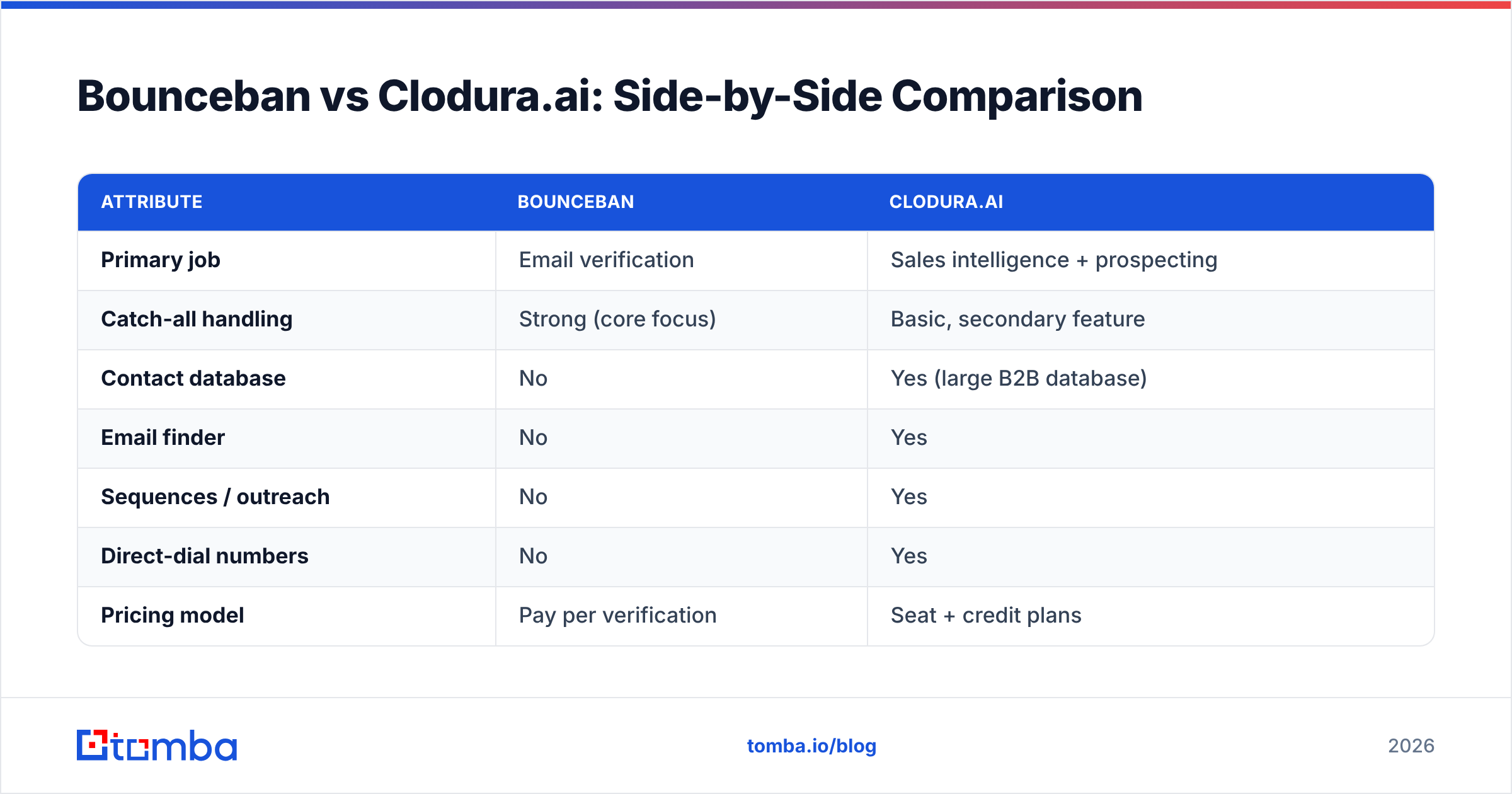
Here is the honest head-to-head. Remember that these tools overlap only partially. The table compares them on the dimensions where a buyer actually has to choose.
| Attribute | Bounceban | Clodura.ai |
|---|---|---|
| Primary job | Email verification | Sales intelligence + prospecting |
| Catch-all handling | Strong (core focus) | Basic, secondary feature |
| Contact database | No | Yes (large B2B database) |
| Email finder | No | Yes |
| Sequences / outreach | No | Yes |
| Direct-dial numbers | No | Yes |
| Pricing model | Pay per verification | Seat + credit plans |
| Best for | Cleaning existing lists | Building lists from scratch |
| Free option | Limited trial credits | Free tier with limited credits |
The pattern is clear. If your list is the problem, choose Bounceban. If your pipeline is empty, choose Clodura.ai. If both are true, which is the common case, you need either both tools or a single platform that finds and verifies together.
Is Bounceban better than Clodura.ai for accuracy?#
For verification accuracy, yes. That is not a controversial claim, because verification is the only thing Bounceban does. A specialist tool that lives or dies on catch-all accuracy will almost always out-verify a module bolted onto a larger suite.
But accuracy has two halves, and people mix them up:
- Finding accuracy asks: does the tool return the correct email for a given person? This is Clodura.ai's domain. Bounceban does not find emails at all.
- Verification accuracy asks: does the tool correctly tell you whether an email is deliverable? This is Bounceban's domain.
So "which is more accurate" depends on which half you mean. Here is a clean test. Take a list of known-good addresses from a sales team. Run both tools. Then compare false-positive and false-negative rates on catch-all domains. In that narrow test, the verification specialist usually wins. In a "find me 500 VPs of Engineering in fintech" test, Bounceban simply cannot compete. It is not built for it.
Is verification your bottleneck? Then a purpose-built catch-all verifier is the category to evaluate. Benchmark more than one vendor before you commit, because catch-all results vary widely by provider.
How does pricing compare?#
Pricing is where the two diverge most, and it reflects their different jobs.
Bounceban prices per verification. You buy credits and burn them as you check addresses. This is efficient if verification is occasional or seasonal. You pay for what you clean and nothing else.
Clodura.ai prices like a platform. You get seat-based subscriptions with monthly credit allotments for database lookups and email finds. You are paying for ongoing access to data, not a one-time clean.
Here is a quick way to think about total cost:
- High-volume, infrequent cleaning points to usage pricing (Bounceban-style).
- Steady prospecting every week favors seat + credit pricing (Clodura.ai-style).
- You need both find and verify, so compare a bundled platform against two separate subscriptions before deciding.
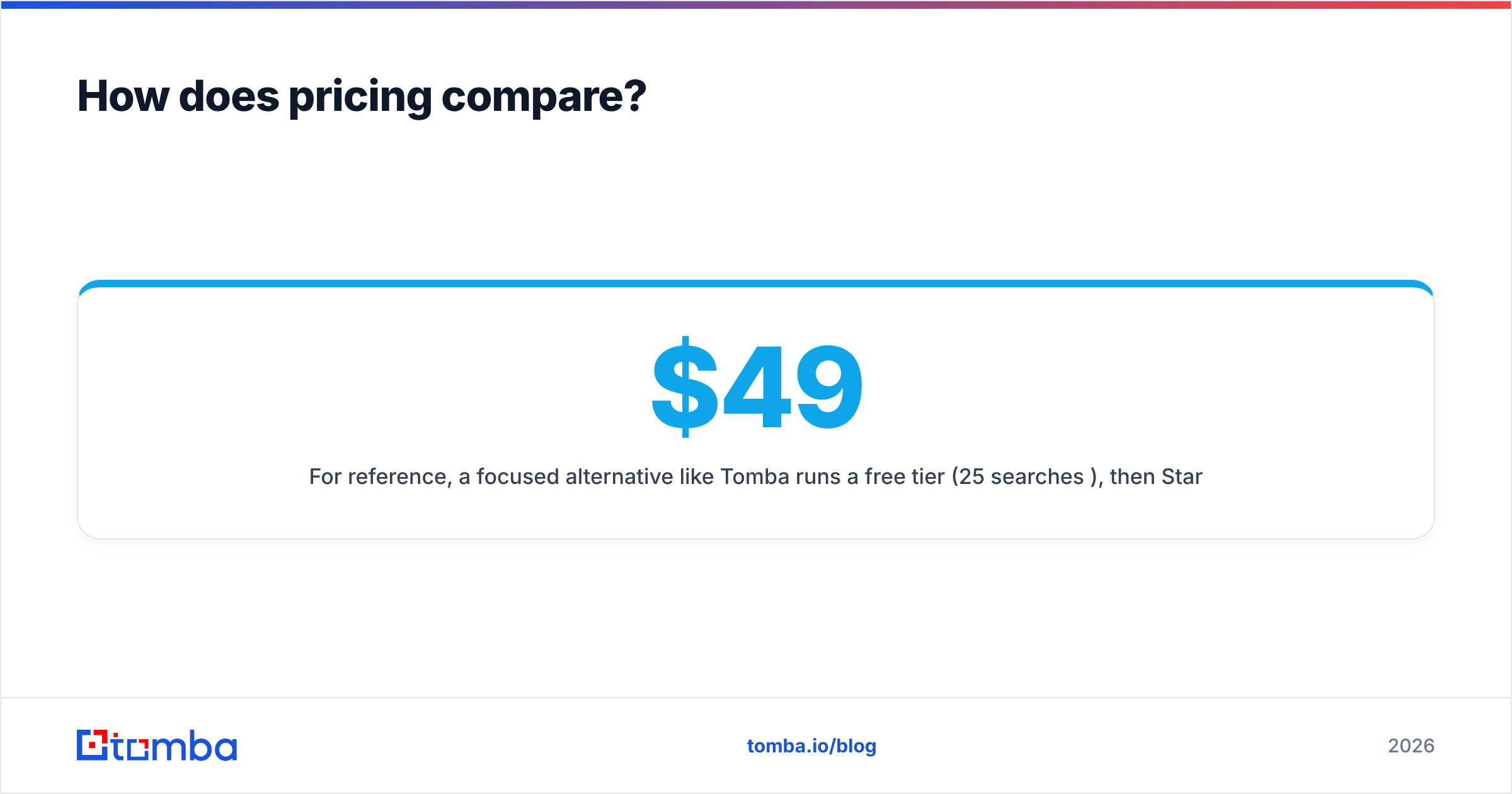
For reference, a focused alternative like Tomba runs a free tier (25 searches/mo). After that, Starter is $49/mo, Growth is $99/mo, and Pro is $249/mo. One plan combines finding and verifying. You can see the full Tomba pricing breakdown to compare the credit math against either tool. (Note: ignore any "$39" figures floating around. The correct Starter price is $49/mo.)
Always read independent reviews before buying. Both tools have profiles on G2, where verified users post real-world feedback on data freshness, support, and billing surprises.
Which tool fits which use case?#
Rather than crowning a single winner, match the tool to the job. Here is a practical breakdown.
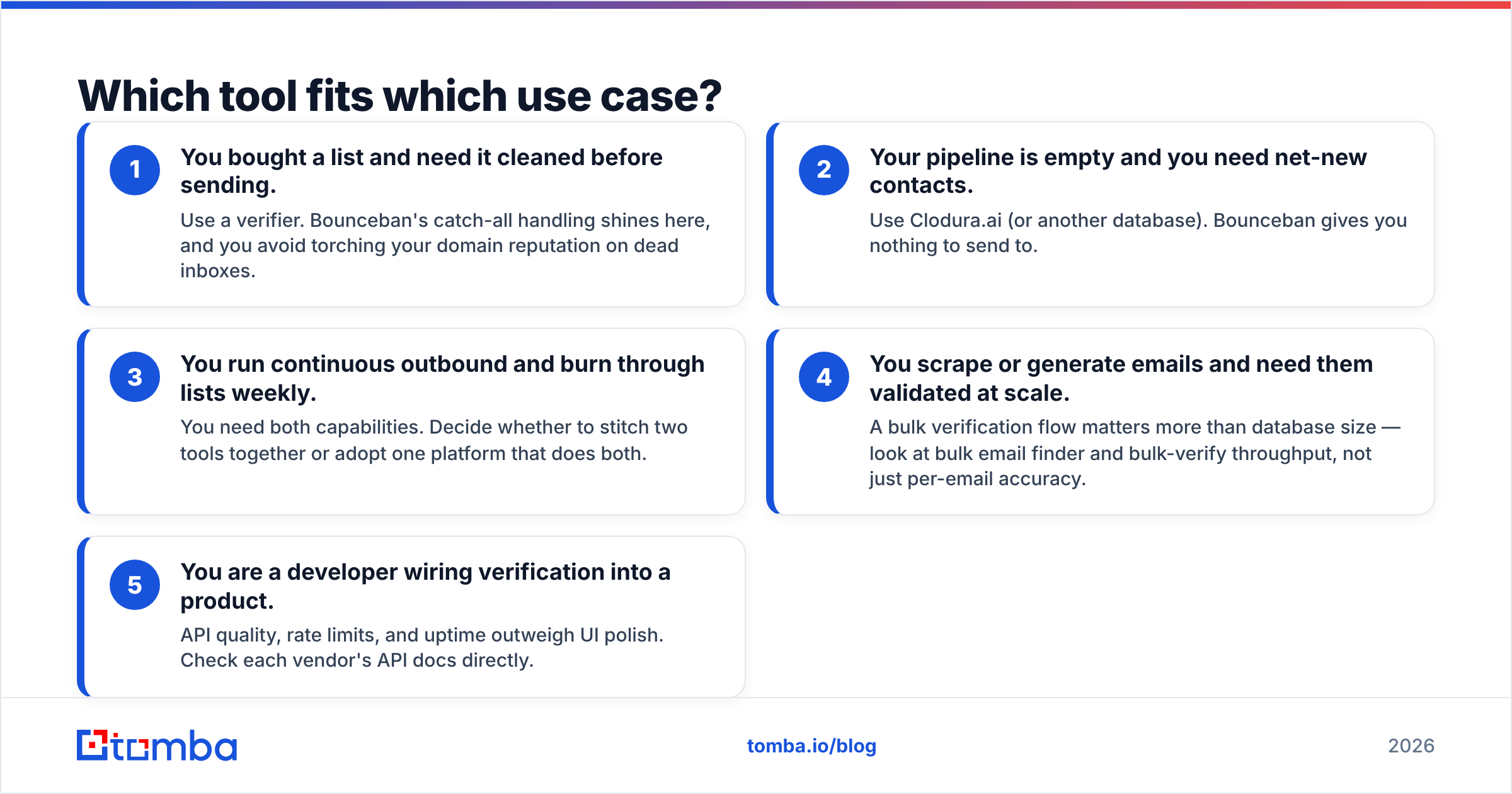
- You bought a list and need it cleaned before sending. Use a verifier. Bounceban's catch-all handling shines here, and you avoid torching your domain reputation on dead inboxes.
- Your pipeline is empty and you need net-new contacts. Use Clodura.ai (or another database). Bounceban gives you nothing to send to.
- You run continuous outbound and burn through lists weekly. You need both capabilities. Decide whether to stitch two tools together or adopt one platform that does both.
- You scrape or generate emails and need them validated at scale. A bulk verification flow matters more than database size. Look at bulk email finder and bulk-verify throughput, not just per-email accuracy.
- You are a developer wiring verification into a product. API quality, rate limits, and uptime outweigh UI polish. Check each vendor's API docs directly.
Most teams land in case 3. That is why the "Bounceban vs Cloduraai" question is slightly the wrong question. The real decision is this: one bundled platform, or a best-of-breed finder plus a best-of-breed verifier?
What about a single tool that finds and verifies?#
This is the option most comparison posts skip. Say you need both halves: finding correct emails and confirming they are deliverable. Then a platform that does both can replace the Bounceban-plus-database stack entirely.
Tomba is built around exactly that workflow. The email finder surfaces professional addresses by name, domain, or company. Every result can then run through the built-in email verifier and catch-all checks before it reaches your sequencer. One subscription, one credit pool, one less integration to maintain.
That does not make Tomba automatically "better" than Bounceban at verification or Clodura.ai at database depth. Specialists will always go deeper in their lane. But much of the market just wants accurate, verified emails without managing two vendors. For that large middle, consolidation usually wins on both cost and simplicity.
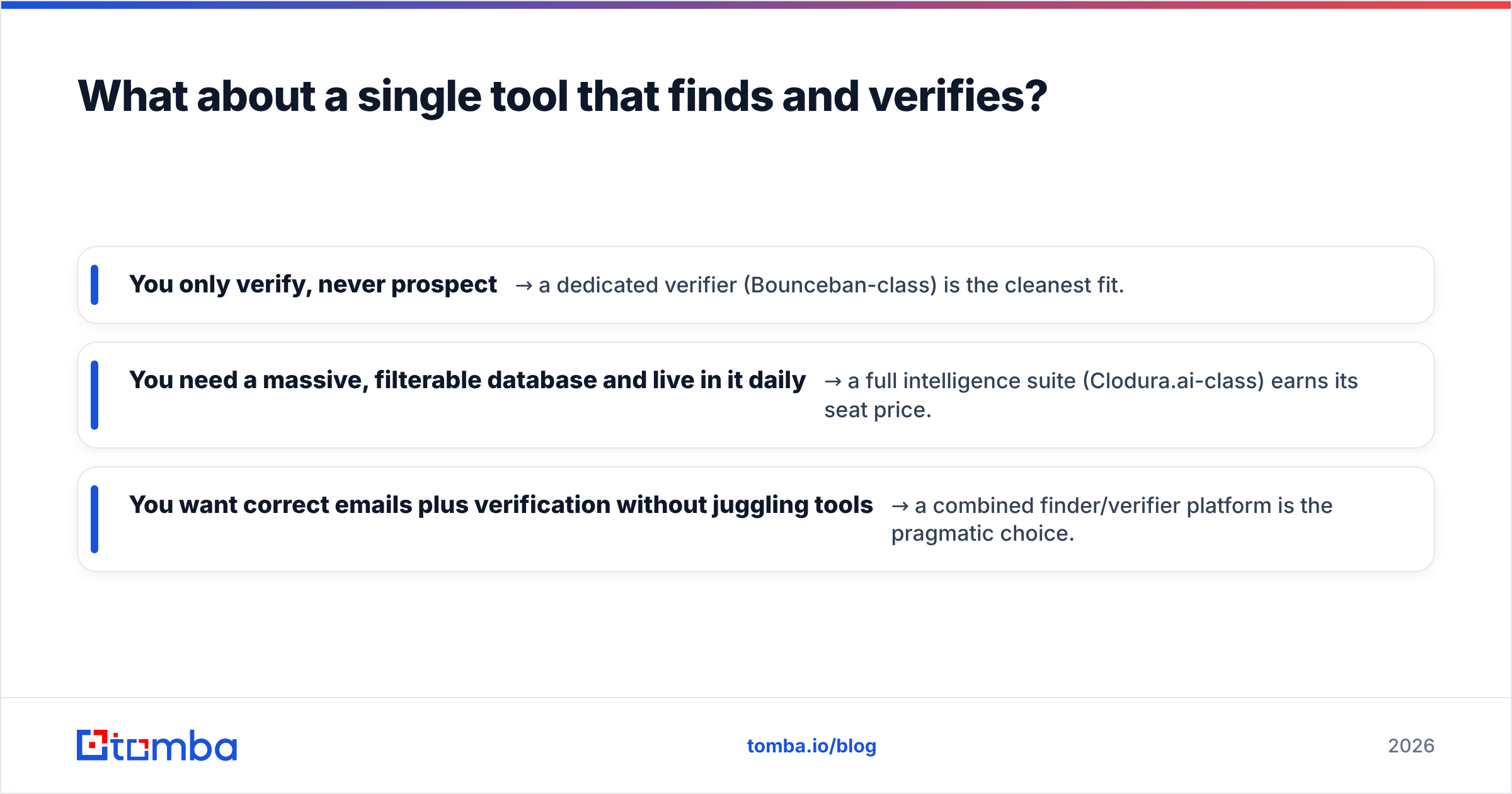
Here is how to decide:
- You only verify, never prospect. A dedicated verifier (Bounceban-class) is the cleanest fit.
- You need a massive, filterable database and live in it daily. A full intelligence suite (Clodura.ai-class) earns its seat price.
- You want correct emails plus verification without juggling tools. A combined finder/verifier platform is the pragmatic choice.
Common mistakes when choosing between them#
A few traps show up again and again:
- Buying a database to solve a verification problem. Maybe your bounce rate is high but your contacts are fine. Then you need verification, not more contacts. Clodura.ai will not fix a dirty list better than a specialist verifier.
- Buying a verifier to solve an empty-pipeline problem. Bounceban cannot generate prospects. No amount of verification fills a funnel.
- Ignoring catch-all rates in trials. Run a real sample of your domains during any trial. A verifier can look great on Gmail and Outlook, then collapse on the catch-all corporate domains where your buyers live.
- Forgetting deliverability is downstream. Verification protects email deliverability, but it is not the whole story. Sender reputation, warmup, and content still decide whether you hit the inbox.
- Comparing list price instead of total cost. A cheap per-email rate can lose to a bundled plan once you add a second tool to cover the gap.
Final verdict: Bounceban or Clodura.ai?#
There is no universal winner, because they are not really competitors. They are complements pointed at different problems.
- Choose Bounceban if your single biggest pain is verification, especially catch-all domains, and you already source contacts reliably.
- Choose Clodura.ai if you need a contact database and outreach engine in one place, and you can live with verification as a secondary feature.
- Choose a combined finder/verifier platform if you want accurate emails and trustworthy verification under one roof, with simpler billing and fewer integrations.
That last group is most outbound teams. For them, Tomba's email finder plus built-in verification covers finding and validating in a single workflow. It starts free and scales to $49/mo, with no two-vendor stack to assemble. Run your own contacts through a free trial. Measure the verified-email rate against Bounceban and Clodura.ai, and let the numbers make the call.
// get started
Find, verify and enrich your first contacts today
Start on the free plan with 25 searches a month, then scale when your team is ready.
Free plan · No credit card required · GDPR & CCPA
// about the author