Bounceban vs Jet Leads Pro: Which Lead Tool Wins in 2026?
Bounceban vs Jet Leads Pro compared head-to-head on accuracy, catch-all handling, pricing, and workflow fit — plus where a finder-plus-verifier stack beats both in 2026.
Choosing between Bounceban and Jet Leads Pro usually comes down to one question: do you need a sharper email verifier, or a broader lead workflow? They sit on different sides of the same problem — getting clean, deliverable contacts into your sequencer without burning your domain. This guide breaks down where each one earns its keep, where it falls short, and when a finder-plus-verifier stack quietly beats both.
TL;DR — Bounceban vs Jet Leads Pro#
- Bounceban is a verification-first tool. Its standout feature is catch-all (accept-all) handling, where most verifiers just shrug and return "unknown."
- Jet Leads Pro leans toward lead sourcing and list-building — more about finding contacts than stress-testing them.
- Pricing models differ: Bounceban tends to charge per verification credit; Jet Leads Pro bundles sourcing and verification, so cost-per-clean-lead is harder to compare at a glance.
- Neither is a true all-in-one. If you need find + verify + enrich in one API, a dedicated stack like Tomba covers more of the pipeline.
- Our pick depends on your bottleneck: verification accuracy → Bounceban; sourcing volume → Jet Leads Pro; end-to-end pipeline → a combined finder/verifier.
What is Bounceban?#
Bounceban is an email verification service built to reduce bounce rates before you send. Its core promise is confidence on the addresses other tools give up on. When a domain is configured as "catch-all" — meaning the mail server accepts any address at that domain during the SMTP handshake — most verifiers can't tell a real inbox from a typo. Bounceban's pitch is that it pushes past that ambiguity to give a usable verdict.
That matters because catch-all domains are everywhere in B2B. A large share of corporate domains accept-all, so "unknown" results pile up fast on enterprise lists. If 30% of your list comes back unverifiable, you're either guessing or throwing away good leads. A verifier that resolves more of those is doing real work.
Where Bounceban is narrow: it verifies, it doesn't find. You bring the addresses; it grades them. That's a clean model, but it means another tool has to feed it.

What is Jet Leads Pro?#
Jet Leads Pro positions itself further upstream — toward sourcing and building lead lists, with verification bundled in. The appeal is fewer tabs: search for prospects, pull their contact details, and get a deliverability signal in one motion. For a solo founder or a small SDR team, that consolidation is attractive.
The trade-off is depth. Bundled verification is rarely as rigorous as a verification-first engine, and "leads found" is a vanity metric if a chunk of them bounce. The question to ask isn't "how many contacts did it return?" but "how many landed in an inbox and got a reply?" A sourcing tool optimizes the first number; a verifier optimizes the second.
Jet Leads Pro is best understood as a breadth play. If your problem is an empty pipeline, breadth helps. If your problem is a dirty pipeline, breadth can make it worse.
Bounceban vs Jet Leads Pro: side-by-side#
Here's the head-to-head on the attributes that actually move reply rates and cost.
| Attribute | Bounceban | Jet Leads Pro |
|---|---|---|
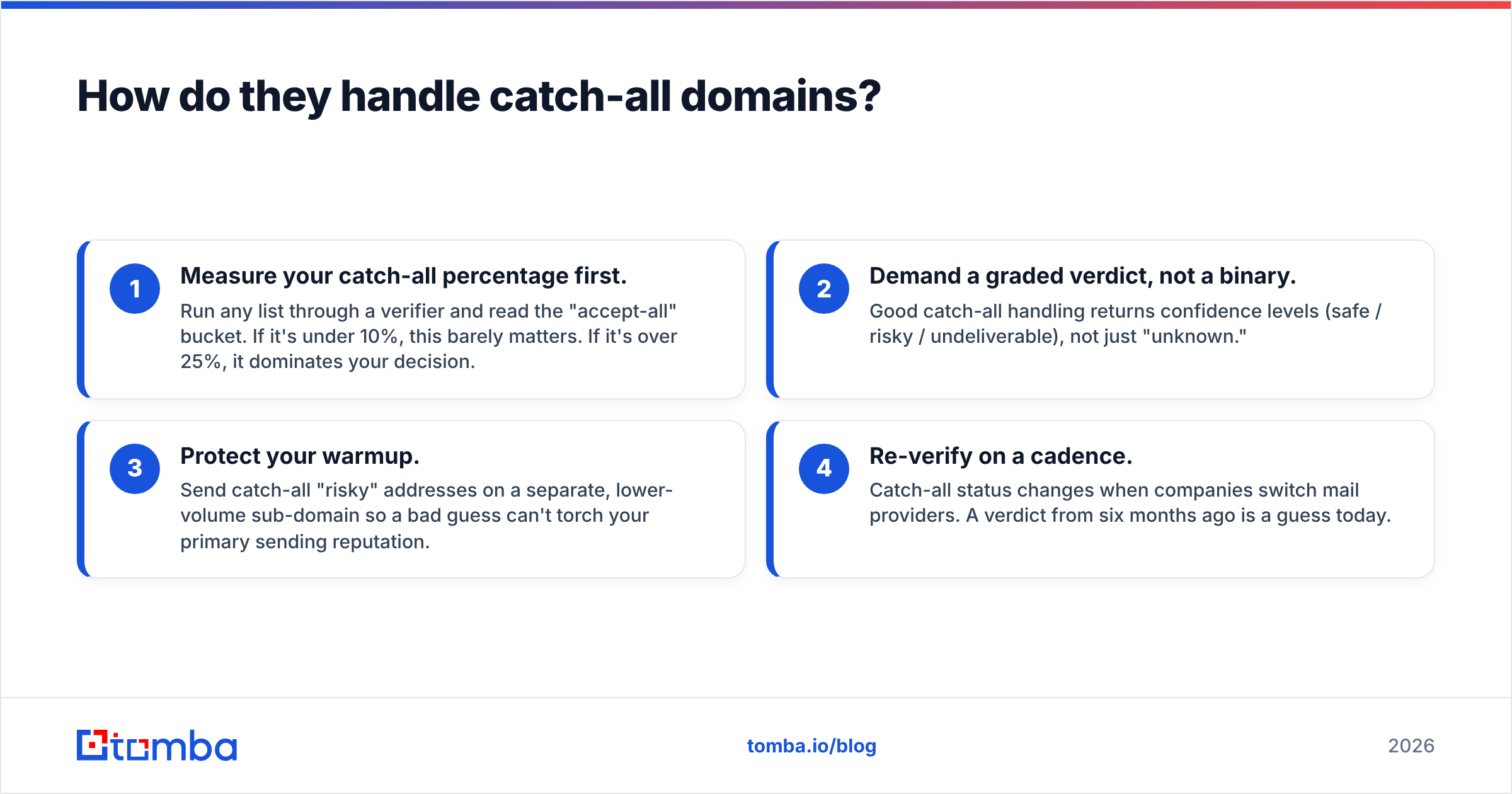
| Primary job | Email verification | Lead sourcing + verification |
| Catch-all handling | Core strength | Basic / bundled |
| Finds new emails | No | Yes |
| Bulk verification | Yes | Partial |
| API access | Yes | Varies by plan |
| Best for | Cleaning existing lists | Building lists from scratch |
| Weak spot | No sourcing | Verification depth |
| Cost model | Per-credit | Bundled seat/credit |
The pattern is clear: these tools are complements as often as they're competitors. Bounceban makes a list safe to send; Jet Leads Pro makes a list exist. Picking "the winner" only makes sense once you name your bottleneck.

Which one is more accurate?#
Accuracy depends on what you're measuring. For pure verification on hard cases — catch-all domains, role accounts, greylisted servers — a verification-first tool like Bounceban has the edge by design, because that's the only thing it's built to do. For coverage — did the tool surface a contact at all — a sourcing tool like Jet Leads Pro wins, because Bounceban won't find anyone.
The trap is conflating the two. A high "match rate" on a sourcing tool tells you how often it returned something, not how often that something was deliverable. Always separate two numbers:
- Find rate — share of target prospects for whom you got an address.
- Valid rate — share of those addresses that actually accept mail.
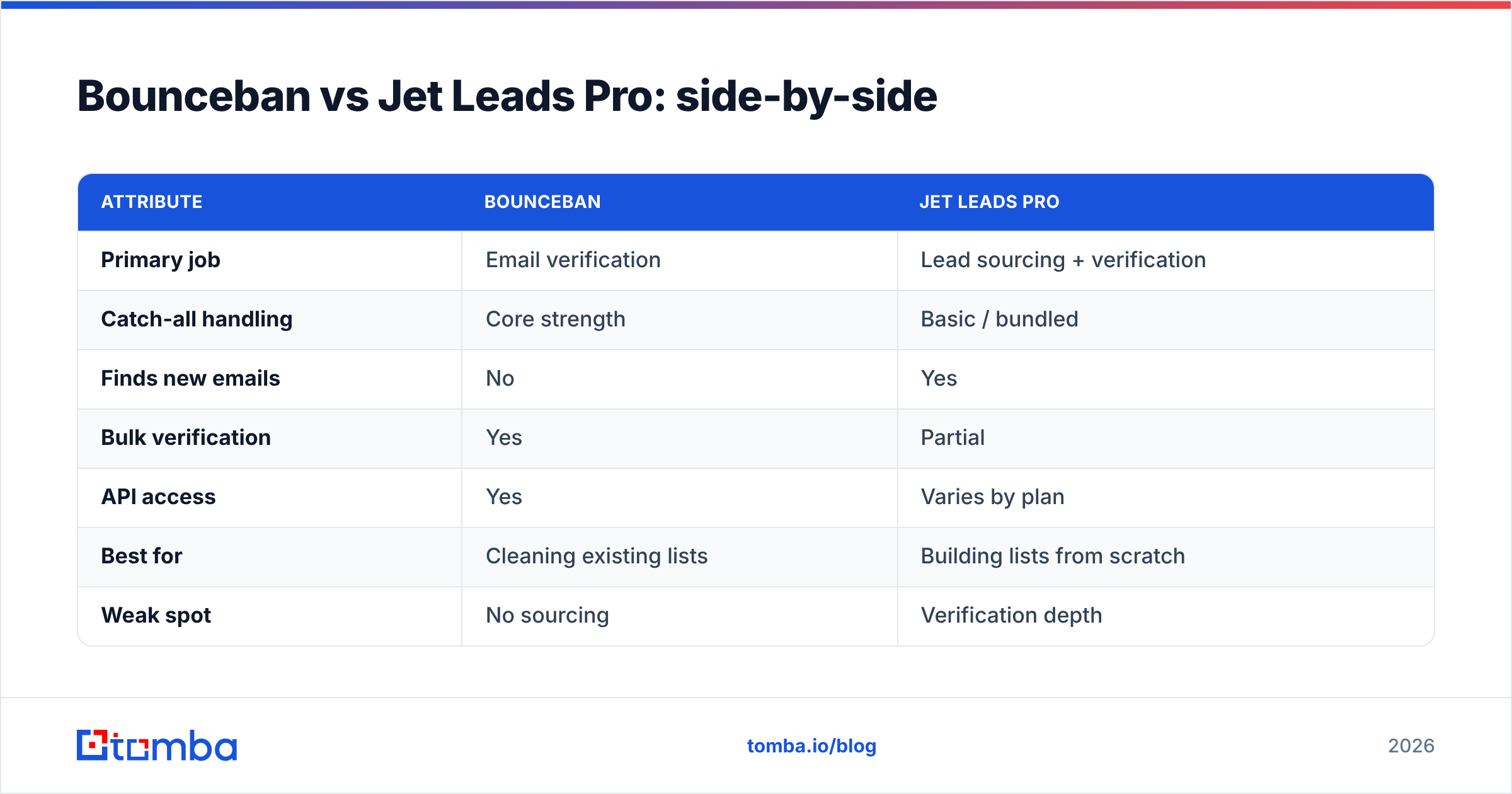
Multiply them and you get usable contacts per search, the only number that maps to revenue. A tool with a 90% find rate and a 60% valid rate (54% usable) loses to one with 70% find and 85% valid (60% usable). This is exactly why many teams pair a strong finder with an independent email verifier instead of trusting a single bundled score. Run a sample of 200 contacts through both paths and compare bounce rates in your sending tool — that's the only benchmark that counts. For background on why bounces wreck sender health, see Mailgun's email deliverability guide.
How do they handle catch-all domains?#
This is the single biggest differentiator. Catch-all (accept-all) domains return a positive SMTP response for every address, so a naive verifier can't distinguish jane.doe@acme.com from asdf@acme.com. Most tools file both under "unknown" and pass the risk back to you.
Bounceban's whole identity is built around squeezing a real verdict out of these. Jet Leads Pro, with bundled verification, typically gives a softer signal here — fine for low-stakes blasts, riskier for high-value accounts where one spam complaint from a wrong guess matters.
If catch-all is a big slice of your list, treat it as a first-class requirement, not a footnote. A dedicated catch-all verifier — whether it's Bounceban or a stack tool — should be non-negotiable. Here's the practical decision framework:
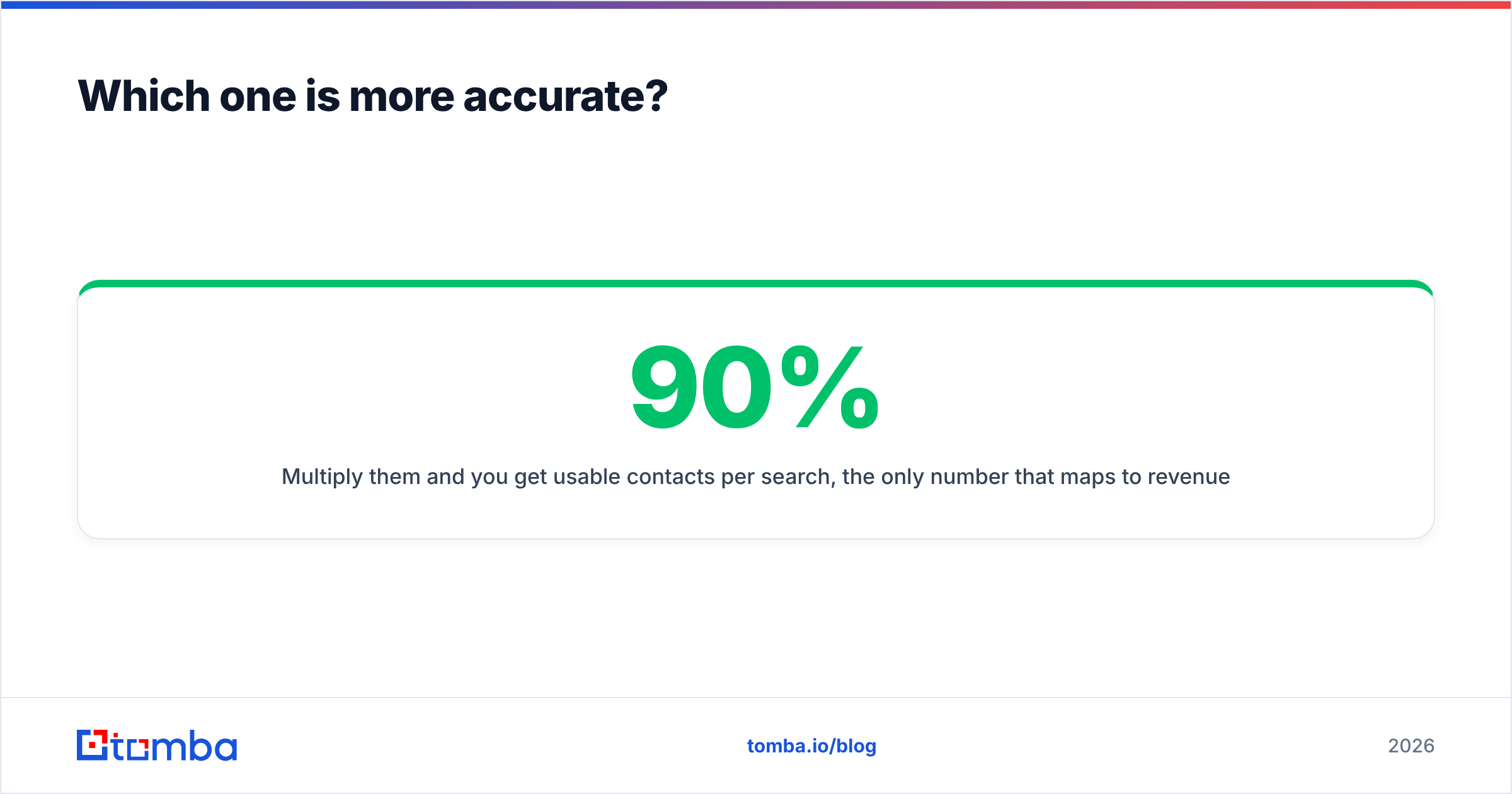
- Measure your catch-all percentage first. Run any list through a verifier and read the "accept-all" bucket. If it's under 10%, this barely matters. If it's over 25%, it dominates your decision.
- Demand a graded verdict, not a binary. Good catch-all handling returns confidence levels (safe / risky / undeliverable), not just "unknown."
- Protect your warmup. Send catch-all "risky" addresses on a separate, lower-volume sub-domain so a bad guess can't torch your primary sending reputation.
- Re-verify on a cadence. Catch-all status changes when companies switch mail providers. A verdict from six months ago is a guess today.
Pricing: Bounceban vs Jet Leads Pro#
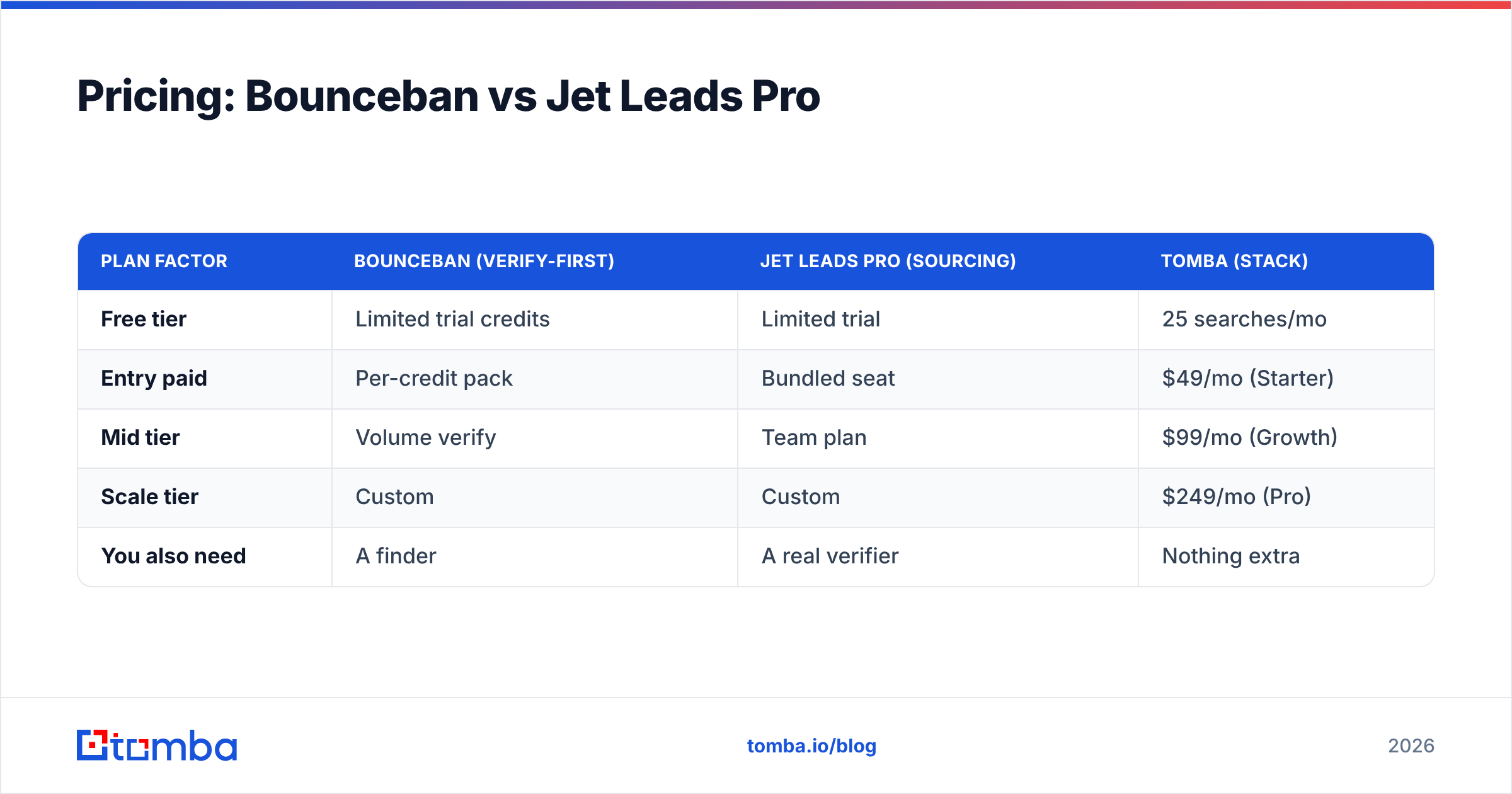
Direct price comparison is tricky because the two charge for different things — Bounceban for verifications, Jet Leads Pro for sourcing-plus-verification seats or credits. The honest way to compare is cost per usable contact, factoring in both find and valid rates.
| Plan factor | Bounceban (verify-first) | Jet Leads Pro (sourcing) | Tomba (stack) |
|---|---|---|---|
| Free tier | Limited trial credits | Limited trial | 25 searches/mo |
| Entry paid | Per-credit pack | Bundled seat | $49/mo (Starter) |
| Mid tier | Volume verify | Team plan | $99/mo (Growth) |
| Scale tier | Custom | Custom | $249/mo (Pro) |
| You also need | A finder | A real verifier | Nothing extra |
Notice the "you also need" row — that's the hidden cost. A cheap verifier still needs a finder; a sourcing tool still needs serious verification. For teams tired of stitching two bills together, an all-in-one email finder with verification built into the same credits removes the math entirely. Compare current Tomba pricing against the combined cost of running a separate finder and verifier and the bundling usually wins on both price and headache.
When should you pick Bounceban?#
Pick Bounceban when verification is your bottleneck and you already have a source of contacts. Typical fits:
- You buy or scrape lists and need to clean them hard before sending.
- Your domain reputation took a hit and you can't afford another bounce spike.
- A large share of your targets sit on catch-all domains and "unknown" results are killing your usable volume.
- You want a focused tool that does one thing well and plugs into the rest of your stack via API.
In these cases Bounceban's narrowness is a feature. You're not paying for sourcing you don't need, and you're getting the deepest verdict on the addresses that matter most. Pair it with a finder and you've built a respectable two-tool pipeline.
When should you pick Jet Leads Pro?#
Pick Jet Leads Pro when your pipeline is empty and sourcing is the priority. Good fits:
- You're starting from zero and need volume fast.
- You value one login over best-in-class depth on any single step.
- Your campaigns are higher-volume and lower-stakes, where a softer verification signal is acceptable.
- You don't yet have a separate verifier and want bundled "good enough" deliverability checks.
The caution: as your volume and deal sizes grow, bundled verification becomes the weak link. Many teams start on a sourcing tool and later bolt on a dedicated verifier once a bounce-driven blacklisting scares them. Plan for that step instead of being surprised by it.
Is there a better all-in-one alternative?#
Often, yes — if your real need is the whole pipeline, not one slice. Bounceban verifies but doesn't find. Jet Leads Pro finds but verifies softly. Run both and you're managing two vendors, two bills, and two data formats. A combined platform collapses that.
This is where Tomba fits the comparison honestly. It's a finder and verifier on the same credits, with extras the two single-purpose tools don't carry:
- Domain search to pull every known address pattern at a target company.
- Catch-all verification built into the same workflow, so risky addresses are graded, not dumped.
- Bulk processing for cleaning thousands of rows in one pass.
- An email finder API so find + verify happen in one call inside your own app or sequencer.
It's not magic — no tool hits 100% on every domain, and you should still sample-test against your own bounce data. But for teams who'd otherwise pay for Jet Leads Pro and Bounceban, a single stack usually wins on cost per usable contact and on the number of tabs you keep open. You can cross-check independent reviews on G2 and Capterra before committing to any of the three.
How to choose in 5 minutes#
Skip the feature-matrix paralysis. Answer three questions:
- What's empty — your list, or your deliverability? Empty list → sourcing (Jet Leads Pro). Dirty list → verification (Bounceban).
- What's your catch-all percentage? Over 25% → prioritize a tool that grades catch-all, full stop.
- Do you want one bill or two? One → an all-in-one stack. Two → best-of-breed finder + Bounceban.
Then validate with data, not marketing. Take 200 real prospects, run them through your shortlist, push the results into your actual sending tool, and read the bounce and reply rates a week later. The tool with the best usable contacts per dollar — not the best landing page — is your answer.
The bottom line#
Bounceban and Jet Leads Pro aren't really rivals so much as two halves of the same job. Bounceban makes lists safe; Jet Leads Pro makes lists exist. If you only have budget for one and your sends are already bouncing, lead with verification. If you're staring at an empty CRM, lead with sourcing — then add a real verifier before you scale.
If you'd rather not run two tools and reconcile two formats, start with a platform that finds and verifies on the same credits. Spin up the free tier of the Tomba Email Finder — 25 searches a month, no card — run your hardest catch-all domains through it, and compare the usable-contact rate against whatever you're paying for Bounceban or Jet Leads Pro today. Let the bounce numbers pick the winner.
// get started
Find, verify and enrich your first contacts today
Start on the free plan with 25 searches a month, then scale when your team is ready.
Free plan · No credit card required · GDPR & CCPA
// about the author