Bounceban vs Lead411 (2026): Which B2B Data Tool Wins?
Bounceban verifies catch-all emails; Lead411 sells B2B contact data. Here's how they actually compare in 2026 — and where a finder-first stack beats both.
You typed "Bounceban vs Lead411" into a search bar because you are trying to fix one of two problems: emails that bounce, or a list that is too thin to send in the first place. The confusing part is that these two tools solve different halves of that problem — and pitting them head to head only makes sense once you understand which half each one owns.
This breakdown cuts through the marketing. You will see what each tool actually does, where they overlap, where they don't, and how to decide without overpaying for capabilities you won't touch.
TL;DR#
- Bounceban is a verification tool. Its specialty is real-time email verification, including the hard cases — catch-all (accept-all) domains — that most validators punt on.
- Lead411 is a sales intelligence platform. It sells B2B contact and company data: emails, direct dials, intent signals, and trigger events, usually on an annual contract.
- They are not direct competitors. You verify with Bounceban; you source leads with Lead411. Comparing them is comparing a spell-checker to a library.
- The real question is your bottleneck. Need cleaner sends on lists you already have? Verification. Need more contacts? A data provider.
- A finder-first stack often beats both for lean teams — pair a pay-as-you-go email finder with built-in verification and skip the enterprise contract entirely.
What is Bounceban?#
Bounceban is an email verification service built around one stubborn problem: catch-all domains. A catch-all (or accept-all) mail server says "yes" to every address you throw at it during the SMTP handshake, so ordinary verifiers can't tell a real inbox from a typo. Bounceban runs deeper checks to predict whether a catch-all address is actually deliverable.
Think of it like a bouncer at a club that lets everyone walk up to the door. A basic verifier just confirms the door exists. Bounceban tries to figure out whether you'll actually be let inside.
Its core jobs:
- Real-time single verification — check one address at the point of capture (a form, a CRM field).
- Bulk list cleaning — upload a list, get back valid / invalid / risky / catch-all verdicts.
- Catch-all resolution — its headline feature, attempting a confident verdict where others return "unknown."
- API access — drop verification into your own signup flow or enrichment pipeline.
What Bounceban is not: a place to find new contacts. It validates emails you already have. If your problem is "my list is empty," Bounceban has nothing to give you.
)
What is Lead411?#
Lead411 is a B2B sales intelligence platform — closer in spirit to ZoomInfo or Apollo than to a verifier. You go there to acquire contacts, not clean them.
Its stack includes:
- Verified business emails and direct-dial phone numbers across millions of company records.
- Intent data — signals that a company is researching a category you sell into.
- Growth and trigger events — funding rounds, hiring spikes, leadership changes that suggest a buying window.
- Chrome extension and CRM integrations for pushing contacts into Salesforce, HubSpot, and outreach tools.
Lead411 sells outcomes for full-cycle sales teams: build a territory, layer intent on top, and reach out while the iron is hot. Pricing is typically annual and seat-based, which is normal for the data-provider category but a real commitment for a small team.
The catch: data providers vary wildly in coverage by region and company size. North American mid-market is usually well covered; niche verticals, SMBs, and non-US contacts can be patchier. Always trial against your actual target list, not a vendor demo.
Bounceban vs Lead411: how do they compare?#
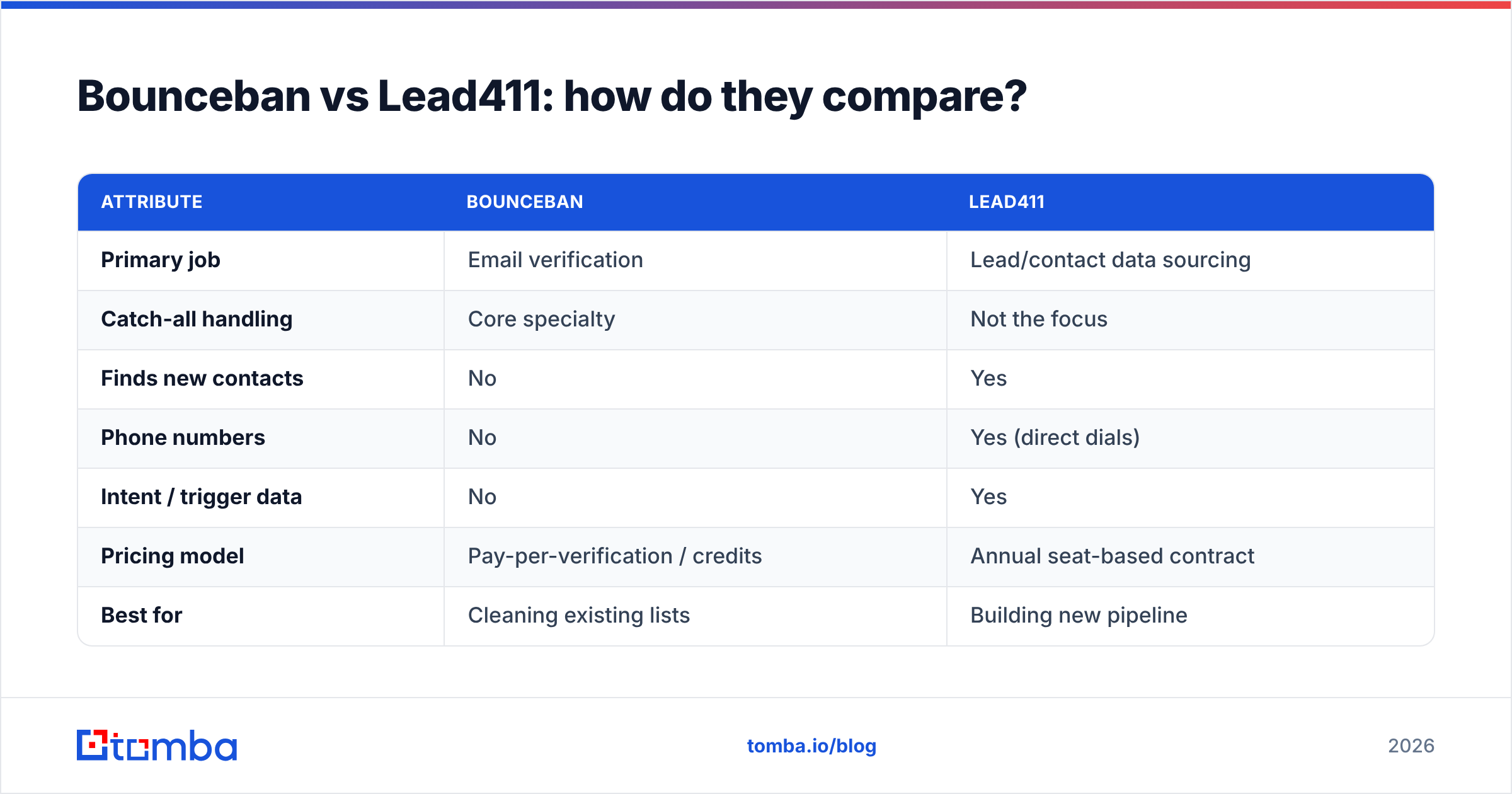
Here is the honest side-by-side. Notice that most rows describe different jobs rather than a winner — that is the whole point.
| Attribute | Bounceban | Lead411 |
|---|---|---|
| Primary job | Email verification | Lead/contact data sourcing |
| Catch-all handling | Core specialty | Not the focus |
| Finds new contacts | No | Yes |
| Phone numbers | No | Yes (direct dials) |
| Intent / trigger data | No | Yes |
| Pricing model | Pay-per-verification / credits | Annual seat-based contract |
| Best for | Cleaning existing lists | Building new pipeline |
| Typical buyer | Deliverability / ops teams | AEs / SDR teams |
| Contract commitment | Low, flexible | Higher, annual |
| API available | Yes | Yes |
The takeaway: if a vendor comparison feels like apples-to-oranges, it's because it is. You might genuinely need both — Lead411 to source, a verifier to scrub before you send. Or you might need neither, if a single finder-plus-verifier tool covers your volume.
Which problem are you actually solving?#
Before you spend a dollar, name your bottleneck. Use this decision list:
- "My bounce rate is wrecking my sender reputation." → You need verification. Bounceban (or any strong verifier) is your lane. Pair it with good email deliverability hygiene — bounces above ~2-3% put your domain at risk.
- "I don't have enough contacts to hit quota." → You need data sourcing. Lead411, or a finder-led workflow.
- "Most of my targets are on catch-all domains." → Verification with a catch-all specialty matters most. Test catch-all verification head-to-head on your domains.
- "I need phone numbers, not just email." → A finder/data provider with a phone finder beats a pure verifier, which has no phone layer at all.
- "I want one tool that finds AND verifies." → Neither standalone product is ideal; a finder with built-in verification is the cheaper path.
- "I'm on a tight budget and low volume." → Avoid annual contracts. Pay-as-you-go credits win.
If two or three of these describe you, you're looking at a stack, not a single purchase. That's where total cost — and contract flexibility — starts to matter more than any single feature.
How accurate is each one, really?#
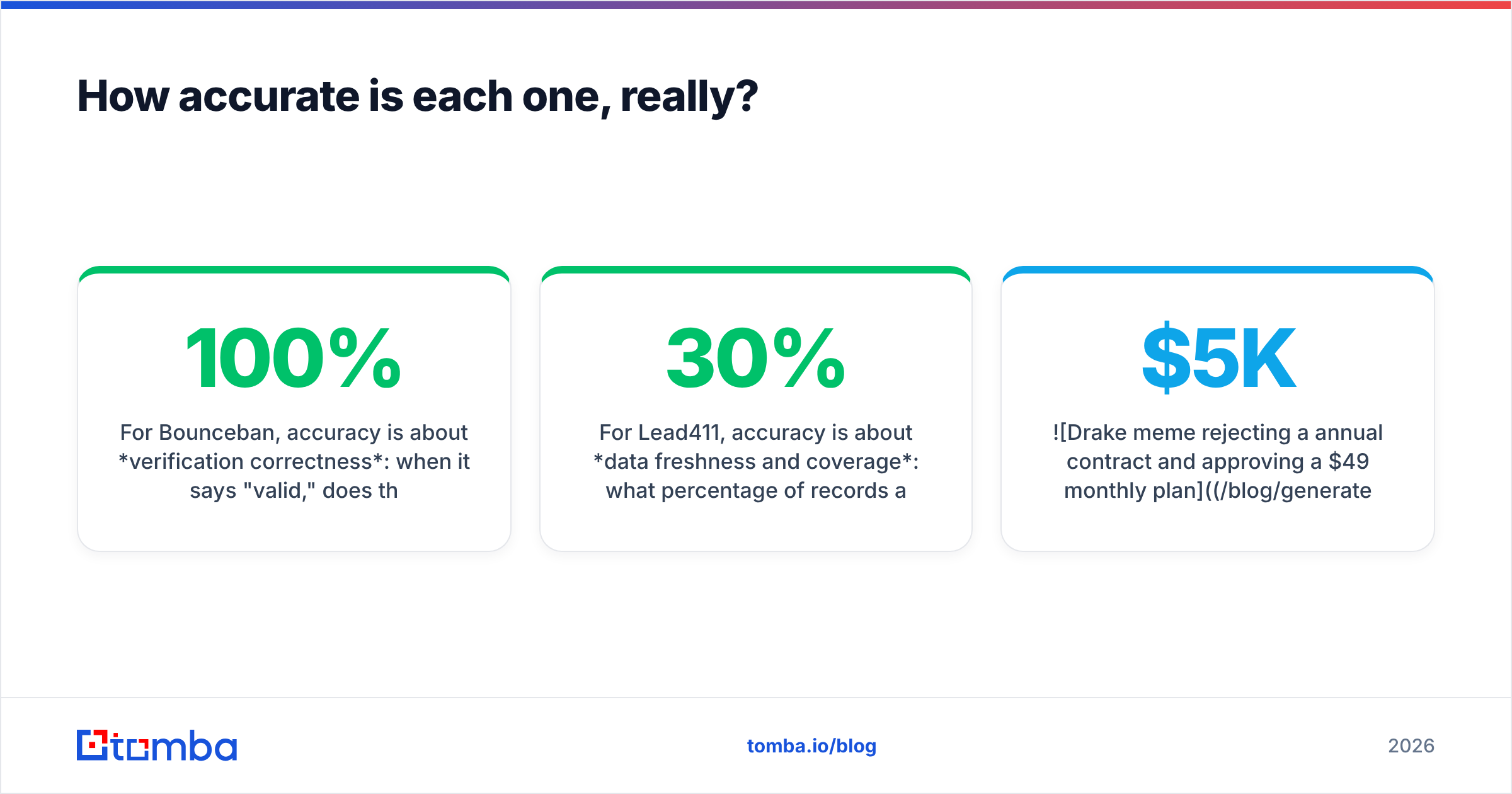
Accuracy means two different things here, so don't let a single percentage fool you.
For Bounceban, accuracy is about verification correctness: when it says "valid," does the email actually accept mail? When it says "invalid," is it really dead? The hard test is catch-all domains, where confident verdicts are genuinely difficult. No verifier is 100% on catch-alls — anyone claiming so is selling, not measuring. Run a sample of known-good and known-bad addresses through any verifier and check the false-positive and false-negative rates yourself.
For Lead411, accuracy is about data freshness and coverage: what percentage of records are correct today, and how much of your target market is even in the database? B2B data decays fast — people change jobs constantly, so a contact verified six months ago may already be stale. According to widely cited industry estimates, roughly 25-30% of B2B contact data goes bad every year. That's why even sourced data should be re-verified at the moment you send.
The practical implication: even if you buy data from Lead411, you should verify it before a campaign. Sourcing and verification are complementary, not redundant. A great data provider with no verification step still ships you stale addresses; a great verifier with no data still leaves your list empty.
)
Where does Tomba fit between these two?#
Tomba collapses the find-then-verify split into one workflow, which is exactly the gap that opens up when you compare a pure verifier against a pure data provider.
Instead of buying Lead411 to source and Bounceban to clean, you can:
- Find emails by name, company, or domain with the email finder, then verify in the same pass.
- Run domain search to pull every public email pattern at a target company.
- Validate at scale with the email verifier, including a dedicated catch-all verifier for the same accept-all domains Bounceban specializes in.
- Add phone coverage with the phone finder — something a verification-only tool can't do.
- Enrich and dedupe lists through data enrichment and bulk processing.
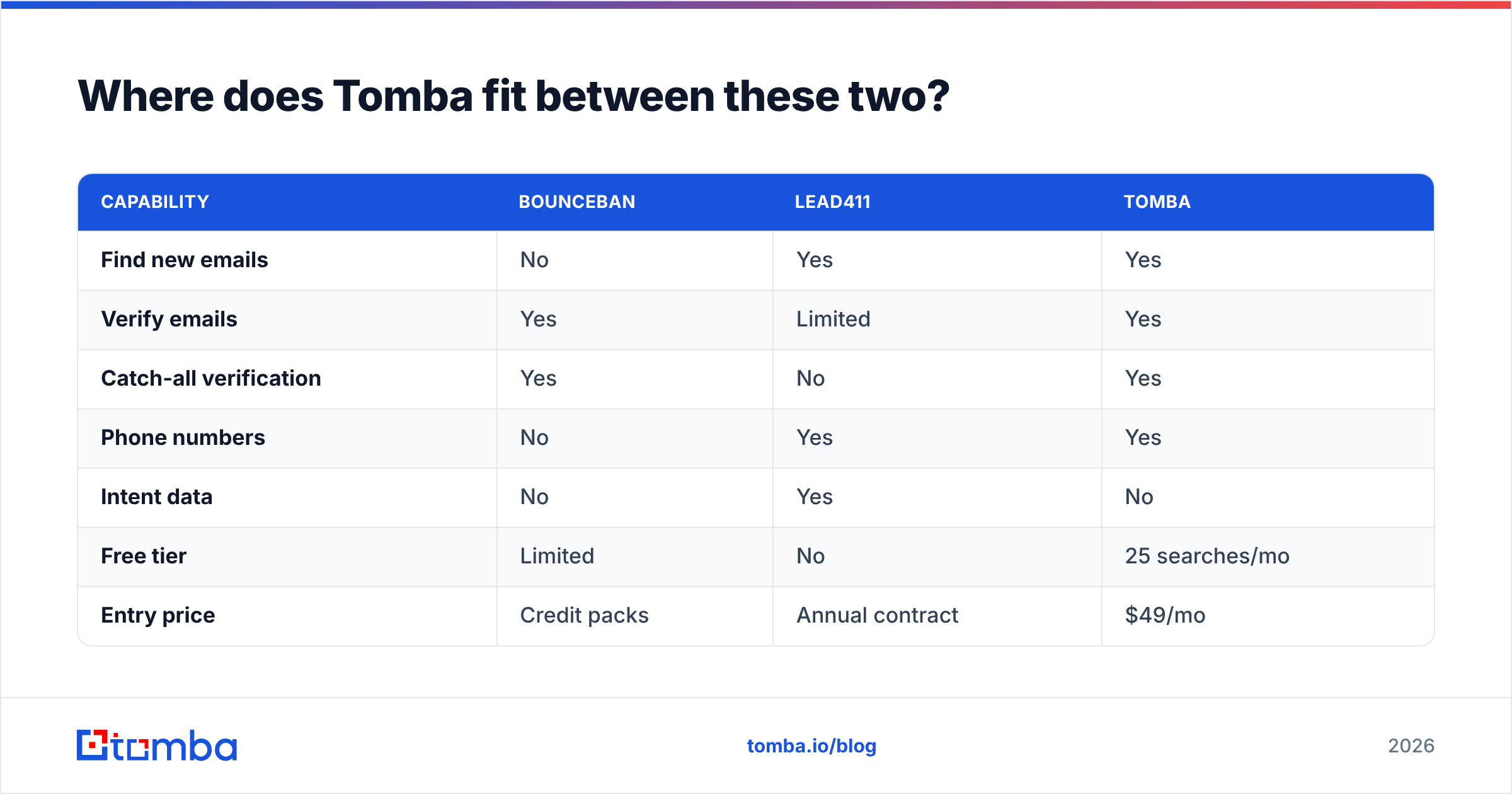
Here's how the three approaches stack up for a lean outbound team:
| Capability | Bounceban | Lead411 | Tomba |
|---|---|---|---|
| Find new emails | No | Yes | Yes |
| Verify emails | Yes | Limited | Yes |
| Catch-all verification | Yes | No | Yes |
| Phone numbers | No | Yes | Yes |
| Intent data | No | Yes | No |
| Free tier | Limited | No | 25 searches/mo |
| Entry price | Credit packs | Annual contract | $49/mo |
| Contract lock-in | Low | High | None |
Two honest caveats. First, if intent data and trigger events are central to your motion, Lead411 offers something Tomba doesn't — that's a real reason to buy it. Second, if you only need verification and nothing else, a dedicated verifier like Bounceban is a perfectly reasonable single-purpose buy. Tomba's edge is for teams that need finding and verifying without juggling two contracts.
What does it cost?#
Cost comparison is where the categories diverge hardest.
- Bounceban uses credit/pay-per-verification pricing. Flexible, no big commitment, scales with how dirty your lists are. Good for sporadic cleaning.
- Lead411 is an annual, seat-based platform contract. You're buying a data subscription, and the per-seat math adds up for a team. Strong ROI if you actively use intent and dials; expensive shelfware if you don't.
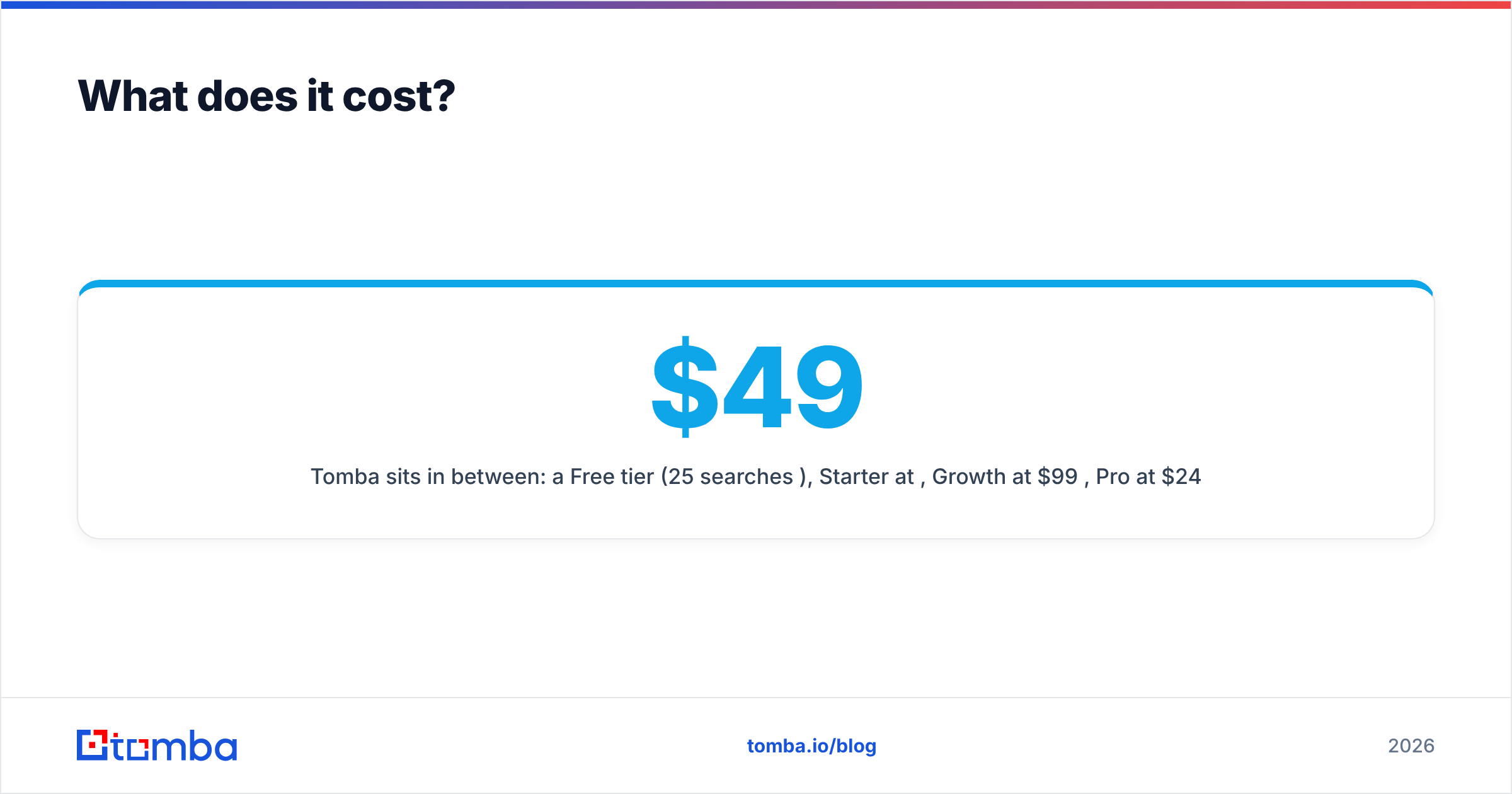
- Tomba sits in between: a Free tier (25 searches/mo), Starter at $49/mo, Growth at $99/mo, Pro at $249/mo, and custom Enterprise — with no annual lock-in. Full Tomba pricing is public.
The cheapest wrong tool is still a waste. Match the spend to the bottleneck you named earlier. If you're verifying occasionally, don't sign an annual data contract. If you need a steady flow of new, verified contacts, don't try to stretch a verifier into a sourcing tool.
For credibility checks on any of these, read real user reviews on G2 rather than vendor pages — sort by your company size and industry to filter out noise.
How should you run a trial?#
Don't trust feature lists. Trust your own data. Run this 30-minute test before committing:
- Build a 50-row truth set — 25 addresses you know are valid (your own team, known contacts) and 25 you know are dead.
- Run it through the verifier and count false positives and false negatives. That's your real accuracy, on your domains.
- For a data provider, pull 50 target accounts and check coverage and freshness — how many contacts exist, and are the titles current?
- Sample catch-all domains specifically if those dominate your market. This is where tools separate.
- Re-verify any sourced data before sending, regardless of vendor. Treat the data's age as unknown.
This is the same logic the email deliverability experts use: protect sender reputation by validating right before send, not weeks earlier.
Final verdict: Bounceban or Lead411?#
Neither — and both. They're not rivals; they're two parts of one pipeline. Buy Bounceban (or any strong verifier) if your problem is bounces and dirty lists. Buy Lead411 if your problem is empty pipeline and you'll genuinely use intent data. If you find yourself wanting both, that's the signal to consolidate.
For most lean B2B teams, the smartest move is to stop buying half-solutions. Pair finding and verifying in a single, no-lock-in workflow: use the Tomba Email Finder to source professional emails by name, company, or domain, then verify them — catch-alls included — in the same pass. Start free with 25 searches a month, prove the accuracy on your own list, and scale to a $49/mo plan only when the volume justifies it. Find it. Verify it. Send it. One stack, no annual contract.
// get started
Find, verify and enrich your first contacts today
Start on the free plan with 25 searches a month, then scale when your team is ready.
Free plan · No credit card required · GDPR & CCPA
// about the author