Bounceban vs Leadzenai 2026: Verification vs Lead Data
Bounceban verifies catch-all emails, Leadzen.ai builds lead lists. They solve different problems. Here is which one your sales team actually needs in 2026.
You typed "Bounceban vs Leadzenai" into a search bar because you are building an outbound stack and someone told you to pick one. Here is the short version before you read another word: these two tools do not actually compete. One cleans your list, the other builds it. Choosing between them is like choosing between a dishwasher and a grocery store.
This guide untangles what each does, where they overlap, what they cost, and why a data-first platform often makes the "versus" question irrelevant.
TL;DR#
- Bounceban is an email verification tool focused on validating tricky catch-all and risky addresses before you send. It reduces bounces; it does not find new contacts.
- Leadzen.ai is an Indian-market-heavy lead intelligence and prospecting platform that surfaces contact and company data. It builds lists; verification is secondary.
- They are complementary, not interchangeable — you would use Bounceban after a tool like Leadzen.ai, not instead of it.
- If your real goal is accurate B2B emails at the source, a find emails platform with built-in verification removes the need to stitch two vendors together.
- For most outbound teams in 2026, the winning move is one source of truth for finding and verifying — not a two-tool tax.
What is Bounceban?#
Bounceban is an email verification service. Its pitch is real-time, no-bounce verification — including the hardest category in the business: catch-all domains, where the mail server accepts every address and refuses to confirm whether a specific mailbox exists.
Catch-all handling is genuinely hard, so a tool that specializes in it has a reason to exist. Bounceban runs SMTP checks, syntax and MX validation, and tries to resolve catch-all addresses to a confidence verdict instead of the useless "unknown" most verifiers return.
What Bounceban does not do: it doesn't find people. You bring a list; it tells you which addresses are safe to send to. If your spreadsheet is empty, Bounceban has nothing to work on. Think of it as the spell-checker — it improves what you already wrote, it doesn't write the document.

What is Leadzen.ai?#
Leadzen.ai sits on the other side of the funnel. It is a lead generation and prospecting platform that pulls together contact details, company firmographics, and intent-style signals so you can build target lists from scratch. It leans heavily on Indian B2B data and offers browser-extension prospecting, bulk search, and enrichment.
Leadzen.ai answers "who should I email and what is their address?" It will give you emails and phone numbers, and it does some validation along the way — but verification is a feature, not the product. Its core job is discovery: turning a target profile into a list of named humans with contact points.
So the honest framing is: Leadzen.ai is upstream (find the leads), Bounceban is downstream (clean the leads). Putting them in a cage match misreads the funnel.
Bounceban vs Leadzenai: how do they actually compare?#
Here is the side-by-side on the dimensions that matter when you are scoping a stack. Pricing reflects publicly listed entry points and shifts often, so treat it as directional and confirm on each vendor's site.
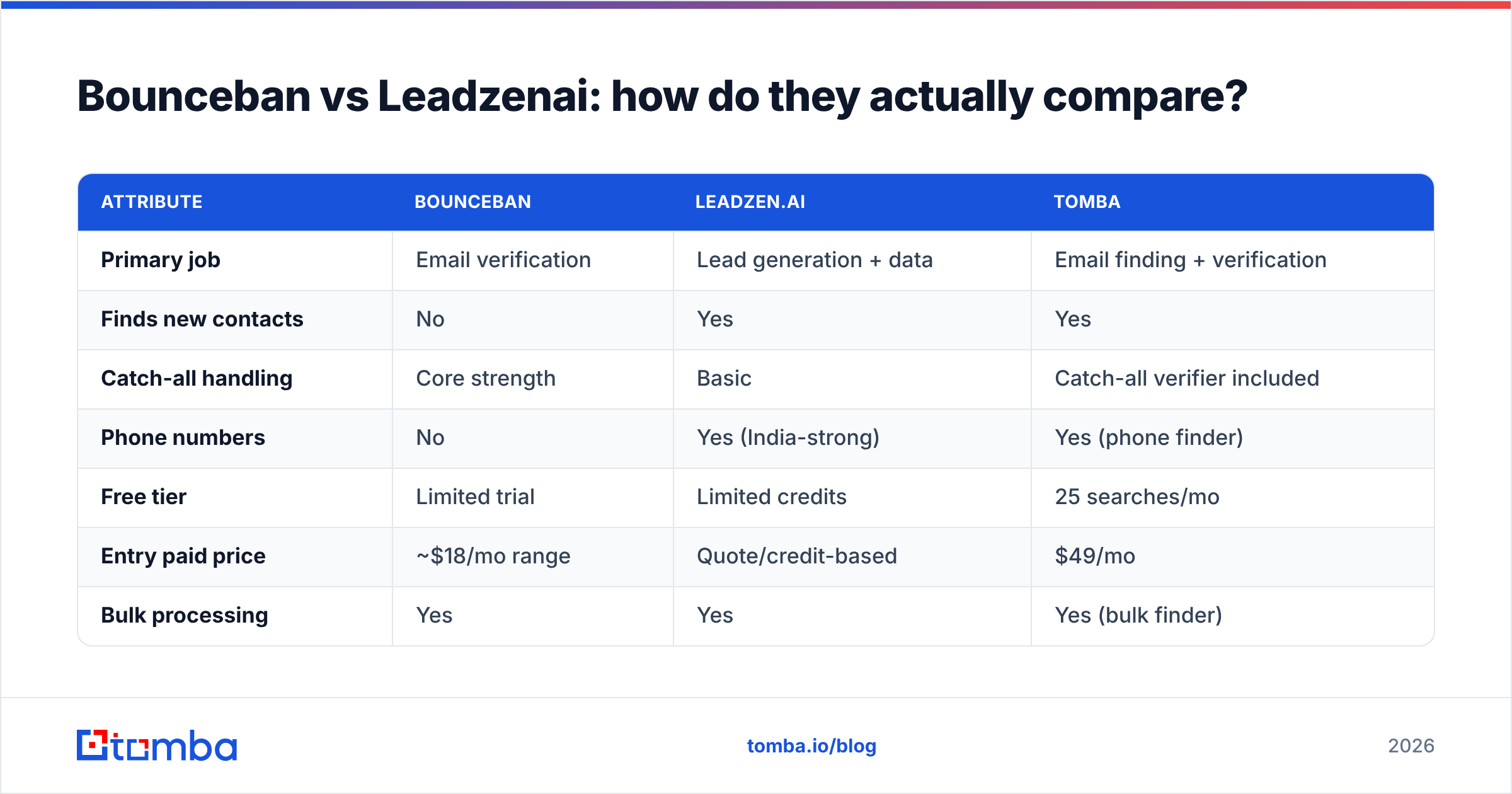
| Attribute | Bounceban | Leadzen.ai | Tomba |
|---|---|---|---|
| Primary job | Email verification | Lead generation + data | Email finding + verification |
| Finds new contacts | No | Yes | Yes |
| Catch-all handling | Core strength | Basic | Catch-all verifier included |
| Phone numbers | No | Yes (India-strong) | Yes (phone finder) |
| Free tier | Limited trial | Limited credits | 25 searches/mo |
| Entry paid price | ~$18/mo range | Quote/credit-based | $49/mo |
| Bulk processing | Yes | Yes | Yes (bulk finder) |
| API access | Yes | Yes | Yes (REST API) |
| Best for | Cleaning existing lists | India-focused prospecting | End-to-end find + verify |
The pattern is clear. Pick Bounceban when you already have volume and your only pain is bounce rate. Pick Leadzen.ai when your pain is an empty pipeline and your market skews toward India. Pick a unified platform when you want one tool that finds the address and confirms it, without exporting CSVs between vendors.
Which problem are you actually solving?#
Before you buy either, sort your problem into one of these buckets. This is the decision, not the brand name.
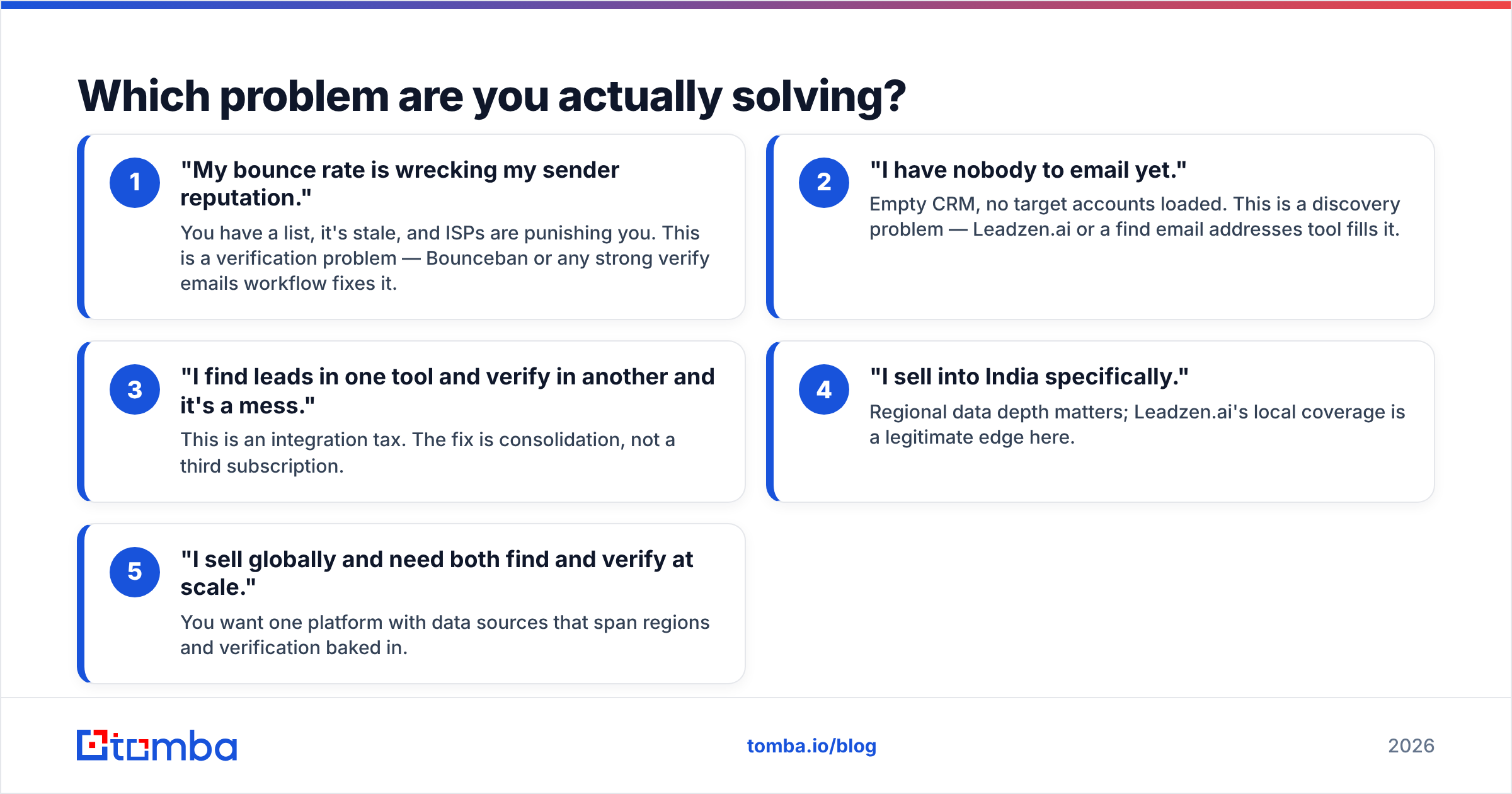
- "My bounce rate is wrecking my sender reputation." You have a list, it's stale, and ISPs are punishing you. This is a verification problem — Bounceban or any strong verify emails workflow fixes it.
- "I have nobody to email yet." Empty CRM, no target accounts loaded. This is a discovery problem — Leadzen.ai or a find email addresses tool fills it.
- "I find leads in one tool and verify in another and it's a mess." This is an integration tax. The fix is consolidation, not a third subscription.
- "I sell into India specifically." Regional data depth matters; Leadzen.ai's local coverage is a legitimate edge here.
- "I sell globally and need both find and verify at scale." You want one platform with data sources that span regions and verification baked in.
Most teams who land on a "Bounceban vs Leadzenai" search are actually in bucket 3 — they're trying to solve two problems with two tools and feeling the seams.
Is accuracy better with a verifier or a finder?#
Accuracy is not one number — it splits into two questions that map onto these two tools.
A verifier like Bounceban measures deliverability accuracy: of the addresses you hand it, how reliably does it predict which will bounce? On clean corporate domains, most credible verifiers cluster in the high-90s. The real differentiator is catch-all domains, where naive verifiers throw up their hands. Bounceban's whole reason to exist is squeezing a verdict out of that gray zone, and that's a fair thing to pay for.
A finder like Leadzen.ai measures sourcing accuracy: when it claims "this is Priya's work email," is it real and current? That depends on the freshness and breadth of its underlying database, which is exactly why regional focus matters — depth in one market, thinner elsewhere.
The trap is treating a high verification score as proof of good data. A verifier can confirm an address is deliverable while the finder that sourced it attached it to the wrong person. Garbage in, verified garbage out. That's why sourcing and verification working from the same dataset beats bolting a cleaner onto a separate finder. When the find emails engine and the verifier share one pipeline, the confidence score actually means something end to end.

What does each tool cost in 2026?#
Budget framing, because "which is cheaper" is the wrong question when the tools do different jobs.
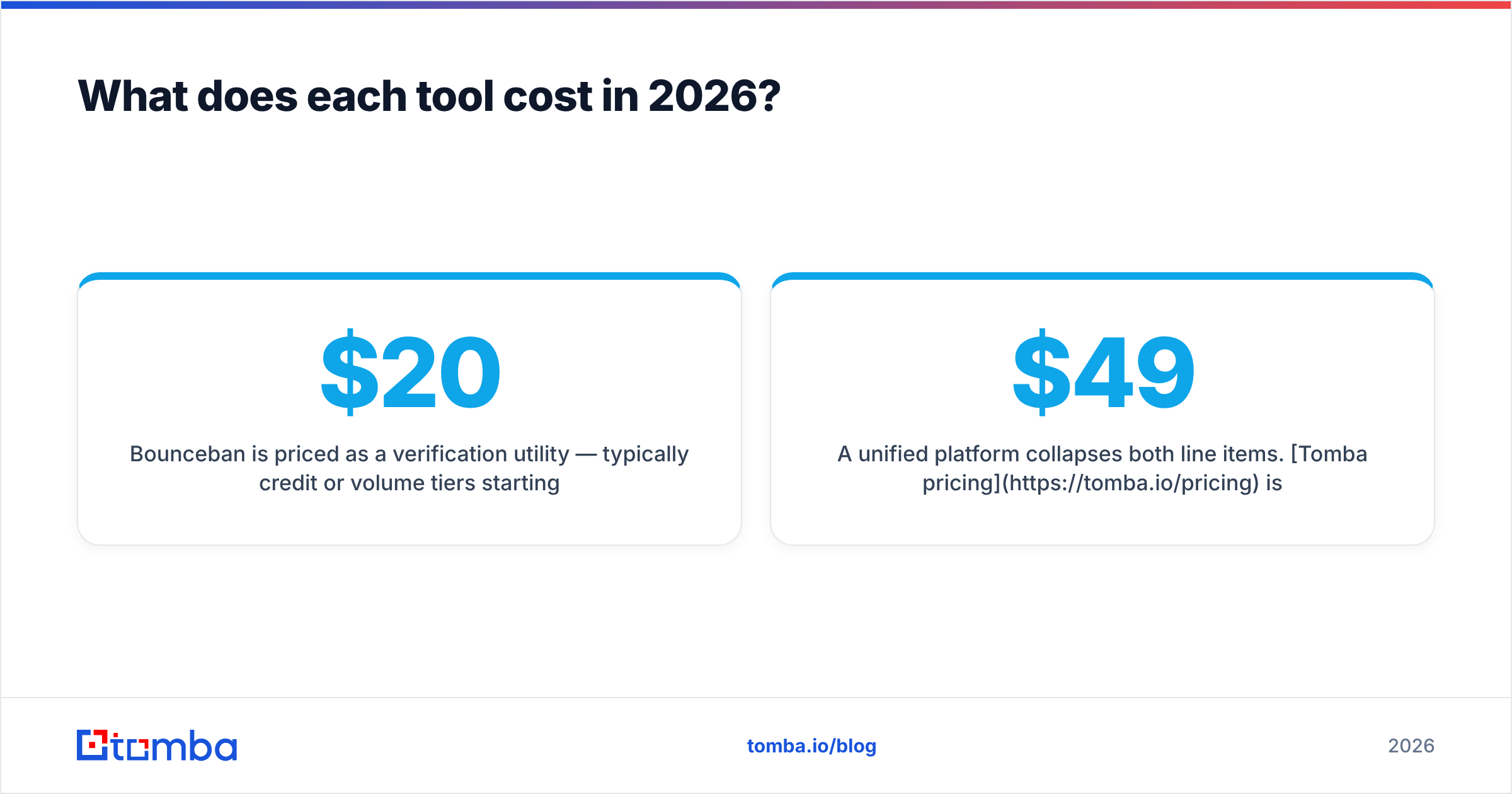
- Bounceban is priced as a verification utility — typically credit or volume tiers starting in the sub-$20/mo range for light use, scaling with how many addresses you clean. You'll also still pay your finder separately, so the real cost is Bounceban plus whatever sources your leads.
- Leadzen.ai uses a credit/quote model common to data platforms; pricing depends on seats and export volume and usually requires talking to sales for anything serious.
- A unified platform collapses both line items. Tomba pricing is a Free tier (25 searches/mo), Starter $49/mo, Growth $99/mo, Pro $249/mo, and custom Enterprise — finding and verification under one bill.
Run the math on your own stack. Two specialist subscriptions plus the engineering time to move data between them frequently costs more than one platform that does both — before you count the hours lost to CSV juggling. You can sanity-check vendor reputations on G2 or Capterra before committing.
When should you use Bounceban and Leadzen.ai together?#
There's a legitimate combo: you prospect heavily in India with Leadzen.ai, then run the riskiest catch-all addresses through Bounceban before a high-stakes campaign. If both tools are already paid for and your market fits, that pipeline works.
But notice what you're doing — you're manually building the exact workflow a unified tool ships out of the box: find, then verify. The two-tool approach makes sense only when each tool is meaningfully better at its niche than the all-in-one alternative for your specific market. For most global B2B teams, that bar isn't cleared, and the integration overhead eats the benefit.
If you do run both, automate the handoff. Wire it through Zapier or push everything into your CRM with a HubSpot integration so addresses flow find → verify → sequence without a human exporting spreadsheets at midnight.
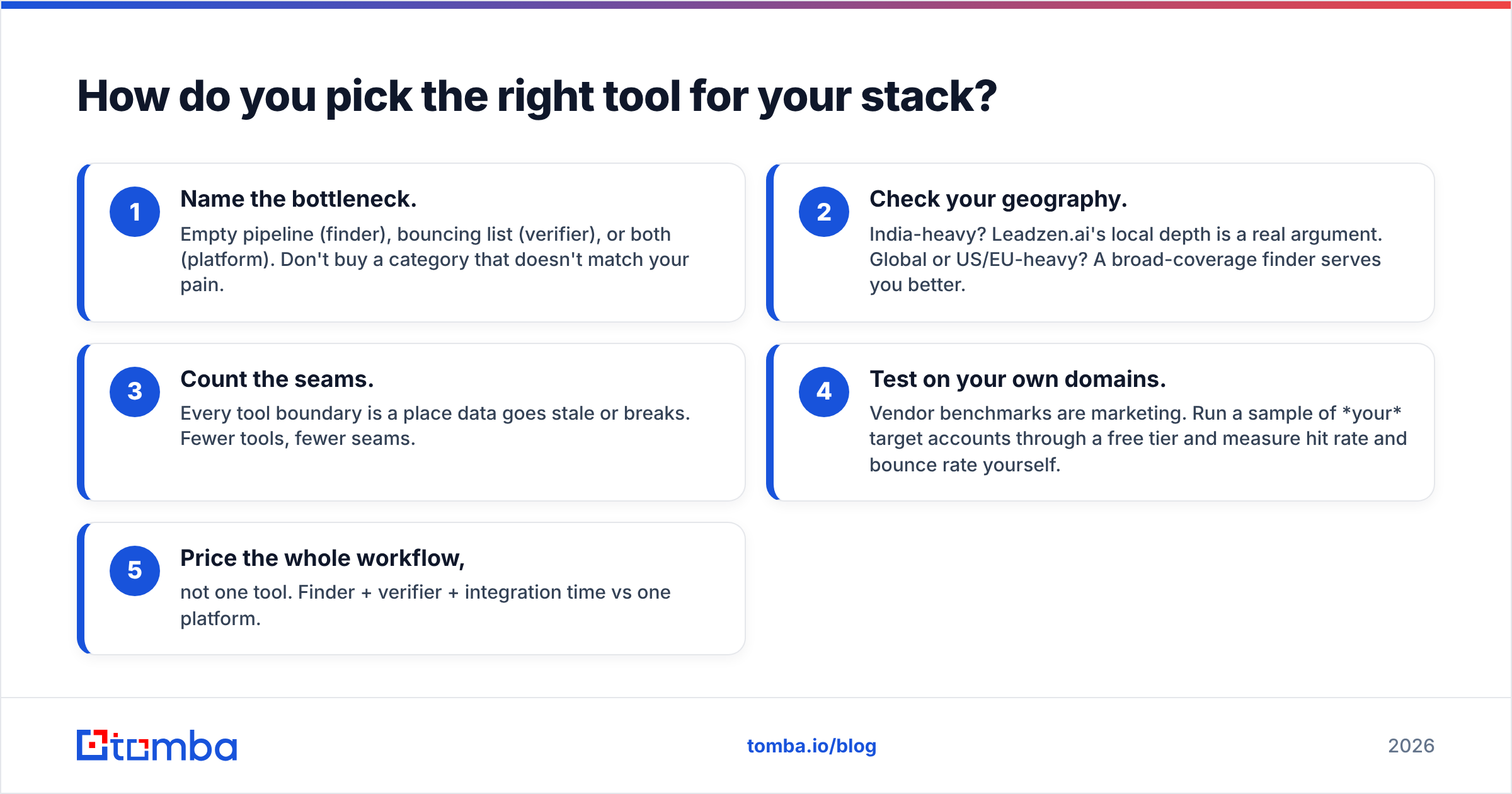
How do you pick the right tool for your stack?#
Decide in this order:
- Name the bottleneck. Empty pipeline (finder), bouncing list (verifier), or both (platform). Don't buy a category that doesn't match your pain.
- Check your geography. India-heavy? Leadzen.ai's local depth is a real argument. Global or US/EU-heavy? A broad-coverage finder serves you better.
- Count the seams. Every tool boundary is a place data goes stale or breaks. Fewer tools, fewer seams.
- Test on your own domains. Vendor benchmarks are marketing. Run a sample of your target accounts through a free tier and measure hit rate and bounce rate yourself.
- Price the whole workflow, not one tool. Finder + verifier + integration time vs one platform.
For teams that land in bucket 3 or 5 — and that's most of them — the cleanest answer isn't Bounceban or Leadzen.ai. It's a single source that finds the address and verifies it in the same step, with a bulk email finder for scale and a real email finder API so the workflow lives in your code, not in a spreadsheet.
The bottom line#
Bounceban and Leadzen.ai are not rivals — they're neighbors on opposite ends of the same funnel. Bounceban cleans; Leadzen.ai sources. If you only have one of those two problems, buy the matching tool and move on. If you have both — and you sell beyond a single region — stop renting two specialists and pay the integration tax in lost hours.
That's where consolidating pays off. Tomba's Email Finder finds professional addresses by domain, name, or company and verifies them in the same pipeline, with catch-all handling, bulk processing, and an API built in — starting free at 25 searches a month and $49/mo when you scale. Skip the CSV relay race: find and verify in one place, and let your reps spend their time selling instead of cleaning lists. Start free and test it on your own target accounts today.
// get started
Find, verify and enrich your first contacts today
Start on the free plan with 25 searches a month, then scale when your team is ready.
Free plan · No credit card required · GDPR & CCPA
// about the author