Bounceban vs RocketReach 2026: Accuracy, Pricing & Picks
Bounceban focuses on real-time email verification; RocketReach sells a massive contact database. Here's how they compare on accuracy, price, and fit in 2026 — and where a third option beats both.
Bounceban vs RocketReach: Which One Should You Actually Pay For in 2026?
Bounceban and RocketReach get lumped together in "best email tool" lists, but they solve different problems. One cleans the emails you already have. The other hands you emails and phone numbers for people you've never met. Picking the wrong one means you either pay for data you don't need or skip the verification step that protects your sender reputation.
This breakdown cuts through the marketing pages and tells you which tool fits which job — and where a single platform can cover both without the price jump.
TL;DR#
- Bounceban is a real-time email verification tool built around catch-all detection. It tells you whether an address is safe to send to. It does not build prospect lists at scale.
- RocketReach is a contact database. It surfaces emails and phone numbers from a claimed 700M+ profiles, but its data freshness and verification depth are inconsistent, and pricing climbs fast.
- Accuracy: Bounceban wins on verification confidence; RocketReach wins on raw coverage. Neither is best-in-class at both.
- Pricing: RocketReach gets expensive at team scale ($80+/user/mo on annual). Bounceban is cheaper but narrower.
- Best all-rounder: if you want finding and verification in one bill, Tomba covers both starting at $49/mo with a real free tier.
What Is Bounceban and What Does It Actually Do?#
Bounceban is an email verification service. Its headline feature is real-time, deep verification of catch-all (accept-all) domains — the addresses most verifiers flag as "unknown" and quietly give up on. You feed it an address or a list, and it returns a deliverability verdict: valid, invalid, risky, or catch-all-resolved.
That narrow focus is the point. Bounceban is not trying to be your prospecting database. It assumes you already have addresses — from a scraper, a CRM export, a bulk email finder, or a webform — and you need to know which ones will bounce before you hit send. Think of it as the bouncer at the door checking IDs, not the promoter who filled the room.
Where it shines:
- Catch-all resolution. Many tools return "accept-all" and leave you guessing. Bounceban attempts a real verdict, which matters because catch-all domains are common in B2B.
- Real-time API checks for signup forms and lead capture, so junk addresses never enter your funnel.
- Simple, send-focused output — no bloated enrichment fields you'll never map.
Where it stops: it doesn't give you a person's email when all you have is "VP of Sales at Acme." That's a finder job, and Bounceban isn't a finder.

What Is RocketReach and Who Is It For?#
RocketReach is a contact-data platform. You search by name, company, title, or domain, and it returns professional emails, personal emails, and phone numbers pulled from a large aggregated database — the company markets figures north of 700 million profiles and tens of millions of companies. According to RocketReach's own site, the pitch is breadth: find anyone, anywhere.
That breadth is genuinely useful for top-of-funnel prospecting. If you're a recruiter, a BDR, or a founder building a cold list from scratch, RocketReach gives you contact points you didn't have. It also offers a Chrome extension, bulk lookups, and integrations with CRMs and outreach tools.
The trade-offs show up on three fronts:
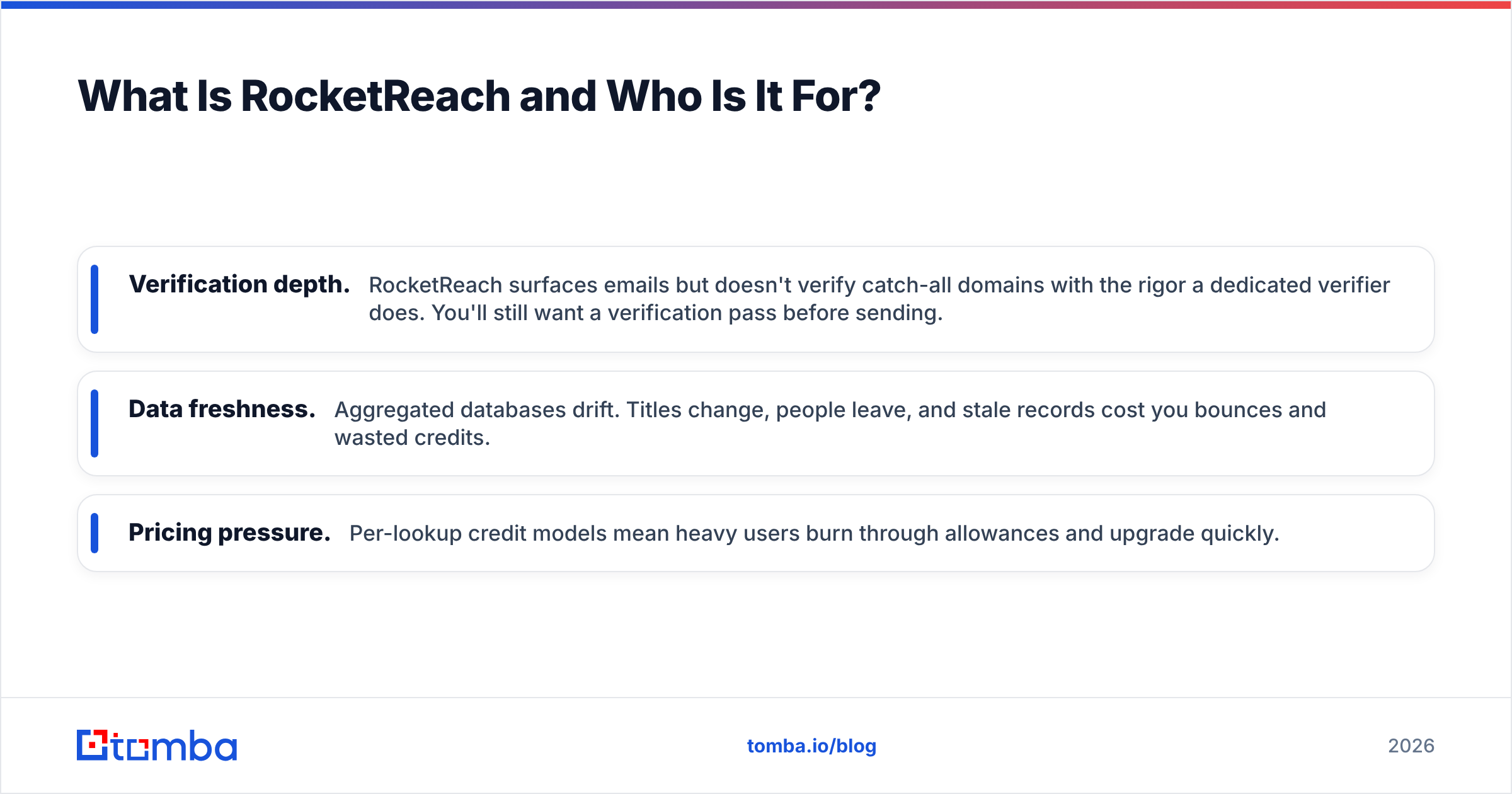
- Verification depth. RocketReach surfaces emails but doesn't verify catch-all domains with the rigor a dedicated verifier does. You'll still want a verification pass before sending.
- Data freshness. Aggregated databases drift. Titles change, people leave, and stale records cost you bounces and wasted credits.
- Pricing pressure. Per-lookup credit models mean heavy users burn through allowances and upgrade quickly.
In short: RocketReach fills your list, but it doesn't guarantee the list is clean.
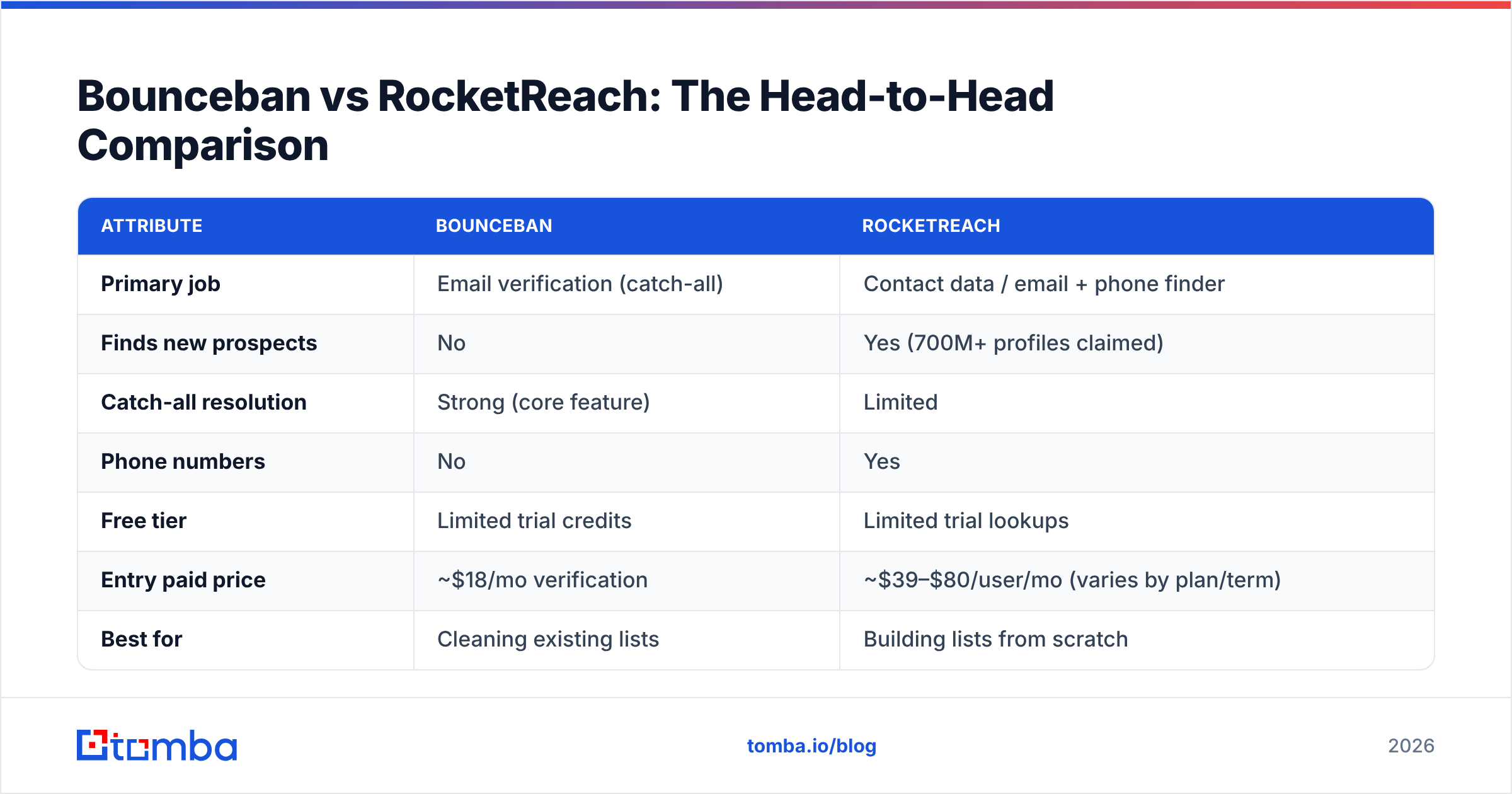
Bounceban vs RocketReach: The Head-to-Head Comparison#
Here's the direct comparison on the attributes that decide real purchases.
| Attribute | Bounceban | RocketReach |
|---|---|---|
| Primary job | Email verification (catch-all) | Contact data / email + phone finder |
| Finds new prospects | No | Yes (700M+ profiles claimed) |
| Catch-all resolution | Strong (core feature) | Limited |
| Phone numbers | No | Yes |
| Free tier | Limited trial credits | Limited trial lookups |
| Entry paid price | ~$18/mo verification | ~$39–$80/user/mo (varies by plan/term) |
| Best for | Cleaning existing lists | Building lists from scratch |
| Verification confidence | High | Moderate |
| Data enrichment | Minimal | Moderate |
The pattern is clear: these tools sit on opposite ends of the prospecting workflow. RocketReach is acquisition; Bounceban is hygiene. Buying one and expecting it to do the other's job is the most common mistake teams make.
Which Tool Is More Accurate?#
It depends on what you mean by accurate, and that distinction matters more than any single benchmark number.
RocketReach accuracy is about coverage and match rate — how often it returns a contact for a given search, and whether that contact point is correct. Coverage is strong, but because the data is aggregated and not always re-verified at lookup time, a meaningful share of returned emails are stale or catch-all. You get an address; you don't always get confidence.
Bounceban accuracy is about verification precision — when it says an address is valid, how often is that true, especially on catch-all domains. This is a narrower claim, and Bounceban is genuinely good at it.
So the honest answer: RocketReach is more accurate at finding, Bounceban is more accurate at validating. If your bounce rate is the problem, Bounceban's verification beats RocketReach's raw output. If your empty pipeline is the problem, RocketReach's coverage beats Bounceban's (nonexistent) finder.
This is also why a lot of teams end up paying for both — and why a combined tool changes the math. Accuracy benchmarks for email tools vary widely by data source and test methodology, so treat any single vendor's self-reported number with skepticism.

How Do They Compare on Price?#
Pricing is where the decision often gets made, because both tools punish scale differently.
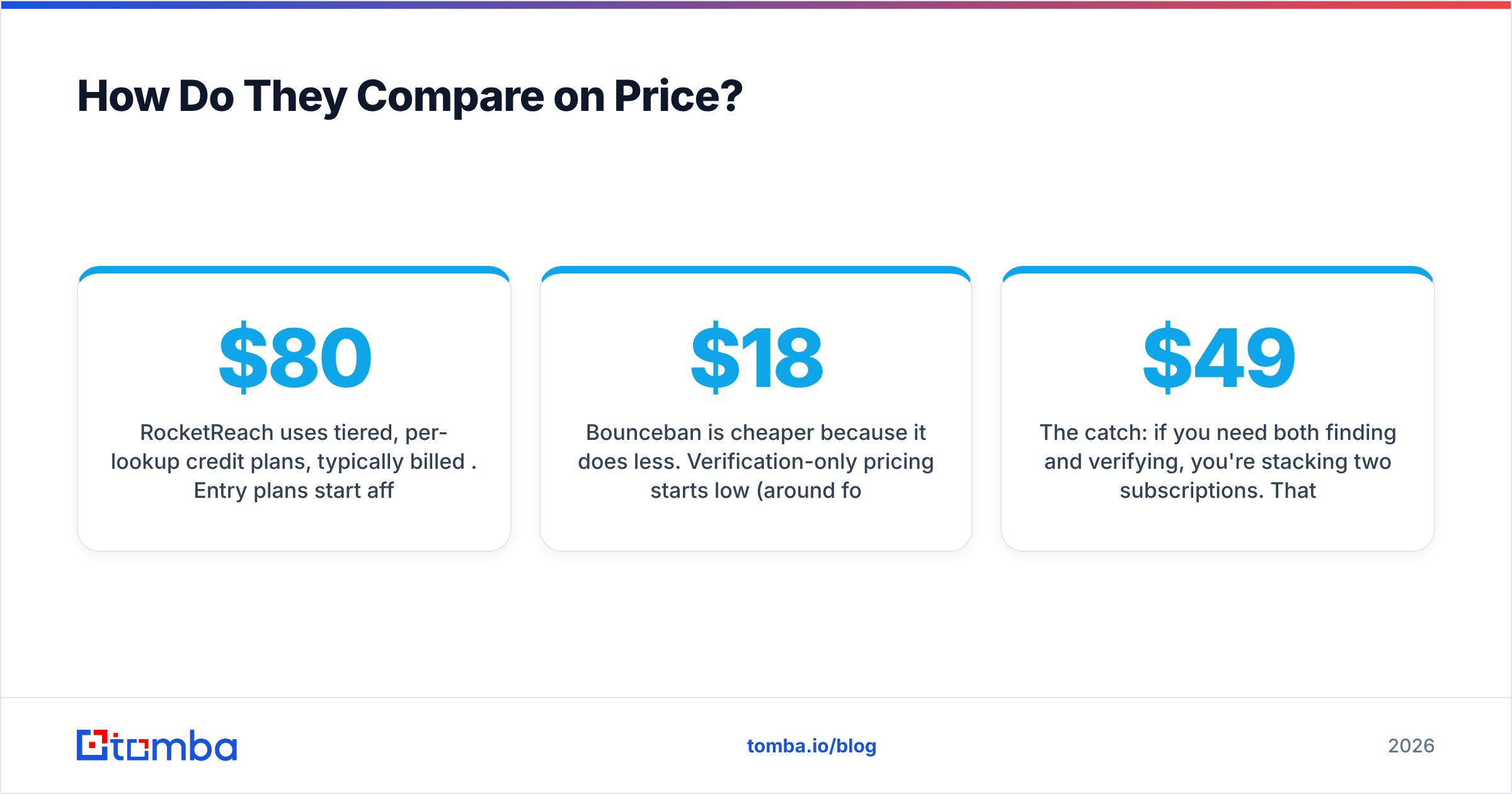
RocketReach uses tiered, per-lookup credit plans, typically billed per user. Entry plans start affordable but cap lookups; serious prospecting pushes you into higher tiers that run $80+ per user per month on annual billing once you need emails and phone numbers plus exports. For a team of five, that adds up fast.
Bounceban is cheaper because it does less. Verification-only pricing starts low (around $18/mo for a modest monthly volume), scaling with the number of addresses you check. There's no per-seat tax because you're buying verification credits, not contact discovery.
The catch: if you need both finding and verifying, you're stacking two subscriptions. That's two bills, two dashboards, two credit systems to reconcile. For comparison, a combined platform like Tomba's pricing bundles finding, email verification, and catch-all verification into one plan — Free (25 searches/mo), Starter $49/mo, Growth $99/mo, and Pro $249/mo — so you don't pay two vendors for one workflow.

Can One Tool Replace Both Bounceban and RocketReach?#
Yes — and for most small-to-mid sales teams, consolidating is the smarter buy.
The reason RocketReach and Bounceban feel like they belong together is that finding and verifying are two halves of the same job. You find an address, then you confirm it's deliverable. Splitting that across two vendors creates friction: exporting from one, importing to the other, mapping fields, and reconciling credit usage.
A consolidated platform removes that handoff. With Tomba you get:
- Email Finder — find professional emails by name, domain, or company, the job RocketReach does.
- Email Verifier and Catch-All Verifier — confirm deliverability and resolve accept-all domains, the job Bounceban does.
- One credit pool, one dashboard, one bill — no exports between tools.
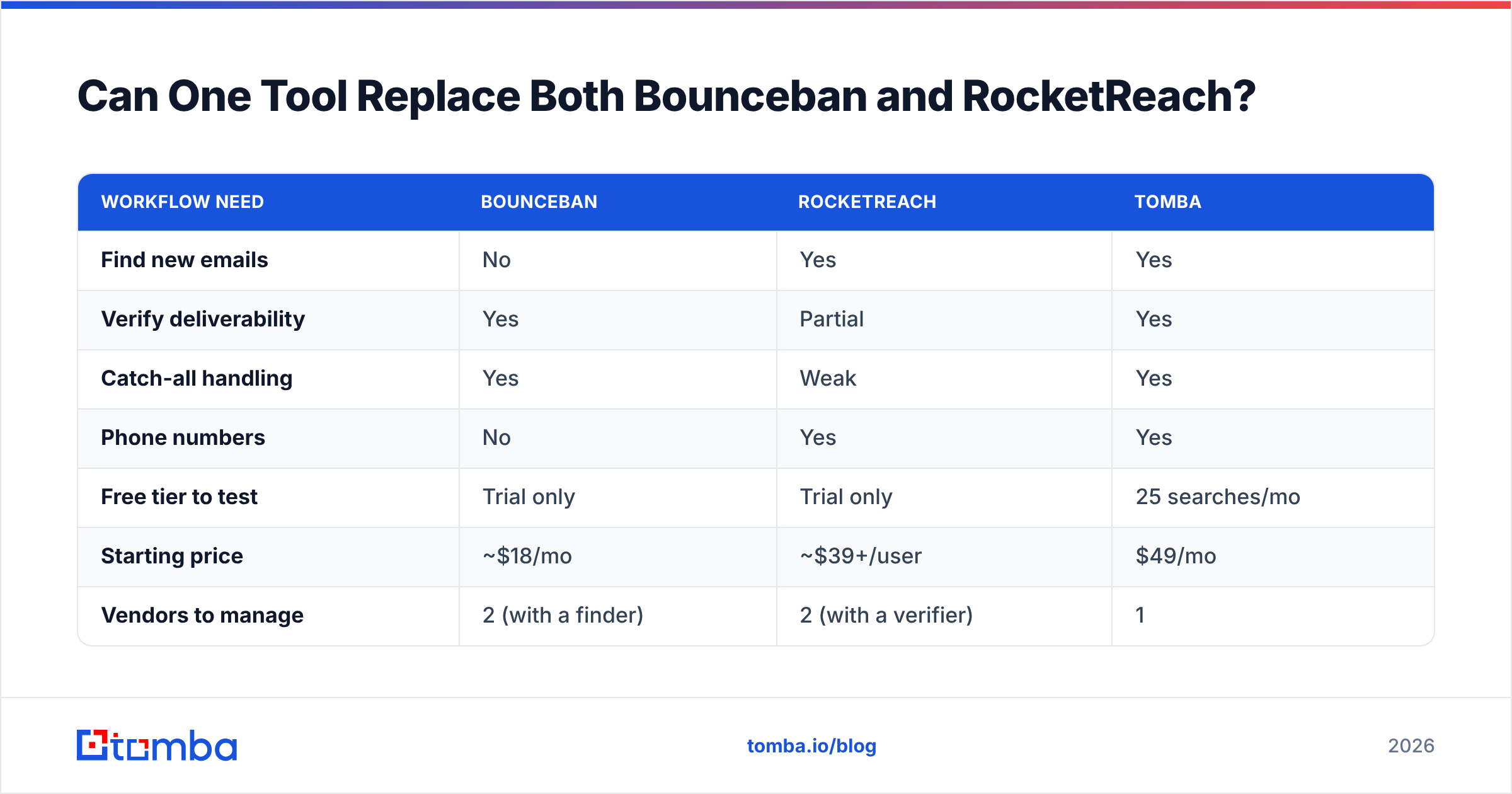
Here's how the three options stack up when you need the full workflow.
| Workflow need | Bounceban | RocketReach | Tomba |
|---|---|---|---|
| Find new emails | No | Yes | Yes |
| Verify deliverability | Yes | Partial | Yes |
| Catch-all handling | Yes | Weak | Yes |
| Phone numbers | No | Yes | Yes |
| Free tier to test | Trial only | Trial only | 25 searches/mo |
| Starting price | ~$18/mo | ~$39+/user | $49/mo |
| Vendors to manage | 2 (with a finder) | 2 (with a verifier) | 1 |
That doesn't mean RocketReach or Bounceban are bad tools — they're focused tools. If you genuinely only need verification, Bounceban is a clean choice. If you only need a huge contact database and budget isn't tight, RocketReach delivers coverage. But "only one of those needs forever" is rare. Most teams grow into needing both.
When Should You Pick Bounceban?#
Choose Bounceban if:
- You already have a reliable source of prospect emails (an existing CRM, a scraper, or another finder) and your only gap is verification.
- Catch-all domains are wrecking your bounce rate and your current verifier keeps returning "unknown."
- You want a lightweight, API-first verification layer on your signup forms.
- You don't want to pay for enrichment fields you'll never use.
Bounceban is a specialist. If verification is your single problem, a specialist is a defensible pick. Just know it won't grow with you into prospecting.
When Should You Pick RocketReach?#
Choose RocketReach if:
- You're building lists from zero and need maximum coverage across industries and regions.
- Phone numbers matter to your motion (recruiting, cold calling, multi-channel outreach).
- You have budget headroom and don't mind a per-seat, per-credit model.
- You'll run a separate verification pass before sending anyway.
RocketReach is a strong database play. If breadth of contact data is your bottleneck and you can absorb the cost, it earns its place. Compare current plans on a neutral source like G2 before committing, since tiers and limits shift. If the per-seat pricing gives you pause, it's worth weighing a RocketReach alternative that combines coverage with built-in verification.
What's the Bottom Line on Bounceban vs RocketReach?#
Bounceban verifies; RocketReach finds. Neither does both well, and that's the whole story.
If you map your actual workflow, you almost always need finding and verifying. Paying two vendors for that — RocketReach for discovery, Bounceban for hygiene — works, but it costs more and adds friction at every export. For teams that want one clean pipeline, a combined platform is the more efficient buy.
Tomba's Email Finder gives you the prospecting reach you'd want from RocketReach, with the verification and catch-all confidence you'd want from Bounceban, in a single plan that starts free at 25 searches a month and scales to $49/mo when you're ready. You stop reconciling two dashboards and start running one workflow.
Start with the free tier, find your first list, verify it in the same place, and see whether you ever actually need two tools again.
Frequently Asked Questions#
Is Bounceban a finder or a verifier? Bounceban is a verifier. It checks whether existing email addresses are deliverable, with a focus on resolving catch-all (accept-all) domains. It does not generate new prospect lists.
Is RocketReach accurate? RocketReach has strong coverage but variable freshness. Returned emails aren't always re-verified at lookup time, so a separate verification pass is recommended before any cold campaign.
Why would I use one tool instead of both? Finding and verifying are two halves of one workflow. A combined platform like Tomba removes the export-import friction and gives you one credit pool and one bill instead of two subscriptions.
Which is cheaper, Bounceban or RocketReach? Bounceban is cheaper because it only verifies. RocketReach costs more because it provides contact discovery and phone data, usually billed per user. For the full find-plus-verify workflow, a bundled plan is typically the most cost-effective.
// get started
Find, verify and enrich your first contacts today
Start on the free plan with 25 searches a month, then scale when your team is ready.
Free plan · No credit card required · GDPR & CCPA
// about the author