Bounceban vs Warpleads 2026: Verify or Generate Leads?
Bounceban verifies risky emails; Warpleads exports leads in bulk. Here's which one your outbound motion actually needs in 2026 — and where a finder beats both.
Bounceban and Warpleads get lumped into the same "outbound data" bucket, but they solve opposite halves of the same problem. One cleans the list you already have. The other hands you a brand-new list. Pick the wrong one and you either pay for volume you can't trust, or you verify a database you never built.
This guide breaks down what each tool actually does, where each one wins, and why most teams running cold email in 2026 end up needing a third piece neither of them covers well.
TL;DR#
- Bounceban is an email verification tool. Its standout feature is real-time catch-all verification — guessing whether a risky "accept-all" domain will actually deliver. It does not build lead lists for you.
- Warpleads is a lead-generation database. It exports B2B contacts in bulk (often marketed as "unlimited" exports on higher tiers). It is not a precision verifier.
- They are complements, not true competitors. Warpleads fills the top of the funnel; Bounceban scrubs the bottom. Using only one leaves a gap.
- Pricing models differ sharply: Bounceban charges per verification credit; Warpleads charges for export volume and seats. Cost-per-usable-lead is what actually matters.
- Where Tomba fits: if you want find + verify + enrich in one place — including a catch-all verifier and a real email finder — you can skip stitching two narrow tools together.
What is Bounceban?#
Bounceban is built around one hard problem: catch-all domains. A catch-all (or "accept-all") server says yes to every address you throw at it during SMTP handshake, so standard verifiers can't tell a real inbox from a typo. Bounceban runs deeper real-time checks to predict whether those risky addresses are genuinely deliverable, instead of just marking them "unknown" and walking away.
That focus matters because catch-alls are now a huge share of B2B domains. If your verifier flags 30% of a list as "risky/unknown," you're either deleting good leads or mailing dead ones. Bounceban's pitch is that it rescues more of that gray zone.
What Bounceban is not: a place to find contacts. You bring the email addresses; it tells you which ones are safe to send to. Think of it as a bouncer at the door checking IDs — it never invited anyone to the party.

What is Warpleads?#
Warpleads sits at the opposite end of the funnel. It's a lead database and exporter: you filter by industry, title, geography, or company size, then pull contact records out in bulk. The marketing hook is volume — export large lead sets without the per-record metering that classic data vendors use.
For teams that burn through lists fast (agencies, high-volume SDR shops, anyone running multiple cold inboxes), that volume story is attractive. You're not nickel-and-dimed per contact; you're paying for access and throughput.
The trade-off is the one every bulk database faces: freshness and accuracy degrade at scale. A record that was correct six months ago may now be a job-changer, a renamed domain, or a deactivated mailbox. Bulk export gives you quantity; it does not guarantee that each row is send-ready today. That's exactly why a verification layer exists in the first place.
Bounceban vs Warpleads: the core difference#
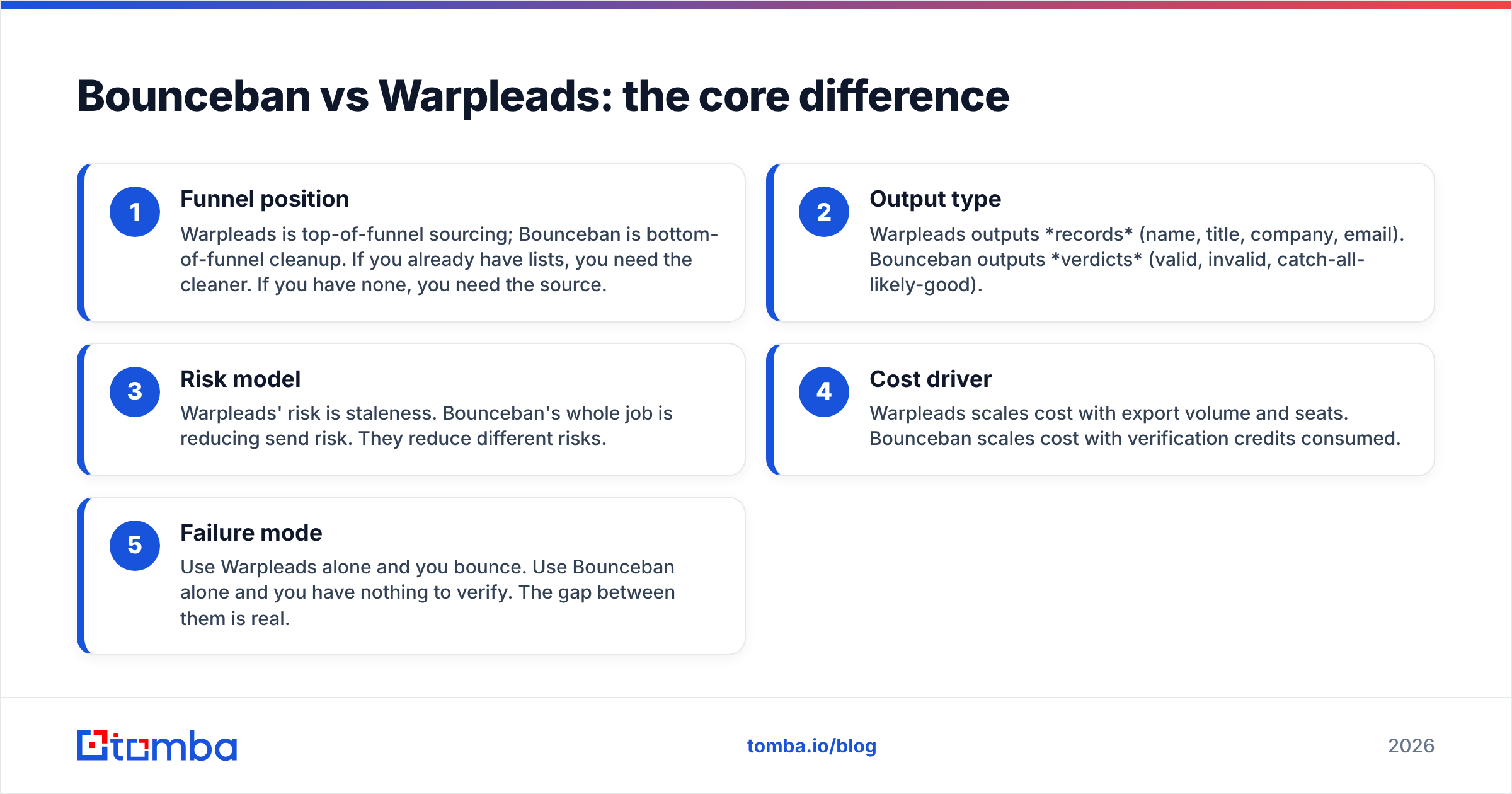
Here's the cleanest way to think about it: Warpleads answers "who do I contact?" and Bounceban answers "will this email land?" They're sequential steps, not rival products.
The four moving parts that actually decide which you need:
- Funnel position — Warpleads is top-of-funnel sourcing; Bounceban is bottom-of-funnel cleanup. If you already have lists, you need the cleaner. If you have none, you need the source.
- Output type — Warpleads outputs records (name, title, company, email). Bounceban outputs verdicts (valid, invalid, catch-all-likely-good).
- Risk model — Warpleads' risk is staleness. Bounceban's whole job is reducing send risk. They reduce different risks.
- Cost driver — Warpleads scales cost with export volume and seats. Bounceban scales cost with verification credits consumed.
- Failure mode — Use Warpleads alone and you bounce. Use Bounceban alone and you have nothing to verify. The gap between them is real.
How do Bounceban and Warpleads compare on features and pricing?#
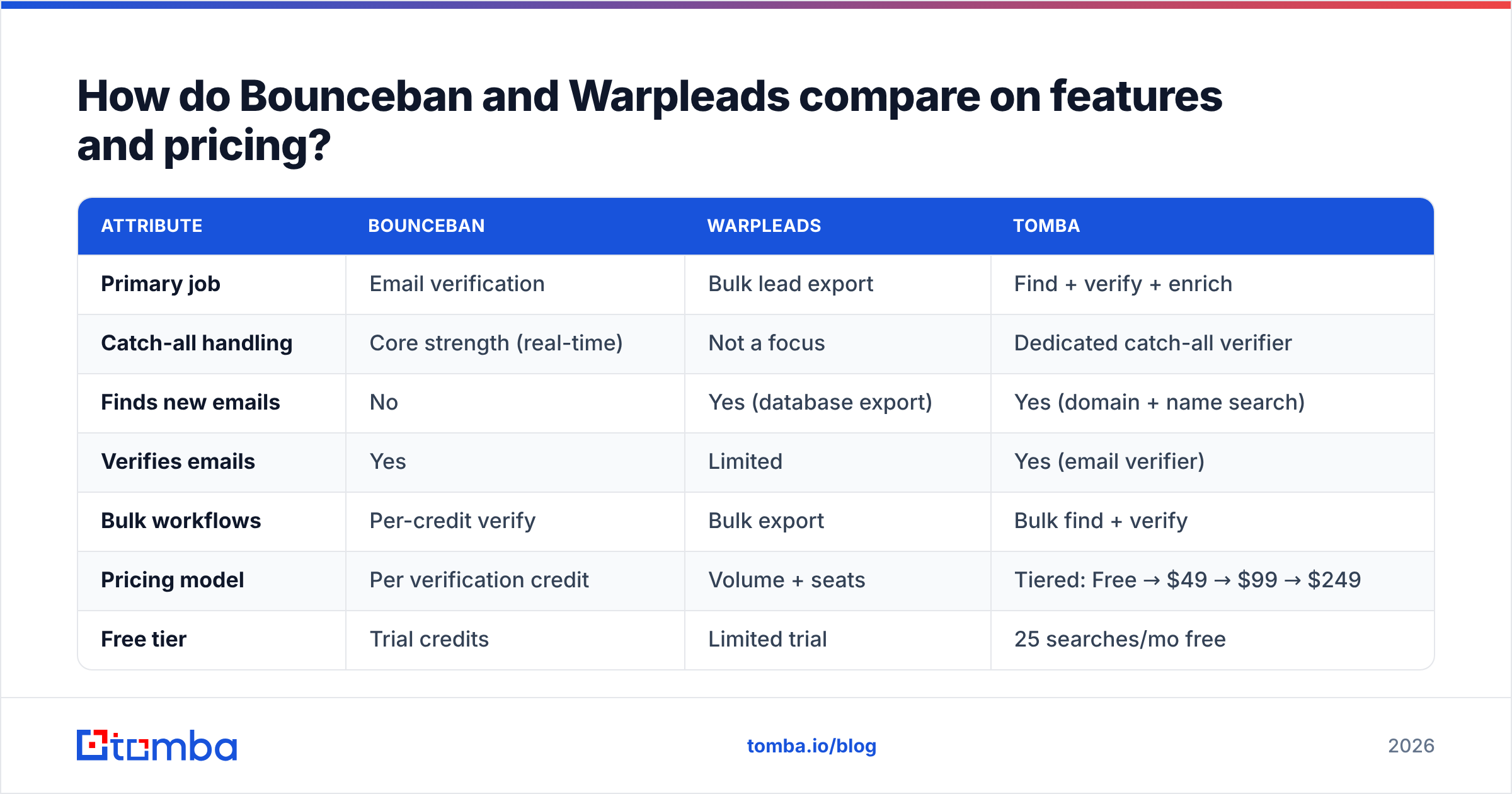
| Attribute | Bounceban | Warpleads | Tomba |
|---|---|---|---|
| Primary job | Email verification | Bulk lead export | Find + verify + enrich |
| Catch-all handling | Core strength (real-time) | Not a focus | Dedicated catch-all verifier |
| Finds new emails | No | Yes (database export) | Yes (domain + name search) |
| Verifies emails | Yes | Limited | Yes (email verifier) |
| Bulk workflows | Per-credit verify | Bulk export | Bulk find + verify |
| Pricing model | Per verification credit | Volume + seats | Tiered: Free → $49 → $99 → $249 |
| Free tier | Trial credits | Limited trial | 25 searches/mo free |
| Best for | Cleaning risky lists | High-volume sourcing | End-to-end outbound data |
A note on pricing honesty: published prices on tools in this space move constantly, so always confirm on the vendor's own page before you commit. Bounceban's cost rises with how many addresses you verify; Warpleads' cost rises with how many you export and how many seats you need. Neither model is "cheaper" in the abstract — it depends entirely on your ratio of new leads sourced to addresses verified. For reference on a transparent tiered model, Tomba pricing starts free (25 searches/mo) and runs $49/mo Starter, $99/mo Growth, and $249/mo Pro.
Is Bounceban better than Warpleads?#
Wrong question — but the honest answer is "for verification, yes; for sourcing, no." Bounceban is the better tool at the specific job it does. Warpleads is the better tool at its job. Asking which is "better" is like asking whether a water filter is better than a well. You need the well to have water at all, and the filter to make it drinkable.
Where Bounceban clearly wins:
- You already own large lists (scraped, exported, or CRM exports) and bounce rates are creeping up.
- Your domains are catch-all heavy and your current verifier dumps everything into "unknown."
- Deliverability — not list size — is your bottleneck.
Where Warpleads clearly wins:
- You have no list and need raw volume fast.
- You run high-throughput outbound across many inboxes and churn through contacts.
- Per-record data pricing has been eating your budget.
If your real problem is deliverability, neither bulk export nor a single verifier fixes the upstream issues — authentication, warmup, and sending reputation. Read up on email deliverability and sender reputation before you blame the data; a clean list sent from a cold domain still lands in spam.

What about accuracy — does verification alone save a bulk list?#
Partly. Verification catches dead and malformed addresses, and a good catch-all checker rescues some of the gray zone. But verification cannot fix a record where the person is wrong — wrong company, wrong title, job-changed three months ago. That's a sourcing-quality problem, and it's why "verify a cheap bulk list" only gets you so far.
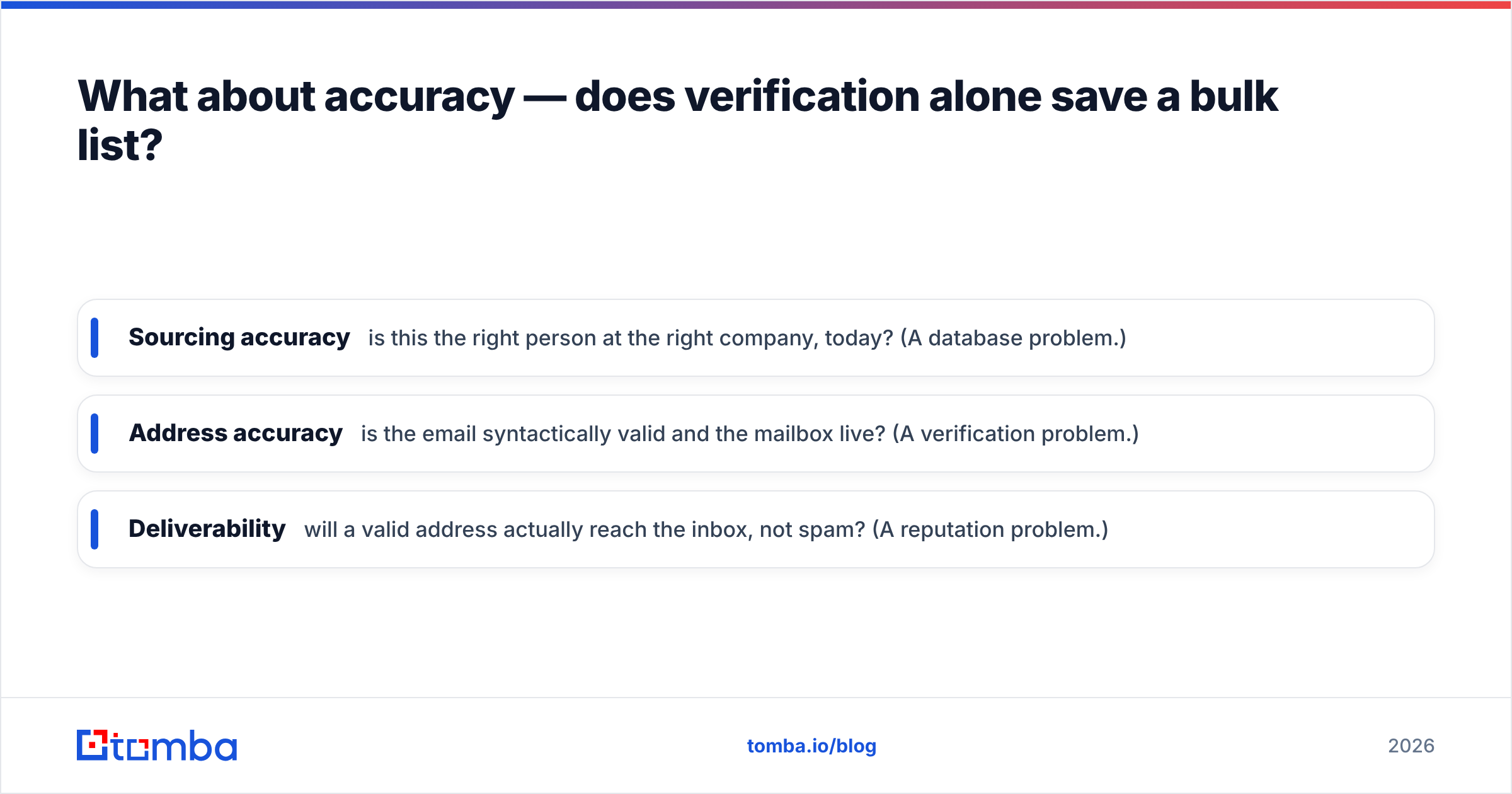
The accuracy stack has three layers, and most teams only think about one:
- Sourcing accuracy — is this the right person at the right company, today? (A database problem.)
- Address accuracy — is the email syntactically valid and the mailbox live? (A verification problem.)
- Deliverability — will a valid address actually reach the inbox, not spam? (A reputation problem.)
Warpleads addresses layer one. Bounceban addresses layer two. Neither touches layer three. If you stitch the two together, you've covered sourcing and verification but still have to handle reputation yourself — with warmup, proper SPF records, and sane sending volume.
This is the structural argument for an integrated finder: when find, verify, and catch-all checks come from one dataset, layer one and layer two reinforce each other instead of being bolted together after the fact. Tomba's domain search finds addresses by company and verifies them in the same pass, and the data sources behind it are what determine layer-one accuracy.
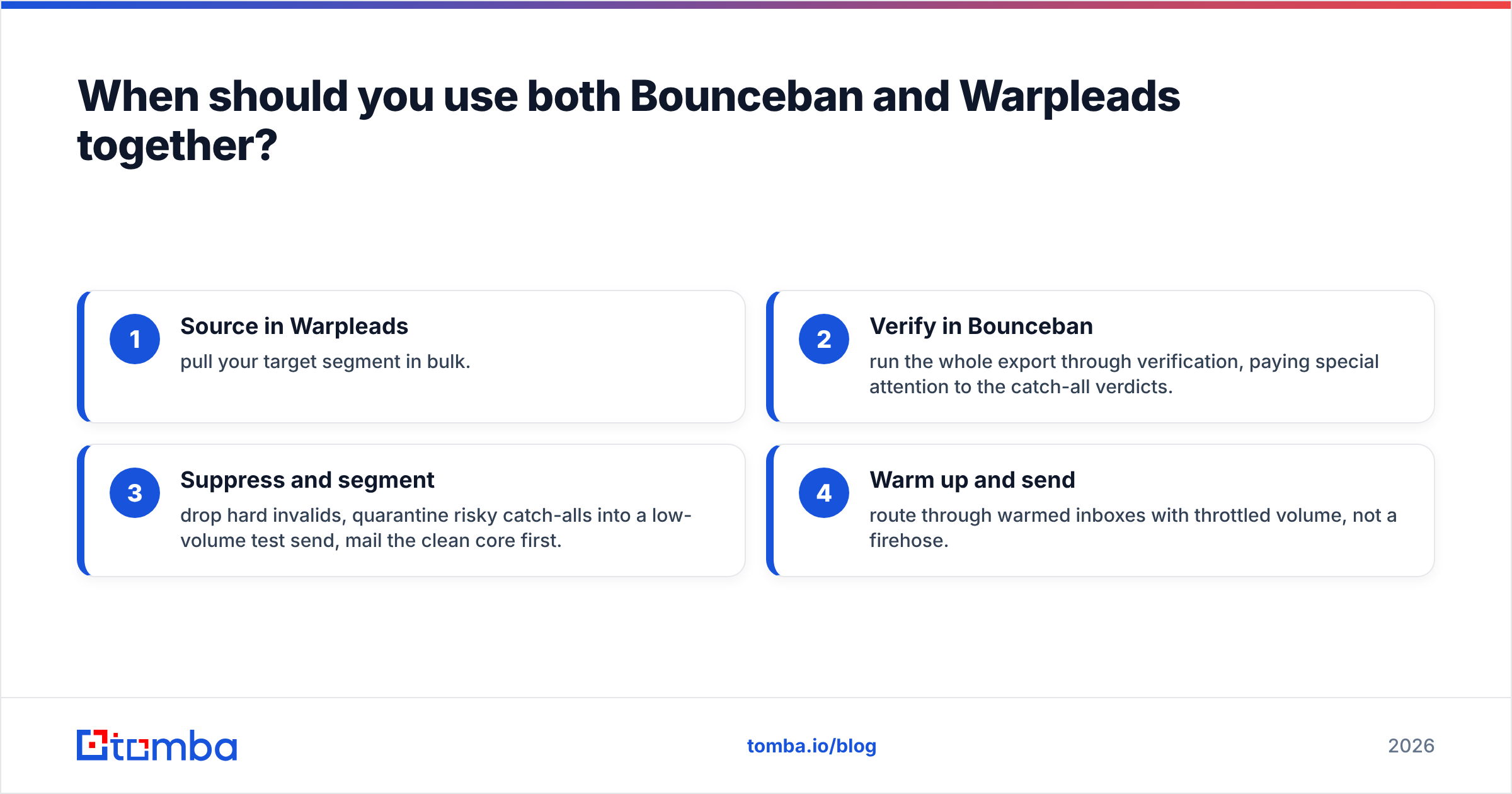
When should you use both Bounceban and Warpleads together?#
If you're committed to the two-tool route, the workflow is straightforward and genuinely works:
- Source in Warpleads — pull your target segment in bulk.
- Verify in Bounceban — run the whole export through verification, paying special attention to the catch-all verdicts.
- Suppress and segment — drop hard invalids, quarantine risky catch-alls into a low-volume test send, mail the clean core first.
- Warm up and send — route through warmed inboxes with throttled volume, not a firehose.
The friction is operational: two logins, two billing relationships, two data formats to reconcile, and a manual export-import-export shuffle between them. For a small team running a few hundred leads a week, that overhead is tolerable. For anyone scaling, the handoff between tools becomes the thing that breaks.
That's the case for consolidating. A single platform that does bulk email finding and verification removes the export-import step entirely — you filter, find, verify, and push to your CRM through native integrations without a CSV ever touching your desktop.
How does Tomba compare to Bounceban and Warpleads?#
Tomba overlaps with both but isn't a clone of either. Against Warpleads, Tomba is more precision-oriented — you find emails by domain, name, or company rather than dumping a giant pre-built segment, which tends to produce fresher, more targeted results. Against Bounceban, Tomba includes its own email verifier and a dedicated catch-all finder, so you get verification in the same workflow as discovery.
| Use case | Reach for |
|---|---|
| Clean a huge list I already own | Bounceban |
| Dump maximum raw volume, fast | Warpleads |
| Find targeted emails by company + verify them | Tomba |
| Avoid juggling two tools and a CSV shuffle | Tomba |
| Hardest catch-all domains, verification-only | Bounceban or Tomba |
The honest framing: if your only problem is verifying a list you already have, a focused verifier like Bounceban is a perfectly good buy. If your only problem is raw volume and budget, Warpleads' export model has a real audience. But if you're building outbound from scratch and want sourcing, verification, and enrichment to live in one place — with one bill and one data layer — that's where a finder-first platform pulls ahead.
For broader context on data tooling, G2's lead intelligence category and the general concept of lead generation are worth skimming before you lock into any single vendor. And if your stack already runs on HubSpot, check how data flows through the HubSpot CRM so your verified leads don't die in a disconnected spreadsheet.
Which one should you pick?#
Decide by your bottleneck, not by the brand:
- No leads at all? Start with sourcing — Warpleads for volume, or a finder like Tomba for targeted, fresher contacts.
- Lists but high bounces? Verification is your fix — Bounceban for catch-all-heavy lists, or Tomba's verifier if you also want finding.
- Both problems, hate tool sprawl? Consolidate into one find-and-verify platform.
- Spam folder despite clean lists? Your problem is reputation, not data — fix authentication and warmup first.
Most growing outbound teams discover they don't actually want "a verifier" or "a bulk exporter." They want verified, targeted leads ready to send, with the fewest moving parts. That's the gap two single-purpose tools leave open.
Start with one tool that finds and verifies#
If you're tired of exporting from one app, importing into another, and reconciling formats in between, start at the source. The Tomba Email Finder finds professional addresses by domain, name, or company and verifies them in the same workflow — catch-all checks included — so the list you build is the list you can actually send to. Try it free with 25 searches a month, and only step up to a paid plan once it's earning its keep. Source clean, verify in place, and skip the two-tool shuffle entirely.
// get started
Find, verify and enrich your first contacts today
Start on the free plan with 25 searches a month, then scale when your team is ready.
Free plan · No credit card required · GDPR & CCPA
// about the author